In the aftermath of the pandemic, everyone and their cousin who wants to travel and can travel is heading for Europe. Recently, Italy was named the number one tourist destination in the world, with France close behind. Many destinations are full to bursting with visitors, which means sold-out accommodations, packed beaches, and museums filled to the rafters.
Some communities, such as Barcelona and Malaga in Spain, and Santorini in Greece, have even launched campaigns to limit the number of tourists permitted to invade their hometowns at any one time.
Introduction
I’ve experienced my share of crowds all flocking to experience the same iconic sites—the Sagrada Familia in Barcelona, the Uffizi in Florence, the Colosseum in Rome, the Eiffel Tower in Paris. Thousands surge into spaces meant for hundreds, each holding aloft a smartphone to capture the moment.
The joys of travel—discovering new places, meeting new people, learning new things, enjoying great art—quickly dwindle in the face of relentless crowds, inflated prices, and grumpy locals.
Interacting with Locals
When you travel to a new place, consider looking for opportunities to interact with locals instead of lining up for the big-ticket sites. Sample local food, check out off-the-beaten path museums and galleries, meet local artists and artisans, go to local concerts, ride public transit, and wander around back streets where local people live.
You can do all these things in even the most heavily-touristed destinations if you’re willing to zig away from the crowds rather than zag towards them. Doing so may require you to skip the most famous—and crowded—sites. But the rewards more than make up for any lingering feelings of FOMO (Fear of Missing Out).
Here are my top ten ways to joyously enjoy your European travels.
1. Check Restaurant Reviews
Chances are you’re traveling with a smartphone. Use it to find restaurants that fellow travelers and especially locals have rated highly. Ever since I started checking reviews and purposely choosing restaurants instead of wandering the streets in hopes of finding a place, I’ve enjoyed numerous awesome dining experiences.
In fact, I can safely say that almost every highly rated restaurant I’ve eaten at in Europe in the last few years was a winner.
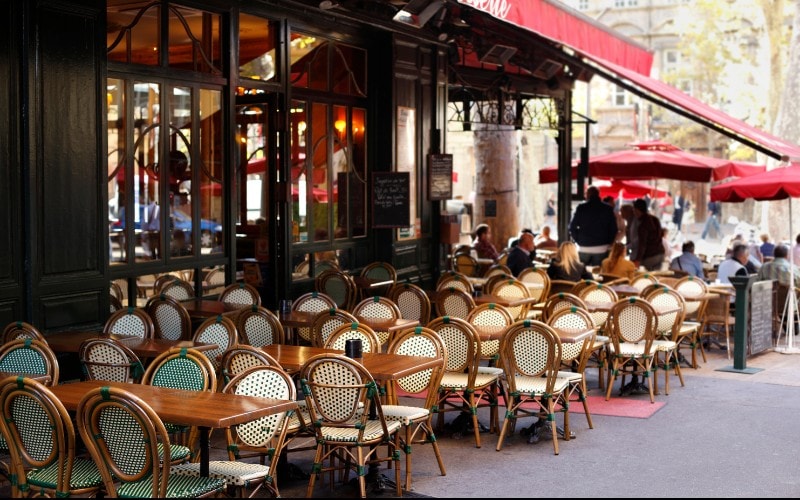
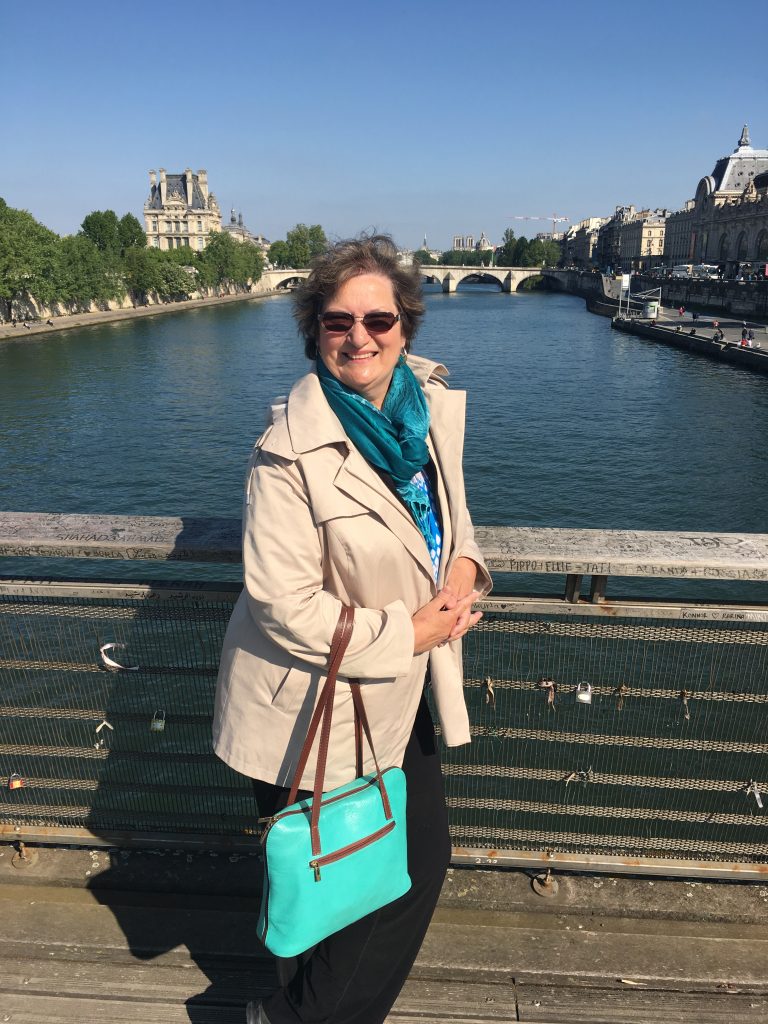
A Parisian café is a great place to people watch while enjoying a trip to Europe
Search Criteria
I search for restaurants that have at least a 4.5-star average review and then read what people say about the quality of the food and the service. If most of the best reviews are in the local language, that’s a plus because it means the restaurant is well frequented by locals.
Make Reservations
Once I’ve made my choice, I visit the restaurant’s website and call to reserve a table or use the online booking system if it’s available. I’ve found in recent years that reservations are essential in many popular places. Without one, you may well be wandering for quite some time before finding a well-reviewed restaurant with available tables.
Note that during busy periods, you may have better luck choosing a reservation time when the restaurant opens (usually 7 or 8 pm, depending on the location). Europeans tend to eat dinner later than North Americans. If you make a reservation for 7 pm, you may well have the restaurant to yourself.
A good rule of thumb in any big European city is to steer clear of restaurants that are full of tour groups reading multi-lingual plasticated menus in high-rent locations such as the Piazza Navona in Rome.
Walk a few blocks away from the busy areas to quiet side streets and you’ll find favorite local restaurants with superb food.
Ask a Local for Recommendations
Another good strategy is to ask your hotel to recommend a local restaurant and then make a reservation for you. Every time we’ve gone to a restaurant recommended by our hotel, we’ve had a great meal.
For a giggle, check out what happened to me when I did not follow my own advice in Bella Roma Rip-off, one of the pieces inPastel & Pen: Two Ways of Seeing, a collaboration of my writing with Gregg Simpson’s artwork. Gregg is an artist and my husband and usual travel companion.
2. Seek Out Lesser-Known Museums
Your sightseeing time is precious. Instead of spending it waiting in long lines, seek out museums and other sites that may be less well known but are just as interesting (sometimes more so) and considerably less crowded. These days, you’ll stand in line to tour the big sites even if you book ahead. On a recent trip to Pompeii, I lined up for forty minutes to get my skip-the-line ticket that I’d purchased online days earlier, and then lined up for another twenty minutes in the skip-the-line line to get into Pompeii.
Instead of sweating in the queue outside the Louvre in Paris, visit the lovely Rodin Museum.
In Amsterdam, skip the Van Gogh Museum (or go very early in the day) and visit the charming and informative Rembrandt Huis.
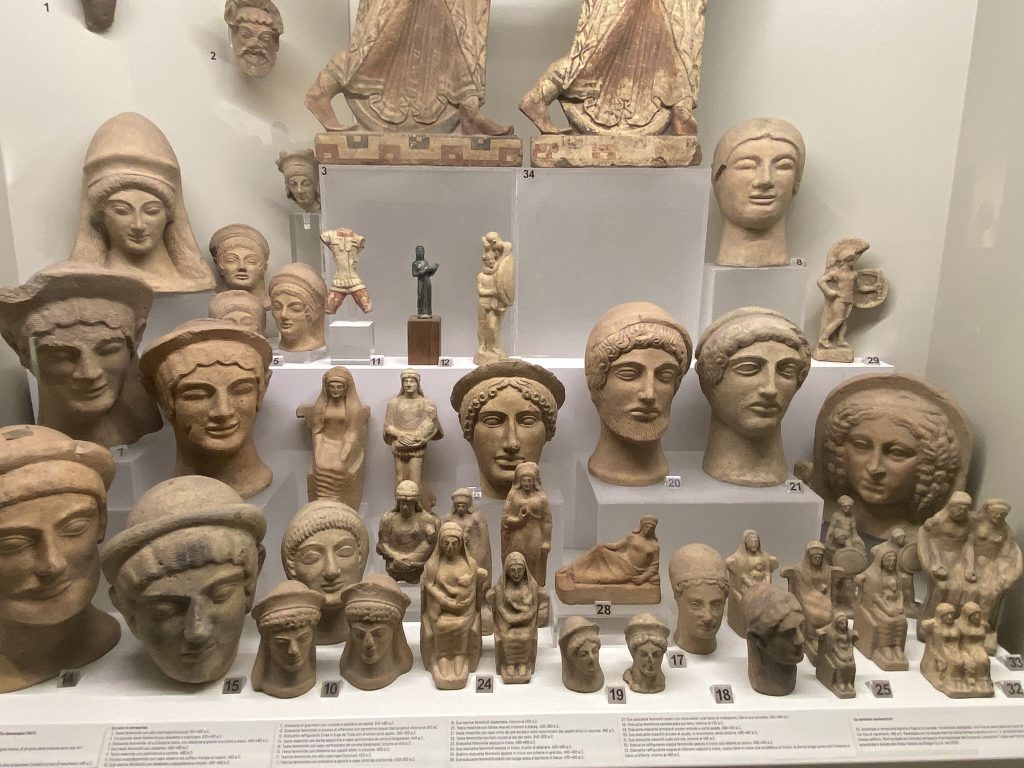
In Rome, forget the Vatican Museum and head instead to the marvelous Etruscan Museum that houses an incredible collection of treasures. Both times I’ve visited, the museum was virtually empty, which is in no way a reflection on the quality of the displays. The museum just happens to be so far off the beaten track of Rome’s iconic sites that few tourists find it.
The Etruscan Museum is one of Rome’s most interesting museums
Lesser-Known Museums to Visit
Here are posts about some of my favorite lesser-known and fabulous museums:
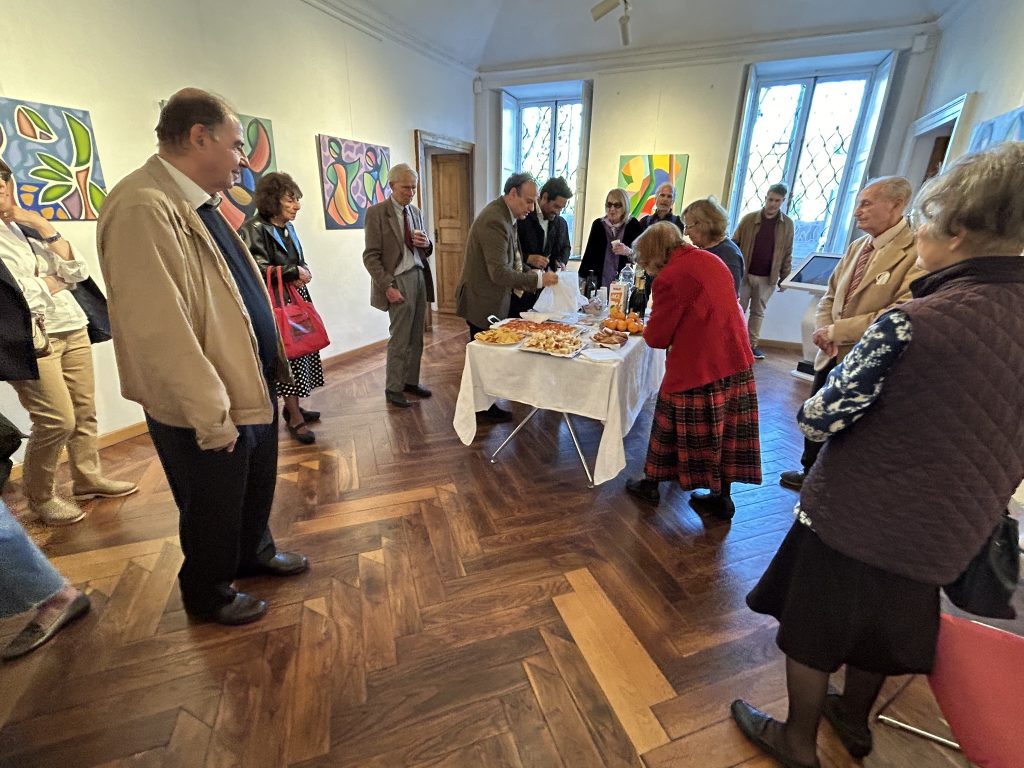
If you’ve checked out other posts on Artsy Traveler, you’ll know that a lot of my European travel centers around my husband’s art exhibitions. Most exhibitions include an opening (a vernissage in France; an inaugurazione in Italy). These events often include food and wine, and a short talk by the artist and the curator. They are also free to anyone who wants to drop in.
We’ve frequently met fellow travelers at Gregg’s openings, in addition to local art lovers, and have attended the openings of exhibitions by other artists—some we knew, some we didn’t. We always have a memorable time!
Art openings at private galleries in Europe are usually free and open to everyone
Finding Art Openings
To find art openings, check online listings. Also, stroll areas that have a lot of art galleries, such as the Left Bank and Marais districts in Paris. You’ll have the most luck finding an opening in the early evening on Thursdays, Fridays, and Saturdays.
If you pass an art gallery hosting an opening, don’t be shy! Walk in and say hello, check out some artwork, and maybe even have a glass of wine and an appetizer. You’re bound to meet a few locals who speak English, or you can practice your language skills.
4. Attend Local Concerts and Events
One of my favorite things to do when traveling in Europe is going to classical music concerts. Sometimes, I book tickets ahead of time to see a particular concert, but at other times, I look for posters and flyers.
On a recent trip to Siena, I picked up a flyer in our hotel advertising an intimate concert with a singer and pianist held in a local church. It was magical!
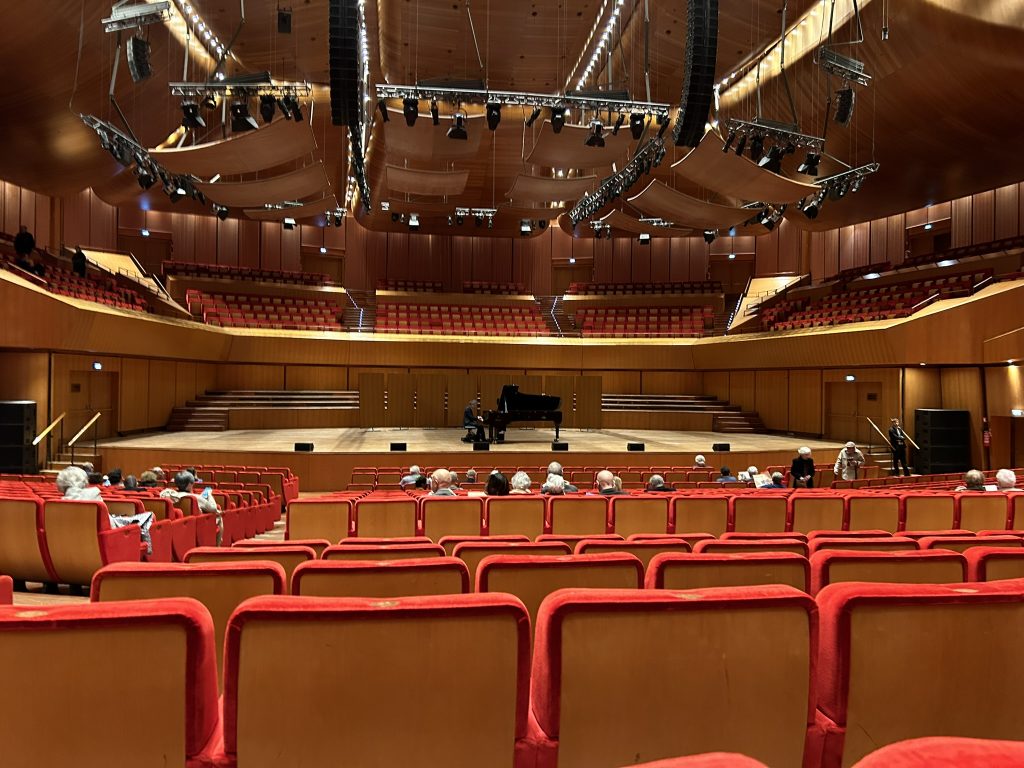
While in Rome, we saw a poster advertising concerts at the stylish Auditorium Parco della Musica well off the tourist beat north of the city. We bought tickets, and enjoyed two fantastic concerts with other music lovers, the vast majority of whom were locals.
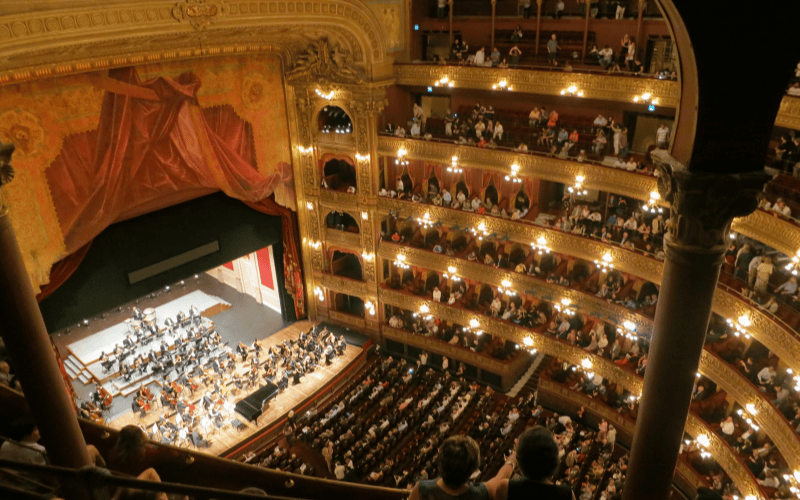
Classical music concerts are top quality and reasonably priced
Tourist Concerts
I find that attending concerts in Europe really enhances my appreciation of the local culture. Even if the concert is advertised for tourists—such as a flamenco performance in Seville—it’s going to be good.
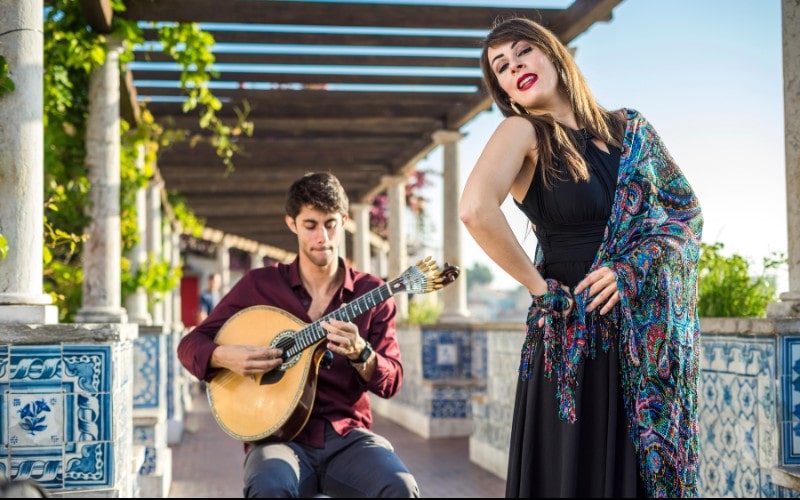
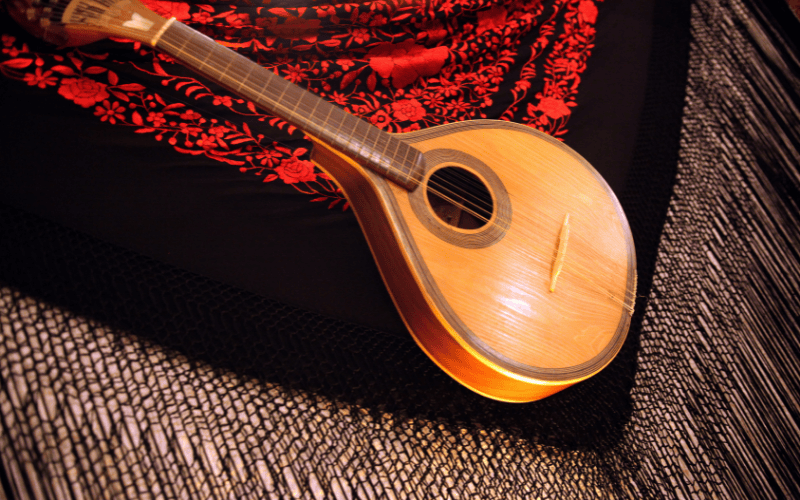
Trust me on this. We’ve enjoyed fado in Lisbon, flamenco in Spain, medieval music in southern France, opera in Paris, folk music in Bacharach on the Rhine, Vivaldi in Venice, Stravinsky in Berlin, Chopin in Leipzig, Shostakovich in Hamburg…I could go on and on.
And best of all, prices for classical music concerts in some of the world’s best concert venues are shockingly reasonable compared to what we pay to attend a concert in Canada.
Local performances are generally authentic and well worth the price
5. Ride Public Transit
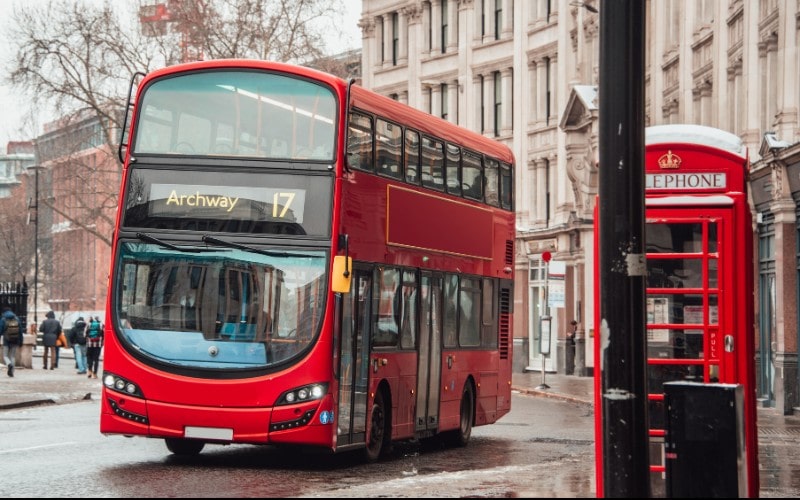
Few travel experiences bring you closer to locals than riding busses, trains, and metros. These days, you can pay for most transit options with a tap of your credit card. I love hopping on a bus and following my progress on Google Maps, so I know exactly where to get off.
I also enjoy people-watching on public transit. On very crowded busses and metros, just be sure to keep a good grip on your valuables. While violent crime in Europe is rare, pickpockets do flourish in crowded cities.
Take a city bus in Europe and enjoy great people watching
A Cautionary Tale
A word of caution about bus travel. If you happen to have a paper ticket, ALWAYS remember to validate it when you get on the bus. I learned this lesson the hard way. On a recent stay in Turin, I got on the bus, paper ticket in hand, and noticed that no one else was validating their tickets at the machine. I wrongly presumed that validation wasn’t required. Maybe it was a special holiday?
Ten minutes later, an inspector got on the bus and started checking tickets. Everyone on the bus held up their smartphones. As tourists, we had only the paper tickets we’d purchased from the local tobacconist. When the inspector came to Gregg and me and tried to scan our tickets—nada. My protestations of being a dumb tourist fell on deaf ears. That mistake cost us 40 euros—each.
So, just because no one else is validating their ticket doesn’t mean you shouldn’t validate your ticket!
6. Shop for Food in Local Markets
Shopping for snacks, lunches and the occasional dinner in your hotel room or apartment not only lets you experience life as a temporary local, but it also saves you money. In general, food prices are lower in Europe (although starting to rise). The quality of the fresh produce is also far superior to what is found in the average North American grocery store.
I love prowling the aisles of a European supermarket and ordering pre-made food at the in-store delis. I’ve typically found the staff to be friendly and tolerant of my attempts to at least say hello, good-bye and thank you in their language.
Outdoor Markets
Be on the lookout for open-air markets where you’ll find a dizzying array of foods along with clothing and knick-knacks. Some cities also have large indoor markets, such as the Mercado de Triana in Seville.
Interact with locals while browsing outdoor markets in Europe
7. Take a Cooking Class
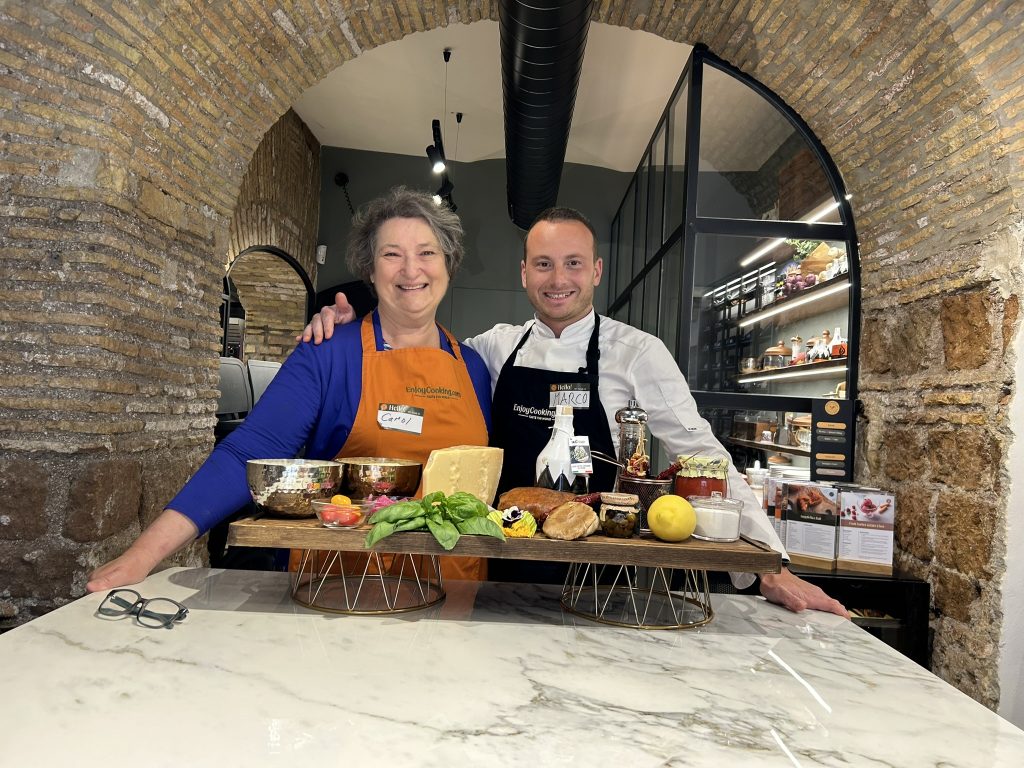
When you take a cooking class in Europe, you’ll meet travelers from around the world and learn from a local chef. I’m a firm fan of cooking classes and take one every chance I get.
In a tapas class I took in Madrid, I met fellow travelers from Australia, Holland, the UK, France, and Korea.
8. Go on a Walking Tour
I’ve also become a big fan of walking tours, particularly specialty tours that cater to a specific interest. In Rome, I went on a walking tour of the old Jewish ghetto. In London, I explored the back alleys and colorful history of the Covent Garden theater district. In Stratford-upon-Avon, I joined three other people for a small walking tour with a guide pretending to be William Shakespeare.
Walking tours usually take you behind the scenes and to places where regular bus tours can’t go. The guides are often locals who are very enthusiastic about their subject and love showing off hidden gems.
A great source for walking tours is GuruWalk. All the tours listed are pay-what-you-can and run by locals. Here are some of the free walks available from GuruWalk in Paris.
9. Skip the Iconic Sites
Yes, this recommendation is blasphemy but heeding it could make the difference between reveling in a relaxing and memorable European vacation and enduring one that leaves you hot, bothered, and blistered. When you’re planning what you want to see, consider not visiting super popular sites such as the Colosseum in Rome, the ruins in Pompeii, and the Eiffel Tower in Paris. Instead, choose smaller, lesser-known museums and sites, and leave more time for wandering.
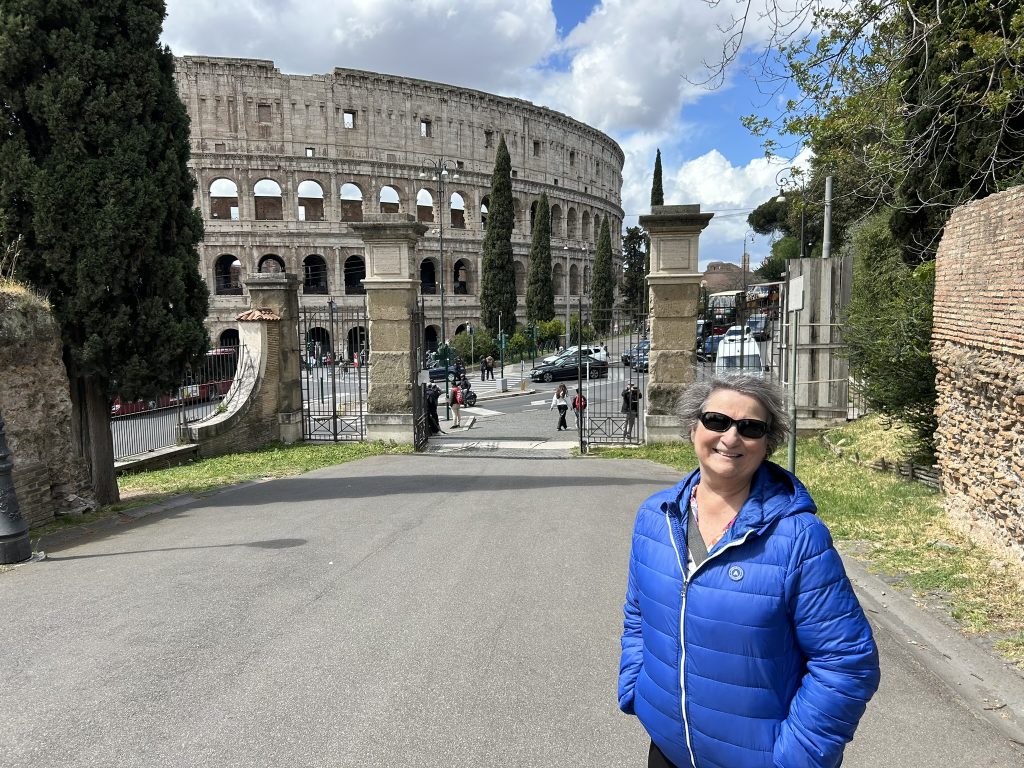
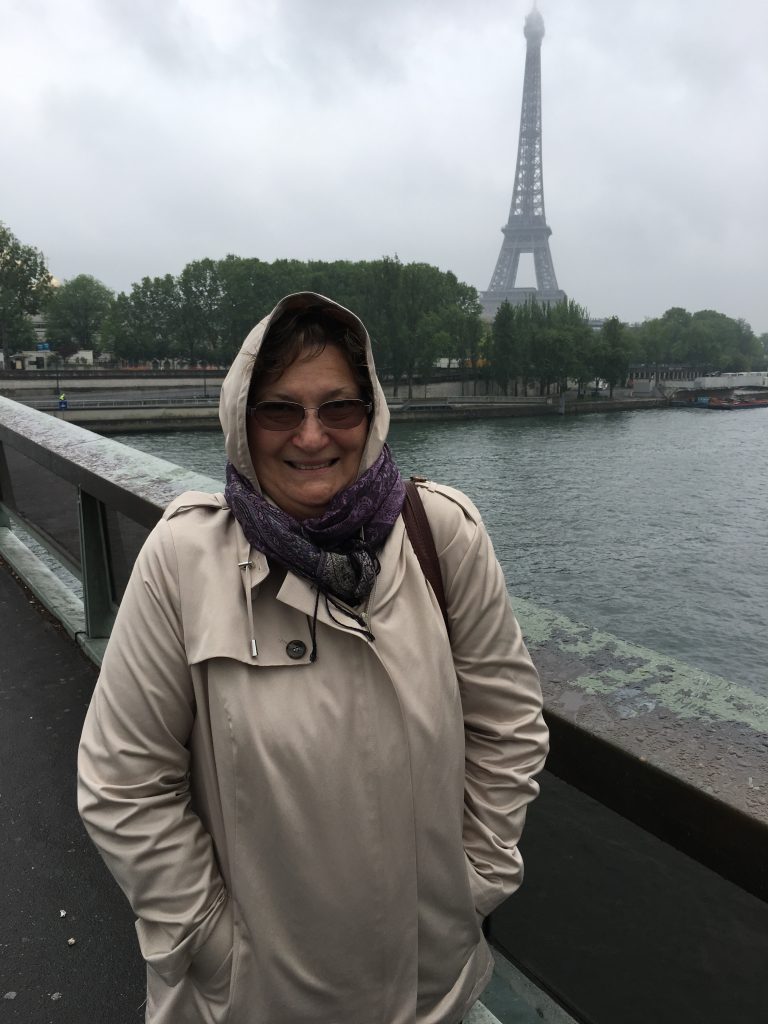
By all means, stroll past the Colosseum and view the Eiffel Tower from one of the bridges. Snap some photos and drink in the view. Then, veer off into a shady side street and enjoy an hour or tour wandering around a quiet neighborhood, sitting in a park, and enjoying a drink at an outdoor café surrounded by locals.
See the Colosseum from the outside only
Travel isn’t all about ticking off the big sites. Instead, think of travel as your opportunity to surround yourself with a kaleidoscope of interesting sights, sounds, and smells.
Slow down and savor the displays in a small museum, make time for a concert or an art opening, be on the lookout for a local festival, and just be.
10. Walk Away from the Crowds
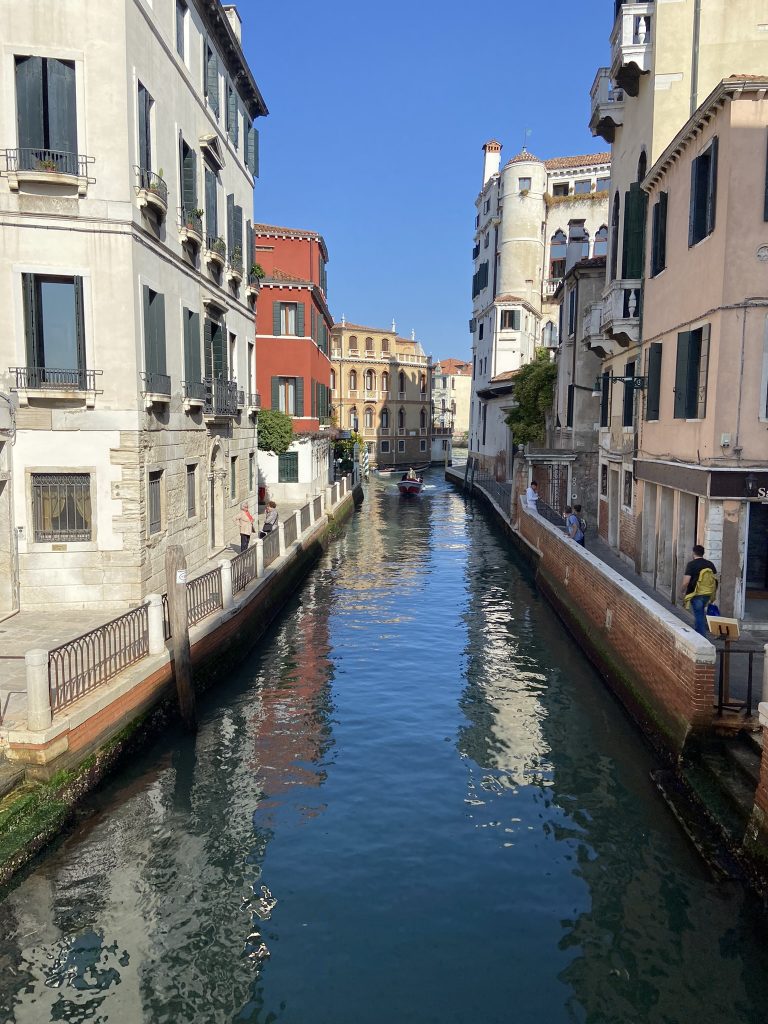
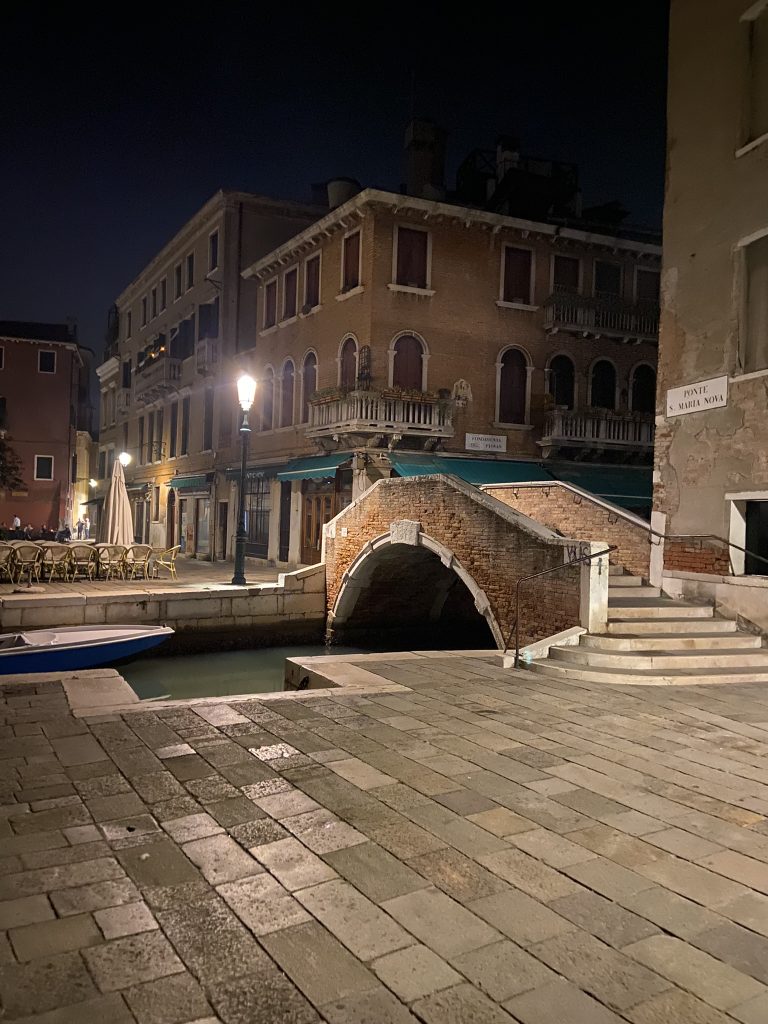
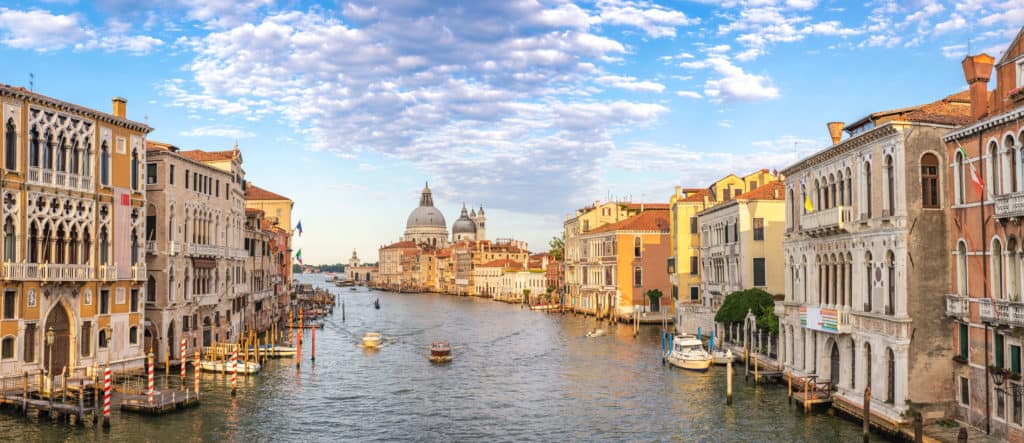
Even in Venice, one of Europe’s busiest tourist cities, you can find solitude. Leave the busy piazzas and thoroughfares and within seconds, you’ll be wandering down narrow alleyways and crossing tiny bridges spanning sleepy canals that look like they haven’t been disturbed for centuries.
Even in crowded Venice, you can easily find quiet corners
I skirt the main tourist drags in busy towns by going left or right down the first narrow street I see. I may get a bit lost, but I’ll also find glorious solitude and the chance to commune with the past.
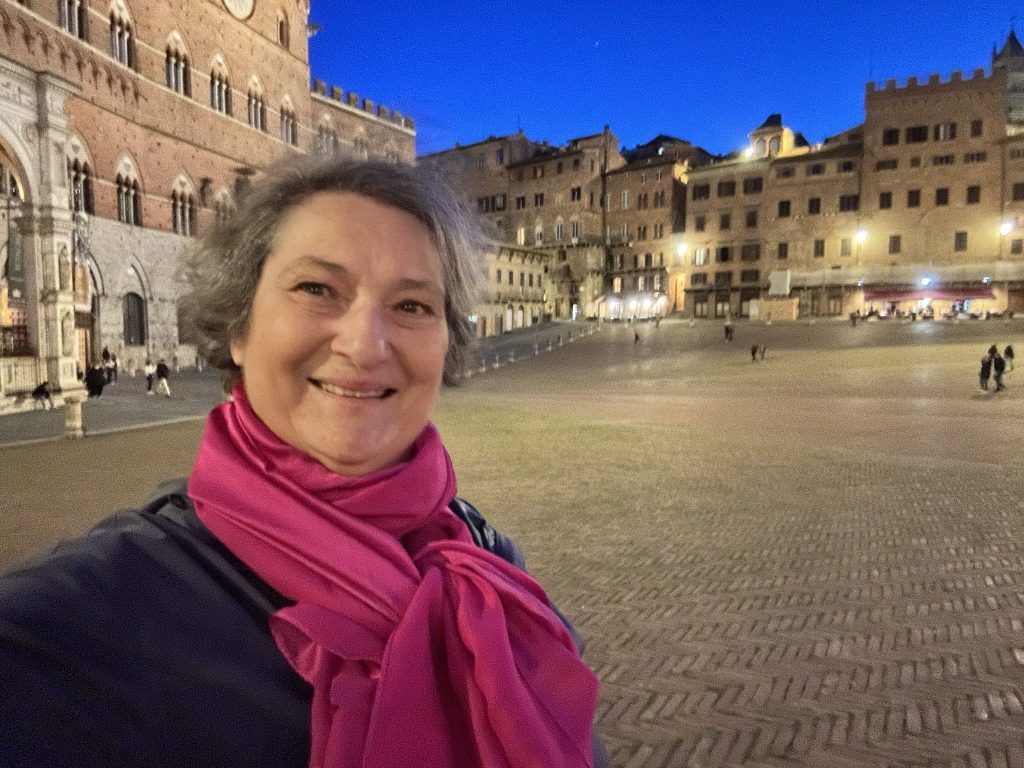
Siena’s Campo bustles with tourists but walk a few meters down a side street and you’re alone and surrounded by buildings that haven’t changed much in 700 years. And at night, you’ll even have the Campo all to yourself.
Have the Campo in Siena to yourself at night
Such opportunities for quiet encounters with history make European travel endlessly appealing.
Are you trying to figure out the best time of year to tour Europe? You probably already know that summer may not be the optimal time to tour some European countries, but not necessarily all.
How do you plan your trip to get maximum bang for your euro while also avoiding crowds and enjoying decent weather?
Don’t worry! You’re not the first person to ask this question. I ponder it myself when planning my trips to Europe. And the answer depends on three factors:
Crowds
Activities
Weather
I do consider two other factors–the dates of writers’ conferences and retreats I may want to attend, and the dates when my husband, artist Gregg Simpson, has an art exhibition scheduled.
Introduction
I’ve visited Europe in all four seasons, and each has its pros and cons. Yes, even summer can be a great choice, depending on where you’re going.
Read on for my recommendations for when and where to tour Europe in each of the four seasons, starting with summer.
Touring Europe: Is Summer Best?
I think back to summer vacations when I was a child. My parents packed my big brother and me into a hot car (no air con in those days) and drove us to a National Park or a beach or to visit relatives. Summer vacations were a combination of fun and sunburn.
Now that I’m a grown-up, I think about summer a bit differently. I no longer have children in school and my work commitments are flexible. I can stay home in the summer and avoid excessive heat and crowds, or I can choose destinations that give me a comfortable summer holiday experience.
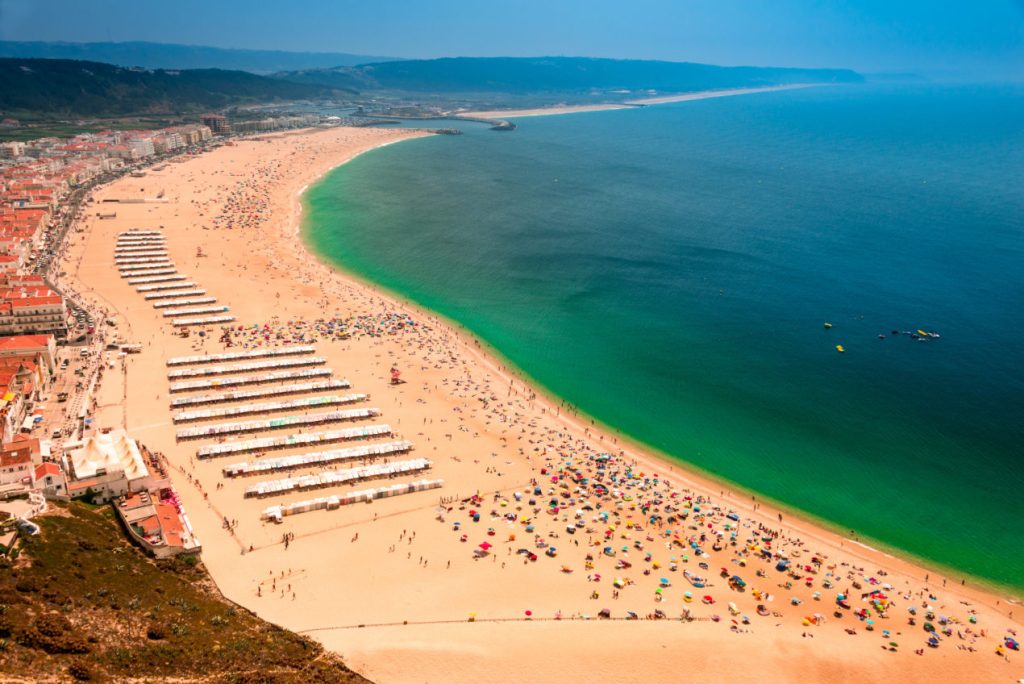
Tour Europe in the summer to experience plenty of awesome beach time
Touring Europe in the Summer
Some European countries are best visited in the summer—and some are not. Here are my recommendations.
Countries to Avoid in Summer
If possible, avoid summer travel to destinations such as southern Portugal, southern Spain, southern Italy, and Greece. Thanks to climate change, summers are getting hotter and tourist spots are paying the price.
Attractions such as the Acropolis in Greece are often closed in the afternoons because of excessive heat, and trust me, you really don’t want to tour Rome when the temperatures soar above 38 C (100 F).
Countries to Consider in Summer
Southern France, northern Italy, northern Spain, and northern Portugal can all experience hot summer weather, but don’t rule them out as summertime destinations.
I’ve visited southern France in June and ended up gasping for air during a canicule when temperatures hit 45 C. With air conditioning still not that common, I spent a lot of time floating in a pool when I wasn’t sitting indoors next to a tray of ice in front of a fan.
But I’ve also stayed for several weeks in southern France during July and August and enjoyed beautiful weather. Yes, it was warm, but not excessively so, and finding reasonably priced accommodations with pools was pretty easy.
And of course, there are beaches.
So don’t rule out visiting the south of France in summer, although you will find it crowded, particularly in August.
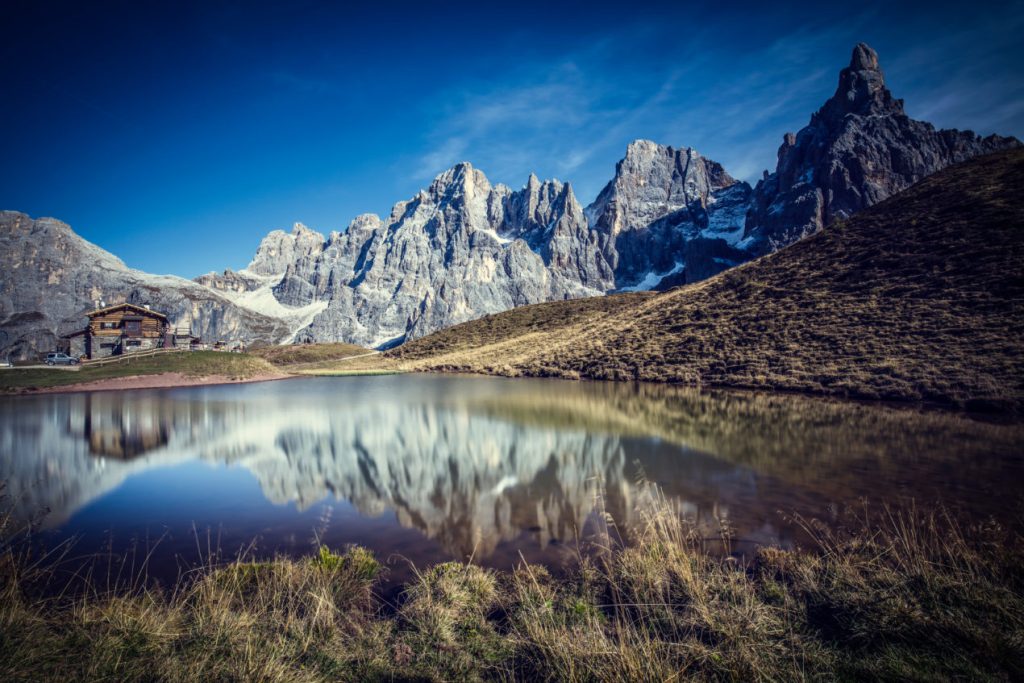
Northern Italy is generally comfortable in the summer, and there are all those beautiful lakes and mountains to explore.
I’ve also visited northern Spain and northern Portugal in summer and enjoyed both, even experiencing quite a bit of rain in green and pleasant Galicia in northwest Spain.
Destinations such as the Dolomites in northern Italy are a summer travel choice.
Countries to Choose in Summer
You can’t go wrong visiting countries in northern Europe during the summer. Here are my recommendations.
France
Take a summer vacation in Brittany. You’ll find some crowds, but you’ll also enjoy beautiful weather and fabulous beaches along with local festivals.
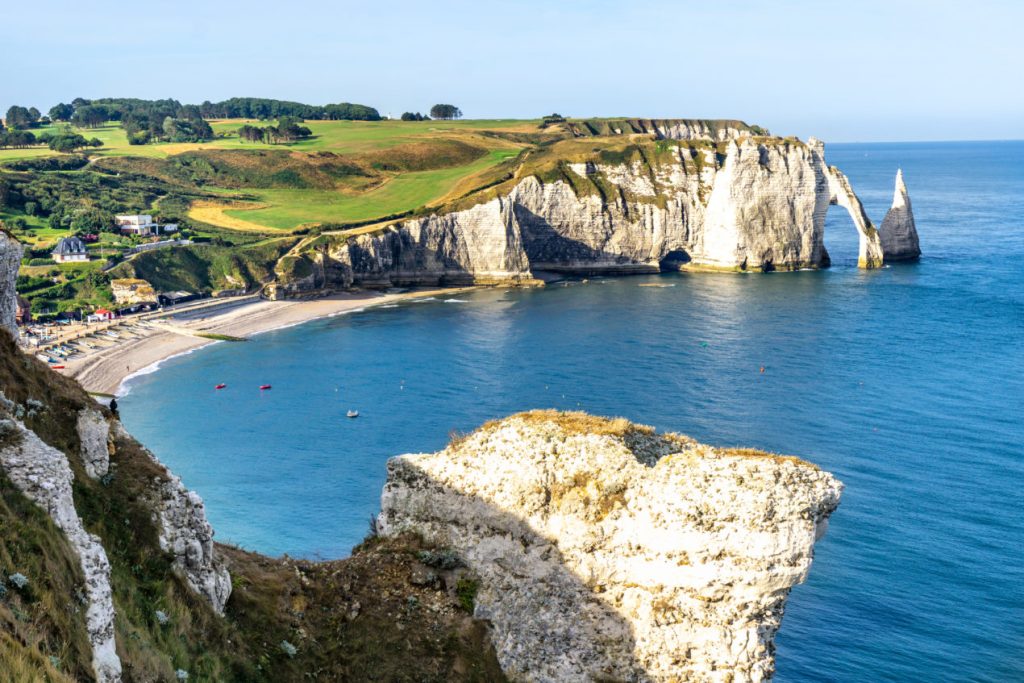
Other great options in France for summer touring are Normandy and the Loire Valley.
Normandy is beautiful in the summer with plenty to see and great beaches to enjoy.
Austria, Switzerland, Germany and the Low Countries
I love visiting these countries in the summer, particularly Austria and the Low Countries. Hiking in the Alps is best (and safest) during the summer months.
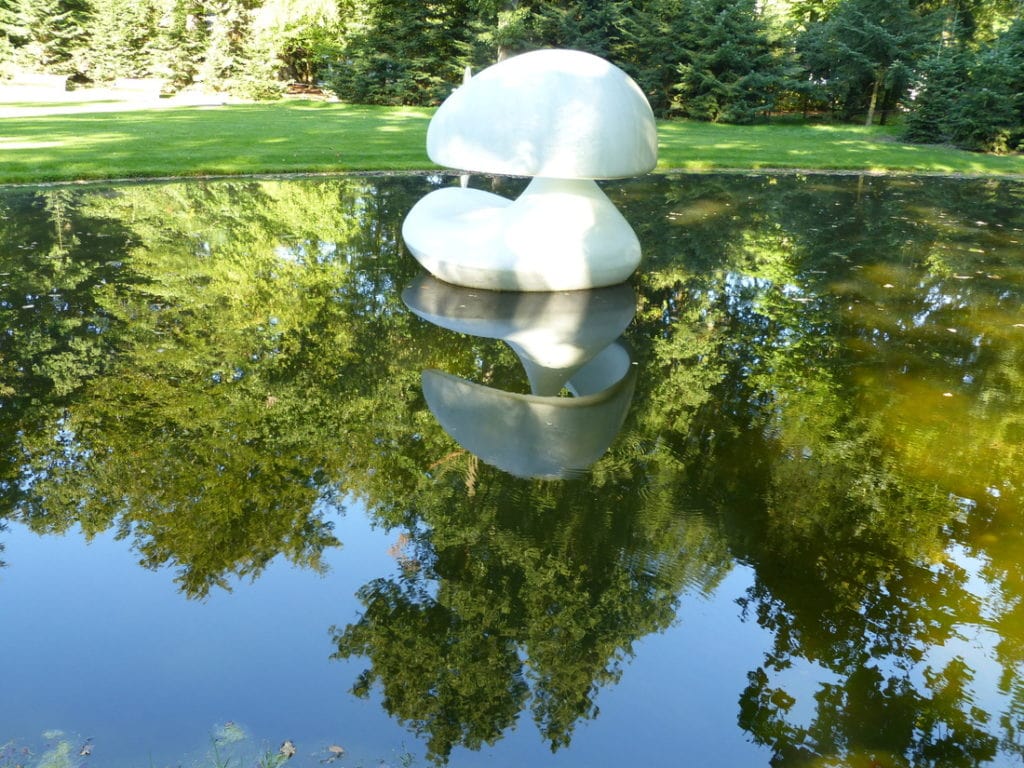
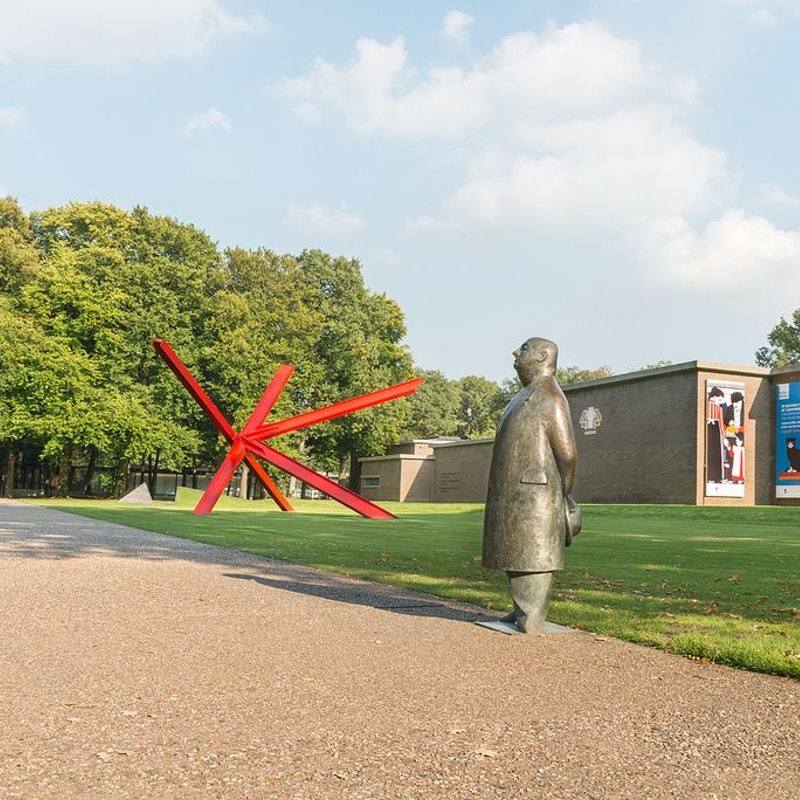
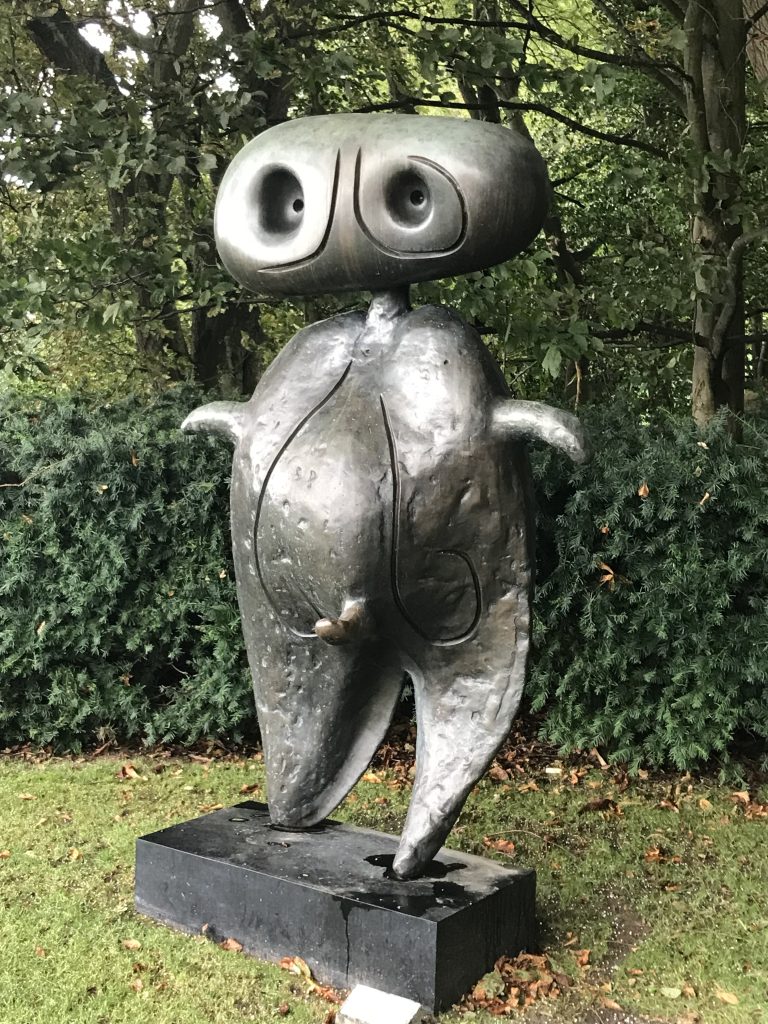
And as for the Netherlands, the gloomy skies you’ll find during most of the year tend to clear in summer. A visit to the spectacular Kröller-Müller Museum near Arnhem on a balmy summer afternoon is an Artsy Traveler must.
Don’t miss the outdoor sculptures at the Kröller-Müller Museum near Arnhem if you visit the Netherlands in summer.
United Kingdom
Having traveled frequently in the UK, I can safely say that summer is the best time to visit England, Scotland, Ireland, and Wales if you’re hoping for good weather. You may not actually get good weather, but your chances are higher during July, August and even early September than at any other time of year.
That said, I’ve toured southern Ireland in August and have needed to buy gloves and a hat.
Artsy Traveler Motto: Be Prepared!
I’ve also visited Scotland three times during the month of September and each time, the weather was spectacular. The only thing you can be certain about regarding summer travel in the UK is that if it’s raining in the morning, chances are the sun will come out in the afternoon.
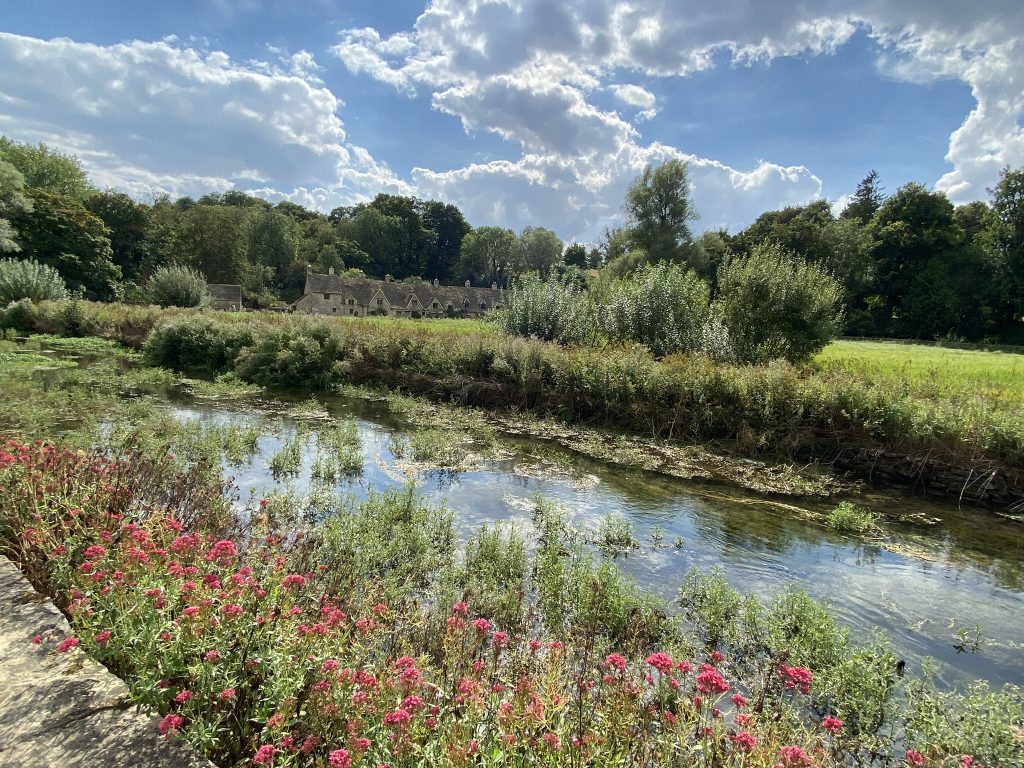
The English countryside in late summer rarely disappoints.
A Note About Garden Tours
One compelling reason to visit the United Kingdom during the summer months is to enjoy the profusion of flowers found both in private and public gardens. I have a soft spot for a good garden tour, and in the UK, you’re spoiled for choice.
Scandinavia
Traveling in the Scandinavian countries in summer is delightful thanks to long days and relatively balmy weather. I spent time in Copenhagen during early September and found the weather a shade cool but mostly dry and perfect for sightseeing.
If you choose to go to Iceland during the summer, you’ll find a lot of fellow travelers. It’s a trade-off.
Visit Iceland in winter and you’ll have many sites to yourself in the semi-darkness. Visit Iceland in midsummer and you’ll jostle for position in front of every waterfall, but on the plus side, you’ll see waterfalls for about 20 hours a day.
Tour Iceland in the summer to experience a maximum number of daylight hours.
No matter when you travel to Iceland, you’ll experience ferocious weather. I visited in February, so I expected it to be cold, but I know people who visited in June and saw almost nothing of the spectacular scenery. How tragic is that?
Summer At a Glance
Crowds: Destinations can be extremely crowded, with many popular sites sold out if you don’t purchase tickets in advance.
Activities: Lots of festivals and markets, but fewer blockbuster art shows and concerts
Weather: Unbearably hot in the south; relatively comfortable in the north
Touring Europe: How About Fall?
I think that fall is the second-best season to tour Europe (or at least most of it). And if you’re wondering, I think spring is the best season (more on touring Europe in the spring below).
Here are the pros of touring Europe in the fall (or autumn for my British friends):
Major Exhibitions
I always check what art and museum exhibitions are going to be on in the destinations I’m planning to visit. While some exhibitions run through the summer, many of the best ones start in September or October.
Concert Season
Whenever possible, I get tickets to as many classical music concerts as I can when I’m traveling in Europe. Some of the world’s best orchestras are located in cities such as Berlin, Paris, and London, with most concert seasons running from September to May.
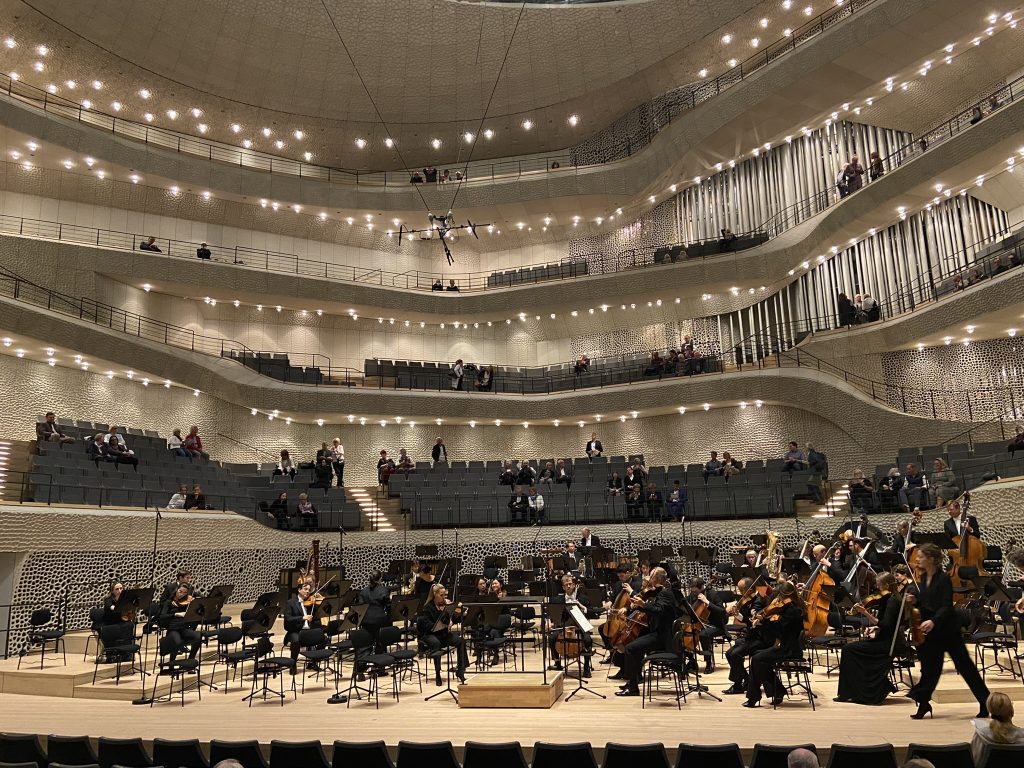
Interior of the Elbphilharmonie concert hall in Hamburg, one of the world’s great concert halls.
Manageable Crowds
Well, more or less. Even on a cold November day, Venice was crowded, and a recent visit to the Louvre in Paris in October was a nightmare. But overall, the crowds are not nearly as large in the fall as they are in midsummer, or even spring.
Visit popular sites early in the morning and book ahead, and you should be fine.
Pleasant Weather
I’ve visited most countries in western Europe during the fall at least once and have almost always enjoyed great weather. The temperatures, particularly as you go farther south, are warm but not too hot, and rainfall is generally scarcer in fall than in spring.
Just make sure you’re equipped with a rain jacket and hat no matter where you plan to travel in the fall (or spring, for that matter).
And if you’re traveling in November, be prepared for chilly temperatures pretty much everywhere in Europe. I froze in Venice in late November, and I wouldn’t recommend venturing north of London after October.
The days get very short by the time you make it to Scotland.
Fall At a Glance
Crowds: Popular destinations are generally less crowded than in summer, although purchasing advance tickets is always a good idea.
Activities: Major exhibitions and concert seasons start, along with some festivals.
Weather: Balmy and warm in the south growing increasingly chilly as you move north, with rain common everywhere, especially in November
Touring Europe: Winter Wonderland?
Winter is, surprisingly, not a terrible time to visit Europe, although it’s my fourth choice overall. In winter, you should focus your energies on touring cities such as London, Paris, Berlin, and Rome.
I once spent two weeks in Rome in December and loved it. The Vatican Museum was almost empty (that never happens at any other time of year) and the days were clear and crisp.
In winter, the concert season is in full swing, you’ll find plenty of exhibitions to tour, and prices for accommodations will be lower. In northern Europe, the days are shorter, but since you’ll mostly be visiting indoor sites, the lack of daylight isn’t a drawback.
I visited Iceland for ten days in February and enjoyed clear skies on every day but one. I also was able to commune with the major scenic sites in relative solitude and even saw the northern lights.
Winter At a Glance
Crowds: Popular destinations will be much less crowded, and purchasing advance tickets typically not required except for the most popular sites such as da Vinci’s Last Supper in Milan.
Activities: Major exhibitions and concert seasons are ongoing; also, Christmas celebrations and decorations enliven December all over Europe.
Weather: Chilly in the south growing increasingly colder as you move north, with rain common and snow likely
Touring Europe: Spring is the Winner!
The spring months are the perfect time to tour Europe if you don’t have your heart set on enjoying beach time or lazy afternoons by the pool. Even in southern Italy, the beaches don’t open until the end of May, and the unheated pools in most resorts are frigid.
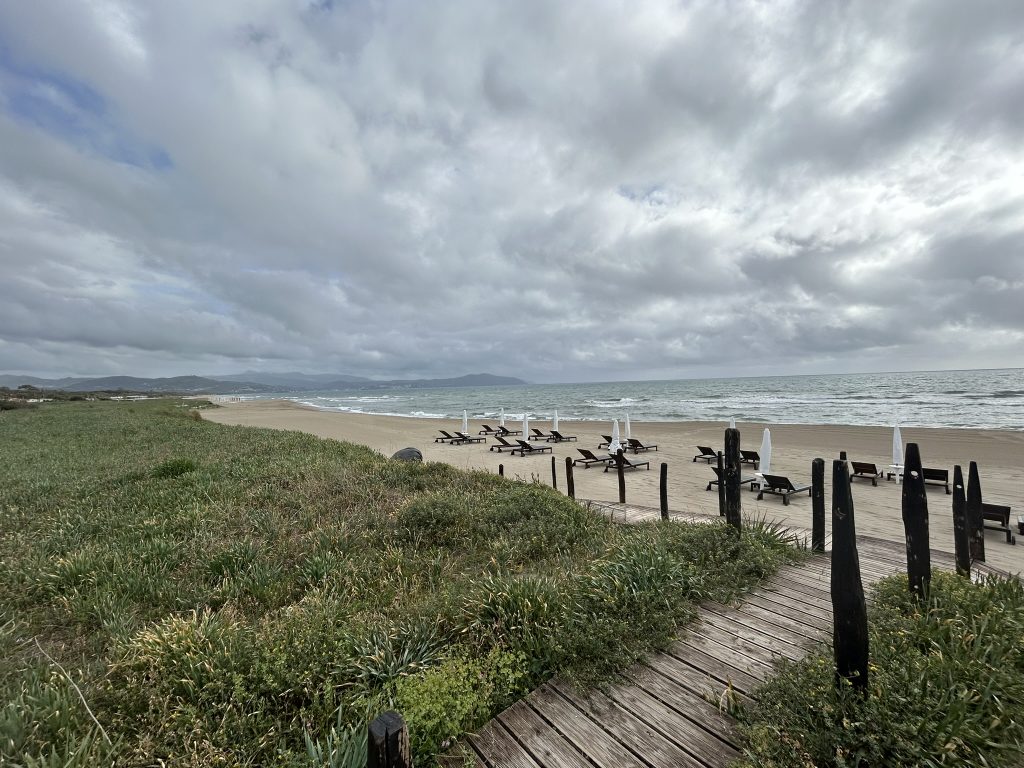
A breezy beach in southern Italy in early May is still not open for business.
In spring, the crowds are generally larger than in fall or winter (but not as large as in summer!). You won’t be enjoying your favorite sites alone (read about my ill-fated visit to the Colosseum in Rome in May!), but at least the weather won’t be as hot.
Standing in long lines when the temperature is 24 C is manageable. Doing the same thing when the temperature hits 40 C is not.
One caveat about traveling in spring—be prepared for rain. I almost always experience a lot more rain in Europe in the spring than in the fall. On a recent trip to Italy in May, I wore a dress and sandals only once. The rest of the time, I needed long pants and a warmish jacket.
And in April and May in Paris, expect rain and then sun and then rain on repeat.
As with fall and winter, a lot of major exhibitions at museums and galleries start in the spring. In addition, concert seasons are still in full swing.
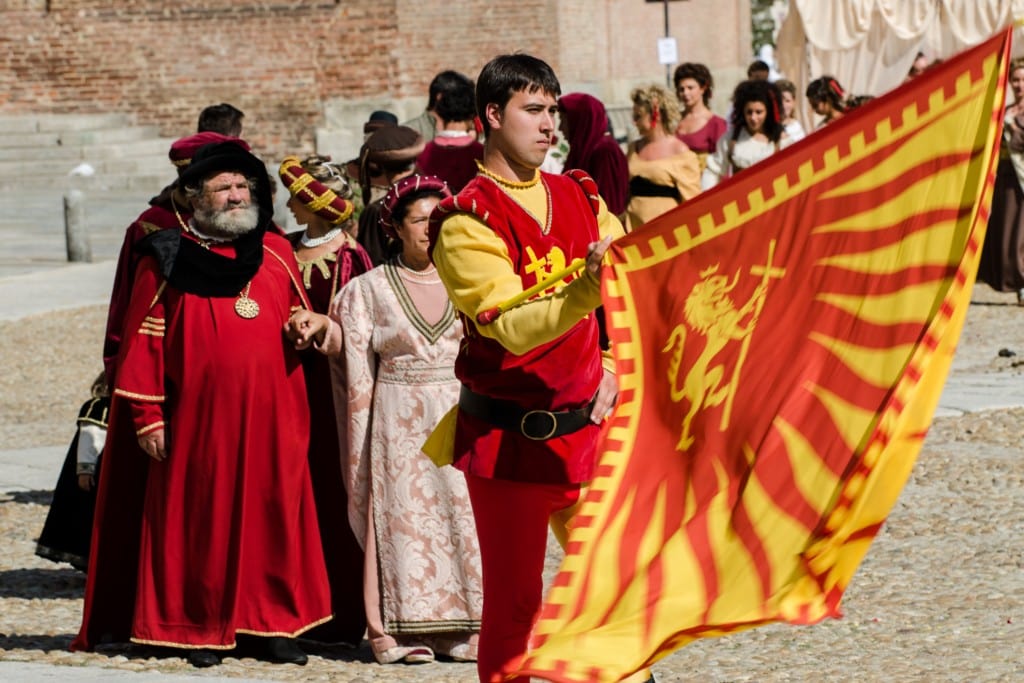
You’re also more likely to stumble across pageants and processions in spring, particularly around Easter.
Medieval processions are popular in Tuscany in the spring
Tulips!
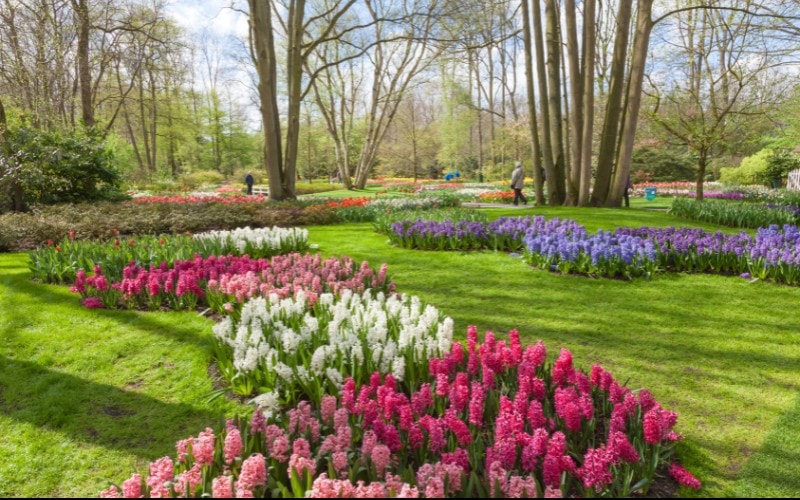
And if you can, make a point of visiting the Netherlands in the spring so you can tiptoe through the tulips in the fabulous Keukenhof Gardens. You’ll find plenty of crowds (go early to avoid the tour busses), but the chance to see so many tulips in one gloriously landscaped garden is not to be missed.
I’ve visited Keukenhof Gardens in April twice. It doesn’t get old.
View of tulips in the Keukenhof Gardens in the Netherlands
Spring At a Glance
Crowds: Popular destinations can be crowded with advance tickets advisable for most sites and required for very popular sites and museums such as the Uffizi and the Louvre
Activities: Major exhibitions and concert seasons are ongoing.
Weather: Moderate in the south and chilly in the north but generally good weather for sightseeing, although often rainier in the spring than in the summer and fall
A Note About Costs
Costs vary from place to place and season to season. You’ll pay more when you travel in high season, but high season is not always summer.
At a ski resort in the Alps, for example, the high season is winter.
I’ve generally found that prices are low-ish in winter, relatively affordable in spring and fall, and at their peak in summer, depending on the destination.
At popular times of the year, steer clear of resorts and tourist meccas such as Paris and Florence. Instead, seek out off-the-beaten path destinations. Regardless of the time of year, you’ll encounter fewer crowds, meet more locals, and get better value for the money you spend.
Top Tips for Touring Europe
Planning a trip to Europe is almost as fun as going on a trip to Europe. Keep in mind these three tips and you’re sure to make informed choices:
Tip #1: Choose countries based on the weather: go north in the warmer months and south in the cooler months.
Tip #2: Check when major exhibitions and concerts are scheduled and plan accordingly.
Tip #3: Avoid crowds by visiting popular tourist spots during less popular times such as in fall and winter, or first thing in the morning or late in the afternoon.
Ultimately, the best time to travel to Europe is whenever you have the time. You may have to go to Greece in August.
If so, travel smart by avoiding strenuous activities during the heat of the day, scheduling visits to tourist hot spots such as the Acropolis in the early morning or evening (it stays open quite late), and opting for less sightseeing time and more pool/beach time.
Or you may only be able to visit England in December. No worries! Spend the mornings visiting scenic areas and quaint villages, and then visit museums later in the day when the sun starts to go down.
And in London, spend an evening or two enjoying a West End show.
Conclusion
What advice do you have for someone planning a trip to Europe? In what seasons have you traveled? Which were great? Which are best avoided? Share your experiences in the comments below.
When it comes to experiencing memorable concerts & performances in Europe, you are spoiled for choice.
Europe is like a chocolate box brimming over with artsy flavors. Venues in every city and town showcase a wide range of musical styles, from classical to traditional to rock.
In addition to music concerts, you’ll find plenty of theater and dance performances, along with festivals and special events.
Some of my favorite memories are of performances we stumbled across, often as a result of chatting with local artists and fellow travelers, noticing posters and flyers, and checking out “What’s On” pages on local websites.
In this post, I present my favorite venues and performances in fourteen European cities: Amsterdam, Barcelona, Berlin, Cologne, Hamburg, Leipzig, Lisbon, London, Paris, Seville, Stratford-upon-Avon, Venice, Verona, and Vienna.
Overview – Planning Ahead
While I’m always open to serendipity when it comes to choosing performances and concerts, I also believe in planning ahead.
I suggest that as soon as you know the dates of your trip, go online and search for concerts, performances, festivals and other live events that will be on while you’re traveling.
A search for “musicals in London”, “classical concerts in Paris”, or “dance performances, Seville” should yield good results.
You can also use generic searches such as “what’s on in Berlin” or “concerts in Vienna” and then narrow down the choices to focus on the music genres that interest you.
Classical Concerts in Amsterdam
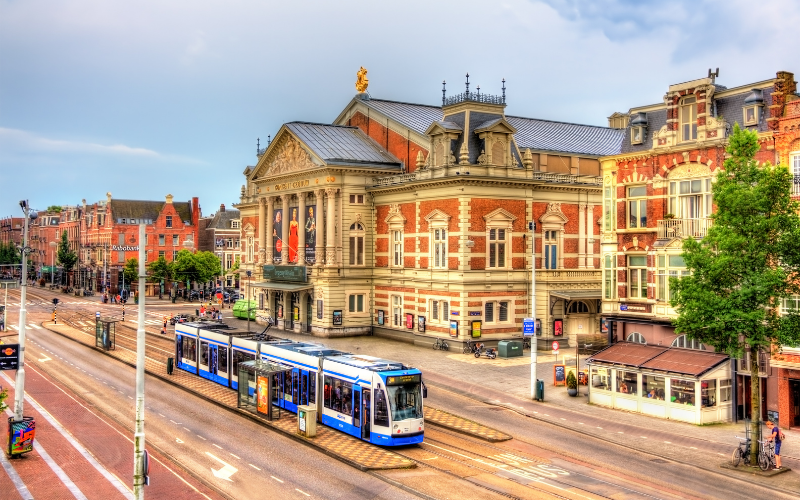
One of Europe’s most beautiful concert halls is Amsterdam’s Concertgebouw, located across from the Museumplein. Free lunchtime concerts are held on Wednesdays in the small concert hall adjacent to the main hall.
On a recent visit to Amsterdam, we enjoyed a lively performance by two vibraphonists. Check the website to find out what’s on when you’re in Amsterdam.
You’ll join locals and very few other tourists for a marvelous (and free!) musical experience.
The Concertgebouw in Amsterdam
Where to Stay in Amsterdam
Here are two of my recommended places to stay in Amsterdam.
Clayton Hotel Amsterdam American: This place is located within walking distance of the Concertgebouw and close to where you can hop onto a canal cruise. It’s stylish, comfortable, and excellent value in this expensive city.
Mokum Suites overlooking the Herengracht canal and near the Rembrandtplein is one of my favorite places to stay in Amsterdam. From your suite, watch the canal boats slide past.
If you’re even remotely interested in what’s playing, get tickets! Attending a concert at the astonishly exquisite Palau de la Música will quite simply blow your mind!
I saw a Ópera y Flamenco performance there that transported me.
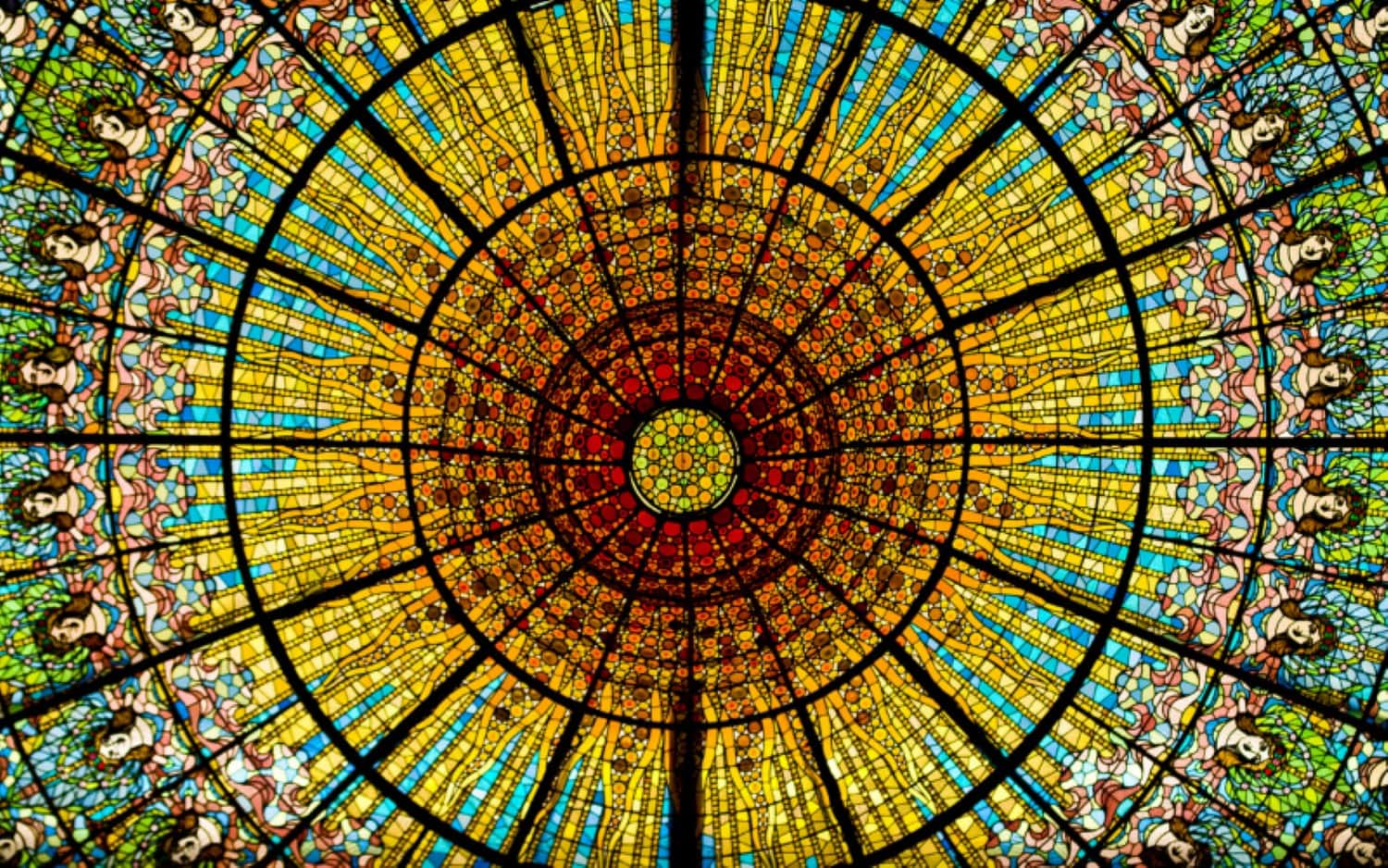
The magnificent stained glass at the Palau de la Música Catalana
Built between 1905 and 1908 by the modernist architect Lluís Domènech i Montaner, the Palau de la Música Catalana is designated as a UNESCO World Heritage Site.
If you can’t get tickets to a performance, you can still take a tour of the building. I’ve also done this and can recommend the experience. You’ll learn a lot, and get plenty of time sitting in the hall and gazing up at the incredible stained glass.
Where to Stay in Barcelona
Here are two of my recommended places to stay in Barcelona.
I loved staying at the Cram Hotel in the Eixample district for obvious reasons! I told the attendant that my last name was Cram, but unfortunately, I didn’t get a discount! Apparently the name “Cram” comes from spelling the name of the owner’s son (Marc) backwards. This is a truly lovely hotel with a rooftop pool.
I also recommend the Casp 74 Apartments near the Eixample district. The apartment hotel includes kitchens and an underground parking garage.
Concerts at the Berlin Philharmonic
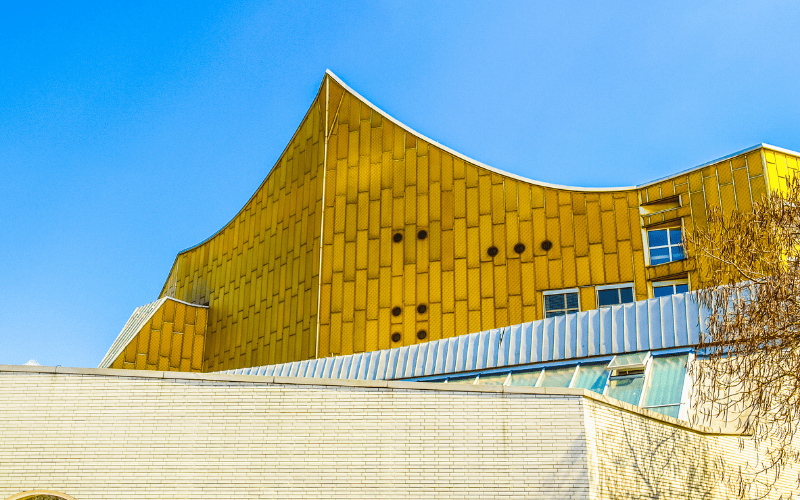
If you’re a classical music fan, check out what’s on at the impressive home of the Berlin Philharmonic (Berlin Philharmoniker).
The building itself is fabulous with wonderful acoustics and worth touring even if you can’t see a concert there. I enjoyed an awe-inspiring performance of Stravinsky’s Rite of Spring performed by the Deutsches Symphonie-Orchester Berlin.
The Berlin Philharmoniker
Check out the concert calendar and buy tickets from the Berlin Philharmoniker website.
While we usually book tickets well in advance, we’re always open to attending concerts on the spur of the moment. One such memorable concert was at the Kölner Philharmonie, a magnificent concert hall a stone’s throw from Cologne’s famous cathedral and in the same complex as the wonderful Ludwig Museum.
We had just finished visiting the Romano-Germanic-Museum (a must-see!) and were walking past the Kölner Philharmonie when we noticed a poster for the evening’s concert. The programme appealed to us and so we inquired at the box office about tickets. The very friendly, English-speaking attendant told us that tickets were available and at a price we considered incredibly reasonable, at least compared to what we were accustomed to paying in Vancouver.
Two hours later, we took our seats in one of the most dazzling modern concert halls I’d ever been in. Built in 1986, the Kölner Philharmonie is constructed like an amphitheatre and provides near-perfect acoustics. Even the size and padding of the seats have been selected to ensure constant acoustics regardless of whether the seat is occupied.
Select one of the hotels overlooking the Rhine and within walking distance of the cathedral and the concert hall. I recommend the Hotel Drei Kronen.
Elbphilharmonie in Hamburg
In Hamburg, get tickets to see a performance at the ultra-modern Elbphilharmonie, one of the world’s most stunning concert halls.
I saw a classical concert here that was inspiring, not least because of the beauty of the venue itself. You’ll climb up, up, up (elevators are available) and enjoy stunning views over Hamburg before and after the concert.
Where to Stay in Hamburg
Here are two recommendations for where to stay in Hamburg:
Radisson Blue Hotel Hamburg: I find the Radisson Blu hotels consistently good in Europe (I also recommend one in Leipzig).
Hotel Wedina an der Alster: The room was small, but the breakfast area was spacious and the food excellent.
Gewandhaus in Leipzig
Marvelous Leipzig is a must-visit for classical music lovers, particularly if you adore (like I do!) the music of Johann Sebastian Bach. Read my post about our visit to the Bach Museum (I still swoon when I think of it!).
While in Leipzig, we attended a wonderful concert at the famed Gewandhaus where the young Clara Wieck (who became Clara Schumann and the inspiration for my second novel, A Woman of Note) debuted as a solo pianist in 1828.
Many other famous musicians have played at Gewandhaus and for that reason I was curious to see a performance there.
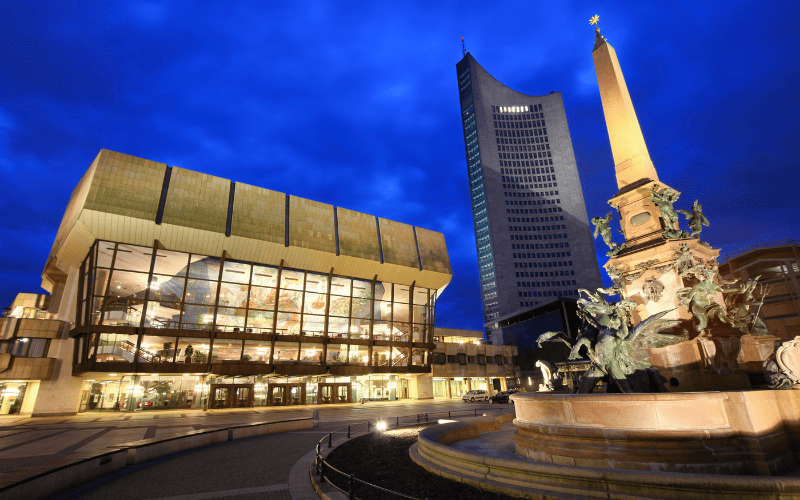
Gewandhaus concert hall in Leipzig, Germany
The ultra-modern Gewandhaus concert hall is nothing like the venue Clara played in, and is, in fact, the third concert hall to bear the name Gewandhaus, the first being built in 1781, the second in 1884 (designed by famed architect Martin Gropius), and the current hall in 1981.
We snagged tickets to a solo piano concert of music by Mozart and Chopin. What a treat, and, at less than $30CDN per ticket, probably the best value for a concert I’ve ever enjoyed.
At the interval, we thought the concert was over. The pianist had played for so long that we couldn’t imagine he’d be able to perform any longer. As we prepared to leave, a local woman came up to us and told us in careful English that it was only the break and that we needed to stay for the second half.
Gratefully, we returned to the concert hall to enjoy another ninety minutes of jaw-dropping music performed by the very hard-working pianist.
When you’re visiting Lisbon, make time for a fado performance (or two). We favor the smaller clubs with intimate performances over the more touristy offerings.
Our favorite place for fado in Lisbon is Restaurante Canto do Camões on Travessa da Espera in the Bairro Alto. Sadly, Restaurante Canto do Camões is now closed permanently; however, you’ll find other small restaurants that feature fado in the Bairro Alto and the Alfama. Walk around and listen!
Another option is to book a Fado performance. Here is an option with GetYourGuide:
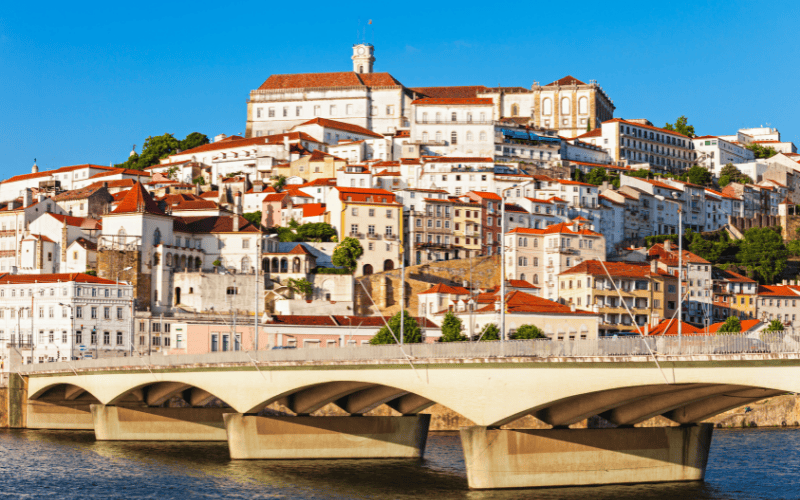
You can also see fado performances in Porto and Coimbra. In Porto, we loved the performance at the Casa da Guitarra, which also included a glass of port. In Coimbra, fado is only sung by men.
We saw a troupe of men who sing wearing traditional costumes at À Capella, a 14th-century chapel that includes a bar and tapas with the live fado serenades.
Coimbra is a charming town and a great place to enjoy fado
Where to Stay in Lisbon
I suggest staying in the central Baixa area. From there, you can walk just about everywhere. I highly recommend Vincci Baixa. It’s stylish and with excellent service.
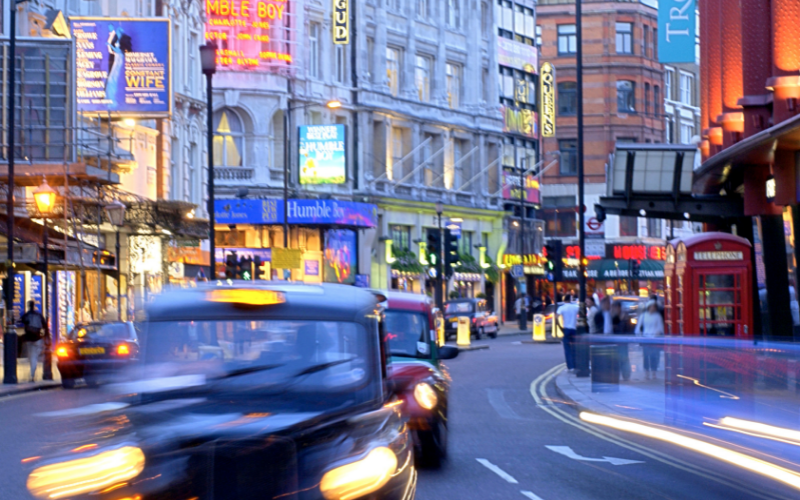
Theater in London
The first thing I do after booking a trip to London is check out what’s playing in the West End and what’s on at the National Theater and the Globe.
I’ve enjoyed so many memorable performances in London, starting in the 1970s when I was a student at Reading University, a 40-minute train ride from the bright lights of the West End. In those days, performances in London were so reasonably priced that even a student could afford them!
Even now, I find that prices for musicals in the West End are far below what I’ve paid in New York.
London’s busy West End has plenty of great theaters
Go to the London Theatre website, see what’s on and get tickets well in advance. You can also take your chances during your trip and purchase last-minute tickets, often at a reduced rate. However, I don’t recommend doing this for a performance that you really want to see.
If you are flexible and open to seeing what’s playing, you could well get lucky. On a recent trip to London, I got a ticket for Mamma Mia on the day of the performance for just 40 GBP.
Before going to the theater, enjoy an early dinner at one of the many restaurants in the West End advertising pre-theatre menus.
And while planning your entertainment options in London, don’t forget to check out what’s on at venues such as the Albert Hall and the Barbican Centre.
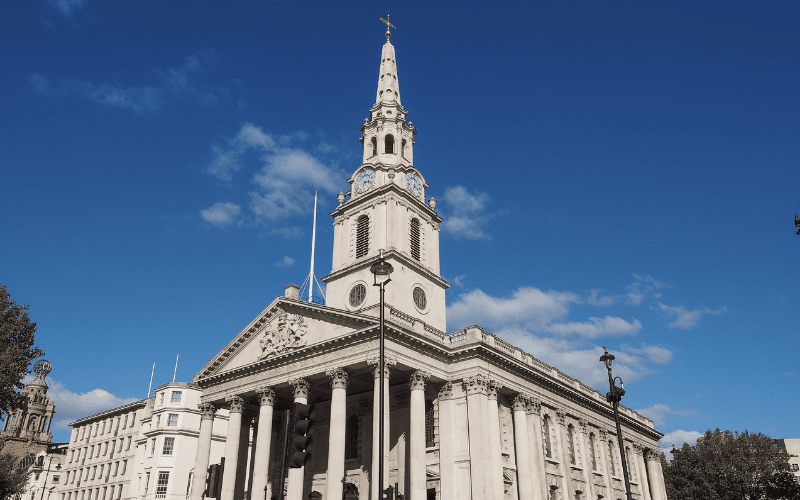
Another option is the lunchtime and evening concerts at the achingly lovely St Martin-in-the-Fields near Trafalgar Square.
Saint Martins-in-the-Fields next to Trafalgar Square in London hosts classical music concerts
Here are some more options for concerts in London:
Where to Stay in London
I visit London frequently, and here are two of my favorite places to stay:
The Wilde ApartHotel just off the Strand is also a wonderful choice. I loved its very central location within walking distance of Trafalgar Square and most of the West End theaters.
Opera & Classical Music in Paris
We love going to concerts in Paris. Spectacular venues such as the Opéra Bastille, the Paris Philharmonie and Sainte-Chapelle enhance the musical experiences, and the quality of the performances is always first-rate. Here are just a few of the venues to check out, particularly if you are a classical music lover.
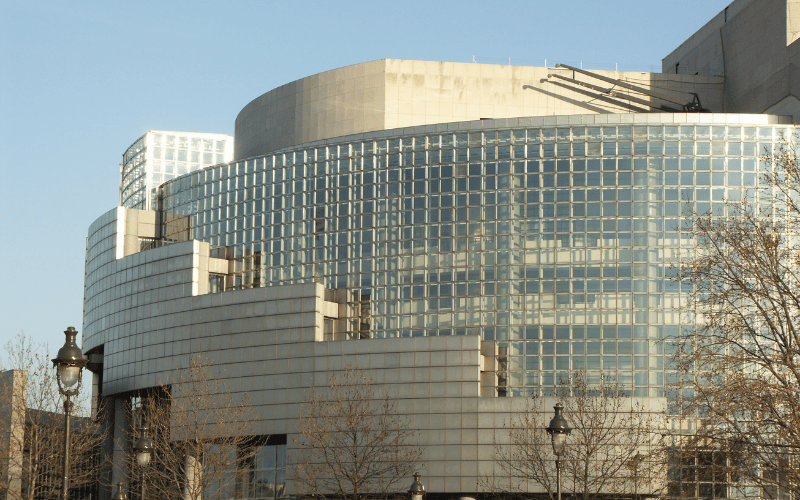
Opéra Bastille
Seeing an opera in Paris is definitely a cool experience, and one that we hope to repeat as restrictions continue to lift. One of our most memorable opera experiences was seeing Götterdämmerung at the Opéra Bastille. Talk about mind-exploding!
Opéra Bastille in Paris
The Opéra national de Paris presents operas at two venues—the ultra chic and modern Opéra Bastille and the sumptuously decorated and historic Opéra Garnier. Check the website for the Opéra national de Paris.
Paris Philharmonie
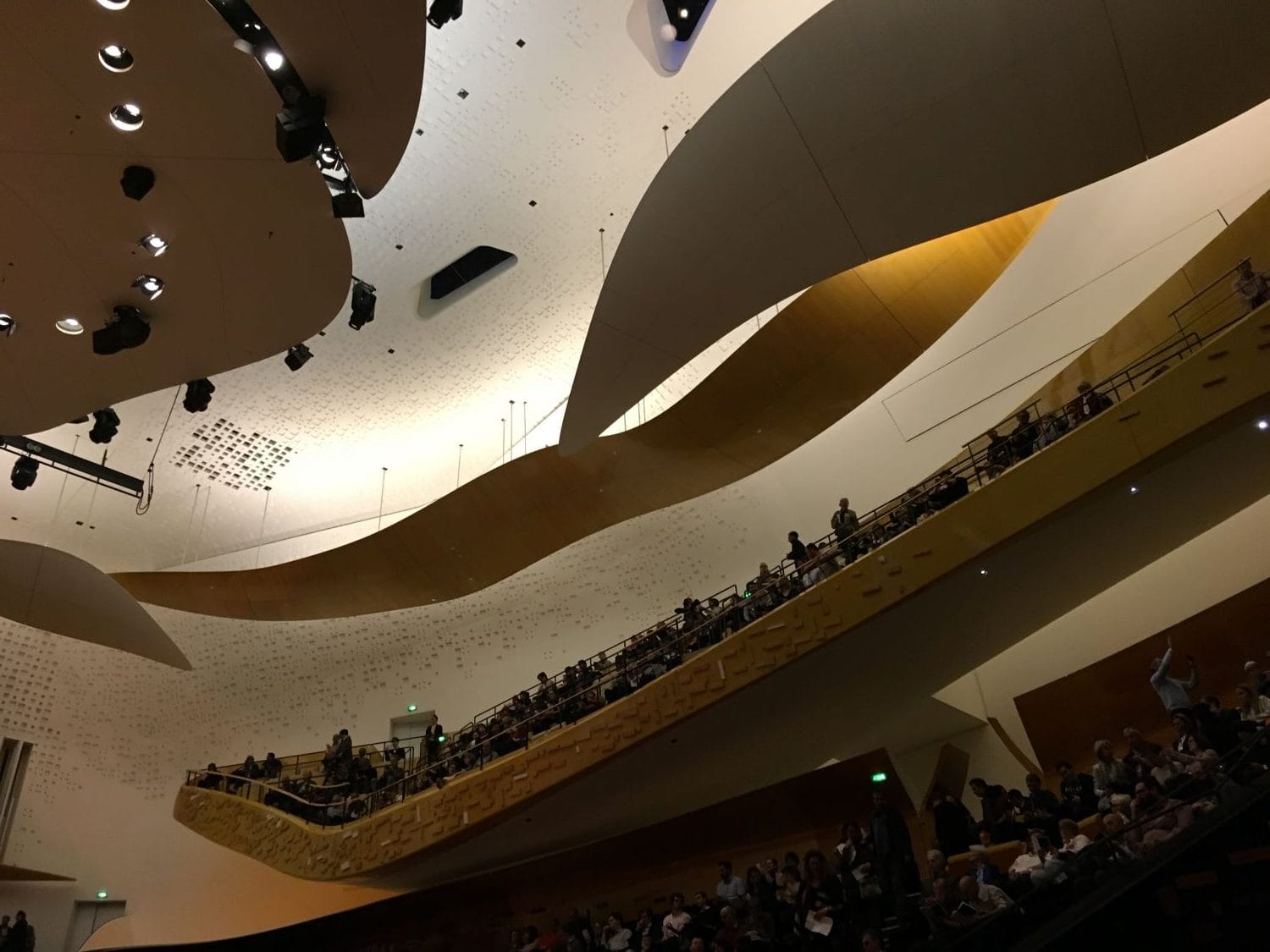
The Philharmonie de Paris is just breathtaking! Located in Parc de la Villette in the northeast of Paris, the Philharmonie is a complex of buildings that also house exhibition spaces and rehearsal rooms. We attended a performance in the symphonic concert hall—a 2,400-seat über-modern venue designed by Jean Nouvel and opened in January 2015. It was a stunning experience.
Interior of the Paris Philharmonie
Check the website for upcoming performances and events.
Piano Concerts at Église Saint-Julien-le-Pauvre
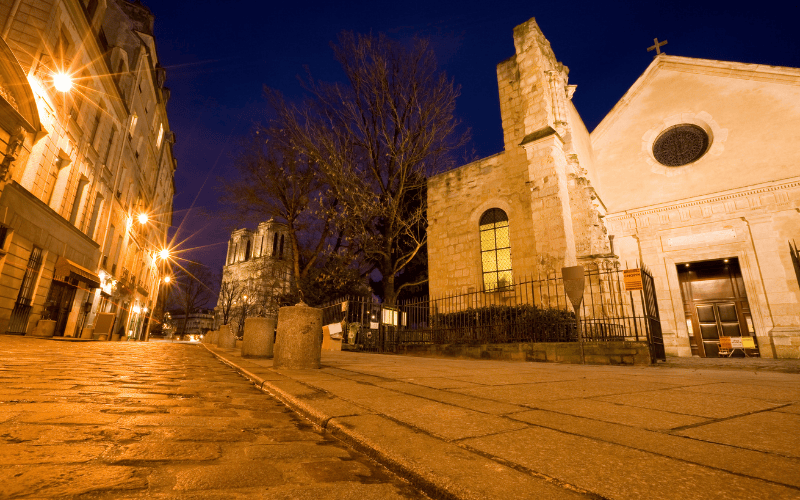
Located just across the Seine from Notre-Dame Cathedral in the 5th arrondissement, the Église Saint-Julien-le-Pauvre is one of the oldest churches in Paris. Concerts featuring either solo piano or duos (e.g., violin and piano or cello and piano) are frequently held there—and they are well worth attending. We’ve been to several. Tickets are reasonably priced, the venue is deliciously ancient and atmospheric, and the quality of the playing is first-rate.
Saint-Julien-le-Pauvre is just across the Seine from Notre-Dame Cathedral
Check the website for upcoming concerts and keep an eye out for posters in the area (that’s how we discovered what was on).
Sainte-Chapelle Concerts
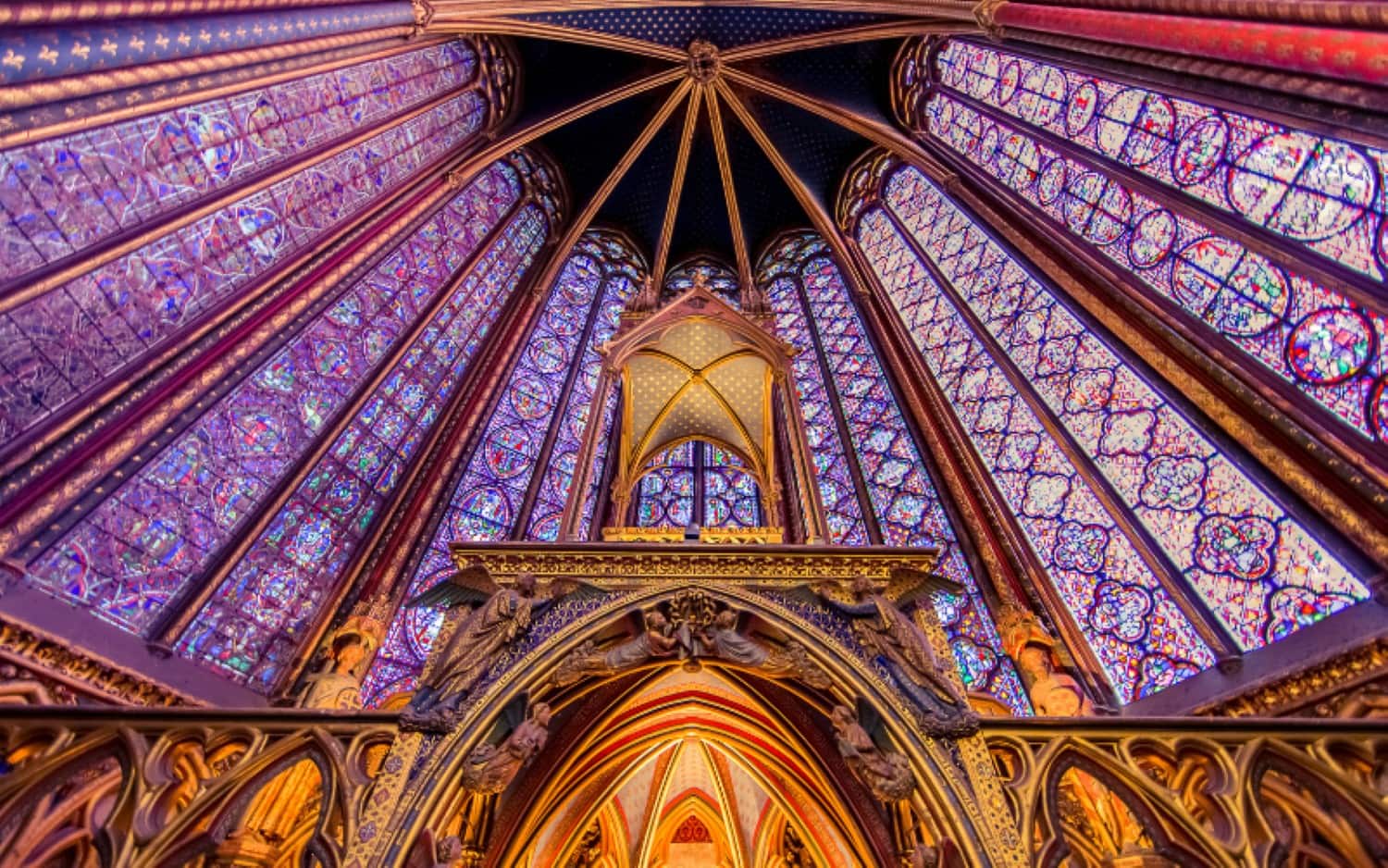
Fancy spending an hour or two staring up at sublimely beautiful stained glass supported by impossibly slender columns while listening to sublimely beautiful classical music? Then check out the website for Sainte-Chapelle’s concerts and purchase tickets for a performance. You won’t be disappointed!
Imagine listening to music surrounded by this view!
We’ve enjoyed several concerts at Sainte-Chapelle and have always been transported into ever higher planes of awesomeness. A favorite evening out is to enjoy the performance at 7 pm and then to wander starry-eyed through the cobbled streets of Île de la Cité to Île Saint-Louis and dine at one of the many small bistros in the area. Artsy traveling doesn’t get much better!
Where to Stay in Paris
I favor hotels and apartments on the Left Bank in Paris. Here are two of my favorites:
Hotel de L’Universite: in the heart of Saint-Germain, this boutique hotels is a bit removed from the crowds
We’re firm fans of flamenco. See my post describing the flamenco performance we enjoyed on our first visit to Seville. In Seville, you can see flamenco at several venues. I recommend two.
A flamenco performance will captivate you!
Flamenco Museum
From the website, purchase the combo ticket that includes the museum and a late afternoon flamenco performance that will leave you breathless.
Los Gallos
Situated in a charming little courtyard in the heart of Seville, Los Gallos is an intimate venue with world-class talent. Sip the Sangria included in the ticket price and prepare to be blasted into the stratosphere.
Where to Stay in Seville
I recommend the Hotel Amadeus Sevilla deep in the old town in Seville. If you’re driving, park your car on the outskirts and take a taxi into the city.
Theater in Stratford-upon-Avon
Every time I visit England, I do my best to squeeze in a trip to Stratford-upon-Avon to see a performance by the Royal Shakespeare Company. I have been fortunate to see many wondrous performances there, including productions of Romeo and Juliet and Hamlet that both starred the incomparable David Tennant.
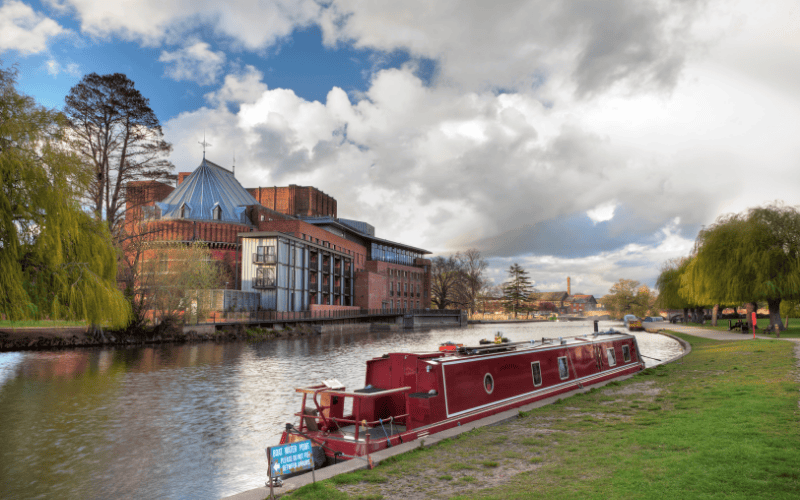
Main theatre at Stratford-upon-Avon
When I was a student at Reading University, a two-hour drive southeast of Stratford-upon-Avon, I frequently made the trek to see a performance. I was studying for a degree in English Literature so taking in as many Shakespeare productions as possible was almost mandatory.
You can see Shakespeare productions at the Globe in London and the experience is highly recommended. However, I must admit that I prefer the productions at Stratford-upon-Avon. The seating is more comfortable, and the quality is top-notch. I liken seeing a production by the Royal Shakespeare Company as the auditory equivalent of looking at high-quality cut crystal. Every word and gesture is crisp and perfect.
When you go up to Stratford-upon-Avon to slake your Shakespeare yen, you also get the bonus of having time to wander the charming streets of Stratford. Sure, it’s a bit touristy, but so what? I love touring Shakespeare’s birthplace, paying my respects at his grave in the church, and watching the swans glide by on the River Avon.
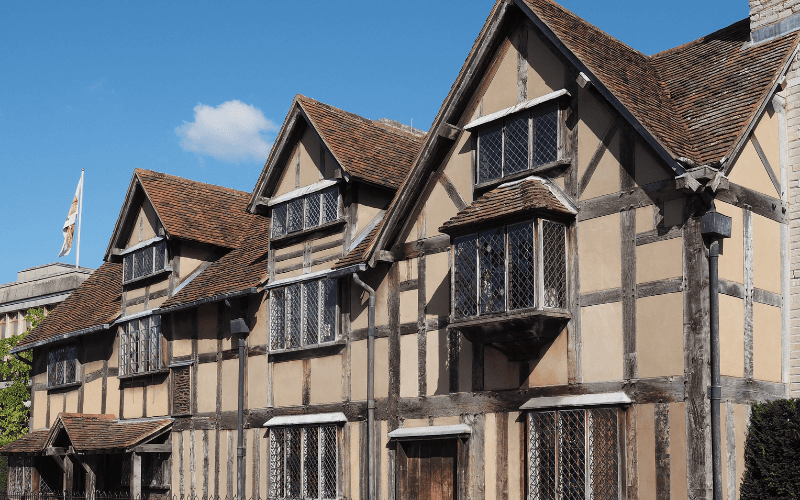
Shakespeare’s birthplace in Stratford-upon-Avon
Visit the RSC’s website for details about upcoming productions in Stratford-upon-Avon and London. Here are some other options:
Where to Stay in Stratford-upon-Avon
I recommend the Pen and Parchment Inn. The location is convenient to the theater and the breakfast was first-rate.
Vivaldi in Venice
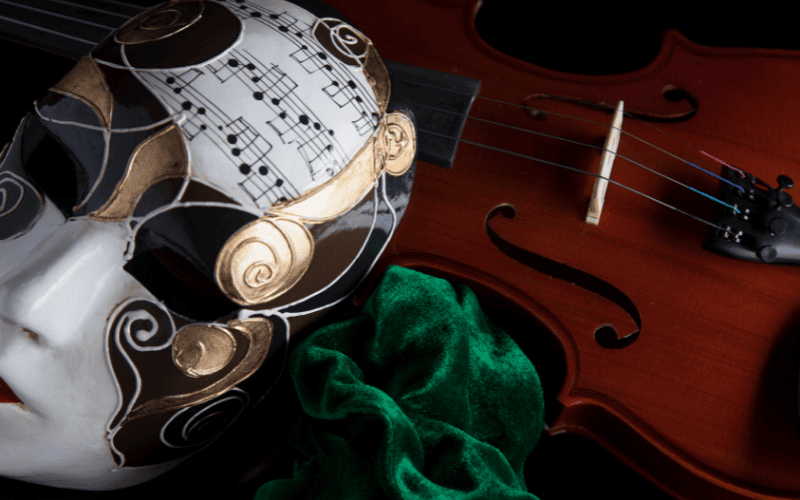
On one visit to Venice, we were strolling through the quiet streets after dark when we noticed a young man dressed in 18th-century garb and carrying a violin case hurry past. We caught up to him and asked if he was a musician. He told us he was on his way to play a concert of 17th- and 18th-century music in a church. Did we like music like that?
Is Vivaldi Venetian?
Yes!
We followed him to the church and half an hour later were sitting beneath a mural painted by Titian and listening to a selection of Venetian classical music favorites. Bliss! The orchestra was clad in 18th-century garb and the performance was obviously aimed at tourists, but that didn’t affect the quality of the musicianship or the depth of our enjoyment.
Hearing Baroque music in Venice just makes sense!
After the concert, we floated out into a warm evening to find ourselves moments later at the edge of the Grand Canal. A barge filled with another group of musicians in period dress slid past, the music wafting through the balmy air like the rustling of silk stockings.
Magical!
In Venice, several venues feature classical music concerts. Check out the Music in Venice website for programs and dates.
Where to Stay in Venice
Here are two of the places I’ve stayed in Venice.
San Teodoro Palace: This one-bedroom apartment is huge by Venice standards and located steps from the Rialto Bridge in a very lively and touristy area.
Ca’ Mirò: Settle into this two-floor apartment in a quiet area of Venice not far from the train station and become a temporary Venetian. It’s gorgeous.
Opera in Verona
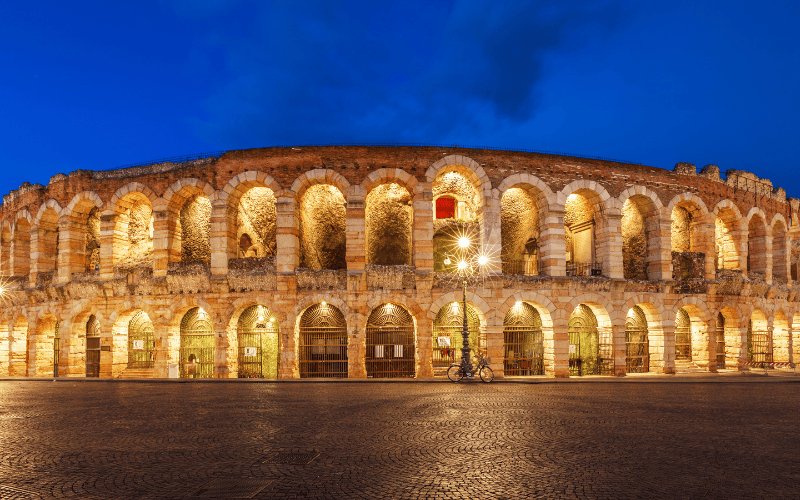
The Arena di Verona, the Roman amphitheatre in Verona, Italy, periodically presents operas to hundreds of fans who are mostly perched on the edge of very hard, very ancient Roman stone steps. We know because several years ago, we were such fans. To read about an evening that has become synonymous with disaster in our family, check out Meltdown in Verona.
Our experience aside, attending a performance at the Roman arena in Verona could be the magical experience we’d expected.
The detailed RM Europa Tickets website contains information about all the opera festivals in Europe in a given year. You’ll find opera festivals in almost all European countries, along with a detailed list of venues and schedules, including the Arena di Verona.
Arena di Verona
Where to Stay in Verona
Check out Hotel Torcolo, located a few steps from the arena in the heart of the old town.
Classical Concerts in Vienna
You can’t walk two feet in Vienna’s Stephansplatz without tripping over a bewigged young person trying to sell you tickets to a performance of Strauss, Mozart, or both. Vienna has several venues featuring tourist-oriented shows designed to showcase the oldie goldies of several of its most famous composers, particularly Johann Strauss.
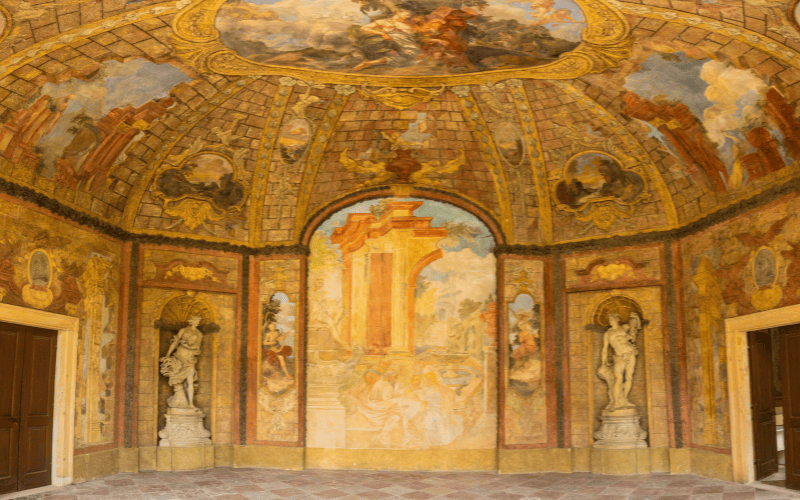
The last time I visited Vienna, traveling solo, I attended a delightful string quartet concert at the gorgeous Sala Terrena, an intimate and heavily decorated venue in the center of the city. Mozart allegedly lived in the building in which the Sala Terrena is housed when he first came to Vienna as a young man. While you wait for the concert to begin, feast your eyes on the riotous Baroque frescoes and look out especially for the leopard! For more about my experience at the Sala Terrena concert, check out my post on Music in Vienna.
Some of the frescoes at the Sala Terrena in Vienna
On the same trip to Vienna, I took the tram and then a bus out to Schloss Laudon (Water Palace) in the bucolic countryside surrounding Vienna to attend a concert that was part of the five-day Schloss Laudon festival.
I discovered the festival while planning my trip to Vienna and was very glad I managed to snag a ticket for a performance that featured an early Beethoven piano trio in the style of Haydn and a marvelous rendition of Tchaikovsky’s piano trio.
Where to Stay in Vienna
Here are some hotels in the center of Vienna with +9 ratings on booking.com that offer good value:
Before you travel, check websites for venues and performance times and budget as much money as you can spare for live entertainment. You’ll be making memories that last a lifetime.
And keep a lookout for local folk performances that are often free, with some even encouraging participation. You’ll typically find these advertised in flyers and on posters.
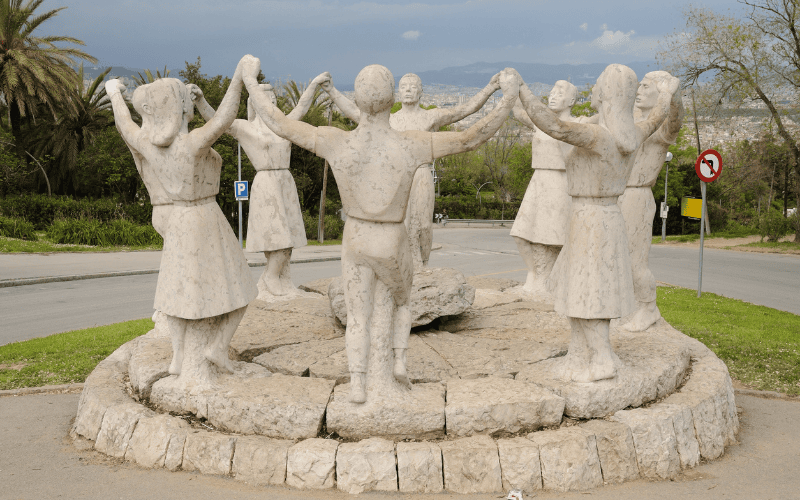
Watch a flag-waving demonstration by young people dressed in medieval garb in Siena, dance the Sardana in front of Barcelona Cathedral along with hundreds of locals and tourists, watch a concert featuring ancient instruments in a tiny chapel in Les Baux de Provence, and more!
Keep your eyes and ears open; you never know what’s around the next corner.
Statue commemorating the Sardana in Barcelona
Have you attended concerts while traveling in Europe? Share your experiences and recommendations in the Comments below. Here are some more posts that feature information about concert-going in Europe:
Staying healthy while traveling in Europe requires more vigilance than you exercise at home. You’ll come into contact with thousands of people, often in close quarters, and be exposed to millions of germs.
And if you work from home like I do, you’re at even greater risk of getting sick while traveling. Your system is likely not exposed to the variety of germs you’ll encounter when you travel to Europe.
This post presents some common sense guidelines for how to stay healthy while traveling in Europe–and what to do if you need a doctor. Spoiler alert: Seeing a doctor in Europe is surprisingly easy, at least in my experience.
Good Hygiene for Staying Healthy in Europe
Be Vigilant About Hand-Washing
I
know—what else is new? But when you’re traveling, hand-washing is even more
important than it is when you’re at home. Not touching your face and keeping
your hands clean can help prevent the spread of germs and infectious diseases.
The current guideline is to wash your hands for 20 seconds with soap and water.
Wet
your hands, leave the water running, soap up and then wash your hands while
singing Happy Birthday twice. Rinse your hands, then dry them with a
paper towel. Use the paper towel to turn off the water and to open the bathroom
door.
Frequent hand washing helps prevent getting sick.
In
a public washroom, you may want to sing under your breath. Or take a stab at
singing it in the local language and maybe make some new friends or at least
attract some smiles.
Finding Washrooms in Europe
As soon as you get to a restaurant and before you reach for the bread sticks, find the washroom and wash your hands. Take time to learn how to ask, “Where is the toilet?” in the language of the country you’re traveling in.
Or just raise your eyebrow at the server, smile ruefully and cock your head politely toward the back of the restaurant. The server will know what you want and steer you in the right direction.
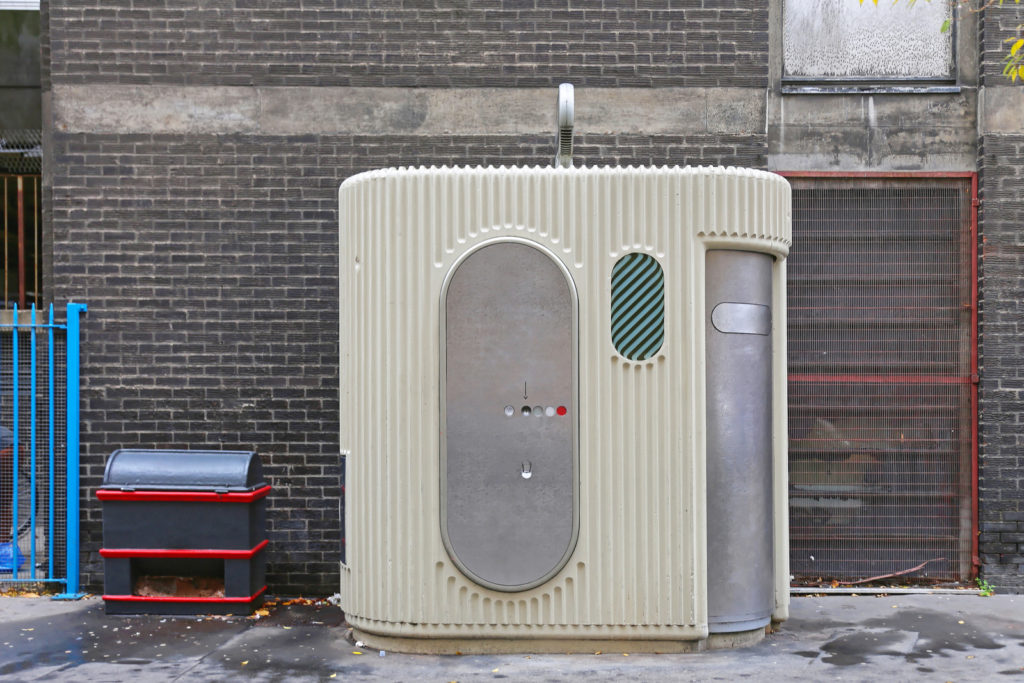
That said, avoid public washrooms as much as possible, particularly the coin-operated, telephone-booth type WC on street corners. In a pinch, you may have no choice, but if you can, wait until you get back to your hotel room.
Public toilets – useful in a pinch!
For an entertaining and detailed look at toilets in Europe, check out this article by Rick Steves.
Take Alcohol Wipes or Hand Sanitizer
Stash several packets of alcohol wipes in your day pack or handbag. When you get to Europe, look for the European versions in pharmacies and large supermarkets.
Purchasing
these kinds of products in Europe is always interesting because you often end
up with products that are different from what you’re used to and are work just
as well or better.
Keep Safe on the Plane
I’ve taken to wiping down my tray table on the plane in recent years. I never used to, which is probably why I usually caught a cold within the first few days of arriving in Europe.
I
also recently read that the seat pocket in front of you is NEVER cleaned which
means it’s probably a ninth-grade science experiment. You don’t want to think
about it.
Resist
the temptation to stash your book or laptop in the seat pocket. Keep a small
bag with you at your seat for storing the stuff you need during the flight.
You should also wipe down the seat belt and buckle, the remote control, the TV screen, and the headrest.
Accommodation Tips for Staying Healthy in Europe
Inspect Hotel Rooms Carefully
Unfortunately, hotel rooms can be notoriously filthy even if they look clean. Although I don’t think it helps to get too paranoid in our post-COVID world, check for obvious signs of dirt such as poorly cleaned bathroom fixtures, stained carpets, and musty bedding. If the place is really awful, leave.
A
pervading smell of bug spray is another clue that you might want to find a
different place.
Also,
even in “good” hotels, bedspreads and decorative pillows are rarely washed. Be
sure to remove the bedspread before sitting on the bed and don’t cuddle up to
the pillows.
Another
germ-laced object in hotel rooms is the TV universal remote control. Before
using it, give it a good swab with an alcohol wipe.
Medications and First Aid to Keep You Healthy in Europe
Take Extra Medications
If
you take prescription medications, bring along more than you think you’ll need
for the duration of your trip. If you’re quarantined or otherwise delayed, you
want to be sure to have enough medication.
Consider
taking enough to last for at least four to six weeks beyond the duration of
your trip.
Take a First Aid Kit
In
addition to the usual first aid kit supplies (Band-Aids, tweezers, aspirins,
etc.), take along a small bottle of Oil of Oregano or the cold remedy of your
choice. At the first sign of a scratchy throat, take a dose or two.
Take along a good first aid kit
And
then get thee to a European pharmacy pronto.
Staying Healthy Using European Pharmacies
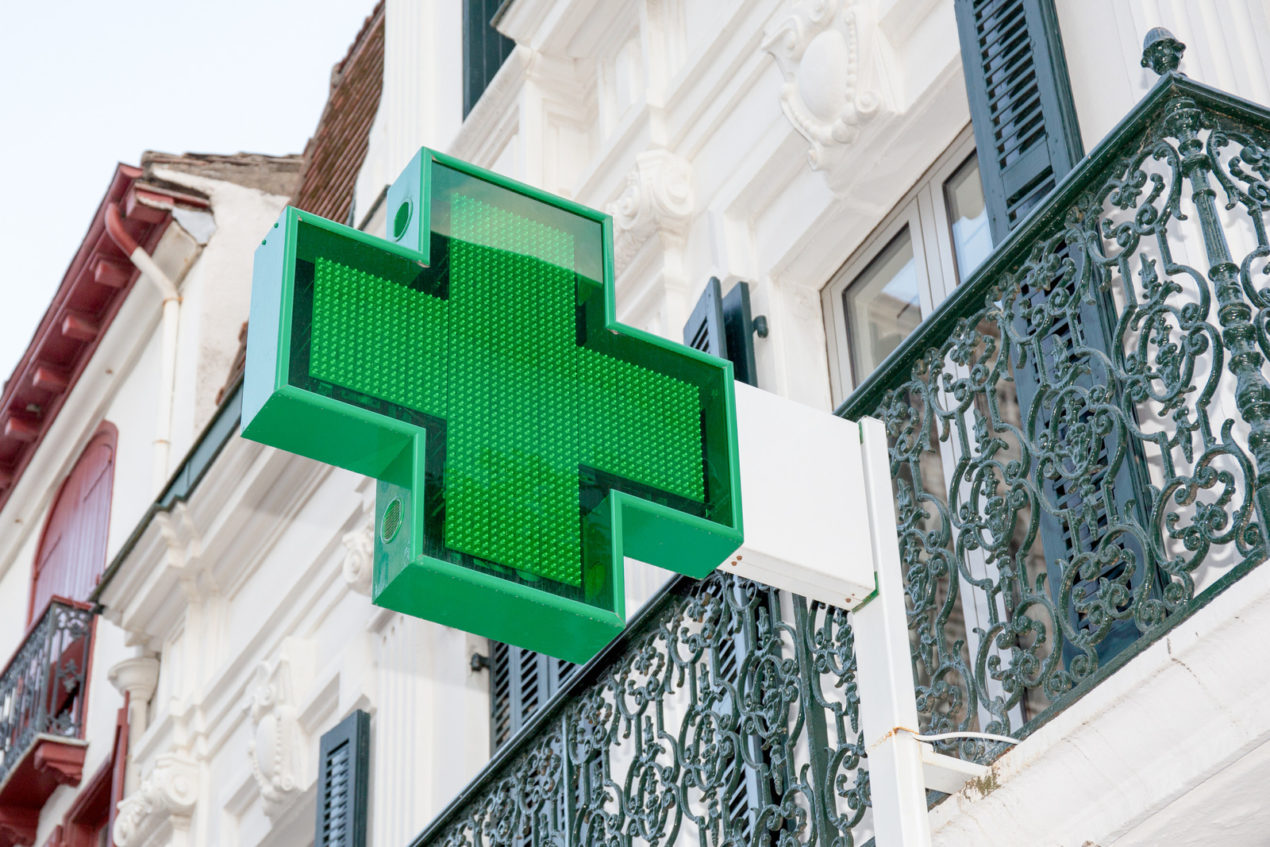
Look
for the illuminated green cross. In many European cities, you’ll find a
pharmacy on every other block.
One
of the great joys of traveling in Europe is discovering the quality of the
pharmacies. Most are staffed with English-speaking health care professionals.
Buy Suggested Remedies at Pharmacies
Explain what’s wrong to the pharmacist. He or she will probably ask several detailed questions about your symptoms and health history. The remedies they recommend can be pricey, but in my experience they work well. Don’t stint!
Getting Medical Attention on the Road
Connect with a Local Doctor
Thanks to the Internet, it’s increasingly easy to find a doctor while traveling in Europe. I’ve consulted with doctors in Spain, Italy, and France, and all have been English-speaking and very helpful. Ask for a list of doctors at the local pharmacy or search online for “English-speaking doctors in [city]”.
In Madrid, I searched for “English-speaking doctors for travelers” and came up with several websites that catered to tourists in need of medical attention. I called one of them and literally within an hour, a doctor arrived at my hotel room. She examined me, gave me a shot, prescribed medications, and then whipped out her Visa machine. The cost was 150 Euros. I could have claimed it on my medical insurance, but with a deductible of $500, it wasn’t worth it. The doctor told me that a lot of her calls are to tend to tourists who are hungover after too much Madrid partying!
I paid for each visit I made to a doctor in Europe, but the cost was extremely reasonable (the 150 Euros in Madrid was the most expensive) and the care first rate. When you’re in need of a doctor in Europe, don’t wait! Go online, find a doctor or a service that caters to tourists and either call or book online.
Go to the Hospital if Needed
In a medical emergency, go directly to the hospital. I’ve heard from many travelers that the level of care is excellent. If whatever ails you can’t be fixed by a trip to the pharmacy or a visit to a local doctor, go to a hospital and ask for help.
Staying Healthy on the Road
Avoid Large Crowds at Attractions
When
possible, avoid visiting attractions at peak times when crowds are at their
thickest. Your best bet is to go first thing in the morning.
When you get to the Louvre as soon as it opens, you’ll not only avoid crowds and germs, you’ll also have the place to yourself. Imagine being the day’s first person who gets to see the Mona Lisa!
If you have a cold or are immune compromised, wearing a mask when out in crowds makes good sense.
Rent a Car
I know — it’s not the
green thing to do, but driving in your own car could help keep you healthy. If
you do travel by train, get out those alcoholwipes
and ramp up your hand-washing routine.
Travel Healthy: Walk More & Use Transit Less
Being
jammed next to someone who is coughing and sneezing when you have no room to
get away is a recipe for disaster. Be conscious of crowds on public transit and
whenever possible, walk or wait for the next bus or train that may be less
crowded.
Enjoy walking in European cities.
You
can mitigate some of the risk by avoiding traveling by public transit during
rush hour times.
Take Lots of Reading Material
What if you get delayed because of a health scare or, heaven forbid, you get sick yourself? Take along an e-Reader loaded with several novels. For inspiration, check out some of the novels listed in these posts on Artsy Traveler:
If you’re not able to enjoy your destination in person, you can at least read about it.
Conclusion
Staying
healthy while traveling in Europe is possible. Just like at home, you can avoid
germs by taking sensible precautions. The good news is that health care in
Europe is first rate.
Buy good travel insurance that includes health coverage and then relax. If you do get sick, you will be well taken care of.
Finding awesome and unique accommodation in Europe takes time and patience, but the rewards are worth it. Your enjoyment of travel increases immeasurably when you stay in memorable hotels and apartments that don’t break your budget.
I’m not talking about student hostels and cheap hotels here, because for me, comfort is key. While I recommend keeping track of your euros when you travel, I also recommend that you not sacrifice comfort to save money.
Let’s be honest! I’m not a student anymore, and my back appreciates a comfortable mattress. In addition, I like my accommodations to include WIFI in my room, a well-appointed bathroom with nice towels, air conditioning if the weather is hot, and plenty of space to move around.
Read on for my recommendations on finding the best accommodation in Europe. And note that some links to accommodations and other travel providers are affiliate links. If you click on one and book a stay, I get a small commission. Thank you!
My Accommodation Philosophy
After decades of traveling in Europe, I’ve come to believe wholeheartedly in spending a little more money to get awesome accommodations that I still rave about.
Sometimes, the difference between a mediocre 3-star property and an incredible 4-star property is negligible. The trick is to focus on value for money. I’d rather spend €200 on a fabulous hotel with a balcony overlooking the Mediterranean than €175 on a dumpy place with a broken ceiling fan overlooking an industrial park.
Oh yes, I’ve on occasion stayed in those kinds of places when trying to a little to hard to “save money”.
Costs for Accommodation in Europe
On Artsy Traveler, I recommend moderately priced accommodations in Europe that are comfortable and in the three-star to four-star range. My preferred budget is between €120-€250 per night, depending on location, for two people sharing. Yes, I know, that amount doesn’t sound very moderate. After all, I remember the days of traveling in Europe on $5 a day! But post-pandemic, prices have really risen.
And be prepared to pay more (sometimes much more) in Europe’s most popular tourist destinations such as Amsterdam, Paris, and Copenhagen and less in the countryside. Recently, I’ve been paying around €400 a night in the big cities, which I have to say is a bit on the high side.
However, I’ve learned that it’s much better to not cheap out when staying in big cities. Yes, you could find a budget place on the dreary outskirts, but you’ll spend hours commuting each way, and you’ll miss out on the ambiance and proximity to museums and other sites in the historic city centers. After all, that’s why you’ve traveled to Europe!
On a recent trip to Europe, four nights at an apartment with a terrace in the Loire Valley cost slightly less than one night in Paris. And I didn’t even book a particularly expensive place in Paris. However, the Citadines Saint-Germain-des-Prés was located right on the Seine in my favorite area of Paris. During a one-week stay, I almost never needed to take the Metro.
Tips for Finding Accommodations in Europe
Finding the right place takes time and patience. Use a variety of methods to find lodging in the European destinations you’re visiting. I favor booking.com because they keep track of all my bookings and because I can book and cancel easily. Several other agencies offer the same service, including Trivago, TripAdvisor, Hotels.com, and Expedia.
I also check the websites of individual hotels and refer to guidebooks. Fortunately, there’s no end of places to look for accommodations!
The challenge is how to get the biggest bang for your accommodation euro. And that’s the whole point of my six steps to ensuring accommodation awesomeness.
Step 1: Consider Location, Location, Location
Check maps to determine the location of the hotel you’re considering. If it’s on the outskirts, look at the surroundings. Will you be staying in a soul-sucking suburb or a park-like resort?
Thank goodness for Google Maps! Use it to check out ground views of the hotel. You’ll quickly figure out if the hotel looks run-down or if the neighborhood appears to be on the sketchy side.
If you’re driving, do not attempt to drive into the center of old historical towns and villages, especially in hill towns in Tuscany and Provence. The roads are very narrow, you may get ticketed, and finding parking can be horrifically difficult.
Either park your car in a nearby car park and walk with your luggage to the hotel, or choose a place outside the city walls.
If you’re traveling by train, avoid hotels near the train station. They can be a bit scuzzy compared to hotels in the historic center that are typically several minutes’ walk or a taxi ride away from the station.
When I’m traveling by train, I always book the coolest, quaintest hotel I can find in the historic center. I want to make up for the times I traveled by car and had to opt for modern, outside-the-walls convenience.
Step 2: Identify Room Size
Sites such as booking.com always specify the size of the room in square meters. 15 square meters (about 160 square feet) or smaller is too small for two people and their luggage to fit comfortably.
In the middle of the night, I want to get to the bathroom without breaking my leg tripping over a suitcase.
I search for the largest room available within my budget and location options. Usually, rooms over 20 square meters are fine, but the bigger the better!
Step 3: Select the Accommodation Type
We favor hotels for one- or two-night stays and self-catering apartments or house rentals for longer stays. Hotels are great in big cities when you wish to take advantage of in-house restaurants and bars and want access to the services of the front desk staff.
When we drive into a city, we choose hotels that either include parking garages or offer valet parking so we don’t need to search for a spot on the street.
Apartments in cities work well when you want to settle in and live like a local. Buy food and a bottle of wine (so much cheaper than a restaurant!) at local stores, cook a meal, and really stretch out. Here’s an awesome apartment I stayed while visiting Copenhagen, Denmark.
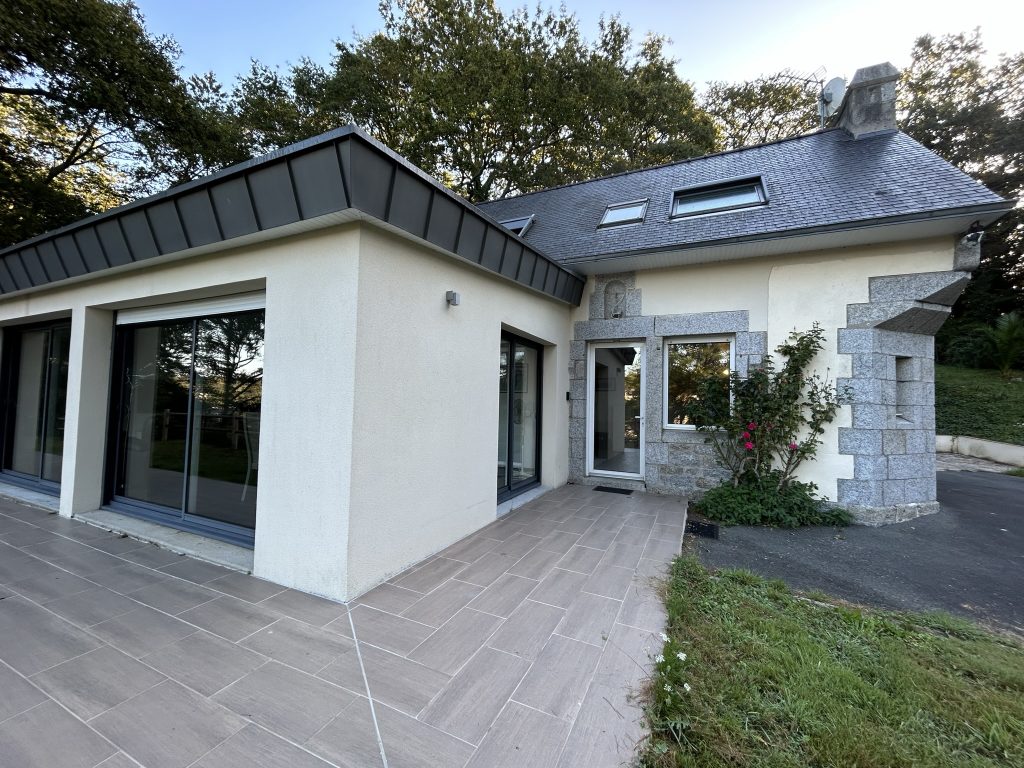
When staying in the countryside or in small towns or villages, check out options for renting a whole house. You’ll find many places listed on the travel websites. Here’s the gorgeous (and surprisingly affordable) house I stayed in during a one-week visit to Pont-Aven in Brittany.
I’ve also enjoyed staying in agriturismo establishments, where you’ll likely eat produce grown steps from your front door.
Unique Accommodation Options
And for a truly special travel experience, explore options for staying in a castle, chateau, convent, monastery, or other historic building. Often these places are no more expensive than a regular hotel, and can really elevate your trip to Europe!
A great source for unique accommodations in Spain are Paradores. Here’s their website.
Where to Find Self-Catering Accommodations
You’ll find apartments on websites such as AirBnB, VRBO, and HomeAway. Lately, I’ve favored the ones listed on Booking.com because the booking and cancellation requirements are not as stringent as they are on other sites.
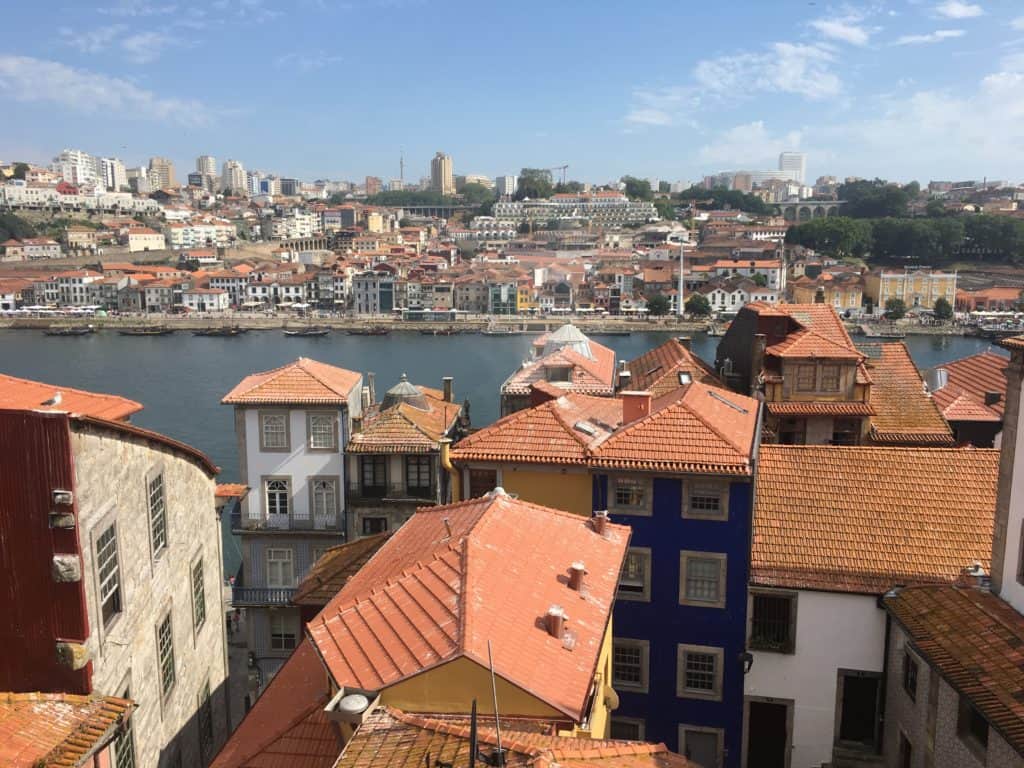
On a recent trip to Porto in Portugal, I rented a place on the top floor of a lovely old house with a view of the river. I paid a few euros more to have a fabulous breakfast delivered to my door every morning.
View from our apartment in Porto, Portugal over the Douro River
Spectacular!
Step 4: Check Accommodation Amenities
At a minimum, I want wireless networking (WIFI, pronounced WEE FEE in Europe) available in my room. Read the fine print. Some hotels offer WIFI only in the lobby and public spaces.
I also prefer bathtubs to showers, although they’re becoming increasingly rare. When traveling in the summer, I choose rooms with air conditioning, even when I’m traveling in the north and definitely when I’m traveling in the south. Summers are, regrettably, getting hotter. If you choose to travel during the summer months, do yourself a favor and make sure your room is air conditioned.
A fridge is also a necessity to store breakfast and picnic food.
And I like rooms with a balcony or terrace or at least a garden.
TIP: Pack a soft-sided, collapsible insulated bag. You’ll find it invaluable for keeping food cool-ish during transit. We fill ours with yogurts, cheeses, vegetables, and fruits, and buy fresh buns at local bakeries to make picnic lunches.
Step 5: Identify Cancellation Options
Choose rooms with free cancellation options until or unless you’re 100% sure you’ll be staying there. You never know what can happen, and to me, the money saved by choosing the no-cancellation option is not worth the risk.
I’ve been burned before!
Step 6: Pay Attention to Accommodation Ratings and Reviews
I pay attention to the reviews and the rankings on travel websites such as Trip Adivsor. A hotel that has an average rating of 6.8 out of 10 is a hard pass.
Occasionally I’ve chosen hotels in the high “7’s”, but 8.0 is typically my cut-off.
I also read a selection of the reviews. If a fair number of people grumble about cleanliness or unfriendly staff or funny smells, I move briskly on to the next listing.
Again, the key to making great accommodation choices is searching for value over price within your budget. If the difference between a hotel with a 9+ rating and one with a 7+ rating is not appreciable, always choose the hotel with the higher rating.
Make the Final Choice
Don’t wait too long to book your accommodation in Europe. I usually start at least six months in advance of my trip, and even then, I can have trouble finding exactly the properties I want.
If a property is not available on one website, try another website or go directly to the hotel’s website. Sometimes a property is listed as ‘sold out’ on a website like booking.com when rooms are available on other sites.
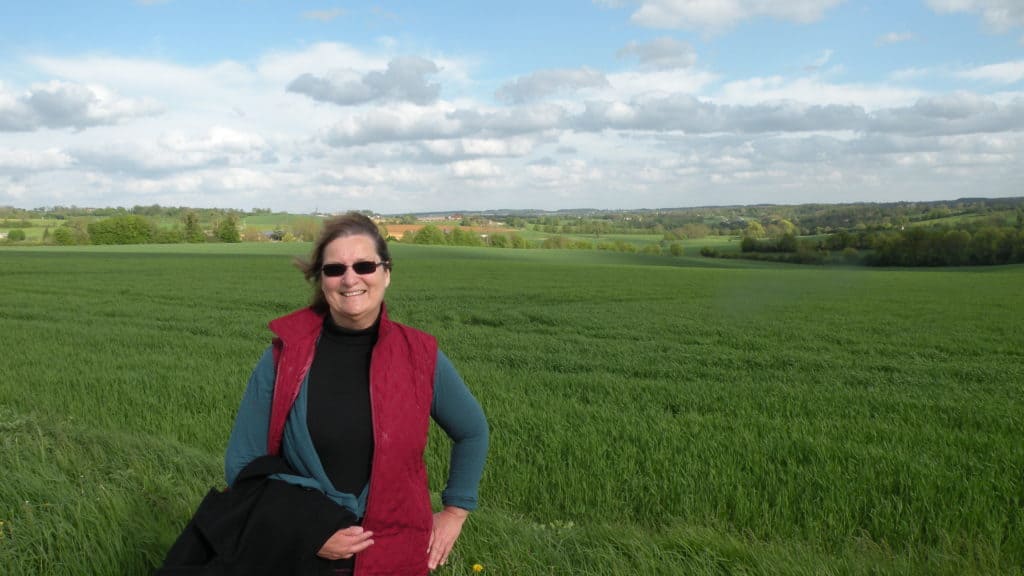
Enjoy relaxing in the countryside. Here I am in Normandy in France.
Stay flexible and be choosy.
Happy hunting!
Accommodation Recommendations
Here are links to my accommodation recommendations in several of the countries featured on Artsy Traveler. You’ll find many more recommendations in posts about specific destinations.
Do you have tips and suggestions for finding great places to stay in Europe, or recommendations for places you’ve stayed that you’d like to share? Please let me know in the Comments section below.
Are you a fan of modern art? If so, then you’ll find plenty of art thrills in Europe, where some of the best modern art and contemporary art museums in the world are located.
In this post, I’ve chosen mostly large modern art museums in Europe that feature a variety of artists, mostly from the 20th century, and modern art museums in Europe have collections that span the decades.
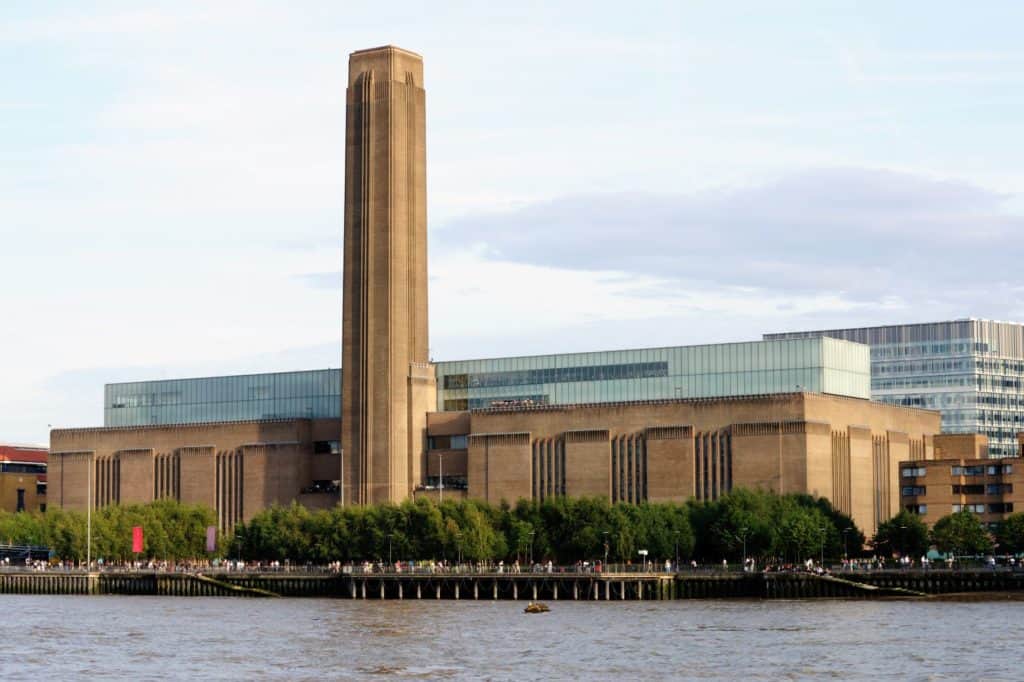
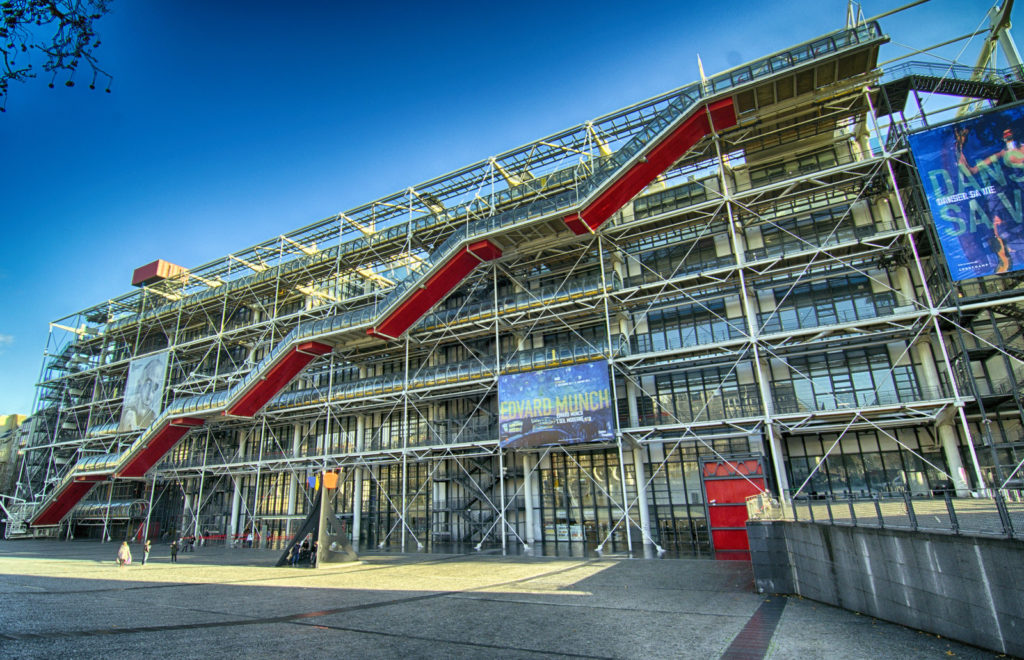
My focus is on modern art so you won’t find museums like the Prado and the Louvre in this post. But you will find the Pompidou, the Guggenheim Bilbao and the Tate Modern!
As a life-long lover of modern art (check out my husband Gregg Simpson’s art and you’ll see why!), I’m a bit of a kid in a candy store when it comes to finding awesome modern art museums in Europe.
You’ll be spoiled for choice!
Highlights at a Glance
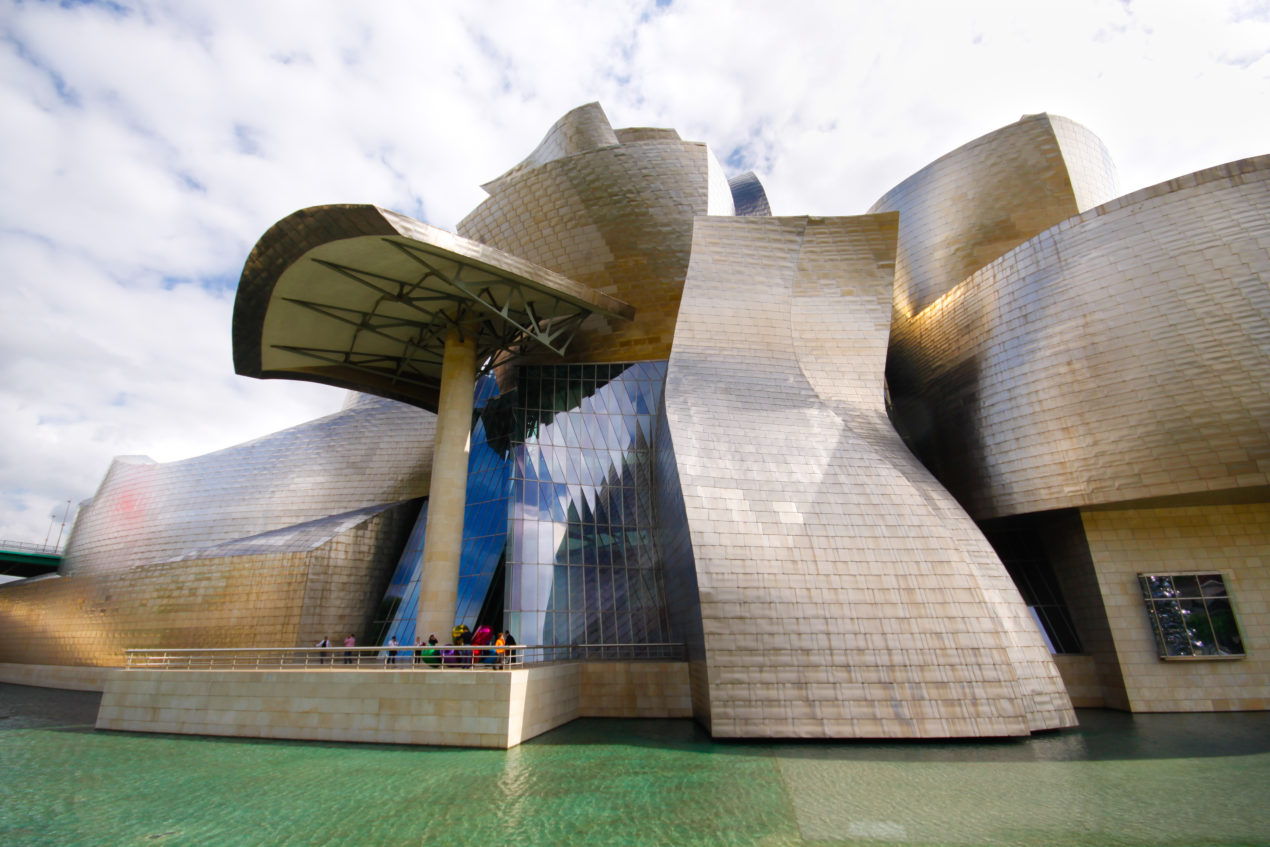
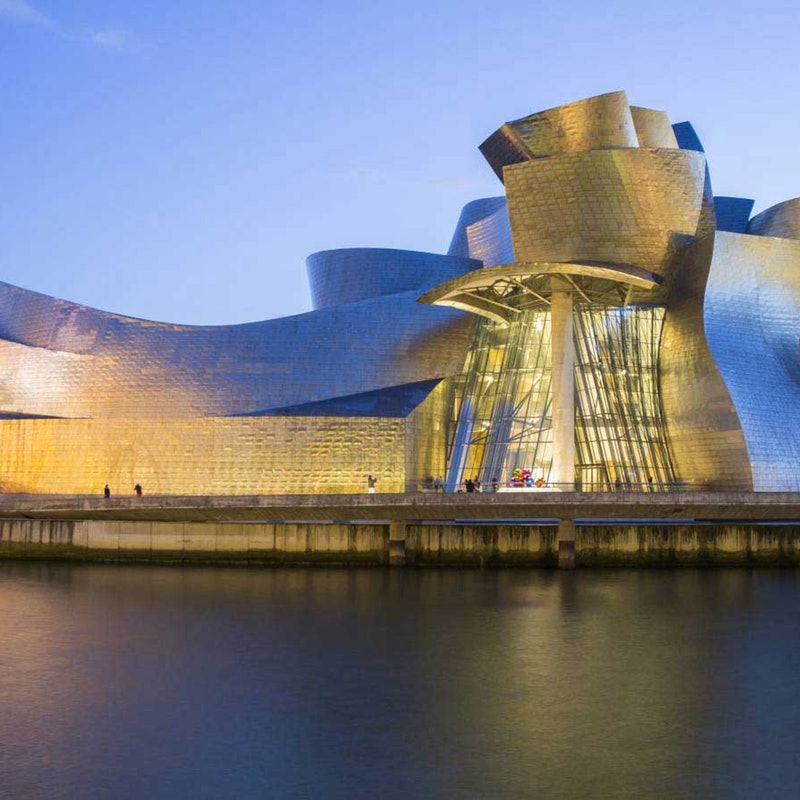
The iconic architecture of the Guggenheim Museum in Bilbao in Spain’s evocative Basque Country
Picasso’s Guernica at the Reina Sofia in Madrid, Spain–so much more powerful in person than in reproductions
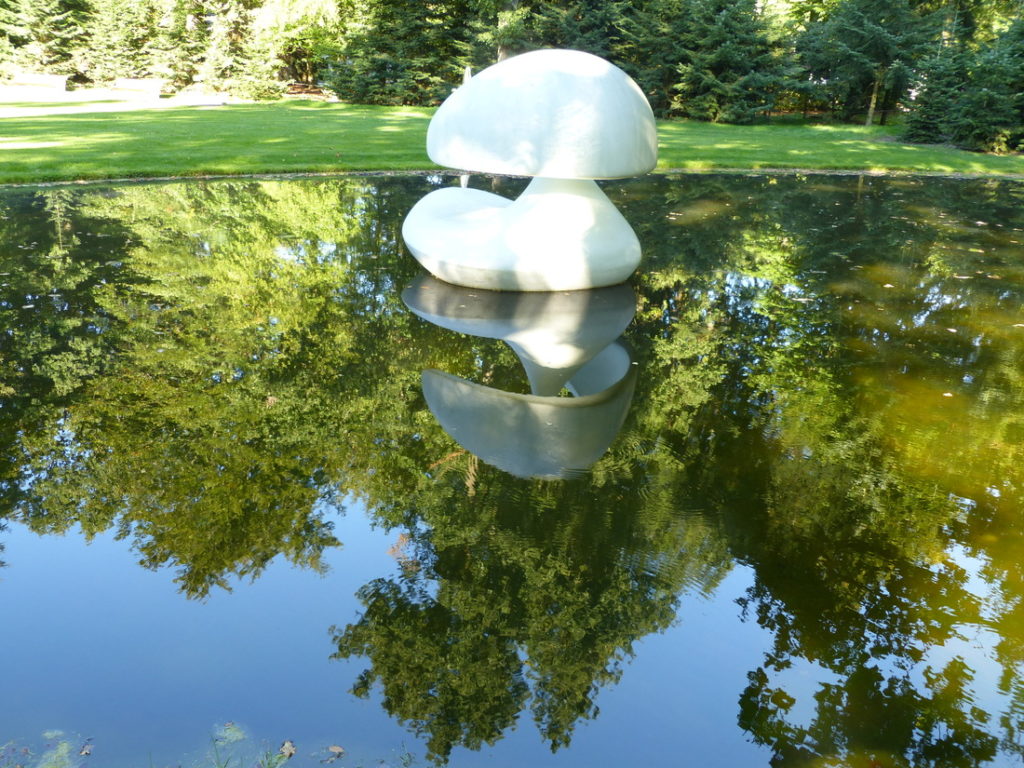
The stunning outdoor art installations at the Kröller-Müller Museum near Otterlo in the Netherlands
The collection of 20th century modern masters on the 4th floor of the Pompidou in Paris
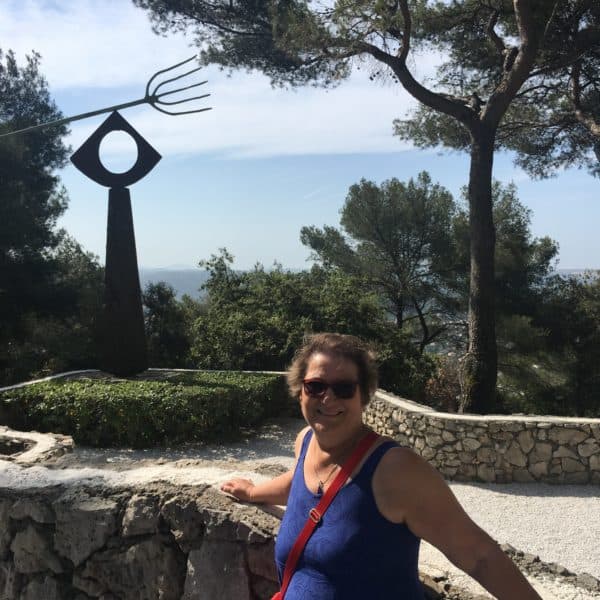
The location and ambiance of the Fondation Maeght in the hills above the French Riviera near the delightful village of Saint-Paul-de-Vence
Check for Exhibitions
Modern art museums in Europe often host temporary exhibitions showcasing the best of contemporary art.
Before you set off for Europe, take some time to check for special exhibitions in the places you’re visiting. Many times, I’ve changed my itinerary on the fly to catch an exhibition before it closes or to take in one at its start.
One of the great pleasures of traveling is switching gears halfway through a trip—to zig when you planned to zag. Stay open to possibilities when you travel. Often, you’ll meet someone who’ll tell you about a must-see art museum that you’ve never heard of.
On a recent trip to Porto in Portugal, we were told about a special exhibition of the work of M. C. Escher. What a treat! We never would have known about it because of its location in an exhibition space rather than a museum.
Chat with servers at dinner and strike up a conversation with other travelers you meet on the train or at your hotel. People love to share recommendations!
Modern Art Focus
As I mentioned earlier, this post focuses only on modern art museums in Europe that have significant and varied modern artcollections.
What do I mean by modern art? I’m a huge fan of 20th-century art from about the turn of the century to the 1960s. I also appreciate some (not all) of the contemporary art created post-1960.
Most of the art museums covered in this post primarily exhibit traditional modern art. That sounds like an oxymoron, but if you’re an art fan, you’ll know what I mean!
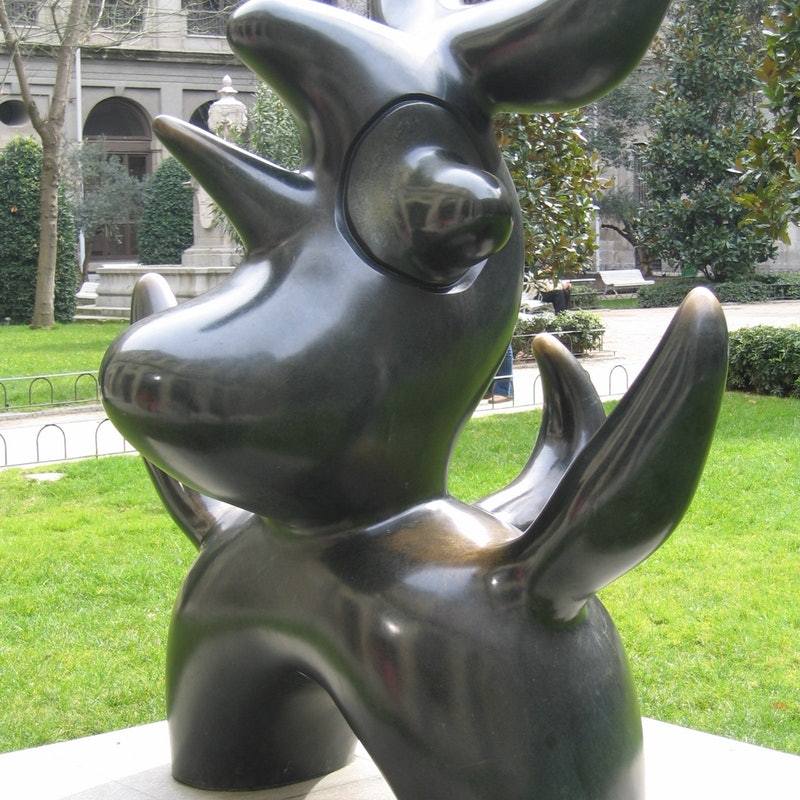
Modern art—as distinct from contemporary art—encompasses the work of a slew of big names. These include Pablo Picasso, Joan Miró, Henri Matisse, Georgia O’Keeffe, Rene Magritte… the list goes on and on and on.
In this post, I list only modern art museums in Europe that feature works by modern masters in their permanent collections.
Map of Modern Art Museums in Europe
From the Louvre to the Tate Modern, the modern art museums in Europe are vast and varied.
Here are the locations of all the modern art museums covered in the post–from Bilbao (#1) in Spain to the Tate St. Ives (#12) in Cornwall, England.
Although not included in this post, another excellent modern art museum well worth a visit is the Ludwig Museum in Cologne. For more about this museum check out my post Cologne’s Museum Ludwig: Best Bet for Modern Art Lovers
Bilbao, Spain: The Guggenheim Museum
The Guggenheim Museum Bilbao (#1 on the map) is worth the hype and worth the trip. Located in the Basque region of northeast Spain, Bilbao isn’t on the beaten tourist path.
But please, if you’re in northern Spain and within striking distance of Bilbao, find the time to spend a night there so you can spend a few hours exploring the Guggenheim Museum Bilbao.
The Guggenheim Museum Bilbao was built to revive the failing industrial city. How marvelous that the city bigwigs used art to pull their city out of the economic doldrums and place it firmly on the world cultural map.
The move was bold, even audacious, but it’s paid off spectacularly, thanks to Frank Gehry’s spectacular structure.
Now the Guggenheim Bilbao shows up in just about every Top Ten list of modern art museums worldwide.
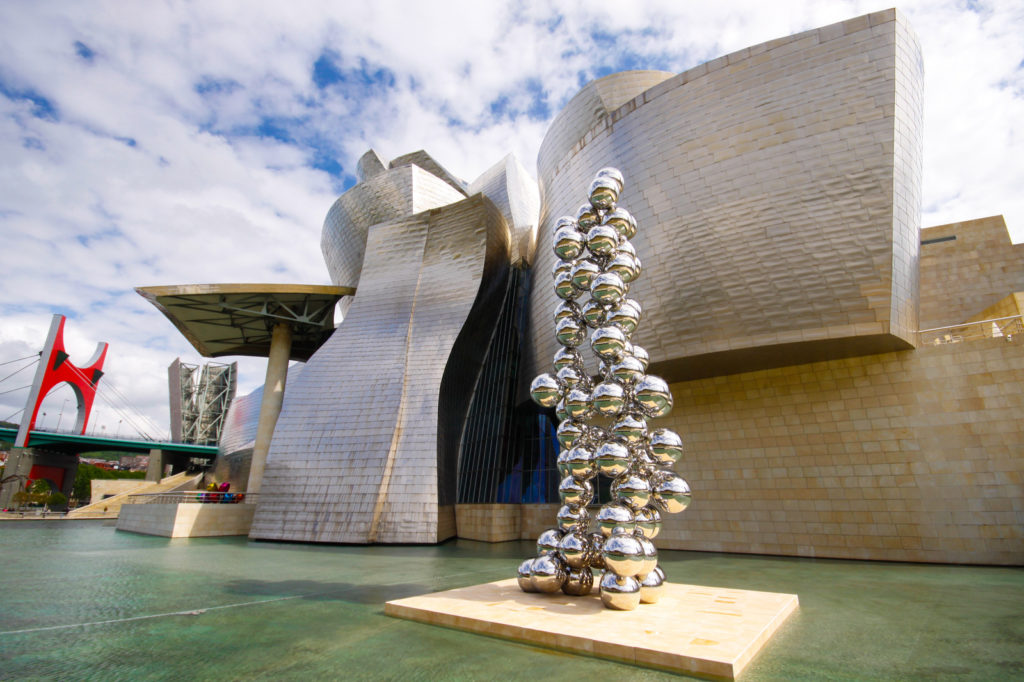
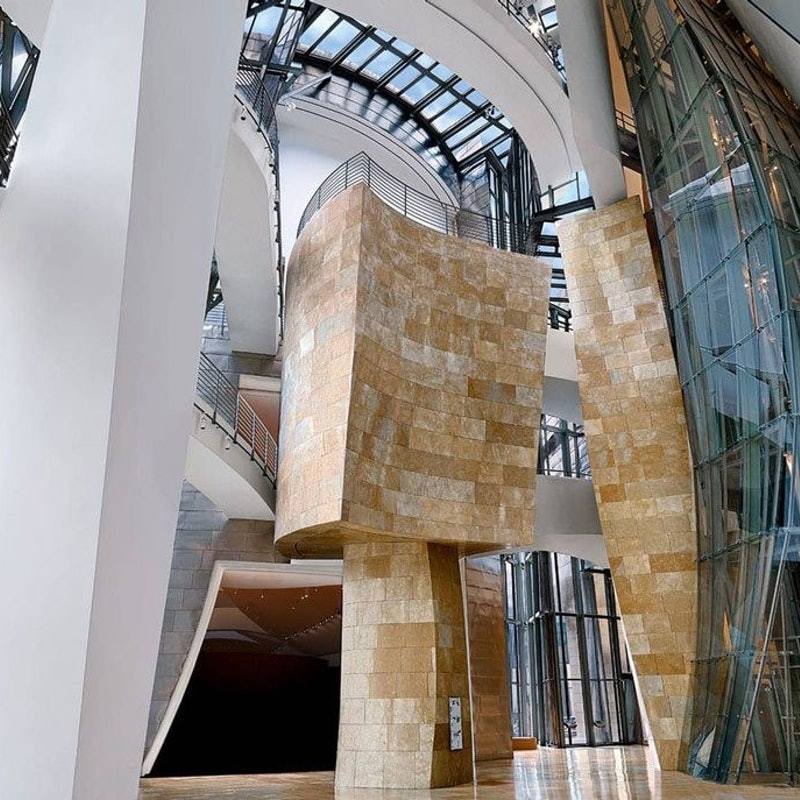
Exterior of the Guggenheim Bilbao
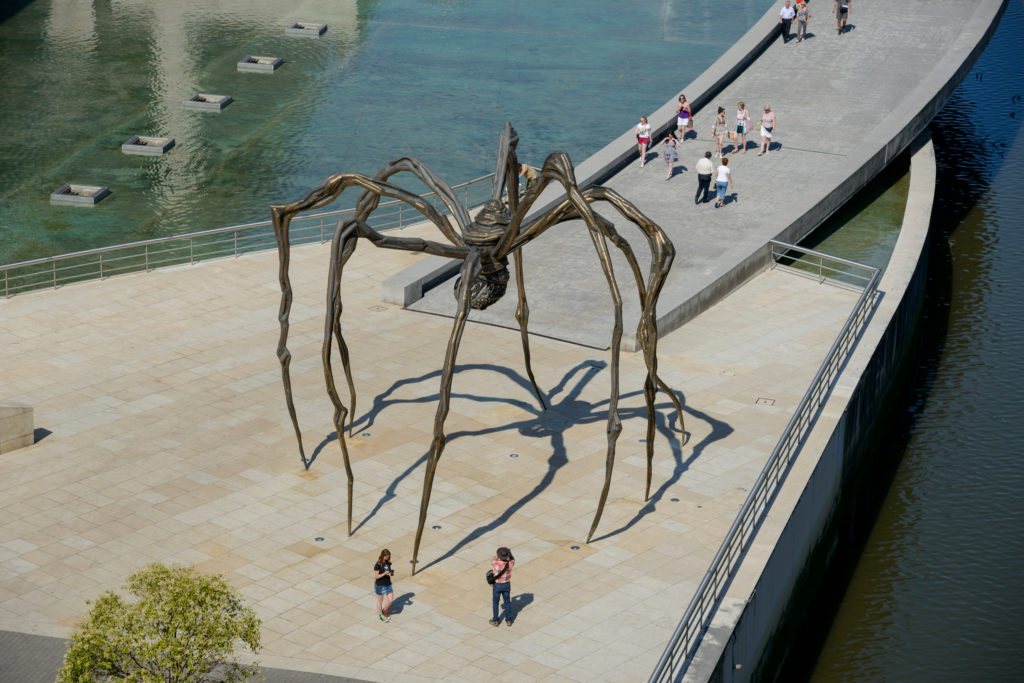
The exterior of the Guggenheim Bilbao plays a major role in its appeal to art lovers. Stroll around outside the building to see the many amazing sculptures.
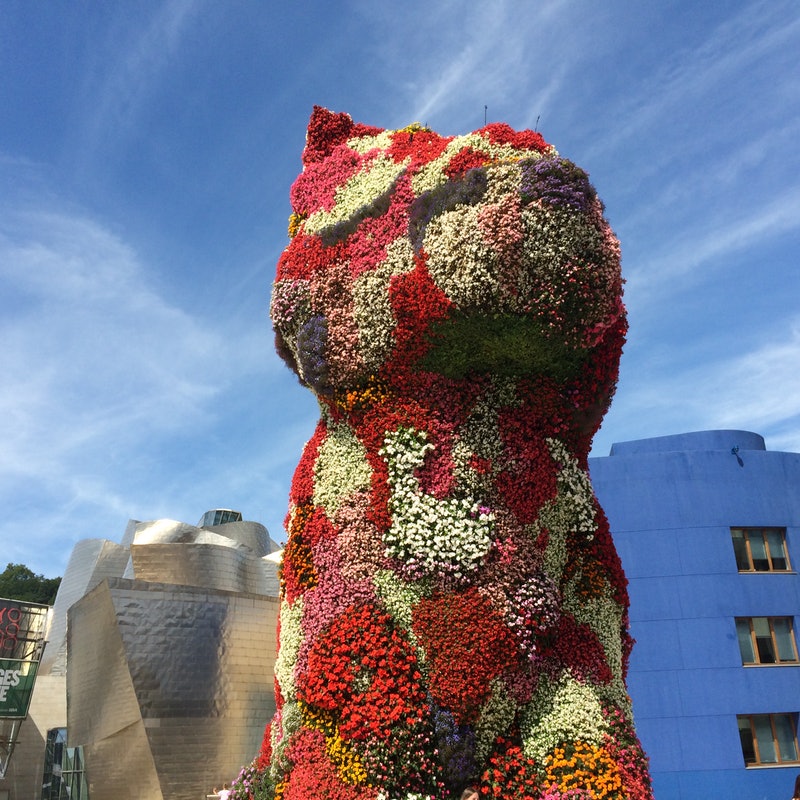
Most notable are Tall Trees and The Eye by Anish Kapoor, the massive spider Maman by Louise Bourgeois, and the wildly popular Puppy by Jeff Koons.
I defy anyone to stand in front of Puppy and not smile. He is adorable. That is, if a 43-foot tall, flower-encrusted West Highland Terrier can be called adorable.
The museum’s interior is as compelling as its exterior.
On one of my two visits to Bilbao, I was lucky to catch a major exhibition of recent landscapes by David Hockney. The massive galleries and thoughtful curatorial choices made the exhibition one of my favorites, which is saying something.
I was also taken with the massive installations by Frank Serra.
The whole complex with its gorgeous setting on the Nervion River really is miraculous. The museum attracts over 20 million visitors annually.
Now, that’s an art success story!
Exhibitions at the Guggenheim Bilbao change frequently, so check what’s on and then plan your visit accordingly. You won’t regret devoting time to exploring the Basque region of Spain.
Practical Information for the Guggenheim Bilbao
Guggenheim Bilbao is open from Tuesday to Sunday from 10 am to 7 pm. It’s closed on Christmas Day and New Year’s Day. Museum admission currently costs €15 for adults, €7.5 for seniors (65+) and students. Youths under 18 and Museum members are admitted free. The website has the latest rates.
Tours of the Guggenheim Bilbao
A great way to see the Guggenheim Bilbao is on a private tour if you have the spare funds, or a small group tour for the more budget-conscious. Modern art is sometimes not so easy to understand, and having a guide can really help you make sense of what you’re looking at.
You’ll also learn a lot about the stunning architecture and permanent installations such as Puppy and Maman. Here’s a guided tour offered through GetYourGuide.
Where to Stay in Bilbao
On both my trips to Bilbao, I stayed in excellent four-star hotels. Both were within walking distance of the Guggenheim Bilbao.
Catalonia Gran Vía Bilbao: In downtown Bilbao, this place is truly lovely with a very friendly staff and a good location for exploring more of Bilbao beyond the Guggenheim.
Hotel Meliá Bilbao: Situated right on the river, the modern hotel has all the amenities and is fairly easy to drive to.
Bratislava, Slovakia: Danubiana Meulensteen Art Museum
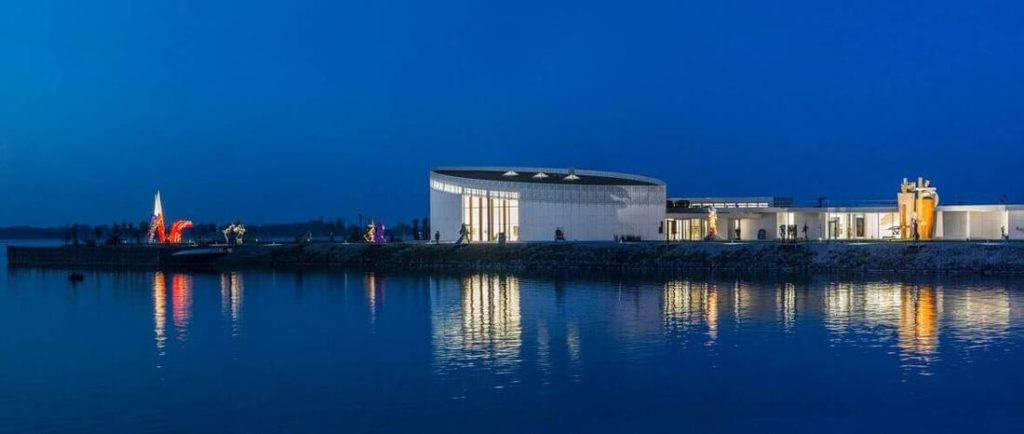
Situated on the Danube as the name suggests and about 20 kilometers from Bratislava in the Slovak Republic, the Danubiana Meulensteen Art Museum is billed as “one of the most romantic museums of modern art in Europe”.
The museum, opened in 2000, was founded by Gerard Meulensteen of Eindhoven, a Dutch collector and art patron, and Slovak gallerist Vincent Polakovič.
The collection includes works by artists from the experimental CoBrA group in the Netherlands, such as Karel Appel and Eugen Brands . Also included are works by Sam Francis, Christo, Corneille, Pierre Alechinsky, and others.
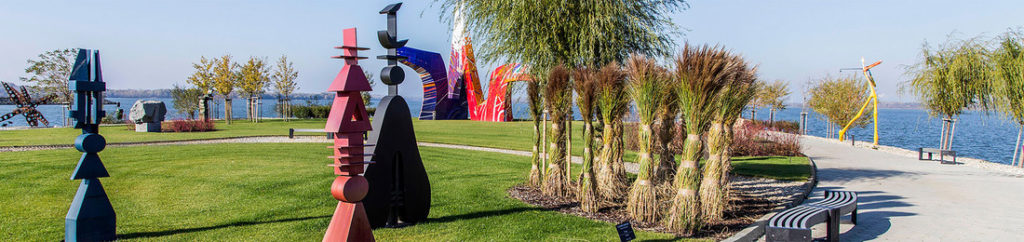
Plenty of quirky and colorful outdoor sculptures along with the dramatic setting on the Danube make this museum a must-see if you’re traveling to Bratislava.
Practical Information for the Danubiana Meluensteen Art Museum
Danubiana Meulensteen Art Museum is open from Tuesday to Sunday from 10 am to 6 pm. Museum admission currently costs €10 for adults, €5 for seniors (62+) and students. Children under 6, seniors (75+) and Museum members are admitted free. The website has the latest rates.
Where to Stay in Bratislava
The Danubiana Museum is a few kilometers up river from Bratislava itself where you’ll find these two hotels. Both are located in historic buildings and highly rated.
Marrol’s Boutique Hotel: Located in Bratislava city center, this hotel is rated 5-star, but the price is more like a 3-star. It looks amazing!
Arcadia Boutique Hotel: Centrally located in a 13th-century building in Bratislava’s Old Town. Rooms include antique furniture.
London, England: Tate Modern
I’ve visited the Tate Modern in London a few times and have mixed feelings about it, to be honest! It’s a monumental place and a huge accomplishment from an architectural perspective.
I mean, seriously—a power station?
It’s pretty darned amazing that the Swiss architecture firm Herzog & de Meuron could convert the Bankside power station into an art gallery and still keep much of the building’s original character.
View of the Tate Modern from the Thames in London, England
However, I can’t say that I loved—or even liked—all the art exhibited in the Tate Modern. Several exhibits comprise contemporary and installation art, most of which was kind of hit or miss, in my opinion.
However, the special exhibitions can be worthwhile. I saw a wonderful retrospective of the work of American artist Georgia O’Keeffe on one visit, and an exhibition of international surrealism on another visit. My husband, Gregg Simpson, was honored to be included in the catalog for the latter exhibition.
Location of the Tate Modern
The location of the Tate Modern on the south side of the Thames, right across the new Millennium Bridge from St. Paul’s Cathedral, is a selling point. You can see the Tate Modern in the morning and then stroll across the bridge and visit St. Paul’s and the City in the afternoon.
You can also take in two Tates in a day. A good strategy is to start at the Tate Britain upriver. Check out the paintings by William Blake and some of the best works by the pre-Raphaelites. Then, hop on the Tate Boat at Millbank Pier and sail downriver to Bankside Pier to see the Tate Modern.
The Tate Boat runs every twenty to thirty minutes along the Thames.
And if you happen be down in St. Ives in Cornwall, don’t miss the Tate St. Ives.
Practical Information for the Tate Modern
Tate Modern is open daily from 10 am – 6 pm and the admission is free.
Tours of the Tate Modern
Why not take a tour of the Tate Modern with an expert guide? You’ll learn about the history and architecture of the gallery along with highlights of the collection. Here’s a guided tour offered through GetYourGuide:
I always stay around the West End so I’m within walking distance of the theaters, Trafalgar Square and two of my favorite art museums–the National Gallery and the Courtauld.
Here are three places I’ve stayed in that I recommend and that won’t break the bank (and are still four-star and comfy):
Wilde Aparthotel Covent Garden: Located steps from the Strand in the center of the action, the Wilde Aparthotel Covent Garden is an excellent choice. I even wrote a whole post about my stay there!
The Cavendish near Green Park is in a posh area and close to just about everything. When I stayed there, I was able to walk or take a bus everywhere I wanted to go. I didn’t once need to take the Tube!
Park Plaza Victoria London Hotel is located right across the street from Victoria Station and is a remarkably good deal for a modern, four-star hotel in the heart of London.
Madrid, Spain: Reina Sofia
The Reina Sofia is home to one of the most famous paintings of the 20th century—Guernica by Pablo Picasso.
You’ve likely seen Guernica many times in reproduction. However, seeing the “real thing” is a different story.
The massive mural in the Reina Sofía has pride of place in a room of its own. You can sense how enraged Picasso must have felt as he painted it.
Its graphic depiction of the bombing of the old Basque city of Gernika in April 1937 has become an iconic image of the brutality of war.
Outdoor reproduction of Guernica by Picasso / Image by Almudena Sanz from Pixabay
As one of the premier modern art museums in Europe, the Reina Sofia combines a modern area with the arched hallways and barred windows of an old hospital. In several rooms, films representing specific 20th-century periods are running. Most are silent-era films, which makes following them a lot easier if your Spanish is minimal.
Included in the Reina Sofia are masterpieces by Salvador Dalí, Joan Miró, and Juan Gris, as well as a collection of over 22,400 works divided into three sections titled: The Irruption of the 20th Century: Utopia and Conflict (1900-1945), Is the War Over? Art in a Divided World (1945-1968), and From Revolt to Postmodernity (1962-1982).
Visiting the Reina Sofía
The museum is located on the Art Walk (Paseo del Arte)—a one-kilometer stretch that also includes the must-see Prado Museum and the Thyssen-Bornemisza Museum.
Reina Sofia is open from daily except Tuesdays from 10 am to 9 pm (Sundays until 2:30 pm). Museum admission currently costs €12. The website has the latest rates.
Tours of the Reina Sofia
Explore the Museo Nacional Centro de Arte Reina Sofía, Spain’s national museum of 20th-century art, on a guided tour and learn about the diverse collection.
Stay as close to the centro as you can in Madrid. Largely traffic free, the centro is full of narrow streets and grand plazas, and not too far from Madrid’s three big museums, including the Reina Sofia.
ApartoSuites Jardines de Sabatini: I stayed here for two weeks and loved it! The location right across the street from the Royal Palace puts it about a ten minute walk from the centro, but still outside the traffic limited zone so you can drive there and park in the parking lot right next door. The staff are wonderful and the one-bedroom apartments are spacious and comfortable.
nQn Aparts & Suites Madrid: This place is even closer to the city center within steps of the Plaza Mayor.
Munich, Germany: Pinakothek der Moderne
The Pinakothek der Modern in central Munich is one of three Pinakotheks in Munich’s Kunstareal (art district).
The museum features an excellent collection of the works of German Expressionist artists. In addition, you’ll find works by modern masters, including Picasso, Miró, Kandinsky, Klee, and Marc.
Other exhibits are related to form and function in a section that features modern industrial design and manufacture, furniture, and appliances.
On Sundays, the admission price is significantly discounted—at least it was when I visited. After strolling through the galleries, stop by the café.
Practical Information for the Pinakothek der Moderne
Pinakothek der Moderne is open from Tuesday to Sunday from 10 am to 6 pm (Thursdays to 8 pm). Museum admission currently costs €10 for adults, €7 for seniors (65+) and students. Youths under 18 are admitted free. The website has the latest rates.
Interesting Art Tour in Munich
After touring the Pinakothek der Moderne, keep the art juices flowing by taking this intriguing-looking street art bike tour with GetYourGuide. There’s a lively street art scene in Munich, a city that pioneered the graffiti movement in Germany in the 1980s.
Boutique Hotel Splendid: Located in the center of Munich within easy walking distance of many attractions. Comfortable rooms.
Andaz Munich Schwabinger Tor by Hyatt: This is a bit of a splurge, but its location next to the English Garden is great if you’re looking for a stroll in nature after touring Munich’s museums. The buffet breakfast here was the most opulent I’ve ever seen.
To say that the Kröller-Müller blew me away on my first visit would be an understatement. Fresh off the plane from Canada, I’d seen nothing like it in my suburban, middle-class life.
The Kröller-Müller Museum is light, airy, and filled with famous works by van Gogh and a load of other great painters.
Even better, the museum is smack in the middle of the Dutch National Park. This amazing park teems with deer, rolling sand hills, intriguing forests, and miles of bike paths.
Visiting the Kröller-Müller Museum
When I revisited the museum with Gregg recently, I was thrilled to discover that the Kröller-Müller and the park were as awesome as I remembered.
Everything about the place is perfect!
The museum includes dozens of paintings by van Gogh, room after room of other greats from the 19th and early 20th centuries, a massive sculpture garden, and even a bustling outdoor café with excellent food.
The word that comes to mind when touring the sculpture garden is serendipity. The sculptures are modern and diverse and often positioned in unexpected places.
Every turn of a pathway through forests and across green clipped lawns reveals yet another vista and another sculpture—stone or wood or marble, some moving, some static, some aesthetically stunning, some quirky, a few ugly, and yet all perfect.
Floating sculpture on the grounds of the Kröller-Müller Museum in the Netherlands
Getting to the Kröller-Müller Museum
If you’re a fan of van Gogh and modern sculpture but haven’t visited the Kröller-Müller, then go.
Take a day tour from Amsterdam, or better, drive and stay a few days in the area. Gregg and I combined our visit to the Kröller-Müller with a bike ride around a portion of the 55-square-kilometer national park.
Explore a remarkably varied landscape that includes stunningly beautiful forests, heathlands, and sand dunes. You’ll spot impressively antlered deer, wild boar, foxes, sheep, and more.
Red deer stag in the Dutch National Park at Hoge Veluwe
Practical Information for the Kröller-Müller Museum
Kröller-Müller Museum is open from Tuesday to Sunday from 10 am to 5 pm. Museum admission currently costs €13.50 for adults, €6.75 for youths (13 – 18). Children under 12 are admitted free. The website has the latest rates. Plaese note that the museum is located in the middle of De Hoge Veluwe National Park. Therefore, you also have to buy a ticket for the park that costs €13.40 for age 13 and older, and €6.70 for ages 6 -12.
Tour to the Kröller-Müller from Amsterdam
This full-day tour is a great option if you don’t have your own transport. The tour goes from Amsterdam and includes time to explore the awesome Hoge Veluwe National Park.
The Kröller-Müller Museum is in a lovely rural area of the Netherlands. You can choose to stay near the museum or in nearby Arnhem. Here’s the place I stayed in:
Fletcher Hotel-Restaurant De Buunderkamp: This place is nestled in the woods not far from the Kröller-Müller Museum. Rooms are spacious and there’s an indoor pool. You can even rent bikes to explore the area, which we did and it was gorgeous!
Paris, France: Centre Pompidou
My most recent experience with the Pompidou Center (one of my absolute favorite modern art museums in Europe) was fraught with pure terror.
Gregg and I were trying to find an art gallery on an obscure side street that even Google Maps couldn’t find. The gallery was hosting an exhibition of Gregg’s work, so finding the gallery was a matter of some urgency.
I directed Gregg to turn down what I trusted was the right street. He drove a short block over cobblestones to emerge into a wide, pedestrian-only space that butted up against the back end of the massive Pompidou Center.
Mon Dieu!
I looked up at the crazy exoskeleton of pipes and glass that had horrified Parisians when it was first built and yelled a few choice curses into my phone. The Google Maps lady was not impressed. She continued to insist that we drive across the square.
Exterior of the Pompidou Center in Paris
Luckily, the space was relatively empty of people (a rare event) so Gregg was able to execute a hasty U-turn and head smartly down the correct street. The only problem was that the street was one-way, and we were barreling down it the wrong way.
Fortunately, we found the gallery without having a head-on collision. A few hours later, after unloading the paintings and hanging the show, we were swanning about the vernissage (the opening), champagne glasses in hand.
Phew!
Visiting the Centre Pompidou
Every time we visit Paris, we make a beeline for the Pompidou. Its special exhibitions are almost always excellent.
UPDATE: The Centre Pompidou is currently closed for renovations set to last for several years. You can still take advantage of the Constellation Program that features exhibitions in venues around Paris. Check the Pompidou website for details.
The best thing about the Pompidou (before is temporary closure) is the collection on the legendary fourth floor. I don’t know where the collection will be housed when the Pompidou reopens, but I’m pretty sure it will still be a veritable “who’s who” of early 20th-century modern art.
All the most famous names are represented. Look forward to the day when you can again stroll through the rooms picking out your favorites and reveling in the glorious mishmash of colors and forms that characterize 20th-century modern art.
After sighing your way around the art, take the escalator to the rooftop to relish one of the best views of the Paris skyline.
Practical Information for the Pompidou Center
Centre Pompidou is currently closed for renovation. The website has the details.
Where to Stay in Paris
I favor staying on the Left Bank when I’m in Paris, preferably Saint Germain, although that area is getting pretty expensive. In Paris, an apartment or aparthotel may be your best bet. Hotel rooms tend to be very small.
Here are three of my recommendations for places to stay in Paris on the Left Bank.
Hotel de L’Université: I love the location of this boutique hotel–close to Boulevard Saint Germain and the Seine but a bit removed from the busiest areas of Saint Germain. Rooms are quite spacious (for Paris) and the old beams in the ceiling are a nice touch.
Citadines Saint-Germain-des-Prés: This aparthotel is part of the Citadines chain and is good value considering the excellent location right on the Seine in the 6th arrondisement. I’ve stayed here twice over the past two years.
Le Clos Medicis: Located very close to the Jardin du Luxembourg, this charming boutique hotel has attractive rooms and a very comfy lobby.
Rome, Italy: National Gallery of Modern Art
Rome’s National Gallery of Modern Art (Galleria Nazionale d’Arte Moderna) is conveniently located on the edge of the Borghese Gardens, surely one of Europe’s most beguiling parks.
View of the Temple of Asclepius at Villa Borghese Gardens in Rome
The gallery features an excellent collection of 20th-century Italian painters, including Giorgio de Chirico (a particular favorite), Amedeo Modigliani, Antonio Canova, Giacomo Balla, and Giorgio Morandi.
You’ll also find works by Rodin, Degas, van Gogh, Monet, Duchamp, Man Ray, and Pollock.
Unlike the Vatican and the other Renaissance and ancient Roman attractions of Rome, the National Gallery of Modern Art is sparsely attended and therefore extremely pleasant.
After your visit, stroll along the shaded pathways of the Borghese Gardens.
Practical Information for the National Gallery of Modern Art in Rome
National Gallery of Modern Art is open from Tuesday to Sunday from 9 am to 7 pm. The admission currently costs €10.
Tour of the Borghese Gallery
The very popular Borghese Gallery is close by. Here’s an option that inclues a guided tour with your tickets. The Borghese is well worth a visit, and houses one of my favorite Baroque sculptures by Bernini.
I favor staying in apartments when in Rome because I’m usually staying at least a week. Here are three of the apartments I’ve stayed in that provided excellent value in great locations:
Monti Apartments: This centrally located place is not far from the Colosseum and close to a charming old neighborhood with lots of small restaurants and quiet side streets. The apartment is spacious, well-equipped, and excellent value. Staff are on hand during the day and the apartment has an elevator.
Viam 16b Suites: I loved this place! It’s located on a tiny side street close to the Piazza del Popolo and the Spanish Steps in an upscale area of Rome. Unlike many apartments in Rome, the Viam 16b Suites is staffed during the day. Our suite included an outdoor terrace.
Saint-Paul-de-Vence, France: Fondation Maeght
The Fondation Maeght makes just about every list of must-see art museums in Europe. While not the largest modern art museum in Europe, the Maeght is one of the most respected and also the most beautifully situated.
On the grounds of the fabulous Fondation Maeght in the south of France
I can’t say that every exhibition we’ve seen at the Fondation Maeght has been great. However, you still ought to visit if you’re in the area. When the exhibitions are good, they are extremely good.
The Fondation Maeght is a private foundation that was conceived and funded by Aimé and Marguerite Maeght to exhibit modern art. The Maeghts had several artist friends, including Georges Braque, Alexander Calder, Marc Chagall, Alberto Giacometti, Fernand Léger, and Joan Miró, who from the get-go donated or sold their work to the Foundation.
As Miró emphasized, the Fondation Maeght “…must before all be a place for art that remains alive.”
Visiting the Fondation Maeght
We first visited the Fondation Maeght in the 1990s during our first family trip to Europe with our young daughter. It was love at first sight!
Highlights include the giant sculptures by so many of the great 20th-century modern artists, including Miró, Giacometti, Arp, and Calder; spectacular views across the hills of the Riviera to the turquoise Mediterranean; and an airy modernist gallery.
You can visit the Fondation Maeght on a tour, but you’d be best off spending at least a few nights exploring the area and visiting the Maeght for a few hours at the beginning or end of the day when the light is best for photography.
Practical Information for the Fondation Maeght
Fondation Maeght is open daily from 10 am to 6 pm (July and Augusut to 7pm). The admission currently costs €18 for adults, €14 for youths (16 – 18), students, press and unemployed visitors. Children under 16 and disabled visitors are admitted free. The website has the latest rates.
Tour of Medieval Villages
If you don’t have a car, this tour of medieval villages that goes from Nice stops in Saint-Paul-de Vence for 1.5 hours, which is enough time for a flying visit to the Fondation Maeght.
The village of Saint Paul-de-Vence has been well and truly discovered and accommodations there are not budget-friendly. Here are two options:
Le Hameau: Located in an 18th-century farmhouse with a view of the valley and the village of Saint-Paul-de-Vence, this place is close to the Fondation and includes a gorgeous pool
Hotel Marc-Hely: Located a few kilometers away in La Colle-sur-Loup, this comfortable hotel room included a balcony and very friendly properietors.
Venice, Italy: Peggy Guggenheim Collection
If I were to pick a favorite modern art museum from this Must-See list, the Peggy Guggenheim Collection in Venice would rank in the top three.
Located right smack on the Grand Canal in the Dorsoduro district of magical Venice between Santa Maria della Salute and the Gallerie dell’Accademia, the Peggy Guggenheim Collection just makes me smile. I can’t visit it often enough!
Carol next to a statue of a horse in front of the Peggy Guggenheim Museum in Venice.
The museum houses Peggy Guggenheim’s personal collection of 20th-century art, including masterpieces of cubism, surrealism, and abstract expressionism.
Gregg is a huge fan of Max Ernst,to whom Peggy was married for a time. Several of Ernst’s marvelous paintings are featured in the collection. Other artists in the permanent collection include Picasso, Kandinsky, Miró, Braque, Giacometti, Klee, Magritte, Dali, Pollock, de Chirico, Brancusi, Braque, Duchamp, and Mondrian.
It really is an embarrassment of 20th-century riches.
If you’re in Venice, take a break from the Renaissance and cross the canal to visit the Peggy Guggenheim Collection. Wander the cool halls of her renovated palazzo to view the paintings and sculptures, then descend the steps to the edge of the canal and watch the boats go by.
Venice panorama city skyline at Venice Grand Canal, Venice Italy
Practical Information for the Peggy Guggenheim Collection
Peggy Guggenheim Collection is open daily except Tuesdays from 10 am to 6 pm. The admission currently costs €16 for adults, €14 for seniors (70+), €9 for students under 26. Members and children under 10 are admitted free. The website has the latest rates.
Art Tour in the Dorsoduro
This private art and culture tour includes both the Peggy Guggenheim Collection and the wonderful collection of Venetian art at the Accademia.
Venice is expensive, but splurge and stay in a central area of this remarkable city rather than in nearby Mestre. Venice at night is the best. Streets that are thronged during the day become dark and empty and you’re bound to get lost on your back back to your accommodations. But you’re on an island and eventually you’ll find your way through alleyways that look like they haven’t changed in centuries, which is pretty much the case.
San Teodoro Palace: This one-bedroom apartment is huge by Venice standards and located steps from the Rialto Bridge in a very lively and touristy area.
Ca’ Mirò: Settle into this two-floor apartment in a quiet area of Venice not far from the train station and become a temporary Venetian. It’s gorgeous.
Another option if you’ve visited Venice before and are looking for some peace and quiet, is to stay on the island of Murano. I recently did just that. Here’s my post with recommendations for what to do and where to stay: Choose Murano For a Unique Venetian Experience
Louisiana Museum of Modern Art Near Copenhagen, Denmark
The Louisiana Museum of Modern Art (#11 on the map at the top of this post) is about a 30-minute train ride north of Copenhagen. It’s world-renowned as one of Europe’s best modern art museums, and therefore a must-visit for the Artsy Traveler!
Check what exhibitions are on, but even if they don’t appeal, visit the museum anyway. It makes for a lovely morning out from Copenhagen. You reach it by train (covered by the Copenhagen Card) followed by a pleasant 20-minute stroll along a suburban road to the museum.
After visiting the exhibitions, head outside where the real stars of the museum are located.
Sculpture at the Louisiana Museum of Modern Art near Copenhagen, Denmark
Practical Information for the Louisiana Museum of Modern Art
Louisiana Museum of Modern Art is open from 11 am to 10 pm on Tuesdays to Fridays and 11 am to 6 pm on Saturdays and Sundays. The admission currently costs DKK 145 for adults, DKK 125 for students. Louisiana members and youths under 18 are admitted free. The website has the latest rates.
Day Tour from Copenhagen
Here’s a private day tour to Louisiana Museum of Modern Art from Copenhagen with Viator, or on another day, consider this day trip from Copenhagen with GetYourGuide to three interesting destinatoins outside Copenhagen: Kronborg, Frederiksborg Castle and Roskilde:
Here are two recommended places to stay in Copenhagen, both in the atmospheric Nyhavn area.
Sanders Haven: This huge apartment is one of the best places I’ve stayed anywhere in Europe (which is saying something). If it’s available, book it!
Phoenix Copenhagen: A stylishly upscale hotel in the Nyhavn area with friendly staff.
Tate St. Ives in Cornwall, England
The Tate St. Ives (#12) is a delightfully compact and easy-to-tour museum overlooking the sea in lovely little St. Ives. I visited on a recent trip to Cornwall, and was lucky to sit in on two curator talks about local artist Robert Lanyon. Here’s one of his pieces.
Lost Mine by Peter Lanyon
Practical Information for Tate St. Ives
Tate St. Ives is open daily from 10 am to 4:20 pm. The admission currently costs £13.50 and visitors aged under 18 is admitted free. The website has the latest rates.
Entry to the Barbara Hepworth Museum
A few minutes’ walk from the tate St. Ives is the Barbara Hepworth Museum and Sculpture Garden. This place is well worth a visit if you’re a fan of world renowned sculptor Barbara Hepworth. Here’s a link to tickets to the site.
Tregenna Castle Resort: Why not stay in a castle! This place is about a kilometer from St. Ives and overlooks the Cornish coast. It even has a heated indoor swimming pool and an outdoor seasonal heated swimming pool.
Sightseeing Tips
I highly recommend purchasing tickets ahead of time when you’re traveling in Europe. Major art museums are increasingly crowded, with long lines that sap your sightseeing energy. Who can enjoy art after standing for an hour under the hot sun waiting to buy tickets?
By purchasing your tickets in advance, you can enjoy a leisurely breakfast before strolling straight into the museum past the long lines of tourists who did not book ahead.
You’ll be sighing in front of some of the world’s great masterpieces in no time!
What are your favorite modern art museums in Europe? Share your suggestions and recommendations for fellow artsy travelers? Please share them in the Comments below.
Looking for more great art? Here are posts on a few more of my favorite art museums in Europe: