Best Cathedrals in Europe for Art, Architecture & History Lovers
Artsy Traveler contains affiliate links for products and services I personally use and can happily recommend. As an Amazon Associate, I earn from qualifying purchases. Please read the Disclosure for more information. If you make a purchase through these links, at no additional cost to you, Artsy Traveler earns a small commission. Thank you!
Europe’s great cathedrals are among the most extraordinary works of art ever created. Rising above town squares and city skylines, they combine architecture, sculpture, stained glass, painting, and centuries of human devotion.
From soaring Gothic masterpieces to mosaic-filled basilicas and intimate chapels, Europe’s cathedrals reward slow, attentive visits—especially for travelers who care deeply about art and history.

In this guide, I share my eight favorite cathedrals in Europe, all places I’ve visited many times and return to whenever I can. Some are famous icons; others are quieter revelations. Together, they represent the cathedrals that have moved me the most as an artsy traveler.
Table of Contents
- How This List Was Chosen
- Map of the Best Cathedrals in Europe
- Durham Cathedral – Durham, England
- Salisbury Cathedral – Salisbury, England
- Westminster Abbey – London, England
- Sainte-Chapelle – Paris, France
- Chartres Cathedral – Chartres, France
- Sagrada Familia – Barcelona, Spain
- Basilica of San Vitale – Ravenna, Italy
- Siena Cathedral – Siena, Italy
- FAQs: Best Cathedrals in Europe
- Final Reflections
- Continue Your Artsy Journey Through Europe
How This List Was Chosen
I chose to feature these cathedrals for their artistic significance, architectural innovation, historical importance, and—most importantly—the emotional impact they had on me as a traveler. This is not a checklist of Europe’s biggest or busiest churches, but a curated selection for visitors who want meaningful, art-centered experiences.
Accommodation widgets appear automatically in this guide. Use them as a quick way to explore stays, or skip ahead to the next cathedral section.
Map of the Best Cathedrals in Europe
The map below shows the locations of the best cathedrals in Europe mentioned in this post. Click a number to read more about the location.
I visit cathedrals to revel in the history and the art and to imagine the incredible skill and dedication required to build them so long ago. When I study just how complex these ancient structures are, I marvel anew at the ingenuity of humanity.
To be clear, not all of the edifices featured in this post are actually cathedrals, which is a specific ecclesiastical term. I’ve thrown in a basilica, a couple of abbeys, and one plain old chapel (which is anything but plain!).
I’ve left out several of the biggies, like St. Peter’s Basilica in Rome and Cologne Cathedral in Germany, that you might expect to see on a list of best cathedrals in Europe. But my aim here is to share the places that over the years have touched me the most and that I revisit every chance I get.
My choices are located in England, France, Spain, and Italy.
Durham Cathedral – Durham, England
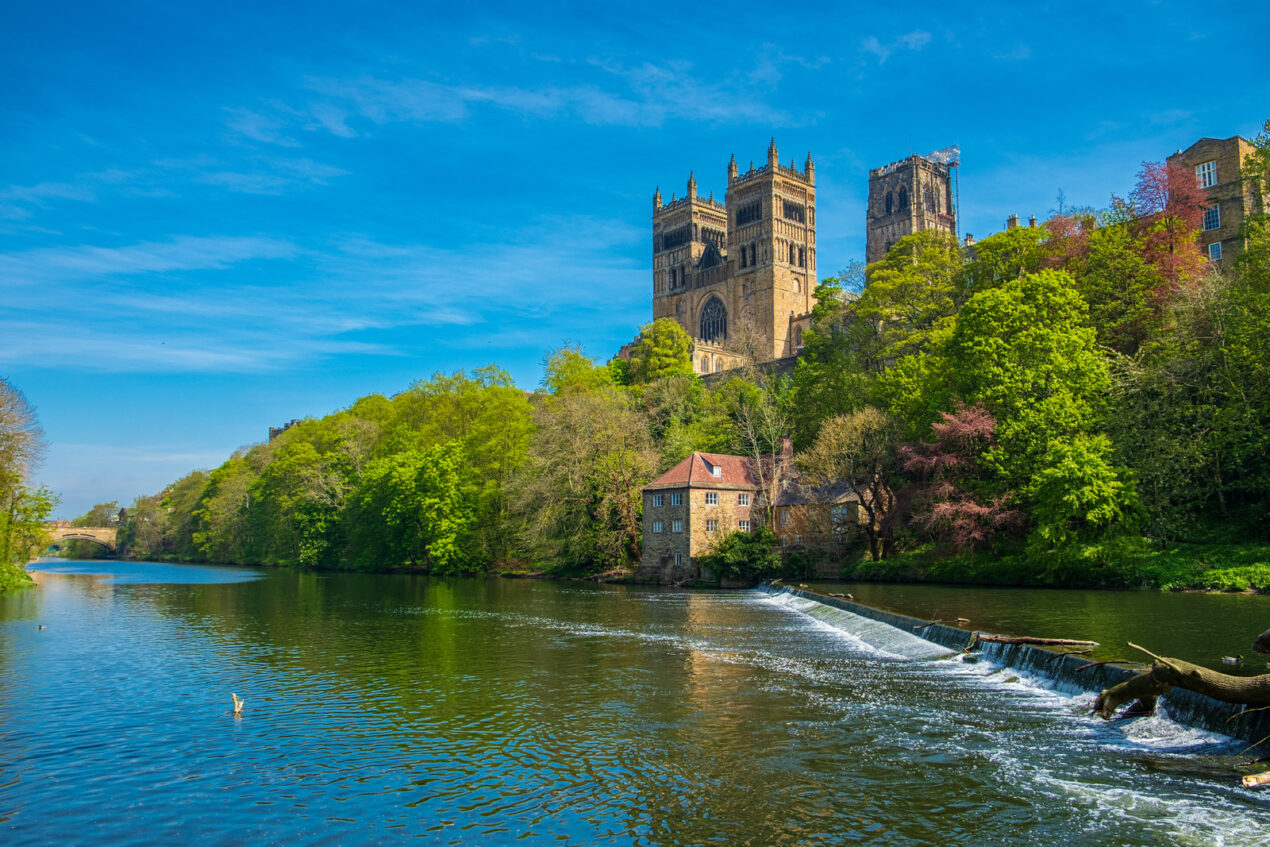
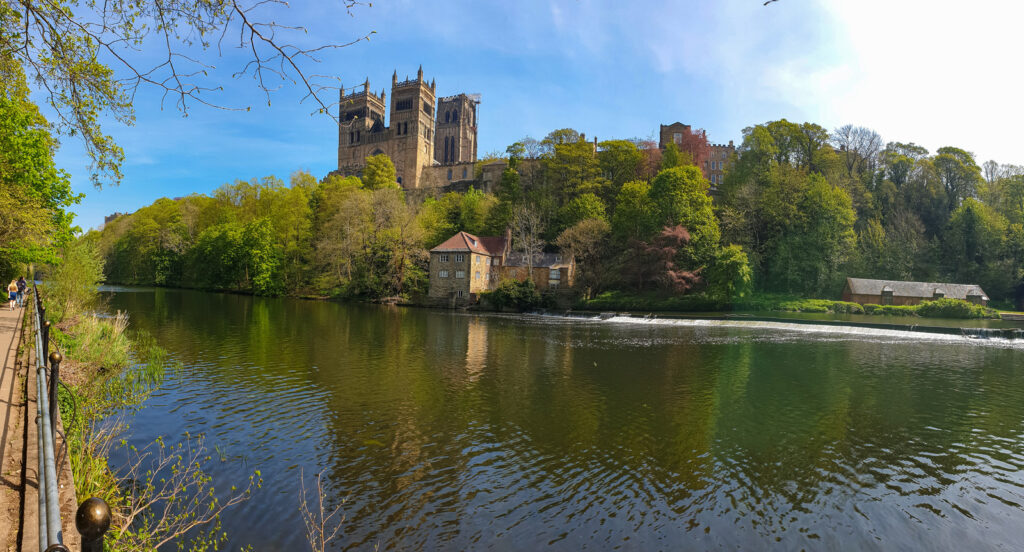
I’ll start with my favorite cathedral in the world—the queen of all cathedrals, in my opinion. Durham Cathedral (#1) is a massive Norman pile situated atop a bluff overlooking the River Wear.
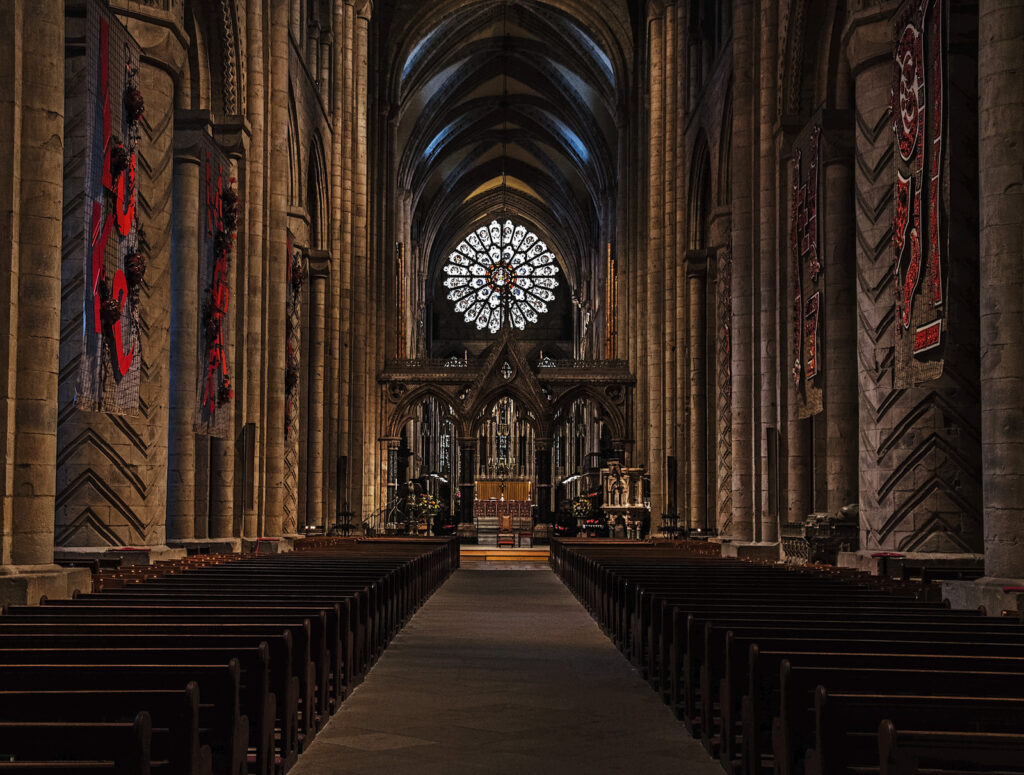
Unlike most cathedrals in northern Europe built in the Gothic style, Durham Cathedral dates from Norman times. Instead of slender columns and vaulted ceilings, Durham Cathedral has massive round columns and solid round arches and is one of the world’s foremost examples of Norman architecture.
Why I Love Durham Cathedral
I adore Durham Cathedral!
In fact, I love it so much that back in the mists of my past, I chose to go to Durham University for a year simply because I wanted to live in the shadow of its cathedral. I have many fond memories of visiting the cathedral, sitting quietly in the nave, and sometimes hearing the organ soar.
Good times!
I’m not alone in considering Durham Cathedral a must-see. Bill Bryson, one of my favorite travel writers, also loves Durham Cathedral. For a time, he was even a Chancellor of Durham University.
Here’s what he wrote in his delightful book Notes From A Small Island:
“Why, it’s wonderful – a perfect little city – and I kept thinking: ‘Why did no-one tell me about this?’ I knew, of course, that it had a fine Norman cathedral but I had no idea that it was so splendid. I couldn’t believe that not once in twenty years had anyone said to me, ‘You’ve never been to Durham? Good God, man, you must go at once! Please – take my car’.”

Durham Cathedral Highlights
The Anglo-Saxon cathedral on the site dates from 995. However, construction of Durham Cathedral as we know it today began in 1093, making it one of England’s oldest cathedrals. Highlights of the cathedral include:
Norman Pillars
These massive carved pillars (6.6 meters round and 6.6 meters high) are one of my favorite things about Durham Cathedral. They support the gorgeous round arches that mark Durham Cathedral as Norman rather than Gothic like most other cathedrals in England, including York Minster and Westminster Abbey.
Shrine of St. Cuthbert
The best loved saint in the north of England is St. Cuthbert. He lived as a monk, a bishop, and finally a hermit on Lindisfarne (aka Holy Island) and was proclaimed a saint in 698. His shrine is located within the cathedral.
Tomb of the Venerable Bede
The Venerable Bede was a monk who lived in the 7th and 8th centuries and is regarded as the greatest Anglo-Saxon scholar. He was declared “venerable” in 836 and canonized in 1899. His bones were brought to Durham in 1022 and eventually entombed in the Galilee Chapel in Durham Cathedral.
Open Treasure Exhibition
Various exhibitions showcasing medieval art and artifacts are featured. Check the website for up-to-date information.
Stained Glass
Enjoy the number and variety of stained glass windows in Durham Cathedral, from medieval to modern, with the most recent installed in 2019.
You’ll find plenty of things to enjoy at Durham Cathedral. After touring it, stroll down to the River Wear to admire the iconic view of the cathedral. When I was a student at Durham University, I spent many hours walking alongside the river and admiring the cathedral.
For more information about opening times, check the Durham Cathedral website.
Practical Information for Visiting Durham
Durham is located between York and Newcastle in northeast England. My first glimpse of Durham Cathedral was from the train when we passed it on my epic BritRail journey around Britain when I was eighteen. I knew then that I had to return!
I recommend staying a day or two in Durham to enjoy the cathedral and the lovely town of Durham and to explore the surrounding countryside. Use the interactive map below to find accommodation in Durham and elsewhere in England.
Salisbury Cathedral – Salisbury, England
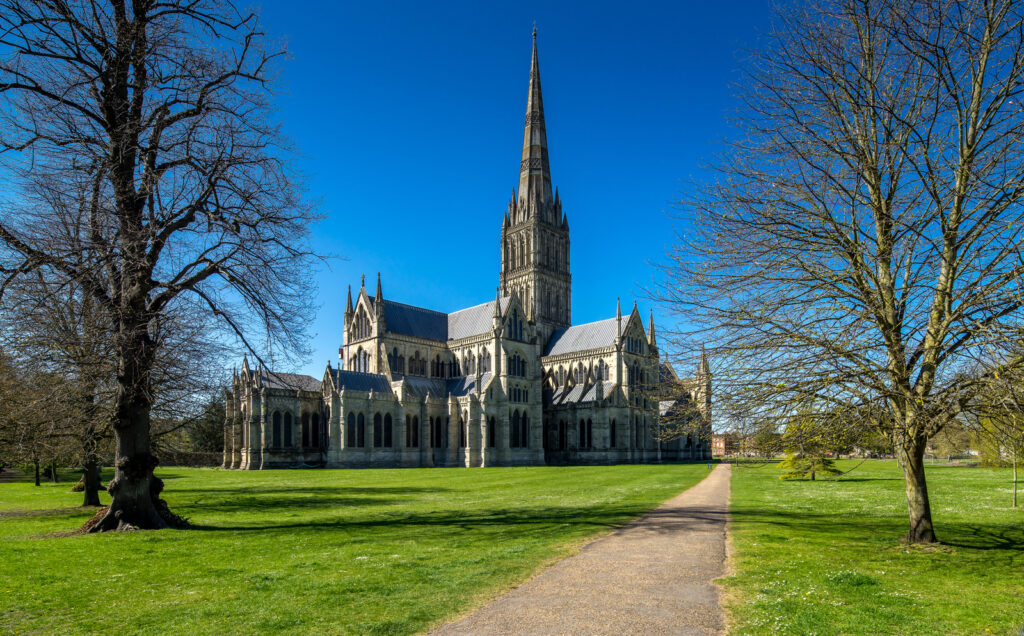
The spire of Salisbury Cathedral (#2) rising above the bucolic Wiltshire countryside is the quintessential English view. Stay a night to also enjoy the charming town of Salisbury. It makes a great home base for exploring the area that includes Stonehenge just 9 miles to the north.
Salisbury Cathedral Highlights
The ornate 13th-century cathedral built in the Gothic style is not as old as Durham Cathedral and includes a graceful 123-meter spire and a 14th-century clock that works to this day. Apart from the beauty of the cathedral itself, the big draw for history buffs is the display of an original copy of the Magna Carta from 1215.
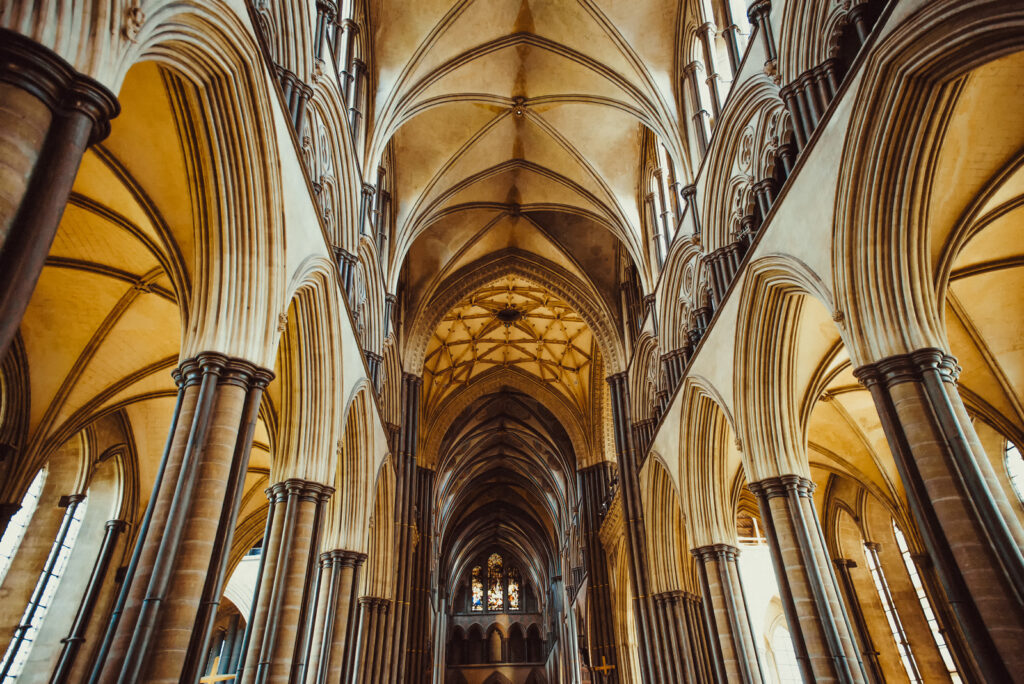
On the Salisbury Cathedral website, you can enjoy a Spirit and Endeavour Virtual Art Tour, an interactive virtual look inside the cathedral.
After touring the cathedral, linger in the 80-acre Cathedral Close, Britain’s largest. Notable highlights include:
Arundells
The home of former Prime Minister Sir Edward Heath houses collections of his sailing and music memorabilia in addition to oriental and European ceramics, paintings, political cartoons, and more.
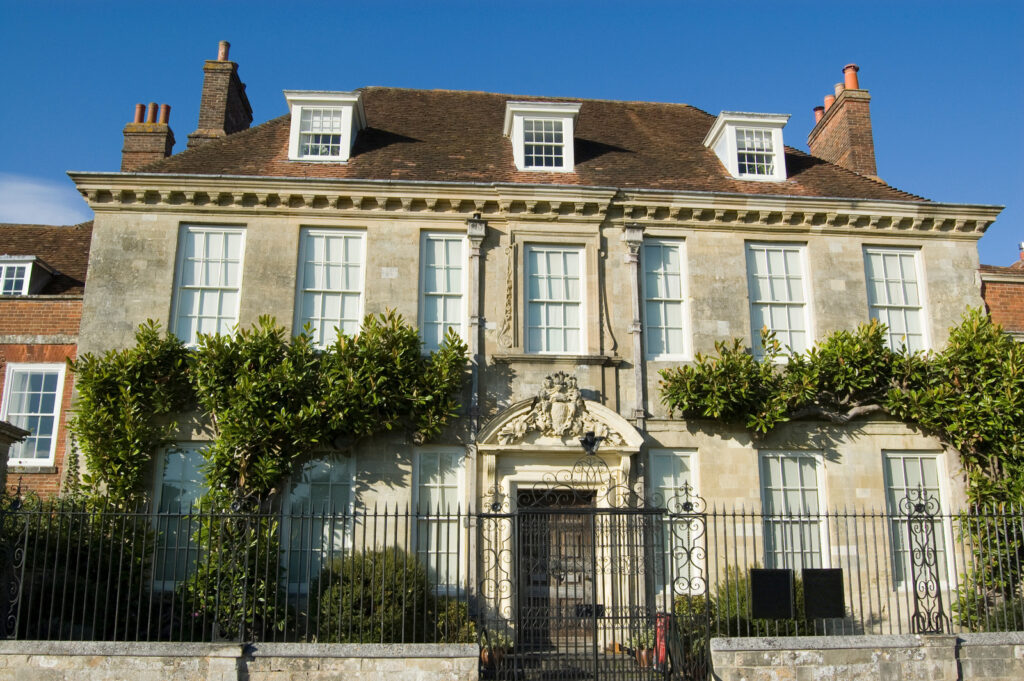
Mompesson House
This National Trust property is an 18th-century townhouse in the heart of Cathedral Close. Check out the notable plaster work, an elegant carved oak staircase, period furniture, and even a collection of 18th-century drinking glasses.
The Salisbury Museum
This fine museum houses archeological collections from the region, including the Stonehenge Gallery and displays of prehistoric, Roman, Saxon, and medieval artifacts.
Practical Information for Visiting Salisbury
Salisbury is located in Wiltshire about 100 kilometers southwest of London. The train journey from Waterloo Station takes about 90 minutes.
I recommend staying at least one night in Salisbury so you can enjoy the town and explore nearby Stonehenge and Old Sarum to the north. The bus to Stonehenge takes 30 minutes from Salisbury, or you can take a tour from London. Here are options.
Use the interactive map below to find accommodation in Salisbury. I stayed at a bed-and-breakfast within walking distance of the Cathedral, a good choice if you’re not traveling by car.
Westminster Abbey – London, England
It’s crowded, you must buy the audioguide, and you can only go in one direction when you tour the abbey, but OMG, it’s worth it. I never tire of visiting Westminster Abbey (#3). The history of this place coupled with the always fascinating Poet’s Corner make it a must-see every time I visit London, which is as often as I can manage!
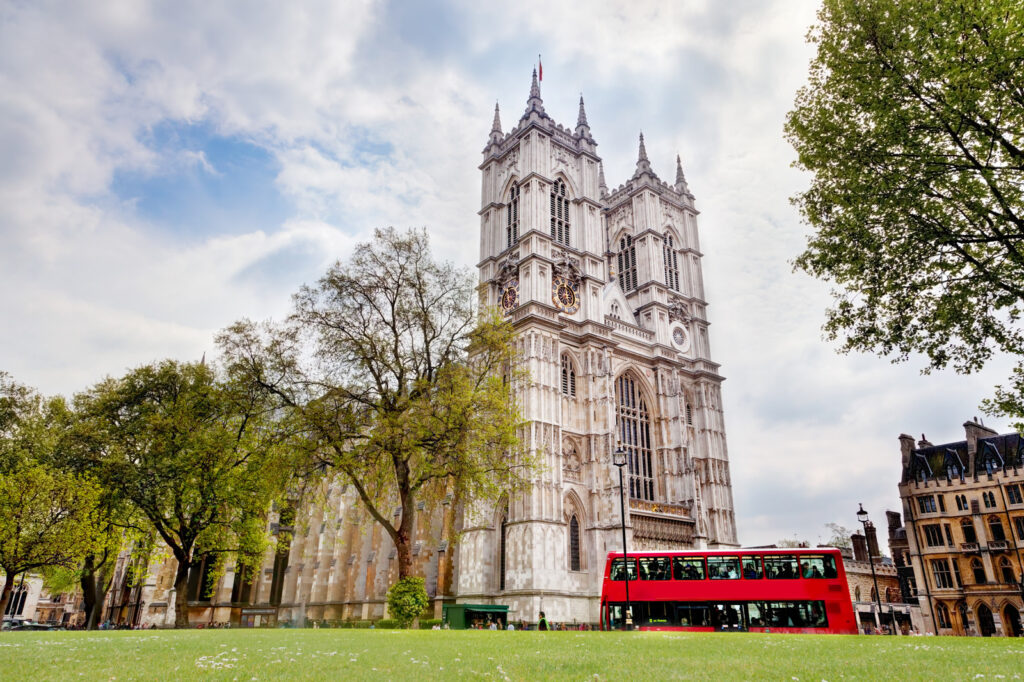
The last time I visited Westminster Abbey, I was extremely fortunate to be taken into a chapel not accessible to the public to view the tombs of John Philip Kemble and Sarah Siddons. They were the two greatest actors of the early 19th century and also make an appearance in my 3rd novel, The Muse of Fire.

I asked an attendant where the tombs were when I couldn’t find them in Poet’s Corner. She directed me to one of the abbey’s clerics who took me to the side chapel where women were arranging flowers. I could look at the two tombs, both decorated with large marble sculptures of the famous actors. However, I wasn’t allowed to take pictures. Still, it was a thrill to pay my respects to two people with whom I’d spent a lot of time while writing The Muse of Fire.
One very good thing about having to tour Westminster Abbey with the audioguide clamped to your ear is that the noise level is very low. People are too busy listening to the audioguide to talk. As a result, even with the abbey heaving with people, you still feel something of the spiritual atmosphere of a church that has played an outsized role in British history since 1066.
Before you visit, take a virtual tour to get your bearings.
Westminster Abbey Highlights
The audio tour is extremely thorough so you’ll get a lot of information about what you’re seeing as you shuffle around the abbey.
Coronation Chair
View where the kings and queens of England have been crowned for over 700 years. Under the chair is the Stone of Scone brought by King Edward I from Scotland to Westminster Abbey in 1295. The stone was stolen on Christmas Day in 1950. For an entertaining movie about the theft, watch The Stone of Destiny.
Pyx Chamber
One of the oldest surviving parts of Westminster Abbey, the Pyx Chamber is a low vaulted room off the East Cloister that was built about 1070. You really get a feel for the incredible antiquity of the abbey in this chamber.
Royal Tombs
Westminster Abbey contains the mortal remains of 30 kings and queens, starting with King Edward the Confessor. As you tour the abbey, you’ll pass the tombs of such major figures as Edward I, Richard II, Henry VII, Queen Elizabeth I, and Charles II. Walking around the tombs is like taking a trip through English history.
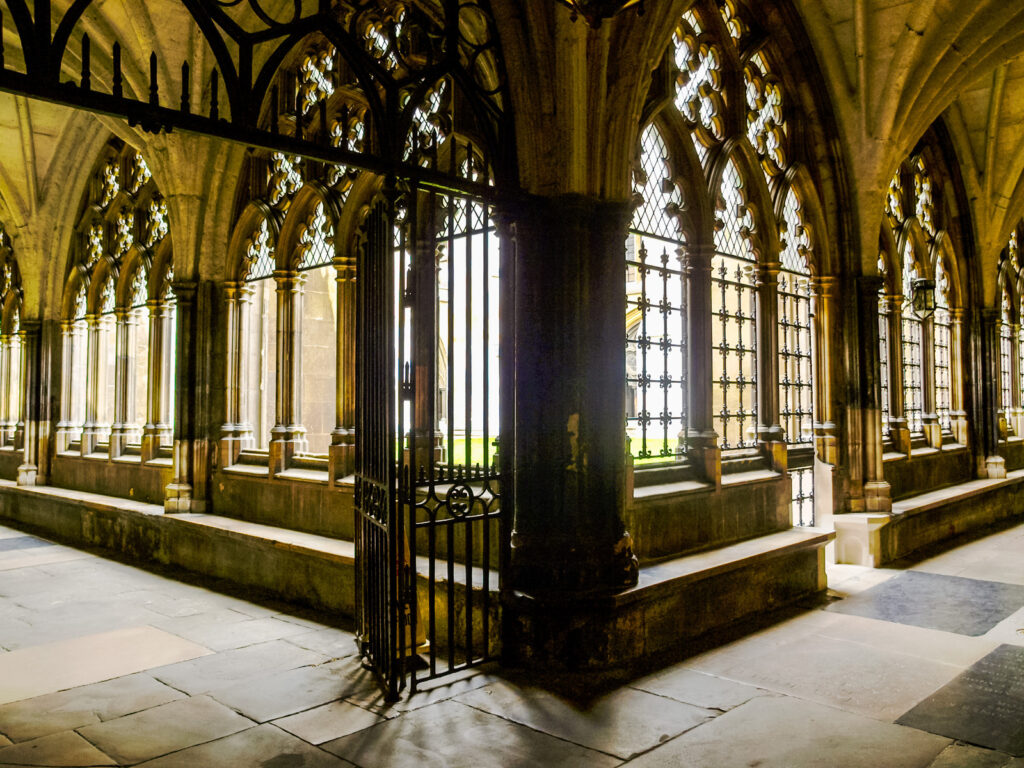
Cloisters
I always enjoy walking around cloisters at cathedrals. The ones at Westminster Abbey enclose a green space with a central fountain commemorating Capability Brown, the famous 18th-century landscape gardener and architect.
Poet’s Corner
This area is a must-visit for artsy travelers. I could spend all day here looking for the tombs of over 100 of England’s greatest writers and poets, including Jane Austen, Charles Dickens, Thomas Hardy, Geoffrey Chaucer, C. S. Lewis, as well as composers such as George Frederick Handel.
Other Tombs and Memorials
Over 3,300 tombs and memorials are scattered throughout Westminster Abbey. If you’re looking for a particular person and can’t find them on the regular tour (and you know a memorial to them exists in the abbey), ask an attendant. If the tomb is accessible, you may be allowed to view it even if it is not in an area open to the public.
Check out the Westminster Abbey website to buy tickets.
Practical Information for Visiting London
London is enormous, so allocate at least 5 days for your visit, preferably a week. You won’t run out of things to see and do in London.
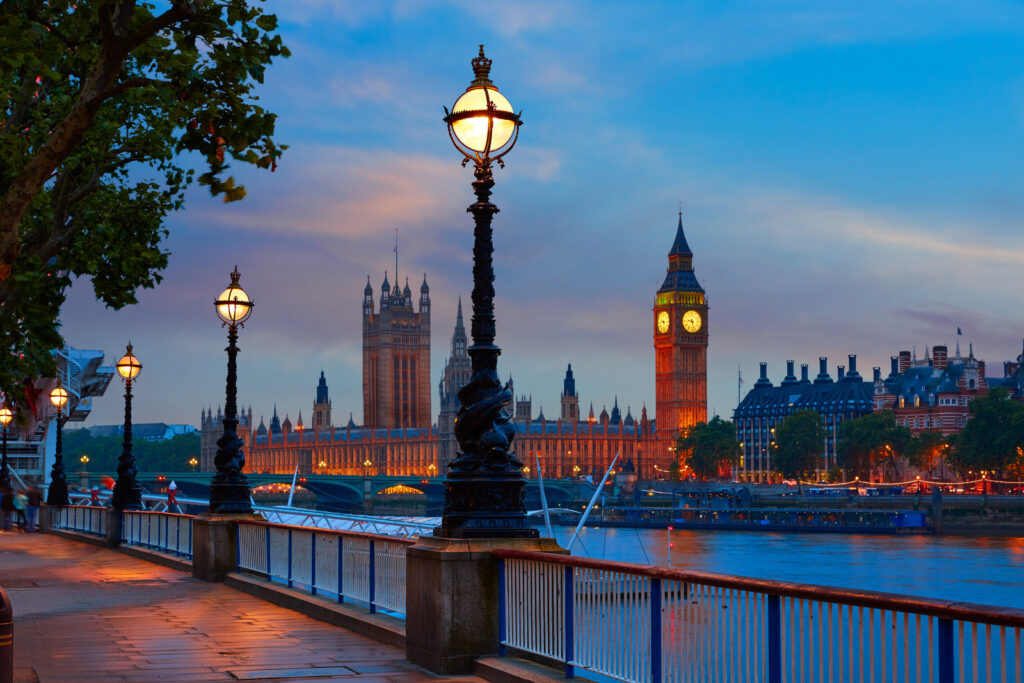
Here are London-based tours to consider, particularly if you are short on time.
When I visit London, I choose the most central accommodation I can find. Yes, you can find cheaper (and drearier) accommodation farther from the center, but you’ll spend more time and money commuting.
On a recent trip to London, I stayed at the Cavendish Hotel near Green Park and within walking distance of London’s West End theaters. The location was perfect. I rarely needed to take the Tube, mostly relying on either riding buses or walking.
Use the interactive map below to find accommodation in London.
Sainte-Chapelle – Paris, France
If you have not visited Sainte-Chapelle (#4) in Paris, put it at the top of your list. It’s one of the city’s marvels, which is saying something in Paris. Every time I visit the City of Light, I make time to pop into Sainte-Chapelle.
What’s So Special About Sainte-Chapelle?
Two words: stained glass. The walls enclosing the top floor of the 2-storey chapel are virtually all glass. Very slender columns separate the soaring stained glass windows.
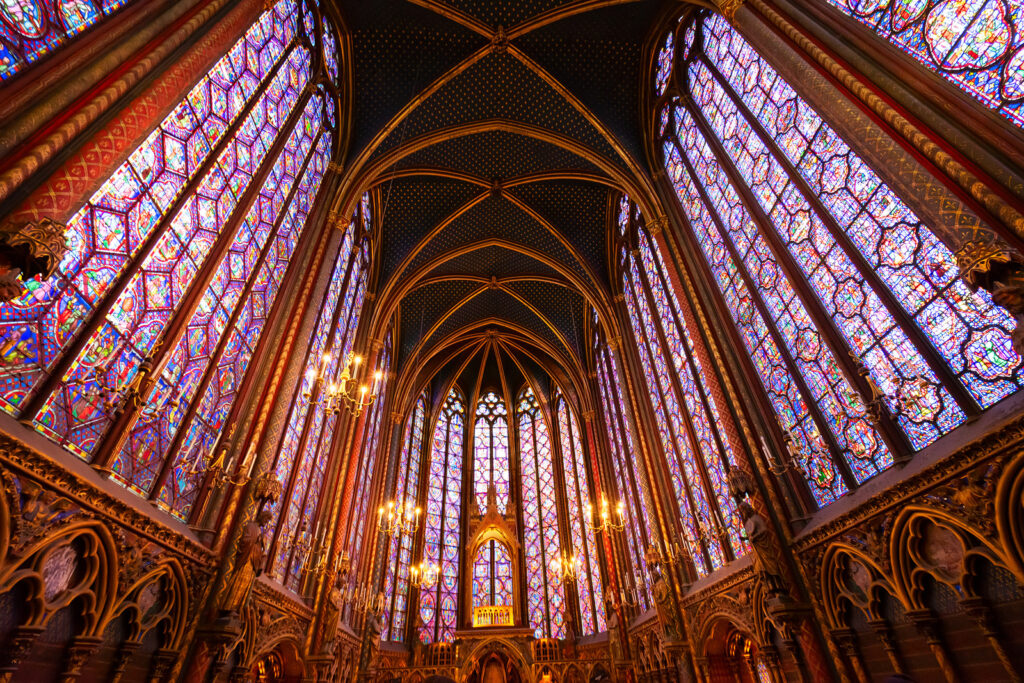
Pictures can’t capture the incredible light and beauty of Sainte-Chapelle. Arranged across 15 windows, each 15 metres high, the stained glass panes depict 1,113 scenes from the Old and New Testaments.
The chapel was built over a period of just 7 years, an incredibly fast pace for the time and why the chapel’s architecture is so harmonious.
For information about opening times, check the Sainte-Chapelle website.
Attend a Concert at Sainte-Chapelle
One of the best ways to enjoy Sainte-Chapelle is to attend a concert there. We’ve done so several times and have always been transported. It’s a wonderful artsy experience to listen to Bach, Vivaldi, and other 18th-century masters while bathed in the colored light filtering through the stained glass.
Lean your head back and look up at the star-spangled ceiling.
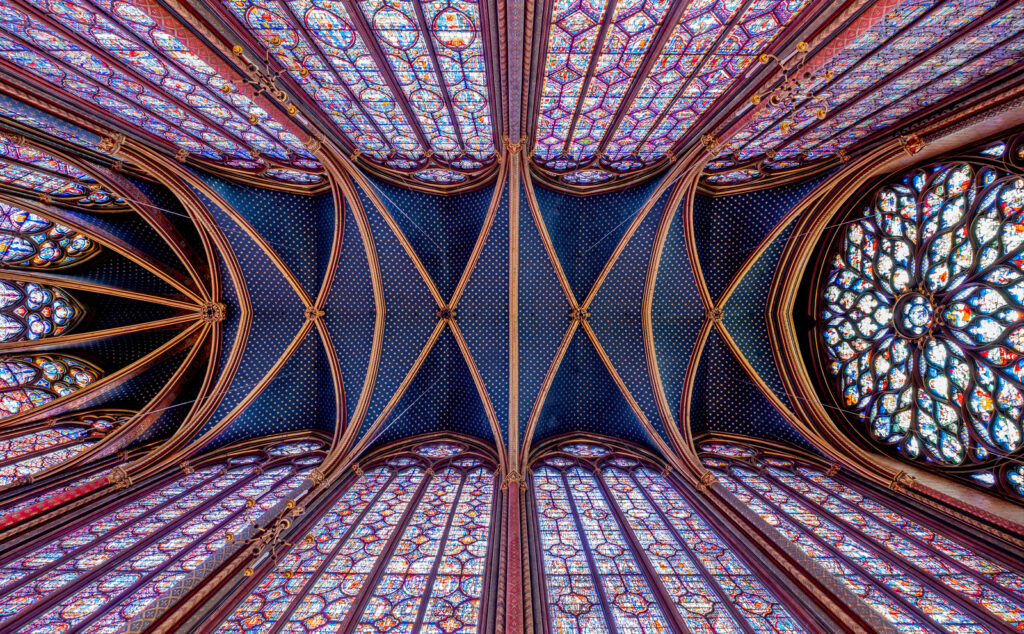
Purchase tickets in advance for concerts at Sainte-Chapelle. The ClassicTic website is a reliable place to find tickets.
Practical Information for Visiting Sainte-Chapelle
Sainte-Chapelle is located on the Île de la Cité in the heart of Paris. Since the chapel is located within the precincts of the Palais de Justice, you need to go through a security screening before you can enter Sainte-Chapelle. Visit early in the day or wait until the evening and combine your visit with a concert.
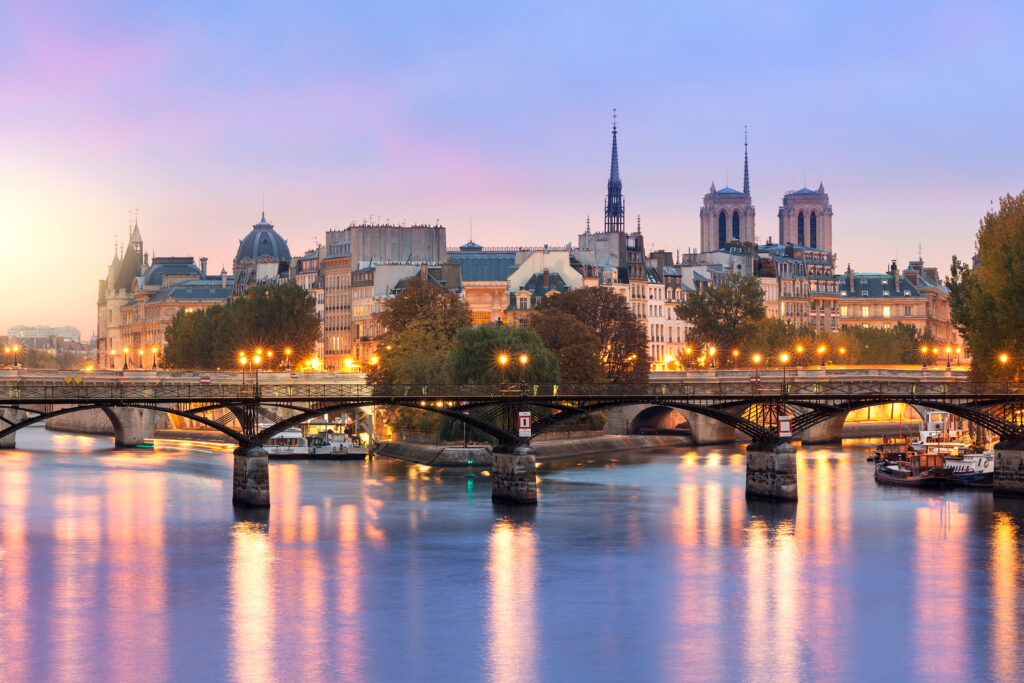
While on the Île de la Cité, you’ll pass by Notre-Dame Cathedral. The cathedral suffered a devastating fire in 2019, and, after more than five years of repair work, reopened in December 2024. That said, the restoration works are not yet complete, as they are scheduled to continue through 2026.
Here’s the Île de la Cité showing Notre-Dame Cathedral before the fire. The spire in the center of the picture is Sainte-Chapelle.
Paris deserves at least 4 days to tour and preferably a week. I’ve stayed for as long as a month at a time and have never run out of things to see and do.
Here are Paris-based tours to consider, particularly if you are short on time.
Staying in Paris
When I visit Paris, I choose the most central accommodation I can find. Cheaper accommodation is available on the périphérique, but the neighborhoods can be soulless, and you’ll spend too much time commuting to central Paris.
See my suggestions about where to stay in Paris or use the interactive map below to find accommodation in Paris.
Chartres Cathedral – Chartres, France
Chartres makes a great day trip from Paris or a stop on the way to the Loire Valley.
Considered one of the most beautiful in France, Chartres Cathedral (#5) is also one of the finest examples of French Gothic architecture. The cathedral dominates the delightful small town of Chartres.
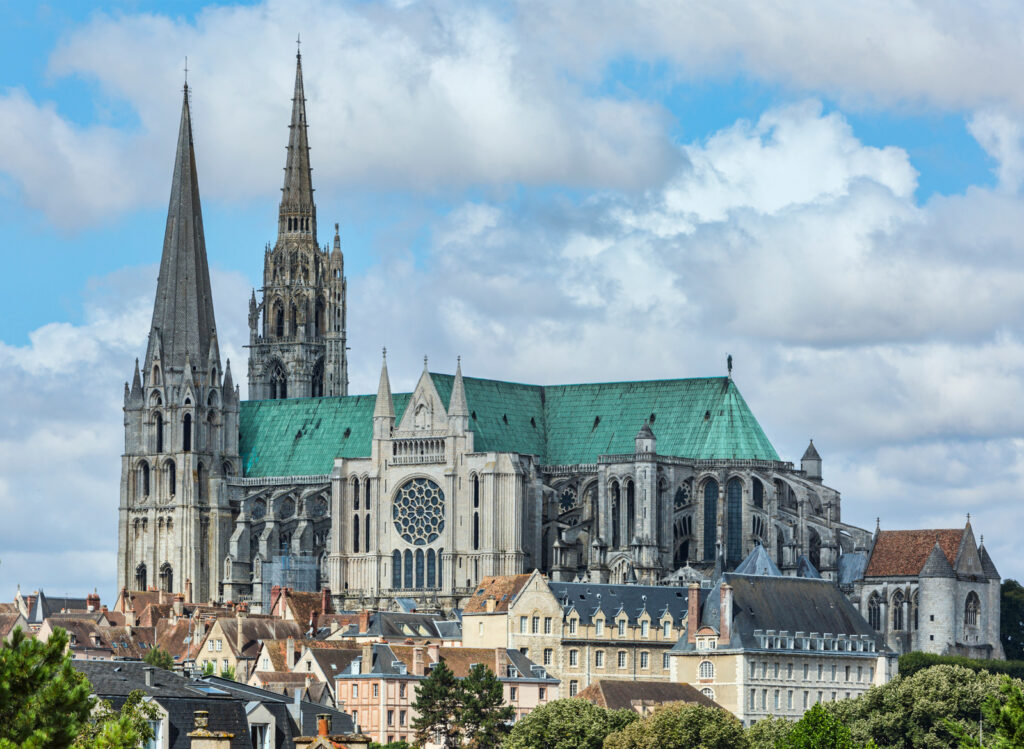
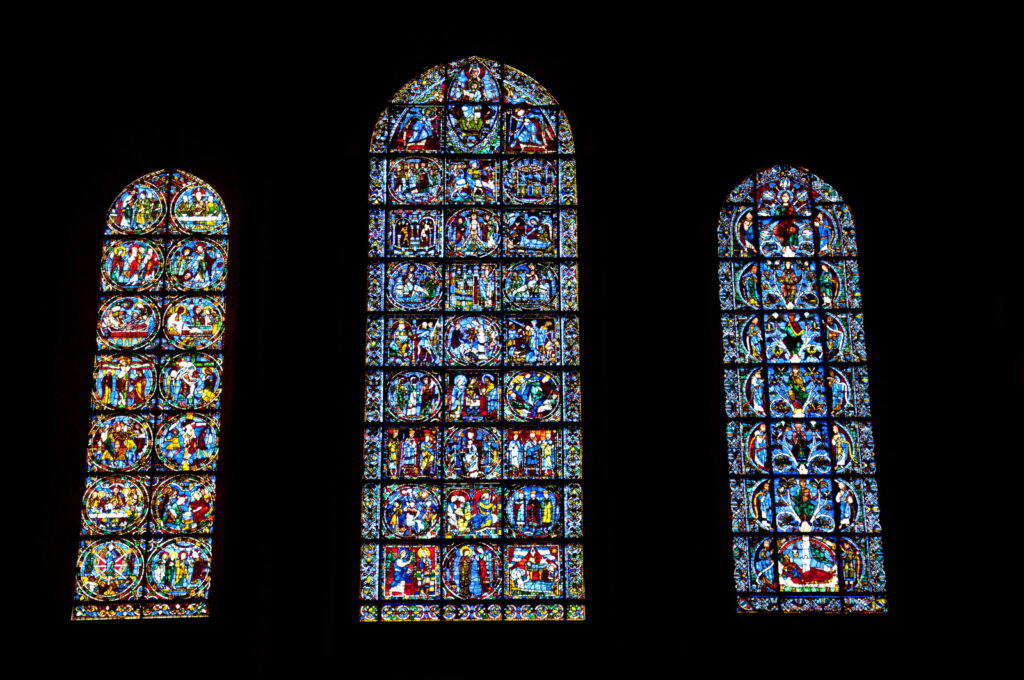
Chartres Cathedral has it all—graceful spires, pointed arches, flying buttresses, and magnificent 12th- and 13th-century stained glass windows. The intensity of your visit is heightened by the fact that no direct light enters the building. All light is filtered through the stained glass, so your enjoyment of the remarkable interior of the cathedral has an other-worldly feel.
At the center of the cathedral is a maze of 290 meters that the faithful used to follow on their knees. Ouch.
Read more about the cathedral on the Chartres Cathedral website, including information about opening times and history.
Practical Information for Visiting Chartres
Chartres is located about an hour’s drive or train ride southwest of Paris. If you decide to make Chartres an overnight stop on the way farther west to visit the châteaux in the Loire Valley, use the interactive map below to find accommodation options.
Sagrada Familia – Barcelona, Spain
I confess that I did not visit the Sagrada Familia (#6) until my 3rd trip to Barcelona. The first time I was 21 and intimidated by seeing phalanxes of helmeted soldiers close in around me in the Plaza Catalunya. This was during the Franco years in the 1970s. On my second visit, I’d failed to get tickets ahead of time. The line of people who did not have the foresight to book ahead stretched around the building, and so I passed.
Finally, 3rd time lucky! I purchased my ticket to the Sagrada Familia online and well in advance of my visit and happily breezed past the long line-ups of tourists on a day when the temperature hovered around a very humid 35 degrees.
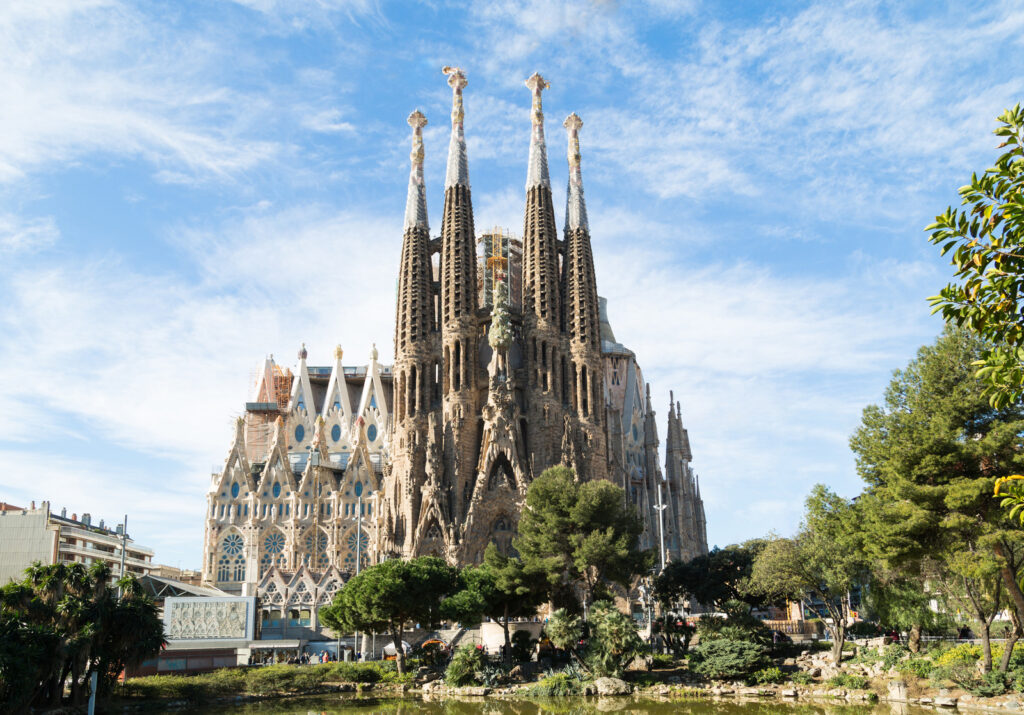
Even with a ticket, make sure you arrive at least 30 minutes prior to your entry time. You’ll still queue but not for as long as the poor souls who didn’t plan ahead. When I visited at 3 pm, people were being told that the next entrance time was at 6.
The Sagrada Familia was started in the 1880s and is not yet finished. Cranes arch across the towers, and you’ll hear hammers pounding. After visiting the interior, take a leisurely walk around the building to admire the intricate sculptures encrusting the walls like artsy barnacles.
What’s Special About the Sagrada Familia?
At your scheduled time, if you’re not taking a tour, join the hordes trudging around the perimeter of the basilica to the entrance for ticket holders, and pick up an audi guide (included in the ticket price and very informative) as you enter.
Then prepare to be blown away!
The interior of the Sagrada Familia is like nowhere else on Earth. Abstract patterns in blues, golds, greens, and reds bounce the Barcelona sun across faces, walls, t-shirts, and floors.
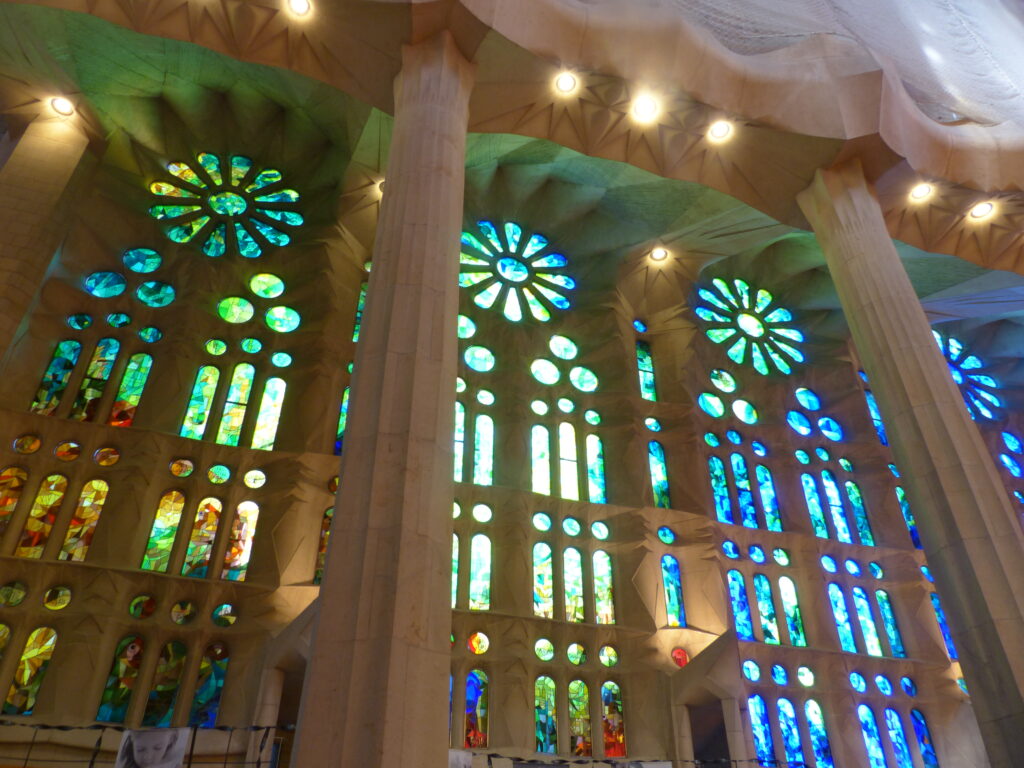
High above, star-shaped openings punch the roof to let the sun stream in like bolts of pure light.
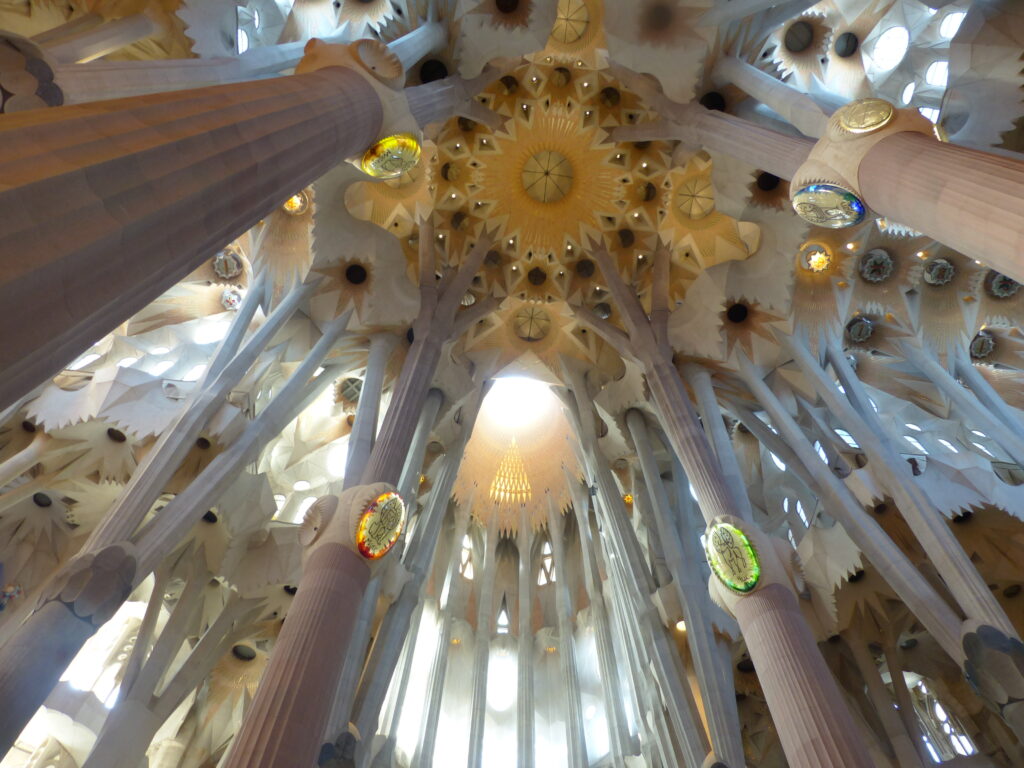
Take your time exploring the Sagrada Familia. I suggest grabbing a pew and just sitting, listening to the audioguide and letting the beauty of the place soak in.
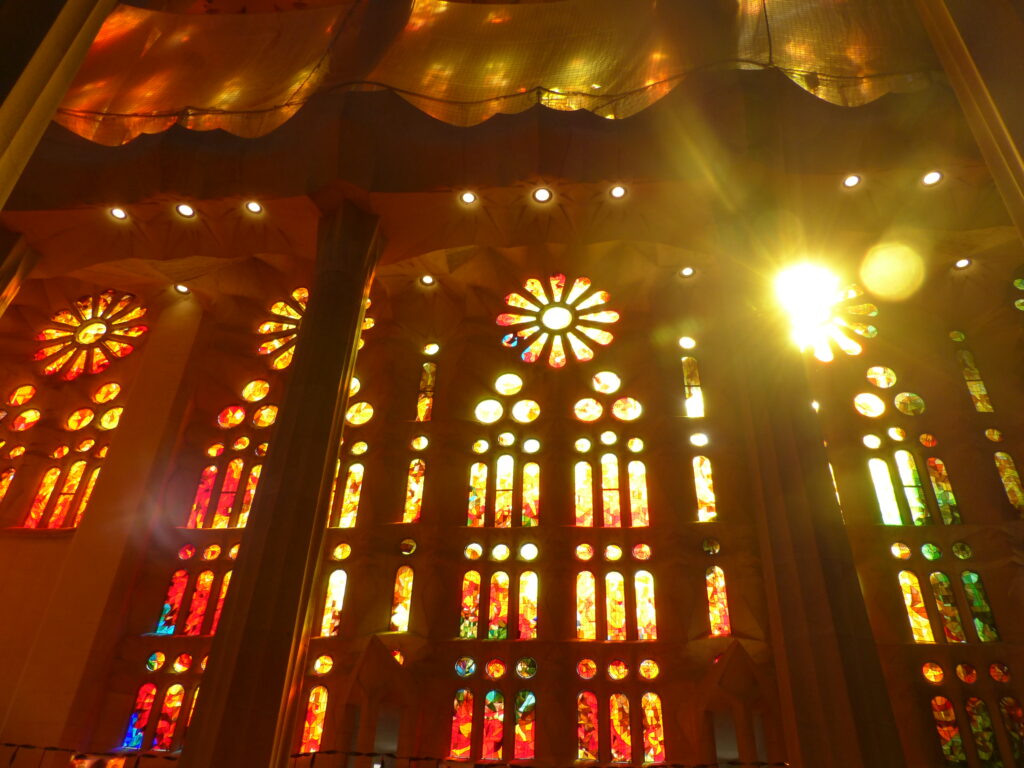
Regardless of your religious convictions, you can’t help but appreciate the magnificence of the architecture as a fitting celebration of spirit. You may never want to leave.
To book tickets, go directly to the Sagrada Familia website.
Practical Information for Visiting Barcelona
For more information about what to do and see in Barcelona, check out my post on Two Packed & Fabulous Days in Trendy Barcelona. In addition to my suggestions, here are tours to consider.
I recommend staying at least 2 days and 3 nights in Barcelona. Check out my suggestions for where to stay in Barcelona or use the interactive map below to find accommodation.
Basilica of San Vitale – Ravenna, Italy
I singled out the Basilica of San Vitale (#7) in Ravenna for this post, but when you go to Ravenna, you’ll definitely want to visit all the churches and mausoleums containing the Byzantine mosaics dating from the 5th and 6th centuries.
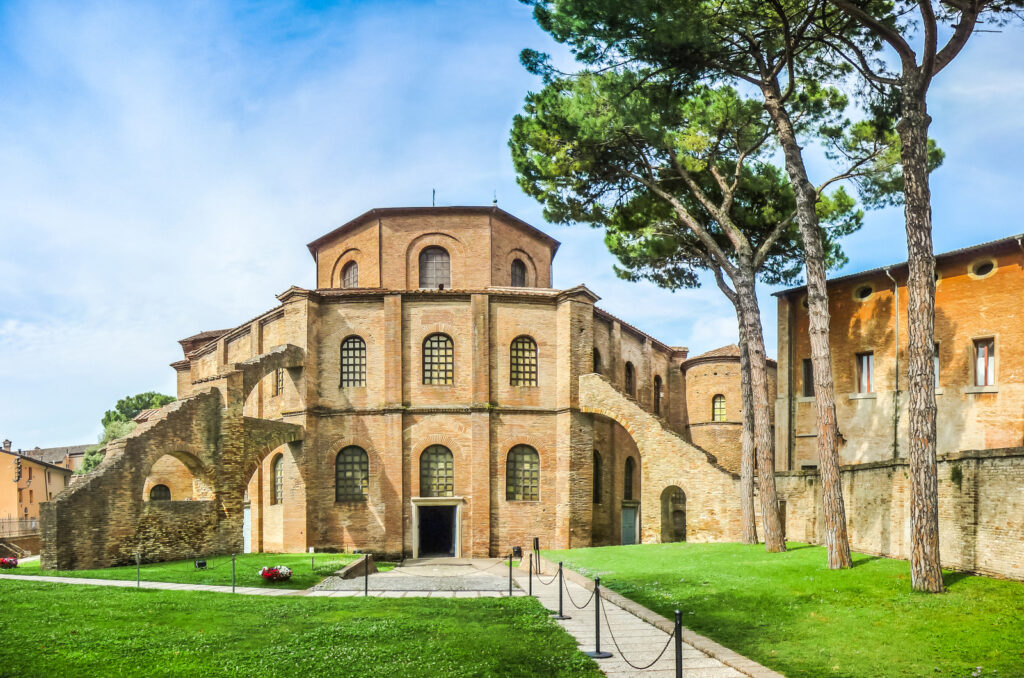
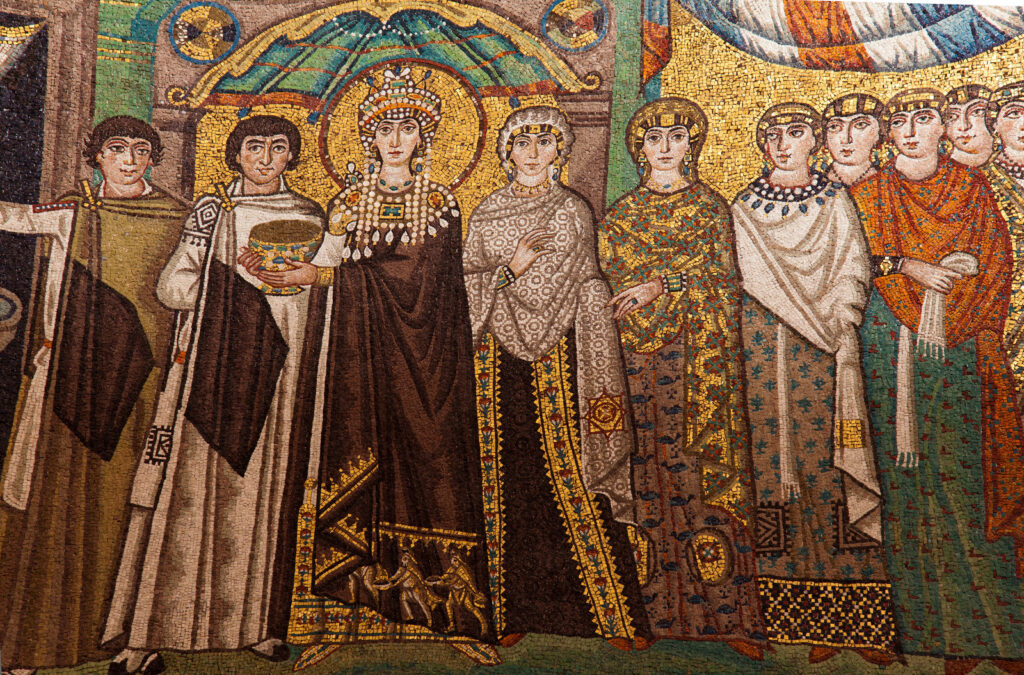
Start at the Basilica of San Vitale, which contains the most famous mosaics, including those showing the Emperor Justinian and Empress Theodora.
When you arrive at the Basilica San Vitale, buy your combination ticket for all 6 UNESCO World Heritage sites in central Ravenna.
The combination ticket is also available at a few other locations, including the Mausoleum of Galla Placidia, the Basilica of Sant’Apollinare Nuovo, the Neonian Baptistry, and the Archbishop’s Chapel. Basically, buy your ticket at the first site you visit.
Or buy tickets online.
The sites are almost all within walking distance of each other and you’ll need a full day to see them all, with a long break to enjoy lunch in the lovely Piazza del Popolo in the center of Ravenna.
What’s Special about Basilica San Vitale
I’ve known about the Byzantine mosaics in Ravenna, particularly the ones in San Vitale, ever since I studied art history at university.
Seeing pictures of the mosaics in books was impressive enough, but the real mosaics take your breath away. You’ll also end up with a sore neck within a few minutes of entering San Vitale. Be warned and pace yourself. When you visit San Vitale, and indeed all the Byzantine sites in Ravenna, you’ll spend a lot of time looking up.
But the pain is worth it. Built in 525, the Basilica San Vitale is by far the oldest of the cathedrals presented in this post and one of the oldest in Christendom. And yet its mosaics look like they were made yesterday. It’s almost impossible to believe they are getting on for 1,500 years old.
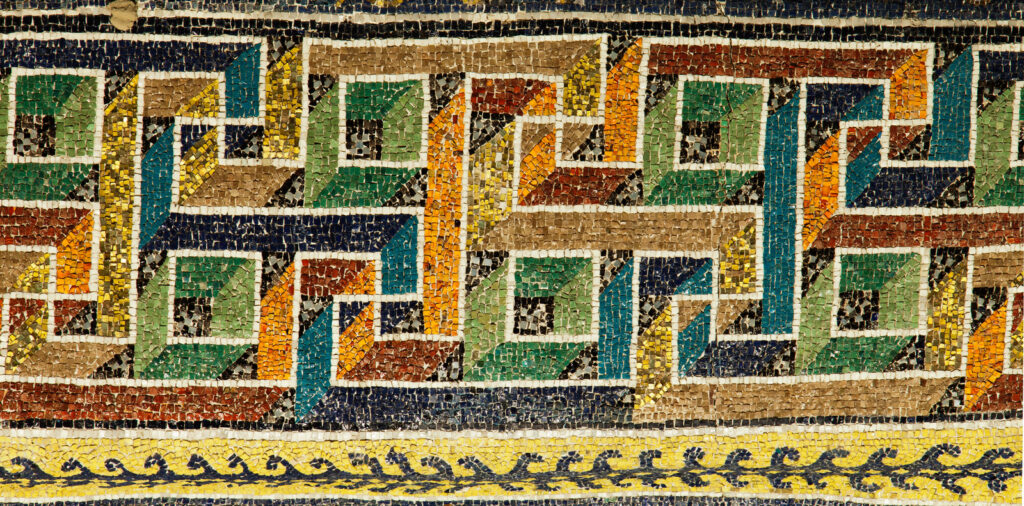
What also struck me was the modernity of many of the decorative elements surrounding the figurative mosaics. You’ll also see many details from the natural world, such as birds, flowers, and small animals.
Practical Information for Visiting Ravenna
Ravenna is located about 145 kilometers (a 2-hour drive) south of Venice and 85 kilometers due east of Bologna on the Adriatic Sea. The city makes a great stop on your way to or from Venice.
I recommend staying at least a night in Ravenna so you have plenty of time to tour both the Basilica San Vitale and the other World Heritage sites containing Byzantine mosaics. Check out my suggestions for where to stay in Ravenna or use the interactive map below to find accommodation.
Siena Cathedral – Siena, Italy
Siena Cathedral (Cathedral of Santa Maria Assunta) (#8) has so much to offer that you’ll need the better part of a day to explore and appreciate it and the adjacent museum.
Chock-full of fabulous art, much of it from the 14th century (my favorite century for art!), Siena Cathedral is my pick for the best medieval cathedral in Italy.
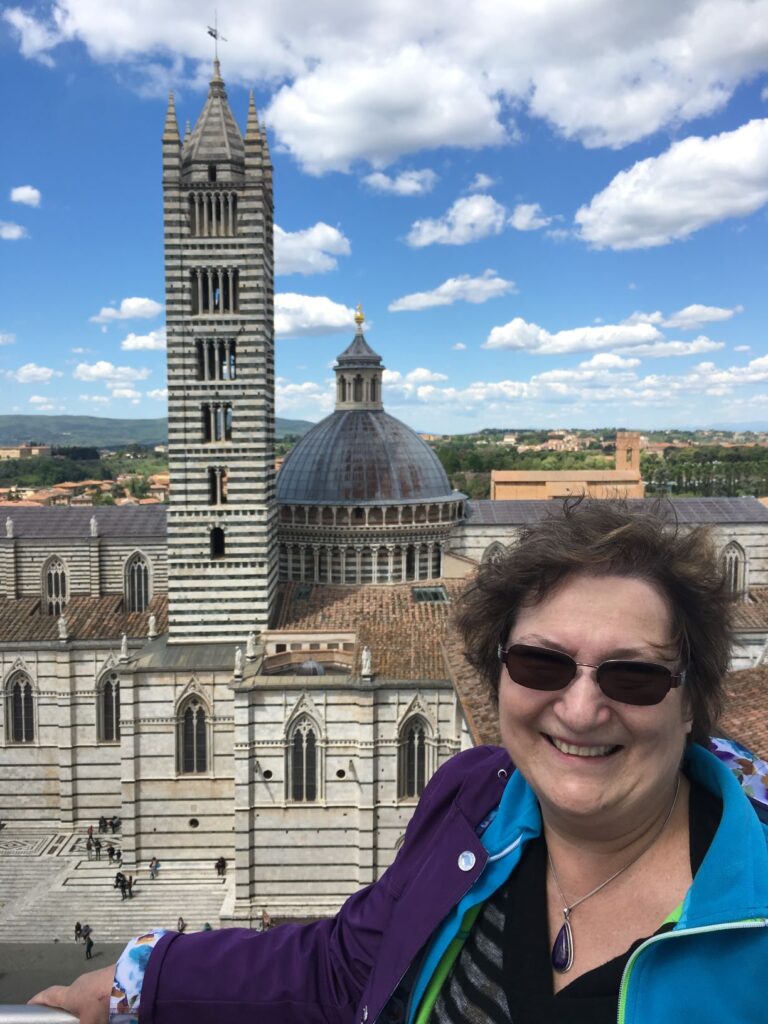
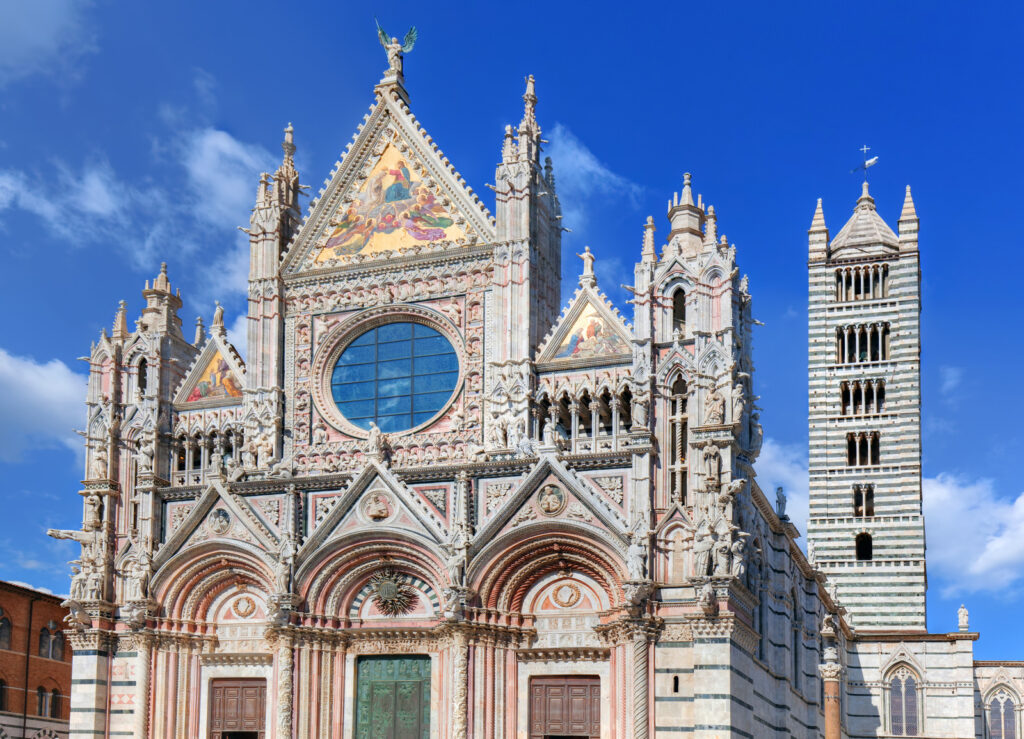
To start with, the exterior of the cathedral is stunning, with its black and white striped tower and super ornate façade. Dating from the 12th century, the cathedral is a masterpiece of Romanesque and Gothic architecture.
Siena Cathedral Highlights
The interior of the cathedral is just as stunning as its exterior, maybe more so. Here are the highlights of Siena Cathedral and the adjoining museum.
Cathedral Floor
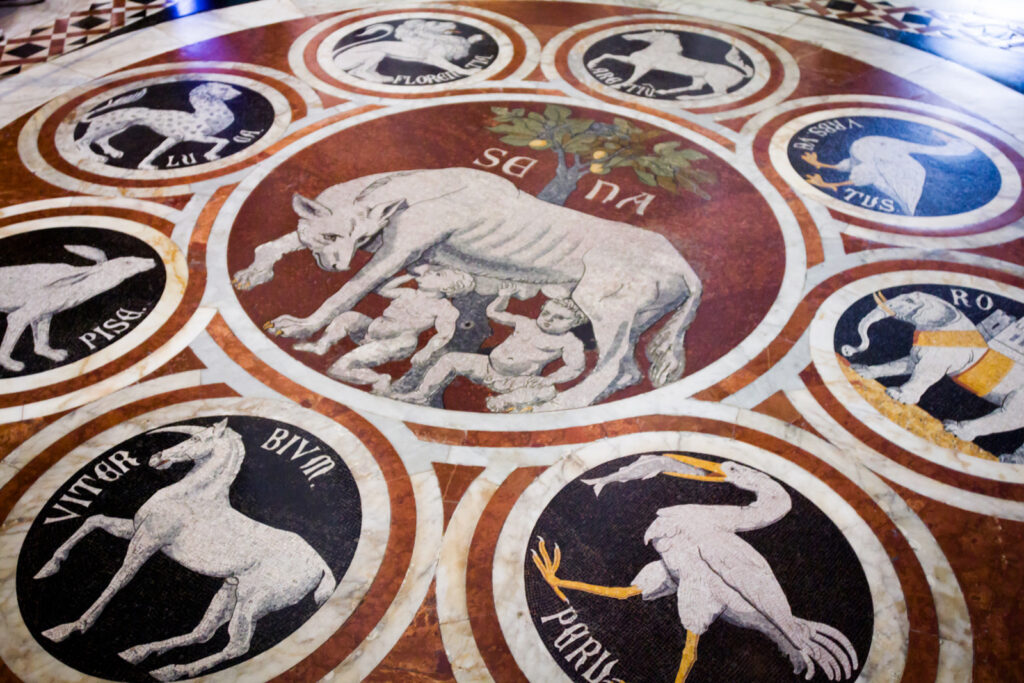
You’ll spend a lot of time looking down when you’re inside Siena Cathedral. In fact, its floor is the most interesting floor I’ve ever seen in a cathedral. Giorgio Vasari, who wrote the famous round-up of artists called Lives of the Most Excellent Painters, Sculptors, and Architects in the 16th century, considered the floor in Siena Cathedral the “most beautiful…, largest and most magnificent floor ever made”.
He got that right. The floor consists of 56 inlay panels created between the 14th and 19th centuries. All of the artists who worked on the floor were Sienese, except for Pinturicchio who was from Umbria. The panels represent the sibyls, scenes from the Old Testament, allegories, and virtues, and remarkably, most remain in their original state.
Piccolomini Library
I confess that I had not heard of the Piccolomini Library, which is a sad admission by a lover of medieval and Renaissance art. But there you go, and I’ve now discovered the error of my ways.
The library is to the left of the nave as you enter the cathedral. You might need to line up to get in.
Between 1503 and 1508, Pinturicchio covered the walls and ceiling of the library with scenes celebrating the life and work of Pope Pius II. You’ll be amazed by the atmospheric landscapes, the splendid costumes of the figures, and the rich, enameled palette. The colors look like they were applied yesterday. The frescoes are a wonder.
Gate of Heaven
Recently, the cathedral began to allow people to tour a series of rooms at the top of the cathedral. You can walk above the nave to admire views both inside and outside the cathedral. It looks pretty cool (I haven’t done it yet!).
Museo dell’Opera
Not all museums adjacent to cathedrals are worth visiting, but the Museo dell’Opera is. The museum houses numerous masterpieces. My favorite (and the biggest draw) is the Maestà altarpiece by Duccio di Buoninsegna (usually referred to as Duccio).
Duccio painted Mary and Jesus (Maestà means a madonna and child) in the early 14th century for the cathedral’s altarpiece. He is considered one of the greatest Italian painters of the late medieval period and is credited with creating the paintings styles of the Sienese school.
The Duccio altarpiece is housed is quite a large room, suitably darkened and climate controlled and equipped with chairs so you can sit and contemplate this miraculous work for as long as you want.
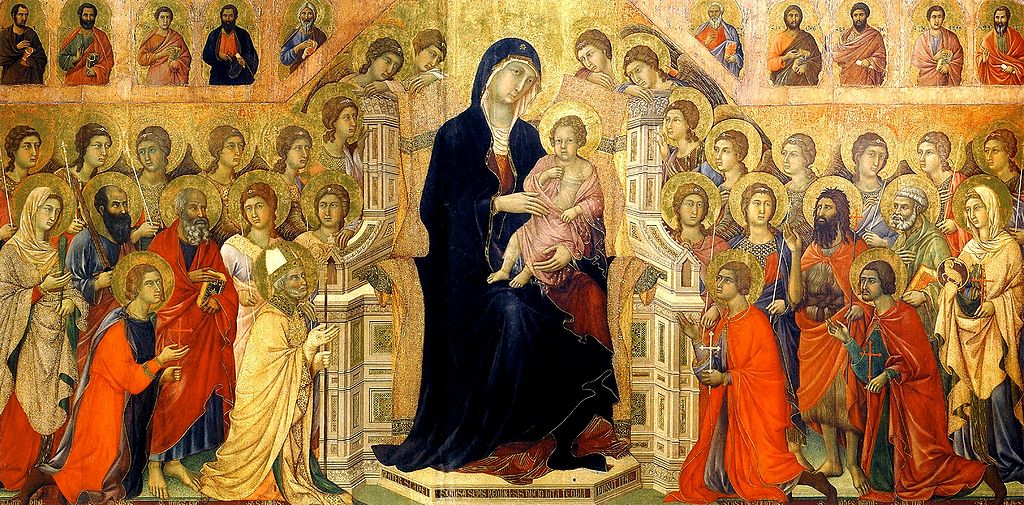
Source: Creative Commons
Duccio’s altarpiece is close to my heart because I feature it in my novel The Towers of Tuscany about a fictional woman painter in 14th century Italy who spent some time in Siena.
The museum also includes sculptures by Donatello, Pisano, and Jacopo della Quercia, a treasury that exhibits fabulous works by goldsmiths and jewelers, and a very rare collection of illuminated manuscripts.
I was in 7th heaven in this museum.

Practical Information for Visiting Siena
Siena is located about an hour south of Florence and 2 hours north of Rome in beautiful Tuscany. To read more about Tuscany (one of my all-time favorite places to visit in Italy), see my post on Tuscany and Umbria.
Here are other tour options in Siena and the surrounding countryside.
I recommend staying at least 2 nights in Siena to allow ample time to explore this wonderful city and to just relax in the Campo. Check out my suggestions for where to stay in Siena or use the interactive map below to find accommodations.
FAQs: Best Cathedrals in Europe
Some of Europe’s best cathedrals include Durham Cathedral in England, Chartres Cathedral in France, Siena Cathedral in Italy, and the Sagrada Familia in Barcelona. Each offers a unique blend of art, architecture, and history.
Art lovers should prioritize cathedrals known for stained glass, mosaics, and frescoes, such as Sainte-Chapelle in Paris, Chartres Cathedral, the Basilica of San Vitale in Ravenna, and Siena Cathedral.
No. A cathedral is defined as the seat of a bishop. Some of Europe’s most impressive religious buildings—including basilicas, abbeys, and chapels—are not technically cathedrals but are equally rewarding to visit.
Yes, for popular sites like the Sagrada Familia, Westminster Abbey, and Sainte-Chapelle, advance booking is strongly recommended, especially in high season.
Allow at least 60–90 minutes for major cathedrals, and longer for places like Siena Cathedral or the Sagrada Familia if you plan to explore museums, chapels, or towers.
Final Reflections
Europe’s cathedrals are far more than places of worship. They are repositories of human creativity, bringing together architecture, sculpture, painting, and light.
Standing beneath the Norman arches of Durham Cathedral, gazing up at the stained glass of Sainte-Chapelle, or wandering through the mosaic-filled sanctuaries of Ravenna invites you to slow down and look closely.
You don’t need religious faith to be deeply moved by Europe’s great cathedrals. Curiosity and attentiveness are enough to appreciate the artistry, history, and craftsmanship found inside these remarkable buildings.
If you enjoy learning about the building of the great Gothic cathedrals in Europe, then read Ken Follett’s Kingsbridge Series. The extraordinary novels chart the course of the fictional Kingsbridge Cathedral through four centuries. The prequel to The Pillars of the Earth (1989), The Evening and the Morning, was published in 2020.



Continue Your Artsy Journey Through Europe
If Europe’s great cathedrals have deepened your appreciation for art, architecture, and history, there are many other rewarding ways to continue that journey. From world-class museums to intimate, thoughtfully curated spaces, Europe offers endless opportunities to experience creativity across centuries and styles.
- 12 of the Best Modern Art Museums in Europe
- 7 Outstanding Single-Artist Museums in Europe
- 13 Unique & Unusual Museums in Europe Worth Seeking Out
[…] Cathedrals-My Best Picks […]
Spectacular, i didn’t know this is new to me is this really true? yeah, they’re things in life.
Congratulations on the site, also know mine:
https://strelato.com
.
[…] Sainte-Chapelle on the Île de la Cité still ranks as my all-time favorite religious structure. I first visited when I was 14 years old while on my epic trip around Europe with my mom, and I always pop in every time I’m in Paris. The joyful release I experience when stepping from the dark, winding staircase into the bright and airy stained-glass heaven of the upper chapel never gets old. I include Sainte-Chapelle in my post about the top cathedrals in Europe. […]
[…] And for more about Sainte-Chapelle, check out my post about the top cathedrals in Europe. […]