
Best Travel Gear for Europe: What I Pack and Why
I'm Carol Cram, novelist and arts travel writer, and founder of Art In Fiction, a curated database of 2,700+ novels inspired by the arts. Artsy Traveler contains affiliate links for products and services I personally use and recommend. As an Amazon Associate, I earn from qualifying purchases. Please read the Disclosure for more information.
After years of European travel, I’ve made every packing mistake worth making.
I’ve hauled backpacks that wrecked my shoulders, packed light and regretted it, bought cheap luggage that fell apart in Amsterdam, and once wore the same mauve Fortrel pantsuit for thirty days across Europe.
To be fair I was fourteen and have since learned better.
What follows is my practical guide to the travel gear I rely on: the suitcase I swear by, the packing tools that keep me organized, the tech that earns its weight, and the security essentials that give me peace of mind on the road.
This is not a list of gear I’ve been sent to review. This is the gear that makes it into my bag.
Table of Contents
Choosing Your Travel Bag
Your suitcase is the foundation of your entire packing system, and getting it right makes every other decision easier. After years of trial and error, including the Amsterdam incident I’ll get to in a moment, I’ve landed on a recommendation I stand behind completely: a 28-inch midsize hard-shell expandable suitcase with spinner wheels.
It should open flat with internal straps or a divider to keep all our stuff from spilling out, and include at least one large zippered compartment for dirty laundry.
Why Midsize
A midsize suitcase is the sweet spot for European travel.
It’s small enough to hoist onto train luggage racks, squeeze into compact European hotel lifts, and load into car boots without a wrestling match.
At the same time, it’s large enough to fit packing cubes, compression cubes, a pair of sandals, and a pair of nicer shoes for concerts and dinners out. I wear my walking shoes on the plane.
In winter, I wear my boots on the plane, ditch the sandals, and pack my walking shoes.
Another good thing about a midsize is that you probably won’t be able to cram so much stuff into it that it becomes too heavy to lift. Do you really fancy wrenching your shoulder every time you need to stash your bag in the trunk of the car or pull it onto a train?
Me neither.
To Check or Not to Check
I’m firmly TeamCheck, and I’ll tell you why.
Checking your bag means breezing through airport security carrying only your purse and a laptop bag. It means boarding the plane without elbowing anyone for overhead bin space. It means arriving at your seat, pulling out your laptop, and choosing your movies while everyone else is still playing Tetris with their carry-ons. And it means deplaning without wrenching your shoulder lifting a heavy bag down from the overhead bin or inadvertently bonking the person across the aisle on the head.
Yes, you’ll wait a few minutes at baggage claim. In my world, that trade-off is more than worth it.
Yes, airlines are charging for checked baggage and that extra cost is a consideration. But in my opinion, the extra you pay is worth it for the ease and convenience of traveling with a bag that fits your stuff.
The exception is a short trip of two or three days with tight connections. I’ve had bags go missing in transit and it’s no fun.
Buy Quality, Buy Once
Do not buy cheap luggage. I cannot stress this enough, and I have the Amsterdam story to prove it.
The handle of my budget midsize suitcase broke on the morning we were leaving Amsterdam to fly home to Canada. I found myself at Schiphol Airport hunting for a luggage store, paying a premium for a replacement suitcase I actively loathed (but had no choice), packing everything on the floor of the store while the very patient saleswoman looked on, and then hauling my broken suitcase to a bin for disposal.
A good quality suitcase is also the more environmentally responsible choice. Buying and discarding cheap luggage every few years is neither economical nor sustainable.
Matching the Bag to the Trip
Here’s how I think about bag size depending on the type of trip.
Carry-on works if you have two outfits you’re happy to alternate, a tolerance for doing laundry every few days, and a firm aversion to waiting at baggage claim.
Midsize works for most independent travelers taking trips of one to six weeks, which covers the majority of European itineraries.
Large works for cruises, where you unpack on day one and don’t pack again until the final day, or you’re my husband.
Gregg always travels with a large suitcase and has catapulted the art of traveling heavy to new heights. Most of his bag is occupied by a portable fan, power tools for dismantling exhibition crates, assorted pieces of wood for frames, and art materials. His clothes occupy a few corners.
But Gregg is a special case and we won’t dwell on him.
Track Your Luggage
One addition I now consider essential: an Apple AirTag or similar tracker tucked into your suitcase. If your bag goes missing in transit, a tracker gives you its precise location and considerably more leverage when dealing with airline baggage services.
For Android users, a Tile tracker does the same job. It’s a small investment for significant peace of mind.
Packing and Going
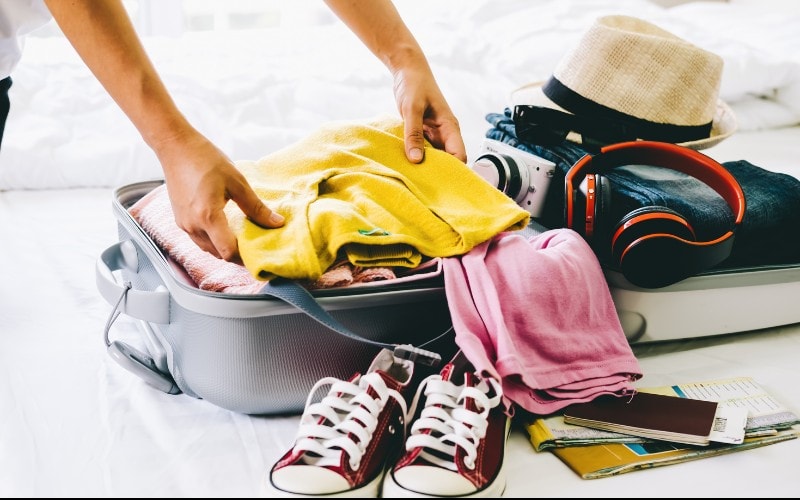
Okay, I’ll admit it. I love packing! Few things are more satisfying than laying all my stuff out on the bed and then systematically rolling and packing each item so everything fits perfectly with space left over for the fruits of foreign shopping.
Let’s address the packing light orthodoxy head on. Every travel blog tells you to pack light, do laundry in your hotel sink, and wear the same three outfits in rotation. That works if you’re twenty-two and backpacking.
It’s considerably less appealing when you’re heading to a concert at the Vienna Philharmonic or a nice dinner in Paris.
You know, not everything has to match! I know, heresy! But seriously?
My rule: pack enough variety that you won’t get bored, and enough socks and underwear to last a minimum of 14 days. Presumably you don’t do your laundry every three days at home, so why do it on the road?
A midsize suitcase gives you the room to do this comfortably without tipping into overpack territory.
What I Pack, Seasonally Adjusted
These days I take long trips of at least two months, which means getting everything into my midsize suitcase while still feeling like I have enough variety not to feel like I’m wearing a uniform.
Spring and Summer Travel
- Three pairs of pants or capris in black or beige; avoid white
- Two or three skirts or light dresses
- One nice dress or skirt and top combination for evenings out
- Six tops of varying weights that go with the pants and skirts
- Two sweaters, one of which can be a fleece
- A good jacket and a rain jacket
- Hat and scarf for cooler evenings
- Small stash of costume jewelry (I add to it as I travel)
- Bathing suit
- Enough underwear, and socks for at least 14 days
Fall Travel
Same as above, fewer dresses and more layers. On every trip, I’ve ended up buying a woolly hat and gloves for autumn days that can get downright chilly, so these days I take them from the get-go.
Cold Weather Travel
When I traveled to Iceland in February, I added winter boots, extra hats and scarves, gloves, thick socks, and long underwear. I made room by leaving behind most of my nicer clothes since staying warm was a considerably higher priority than looking good.
Warm Weather Travel
On a recent trip to Thailand, I ditched the sweaters entirely, added an extra bathing suit and a towel, and took only one pair of pants worn exclusively on the plane.
Most days I wore either a pair of light capris paired with a shirt that covered my shoulders for visiting temples or a light summer dress with sandals for beach days.
Packing for Cultural Travel
If your trip includes concerts, opera, theater, or nice restaurants, pack at least one outfit you’d be comfortable wearing to an evening performance. In my experience European concert-goers dress up to attend performances; I didn’t see a lot of jeans and sweats. You’ll feel more comfortable and confident in something a step up from sightseeing clothes.
I always pack one dress or a good skirt and top combination specifically for evenings out. After a day of museum-going, changing into something fresh before dinner makes the evening feel like a distinct pleasure rather than a continuation of the day.
Packing Cubes
Packing cubes are one of those travel investments that sound ridiculous until you use them, and then you wonder how you ever managed without them.
The system I use: roll pants, jackets, and sweaters into the extra-large cube; put shirts and tops into the large cube; stuff socks into the medium cube; and fill the small cube with underwear.
When you arrive at your destination, pull out the cube you need, extract the item you want, and replace it. No more rifling through layers of carefully folded clothes and destroying your packing system the moment you need a clean shirt.
I can’t begin to calculate how much time packing cubes have saved me over the years. Time I’ve spent more usefully snapping photos, drinking wine on terraces, and writing blog posts.
Compression Cubes and Vacuum Compression Bags
A compression cube is a zippered bag with a one-way valve that squeezes air out, compressing bulky items into flat, compact, waterproof packages. Use them for sweaters, fleeces, and jackets you’ll wear only occasionally. Save your regular packing cubes for everyday items. Note that compression cubes are for soft items only; books and hard objects won’t compress no matter how hopefully you sit on them.
I favor the compression cubes made by Osprey.
I’ve recently upgraded to vacuum compression bags, which use a small pump to remove air through a valve rather than relying on squeezing alone. The difference in compression is considerable.
A thick sweater that barely fit in a standard compression cube disappears into a flat, rigid package with a few pumps. They’re particularly useful for cold weather travel when you’re packing fleeces, down jackets, and bulky layers that would otherwise eat up half your suitcase. The pump is small enough to pack easily and worth every inch of space it takes up.
These bags from Snocod are a good bet.
Pouches
You need at least two pouches: one for electronics (cables, chargers, adapters, earbuds, and batteries) and one or two for toiletries. Pack small-size toiletries so you have the pleasure of shopping for local brands on the road.
Gregg particularly enjoys hunting for aftershave in Italy and Spain, where the scents are, for reasons I’ve never understood, considerably better than anywhere else.
Handbags and Day Bags
For everyday sightseeing, I carry a small crossbody bag with a zippered compartment for my passport, space for my phone, and a slim wallet for cash, an ATM card, and two credit cards.
My bag of choice is a Baggallini, which is light, washable, and worn across the body to discourage theft.
I carry my laptop in a small backpack. Keep your day bag as light and uncluttered as possible. You’ll be walking a lot.
Tip: I use a large safety pin to anchor my wallet to the lining of my bag. That way, I can never accidentally drop my wallet and it also adds a barrier for pickpockets.
Tech, Security, and Comfort Essentials
Walking Shoes
This is the most important item in your bag and the one most travel gear guides bury at the bottom of a list. In Europe, you walk. A lot. Ten thousand steps is a light day of sightseeing. Twenty thousand is not unusual.
Invest in a pair of comfortable, well-broken-in walking shoes before you leave home. Do not bring new shoes to Europe.
Breaking in shoes on cobblestones in Florence is an experience I would not wish on anyone. On a trip to France back in my misspent youth, I made the mistake of taking a new pair of walking shoes. I ended up walking in my socks for half the trip because my blisters were so bad. It wasn’t pretty (or comfortable).
I wear my walking shoes on the plane and pack a pair of sandals and a pair of smarter shoes without heels for evenings out.
Food Bag
Pack a soft-sided, collapsible insulated bag. It’s invaluable for keeping food cool during transit and on day trips.
We fill ours with yogurts, cheeses, vegetables, and fruit, and pick up fresh rolls at local bakeries for picnic lunches.
For more on eating well without overspending while traveling in Europe, read How to Eat Well in Europe: Dining Tips and Smart Splurges.
Power Adapters
When traveling in Europe, you need a good supply of adapter plugs. Most continental European countries use two-round-pin outlets (Type C, E, and F), which are incompatible with North American plugs. The United Kingdom uses a different three-pin plug entirely, so if your itinerary includes both, you need both adapters.
Buy these before you leave home. Finding them in Europe, even at large electronics stores, is a headache. We once searched the entire FNAC in Paris, one of France’s largest electronics chains, without success.
Buy at least four more adapters than you think you’ll need. On just about every trip, we lose a few. I don’t know where they go; they’re like socks in a dryer. Here’s a 6-pack deal.
If you have three devices to plug in at night, take six adapters. Trust me on this.
Power Bank
A portable power bank is essential for long days of sightseeing when your phone is working hard as a map, camera, ticket wallet, and translation device. Carry one that holds at least two full charges for your phone. Your phone dying in an unfamiliar city is an inconvenience that a small investment prevents.
Anker is a trusted brand.
Staying Connected: eSIM
Before you leave home, set up an eSIM for your destination countries. An eSIM is a digital SIM card that gives you local data rates without swapping physical SIM cards or paying ruinous roaming charges.
I use Airalo, which offers eSIM packages for individual countries, regions, or the whole of Europe. You purchase and activate before you leave, and you’re connected the moment you land.
Read my full Airalo review for more details.
Laptops and Tablets
A laptop or tablet is worth bringing for longer trips. Wi-Fi is now essentially universal in European hotels, and having your own device means you can manage bookings, check emails, and watch something decent in the evenings.
English-language TV in European hotels ranges from limited to nonexistent.
Smartphones
A smartphone is now as essential as your passport.
I remember with equal fondness and horror the pre-smartphone days: trekking to train stations to read paper schedules, trudging rain-slicked streets hunting for a bed and breakfast, and running out of cash only to find that every bank within fifty kilometers was closed and nobody accepted traveler’s cheques.
Those were the days. I confess I sometimes miss the serendipity that comes from not always knowing exactly where you are, where you’ll eat, what you’ll see, and so on. On the other hand, it is nice not getting lost so often.
Today a smartphone handles train tickets, accommodation bookings, restaurant research, navigation, translation, and currency conversion.
Documents: Before You Leave
Make digital and physical copies of your passport, credit and ATM cards, travel insurance, and any other important documents before you leave home. Store digital copies in a cloud service you can access from any device.
Make sure you leave a physical copy with someone at home and carry a second copy separately from your originals. If your wallet or passport goes missing, having copies saves hours of stress and speeds up replacement considerably.
Security: Money Belts and Locks
For peace of mind in busy cities and transit hubs, wear a money belt. I prefer the style worn around the waist under clothing. Gregg favors a neck pouch for storing his passport when in transit.
At hotels, use the in-room safe for passports and extra cash. Most safes use a four-digit combination you set yourself. Choose something memorable but not obvious.
Note: In Italy, you are required to carry your passport (not a copy) on your person at all times. Tourists have been stopped and in some cases fined.
A small travel lock for your luggage is worth having for trains and public areas. Some travel bags include built-in combination locks.
RFID Blocking
If you use contactless credit or debit cards, an RFID blocking wallet or card sleeve prevents the cards from being scanned without your knowledge. It’s a simple, inexpensive precaution worth taking in busy tourist areas.
Noise-Canceling Headphones
A good pair of noise-canceling headphones transforms long flights and train journeys.
They’re also useful for blocking out ambient noise in hotel rooms and for listening to music or podcasts during long drives. I consider them essential rather than optional for trips of more than a few days. Bose is a good brand.
Travel Gear FAQs
For most independent travelers taking trips of one to six weeks, a 28-inch midsize hard-shell expandable suitcase with spinner wheels is the sweet spot. It’s large enough to pack comfortably without doing laundry every few days, small enough to fit in the train luggage racks at the end of the carriages and squeeze into compact European hotel lifts, and unlikely to become so heavy you can’t lift it. Buy quality and buy once. Cheap luggage is a false economy, as I discovered the hard way at Schiphol Airport.
For trips longer than two or three days, I strongly recommend checking a midsize bag. You’ll breeze through security, board without the overhead bin scramble, and deplane without wrenching your shoulder. The few minutes at baggage claim are a small price for a considerably more comfortable travel experience. Carry-ons make sense for very short trips or when you have tight connections and can’t risk a bag going missing.
Yes, without reservation. Packing cubes keep your clothes organized, make unpacking and repacking fast, and mean you can find what you need without destroying your entire packing system every time you want a clean shirt. Once you travel with them you won’t go back. Compression cubes and vacuum compression bags are worth adding for bulky items like sweaters and jackets.
Most continental European countries use two-round-pin outlets (Type C, E, and F). The United Kingdom uses a three-pin plug. If your itinerary includes both, you need both adapters. Buy them before you leave home since finding them in Europe can be surprisingly difficult. Buy more than you think you need. They disappear.
Yes, and set it up before you leave home. An eSIM gives you local data rates across Europe without swapping physical SIM cards or paying roaming charges. I use Airalo, which offers packages for individual countries, regions, or all of Europe. Being connected means Google Maps works, transit apps work, and you can look up museum hours, restaurant reviews, and train times on the fly. Read my full Airalo review for more details.
Good walking shoes that are already broken in, a midsize suitcase, packing cubes, power adapters, a power bank, an eSIM, a crossbody bag for daily sightseeing, and a money belt for transit and busy tourist areas.
Pack at least one outfit suitable for an evening performance or nice restaurant. European concert halls and opera houses skew toward smart casual at minimum, and you’ll feel more comfortable and confident in something a step up from your sightseeing clothes. Beyond that, pack enough variety that you’re not wearing the same three outfits in rotation, and enough socks and underwear to last at least fourteen days. Life is too short for hotel sink laundry.
Keep Traveling Smart with Artsy Traveler
Continue building your travel skills with these practical guides from Artsy Traveler:
- How to Plan a European Trip: 9 Easy Steps for a Perfect Itinerary
- Finding the Best Accommodation in Europe: My Top Tips
- Driving in Europe: Top Tips for Happy & Safe Travel
- How to Eat Well in Europe: Dining Tips and Smart Splurges
- Smart Green Travel: Practical Ways to Travel Sustainably
- How to Travel and Stay Healthy in Europe: Practical Tips for Avoiding Illness on the Road
- Airalo ESIM Review: The Best Way To Stay Connected Abroad
Would you like to save this post?

Carol M. Cram writes novels inspired by the arts; runs Artsy Traveler, an arts-focused travel blog, and Art In Fiction, a curated database of 2,700+ novels inspired by the arts; and hosts The Art In Fiction Podcast. She has also authored 60+ textbooks on computer applications and taught at Capilano University for over two decades. Carol lives with her husband, artist Gregg Simpson, on beautiful Bowen Island near Vancouver, BC.




 See all my novels