Best Tips for Visiting Beethoven House in Bonn
Artsy Traveler contains affiliate links for products and services I personally use and can happily recommend. As an Amazon Associate, I earn from qualifying purchases. Please read the Disclosure for more information. If you make a purchase through these links, at no additional cost to you, Artsy Traveler earns a small commission. Thank you!
Beethoven House Museum (known as Beethoven-Haus) in Bonn, Germany, is the place for fans of classical music (like me!) The museum is housed in the birthplace of Ludwig van Beethoven.
As one of the most popular museums in Germany, Beethoven House (Beethoven-Haus) provides music lovers with three three floors of displays in one of the few remaining Baroque townhouses in Bonn.
While staying in Cologne, I made a day trip to Bonn, where I visited Beethoven’s birthplace, strolled through the car-free center of Bonn, and enjoyed a walk alongside the Rhine to admire the passing boats. If you have time, you can even take a boat tour down the Rhine.
This post is part of my guide to artsy & independent travel in Germany, where I share my best tips for exploring Germany’s historic cities, music, and cultural experiences.
Table of Contents
At a Glance
- Take a boat tour from Bonn to Konigswinter.
- Explore Beethoven-Haus Museum and communing with Beethoven.
- Stroll along the Rhine on the wide promenade.
- Discover the old town of Bonn.
- Stay in Cologne at a hotel overlooking the Rhine.
Getting to Bonn
I advise staying in Cologne, where there is lots to do, and then taking the train or the metro to Bonn. The trip takes about 30 minutes on the train and 50 minutes by metro, depending on where in Cologne you are staying.
I took the train from Cologne to Bonn and then the metro back. The metro is about 1/4 the price of the train, and not that much slower. Also, the train which I took from the Koln Sud station (you could also catch it from the main station in Cologne) was extremely crowded with nowhere to sit.
By contrast, the ride on the metro was very pleasant, with quite a bit of the journey skirting the Rhine with beautiful views.
A few years ago, I drove to Bonn and ended up in a major traffic jam, and then couldn’t find a parking lot with space. I had to reluctantly abandon my plan to visit Beethoven-Haus on that trip.. The train is your safest bet.
Once in Bonn, stroll from the train station down to the Rhine to enjoy the view and maybe stop for a drink at one of the riverside cafés. Here’s the view of boats plying the Rhine that we enjoyed while sipping a ginger lemonade:

From the Rhine, walk back to the main part of Bonn and head for Beethoven-Haus at Bonngasse 20 (und 24-26).
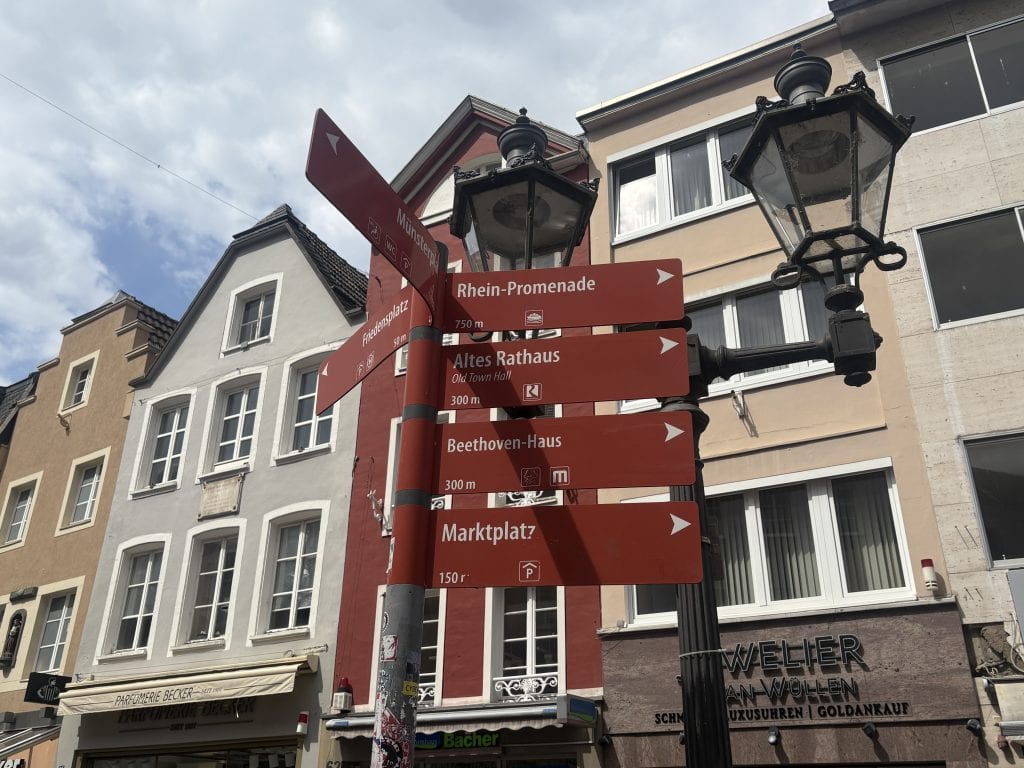
Starting Your Visit at Beethoven-Haus in Bonn
Across the street from the house where Beethoven was born is a building housing the gift shop and ticket office. Go there first to buy your tickets.
If you’ve already bought them online (recommended), verify that you’re entering at the right time and date.
TIP: The museum is small, so to avoid disappointment, buy your tickets in advance for a specific time slot.
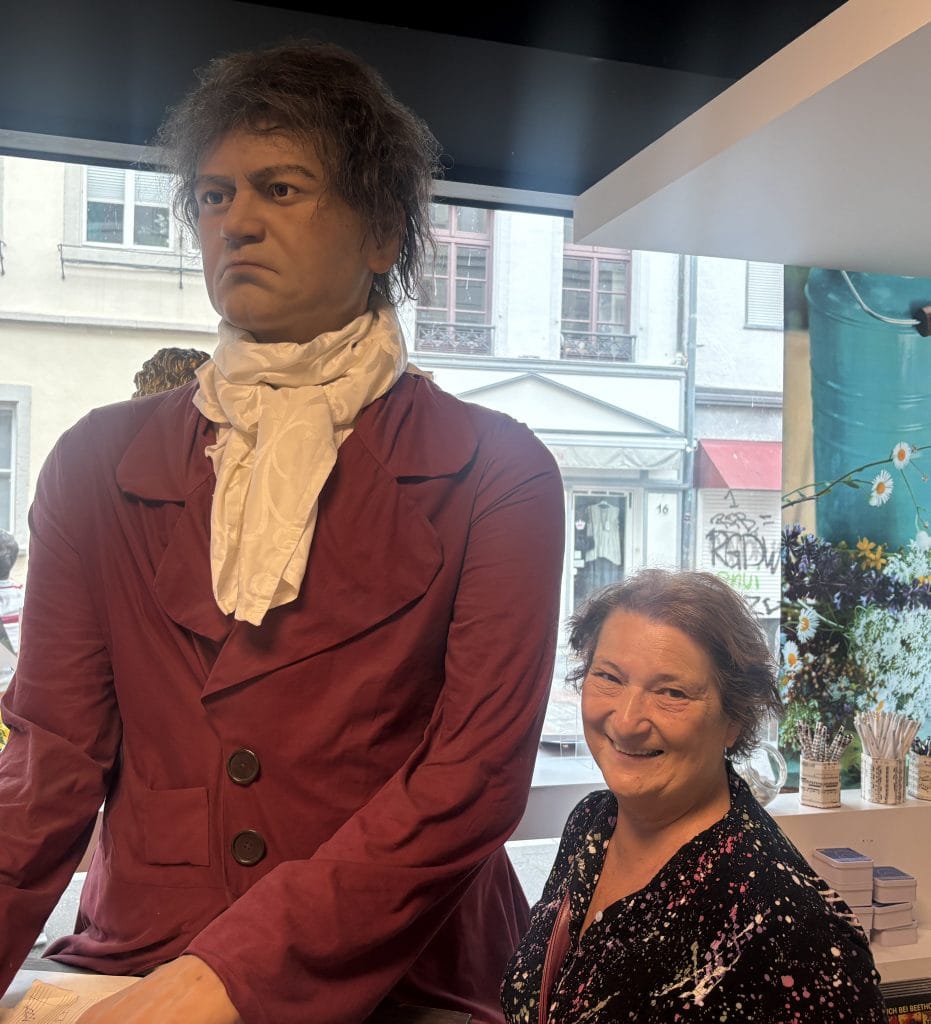
In the gift shop is a massive seated figure representing Beethoven at work. Like legions of Beethoven lovers before me, I had my picture taken standing next to him.
I then crossed the street to the house in which Beethoven was born on December 17th (or possibly December 16th) in 1770 and spent the first three years of his life.
Get the Audioguide
At the entrance to Beethoven-Haus, the attendant handed me a sheet with a QR code to scan to download the audioguide. While you can enjoy the displays spread across three floors without the audioguide, it does provide you with more in-depth information about what you’re looking at.
The first thing you’ll learn by listening to the audioguide is that the house is the only one in Bonn in which the Beethoven family lived that has survived.
When the house was for sale in 1889, a group of wealthy businessmen purchased it and established the Beethoven House Association that to this day manages the site.
Touring Beethoven-Haus
Ground Floor
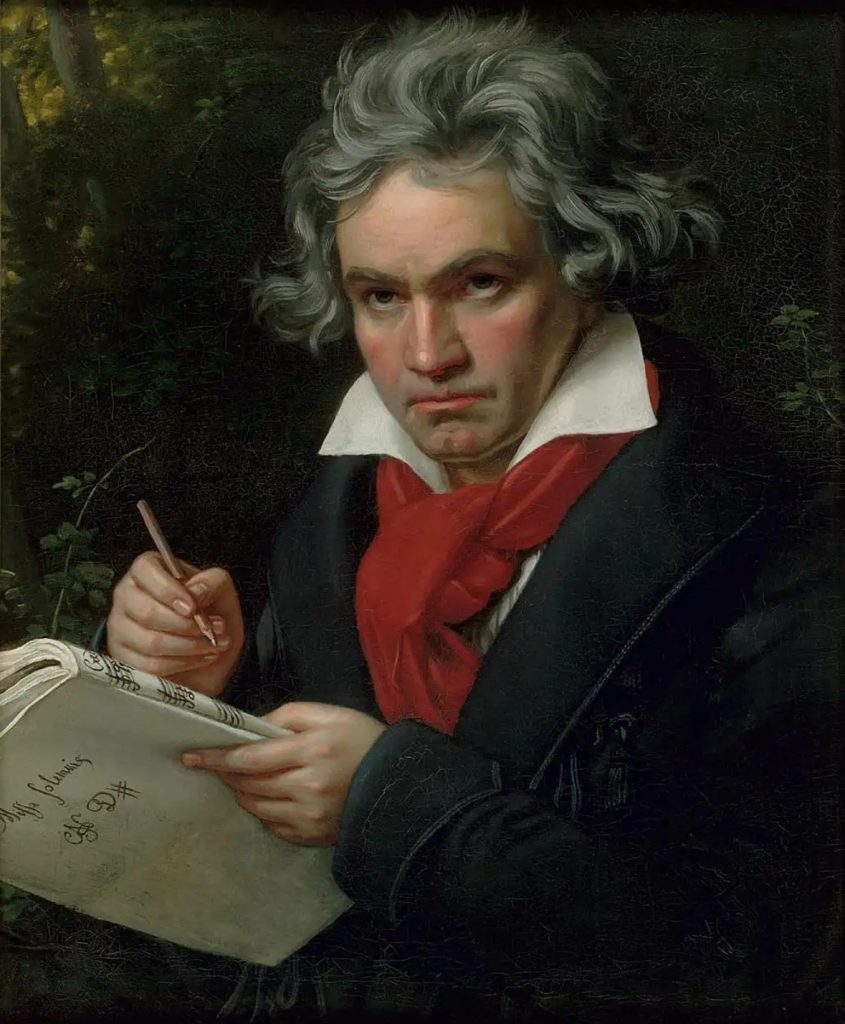
The first room you enter on the ground floor contains several of the many portraits and sculptures of Beethoven created during his lifetime. The most famous portrait of the great composer is by Joseph Stieler. It’s highly romanticized and idealized, and the only portrait showing Beethoven at work.
At the back of the house on the ground floor are displays from Beethoven’s childhood including the record of his christening. Historians don’t know if he was born on December 16th or 17th, only that he was christened on December 17th.
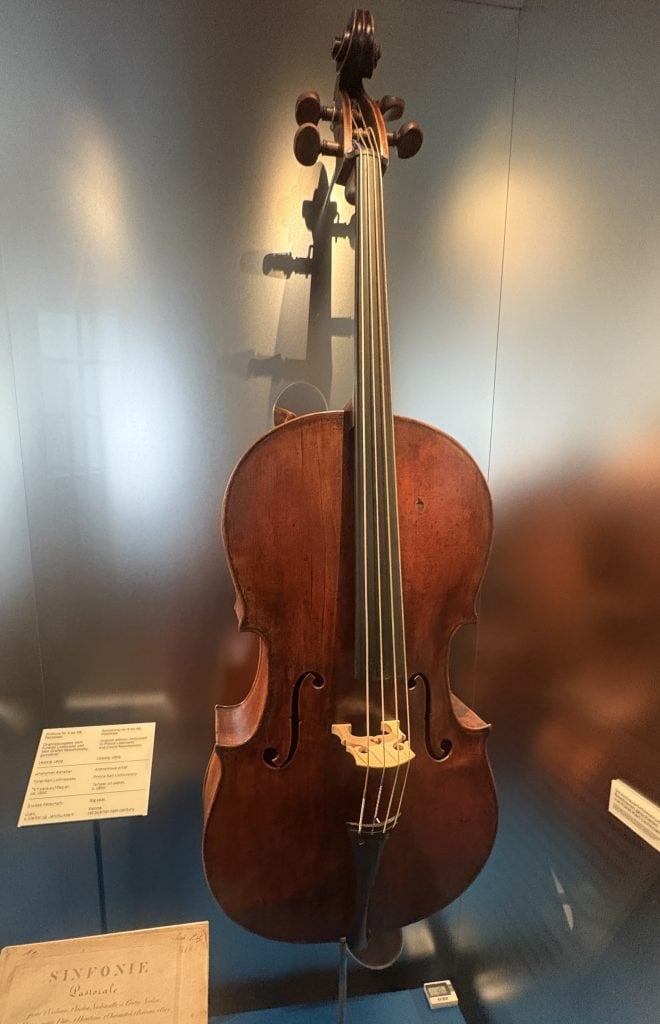
One of the displays is Beethoven’s viola, which he started playing at the age of 19 when he became a court musician. Up until that time, he was primarily known as a pianist, performing in his first public concert when he was just seven years old.
First Floor
Climb the narrow staircase to the first floor where you’ll find displays about Beethoven’s life and work. I was intrigued by the receipt from Beethoven’s publisher that records payment for five works, including the Fifth Symphony.
Beethoven made a lot of his money selling the publishing rights to his pieces in countries all over Europe.
I was also surprised to see his eyeglasses and learn that Beethoven was short-sighted. None of the portraits show him wearing glasses.
Also on this floor are displays related to some of Beethoven’s friends, mostly in Vienna where he lived after leaving Bonn as a young man.
Second Floor
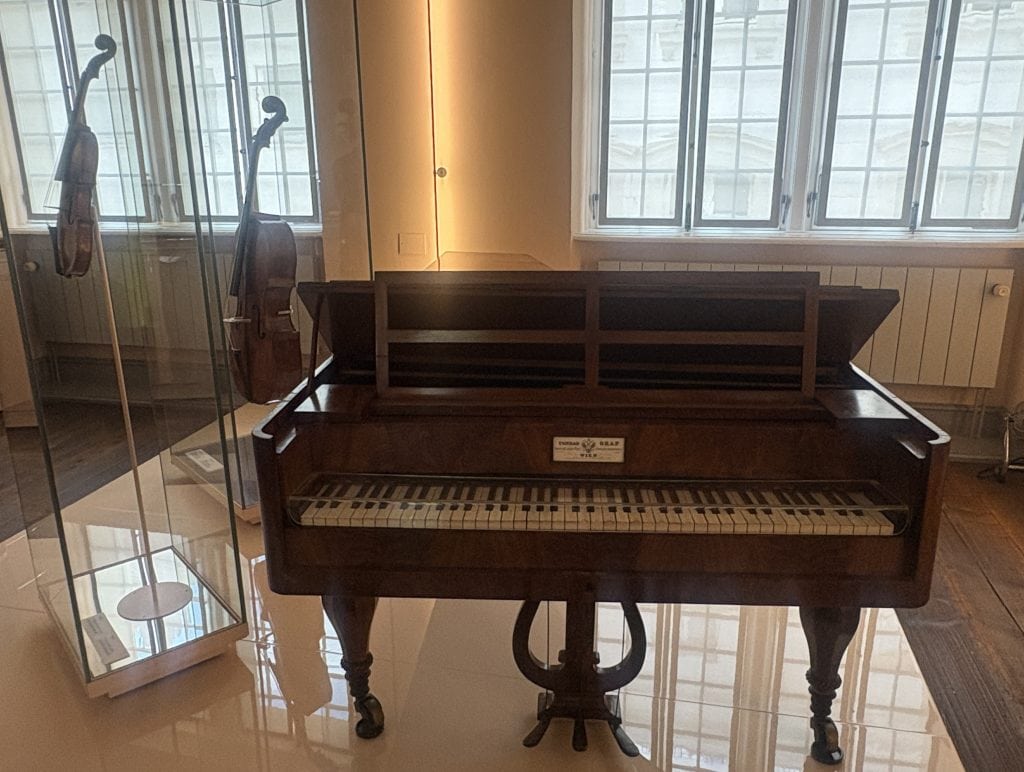
This was my favorite floor because it focused primarily on Beethoven and his work. Included is one of his pianos along with many of his manuscripts written in his characteristically illegible scrawl.
I couldn’t begin to decipher the notes and marveled at the patience of the publishers who managed to do so in order to produce the music I’ve been playing since I was about twelve and could manage an octave!
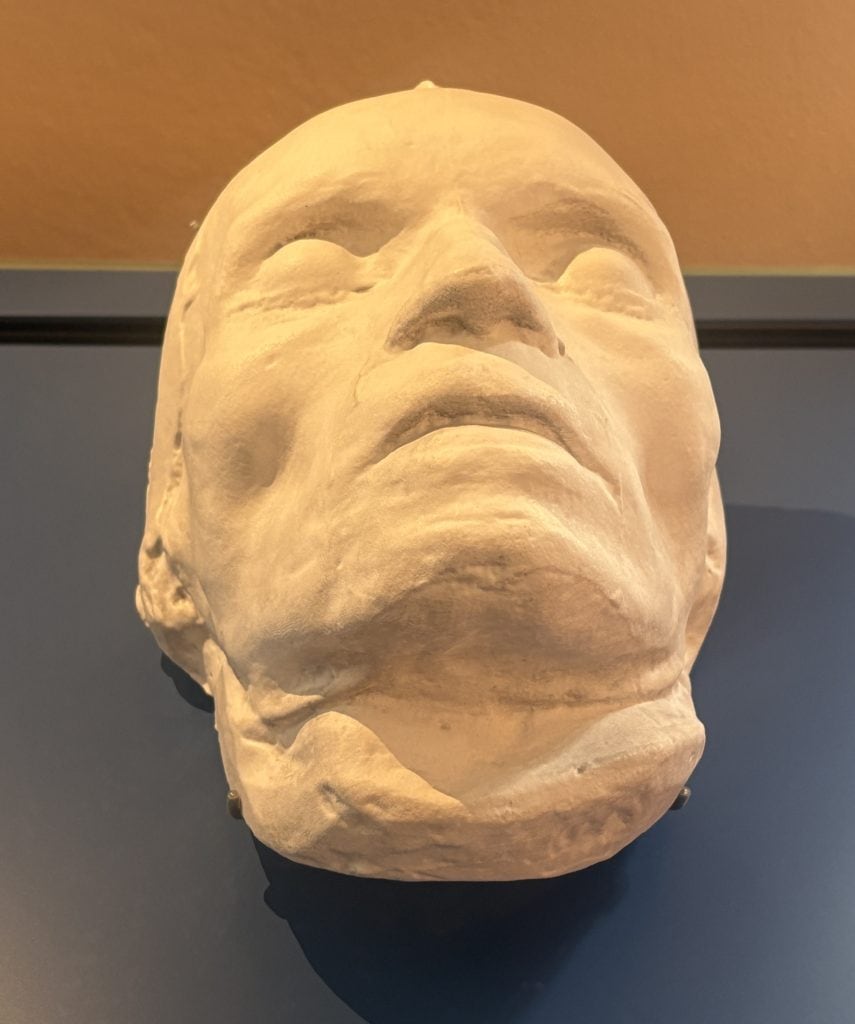
The floor also includes displays related to Beethoven’s tragic hearing loss which began in his early thirties when he was at the height of his fame. The display of ear trumpets is particularly poignant as is this replica of Beethoven’s death mask.
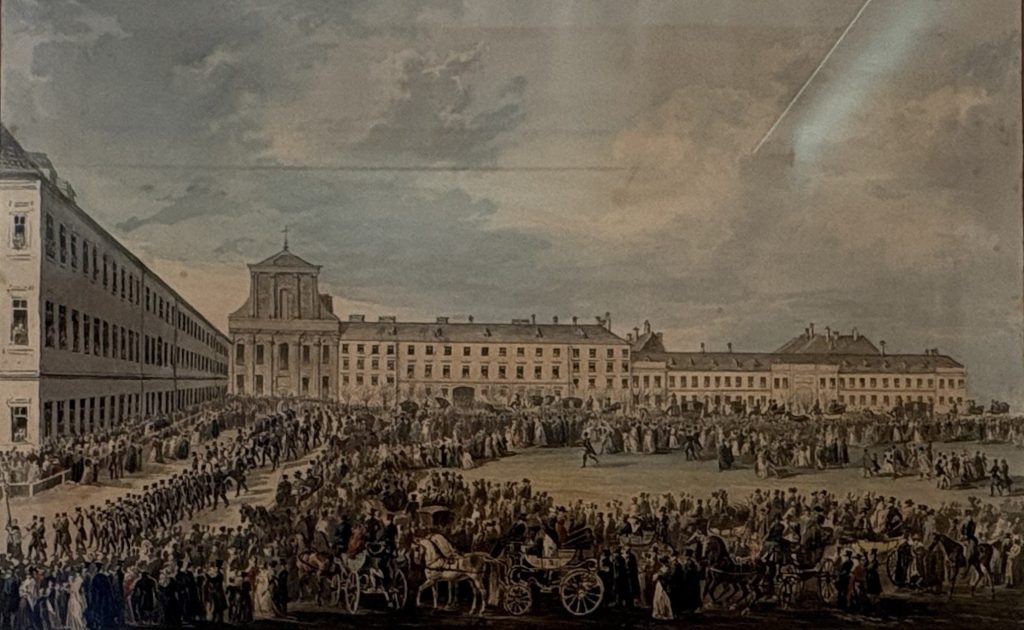
And finally, I was pleased to see a reproduction of a painting depicting Beethoven’s funeral on March 27, 1826. Between 10,000 and 30,000 people turned turned out to watch Beethoven’s casket pass by. Beethoven was very famous and a good chunk of Vienna wanted to pay tribute to the maestro.
My second novel, A Woman of Note, about a female composer in 1830s Vienna, opens with a description of Beethoven’s funeral. I looked at this painting many times during my research to get a sense of what the procession may have looked like.
Courtyard
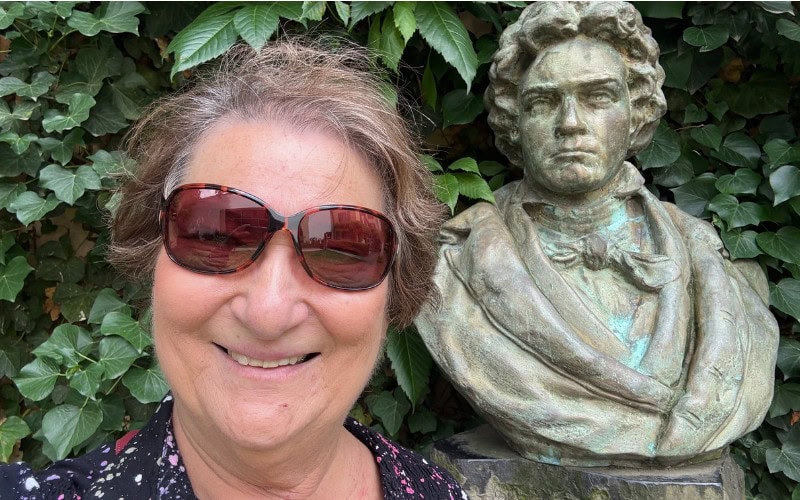
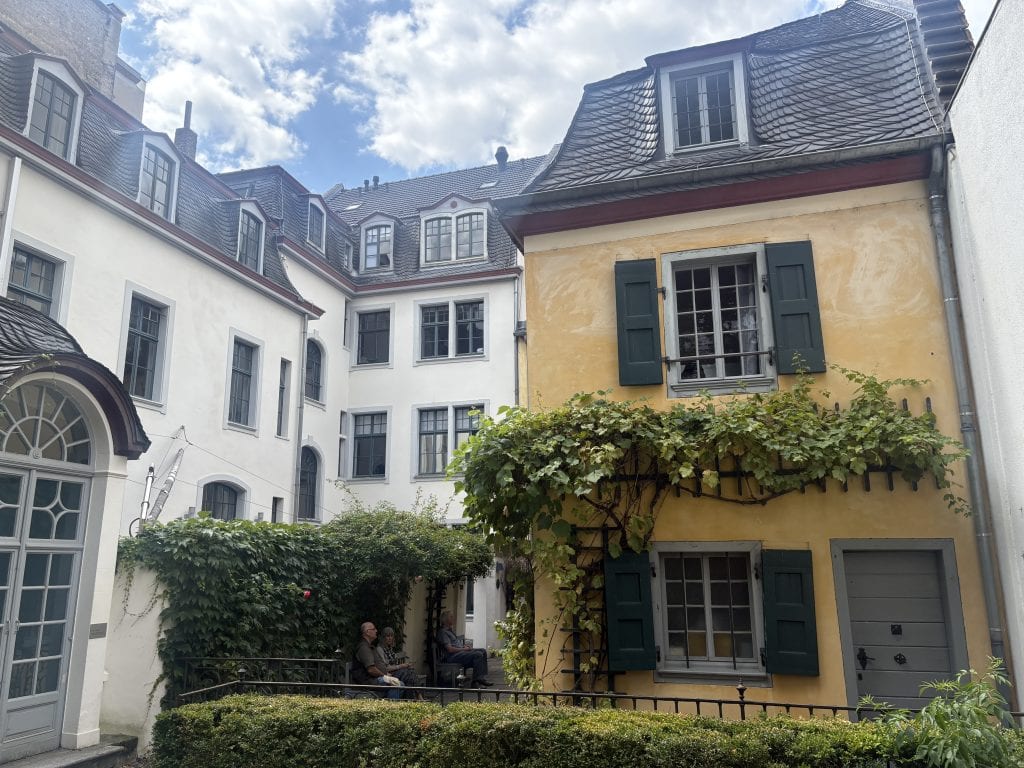
After touring the house, go back downstairs and out into the tranquil courtyard. If you’re lucky, as I was, you’ll find it deserted. Snap a picture of yourself with a bust of Beethoven and then settle onto a bench to enjoy the quiet.
Music Room at the Beethoven-Haus
To finish your visit, make sure you enter the adjacent building. Here, you can sit and enjoy a performance of the Moonlight Sonata. The manuscript that Beethoven wrote, with all its spikes and crossings-out, is projected onto the wall and a light follows the notes as they are played.
I’ve played this sonata many times and was thrilled to hear it played while looking at the actual notes that Beethoven wrote.
Gift Shop
After communing with the maestro in his house and listening to Moonlight Sonata, your very last stop is, naturally, the gift shop. Here, you’ll find plenty of Beethoven-themed schlock that is perfect for the Beethoven lover in your life.
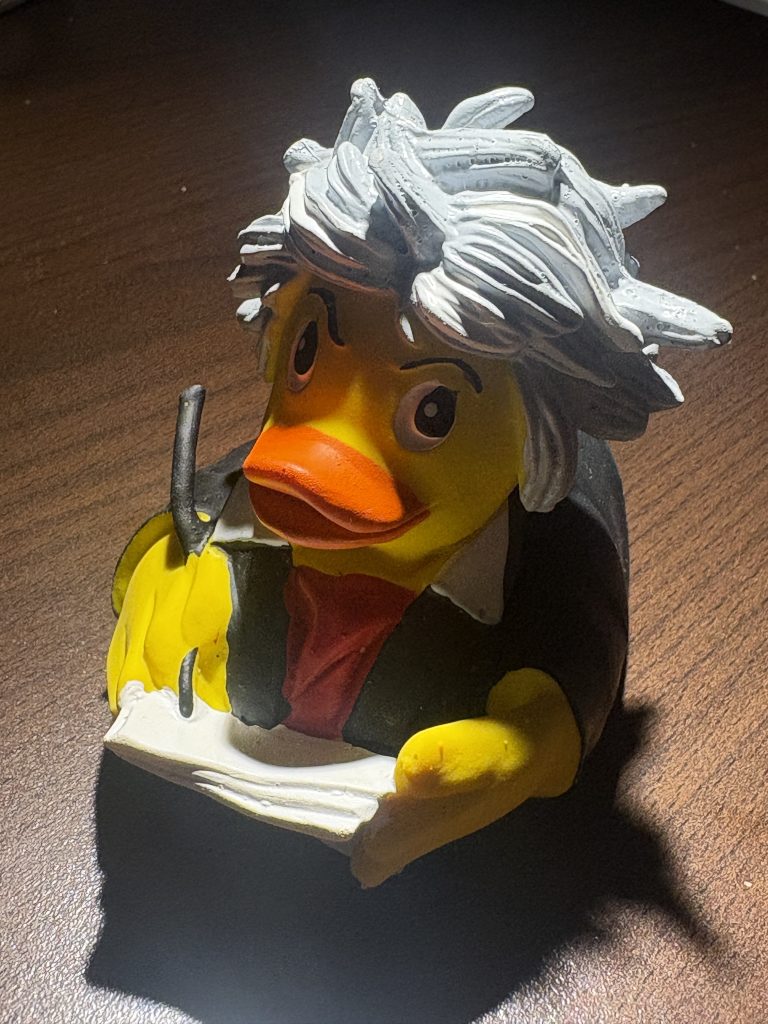
I resisted everything only to be seduced by the tackiest item in the shop, a Beethoven duckie. He sits on my desk as I write. His quill is poised, his hair wild and his orange beak opened just a touch as if ready to tell you all about his latest masterpiece.
Practical Information
The Beethoven-Haus (Bonngasse 20 and 24-26) is situated on the edge of the pedestrian zone within easy walking distance of the main station.
Opening hours are Wednesday to Monday from 10 am to 6 pm (open only to pre-booked groups on Tuesdays). Cost is €14 for adults and €7 for children.
Other Music Museums Worth Visiting
While I enjoyed visiting Beethoven-Haus and communing with the spirit of the young Beethoven, I was even more excited by the Beethoven museums in Vienna. Here, you can visit some of the apartments in which Beethoven lived and worked, and gain a much deeper undrestanding of his music.
Vienna is also home to museums dedicated to Hadyn, Mozart, Schubert, and Strauss, among others. Read more in my post A Music Lover’s Guide to Vienna.
Also check out the Bach Museum in Leipzig, which is the best music museum I’ve ever visited. Read more here.
Staying in Cologne
As mentioned, consider staying in Cologne rather than in Bonn. Cologne as a lot to offer with its museums, cathedral, and lively riverfront area. Here you can watch the locals go by while enjoying a great meal. Don’t forget to sample a glass (or two) of Kölsch, a local beer brewed only in Cologne. It goes down very easy.