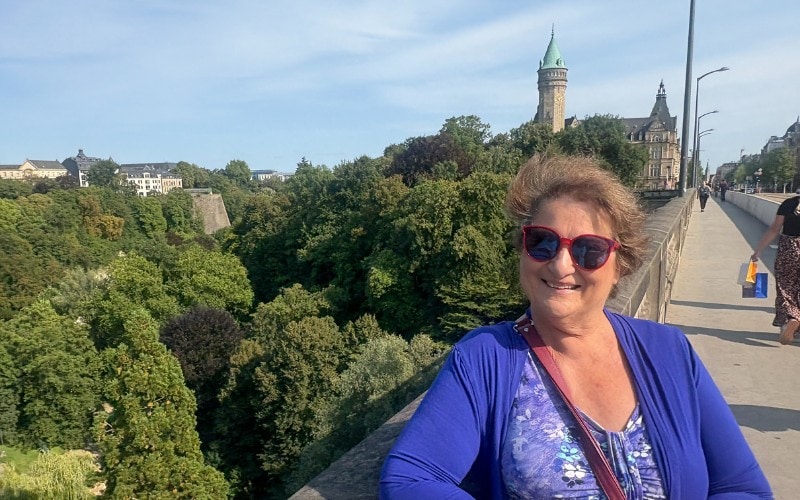
How to Spend Two Nights & One Day in Luxembourg City
I'm Carol Cram, novelist and arts travel writer, and founder of Art In Fiction, a curated database of 2,700+ novels inspired by the arts. Artsy Traveler contains affiliate links for products and services I personally use and recommend. As an Amazon Associate, I earn from qualifying purchases. Please read the Disclosure for more information.
Luxembourg City makes a great choice for a laid-back two-night stay. While it may be short on blockbuster sights, it’s long on understated charm.
I didn’t feel the pressure to do Luxembourg the way I might Amsterdam or Rome or Paris. Instead, I could just hang out, explore, and soak up the relaxed, Luxembourgish vibe.
Yes—Luxembourgish is a real language! It’s one of Luxembourg’s three official languages, along with French and German.
Locals use the term “Luxembourg” to refer to both the capital (Luxembourg City) and the country itself—the Grand Duchy of Luxembourg, the world’s only remaining grand duchy. In this post, I focus on the city, but if you have time, venture farther into this small, history-steeped nation.
Table of Contents
- Luxembourg At a Glance
- Map of Sightseeing Options in Luxembourg City
- Where to Stay in Luxembourg City
- Strolling into Town: Architecture and Bridges
- Exploring the Ville Haute (Upper Town)
- Suggested One-Day Itinerary in Luxembourg City
- My (Less-Than-Ideal) Morning
- Afternoon Walking Tour
- Visiting the Grund
- Final Impressions of Luxembourg City
- Day Trip to Vianden
- Luxembourg FAQs
- Keep Exploring Europe with Artsy Traveler
Luxembourg At a Glance
- Stay at Pétrusse Élite Suites.
- Take a walking tour.
- Stroll the Chemin de la Corniche.
- Sample Luxembourgish cuisine.
Map of Sightseeing Options in Luxembourg City
How Long to Stay in Luxembourg?
My visit spanned two nights and one full day, which felt just right. You can do Luxembourg on a day trip from Belgium or Germany, but I recommend staying at least one night to enjoy its quiet elegance and gorgeous architecture.
Where to Stay in Luxembourg City
I stayed at Pétrusse Élite Suites (#1 on the map), a small aparthotel tucked away on a side street in the embassy district, a pleasant 15-minute walk to the city center.
It turned out to be an excellent choice. The neighborhood was blissfully tourist-free, with convenient parking at Parking Martyrs (#2). Our suite was clean, modern, spacious, and quiet.
A unique touch: the elevator opened directly to our suite. Each floor houses one suite, and we were given an elevator key for direct access. It felt very James Bond.
While you could stay closer to the center in a large hotel, you’ll pay for the privilege. Even Pétrusse Élite Suites was around €200 per night. However, it offered a small kitchen, and there was a shared lounge and full kitchen on the ground floor.
Here are some other options for staying in Luxembourg City:
Strolling into Town: Architecture and Bridges
After settling into our comfy digs, we walked toward the old town via the Adolphe Bridge (#3), also known as the New Bridge (built in 1903).
It spans the lush Pétrusse Valley, while the Old Bridge (called La Passerelle and built in 1859 – #4) runs parallel to it.
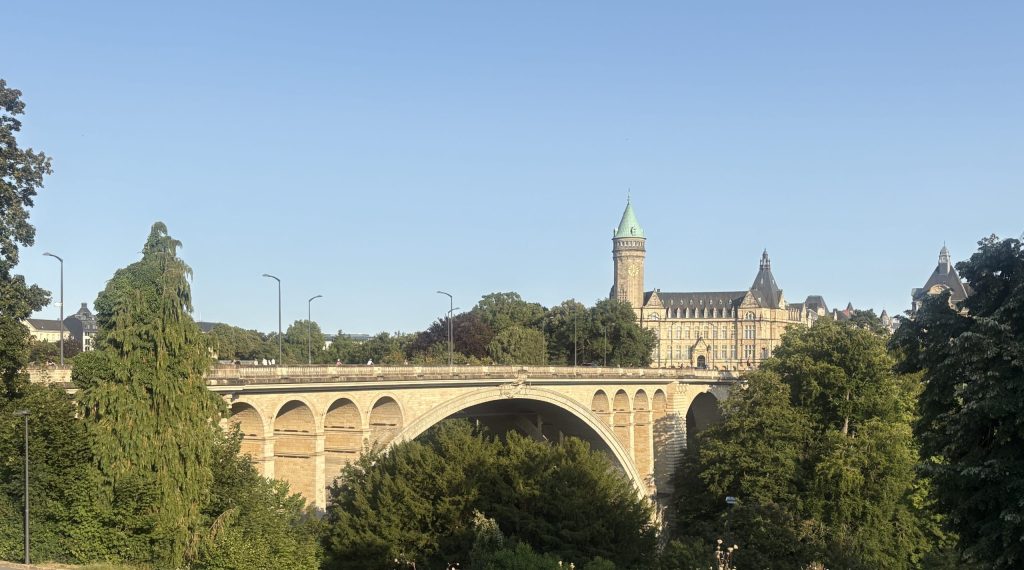
From both bridges, you might glimpse the Pétrusse Creek which flows into the Alzette River winding picturesquely through the Grund, one of the most photogenic areas in the city.
Despite their relative youth (by European standards), both bridges are lovely examples of late 19th-century/early 20th-century engineering and design.
Free Public Transport
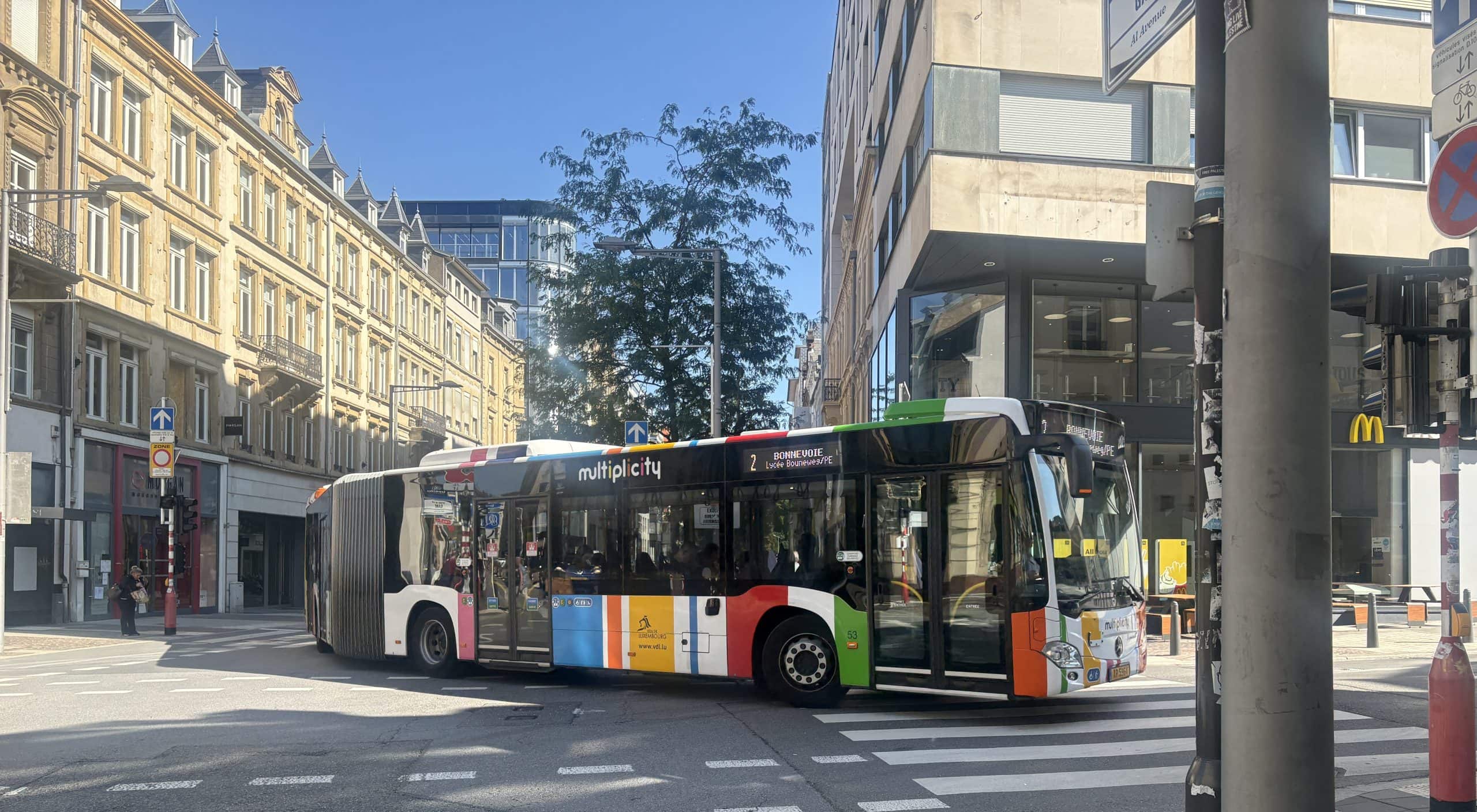
One of Luxembourg’s delights? All public transportation is free—buses, trams, and even trains within the country.
This makes it easy to use Luxembourg City as a home base for exploring the rest of the country without a car.
Exploring the Ville Haute (Upper Town)
Luxembourg’s Ville Haute (#5) is full of pedestrianized streets, wide plazas, fountains, and outdoor cafés. We strolled as far as Place d’Armes (#15), people-watched, and enjoyed the relaxed energy.
With the day winding down and with us recovering after a tiring car ride from Cologne about three hours to the north, we found a sidewalk café.
As we’ve learned to do over many trips to Europe, we ordered an appetizer and a main course to “partager”. That’s almost always enough food for us, particularly if followed either by a dessert at the restaurant or a gelato while strolling back to our hotel.
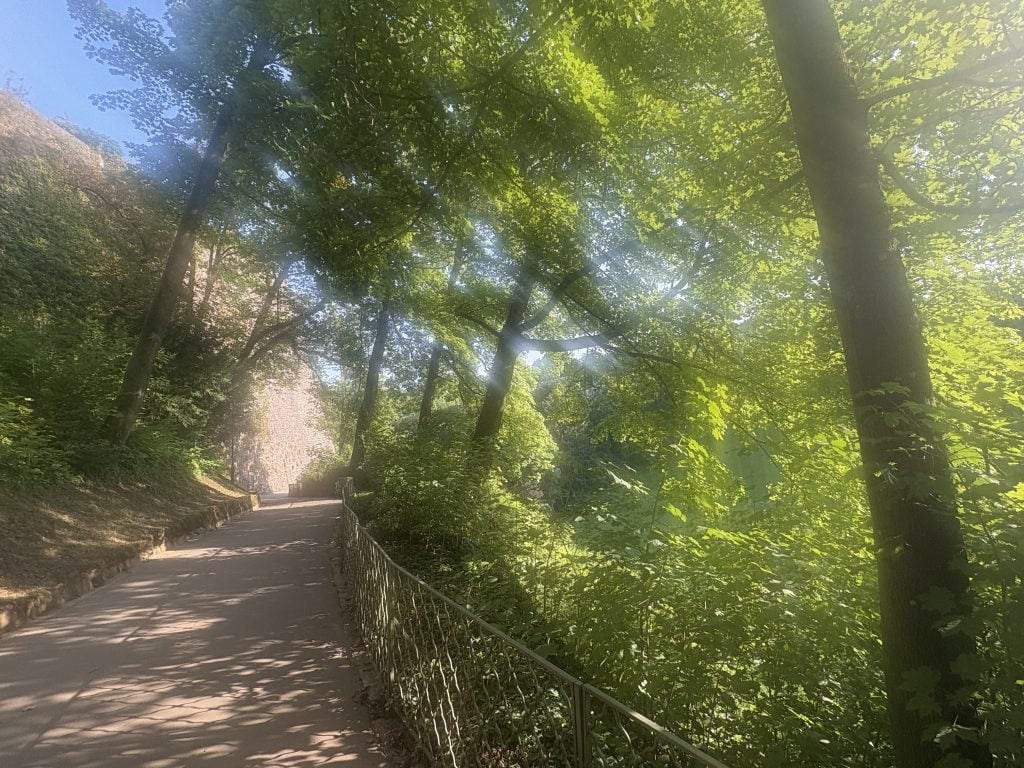
After dinner, we descended below the road to walk a while in the valley.
Sylvan paths beckoned in the twilight and we were alone, apart from a few locals also out strolling or jogging. So far, we’d barely seen anyone who looked like a tourist.
Suggested One-Day Itinerary in Luxembourg City
If you are spending two nights in Luxembourg City with one full day for sightseeing, here’s how I recommend spending your day:
Morning
- Option 1: Tour the Casemates, underground fortifications dating to the 1600s (UNESCO site).
- Option 2: Visit a museum like MUDAM (contemporary art) or MNAHA (national art & history).
Lunch
- Bazaar Bar and Restaurant (#6) on Place Guillaume (#7) for excellent Lebanese cuisine. If you’re lucky, you’ll get Jean-Paul as your server. He was friendly and let us stumble along in French, only helping out when we faltered.
Afternoon
- Take a guided walking tour of the city.
Evening:
- Descend to the Grund via the free public elevator, enjoy the views, then return to Upper Town for dinner.
- Try to get a table at Café-Restaurant Um Dierfgen (#22) for authentic Luxembourgish cuisine (reserve in advance!).
The Luxembourg Pass
If you plan to visit multiple museums and attractions, the Luxembourg Pass covers entry to many sites including the Casemates, MUDAM, and MNAHA, and is available for one, two, or three days. Worth considering if museums are a priority.
My (Less-Than-Ideal) Morning
Full disclosure: I didn’t get to the casemates or museums. I spent the morning tracking down a new laptop charger after leaving mine in Cologne (thank you, MediaMarkt near Luxembourg Station-#8).
Fortunately, the friendly English-speaking staff helped me out. Assuming you’re not in need of emergency electronics, here’s what you should do in the morning.
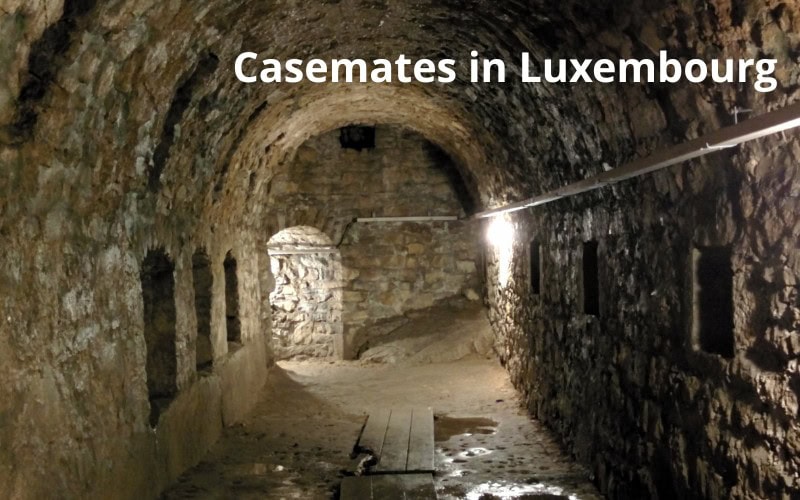
Tour the Casemates
The Bock Casemates (#9) and Pétrusse Casemates (#10) are an essential part of Luxembourg’s military history and a major draw for history buffs. Originally carved in the 17th century by the Spanish, the tunnels helped earn Luxembourg the nickname “Gibraltar of the North“.
- Bock Casemates offer spectacular views over the Grund.
- Entrance: €8 (adults) / €4 (children, students)
- Purchase tickets here
- Hours: Daily from 10 AM to 5 PM, April through November
Visit MUDAM: Contemporary Art in a Stunning Building
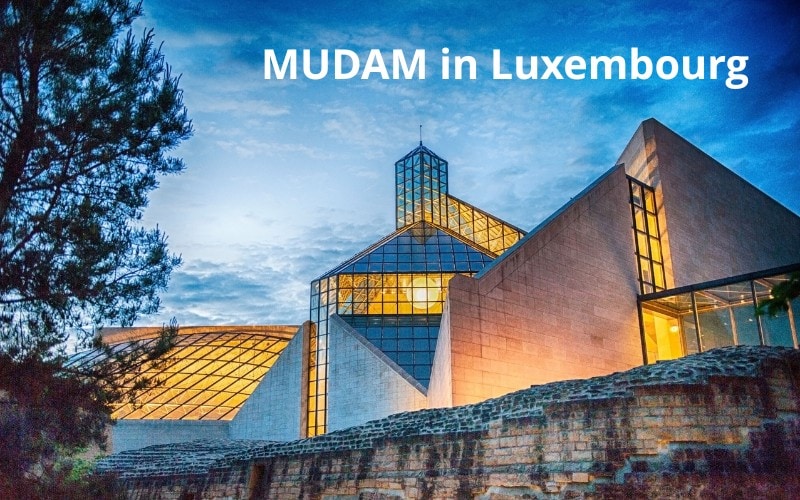
Designed by famed architect I. M. Pei (who designed the Louvre pyramid), the Musée d’Art Moderne Grand-Duc Jean (MUDAM – #11) features a variety of contemporary art exhibitions.
As is often the case with contemporary art museums, the building is just as interesting as the exhibitions, sometimes more so. If you enjoy contemporary art, put MUDAM on your list.
- Hours: Tuesday–Sunday, 10 AM–6 PM (open until 9 PM on Wednesday)
- Location: Kirchberg Plateau, easily reached by tram or bus
Visit MNAHA: National Museum of History and Art
Located in the old town, MNAHA (#12) displays works and artifacts from all epochs of Luxembourg history. You’ll find a mosaic from the Roman villa at Vichten dating back to 240 AD, a fine collection of objects from medieval Luxembourg, Art Deco items from the porcelain manufacturer Villeroy & Boch, and much more.
Also nearby:
- Luxembourg City History Museum (#12)
- Natural History Museum (in the Grund – #13)
Afternoon Walking Tour
I joined a two-hour walking tour starting at the statue of Guillaume II in Place Guillaume (#7). Gregg stayed in the hotel doing what he loves to do best, which is drawing, since he’s a visual artist.
He doesn’t do walking tours!
Our small group was multi-lingual, and the guide delivered info on each stop in English and German.
Some Luxembourg Facts
The guide provided us with many stories related to Luxembourg’s long history and traditions. We learned that Luxembourg is one of the capitals of the European Union, together with Strasbourg and Brussels, and that several EU offices are based here, including the Secretariat of the European Parliament and the Court of Justice of the European Union.
Fun fact: Only 30% of Luxembourg’s population are native Luxembourgers. The rest hail from all over the world, reflected in the multicultural streets, restaurants, and languages heard everywhere.
Notre-Dame de Luxembourg
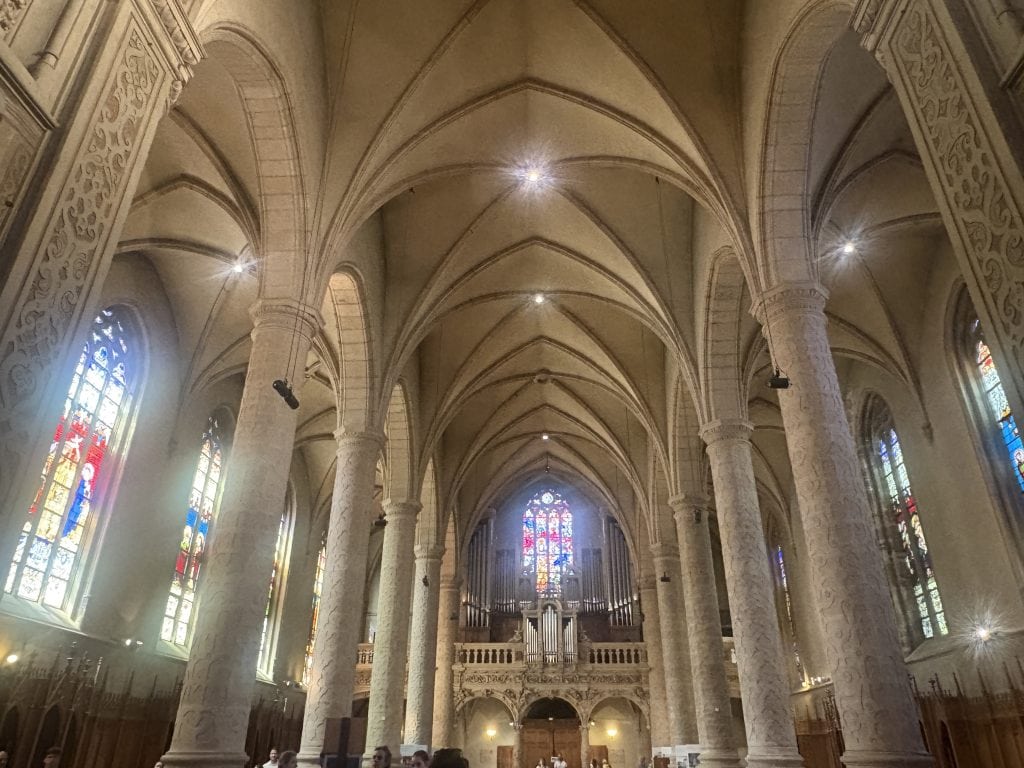
We ducked into Notre-Dame de Luxembourg (#16), a pleasingly well-proportioned cathedral built in 1603 in the late Gothic style.
Grand Ducal Palace
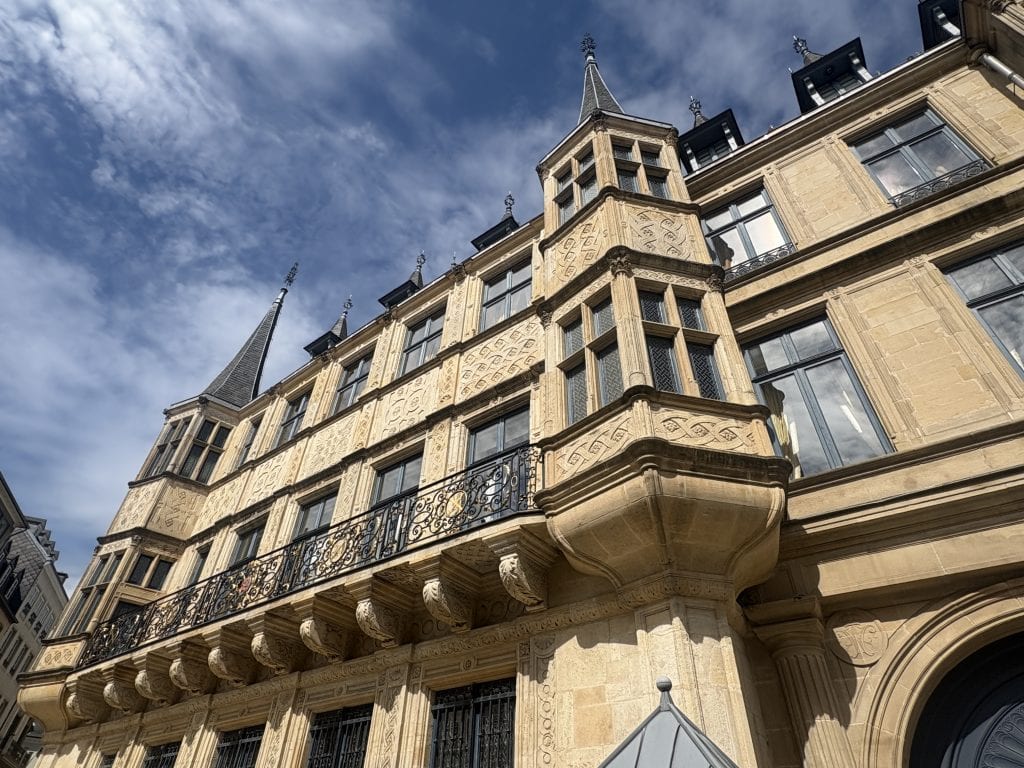
We then entered the old town and walked past the Grand Ducal Palace (#17). The guide showed us pictures of the current Grand Duke and his family and told us that the Grand Duke would soon abdicate in favor of his eldest son.
Pope Francis Anecdote
While walking past a café, the guide related the charming story of when Pope Francis visited Luxembourg several years ago.
While progressing down the narrow street in his popemobile with his entourage and body guards, Pope Francis apparently asked to stop so he could get an espresso at the café.
Inside, he found a young couple, the woman pregnant with her first child. Being the pope, he blessed the unborn child and a few months later the Luxembourg papers were full of news about the birth of their son. No prize for guessing what they named him!
Chemin de la Corniche
From the Ducal Palace, we emerged onto the famous Chemin de la Corniche (#18) and enjoyed panoramic views of Luxembourg with the Grund district below and the skyscrapers of modern Luxembourg in the distance.
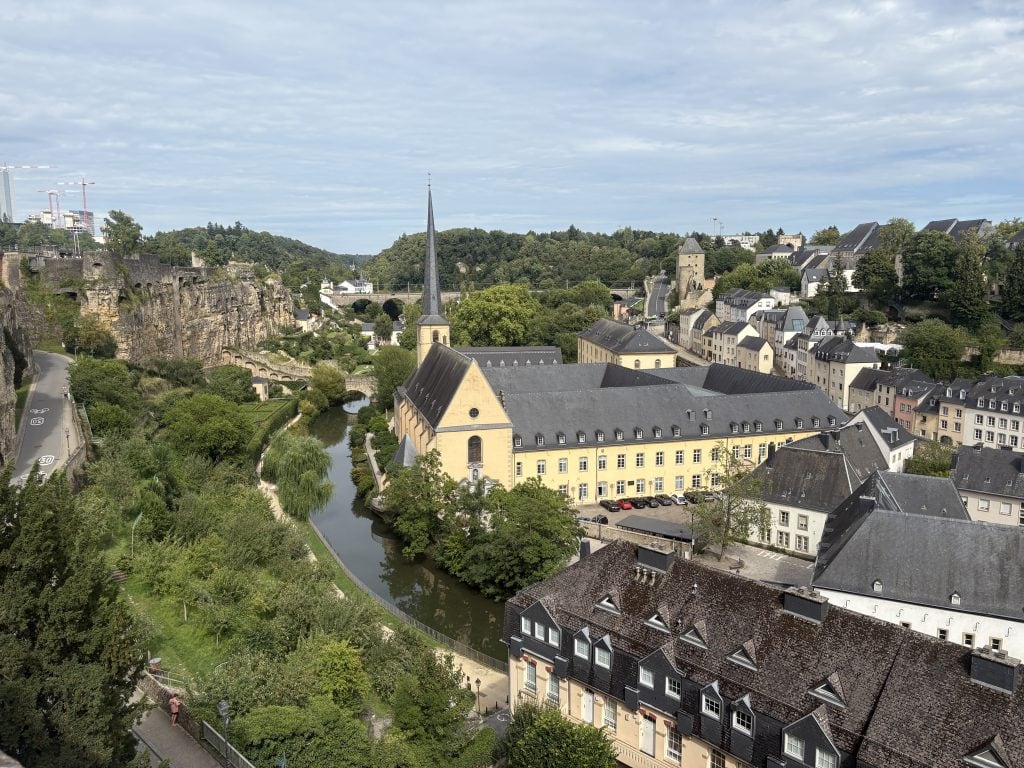
Here was where I encountered tour groups for the first time since coming to Luxembourg. I’m wondering if tour buses sweep in, park, take the walk along the corniche to admire the view, and then sweep out again. I didn’t see tour groups anywhere else.
No matter. I snapped photos along with everyone else and learned about the history of the Grund.
Back in the day, the houses bordering the river in the deep valley, considered a very poor area, were home to artisans. Now, apartments in the Grund are expensive and the area is a UNESCO World Heritage site.
I was relieved when the guide informed us that the easiest way to get down to the Grund was to take the free elevator. Otherwise, it is a steep walk down—and back up.
Sampling Madeleines
At the end of the tour, the guide took us to a small pastry shop called Alegria (#19), where we were each given a freshly baked madeleine.
Perfectly crunchy on the outside and soft and chewy inside, the madeleines were baked under the supervision of Carole Lesquer, a famous chef who retired and opened the patisserie in her native Luxembourg.
Visiting the Grund
Later in the day, Gregg and I returned to the Grund (#20) via the scenic Old Bridge.
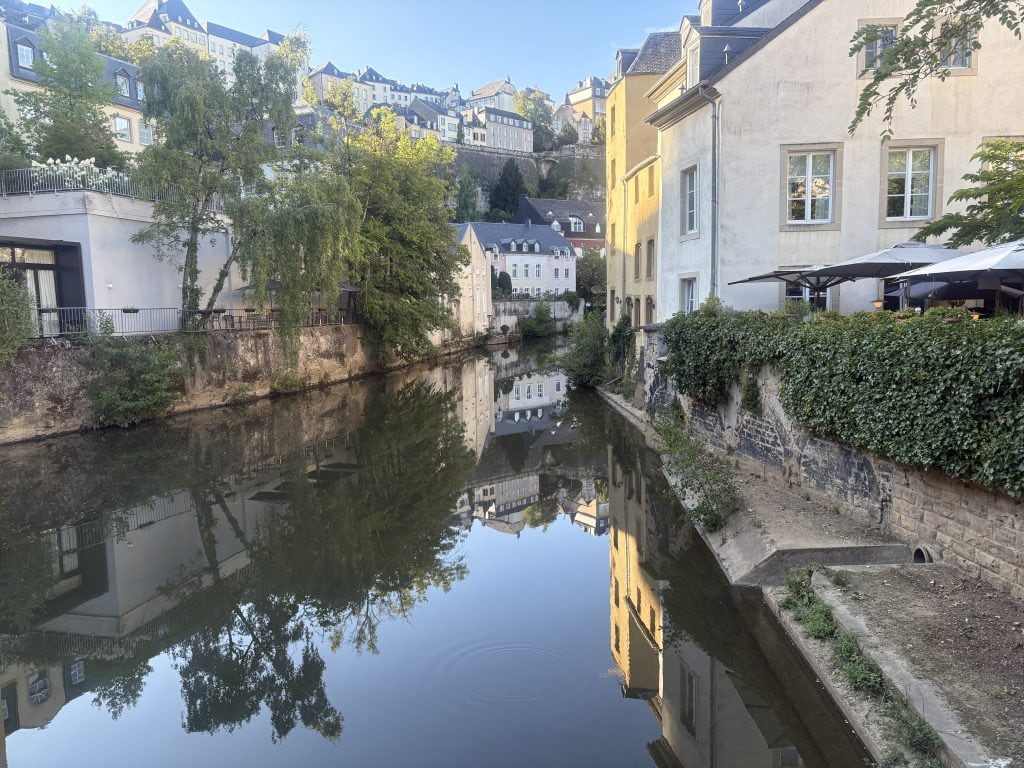
We took the elevator down and walked along the Alzette River, admiring the medieval architecture and quiet vibe. There aren’t many restaurants, but you’ll find a few bars, pizzerias, and one Michelin-starred spot (beyond our budget).
You can also choose to take the Pfaffenthal Elevator (#21) down. This free glass-bottomed elevator connects the upper town to the lower Pfaffenthal district and offers spectacular views on the way down. It’s one of those only-in-Luxembourg experiences that costs nothing and takes five minutes.
We visited in the late afternoon, and the golden light made for gorgeous photos. Highly recommend timing your visit for sunset.
Final Impressions of Luxembourg City
Luxembourg is clean, well ordered, and architecturally lovely—a mix of French and German traditions, but with its own unique flair.
It reminded me a bit of Genovia from The Princess Diaries: a tiny, wealthy kingdom with immaculate streets, designer shops, and fairy-tale charm.
But it’s not all polished perfection. I was panhandled multiple times in just 24 hours, unusual for Western Europe.
Still, it’s a lovely place to spend a couple of nights, especially if you’re looking for something quieter and less touristed than major European capitals. Here are some other tours to consider with GetYourGuide:
Day Trip to Vianden
If you have a second day or an afternoon to spare, Vianden is an easy and rewarding day trip from Luxembourg City, about 45 minutes by car or an hour by bus and train.
The star attraction is Vianden Castle, one of the most impressive medieval fortresses in Europe, perched dramatically above the Our River valley. Largely restored in the 20th century, the castle is remarkably intact and gives a genuine sense of what medieval life looked like for the ruling classes. The views from the ramparts alone are worth the trip.
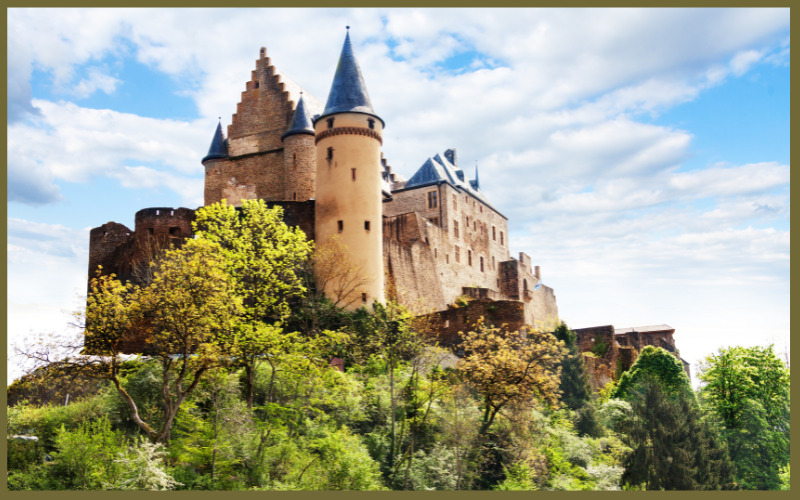
The town itself is charming and compact, with a historic main street, several good restaurants, and a chairlift that rises above the valley for an aerial view of the castle and surrounding forest.
Victor Hugo spent time in Vianden in 1871 and the house where he stayed is now a small museum. For a literary-minded traveler, it’s a must-do addition to the castle visit.
Vianden is also known for its violets. The town celebrates an annual violet festival each spring that draws visitors from across the region. That would be worth timing your visit around if you’re visiting Luxembourg in spring.
Vianden is easiest to reach by car. By public transport, take the train from Luxembourg City to Ettelbruck and then a connecting bus to Vianden. The journey takes about an hour each way but is straightforward and, of course, free.
Luxembourg FAQs
Absolutely. Luxembourg City is one of Europe’s most underrated capitals, offering gorgeous architecture, world-class contemporary art, UNESCO-listed fortifications, and a relaxed atmosphere that feels worlds away from the crowds of Paris or Amsterdam.
Two nights and one full day is ideal. You can visit Luxembourg on a day trip from Belgium or Germany, but staying at least one night lets you enjoy the city at a slower pace and experience it after the day-trippers have gone.
Yes. All public transportation in Luxembourg is free, including buses, trams, and trains within the country. This makes it easy to explore beyond the city without renting a car.
The Chemin de la Corniche is a scenic promenade in Luxembourg City’s old town offering panoramic views over the Grund district and the modern city beyond. It’s one of the most photographed spots in the country and part of Luxembourg’s UNESCO World Heritage site.
The two standouts are MUDAM, a stunning contemporary art museum designed by I. M. Pei, and MNAHA, the National Museum of History and Art, which traces Luxembourg’s history from Roman times to the present.
The Grund is Luxembourg City’s lower town, a picturesque district of medieval architecture and winding streets along the Alzette River. Once home to artisans, it’s now a UNESCO World Heritage site and one of the most atmospheric areas in the city.
The Casemates are a network of underground tunnels and fortifications carved into the rock beneath Luxembourg City, originally built by the Spanish in the 17th century. They earned Luxembourg the nickname “Gibraltar of the North” and are now a UNESCO World Heritage site open to visitors.
Staying in or near the embassy district offers a quieter, more local experience with convenient parking and easy walking distance to the old town. The Pétrusse Élite Suites is a comfortable aparthotel option with spacious suites and a unique elevator-to-your-floor setup.
Keep Exploring Europe with Artsy Traveler
Here are some other posts about European destinations that are not thronged with tourists.
- Beyond Romeo and Juliet Spending a Wonderful Week in Verona
- Two Must-See Museums in The Hague
- How To Spend Two Wonderful Days in Charming Nafplio in Greece
- Staying Overnight in Ghent: The Perfect One-Night Stop for Arts Lovers
- Peaceful Piacenza: Why Visit and What To See
Have you visited Luxembourg City? Share your recommendations for other artsy travelers in the Comments below.
Would you like to save this post?

Carol M. Cram writes novels inspired by the arts; runs Artsy Traveler, an arts-focused travel blog, and Art In Fiction, a curated database of 2,700+ novels inspired by the arts; and hosts The Art In Fiction Podcast. She has also authored 60+ textbooks on computer applications and taught at Capilano University for over two decades. Carol lives with her husband, artist Gregg Simpson, on beautiful Bowen Island near Vancouver, BC.

 See all my novels