
How to See Elephants in Chiang Mai Without Guilt: Sunshine for Elephants Review
I'm Carol Cram, novelist and arts travel writer, and founder of Art In Fiction, a curated database of 2,700+ novels inspired by the arts. Artsy Traveler contains affiliate links for products and services I personally use and recommend. As an Amazon Associate, I earn from qualifying purchases. Please read the Disclosure for more information.
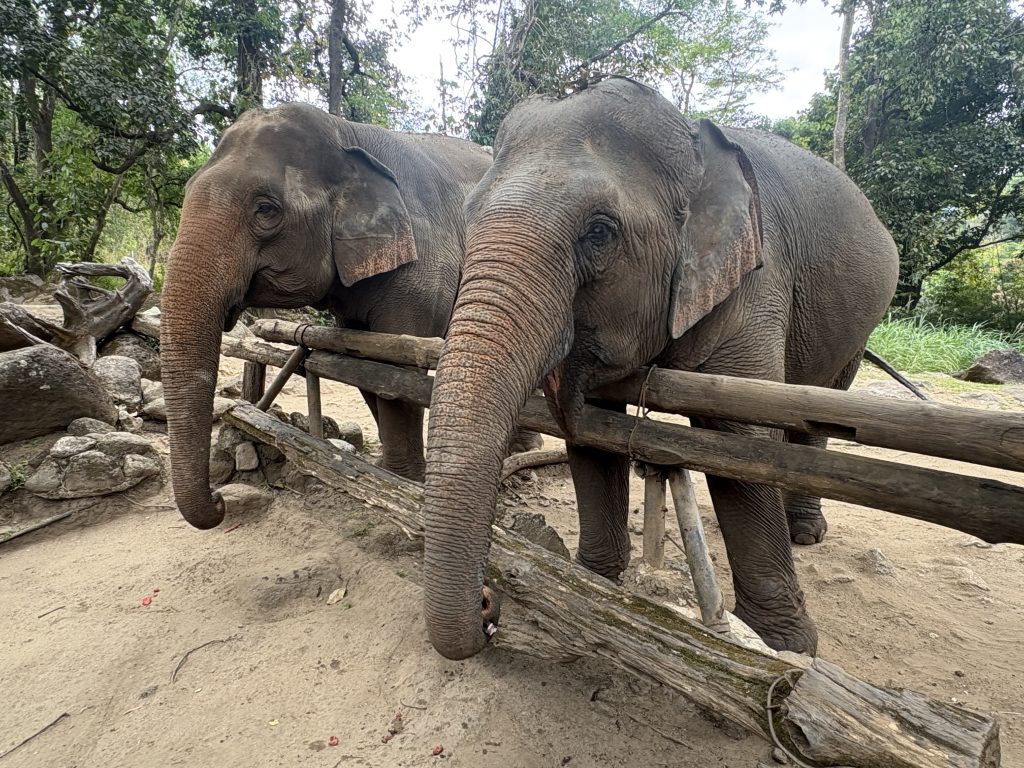
Standing face to face with an elephant for the first time, I could feel her warm breath through the twin nostrils at the tip of her trunk as she delicately wrapped it around a handful of bananas.
She was enormous, unhurried, and completely indifferent to my excitement. I, along with the other ten people on our small-group experience, was simply part of her day and a convenient source of snacks.
That moment, at a small roadside shelter north of Chiang Mai, was exactly what I had hoped for when I started researching ethical elephant experiences in Thailand.
I didn’t want to watch elephants perform or get my picture taken with a restrained elephant. I wanted to see elephants being elephants in all their muddy, leathery glory.
After doing quite a bit of research, the answer turned out to be Sunshine for Elephants, an ethical project connected with Elephant Nature Park, one of the world’s most respected sanctuaries.
In this post, I share what my day was like.
Table of Contents
- Introducing Sunshine for Elephants
- Sunshine for Elephants Quick Facts
- How to Book Sunshine for Elephants
- My Day with Sunshine for Elephants
- Meeting the Elephants
- Walking with Elephants Through the Jungle
- Visiting Elephant Nature Park
- What to Expect at Elephant Nature Park
- Is Sunshine for Elephants Worth It?
- FAQs: Ethical Elephant Experiences in Chiang Mai
- Why This Experience Stayed With Me
- Where to Stay in Chiang Mai
- Keep Exploring Thailand with Artsy Traveler
For a full breakdown of what makes an elephant experience genuinely ethical, and what red flags to watch for, see my guide to choosing an ethical elephant sanctuary in Chiang Mai.
Introducing Sunshine for Elephants
Located in the Mae Taeng region north of Chiang Mai, the project provides a safe, natural environment for rescued elephants while helping local mahout families earn income in ethical ways.
Almost a decade ago, the camp stopped offering elephant riding and transitioned to a “Saddle Off” model, allowing the elephants to live more naturally.
Three years of COVID-19 restrictions devastated these families economically. With no visitors, there was no income — and keeping an elephant is not cheap.
Sunshine for Elephants emerged partly as a response – a way to reconnect elephants, their owners, and ethically-minded visitors in a sustainable model.
Sunshine for Elephants Quick Facts
- Location: Chiang Mai province (Mae Taeng Area – North of the Chiang Mai city) – Northern Thailand
- Nearest Airport: Chiang Mai (CNX)
- Duration: Full day (includes a visit to Elephant Nature Park)
- Fitness level: Moderate. Visitors should be comfortable walking 2–3 hours in jungle terrain including steep or muddy slopes.
- Highlights: Feeding the elephants, walking through the jungle with the elephants, enjoying a vegetarian buffet lunch served in a bamboo hut in the forest, visiting Elephant Nature Park to observe the herds
- What to bring: Hat and sunscreen, comfortable walking shoes, insect repellant, camera
- Best for: Nature lovers, people who prefer ethical interactions with elephants, supporters of sustainable tourism
- Cost: 3,500 THB at the time of writing (about $110 USD) and 1,750 THB for children 4-11.
How to Book Sunshine for Elephants
Sunshine for Elephants operates in partnership with Elephant Nature Park. Spaces are limited and tours often sell out several days in advance.
Book directly through the Sunshine for Elephants website or the Elephant Nature Park website.
My Day with Sunshine for Elephants
Our day began with hotel pickup in Chiang Mai between 8:00 and 8:30 a.m. The experience is limited to just 15 people. Our group consisted of travelers from the United States, England, Canada and Denmark, all riding in a single van.
After collecting other travelers around the city, we drove about an hour north into the countryside toward Mae Taeng. The scenery gradually shifted from urban bustle to forested hills and small rural communities.
Eventually we arrived at a simple roadside shelter beside a river. This is where we’d meet the elephants.
Meeting the Elephants
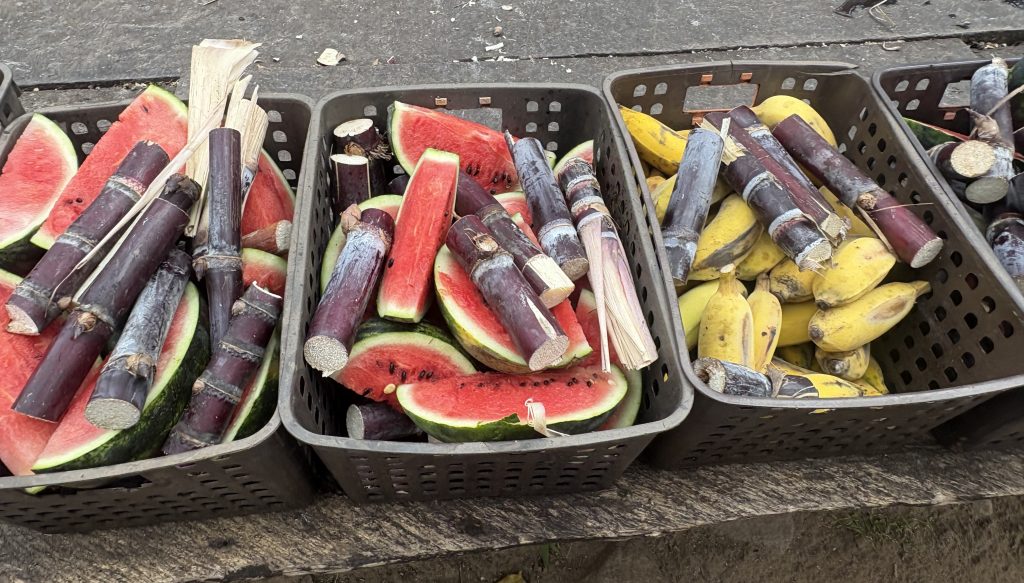
On the table were baskets filled with bananas, watermelon wedges, and sticks of sugarcane.
Before touching anything, we were asked to wash bug spray off our hands. Just like us, elephants aren’t so keen on swallowing bug spray with their fruit.
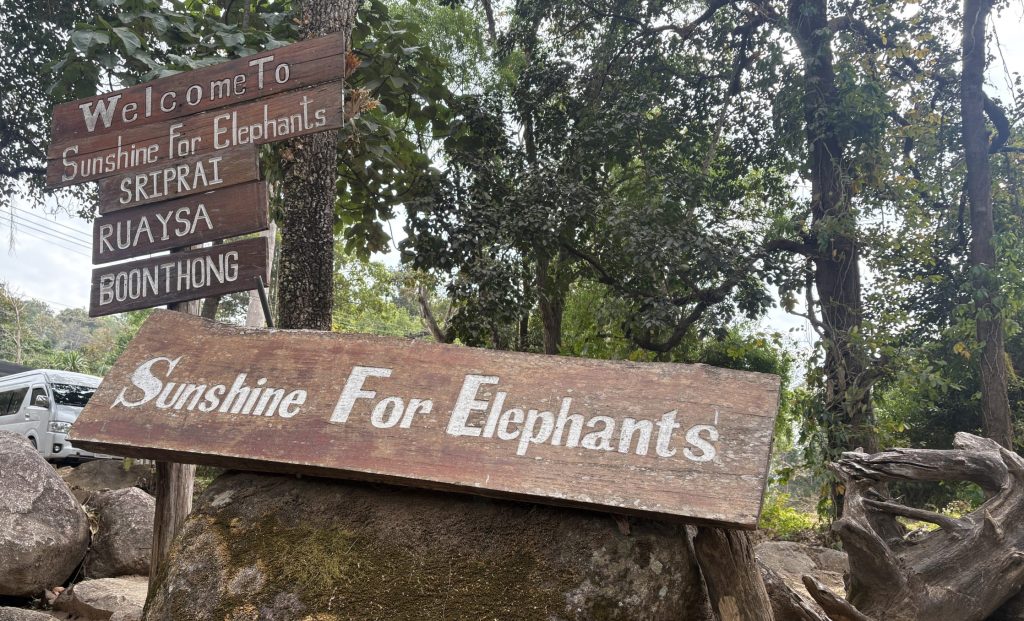
Our guide, Bobby, explained that we would be meeting three elephants owned by local families. All were female and one was blind in one eye. A sign informed us that their names were Sriprai, Ruaysa, and Boonthong.
In the past, these elephants had worked in logging operations or been rented to riding camps. The Sunshine for Elephants model allows their families to earn income without those industries.
Bobby also told us about elephants at Elephant Nature Park who had been traumatized by teasing — people holding out fruit and pulling it back. Some arrived aggressive toward humans as a result. The contrast with what we were about to experience couldn’t have been sharper.
And then our attention was distracted by the sight of three enormous elephants, each accompanied by a caretaker, lumbering towards the railing.
Standing face to face with an elephant was extraordinary. They are BIG!
Feeding the Elephants
We learned to feed the elephants by gently placing fruit into their trunks.
The elephants then delicately transferred each piece of fruit into their mouths where huge pink tongues devoured it.

There was plenty of squealing from the humans. The elephants, however, seemed pleasantly indifferent to our presence.
Walking with Elephants Through the Jungle
Once the fruit was gone, we followed the elephants into the forest.
For the next hour or so, we walked along jungle trails, some flat, others steep, while the elephants wandered ahead, foraging on bamboo and other vegetation.
Elephants eat around 300 kilograms of vegetation per day, mostly gathered while roaming through forest habitat.
Occasionally, their caretakers whistled to guide them along a particular path, but otherwise the elephants moved at their own pace.
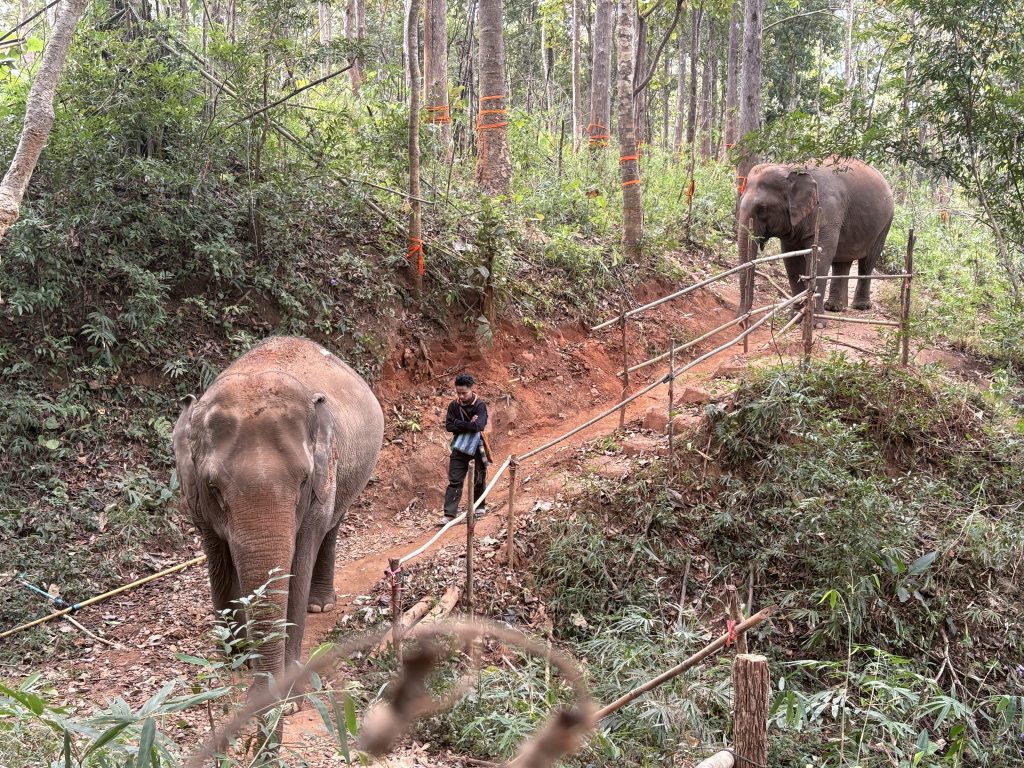
Walking through their environment and quietly observing their natural behavior felt good, like we were contributing to the well-being of the elephants rather than exploiting them.
That said, the elephants didn’t appear to mind hovering close by for a few photo ops. Bobby snapped this picture of Julia and me. The elephant looks like she’s posing, but she just happened to be in the right place at the right time on her way to chomp more bamboo.

Protecting the Forest
Along the route, our guide explained that visitors help support forest conservation by tying red sashes which have been blessed around trees.
This symbolic act comes from local traditions that mark trees as spiritually protected, helping to discourage logging and preserve the elephants’ habitat.
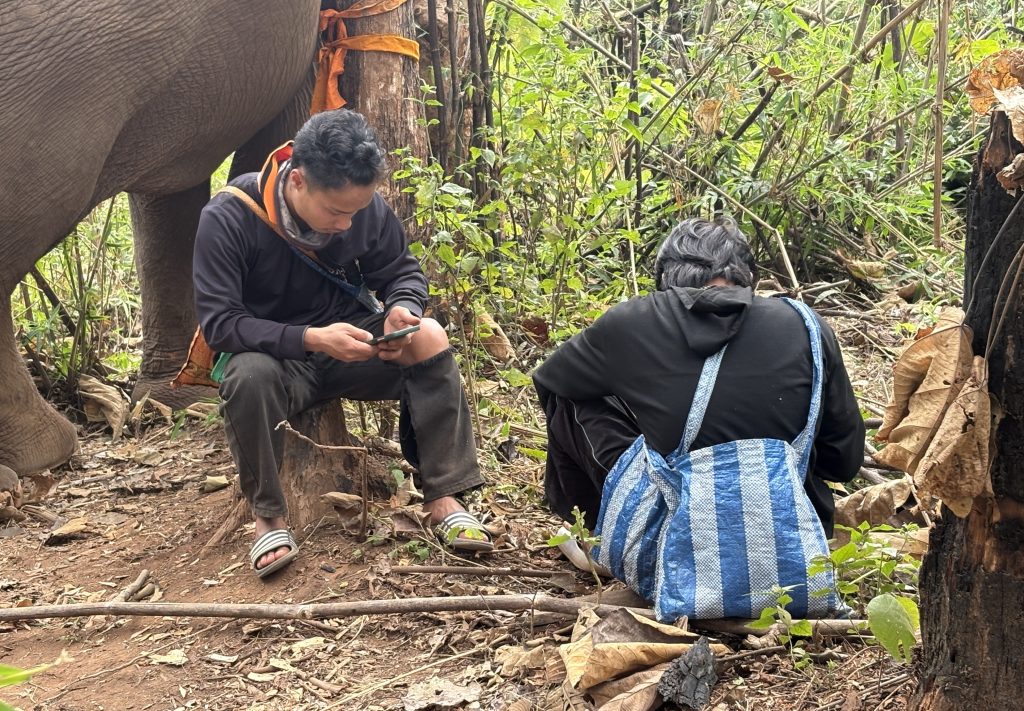
I found a likely looking tree and tied the sash around it. Meanwhile, the elephants peacefully chomped their lunch a few meters away while their caretakers squatted on the ground, eyes glued to their phones.
Lunch in the Jungle
Eventually we reached a wooden hut on a hill overlooking a stream where a vegetarian buffet lunch was set out.
Two travelers in our group—one from England and one from Denmark—were relieved to hear that the meal was truly vegetarian. In Thailand, dishes labeled as vegetarian often contain fish sauce or chicken broth.
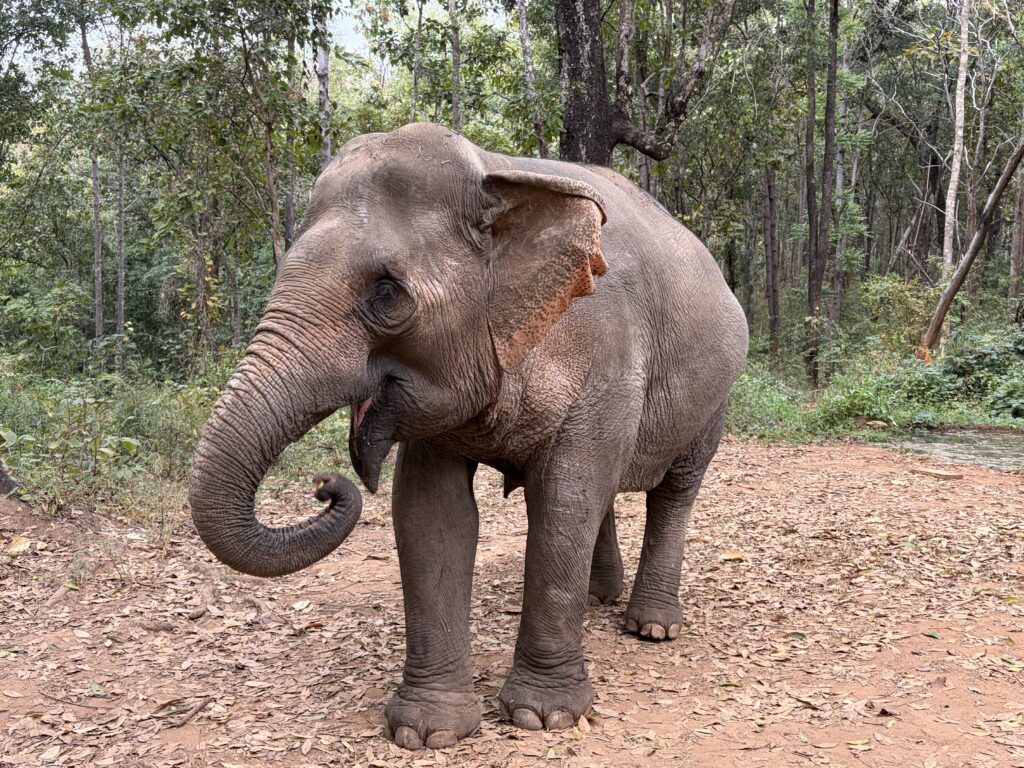
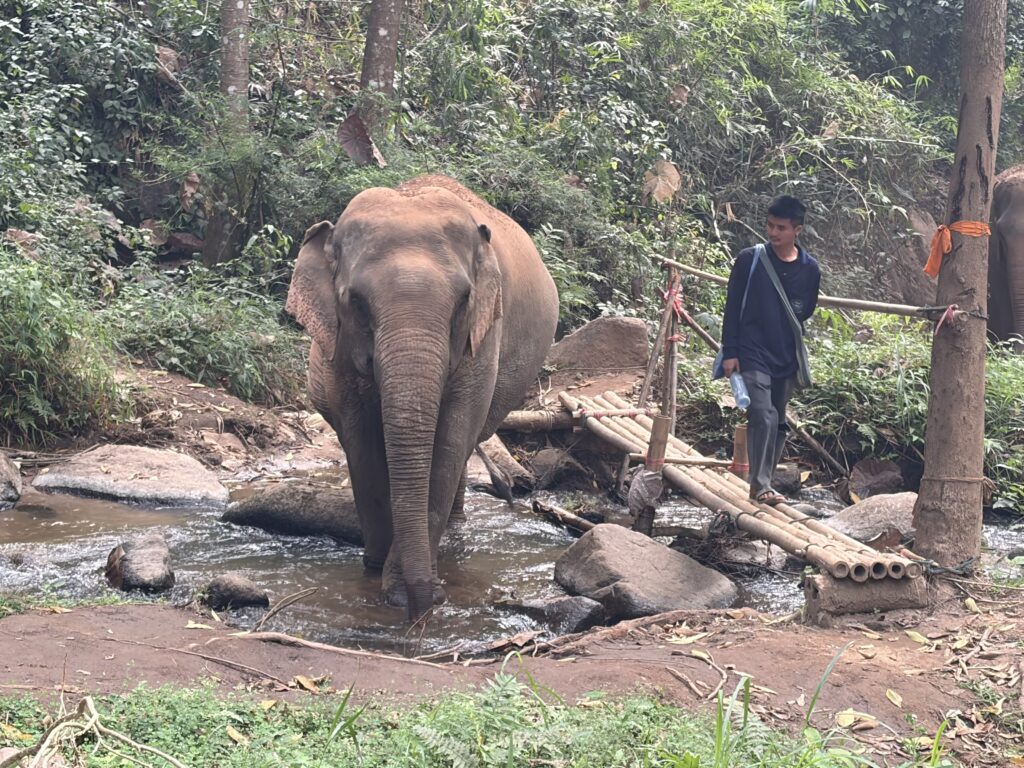
While we ate, we watched the elephants cross the small creek. A bridge was provided for visitors, but it was too spindly for elephants who had no choice but to get their tootsies wet.

Making Elephant Treats
After lunch, we prepared banana rice health balls, a favorite snack for elephants.
Rolling them by hand felt like making energy bites, if those energy bites were destined for a five-ton animal.
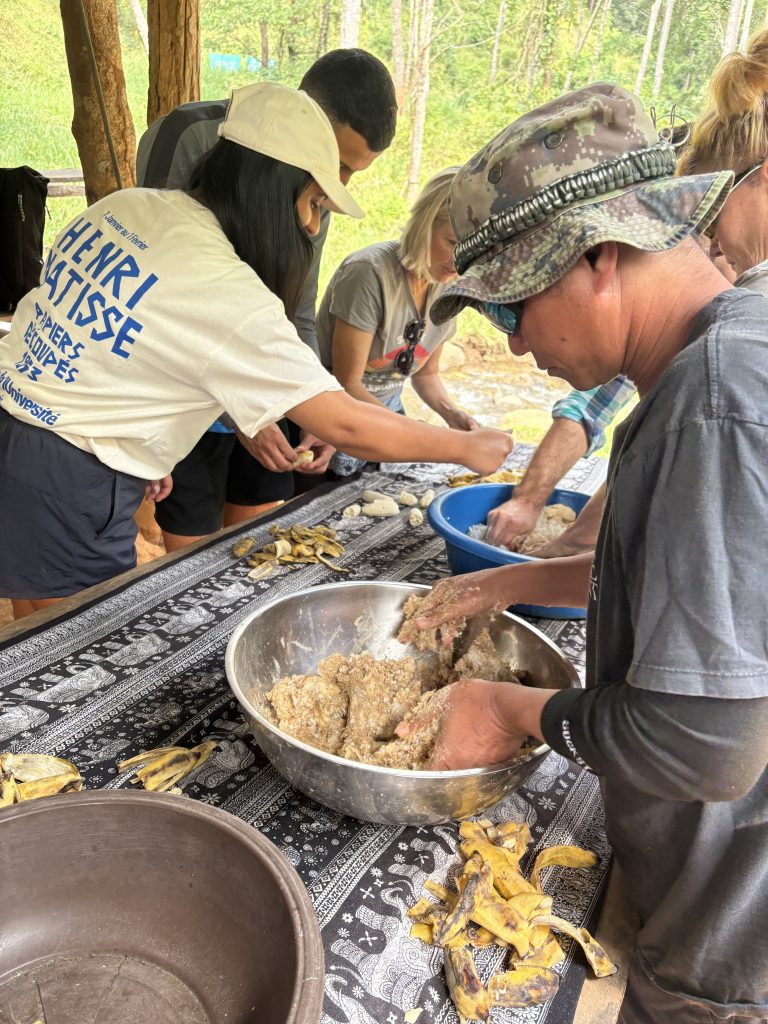
The elephants gobbled them up. I could have sworn they were smiling. After their snack, they lumbered off for more forest grazing, while we walked back to the van.
Visiting Elephant Nature Park
The final part of the day brought us to Elephant Nature Park, the renowned sanctuary founded by elephant conservationist Saengduean Chailert (known as Lek).
The sanctuary pioneered a new model of elephant tourism based on rescue, rehabilitation, and education rather than entertainment.
Before Elephant Nature Park began its work, elephant tourism in Thailand largely revolved around riding camps, circus-style performances, and logging operations. The sanctuary helped shift the conversation by advocating for a “Saddle Off” approach, allowing elephants to live as naturally as possible without being ridden or forced to perform.
Today, the park provides lifelong care for dozens of rescued elephants, many of whom arrived with severe injuries or trauma after years of labor in logging or tourist camps. The organization also supports community programs that help elephant owners transition to more ethical livelihoods.
Because of its long-standing commitment to animal welfare, Elephant Nature Park has become a model for ethical elephant tourism and has inspired similar sanctuaries across Southeast Asia.
Elephant Nature Park provides a permanent home for elephants rescued from:
- Street begging
- Riding camps
- Logging operations
- Circus performances
Elephant Stories
Many of the elephants arrive at Elephant Nature Park with horrendous injuries. Large signs showed Before and After pictures of some of the elephants and their stories.
For example, Yai Boon, shown below, was born in 1949 and was rescued from a tourist trekking camp. She was severely malnourished and in need of immediate veterinary care. Since arriving at Elephant Nature Park, Yai Boon has forged a close friendship with another elephant, DiPor, and has rapidly regained weight thanks to a wholesome diet and nurturing care. She’ll now live out her days in peace.
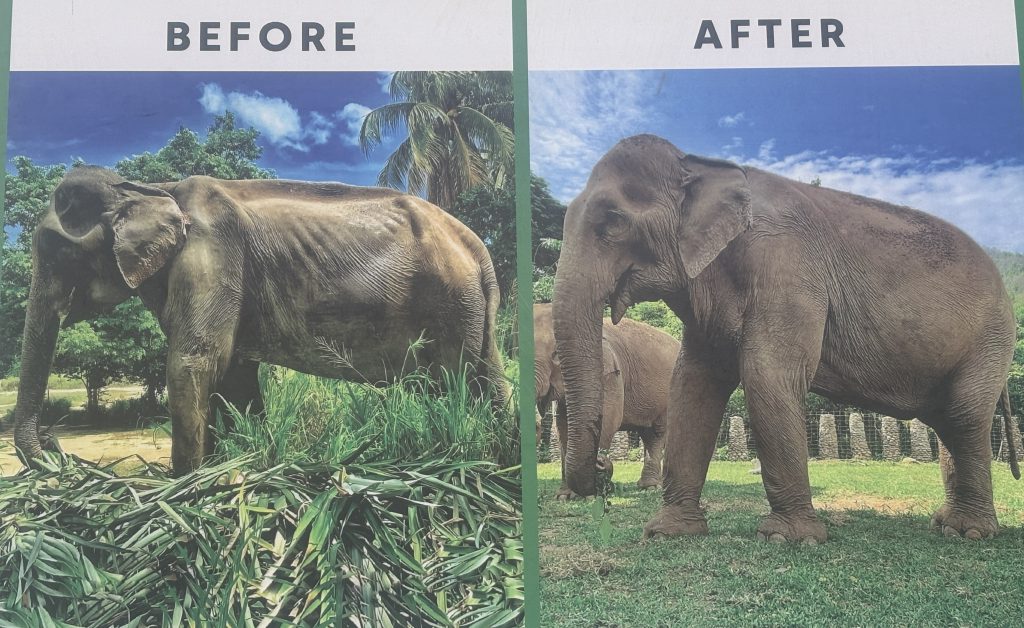
Another elephant, Kabu, was born in 1987. For decades, she’d endured logging work before finally being rescued. After arriving at Elephant Nature Park, she struggled to make friends until the arrival of Chana, a young elephant which also had a leg injury. Now the two elephants are inseparable, and have even recently welcomed two more elephants into the herd. They are a close-knit group.

The stories are both heartbreaking and heartwarming, a true testament to the good work done at Elephant Nature Park. No wonder the place is world-famous.
By visiting and watching the elephants at a respectful distance, we were helping to keep these incredible animals protected.
Bobby told us that when an elephant dies, they are buried in a cemetery on the property. Other elephants who were close companions of the deceased will stand nearby and trumpet for several months in mourning.
It was a powerful reminder of just how intelligent and emotionally complex these animals are.
We watched one of the elephants who had her ankle broken while working in logging walk with a kind of jolting limp. Bobby told us she is no longer in pain and has bonded with another elephant who is blind.
The two elephants moved everywhere together, the blind one closely following the other.
What to Expect at Elephant Nature Park
For about two hours, we walked around the beautiful property, watching the elephants and listening to Bobby talk about them.
Elephant Nature Park offers a variety of ethical half-day and full-day tours in addition to overnight experiences that include full board accommodation.
You can even stay for several days to learn about elephant care and behavior, cut grass and cornstalks for the elephants, wash and prepare fruit and other food for the herds, learn to make an elephant fruit cake, clean their shelters, help with maintenance tasks around the park, and participate in other projects designed to support the elephants.
If you love elephants (and who doesn’t?), a visit to Elephant Nature Park is a must-do while visiting northern Thailand.
Is Sunshine for Elephants Worth It?
Without hesitation: yes.
The combination of spending an intimate morning with three elephants in their forest habitat, followed by an afternoon at one of the world’s best elephant sanctuaries, makes for a full and deeply meaningful day.
The group is small, the guide is knowledgeable and engaging, and the format genuinely prioritizes the elephants’ experience alongside yours.
At around $110 USD, the tour sits at the higher end of elephant experiences in Chiang Mai, but you’re paying for a well-run, ethical program that directly supports both the animals and the families who care for them.
To my mind, that’s worth a few extra baht.
FAQs: Ethical Elephant Experiences in Chiang Mai
Yes. The program follows Elephant Nature Park’s “Saddle Off” model, meaning no riding, no performances, and no forced bathing. Instead, enjoy limited, respectful interaction focused on observation.
No. The elephants belong to local families but now live in environments where they can behave more naturally. Programs like Sunshine for Elephants help owners transition away from exploitative industries.
Elephant experiences run year-round. The cooler season from November to February tends to be the most comfortable for walking outdoors, while the rainy season (June to October) brings lush scenery but muddier trails.
Yes. Elephant Nature Park is widely regarded as one of the most respected elephant sanctuaries in Thailand. Visitors can observe rescued elephants living in a protected environment while learning about their history, care, and the challenges of elephant conservation.
Most animal welfare organizations discourage elephant riding because the training required to make elephants carry riders can be harsh and damaging. Ethical elephant experiences focus on observing elephants rather than riding them.
Yes, children over 4 years old can participate, provided they are able to walk the jungle trails. Note that the weather can be hot and humid and that younger children may tire easily after the initial excitement of seeing elephants up close.
Why This Experience Stayed With Me
Spending time with elephants in a way that respects their dignity and intelligence feels profoundly different from watching them perform tricks for tourists.
What struck me most wasn’t the novelty of being close to such enormous animals. Instead, it was the quality of the quiet. The elephants moved through their day on their own terms. We followed. We watched. We fed them fruit when they wandered close. And then they wandered away again, wholly unbothered by our presence.
That’s what ethical tourism actually looks like: not an experience designed around our entertainment, but one that puts you briefly, respectfully, into someone else’s world, in this case, three elephants going about their morning in a jungle in northern Thailand.
And that’s exactly how it should be.
Where to Stay in Chiang Mai
Chiang Mai has plenty of accommodation for visitors, from budget to luxury. We stayed at Be Phrasingh Hotel for five nights and then The Rim Chiang Mai on our last night before flying south to Khao Sok.
Both accommodations were excellent. Located in the Old Town, Be Phrasingh Hotel is a modern four-story building on a quiet courtyard. We had a two-bedroom suite that included a private rooftop terrace complete with small jacuzzi and a view over Chiang Mai. Staff were friendly and helpful.

The Rim Chiang Mai was our last-night splurge after touring northern Thailand. Located just outside the Old Town, the place had an old understated charm with attentive staff and attractive public areas.


Here are more options for accommodations in Chiang Mai:
Keep Exploring Thailand with Artsy Traveler
- 3 Days in Bangkok: The Ultimate Culture & Food Itinerary: my three-day itinerary for a first timer’s visit to Bangkok
- Jim Thompson House Museum: why it’s one of Bangkok’s most fascinating cultural visits
- Chef’s Tour Bangkok: the Chinatown food tour that changed how I ordered food for the rest of my trip
- Bangkok Temple Tour + River of Kings: Grand Palace, Wat Pho, and why a guide made all the difference
- Penthai Theatre Bangkok: the most distinctive cultural dinner show I found in the city
- Ayutthaya Day Trip: why a small-group tour is the easiest, most rewarding way to see the ruins
Would you like to save this post?

Carol M. Cram writes novels inspired by the arts; runs Artsy Traveler, an arts-focused travel blog, and Art In Fiction, a curated database of 2,700+ novels inspired by the arts; and hosts The Art In Fiction Podcast. She has also authored 60+ textbooks on computer applications and taught at Capilano University for over two decades. Carol lives with her husband, artist Gregg Simpson, on beautiful Bowen Island near Vancouver, BC.


 See all my novels