Sensational Siena: Best Things to Do, Top Sights and How to Visit
Artsy Traveler contains affiliate links for products and services I personally use and can happily recommend. As an Amazon Associate, I earn from qualifying purchases. Please read the Disclosure for more information. If you make a purchase through these links, at no additional cost to you, Artsy Traveler earns a small commission. Thank you!
What is it about Siena that makes an artsy traveler swoon?
Mention Siena to anyone who has traveled there and immediately they’ll clasp their hands to their hearts and look heavenward while intoning their undying love for this gem of a medieval city.
Every time I visit Siena (and I’ve been five times), I am inundated with a profound sense of living history. Of course, I could say that about many other places in Europe, but there’s something about Siena that makes it extra special.
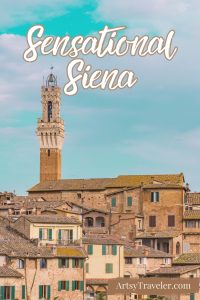
If you’re visiting Tuscany, make some time in your itinerary to visit and preferably stay a night or two in Siena.
In this post, I’ll walk you through the best things to do in Siena, the must-see artistic treasures, and the practical tips you need to enjoy this beautiful hilltop city without rushing. I’ll also share with you my experience touring this wonderful city during my most recent visit.
Quick Facts – Visiting Siena, Italy
- Best for: Art lovers, medieval history fans, slow travelers, Tuscany explorers
- Top Sights: Siena Cathedral (Duomo), Piccolomini Library, Piazza del Campo, Torre del Mangia
- Must-book tickets: Siena Cathedral complex ticket + Palazzo Pubblico)
- Time Needed: 1 full day and two nights
- Best Time to Visit: April–June, September–October
- Where to Stay: Historic center (near Piazza del Campo), or just outside the walls for quieter stays
- Tours Worth Considering: Siena Cooking class, Siena & San Gimignano day trip from Florence, Tuscany wine tasting in Chianti
- Getting There: Train from Florence (~1.5 hours), bus is faster and drops you closer to the center
Where to Stay in Siena
- Historic Center (Centro Storico): Steps from main sights; great for first-timers; challenging for drivers: I loved I Merli di Ada (see a longer review below).
- Near the Duomo: Quiet at night, ideal for art/history lovers: I suggest Siena Vip B&B.
- Near Porta Romana / Porta Camollia: Scenic entrances, good local food, excellent boutique stays: I enjoyed the Hotel Athena, which included secure parking (always a bonus).
Ten Must-See Siena Sites
Before I share with you what I did during my one full day and two-night stay in sensational Siena, here’s a quick overview of the essential sights.
- Siena Cathedral (Duomo) – This is one my favorite cathedrals in all of Italy. I even included it in my post on the Best Cathedrals in Europe. The Duomo is a gothic masterpiece of striped marble, endlessly fascinating mosiacs and an astonishing inlaid marble floor (open seasonally).
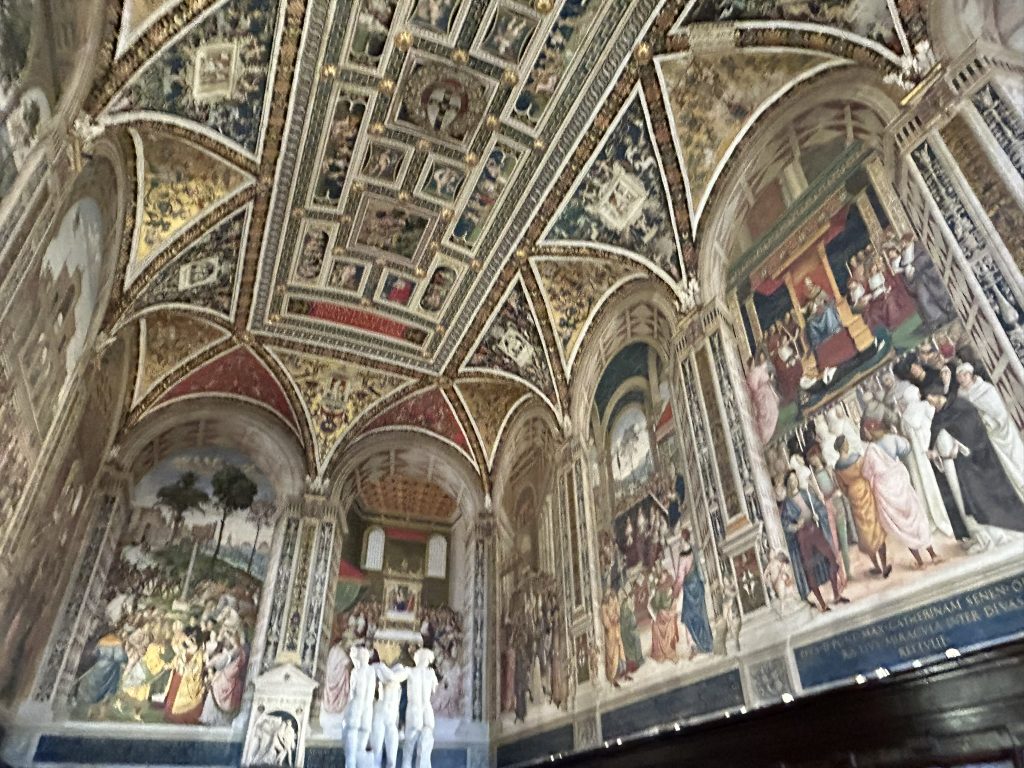
- Piccolomini Library – Accessible from inside the Cathedral, the riot of vivid Renaissance frescoes covering every inch of wall in the small space was painted by Pinturicchio and his workshop which possibly including the young Raphael. This space is not to be missed (more later).
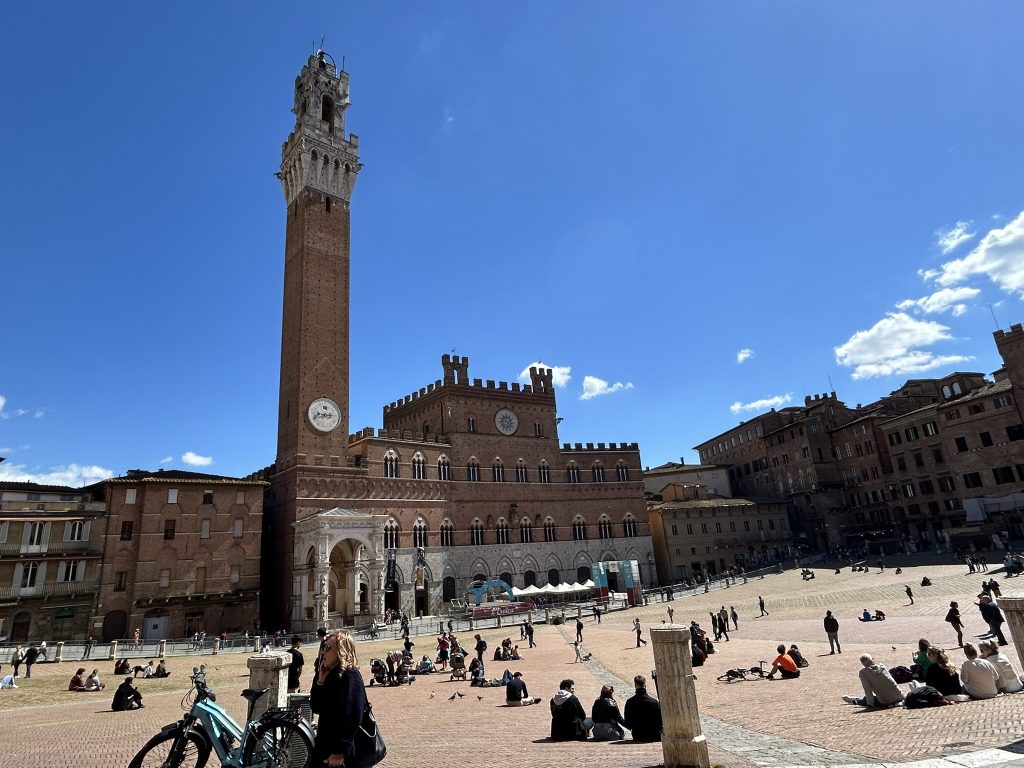
- Piazza del Campo – Siena’s iconic shell-shaped square is stunning from every angle and the dramatic setting for the Palio horse race. It’s the perfect place to slow down and enjoy a glass of wine while gazing out at passersby. I never tire of walking into Siena’s Campo.
- Palazzo Pubblico & the Lorenzetti Murals – Housed in Siena’s medieval town hall (the Palazzo Publicco) are several extraordinary frescoes including the Maesta by Martini and the ground-breaking Allegory of Good and Bad Government by Ambrogio Lorenzetti.
- Torre del Mangia – If you have the energy, get tickets in advance and climb the 400+ steps to enjoy sweeping views of Siena’s rooftops, the Duomo’s striped dome, and the rolling Tuscan hills. I’ve done it once and the view was worth the climb (go on a sunny day).
- Pinacoteca Nazionale – A must for lovers of early Italian painting. This quiet museum houses a rich collection of Sienese trecento and quattrocento works, including masterpieces by Duccio, Simone Martini, and the Lorenzetti brothers.
- Santa Maria della Scala – Once a great medieval hospital, this wonderful museum complex is filled with frescoes, archaeological finds, chapels, and quiet underground corridors. It’s almost always uncrowded and yet one of Siena’s most rewarding stops.
- Facciatone Terrace (Museo dell’Opera del Duomo) – Climb the remains of Siena’s unfinished cathedral façade for one of the best views in the city, and then check out the museum which exhibits Duccio’s famous Maestà.
- Baptistery of San Giovanni – Directly behind the Duomo, the baptistery features a dazzling marble baptismal font with reliefs by Donatello, Jacopo della Quercia, and Ghiberti.
- Wandering the Medieval Streets – Siena is a city made for wandering: shadowy alleys, brick archways, artisan workshops, and neighborhood cafés. The quieter lanes near Porta Romana or Porta Camollia reveal Siena at its most authentic.
Why is Siena So Special?
One reason why Siena is so special is that the modern world intrudes so discreetly that it’s easy to believe, especially at night, that you’ve been transported seven hundred years into the past.
The stone and brick walls of ancient buildings soar into the deep blue sky either side of stone-paved streets. Everywhere you look are bricked archways, scarred and ancient wooden doors, iron rings for tethering horses, and shadowed alleyways.
The ancient past lives and breathes.
Walking Into the Campo
When I walk into the Campo—surely, the most beautiful public space in the world—I feel my throat constrict with emotion.
I am in Siena! I am walking where my Sofia (from my novel The Towers of Tuscany) walked, where my Bianca grew rich and regretful (The Merchant of Siena – to be published) and where hundreds of years of Sienese people lived and died, fought, prayed, loved, and loathed.
On these bricks in the Campo, laid down even before the Black Death, people in heavy gowns walked and talked. They argued and haggled in business, they gazed at each other with love, they snubbed an enemy and clasped hands with a friend.
This space—this Campo—has teemed with life for centuries, its shape and beauty unchanged through wars and famines and plagues and the chain stores of the 21st century.
Views Over the Campo
The view across the Campo to the Torre Mangia and Palazzo Pubblico from the cafés lining the high side of the Campo has not changed appreciably since the buildings were new centuries ago.
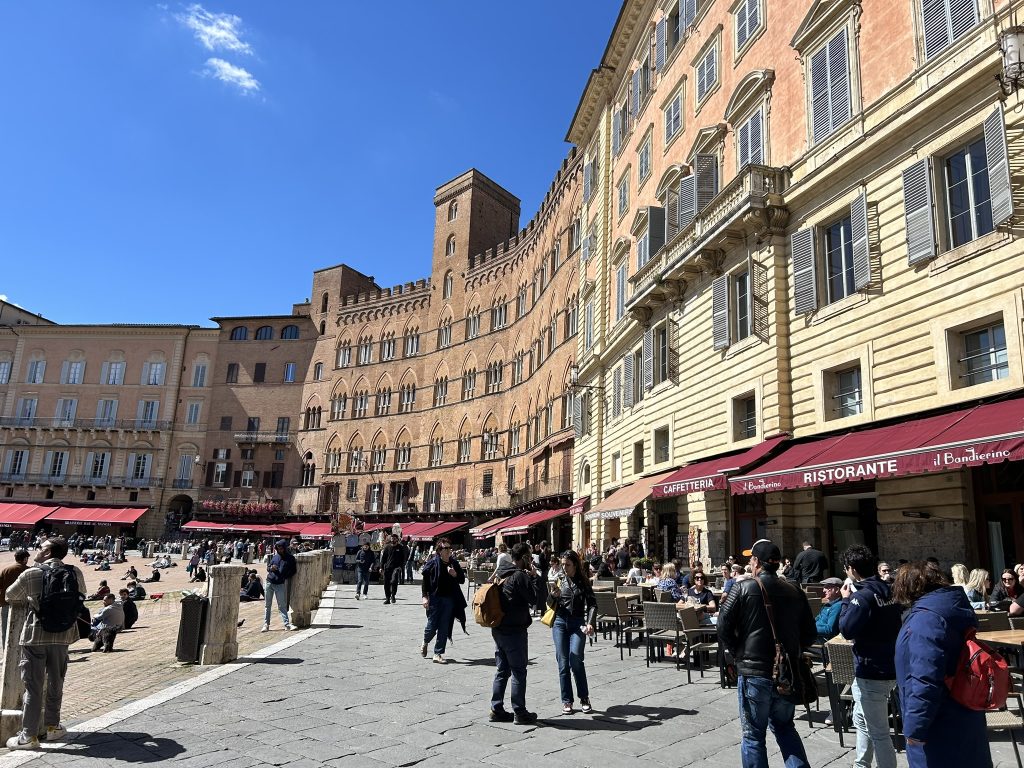
Lorenzetti strode across these bricks on his way to paint the Allegory of Good and Bad Government in the Palazzo Pubblico. From one of the windows in a palazzo above where I sit sipping my Aperol Spritz, my Bianca watched her lover Paolo enter the Campo with an army of mercenaries.
From the street to the left of the Torre Mangia, my Sofia first entered the Campo with Francesco and was instantly captivated.
Siena & Visitors
Siena is still a pulsing living city with more locals than tourists, although there are certainly plenty of tourists. But the crowds are manageable and easy to sidestep.
One minute, you’ll be walking down a street streaming with people, occasionally standing aside to let a car go past. The next minute, you’ll turn into a small side street and be alone with ghosts and your imagination.
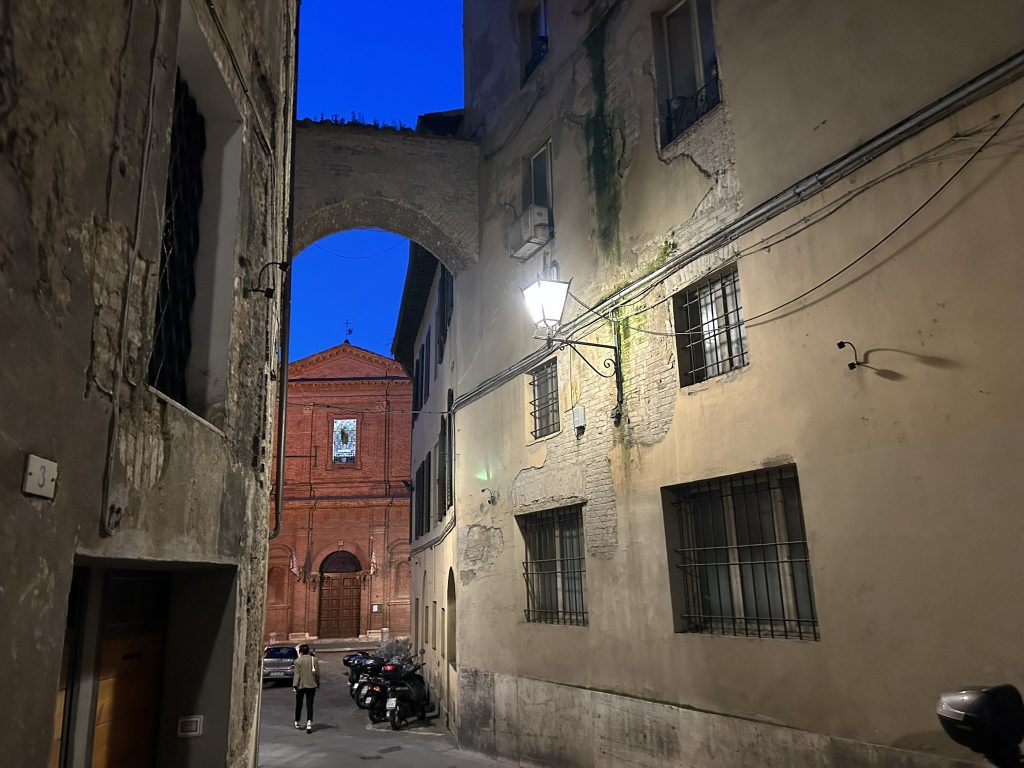
At night, Siena belongs to the locals, particularly young people. The Campo is filled with groups of teens: boys in one tight knot, girls in another.
In the side streets, university students spill out from the bars, glasses of wine in hand and voices at full volume. In the wee hours, a cadre of young men pass under our window, singing with drunken abandon. It’s more endearing than annoying.
Reliving my Novels in Siena
Everywhere I walk in Siena, I think about scenes in the two novels I’ve set there. Is this the street that Bianca ran down before being captured by mercenaries in The Merchant of Siena?
In this piazza, did Sofia in The Towers of Tuscany watch a girl be whipped for dressing like a boy?
I’ve spent so many months, years even, seeing these streets in my mind as I write that to walk in them feels like I’m coming home.
Getting to Siena
If you don’t have your own wheels, take the bus or train from Florence. The train is slower because the station is outsidew the historic center so youll need to walk or take a taxi to your hotel. The bus drops you right near the center of Siena.
If you’re driving, you want to park outside the city walls. Do not drive into the ZTL (Traffic Limited Zone) to avoid getting fined. Check with your hotel; they may have instructions for how to drive to the location, drop your bags, and then park nearby. They may also provide a valet service to park your car once you’ve unloaded. Check before you book.
You can also see Siena on a day trip from Florence but unless your itinerary is super tight, I suggest not doing this. Stay at least two nights in Siena. It is a marvelous little city and deserves some quality time.
Having just a few hours to walk across the Campo and see the cathedral just doesn’t do the city justice.
My Experience Arriving in Siena
On my most recent trip to Siena, I booked a room at the I Merli di Ada which is inside the walls of Siena. Usually, I avoid places inside medieval towns when I’m driving because I know from experience that driving through narrow medieval streets mobbed with people is a recipe for disaster.
But I wanted to be close to the action in Siena and so decided to take the risk.
The hotel sent instructions about parking. We were to enter Siena from the Porta Romana, drive to a little piazza near the hotel, drop off our luggage, then hand our keys to a valet parking attendant. The cost of valet parking was 30 euros per day, but I don’t care. The benefits of staying within Siena’s walls and having someone else park the car far outweigh the cost.
Driving Into Siena
With trepidation, we followed the GPS directions to drive through the Porta Romana past a phalanx of official-looking people in uniform who don’t stop us.
I know we’re being electronically monitored. If we stay too long in Siena, we’ll be subject to a hefty fine. Tourists are allowed a small amount of time to drive to their accommodation and drop off their bags. They then must skedaddle, fast (or in our case, give the keys to a valet who does the skedaddling for us).
The GPS directs us along a street with pedestrians who stand aside to let us pass. Gregg drives very, very slowly.
We turn left as directed up a side street and then sharp left again. The hotel’s directions tell us there will be a little piazza to our right where we can stop to unload our luggage. Lo and behold, there it is! We pull in and breathe a sigh of relief.
I hop out and walk a few paces down the street to find our hotel.
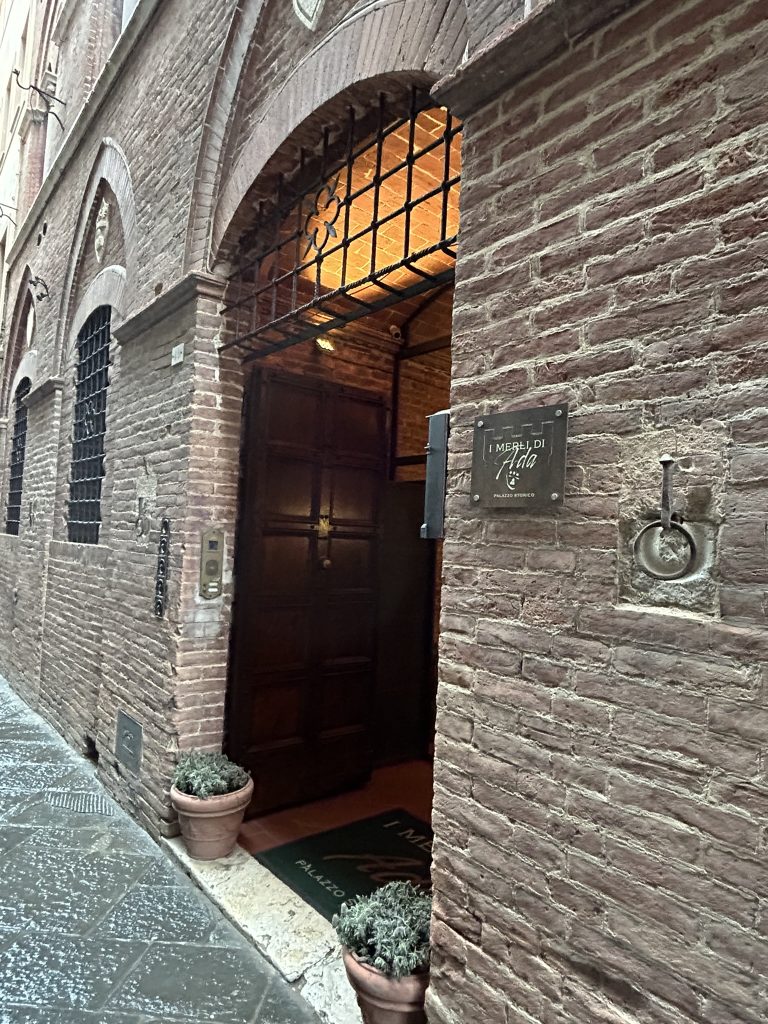
Phew! That was one of the easier entries into a medieval town we’ve experienced.
With great gratitude, Gregg hands the keys to the valet who appears moments later to smilingly move our car to God knows where and I don’t care! We’re informed that we’ll see the car again on Sunday. Spoiler alert – we do.
Staying at I Merli di Ada
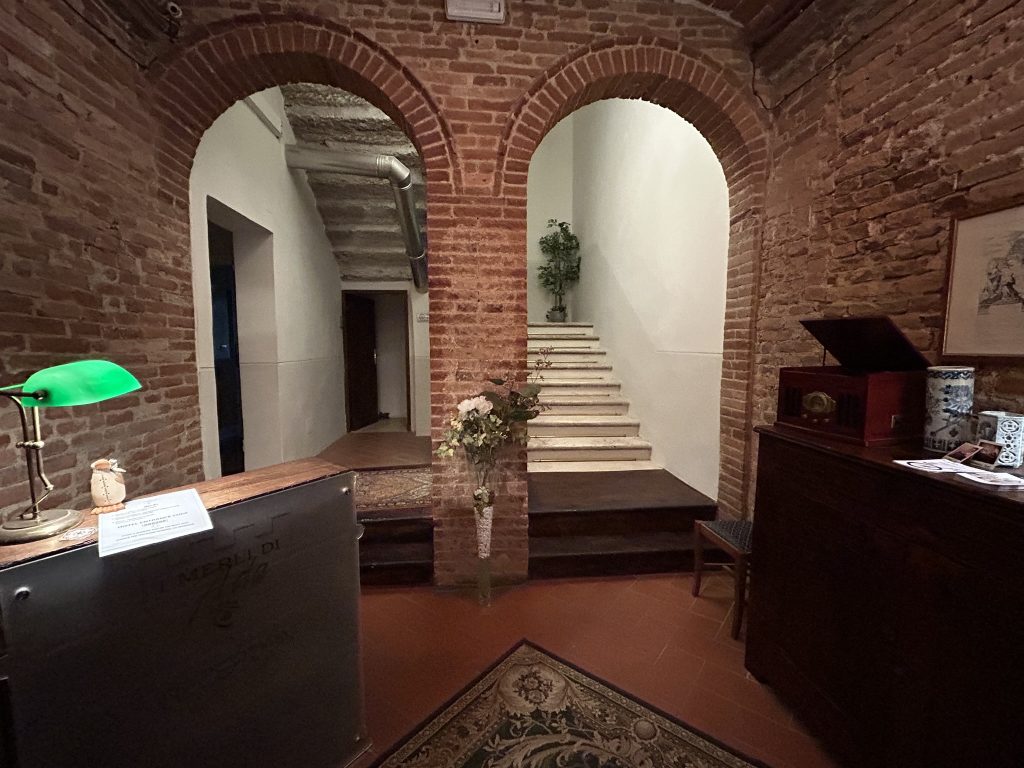
The I Merli di Ada hotel is lovely. The entrance way is brick-arched and reeking with history. The tiny elevator that climbs very slowly from the lobby to the third floor is the only modern intrusion.
We put our luggage into the elevator and climb the winding marble staircase. How many feet have climbed here? I don’t know how old the current building is, but I can say with certainty that its foundations are probably medieval, if not older.
Our room on the third floor is high-ceilinged, the white-painted beams reminding me of former times. I can’t help wondering how many people have lived and breathed in this space over the centuries.
The window looks out over the street and the building opposite—the same red brick as our building with arched windows, most shuttered.
First Walks into Siena
After getting settled, we walk out into Siena with an agenda—find a laundromat, eat a late lunch, buy Gregg some art materials, and, most importantly, drink in our first encounter in six years with my favorite city in Europe.
Thanks to Google, I find a laundromat just down the street, so we head there first. The directions are thoughtfully posted in both Italian and English. Within minutes, we’ve loaded our laundry into one of the machines, inserted eight euros, and pressed the start button.
We leave to find lunch.
Lunch in the Campo
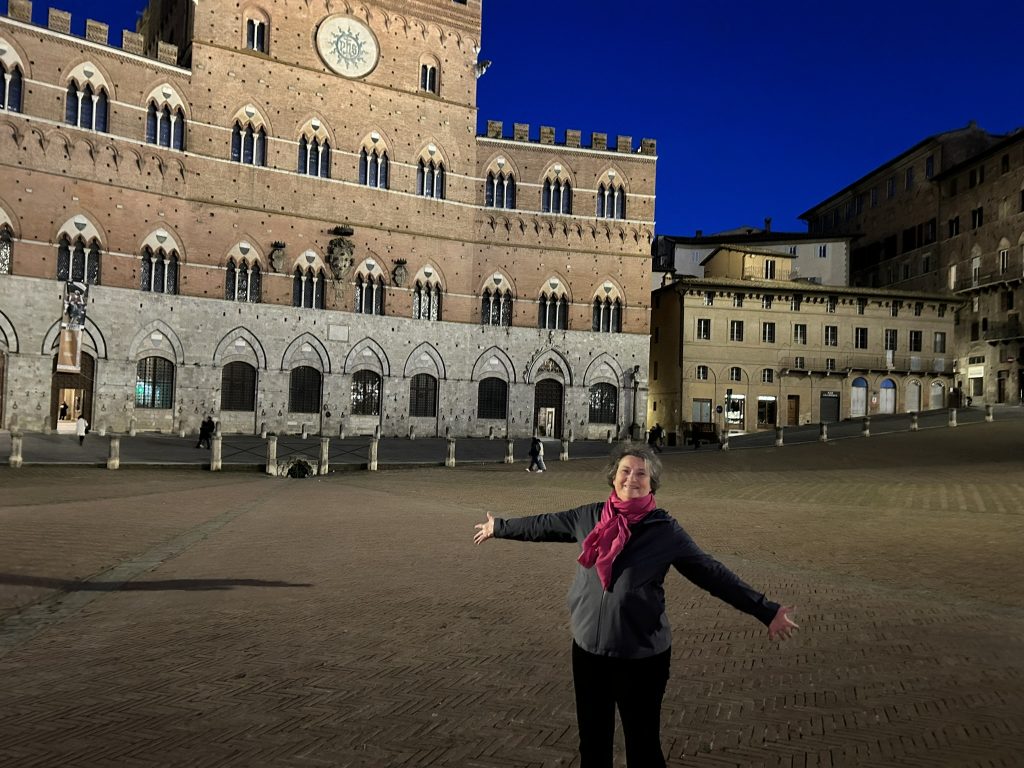
Minutes later, we are entering the Campo and my knees go weak. I want to run right out into the middle and twirl. I resist (although later I do a spot of twirling under the cover of darkness–see later in this post).
We choose one of the uber-touristy cafés on the edge of the Campo and settle in.
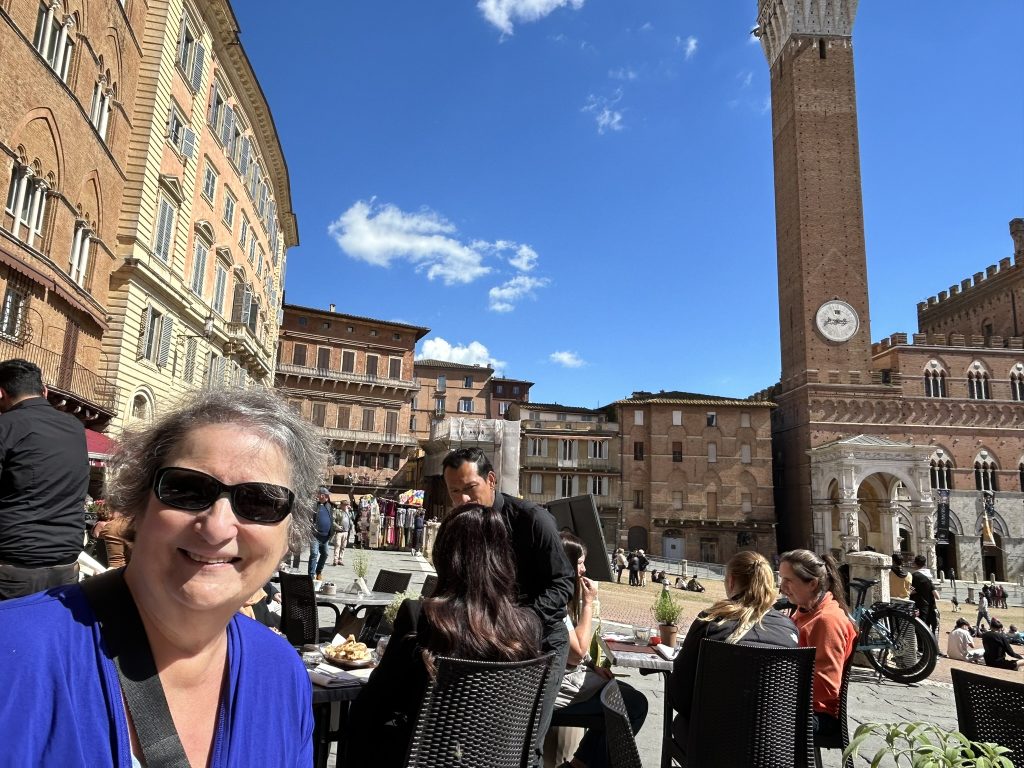
Even Rick Steves, who usually eschews places in ‘high rent’ areas like the Campo, has written in his Siena guidebook that camping at one of the cafés on the Campo is a must-do. Hang the cost.
As it is, the cost is perfectly reasonable, the service efficient and good-humored, and the food really delicious. We split an order of bruschetta along with a large salad replete with anchovies, hard-boiled eggs, very fresh greens, and tomatoes.
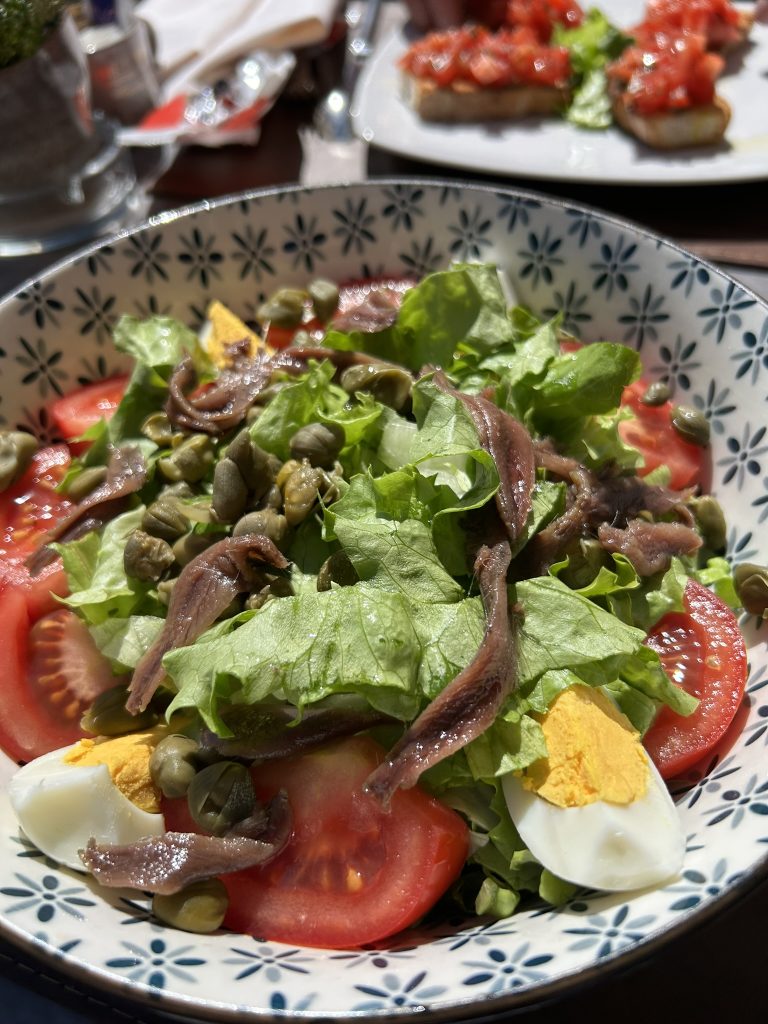
The sun beats down pleasantly warm as we gaze out at the Palazzo Pubblico and the Campo. I am truly in heaven.
Errands in Siena
After our late lunch, we hightail it back to the laundromat, put the clothes in the dryer (another five euros), then go in search of art materials. We find them at a little shop on the other side of the Campo.
Gregg buys a pad of paper and some paints and looks forward to many happy hours of art creating to come.
We pick up a few groceries so we don’t have to buy the hotel breakfast in the morning, then huff up the three flights of stairs to our room for a bit of quiet time before dinner.
Dinner in Siena
In the evening, we venture out to enjoy an excellent dinner at a well-reviewed osteria not far from the hotel. The service is excellent and the ambiance cozy and warm in a brick-vaulted room that’s probably been in use for centuries.
So far as I can hear, we’re the only English speakers. Most of the other diners are Europeans.
We start with fried cheese accompanied by fresh pear sauce recommended by the server and then Gregg has a tasty pasta with bacon and I have thinly sliced Florentine steak. We share a green salad.
The food is fresh, simply prepared, and absolutely delicious. With wine, the bill is about 60 euros, perhaps not a bargain, but certainly not over-priced considering the quality of the food, the service, and the ambiance.
Evening Stroll in Siena
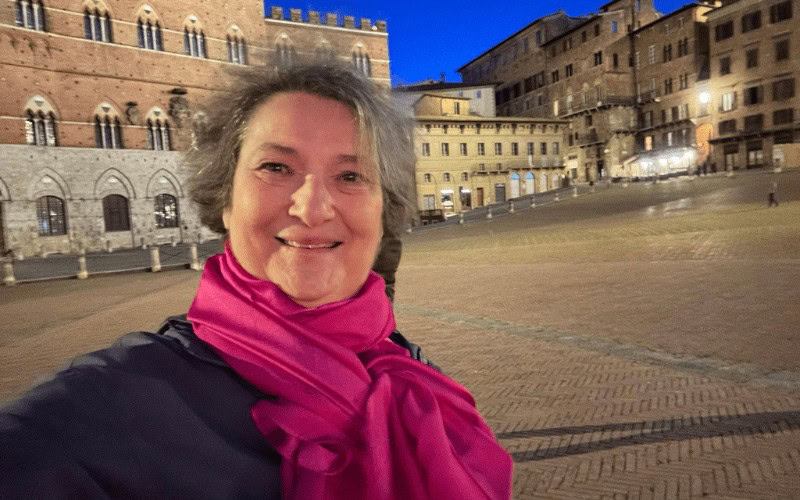
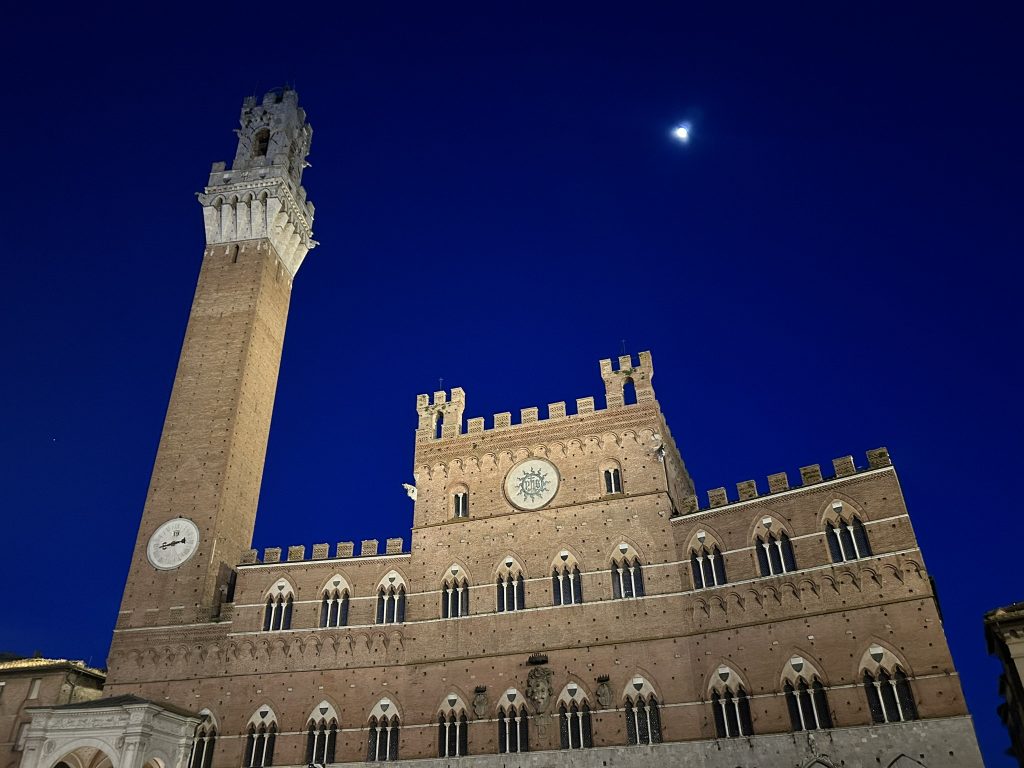
After dinner, we stroll to the Campo where I do indeed twirl across the 14th-century pavement and snap endless shots of the floodlit Palazzo Pubblico in front of a deep azure sky.
We end the evening with a walk along narrow medieval streets and a final stop at a gelateria for a small cup with two flavors—very dark chocolate with amaretto for me; stracciatella and fragola (strawberry) for Gregg.
A Perfect Full Day in Siena
The next day, I’m up early, excited to begin my only full day in Siena. I start with a caffè Americano at a lovely little café just down the street from our hotel. The place is deserted and I spend a productive hour working on The Merchant of Siena.
Set in the second half of the 14th century—a time of great strife and hardship for Siena—the novel tells the story of a woman who is determined to control her own destiny in a world where all the odds are stacked against her.
April Weather
The weather has turned cloudy and chilly. By the time I emerge from the café, the rain has started in earnest, and I wish I’d brought some warmer clothes. I mistakenly thought that Italy in April would be warm.
It can be, for sure, but it also can be chilly and wet. There’s a reason why the Tuscan countryside is so green.
I return to the hotel and together, Gregg and I set out to tour the Palazzo Pubblico. I’m anxious to see an exhibition of costumes from the Palio, and of course to revisit my favorite Lorenzetti frescoes.
Palazzo Pubblico
The Palazzo Pubblico is probably the most photographed building in all of Siena. I’ve taken dozens of photos myself in as many lights as possible—from brilliant sunshine to moonlit evening.
The Palazzo Pubblico with its accompanying tower (the Torre Mangia) was built between 1297 and 1310 and is considered the world’s most perfect example of civic Gothic architecture. The Signoria and the Podestà resided in the Palazzo Publicco and still today, the building is a symbol of political power.
Alas, I discover while buying our tickets that the Lorenzetti frescoes are being renovated. Oh well. I’ve seen them a few times already, and there is still plenty to see between the public rooms and the current exhibition of Palio costumes.
Exhibition of Palio Costumes
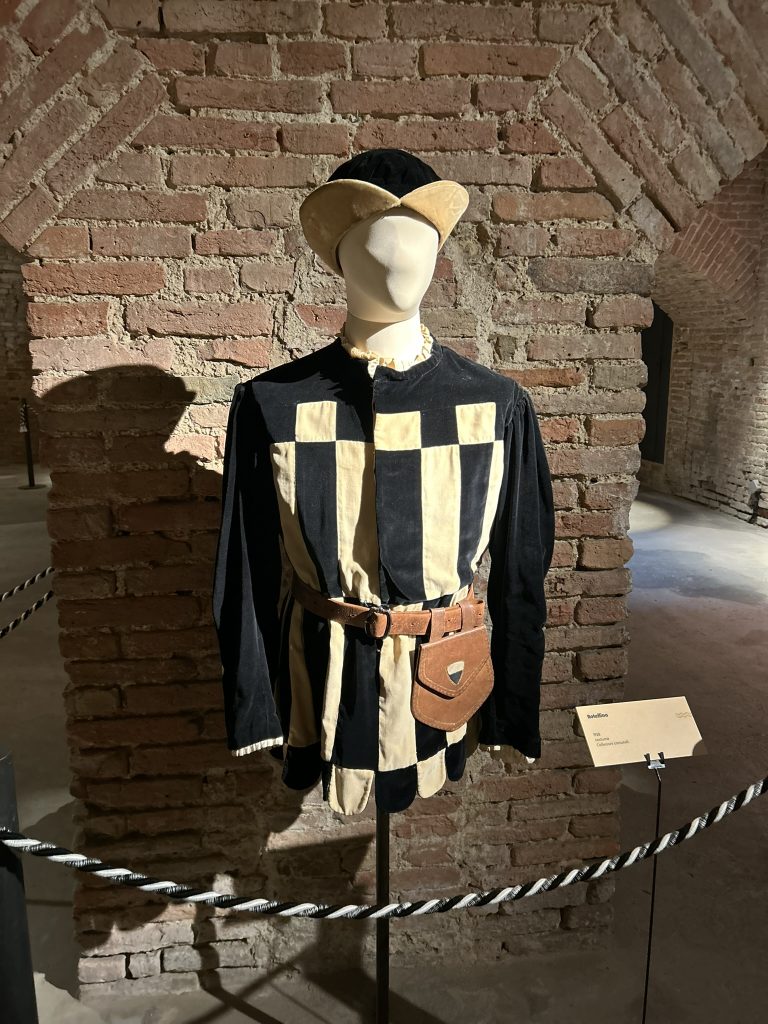
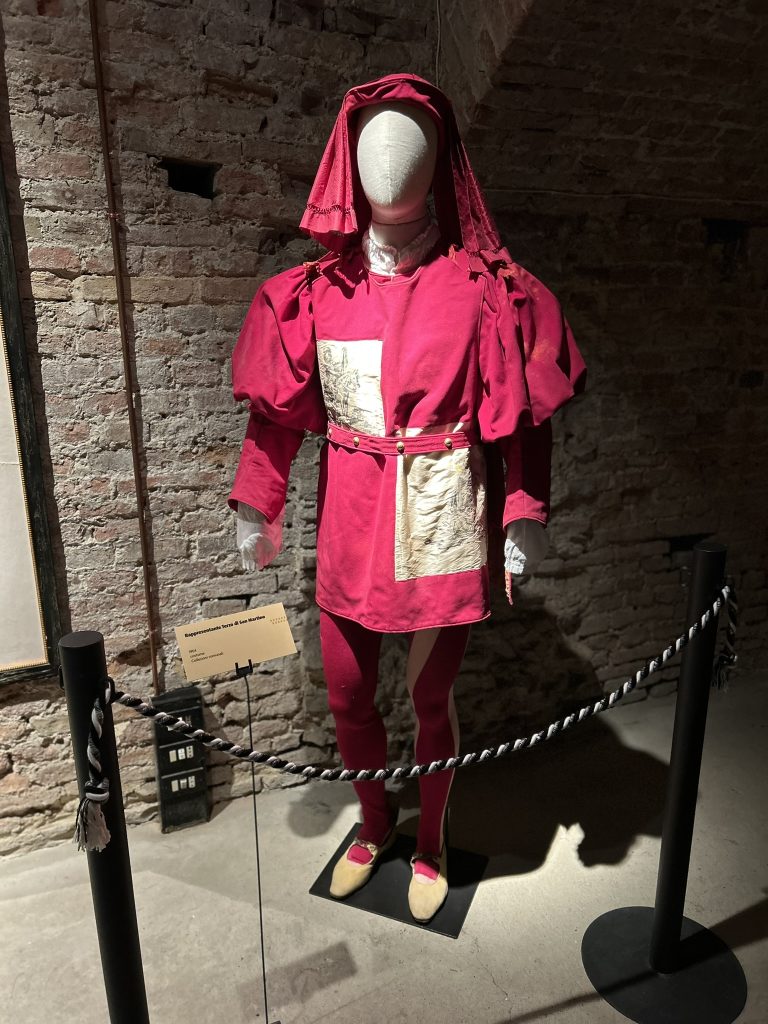
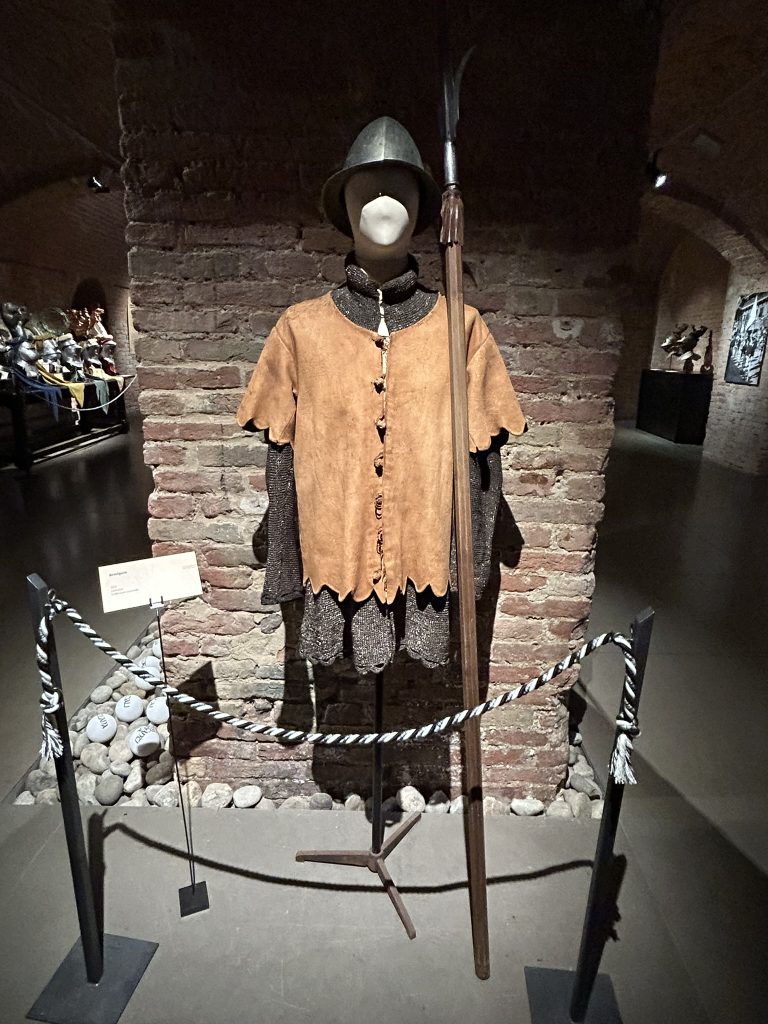
We first head downstairs for the costume exhibition that features examples of the medieval-inspired costumes worn by participants in the Palio.
I’m a sucker for a good costume exhibit and this one certainly doesn’t disappoint. The only thing lacking are women’s costumes since the focus is on how the riders in the Palio dressed and all of them are for men (or at least I presume so).
Public Rooms in the Palazzo Pubblico
Upstairs in the main part of the Palazzo Pubblico are the stunning reception rooms. With the room containing the Lorenzetti frescoes of Good and Bad Government off limits, the main highlight is the Sala del Mappamondo (the World Map Room), which was once the headquarters of the Council of the Republic.
Martini Fresco
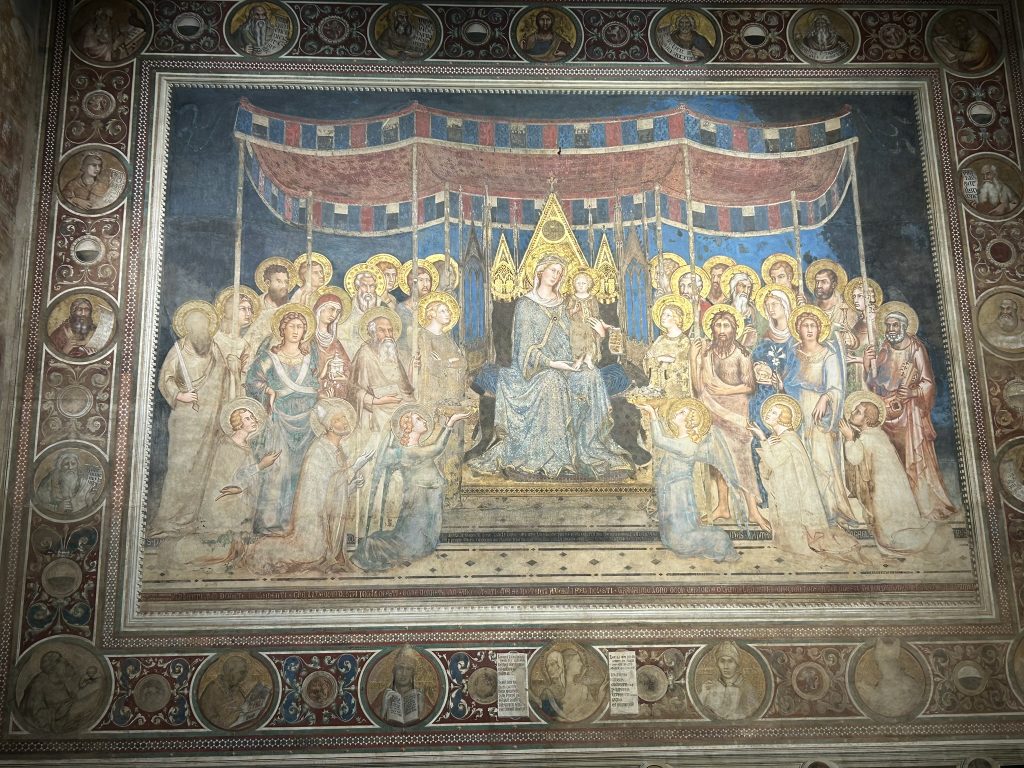
I stand in the middle of the large room and stare at the Maesta by Simone Martini. In The Towers of Tuscany, Sofia stands exactly where I stand to look at the Maesta.
Although obviously restored, the 2024 version probably doesn’t hold a candle to the brilliantly colored original that Sofia would have seen.
I spin around to see Martini’s other famous masterwork–the fresco of Guidoriccio da Fogliano. Mounted on his charger, the captain of the Sienese army rides across the territory he has just conquered (Montemassi, in 1328).
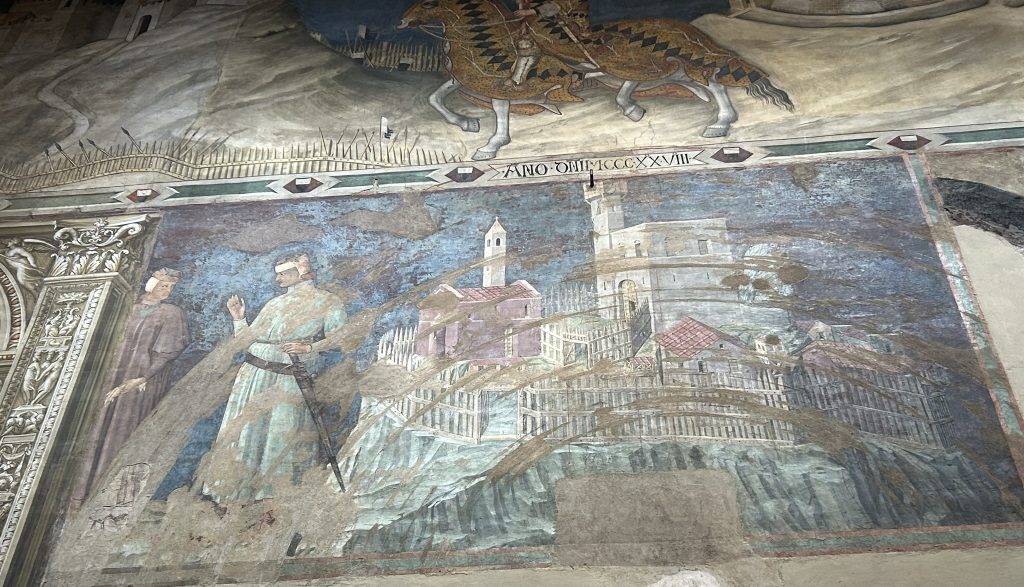
Recently, art historians have disputed the attribution of this work to Martini, claiming that it was either a slightly later work or even a 16th-century fake. Part of what sparked the debate was the 1980 discovery of a slightly older scarred fresco lower on the wall.
This earlier painting depicts two figures standing in front of a wooden-fenced castle. Some claim this is the fresco Martini painted, while those who support the authenticity of the Guidoriccio attribute this older fresco to Duccio, Pietro Lorenzetti, or Memmo di Filippuccio.
Who knows! It’s awesome whoever painted it.
Siena Cathedral
The sun bursts forth after our visit to the Palazzo Pubblico. Gregg heads back to the hotel and I set off to tour Siena Cathedral and the adjoining museums.
Here’s where you’ll find the crowds in Siena! The cathedral is mobbed with tour groups, but it’s definitely worth a look-see.
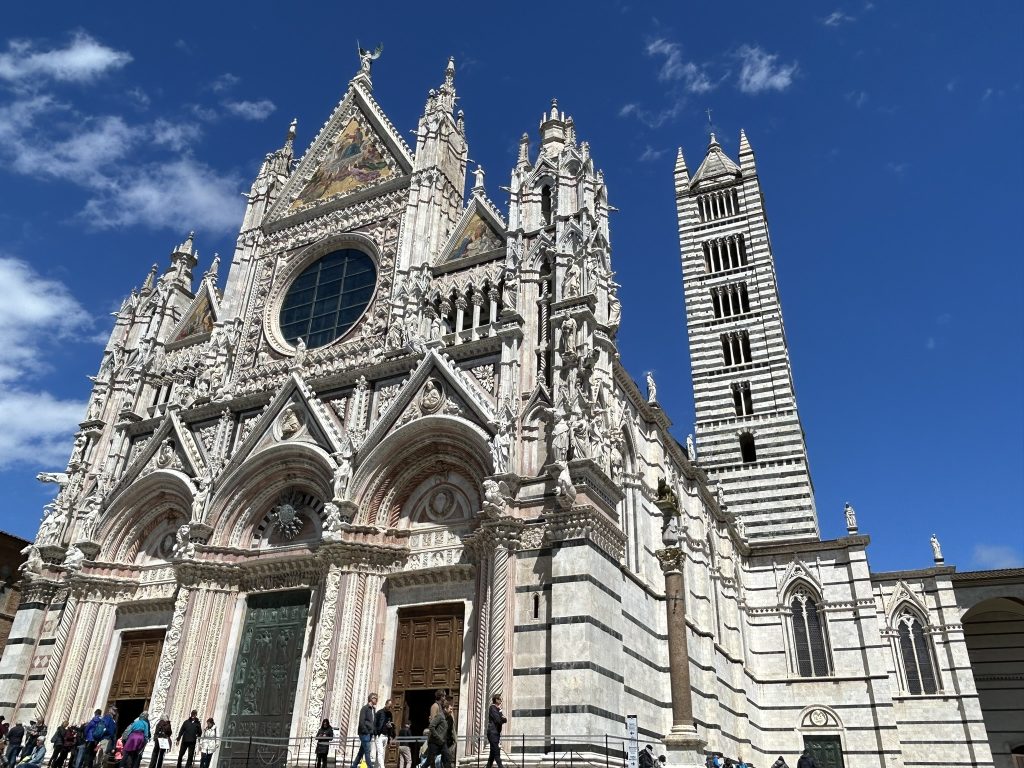
As mentioned in my list of highlights at the beginning of this post, you can’t miss the very cool 15th century paintings in the Piccolomini library. You have to line up to get in, but entrance is included in your ticket to the cathedral.
If you visit Siena Cathedral, buy a ticket that includes all of the various components, even if you don’t visit them all. I made the mistake of only buying a ticket for Siena Cathedral and then discovering later that I couldn’t access the Museo Opera where the fabulous Maesta by Duccio is housed (it has a cameo appearance in The Towers of Tuscany).
By the time I figured out that I didn’t have the right ticket, I couldn’t summon the energy to trudge all the way back to the side of the cathedral to line up to buy the correct ticket. Fortunately, I’ve seen the Duccio twice before!
I return “home” for an hour’s rest before setting off for the other side of Siena where we find a great place for dinner prior to attending a concert.
Italian Opera in Siena
When we’d arrived at I Merli di Ada, I’d picked up a brochure about opera concerts held three times a week in Siena. The price is reasonable and tickets are available. We decide to check it out.
The Italian Opera in Siena concert turns out to be very entertaining. A soprano accompanied by a pianist sings many opera favorites by Puccini, Verdi, and Bizet.
Keep an eye out for concerts such as the one we saw in Siena. If you’re going to Rome, get tickets for the Great Opera Arias Concert by Opera Lirica di Roma at the Palazzo Poli behind the Trevi Fountain. Like the concert in Siena, it features opera arias along with instrumental pieces by favorite Italian composers.
Afterwards, we float out on an operatic high and stroll the thirty minutes back to our hotel through the moonlit streets.
Siena at night goes beyond magical to mesmerizing. Most of the time, we are alone, the only sounds our footsteps on the cobblestones and the muted clanking of iron rings in the wind.
Out in the Campo for the last time, I shoot a 360-degree video of one of my favorite places in the world!
Siena will forever hold a special place in my artsy traveler heart!
Siena FAQs
Here are some of the questions I’ve been asked about Siena.
You can see the major sights in one day (the Duomo and the Palazzo Publicco) and have time for wandering, especially if you stay at least one night. You want to experience Siena’s quiet streets after the day-trippers leave.
Yes, especially for the Porta del Cielo (rooftop tour) and the Piccolomini Library, which fill up quickly. Here’s link to book tickets on GetYourGuide.
The bus is fastest and drops you closest to the center; the train is slower with an uphill walk into Siena.
Medieval architecture, the Palio horse race, the magnificent Duomo, and some of Tuscany’s richest artistic treasures.
The panforte, a dense cake full of nuts and dried fruit is fabulous (I always buy a large slab). Also try pici with cacio e pepe, ribollita (vegetable soup), and Bistecca alla Fiorentina (melt in your mouth steak with a hefty price tag but worth it).
Where to Stay in Siena
Here are more options in addition to the highly recommended I Merli di Ada:
Tour Options In and Around Siena
On one trip to Siena several years ago, I joined a small group tour of wineries in Montalcino and Montepulciano that also included an amazing lunch.
If you’re in Siena for a few days and want to spend one of them touring the wine regions, then check out some of the many tours available. You could also choose a cooking class (I always enjoy a good cooking class!), or guided tours of some of Siena’s sites.
As I’ve mentioned many times on Artsy Traveler, I’m a huge fan of Get Your Guide tours. Without exception, every tour I’ve taken has been excellent value. Full disclosure – if you click on any of the tours below and purchase a tour (any tour) from Get Your Guide, I receive a small commission. Thank you.
Conclusion
Have you visited Siena? Share your tips for an awesome experience with other artsy travelers in the comments below. View all posts on Italy on the Visiting Italy page. Here are a few of my favorite posts:
- Experience the Magic of a Night in Sirmione on Lake Garda
- A Week in Fascinating Little Padua Reveals Hidden Treasures
- A Tuscan Dream Come True: Sant’Antonio Country Resort near Montepulciano