
Small Museums in Amsterdam: Rembrandt House and the National Maritime Museum
I'm Carol Cram, novelist, podcaster, and travel writer, and founder of Art In Fiction, a curated database of 2600+ novels inspired by the arts. Artsy Traveler contains affiliate links for products and services I personally use and recommend. As an Amazon Associate, I earn from qualifying purchases. Please read the Disclosure for more information.
I love Amsterdam so much it’s my default first stop on almost every European trip. Since 1970, when I got my introduction to Europe with my mom, I’ve been back at least ten times.
You’d think I’d have tracked down every small museum in Amsterdam by now, but two managed to hide from me until my most recent visit: the National Maritime Museum and the Rembrandt House Museum.
Table of Contents
- Finding These Small Museums on the Map
- National Maritime Museum
- The Rembrandt House Museum
- Wandering Around Amsterdam
- Recommended Novels to Read Before You Go
- Tickets & Tours: Rembrandt House & National Maritime Museum
- Other Tours in Amsterdam
- Staying in Amsterdam
- Keep Exploring Amsterdam with Artsy Traveler
Finding These Small Museums on the Map
First is the National Maritime Museum (#1 on the map below) and second is the Rembrandt House Museum (Rembrandt Huis – #2). Both deliver excellent bang for your euro. The map below also shows the location of my recommended hotel (#3) and for context, Amsterdam’s two heavyweight museums: the Rijksmuseum (#4) and the Van Gogh Museum (#5).
National Maritime Museum
Despite all my visits to the city, I’d never heard of Amsterdam’s excellent Maritime Museum. On my latest trip, the taxi drove us right past the massive replica of an 18th-century Dutch three-master sailing ship (the Amsterdam) moored in the harbor. I asked him what it was and he told us it was part of the National Maritime Museum. Intrigued, I looked it up when we got to the hotel, which turned out to be only a six-minute walk away.
Arriving at the National Maritime Museum
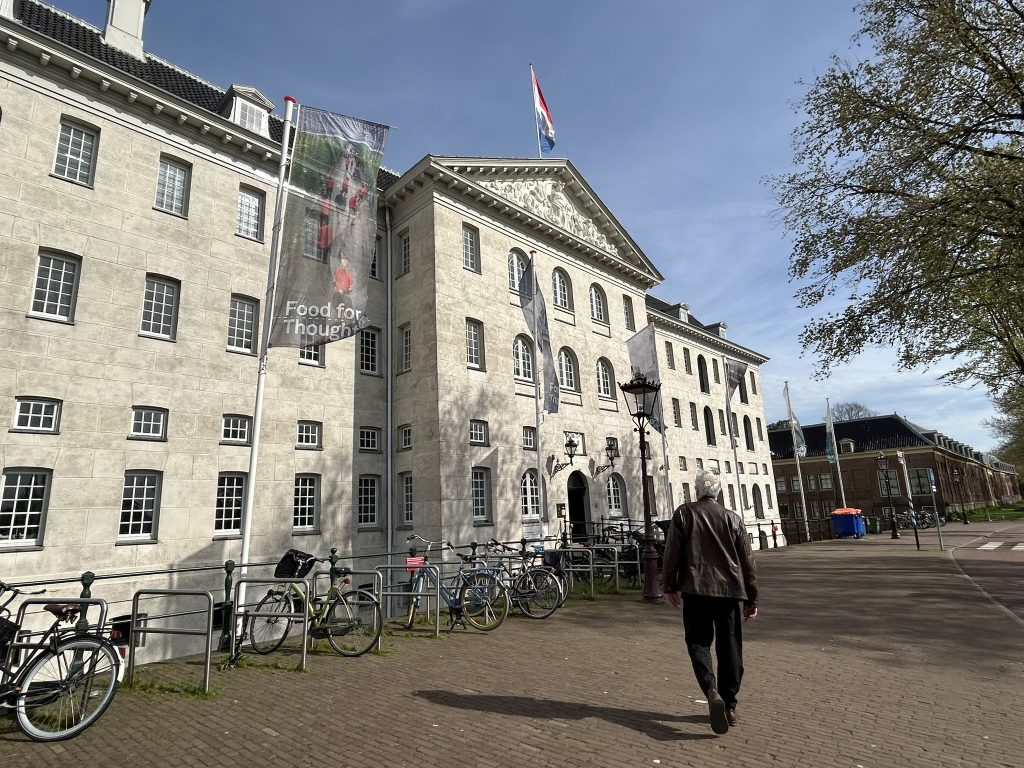
The National Maritime Museum is housed in a stately three-story building on the edge of Amsterdam’s massive harbor and adjacent to the Amsterdam ship moored in the harbor. After entering at the south side of the building, we walked into a spacious covered atrium with entrances leading to the north, west and east.
Touring The Amsterdam
We headed first for the north door that led straight out to a wharf and the docked replica of the Amsterdam. What a sight! The huge hull rose several stories above our heads, above which soared three masts.

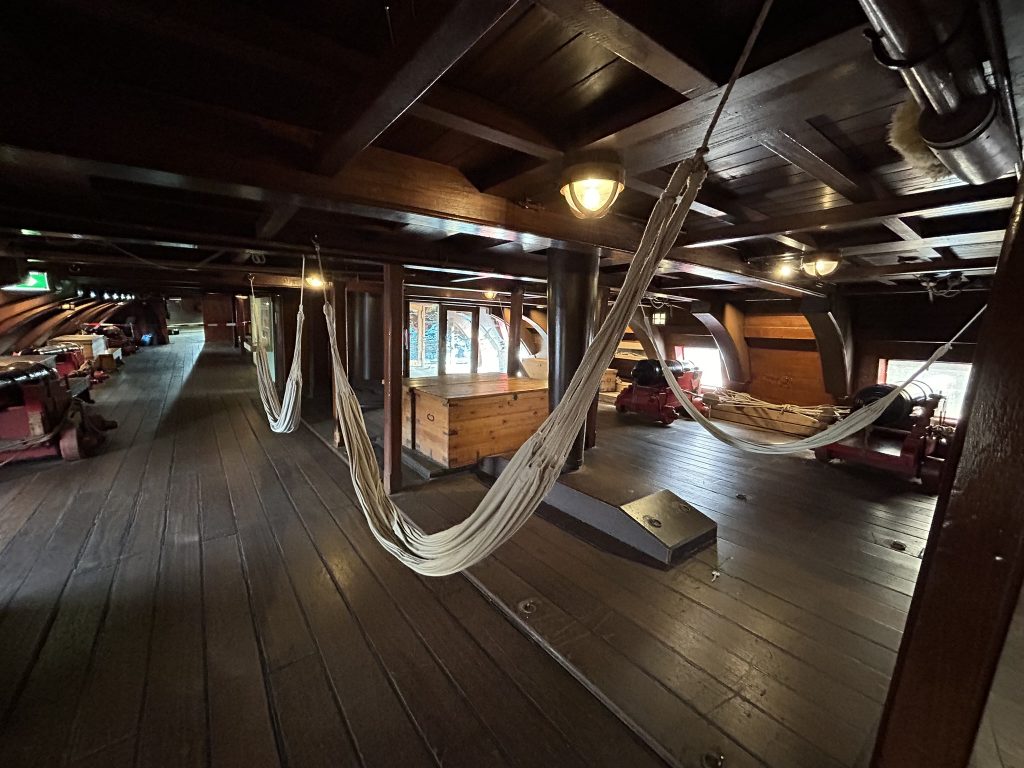
We boarded the ship and were immediately engulfed by a posse of schoolchildren all wearing yellow safety vests and swarming through the sailors’ quarters. Apart from the kids, the quarters looked spacious until I realized the space would house a crew of 191 sweaty sailors. The smells and swells on a rough day at sea would not have been pretty.
Information about the Amsterdam
Throughout the ship, descriptions in both English and Dutch provided fascinating glimpses into the history of the original Amsterdam and Dutch trade back in the 17th and 18th centuries. I learned that on one voyage, the Amsterdam carried one captain, 191 sailors, 128 marines, 11 artisans, and 3 women passengers for a total of 334 people. That’s a lot of bodies to squeeze onto a ship that, while large, wasn’t that large. I found it a bit crowded with a school group of maybe 30 kids!
Eating on the Amsterdam
In the galley at the front of the ship, the cook would prepare meals for everyone on board, who would then take turns eating in groups of seven. The captain and passengers got the best and freshest food, leaving the crew to half starve and fall prey to diseases such as typhus, dysentery, and scurvy. It must have been pretty grim, particularly since long voyages to destinations in the East Indies took many, many months.
Women Dressed as Men
I was particularly taken by a description of women dressed as men who sailed on the Dutch ships. Some were forced by circumstances to earn money; some were likely trying to escape an unhappy marriage; some maybe just wanted adventure. Unfortunately, any woman who was trying to pass herself off as a man on a ship was severely punished.
In 1770, a woman called Margereta Reymers dressed as a man and joined the crew of the East Indiaman Schoonzicht under the name Hans Hendrik Reymers on a ship sailing to Asia. Margereta was discovered two months into the voyage and put ashore at Cape Town where a man who had promised to marry her left her pregnant.
Eventually, Margereta managed to find a place on a ship returning to the Netherlands. Her daughter was born at sea. No one knows what happened to Margereta and her daughter. Hmmm—therein lies an interesting idea for a novel!
The Maritime Museum Exhibits
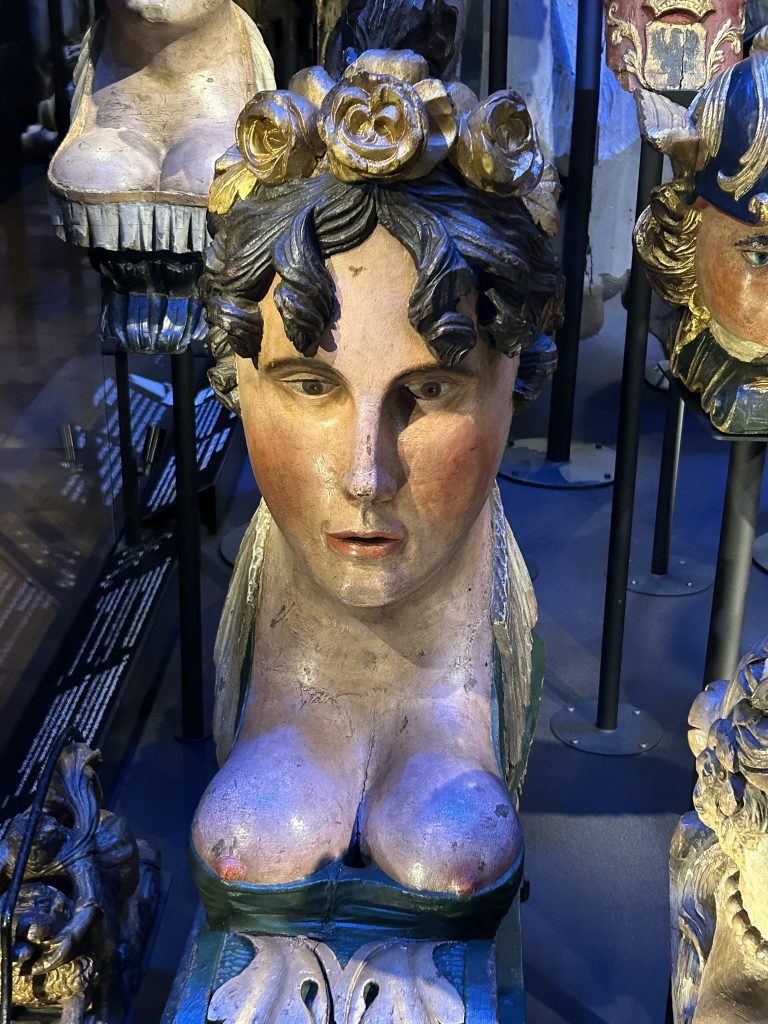
The museum itself is quite vast and beautifully curated. If you are into ships, navigation, and sailing, you could spend many happy hours there. I particularly enjoyed the displays of figureheads and model ships.

For more information about the National Maritime Museum, check out their informative website: https://www.hetscheepvaartmuseum.com/
After touring the National Maritime Museum, we enjoyed lunch in a typical Dutch pub, then headed to the Rembrandt House Museum, about a ten-minute walk from our hotel.
The Rembrandt House Museum
Unlike the National Maritime Museum, I had heard about the Rembrandt House Museum, but had never managed to visit it. I thought it would be a rather dusty old place with little to recommend it beyond the fact that Rembrandt once lived there.
I discovered that I was wrong and that the Rembrandt House Museum is well worth an hour of any artsy traveler’s time.
Renovated Museum
The museum has been recently renovated to include an adjacent building containing the entrance area, a gift shop (of course), and two floors of exhibition space.
We entered the airy modern foyer, purchased our tickets and picked up our audioguides. We don’t usually opt for audioguides, but the man at the desk told us they were essential to our enjoyment of the museum and so we dutifully donned the earphones and headed for door leading into the house that Rembrandt called home for 19 years.
Touring Rembrandt House
For the next hour or so, we drifted from room to room and up several sets of winding stairs to explore the nooks and crannies of what was, and still is, a large and comfortable home. Rembrandt was flying high when he and his wife purchased the house. He was receiving many commissions in addition to earning a sizable chunk of his income from teaching wannabe Rembrandts.
But regrettably, Rembrandt was not the best of businessmen. After nineteen years of enjoying the good life, Rembrandt’s many creditors forced him to sell just about everything not nailed down and move across town.
Rembrandt’s Misfortunes are History’s Gains
I learned that it was thanks to Rembrandt’s financial misfortunes that his house has been so immaculately recreated. When Rembrandt was forced to liquidate all his assets, he left behind an extremely detailed inventory of the house contents. Historians were able to use this inventory to faithfully recreate the rooms in his house so that today we can wander through them secure in the knowledge that they look more or less the same as they did in Rembrandt’s day—except with electric light and tourists listening to audioguides.
The comprehensive audioguide provided us with a wealth of information about each of the rooms we entered, from grand salon to the room of curiosities to Rembrandt’s gorgeously bright and airy painting studio. In each room, audio commentary described the room and its uses, and provided information about Rembrandt’s life and work.
Rembrandt House Highlights
Box Beds
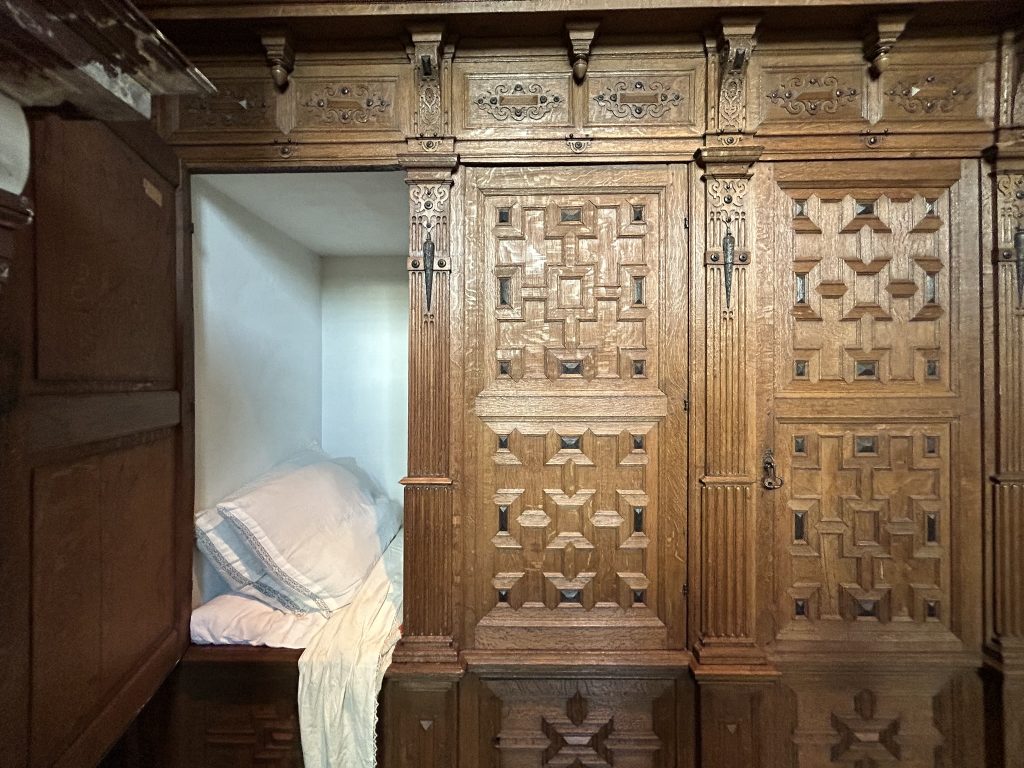
One of several box beds in the house was situated in the main salon and, like every box bed in the house (there were several), was much shorter than would seem reasonable to accommodate an average-sized human. I learned that back in Rembrandt’s time, people slept sitting up and so had no need of a bed that extended their full height. Apparently, the prevailing medical wisdom of the day dictated that sleeping completely prone was very bad for the health. Peering into the box beds, I shuddered at the thought of actually sleeping in one. If you are at all prone to claustrophobia, you wouldn’t last ten minutes.
The box bed shown below was in the main salon and would have been for visitors.
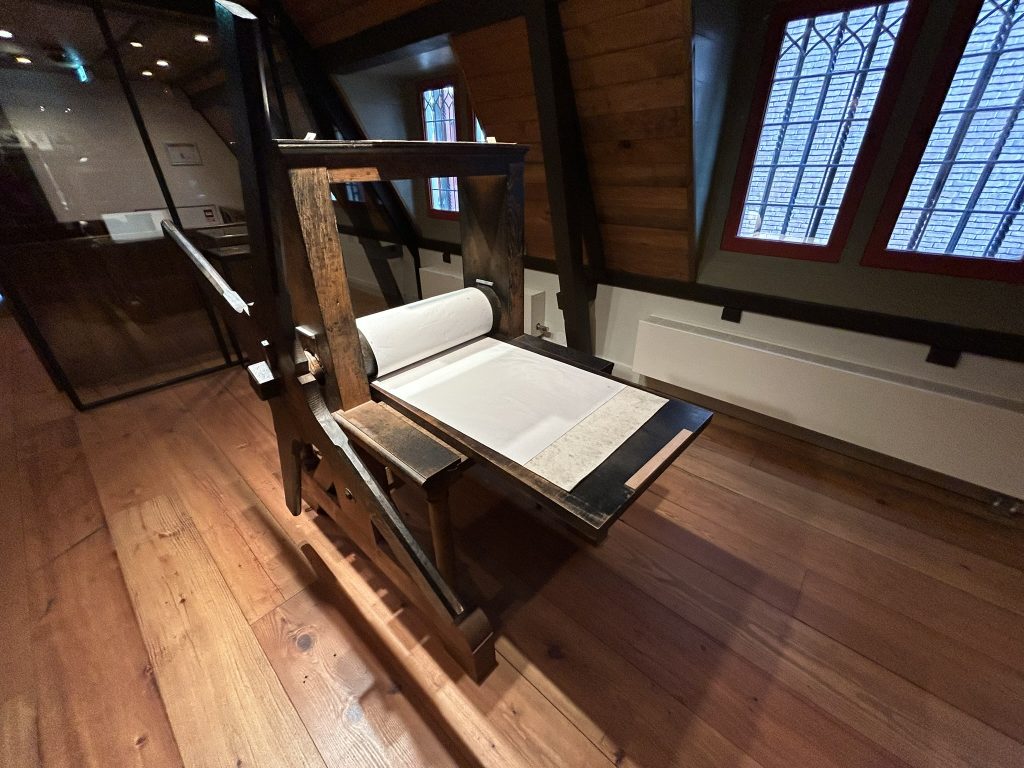
Etching Studio
Rembrandt was known for his etchings, many of which he made in the etching studio. Nowadays, a rubber-gloved attendant demonstrates the art of etching.
Unfortunately, we missed her demonstration but it was likely very similar to the one we saw at the house of Albrecht Dürer in Nuremberg. In fact, the setup of the Rembrandt House Museum reminded me of the Dürer museum. You can read about our visit there in my page about Artsy Sightseeing in Germany.
Painting Studio
Stepping into Rembrandt’s large painting studio feels quite magical. Although now filled with visitors all listening intently to their audioguides, it’s salutary to remember that you are actually treading the same floor boards and looking out the same windows as Rembrandt did four hundred years ago.
The room faces north, an aspect favored by painters because the light varies, the least throughout the day. The studio is at the top of the house and so would have been as bright and airy as any room in a 17th-century house could be.
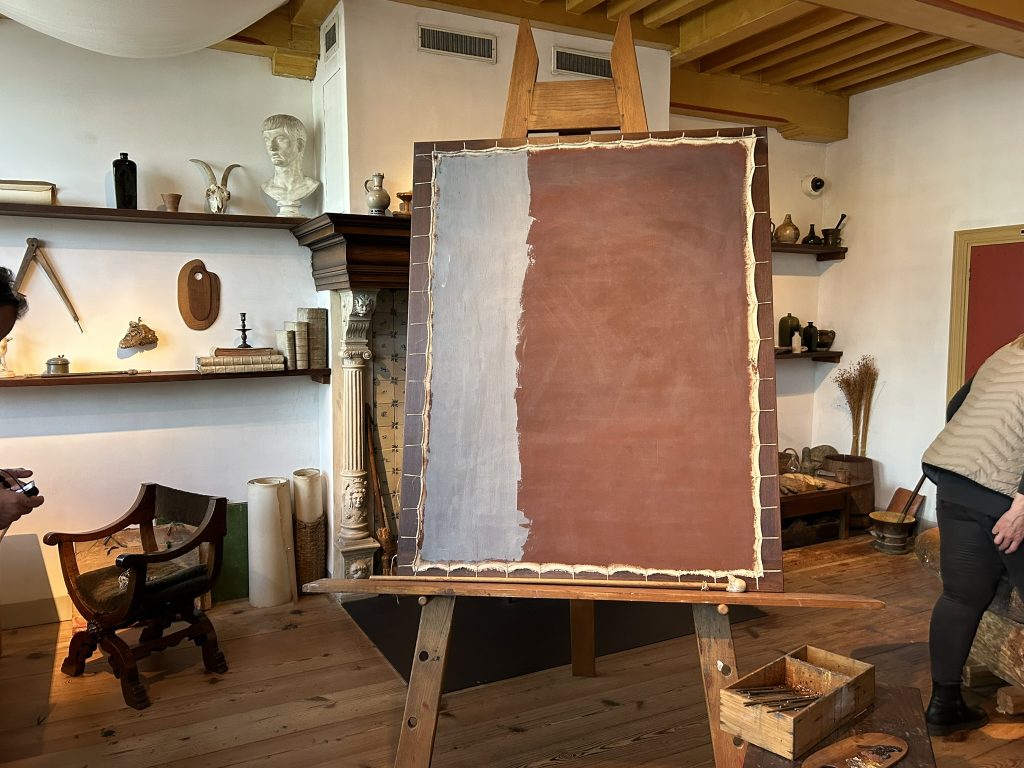
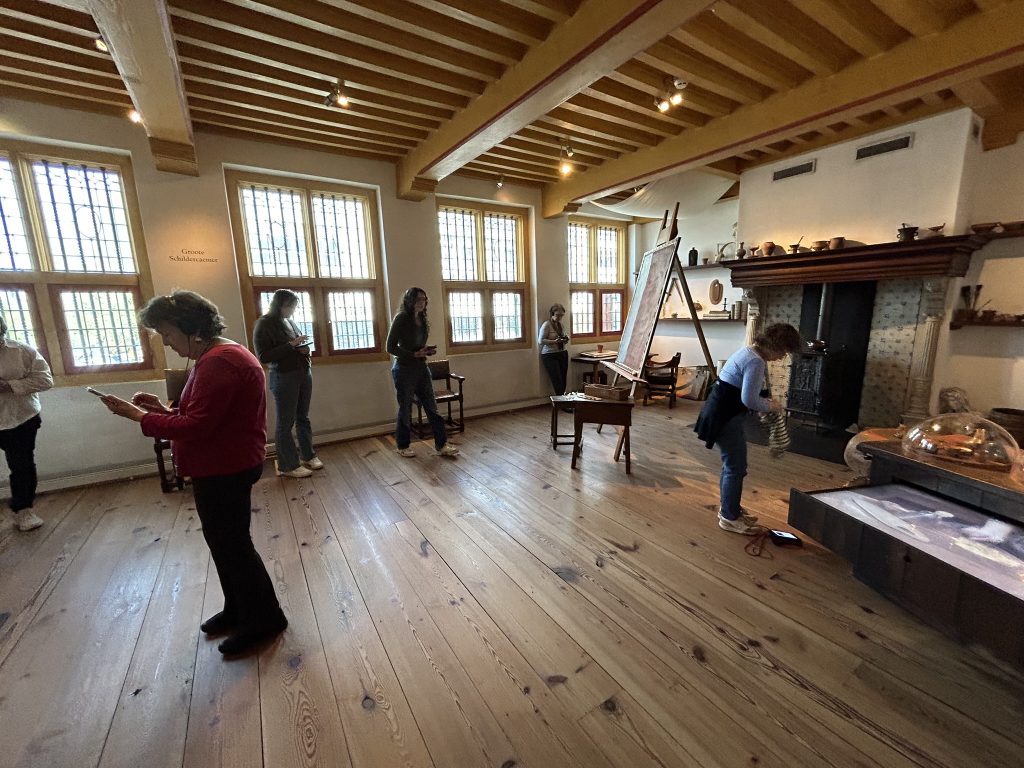
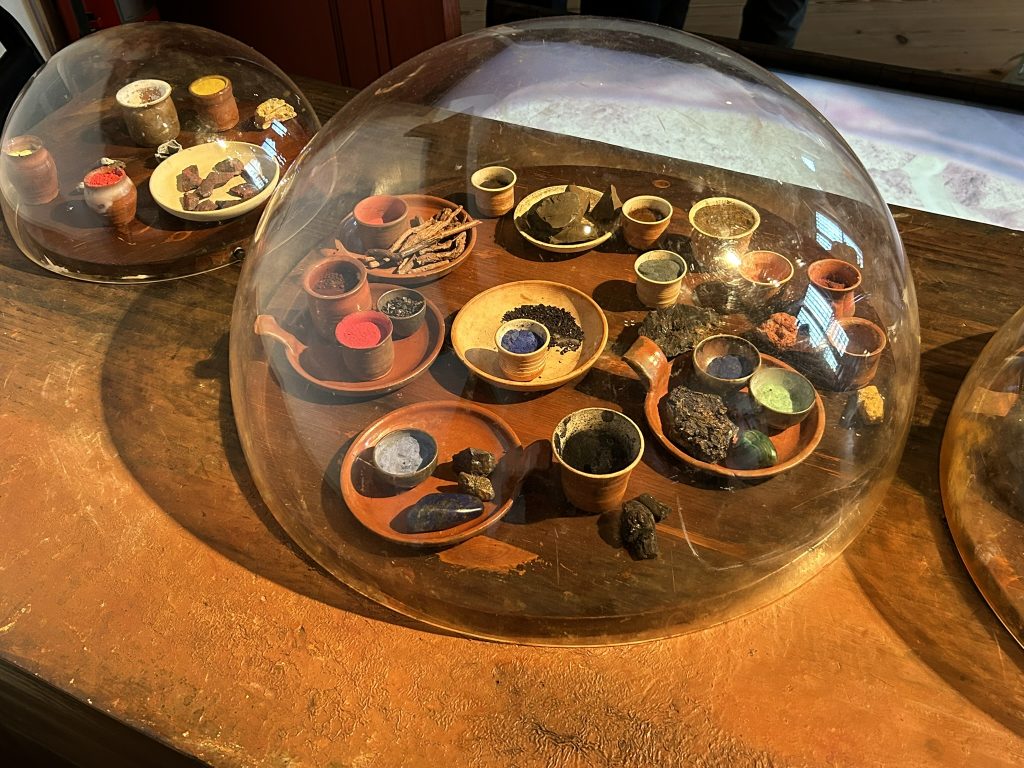
The studio includes a large video screen showing a demonstration of how Rembrandt and his assistants made pigments. I’m familiar with the process of grinding and mixing the pigments from my research for my debut novel, The Towers of Tuscany.
But whereas my characters in 14th-century Italy mixed their pigments with egg yolks, Rembrandt and his contemporaries mixed pigments with linseed oil.
Small Painting Studio
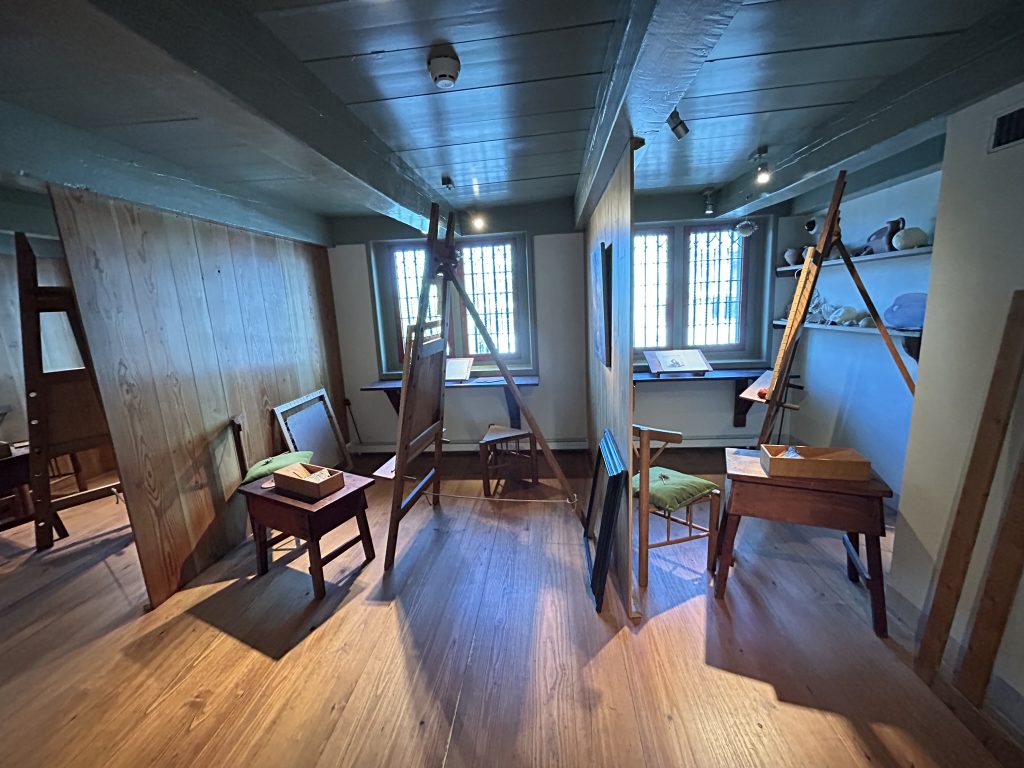
I was quite taken with the second painting studio which was partitioned into four sections to accommodate four students.The whole set-up looked so modern. Apparently, Rembrandt made 30% of his annual income from students, but even that income wasn’t enough to keep him afloat. I wonder what became of the students after Rembrandt had to liquidate?
But check out these studios. Many artists would feel quite at home in one today!
The Room of Curiosities
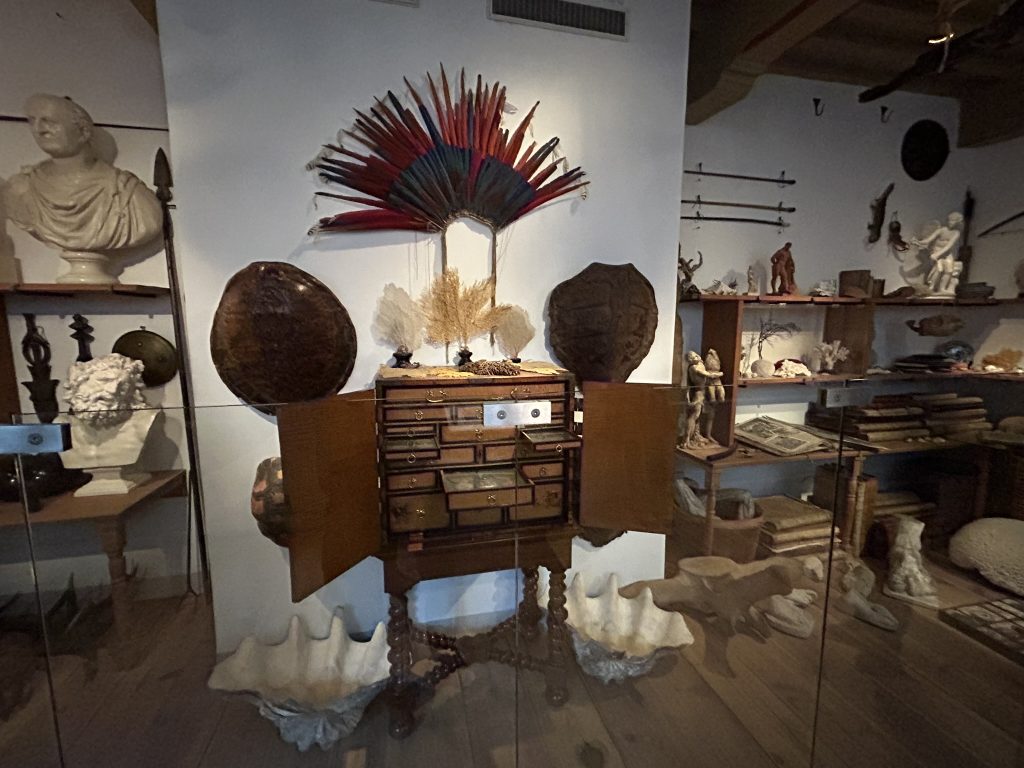
Like many people of his time, particularly artists, Rembrandt was an avid collector. His many collections fill the room of curiosities, from parrot feathers and stuffed caimans and armadillos, to tortoise shells, butterflies, rocks, and a hundred other exotic bits and pieces he accumulated over the years. Amsterdam, of course, was a port, and so Rembrandt was able to acquire objects from around the globe that had been brought to Amsterdam by the sailors.
Exhibition Center
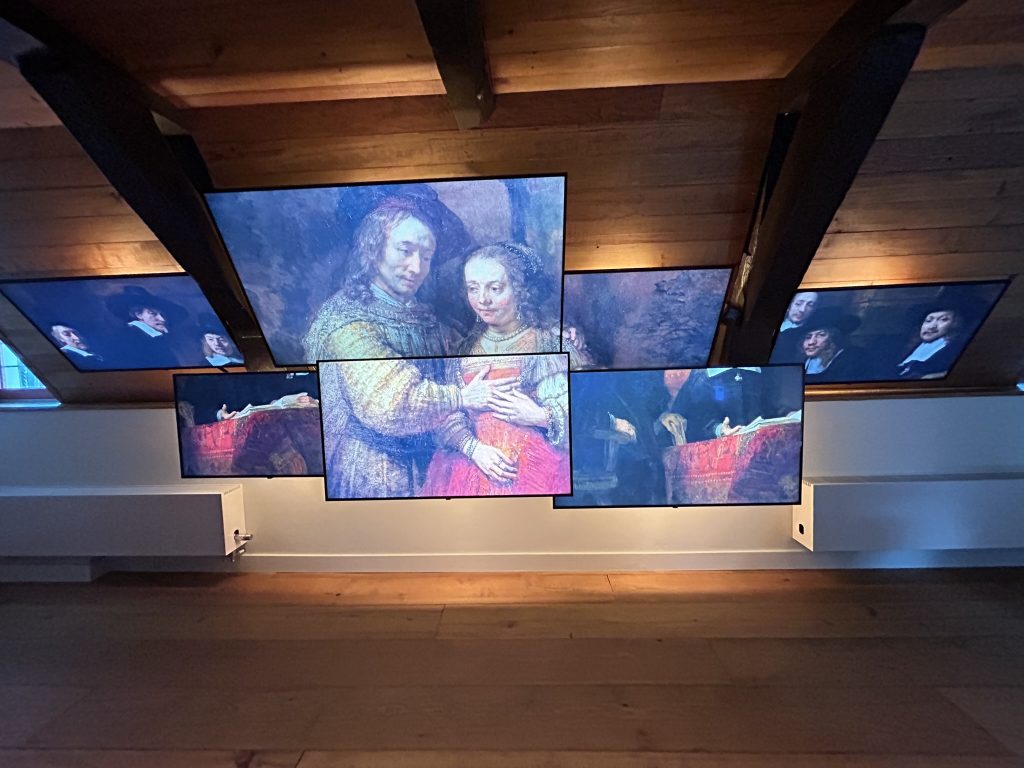
After touring Rembrandt’s house, we funneled back into the exhibition center. There wasn’t much on when we were there, but I did appreciate the projection of a montage of Rembrandt’s greatest hits.
Wandering Around Amsterdam
Amsterdam is a fantastic city for walking, so long as you keep a very sharp eye out for cyclists. They go very, very fast! I wonder how many tourists who stepped off a curb without looking ended up in Emergency.
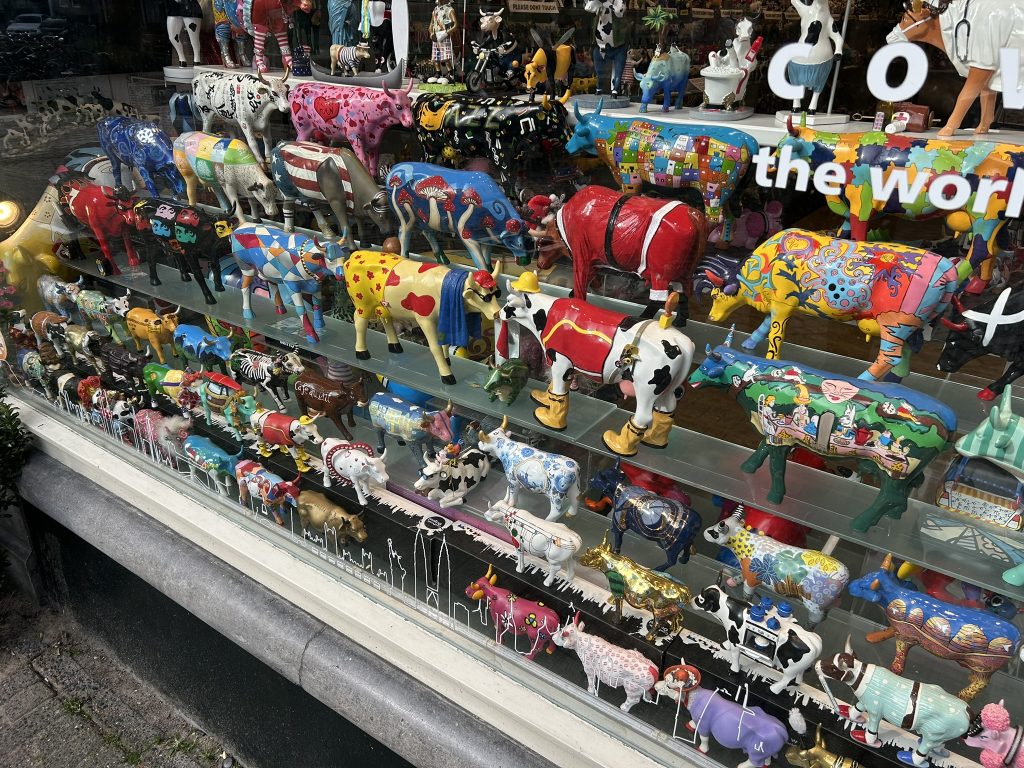
The city has an admirably eclectic variety of stores carrying everything from Old Master knock-offs to rubber duckies to high fashion to painted cows. I adore window shopping in Amsterdam.
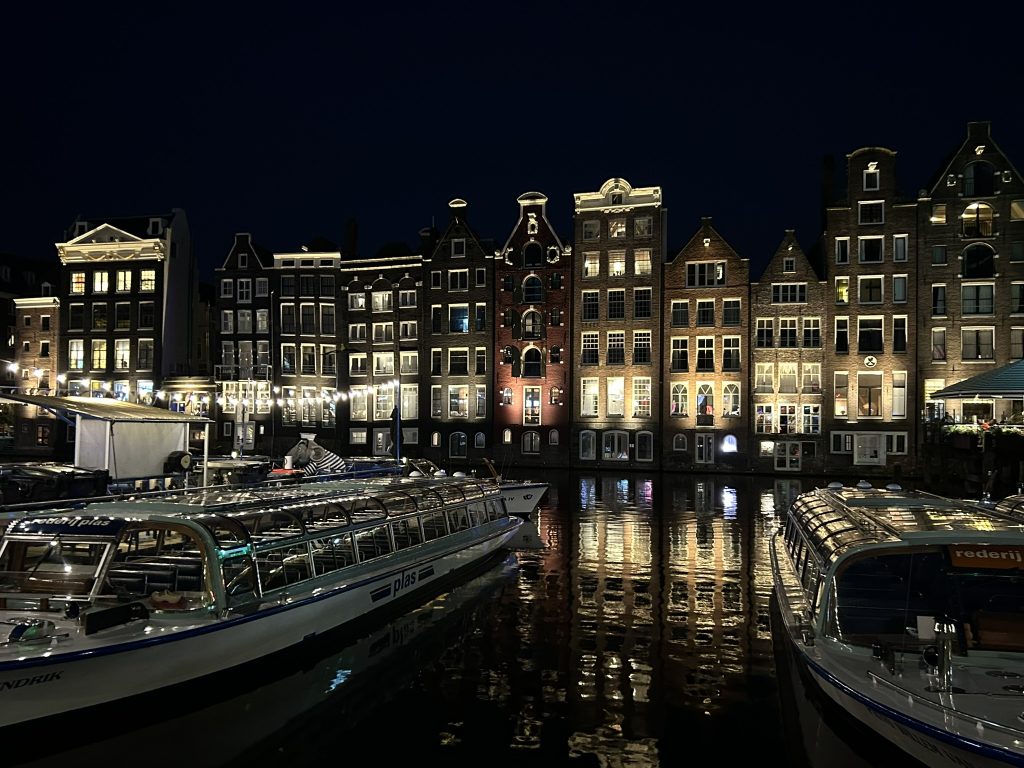
Amsterdam at night is magical! The side streets are quiet, the canals serene in the moonlight, the bike traffic considerably calmed. You can wander for hours, imagining yourself into a cityscape that hasn’t changed appreciably for four hundred-odd years.
Recommended Novels to Read Before You Go
The Girl Who Adored Rembrandt by Belle Ami
A time-travel thriller in which psychic art historian Angela Renatus is drawn into a chase to uncover the truth behind a priceless, stolen Rembrandt family portrait.
The Rembrandt Secret by Alex Connor
A historical thriller in which a serial killer’s gruesome trail across London and New York uncovers the hidden truth behind one of Rembrandt’s most famous works.
Tickets & Tours: Rembrandt House & National Maritime Museum
Both museums are easy to walk into without a reservation, but if you’d rather not risk it, or you want a guide to connect the two stops for you, here are some options at different price points.
Rembrandt House Museum Entrance Ticket
Includes
- Rembrandt House Museum entry fee
- Multimedia audio tour in 16 languages
- Access to the etching and painting studios
Best For
Independent travelers happy to wander at their own pace
Why Choose It
The only museum in the world entirely devoted to Rembrandt, and the audio guide is worth putting on, not just a rental you feel obligated to use
From $22 per person
Book with GetYourGuideNational Maritime Museum Skip-the-Line Ticket
Includes
- Entrance ticket to the National Maritime Museum
- Visit to the replica 18th-century ship Amsterdam
- Audio tour in 11 languages
Best For
Anyone pairing both museums from this post into one day
Why Choose It
This is the ticket to the ship itself, the tall-masted Amsterdam replica moored in the harbor, not just the museum building behind it
From $23 per person
Book with GetYourGuideMost Immersive
Private Rembrandt Walking Tour & Optional Museums
Includes
- Private walking tour through Rembrandt’s Old Town with an Art History Expert-Guide
- Optional skip-the-line Rijksmuseum ticket (4 and 5-hour options)
- Optional skip-the-line Rembrandt House ticket (5-hour option)
Best For
Readers who want a guide connecting the dots between Rembrandt’s house and his art
Why Choose It
Turns the two stops in this post into one guided story, starting at the Oude Church where Rembrandt married Saskia and ending in front of The Night Watch
From $229 per person
Book with GetYourGuideRijksmuseum Entry Ticket
Includes
- Museum entry and permanent exhibition access
- Cloakroom and free WiFi
Best For
Readers extending their day to the “heavyweight” museum from the map above
Why Choose It
Skip-the-line access to The Night Watch and the rest of Rembrandt’s major works, a natural add-on after seeing where he actually lived
From $31 per person
Book with GetYourGuideOther Tours in Amsterdam
There’s so much to see in Amsterdam for the artsy traveler! I highly recommend booking one of the GetYourGuide tours, if only to skip the line at the most popular museums. I’ve consistently found GetYourGuide tours to be good value, and have taken them in Rome, Venice, Paris, Madrid, and Sirmione.
Here are links to GetYourGuide tours in Amsterdam.
Also, check out a walking tour with GuruWalks. They offer these tours in Amsterdam:
Staying in Amsterdam
Over the years, I’ve stayed at many different places in Amsterdam, from Airbnbs to hotels on the outskirts. To my surprise the Holiday Inn Express – City Hall in Amsterdam, steps from the harbor and within walking distance of old Amsterdam, was a perfect choice.
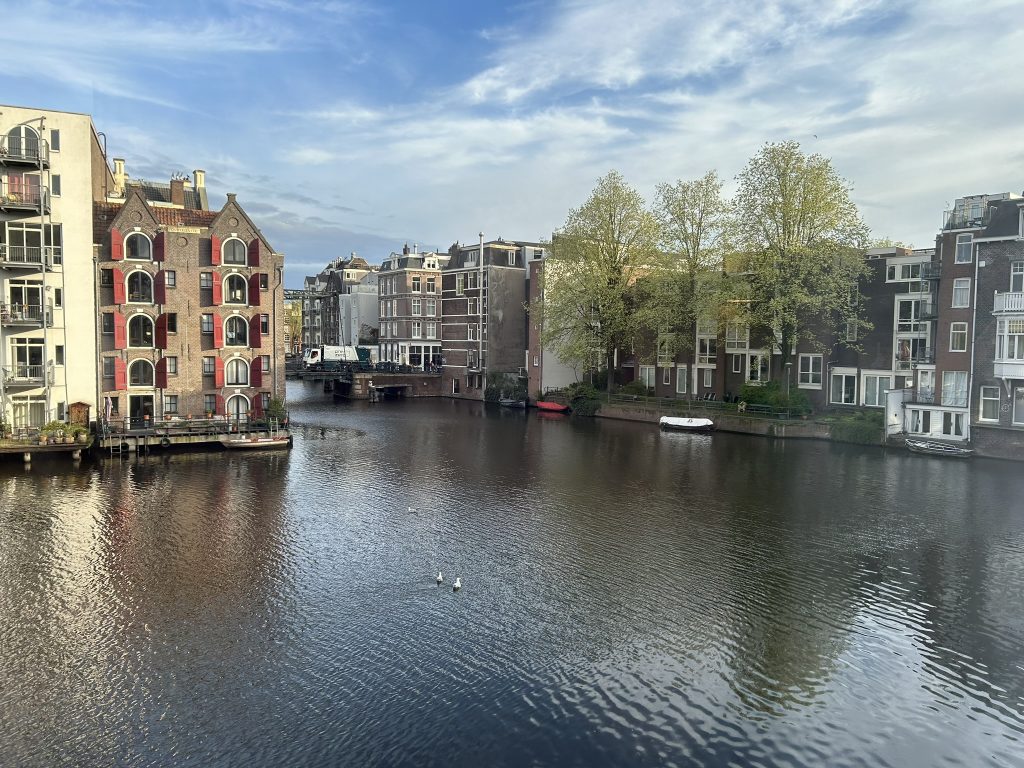
The view of the canal from our window was endlessly fascinating (depending on the time of day and the shifting April weather), the room was comfortable, and the staff friendly and helpful.
I also appreciated the large urn full of citrus fruits and water in the lobby. Every time I came into the hotel, I helped myself to a refreshing glass of citrus water.
Here are other options for staying in Amsterdam. I recommend you resist the temptation to opt for the cheaper places outside the city center. Amsterdam is worth the splurge. Book a place as close to the ring of canals as you can and enjoy many happy hours of wandering, particularly after dark.
Keep Exploring Amsterdam with Artsy Traveler
For more about Amsterdam, check out these posts:
- Best Two Days in Amsterdam
- Rijksmuseum in Amsterdam: Guaranteed Thrills for the Artsy Traveler
- Van Gogh Museum in Amsterdam: Best Bets for the Artsy Traveler
Would you like to save this post?

Carol M. Cram is the author of five award-winning novels inspired by art and the women who shaped it, the creator of Artsy Traveler, an arts-focused travel blog, the founder of Art In Fiction, a curated database of 2,600+ novels inspired by the arts, and the host of The Art In Fiction Podcast. She lives with her husband, artist Gregg Simpson, on beautiful Bowen Island near Vancouver, BC.