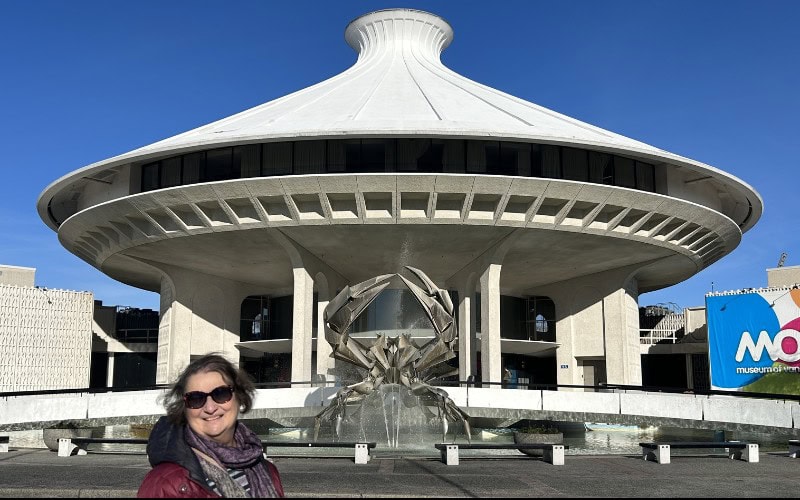
Carol Cram stands in front of the Museum of Vancouver, a futuristic looking white building with a saucer shaped roof and a fountain sculpture at the entrance. The building is labeled as the Museum of Vancouver, and the bright blue sky enhances the structure's architectural design.

The Vancouver Museum & Granville Island: A Great Day Out

If you’re looking for a family-friendly outing in Vancouver, carve out a few hours to visit the Vancouver Museum (AKA the Museum of Vancouver).

After getting a good hit of cultural history, walk the seawall or hop on the False Creek ferry to Granville Island for lunch and shopping.

At the Museum of Vancouver (MOV), you’ll discover the cultural history of the city. A series of exhibits take you on a journey past hundreds of artifacts used by individuals and communities that have called the area home.

A graphic promoting "The Vancouver Museum & Granville Island," featuring a view of Vancouver Museum with the author Carol Cram in front above the text and a little ferry on the water in English Bay in Vancouver among many other anhored boats below the text.


Highlights of Your Vancouver Day


Introduction

I’ve lived in Vancouver all my life. I remember when the Museum of Vancouver was built in 1968. I also remember when, in 1979, Granville Island was transformed from an industrial wasteland to a major Vancouver tourist attraction.

On a recent bright and sunny January day, I joined the throngs of Vancouverites who emerge when the sun shines and headed for Kitsilano. This laid-back residential area is one of Vancouver’s most beautiful, with its huge saltwater pool and mountain views from Kitsilano Beach.

Here, I toured the Museum of Vancouver and then rode the False Creek ferry to Granville Island for lunch and shopping.

The spectacular views of this area of Vancouver never get old.

Carol Cram stands by a tree on the edge of a scenic waterfront. Sailboats float in the blue water, with mountains and clear skies in the background.

Whether you’re a local or a visitor, make time to visit the Vancouver Museum. Then, get yourself over to bustling Granville Island, an especially enjoyable outing on a sunny day.


Locations

The Museum of Vancouver (#1) is located at 1100 Chestnut Street in Vanier Park (#2) in Vancouver’s Kitsilano neighborhood. It’s located within the unceded territory of the Musqueam, Squamish, and Tsleil-Waututh Nations.

Vanier Park occupies most of Kitsilano Point and overlooks stunning views of the mountains, the ocean and False Creek. Downtown Vancouver is just a 10-minute bus or car ride away. 

Granville Island is located about a 20-minute walk from Vanier Park under the Granville Street Bridge at the edge of False Creek. For decades, the area was a polluted blight on the Vancouver skyline.

After its extensive makeover starting in 1979, Granville Island now teems with shops and activities, including a great area for children and the world-famous Granville Island Public Market (#3).

Map of the Area

This map was created with Wanderlog, the best trip planner app on iOS and Android

Summer Suggestion

In summer, consider this itinerary:

  • Visit the Museum of Vancouver in the morning.
  • Stroll along the seawall or take the False Creek Ferry to Granville Island for lunch.
  • Return to the area to enjoy a matinée at Bard on the Beach (#4), a five-minute walk from the MOV.

History of the Museum of Vancouver

Originally located in downtown Vancouver, the museum was founded in 1894 by a group of art and history enthusiasts who amassed a collection of artifacts and donations from local citizens.

In 1968, the building where the museum is now housed was erected in Vanier Park. The MOV shares its iconic building with the Vancouver Planetarium and the H.R. Macmillan Space Centre. The distinctive dome is meant to resemble the woven basket hats made by Northwest Coast First Nations peoples.

Initially called the Centennial Museum and then the Vancouver Museum, the new building was renamed the Museum of Vancouver in 2009 with the museum positioned as the place to go to learn about Vancouver’s cultural history.

I first visited the MOA not long after it opened in 1968 and have continued to revisit every decade or so, sometimes to take in a special exhibition, or to enjoy the fascinating permanent collection. I always find something new to look at and learn.

The MOV is Vancouver’s largest civic museum and features several history galleries, starting with galleries dedicated to the First Nations people who lived on this bountiful land for centuries before contact with people from other parts of the world, primarily Europe and Asia. 

The City Before the City: c̓əsnaʔəm

The first gallery contains The City Before the City exhibition that features c̓əsnaʔəm, the ancestral village of the Musqueam First Nation. On display are bone, stone, and shell objects from c̓əsnaʔəm that have survived for thousands of years.

A close-up of historical artifacts, including stone tools, wooden items, and other indigenous implements, displayed in a glass case with detailed labels describing their origins and uses.

The exhibition is both respectful and informative, with the aim of educating visitors about the people who inhabited the land before it was transformed by the streets and buildings we see today.

Listening stations encourage visitors to slow down, don headphones, and then watch and listen to videos narrated by First Nations people about their history and the exhibits.

An exhibition showcasing First Nations artifacts and cultural information. The display includes red information panels with indigenous words and visuals, interactive screens, and historical tools arranged on tables under dim museum lighting.

That Which Sustains Us

The focus of the That Which Sustain Us gallery is the land itself and how interactions with it are shaped by culture. You’ll learn about traditional ecological knowledge in addition to the consequences of deforestation and the urbanization of Vancouver. 

I particularly enjoyed the exhibits showcasing ancestral skills such as making leather from tanning fish skin and creating dye pigments from the mushrooms found in local forests.

Also included is this wall showing words from the Musqueam language.

A grid of wooden blocks displaying an indigenous alphabet, with each block featuring a letter, an illustration, and a corresponding English translation, such as "Raven" and "Salt."

1900s to 1920s: Gateway to the Pacific

I’m a third-generation Vancouverite, with both sets of grandparents settling in Vancouver around 1911, coincidentally a few blocks apart. My maternal grandmother remembered carrying water to their log cabin, and I grew up on stories about the expanding city.

The Gateway to the Pacific gallery features thoughtfully curated displays related to the lives of the early settlers, both European and Asian. Photographs, mannequins dressed in vintage clothing, and an impressive collection of objects bring the era to life.

A museum display depicting pre-World War I commerce. Mannequins dressed in period clothing stand beside a vintage cash register and other business-related items in a glass-enclosed exhibit.

Other displays relate to Vancouver during World War I. My maternal great-grandfather, who was originally from England, left Vancouver in 1914 to fight overseas and was killed in 1916 when my grandmother was just 10 years old.

1930s to 1940s: Boom, Bust, and War

The exhibits in this gallery chronicle the growth of Vancouver through difficult times culminating in World War II. 

A dark stain on the city’s history was the internment of people from the well-established Japanese-Canadian community following the bombing of Pearl Harbor. I know people whose grandparents and parents were relocated to internment camps in the interior of British Columbia. My mother, who lived not far from one of the internment camps in the early 1940s, remembered seeing the displaced people.

My mother moved to Vancouver in 1942 when my grandfather got work in one of the many new factories gearing up production for the war effort, and met my dad in high school. I remember my grandmother’s kitchen looking very similar to this one:

A vintage kitchen exhibit featuring an old-fashioned cream-colored stove, a kettle, and various household items like a dustpan and cloth, showcasing domestic life in the early 20th century.

For many of the people who settled in Vancouver, the post-war city was a hopeful place where home ownership was within reach. That was certainly the case for my family. We moved into our first house in the Kerrisdale neighborhood of Vancouver in 1960.

The exhibits in this gallery bring back fuzzy memories. I got a kick out of the old wringer washer which reminded me of my brother trying to put my Barbie doll through the wringer. He was not successful, as I recall.

An antique "Easy" brand wringer washing machine displayed with a sign explaining its functionality. The machine is white with metallic accents and represents household innovations from the early 20th century.

Check out the display of neon signs. Vancouver was famous for its neon, mostly clustered along Granville Street. The full-size car is a nice touch.

A retro museum exhibit featuring a classic 1950s white car parked under neon signs advertising garage, parking, and gas services. The setup evokes the mid-20th-century American automotive culture.

1960s – 1970s: You Say You Want a Revolution

If you were born prior to the 1970s, you’ll experience a major walk down memory lane in this gallery. And even if you’re not from Vancouver, you’ll likely recognize something of your past in the exhibits. 

As in many places in North America, the 1960s and 1970s in Vancouver were a time of contention. The city was growing fast, with protests, “hippies”, and alternative lifestyles front and center. The environmental group Greenpeace started in Vancouver during this period.

A highlight of this fun yet also thought-provoking gallery was seeing a poster with my husband’s name on it. Gregg Simpson was very active in the art scene during the late 1960s and early 1970s, both as an artist and a musician. 

A poster advertising a "Collage Show" with names like Bill Bissett, Gregg Simpson, Joy Long, Gary Lee Nova, Ian Wallace, and others. The event runs from February 1-14 at "Mandan Ghetto, 2645 W4th," with "Opening 8 PM" highlighted. Decorative graphics, including an angel labeled "God" and a vintage building illustration, adorn the design.

I spent quite a bit of time squinting at the many old photographs in the exhibit to catch a glimpse of him. We weren’t successful, but I did see many familiar names in the old posters and commentaries.

Completing Your Visit

The MOA is not a large museum. You can tour it in about an hour, depending on how long you like to spend reading the wealth of information provided.

After your visit, consider taking one of the adorable False Creek ferries to Granville Island.


MOV Practical Information

Getting There

If you’re visiting Vancouver and staying downtown without a car, your best option is to either take the #2 bus or rent a bicycle (weather permitting). Here are all your options:

Take the Bus

The museum is about a five-minute walk from Cornwall Avenue where the #2 bus stops. Plan your route on Translink.

Take the False Creek Ferry

From various points around False Creek, catch a ferry that stops at the Vancouver Maritime Museum (#5). Then, walk south-east for about five minutes to the museum entrance. If you’re planning on more explorations, consider buying a day pass for the False Creek ferry in advance.

Ride a Bike

Use the Mobi Bike Share service to cycle to Vanier Park. The bike share is located at Chestnut Street and McNicoll Avenue, just west of the MOA.

Walk from Granville Island

Walk west along the seawall for about 15 minutes. Note that in the winter months, the seawall may be closed for maintenance. If that’s the case, retrace your steps and take the ferry.

Drive

From downtown Vancouver:

  • Cross the Burrard Street bridge heading south.
  • Veer right onto Cornwall Street as you come off the bridge.
  • Turn right onto Chestnut Street (this will be the first street).
  • Turn right onto Whyte Avenue.
  • Turn left into the parking lot.

From the south:

  • Take Burrard Street going north.
  • Turn left onto Cornwall Street just before the Burrard Street Bridge.
  • Turn right onto Whyte Avenue.
  • Turn left into the parking lot.

Museum Hours and Ticket Prices

The MOV is open 7 days a week from 10 am to 5 pm (until 8 pm on Thursday, Friday, Saturday). Admission costs $23 for adults, $18 for seniors 65+ and students 13-18. Children 12 and under and individuals who self-identify as Indigenous enter for free.

For more information, check the Museum’s FAQ page.


Taking the Ferry to Granville Island

Nineteen little ferries ply the waters of False Creek, stopping at the places shown on the map below. The stop for the Museum of Vancouver is Maritime Museum (Kitsilano Beach).

For a round-trip cost of $11 for adults and $8 for seniors/children, you can take the ferry to Granville Island where you’ll find an excellent indoor market, restaurants, food stalls, and lots of fabulous shops.

I pretty much always find something to buy whenever I visit. On my most recent trip to Granville Island, I couldn’t resist purchasing a gorgeous red leather purse inset with a First Nations design of a raven.

Rates vary depending upon the route and the number of zones covered. If you choose, you can sail all the way to Science World at the easternmost end of False Creek. Check the rates.

The ferries scoot back and forth across False Creek and are a lot of fun to ride:

Catch the ferry from the dock below the Vancouver Maritime Museum, which is about a five-minute walk to the west of the Vancouver Museum.

Buy a return ticket on the ferry (they take credit cards) if you’re parked at the museum, or get a one-way ticket and then take a bus back to your home or accommodation. You can also purchase a day pass and explore more of False Creek.


Granville Island

The Granville Island Public Market is the main attraction on Granville Island. Here, you’ll find a dizzying array of produce, seafood, bakery items, gourmet edibles, gift items, and flowers. Lunch options also abound from food stalls serving up everything from perogies to poke. 

A vibrant market stall filled with colorful fresh produce, including tomatoes, pineapples, bitter melons, and long beans. Handwritten price signs are displayed, and the scene is bustling with bright colors.

Pro Tip: Treat yourself to a cannelle at Le Bise Bakery. They are seriously to die for.

Take your food outside and enjoy it while gazing out at the boats plying the waters of False Creek with the skyline of Vancouver and the mountains beyond. Here’s one of my favorite views towards the Burrard Street Bridge:

A wide-angle view of Burrard Bridge spanning a marina filled with boats. The city skyline and mountains are visible in the background, framed by a partly cloudy sky.

Shopping on Granville Island

After lunch, wander around the many shops on the island or even take in a performance at the Vancouver Arts Club Theatre next door to the market.

If you want more than a quick bite at the market, consider stopping in at the Tap & Barrel – Bridges Restaurant or the Dockside Restaurant. Both offer scenic views of the mountains and water and plenty of seafood options.


Other Vancouver Museums

Here’s a quick roundup of three other Vancouver museums worth visiting.

Museum of Anthropology

If you really want to dig into Indigenous history, head out to the Museum of Anthropology (#6) at the University of British Columbia, arguably the best museum in Vancouver. You’ll discover a comprehensive collection not only of Indigenous art from BC, but also from across Canada and around the world.

Science World

If you have children (or even if you don’t but just like science!), then Science World (#7) should definitely be on your itinerary. Tons of hands-on interactive exhibits, cool science shows, and world-class feature exhibitions will keep you entertained and informed.

If you’ve visited the Museum of Anthropology, then you’ll have already seen some of Bill Reid’s magnificent work.

The Bill Reid Gallery of Northwest Coast Art (#8) in downtown Vancouver exhibits the Bill Reid SFU Art Collection in addition to contemporary Indigenous Northwest Coast Art.


Where to Stay in Vancouver

Visitors to Vancouver are spoiled for choice when it comes to accommodations. Be warned, however, that prices are steep, especially for downtown hotels with views of the magnificent North Shore mountains and the ocean. Here are two of my favorite hotels in Vancouver:

Granville Island Hotel

The Granville Island Hotel (#9) is the closest hotel to the Museum of Vancouver and the Granville Island Public Market. It’s a great choice that’s a bit off the beaten track from downtown Vancouver.

Sutton Place Hotel

Located on Burrard Street (and an easy bus ride over the Burrard Street Bridge to the Museum of Vancouver) and around the corner from plenty of good shops and restaurants on Robson Street, the Sutton Place Hotel (#10) is one of the more reasonable options in Vancouver with comfy 4-star rooms.


Vancouver Tours

GetYourGuide offers a few tours that include Granville Island. Here’s a foodie tour of Granville Island Public Market.

Powered by GetYourGuide

And here are more options for touring Vancouver. Why not really splurge and take a seaplane flight over the city? On a clear day, the views are amazing.

Powered by GetYourGuide

Keep Exploring Museums with Artsy Traveler

Carol Cram
About Carol Cram

Carol M. Cram is the author of five award-winning novels inspired by art and the women who shaped it, the creator of Artsy Traveler, an arts-focused travel blog, the founder of Art In Fiction, a curated database of 2,600+ novels inspired by the arts, and the host of The Art In Fiction Podcast. She lives with her husband, artist Gregg Simpson, on beautiful Bowen Island near Vancouver, BC.
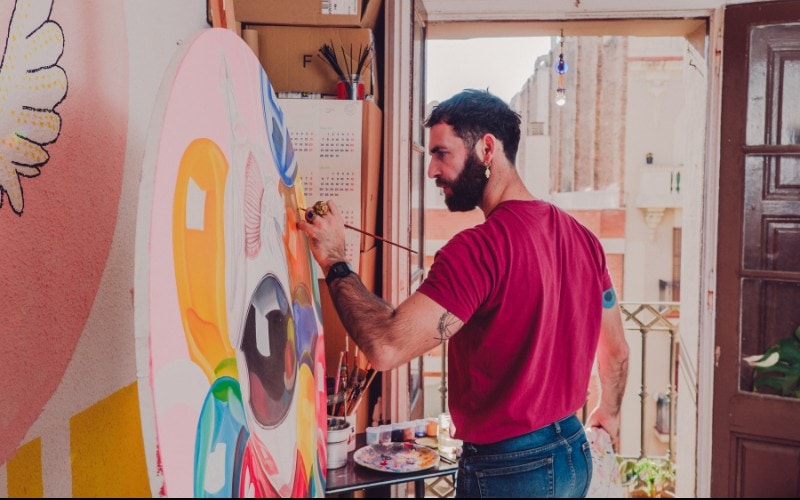
Artist in his studio

Experiential Travel for Art Lovers: How to Connect With Local Artists

Connecting with local artists when you travel provides exciting new perspectives on a destination, sparks fascinating conversations, and gives you an opportunity to support local small businesses.

This kind of immersive, arts-focused approach is known as experiential travel, and it’s one of the most rewarding ways to experience a destination.

It’s a win-win!

In this post, I delve deep into ways in which you can meaningfully connect with local artists when you travel. This process is often called “experiential travel”.


What is Experiential Travel?

The term “experiential travel” is also sometimes referred to as “immersion travel”. Experiential travel helps people connect directly with the culture and people of the places they visit. Instead of merely ticking off sites, the experiential traveler seeks out meaningful ways to connect with locals by engaging in authentic cultural experiences.

And what better way to connect with locals than to seek out artists?

Read on for my suggestions for how to connect with local artists and, by so doing, immeasurably enrich your travel experience.


Why Experiential Travel With Local Artists Is So Meaningful

If you’re an art lover, why not set aside some time during your trip to connect directly with one or two artists? Perhaps you already know and admire the work of an artist who lives in an area you’re visiting. Reach out and connect! Chances are, you’ll get a positive response; what do you have to lose?

If you don’t already know a local artist, do a Google search to find artists who create the kind of art you like and who may be open to meeting with you and telling you about their work. Not all artists will be interested, but some will!

Connecting with Artists Through Social Media

Another source to find artists is through travel and art groups on social media. My husband, Gregg Simpson, who is a painter, has made many connections with local artists through Facebook. Often during our travels, we visit artists and enjoy the opportunity to “talk art”.

If possible, connect with artists with whom you share an interest, be it the style of artwork they do or some other aspect of their background, such as places they’ve traveled, acquaintances or friends you have in common, or organizations you’re both connected with. For example, you may find an artist who has exhibited their work in your home town or is a member of an organization to which you also belong.

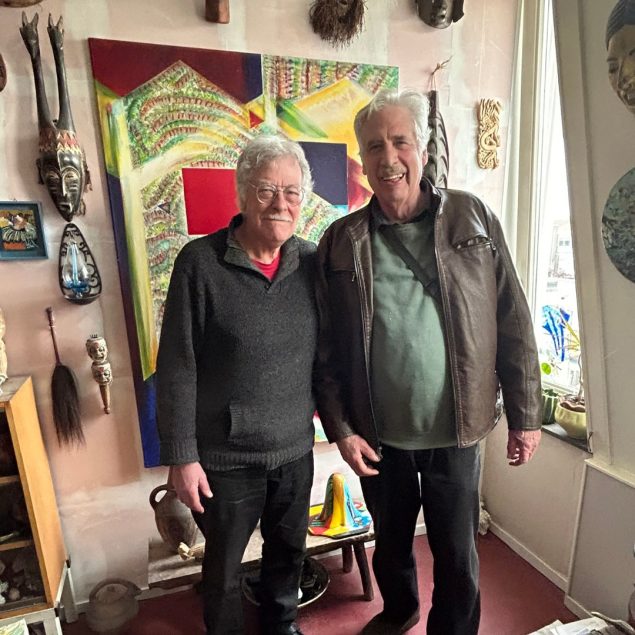
Here’s Gregg with Rik Lina, a Dutch artist who lives in Amsterdam and who has become Gregg’s collaborator and friend.

Visiting an Artist

Once an artist has agreed to meet with you and talk about their work, keep your visit quite short. Artists want to be creating art, and while many enjoy talking about their work, they also usually want to get back to it. There also may be the expectation that you’re interested in purchasing a piece of artwork, so keep that in mind.

Purchasing Artwork from a Local Artist

To be honest, this is a bit tricky, which I know from experience, being married to an artist! While many artists love talking about their work, they also need to make a living just like the rest of us. If possible, purchase something during your visit to an artist’s studio, whether on a solo visit or with a group. If a piece of their original art is out of your budget, buy a greeting card or a print as a thank-you for their time. Also, leave your email address so you can join their mailing list.

Showing respect for the artist and their time is the right thing to do.

My Meeting with Silvia Salvadori in Arezzo, Italy

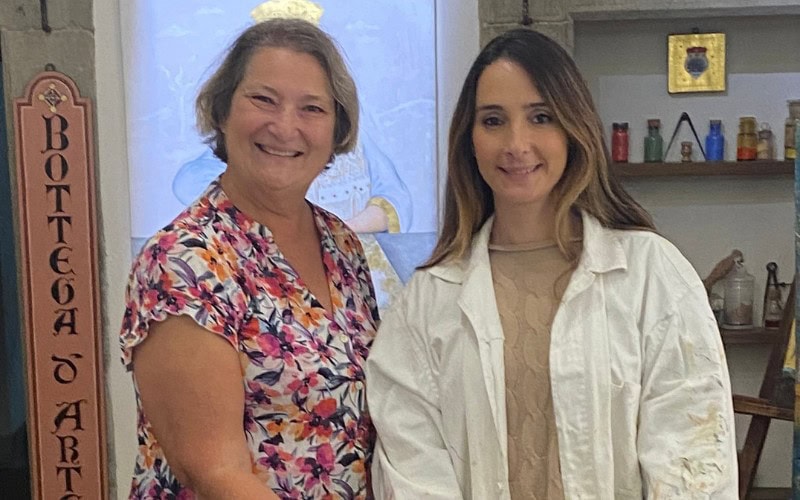
One of the most meaningful connections I had with a local artist was when I visited Silvia Salvadori in the charming Tuscan town of Arezzo. Silvia runs the Bottega d’Arte Toscana where she works and sells her art. Located on a tiny side street steps from the Piazza Grande in Arezzo, her studio is a must-visit for the artsy traveler.

Silvia Salvadori, an artist in Arezzo with author Carol Cram
Silvia Salvadori and me at the Bottega d’Arte Toscana in Arrezo

Silvia creates stunning works inspired by medieval art and using medieval techniques. Her mission is to preserve these typically Tuscan techniques from the Middle Ages and pass them on to future generations. Read more about my visit with Silvia, and check out the small painting I purchased from her.


Attend Art Openings to Connect with Local Artists

Art openings are always free to whomever is walking by and wants to drop in. Don’t be shy! If you’re wandering around an area and spy an art opening, go check it out. Not only will you likely get a free glass of wine, but you’ll also be able to chat with the artist and connect with other locals. You’ll get to admire the artwork and maybe even find the perfect piece to take home.

The vast majority of people attending an art opening will be locals rather than tourists. Over the years, Gregg and I have met so many interesting people at art openings.

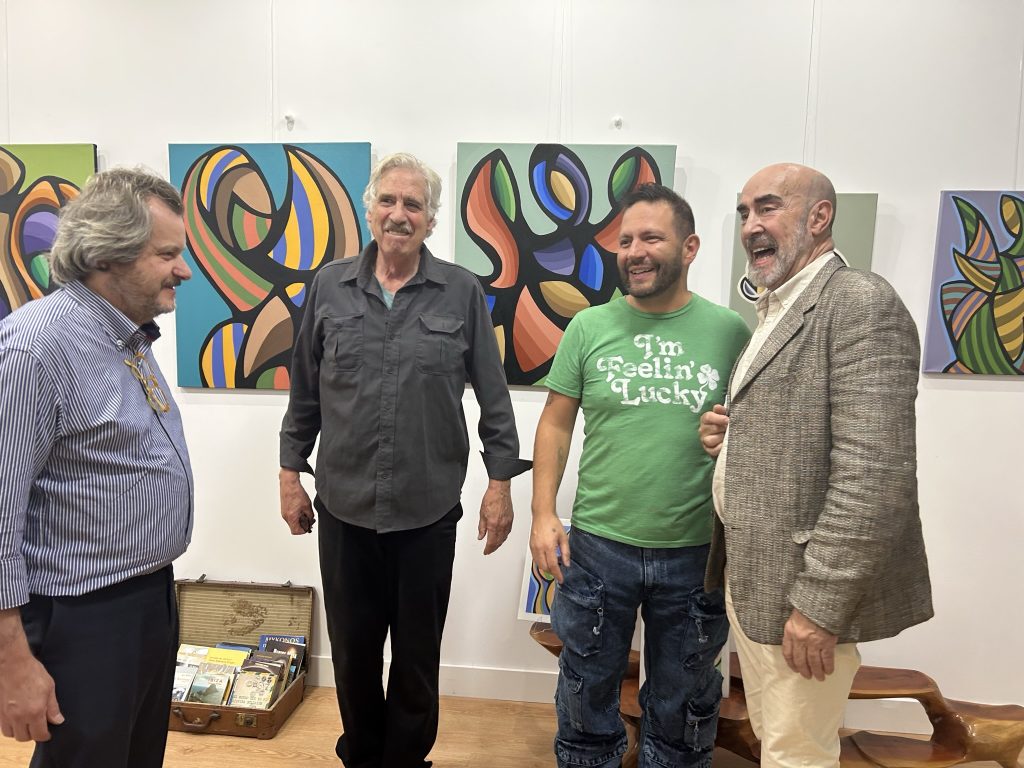
Art gallery opening showing people mingling and looking at art
At the opening of Gregg Simpson’s recent exhibition in Madrid

I fondly remember the time Gregg and I were walking past a gallery in Ravenna that was hosting an art opening. We paused to peer through the window, and moments later, the artist himself bounded out to the sidewalk and invited us in.

Despite our knowing very little Italian, we managed to have several interesting conversations both with the artist and the other attendees. Everyone was so friendly to the Canadese, thanks to our shared interest in art.

A Note About Language

Don’t let the language barrier stop you from dropping into an art opening. Chances are a few people will speak English, and for those who don’t, use a handy translator device or the Google Translate app on your phone.

Go to Multiple Art Openings on “Opening” Nights

In some cities, several galleries in a neighborhood will open late one night a week (often a Thursday or Friday) so that art lovers can hop from opening to opening for a major art fix. Check local listings to find out when galleries are open late and when vernissages (French for “openings”) are being held.

Fun Fact: The term vernissage means varnishing and refers to the practice of varnishing a painting just before exhibiting it. Openings are still called vernissages in Paris and many other places in Europe.


Take a Workshop or Class to Connect with Local Artists

Feel like brushing up on your glass-making skills or throwing a pot or two or maybe doing some flower painting? Whatever your interest, you’ll likely find a workshop or class that intrigues you in some of the destinations you’re visiting.

While most of your fellow participants will likely be visitors like you, the teacher will be a local. In addition to teaching you a new skill, they’ll probably tell you about the local art scene, give recommendations about local museums and galleries to visit, and share lots of other information not found in the guidebooks.

If time is limited, choose a half-day or full-day class.

Read my interview with Tanvi Pathare about the flower painting classes she taught at the stunning Villa Lena in Tuscany.

Finding Workshops and Classes

To find local workshops and classes, check with the local arts councils or tourism offices, or search online. Some tour companies such as GetYourGuide and Tiqets.com may also offer art workshops. Here are a few options.

Powered by GetYourGuide

Attend an Artist Residency

You can also sign up for a multi-day course and really immerse yourself in being creative. Or, if you’re an artist already, apply for an artist residency.

Imagine spending a week or two or even longer in a beautiful location with like-minded people all engaged in creative work! To me, it sounds like heaven, which is why I’m always on the lookout for artist residencies that both Gregg and I can enjoy, he to paint and me to write.

You’ll find several artist residencies in Europe, some in beautiful castles and châteaux. Some allow anyone to apply; others have a competitive application process and offer funding support for successful applicants. Here are links to a few options in Europe:

  • Château d’Orquevaux in Orquevaux, France, provides several options for artists and writers in residence. Orquevaux is located in the Haute-Marne department in the Grand Est region in Northeastern France.
  • The Bellagio Center Residency Program in Bellagio, Italy, brings together academics, artists, and practitioners from around the world and provides them with a space to unlock their creativity and advance groundbreaking work.
  • The art retreats at Casale di Clio are wonderful. I recently spent a week there working on my new novel while Gregg made full use of the “Art Barn” studio.

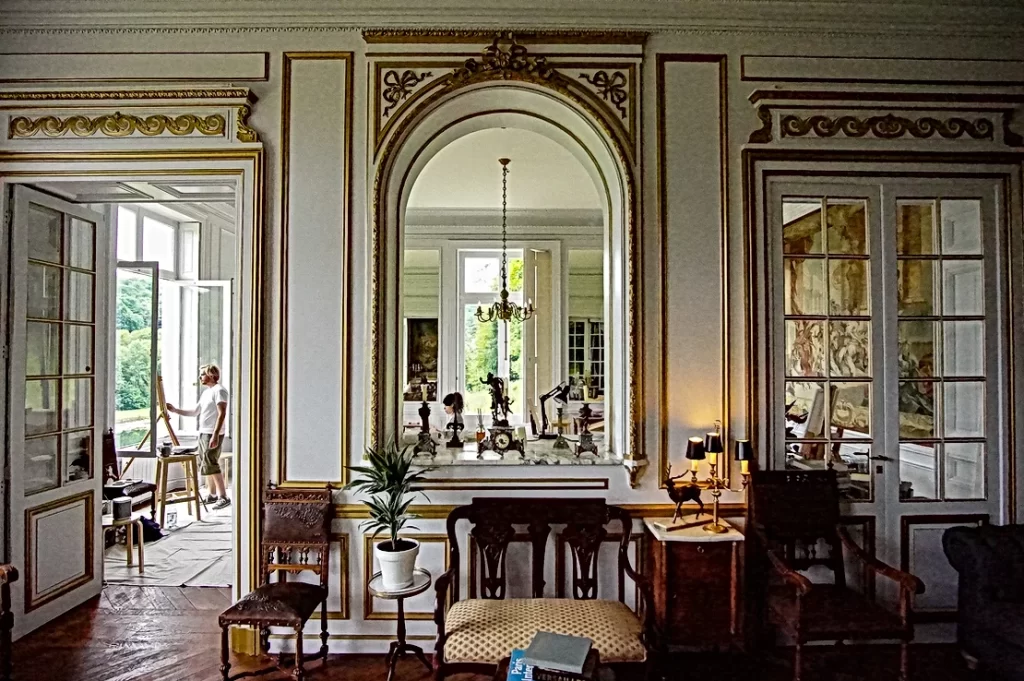
Artist studio at the Châteaux d’Orquevaux in Orquevaux, France

Artist residencies are one of the deepest forms of experiential travel, offering long-term immersion in local creative communities.

An Artist Residency Experience

A few years ago, Gregg and I spent two months at Rouges en Vert, an artist residency in the little town of Soligny La Trappe deep in the Normandy countryside. The place was still under construction and a bit rough, and we were the only occupants, but we had a productive time! And at the end of the residency, the newly completed art gallery attached to the studios hosted an exhibition of the work Gregg had completed.

The very reasonable cost of the residency included accommodation and the use of a studio for Gregg and an office for me.

If you’re looking for an in-depth artist experience, I highly recommend finding an artist residency in the area you want to visit. It’s experiential travel at its most intense!

Italiana Tours Art Retreat

One of my most rewarding experiential travel experiences was being a guest for the first two days of an art retreat in Italy with Italiana Tours. The retreat combined creative workshops, time to work independently, and meaningful connections with artists and fellow travelers, all set within the inspiring landscapes of Marches.

The retreat encouraged slowing down, engaging deeply with art and place, and building genuine relationships through shared creative exploration. It’s a perfect example of how arts-focused experiential travel can transform a trip into something truly memorable.

If you enjoy immersive cultural experiences like this, you may also love exploring small, focused museums that celebrate individual artists and collections.


Check Out Studio Tours

Many tourist offices in areas where the arts are celebrated maintain lists of artist studios you can visit. Sometimes, you’ll be lucky to arrive in a place at a time when a tour of several studios has been organized.

Where I live on Bowen Island near Vancouver in British Columbia, Canada, the annual Bowen Arts Tour takes place in May (May 23-24, 2026). People come from all over the region to visit artists in their studios. Ours is not the only small community to organize studio tours. With the rising interest in experiential travel, more and more visitors are interested in organized studio art tours which easily connect them with local artists, and local communities are responding.

Check the tourism websites in the areas you’re visiting to find out the dates of organized studio tours, exhibitions and other special art events. A quick search for “art studios in [location]” is likely to yield useful results.

And be on the lookout for special art events. We’ve frequently come across exhibitions set up in parks and other public areas and involving several artists. Strolling from booth to booth to connect with local artists is a very artsy traveler way to spend an afternoon!


Book a Multi-day Art Tour

An easy way to connect with local artists is to take an art tour led by professional artists and art historians. Depending on your interests, you can find programs suitable for both practicing artists and art lovers.

A good bet is taking a tour offered by Walk the Arts. They offer a range of tours that are suitable for “artists at all levels, art lovers, lifelong learners, and independent travelers seeking unique cultural experiences”. Their mission is to promote the arts and culture through art courses that emphasize content, creativity, and experiential learning.


Sign Up for an Art Walking Tour

A great source for walking tours hosted by locals is Airbnb Experiences. Some of the tours are arts-related, such as this tour by an artist in Hoxton, London, who takes visitors on a walk along art-lined streets to visit local galleries, independent shops, and other hidden gems.

Also check out GuruWalk. Quite a few of their tours relate to art, such as the Afternoon tour of old Parisian galleries in central Paris that is led by a “proactive pensioner” involved in many cultural and social projects in Paris.

You can even find tours that will take you to exhibition openings. When Gregg had an exhibition in Venice a few years ago, a guide showed up with a small group to see the show. It was great to chat with them and see their reaction to the exhibition.


Experiential Travel FAQs

What is experiential travel?

Experiential travel focuses on meaningful, hands-on experiences that help travelers connect with local culture and people. Instead of just sightseeing, experiential travelers engage in activities such as workshops, walking tours, residencies, and cultural events.

Why is connecting with local artists a form of experiential travel?

Artists offer unique insights into a destination’s history, culture, and daily life. Meeting local artists allows travelers to experience a place through creativity, conversation, and shared interests, making travel more personal and immersive.

How can travelers find local artists while abroad?

Travelers can find local artists through gallery openings, social media groups, studio tours, art workshops, tourism office listings, and art-focused walking tours. A simple online search or visit to a neighborhood gallery often leads to meaningful connections.

Do you need to speak the local language to connect with artists?

No. While speaking the local language helps, many artists speak some English, especially in popular travel destinations. Translation apps and a shared interest in art often bridge language gaps easily.

Is it appropriate to visit an artist’s studio while traveling?

Yes, as long as the visit is respectful and brief. It’s polite to express genuine interest in the artist’s work and, when possible, support them by purchasing a piece, print, or card.

Are art workshops and classes suitable for beginners?

Absolutely. Many art workshops are designed for travelers and beginners. These experiences focus more on creativity and cultural exchange than technical mastery.

What is an artist residency, and can travelers participate?

An artist residency is a program that provides artists and writers with time, space, and accommodation to work creatively. Some residencies are open to non-professionals or offer short-term programs suitable for travelers seeking deeper cultural immersion.

Is experiential travel suitable for non-artists?

Yes. You don’t need to be an artist to enjoy experiential travel focused on the arts. Art lovers, curious travelers, and cultural enthusiasts can all benefit from gallery visits, studio tours, and artist-led experiences.

How does experiential travel support local communities?

Experiential travel supports local economies by directing spending toward independent artists, small businesses, and cultural initiatives. It also fosters respectful, sustainable tourism that benefits host communities.


Keep Traveling with Artsy Traveler

Experiential travel with a focus on the arts has so many benefits. You’ll step well off the beaten track to meet local artists and learn about their work. Depending on the experience you choose, you may even get your hands dirty creating your own artwork.

There are lots of possibilities for arts-inspired experiential travel.

When you’re planning your next trip, find opportunities to enrich your experience by connecting with local artists.

  • Check out the art opening you come across on your way to dinner.
  • Learn new skills in an art workshop.
  • Sign up for a walking tour of local galleries.
  • Make a detour to check out a local art event.
  • Get a list of artist studios from the local tourism office and make a day of touring them.

Here are links to posts about some of my favorite small art museums in Europe:

Carol Cram
About Carol Cram

Carol M. Cram is the author of five award-winning novels inspired by art and the women who shaped it, the creator of Artsy Traveler, an arts-focused travel blog, the founder of Art In Fiction, a curated database of 2,600+ novels inspired by the arts, and the host of The Art In Fiction Podcast. She lives with her husband, artist Gregg Simpson, on beautiful Bowen Island near Vancouver, BC.