
Why the Audain Art Museum is Whistler’s Best Kept Secret
I'm Carol Cram, novelist and arts travel writer, and founder of Art In Fiction, a curated database of 2,700+ novels inspired by the arts. Artsy Traveler contains affiliate links for products and services I personally use and recommend. As an Amazon Associate, I earn from qualifying purchases. Please read the Disclosure for more information.
The Audain Art Museum is reason enough on its own to make a trip to Whistler.
It was certainly first on my list of must-sees on a trip up the Sea to Sky Highway on a sunny weekend in May. With ski season winding down and the summer season about to start, May is a great time to put art at the center of a Whistler weekend.
I was fortunate to enjoy a private tour of the collection with Elyse Feaver, the museum’s Engagement Manager. Her enthusiasm and in-depth knowledge of the work on display added considerably to my appreciation of the Audain Art Museum.
Tip: If a guided tour is being offered during your visit, take it. You’ll learn a lot and come away with a deeper understanding of one of the finest collections of BC art in the province.
In this post, I share some of the many highlights of the permanent collection. When you go, check if a special exhibition is on. During my visit, preparations were underway to launch a special exhibition of the work of Takao Tanabe.
Table of Contents
Audain Art Museum Quick Facts
- Location: 4350 Blackcomb Way, Whistler, BC (short walk from Whistler Village)
- Hours: Thursday to Monday, 11:00 am to 6:00 pm. Closed Tuesday and Wednesday. Hours may vary on statutory holidays; check the website before visiting.
- Admission: Children 18 and under free. Adult prices vary; check www.audainartmuseum.com for current rates.
- How long to allow: Minimum two hours for the permanent collection. More if a special exhibition is on.
- Guided tours: Public Guided tours are available on Fridays, Saturdays and Sundays and are included with the cost of admission. Book a private guided tour of the Audain Art Museum in advance.
- Accessibility: Wheelchair accessible via the Blackcomb Way street-level entrance. Wheelchairs available on request.
- Backpacks: Not permitted in the galleries. Lockers provided at the entrance.
- Website: www.audainartmuseum.com

Arriving at the Audain Art Museum
Located a few minutes’ walk from Whistler Village, the Audain Art Museum is housed in a striking building by Patkau Architects that seems to float above the forest floor on steel columns.
The museum was opened in 2016 to showcase the stunning collection of BC art owned by Michael Audain. Over 200 works of art, some dating back to the 18th century are on display.
At the entrance, stop to admire the large sculpture.
The First Nations Collection
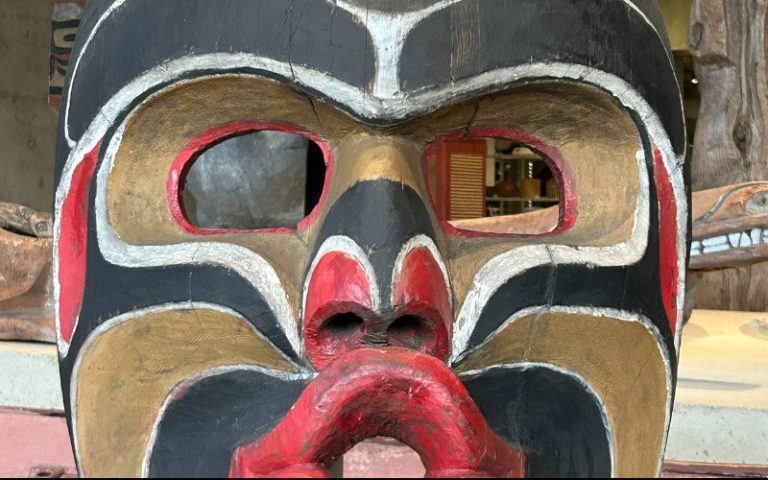
The first large room you enter at the museum features an extraordinary collection of masks with the Haida Dance Screen as the centerpiece.
You’ll want to spend a lot of time in this room, walking from mask to mask and admiring the magnificent dance screen.
The Haida Dance Screen: Where the Spirit World Meets Ours
James Hart (Haida Chief 7idansuu) worked on The Dance Screen (The Scream Too) for three years alongside four other carvers, including his own son. Eagle, bear, orca, and salmon, representing sky, land, sea, and river, are each featured in a single composition.
At the center, a hidden doorway opens to allow dancers to pass through, stepping symbolically from the spirit world into ours. When the museum opened in 2016, Haida dancers emerged through that doorway to perform.

Elyse explained that this is a dance screen, like a stage or a curtain for the storytelling to begin. Hart’s lineage as an artist traces back to Charles Edenshaw, whose works are held in the Art Gallery of Ontario and other major institutions. The passing of knowledge from generation to generation is built into the piece itself.
Air, land, and sea: the whole world is represented in one carving.
The Mask Collection: 250 Years of Ceremony
The collection of Northwest Coast Indigenous masks, some 200 to 250 years old, rewards serious lingering and careful looking.
The craftsmanship, history, and spiritual significance of these masks to the people who made them are a permanent reminder of the contribution to world art made by BC First Nations people.
Many of the masks have been acquired from private collections around the world and brought back to BC permanently.
I asked Elyse what her favorite piece is and she led me to a piece that is a headdress rather than a mask from the Tlingit Nation that dates from 1840.
She pointed out the ermine pelts around the base. These were caught in winter when the fur turns white, which is the most prized color. The abalone shell on the front was traded up from California. At the top, sea lion whiskers rise in a crown. When worn, the inside of the headdress would have been filled with eagle feathers that floated out as the chief moved, a symbol of peace.

Other masks in the room span nations and styles. Several feature articulating pieces designed to open and close as the dancer moved.
One prompted both of us to remark on how Asian it appeared. The art of the Northwest Coast did not develop in isolation, and the visual echoes across the Pacific should not be surprising.


Emily Carr: The Largest Permanent Display Anywhere
The Audain Art Museum holds the largest permanent public display of Emily Carr works anywhere. You’ll find more in one room than you will typically see at the Vancouver Art Gallery.
Carr’s works on paper were painted on brown paper bags with gasoline-thinned paint.
For me, Emily Carr is one of the few artists who managed to capture the brooding essence of the west coast rainforest, particularly on a rainy winter day when mists rise and water drips from every cedar bough.
The forest paintings she made in her final years look exactly like what I see from my window on Bowen Island on a grey November morning.
You could spend a lot of time just in the Emily Carr room. Two works that really stood out for me: Forest Light, painted in 1931, and Survival, painted in 1940.


What the collection does particularly well is show the full arc of Carr’s development. In the 1920s, when she moved toward Impressionism, she became unpopular and her confidence faltered. She turned to other activities, including teaching, raising animals, and running a boarding house.
Then the Group of Seven discovered her, Lawren Harris, in particular, encouraged her which I was pleased to hear since Lawren Harris is my favorite Group of Seven Artist. Apparently, Harris told her she was one of them, and she came back to painting with renewed confidence.
The influence is visible in the geometric, dramatically lit forest compositions of her mature period.
Other Highlights of the Collection
The spacious rooms of the Audain Art Museum hold a great many notable works. Here are some that stood out for me.
Taylor Bay, Gabriola Island, BC, 1952 by Edward John (E. J. Hughes)
As someone who lives on an island off the west coast of British Columbia, I found this painting of Gabriola Island resonated. E. J. Hughes captures the way the clouds can suddenly part on a dull day to reveal a swathe of blue and flood the marine scene with warmth and lights. This painting captures that moment.

Winterscape, 1991, by Gordon Smith
This large abstract was apparently the artist’s favorite and once hung in Audain’s dining room. It is a spectacular piece that captures the white and gray, black and brown messiness of a winter day on the west coast.

Comment on Horseshoe Bay, 1949 by Bertram Charles (B. C.) Binning
This piece by B. C. Binning caught my eye. I am often in Horseshoe Bay in West Vancouver to catch the ferry to Bowen Island. Binning captures something of the marine chaos of a narrow bay in which three ferries come and go.

Abstraction 119, 1945 by Lawren Harris
I was delighted to see that the collection included a work from Harris’s later, more abstract period. He’s known for his landscapes, which are wonderful, but for me, it’s these metaphysical abstracts that capture the essence of modernism.

Coast Mountains #3, The Black Tusk, British Columbia, 2023, 2024 by Edward Burtynsky
Another highlight for me was this large aerial photograph of Black Tusk. The tusk is a volcanic plug that slices the sky in nearby Garibaldi Provincial Park, also accessible from the Sea to Sky Highway. The tiny figures of climbers visible in the photograph give a vertiginous sense of its scale.
I had to tell Elyse how, way back in my considerably more energetic youth, I climbed the tusk on a hot day in July and got a terrible sunburn (sunscreen being something we rarely used in those days).

First Nations Sculptures and Masks
Throughout all the galleries, several sculptures by First Nations artists are featured. This bronze sculpture with jade green patina by celebrated Haida artist Bill Reid depicts Sghaana Jaad, a supernatural female figure from Haida mythology.
Reid (1920-1998) is one of Canada’s most important First Nations artists, best known for The Spirit of Haida Gwaii, versions of which stand at the Canadian Embassy in Washington DC and at Vancouver International Airport.

Contemporary Works
The collection includes several rooms featuring works by contemporary artists, many of which are photo-based.
One standout for me is a remarkable piece by Brian Jungen, made from unstitched and restitched golf bags arranged in two vertical sculptures. Faces emerge from the seams like figures on a totem pole, a commentary on how Indigenous land is being swallowed by golf courses.

Why Visit the Audain Art Museum
The museum reminds me of many of the smaller museums I’ve visited in Europe such as the Fondation Maeght near Nice and the Peggy Guggenheim Collection in Venice. In fact, Audain visited many of these museums in Europe as he was developing the concept for his museum in Whistler.
Like those European gems, the Audain is not trying to be encyclopedic. The museum presents one person’s collection that reflects his preferences in airy, uncluttered spaces that give each piece its due.
Both the building itself and its world-class collection of Indigenous and BC art are well worth an hour or two of your time. Do yourself a favor and go.
Audain Art Museum FAQs
Yes. The Audain holds a world-class collection of BC art including Northwest Coast Indigenous masks and ceremonial objects, the largest permanent display of Emily Carr works anywhere, and significant works by EJ Hughes, Lawren Harris, and other major BC artists. It is worth a trip to Whistler on its own merits.
Yes. Public guided tours are offered on Fridays, Saturdays, and Sundays and are included with the cost of admission. Private guided tours can be booked in advance through the museum website.
The museum is open Thursday to Monday from 11:00 am to 6:00 pm and is closed on Tuesdays and Wednesdays. Hours may vary on statutory holidays so check the website before visiting.
The museum is a short walk from Whistler Village along the Valley Trail at 4350 Blackcomb Way. Free parking is available on site if you are driving.
Yes. A small gift shop in the lobby features work by local BC artists, including some lovely pieces of First Nations jewelry
Keep Exploring Canada with Artsy Traveler
- Sea to Sky Highway: The Ultimate Artsy Traveler Getaway from Vancouver
- Fathom Stone Art: A Unique Hands-On Experience in Whistler
- National Gallery of Canada: Best Bets for the Artsy Traveler
- UBC Museum of Anthropology in Vancouver: Why You Should Go!
- The Vancouver Museum & Granville Island: A Great Day Out
- Jasper Photo Tours: Sharpen Your Skills with a Pro
- 10 Things to Do in Québec City If You Love Art and History
- Memorable Mother-Daughter Bonding on the Rocky Mountaineer
Would you like to save this post?
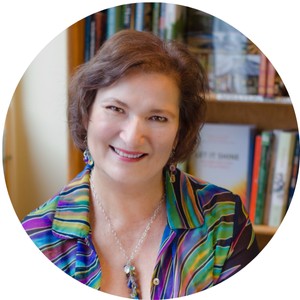
Carol M. Cram writes novels inspired by the arts; runs Artsy Traveler, an arts-focused travel blog, and Art In Fiction, a curated database of 2,700+ novels inspired by the arts; and hosts The Art In Fiction Podcast. She has also authored 60+ textbooks on computer applications and taught at Capilano University for over two decades. Carol lives with her husband, artist Gregg Simpson, on beautiful Bowen Island near Vancouver, BC.

 See all my novels