Blue Rider Day Trip from Munich: Franz Marc Museum and Schlossmuseum Murnau
I'm Carol Cram, novelist and arts travel writer, and founder of Art In Fiction, a curated database of 2,700+ novels inspired by the arts. Artsy Traveler contains affiliate links for products and services I personally use and recommend. As an Amazon Associate, I earn from qualifying purchases. Please read the Disclosure for more information.
I’ve long been a fan of several of the artists in Der Blaue Reiter (the Blue Rider) art group: the most famous being Franz Marc, Wassily Kandinsky, and Paul Klee. So naturally during my three-day stay in Munich, I devoted a day to visiting the Franz Marc Museum in Kochel and the Schlossmuseum in Murnau.
Getting there was half the adventure and well worth the trouble. Both museums are world-class with works that will take your breath away if you’re a fan (like I am) of early 20th century modern art.
Full Disclosure: The Murnau tourist office kindly paid for our taxi between the Franz Marc Museum in Kochel and the Schlossmuseum in Murnau. All opinions are my own.
Table of contents
- Getting to the Museums
- Who Was Franz Marc?
- My Favourites at the Franz Marc Museum
- Also at the Franz Marc Museum
- Onward to Murnau
- Exploring the Schlossmuseum Murnau
- Paul Klee
- Wassily Kandinsky
- Gabriele Münter
- Alexej von Jawlensky
- Also in the Blue Rider Rooms
- Back to Munich
- Where to Stay in Murnau
- Blue Rider Day Trip from Munich: FAQs
- Keep Exploring Germany with Artsy Traveler
Getting to the Museums
Both the Franz Marc Museum and the Schlossmuseum are about an hour southwest of Munich. The area also has other Blue Rider sites, including the Münter-Haus in Murnau and the Museum Penzberg, with its strong collection of works by Heinrich Campendonk.
The best way to explore is by car, with at least two nights in the area. We only had time for a day trip from Munich. It’s doable, but you need to be organized.
Unfortunately, I didn’t take my own advice. The plan was to catch the 9 am train from Munich to Kochel, visit the Franz Marc Museum, then take a taxi to the Schlossmuseum in Murnau. The tourism office in Murnau had kindly arranged for the taxi to pick us up at 1:30.
For some reason, I decided we should take the 10:15 train to Murnau, forgetting that Murnau was our last stop of the day, not our first. Ten minutes before boarding the train, I realized my mistake. After much scurrying and staring at train boards, we found the 11:30 to Kochel. Our timeline was getting uncomfortably tight.
While we waited, I checked the board again and discovered the platform had changed. We normally drive in Europe, so rail travel is new to us. Lesson learned: keep your wits about you.
An hour later, we finally arrived in Kochel.
Getting to the Franz Marc Museum
Kochel is a tiny, provincial town full of lovely Bavarian-style homes and no obvious way to get from the station to the museum. We tried booking an Uber, but after ten minutes of staring at the Thanks for Your Patience message, we gave up and started to walk. It was 1 pm, the walk was supposed to take 20 minutes, and our taxi was due at 1:30.
Fortunately, the sun was shining and the route wound prettily past flower-bedecked houses and quiet lanes. Between Google Maps and the occasional sign, we finally reached a sylvan path leading up to the museum, which overlooks the lake.
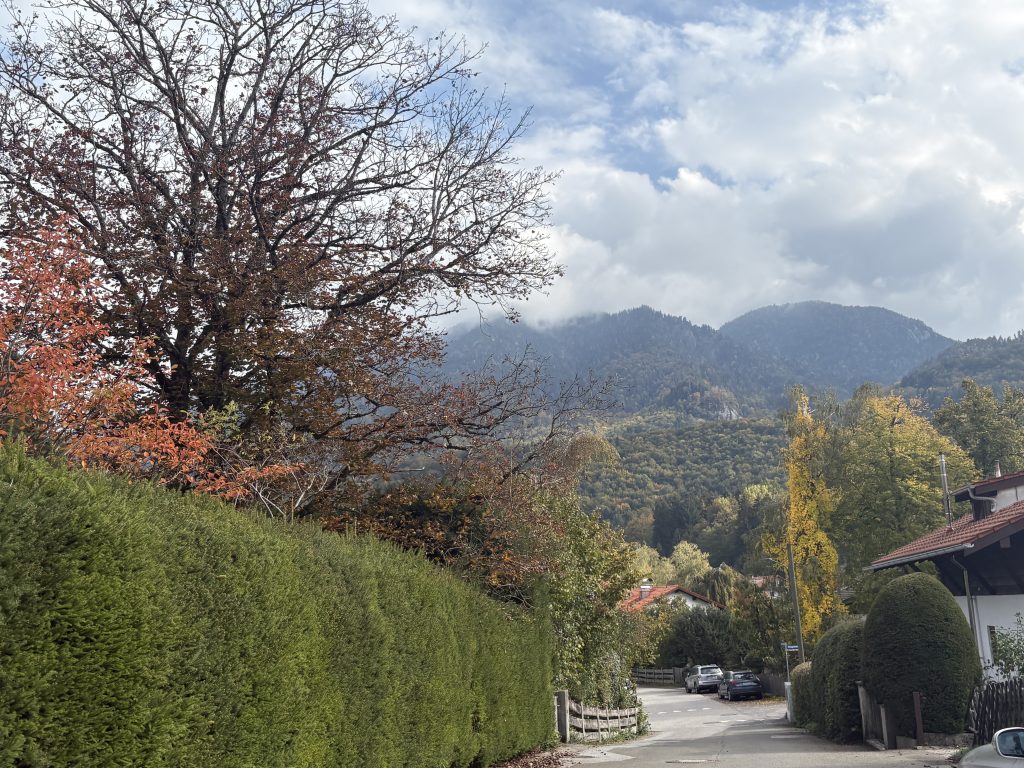

We arrived at exactly 1:30, and the first thing I saw was a taxi. Was it ours? The driver, who didn’t speak much English, confirmed he was waiting to take someone to Murnau but he didn’t have a name. What were the odds it was someone else?
I explained that we were very late and that we hadn’t seen the museum yet. Could he wait 15 minutes? He’d already been paid by the tourist office, and I hoped the extra time wasn’t going to cost him. Hopefully, the generous tip I gave him when we eventually arrived in Murnau was sufficient.
But what choice did we have? Gregg and I are both devoted Franz Marc fans. We had to see the museum!
In we went, and wow! We bounced through the rooms at an embarrassingly fast rate, but we saw enough to be glad we’d come.
Who Was Franz Marc?
Franz Marc was born in Munich in 1880 and briefly studied theology before switching to art. He’s best known for his animals, especially horses, painted in a variety of luminous colours.
For Marc, colour carried meaning. Blue stood for the spiritual and the masculine, yellow for the sensual and the feminine, and red for the material world that both enlivens and challenges the other two. Once you know that, his blue horses stop looking whimsical and start looking like something closer to a prayer.
In 1910, Marc met August Macke and, through him, the collector Bernhard Koehler, whose regular stipend freed Marc to paint what he liked. Marc and his wife, the painter Maria Franck-Marc, settled first in Sindelsdorf and later in Ried, just outside Kochel. In 1911, Marc and Wassily Kandinsky founded the Blue Rider (Der Blaue Reiter), the loose circle of artists who pushed German painting toward abstraction.
When war came in 1914, Marc enlisted, convinced the bloodshed would purify Europe and renew it spiritually. Two years later he was killed at Verdun at the age of 36. Coincidentally, he was the same age my great-grandfather was when he was killed at the Somme fighting for the Canadians.
Marc is buried in the Kochel cemetery, not far from the landscape he painted.
The Franz Marc Museum opened in 1986, with a sleek new building added in 2008. The collection also includes works by his contemporaries, so Marc is shown in conversation with the artists around him rather than in isolation. Check the museum’s website for current opening hours and admission before you go.
My Favourites at the Franz Marc Museum
In 1910, Marc wondered in writing how a horse, an eagle, a deer, or a dog sees the world. His paintings are his attempt at an answer, and seen in order, they show him moving from looking at animals to painting from inside them.
Franz Marc, Composition I

This piece was one of the first paintings by Marc that I came across while touring the museum. It’s got all the elements that I love in a Marc painting: defined shapes in bold colours, a sense of movement, and a geometric precision that feels organic.
Fabulous Beast II (Horse)
The image of a horse in this piece is difficult to see at first. With its head down and foreleg up, it seems to be drinking peacefully from a green pond in a forest in the moonlight. There’s so much to look at in this deliciously colourful work.

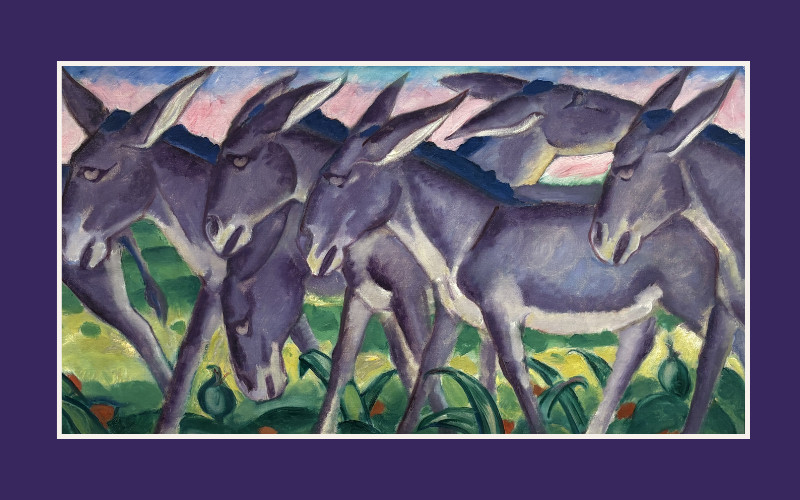
Donkey Frieze, Franz Marc

This large painting is one of Marc’s most famous. Five donkeys march purposefully across the canvas (although one is pausing to pull up a leaf) while a sixth donkey walks in the opposite direction. It’s Marc’s skillful use of colour that brings these humble donkeys to life. The dramatic purple and mauve tones contrast dynamically with the tropical leaves and flowers the donkeys stride across.
Jumping Horse, Franz Marc

A black and gold horse jumps gleefully through a field of shaded shapes rendered in Marc’s characteristically striking palette. Imagine having this painting on your wall. You’d be smiling every day.
Blue Lamb, Franz Marc
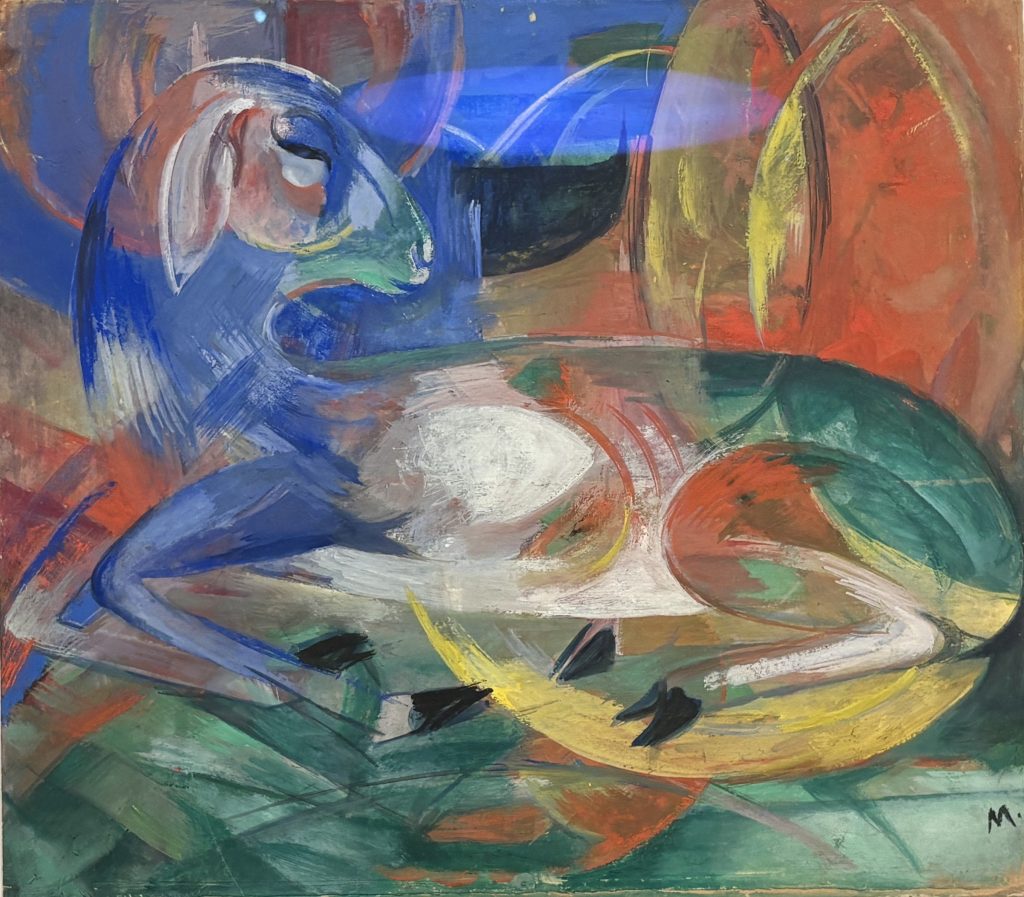
It takes a second to see the lamb, but when you do, you can’t unsee it. The predominant colours of blue, red, and green recur frequently in the work of both Marc and many of the other artists in the museum, particularly Karl Schmidt-Rottluff (see below).
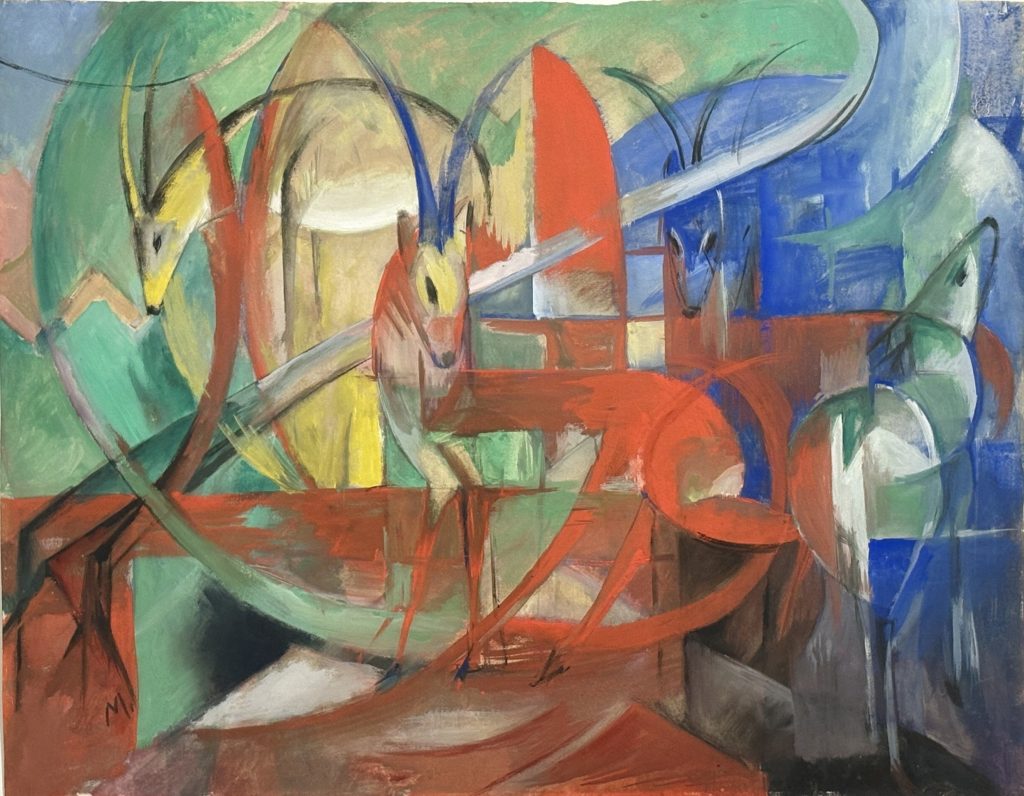
Gazelles, Franz Marc
How many gazelles can you spot? I see four, each in a different colour: yellow, scarlet, blue, and green. Again, they evoke a sense of calm in a world of swirling pigment.
Also at the Franz Marc Museum
Marc wasn’t the only painter in the museum. Maria Franck-Marc was an artist in her own right and sat on the editorial committee of the Blue Rider almanac, one of several women who shaped the group from the start.
Flowers and Leaves, Maria Franck-Marc

This painting by Maria Franck-Marc is a delightfully vibrant still life; the colours and shapes dance across the canvas.
Saint George, Kandinsky

I’ve been a fan of Kandinsky’s work for decades, and so was thrilled to discover this piece at the Franz Marc Museum. The piece bridges Kandinsky’s more realistic work and the pure abstracts that were to follow. There’s a rhythm to this piece that no doubt arises from Kandinsky’s dedication to music.
Tropical Garden, Paul Klee

Red, yellow, and blue shapes burst across the canvas with all the exuberance and joy of an untamed tropical garden. Klee painted it shortly after World War I, and it’s one of his first oil paintings of the postwar period.
Houses by the Water, Karl Schmidt-Rottluff

This painting is a landscape, but what a landscape! I love how the artist uses pure colour to indicate houses and a lake. The canvas vibrates with an unrestrained energy that made me smile.
Onward to Murnau
Slightly puffing, we arrived back at the entrance and clambered into the taxi for a scenic, 20-minute drive through the Blue Land (Das Blaue Land) to the Schlossmuseum in Murnau. Fall colours lit up the hillsides, shimmering lakes and mist-shrouded mountains flashed past, and almost every house was a Bavarian-style chalet. It was easy to see why the Blue Rider painters fell for this landscape.
Lunch at the Schlossmuseum
First up was a light lunch in the garden of the Schlossmuseum. Our young server spoke great English and was pleased to hear we were from Canada. He was hoping to go to Toronto soon and, of course, we told him to come to Vancouver.
I enjoyed an excellent lunch of salad and soft cheese wrapped in slices of bacon. For dessert, we split an amazing slice of walnut cake. Heavenly.

Exploring the Schlossmuseum Murnau
The Schlossmuseum occupies Murnau’s castle, which started life in the Middle Ages and was added to over the centuries. For a long stretch it served as the local seat of the monks of nearby Ettal Abbey, who controlled Murnau, and later it housed a school. The town turned it into a museum in 1993, and two years later it won the Bavarian Museum Prize. Check the museum’s website for current opening hours and admission before you go.

In 2023, for the museum’s 30th birthday, a private foundation handed over 34 Blue Rider works on permanent loan, all closely tied to the summers that Münter, Kandinsky, Jawlensky, and Marianne von Werefkin spent painting in Murnau between 1908 and 1910.
The result is a small-town museum with a world-class collection.
The stars here are Paul Klee, Wassily Kandinsky, Gabriele Münter (new to me), and Alexej von Jawlensky.
Paul Klee
From 1908, Swiss-born Paul Klee lived a few doors down from Kandinsky and Münter on Ainmillerstraße in Munich’s Schwabing district. They didn’t actually meet until October 1911.
Klee wasn’t in the first Blue Rider exhibition that December. It showed only paintings, and at that point he still considered himself an illustrator. A trip to Tunisia in April 1914 with August Macke and Louis Moilliet changed that. Klee wrote in his diary:
Colour has taken possession of me; no longer do I have to chase after it; I know that it has hold of me forever. That is the meaning of this happy hour. Colour and I are one. I am a painter.
When he studied colour afterward, his models weren’t his friends’ latest experiments but the paintings that Kandinsky, Jawlensky, and Münter made right here in Murnau between 1908 and 1910.
Paul Klee, Stars over the City

This is cubism on steroids! Klee’s city is a jumble of geometric shapes in mostly red and purple tones with a few blues and greens thrown in for good measure. The city dominates the canvas, with the stars above almost an afterthought.
Paul Klee, Forest Bird
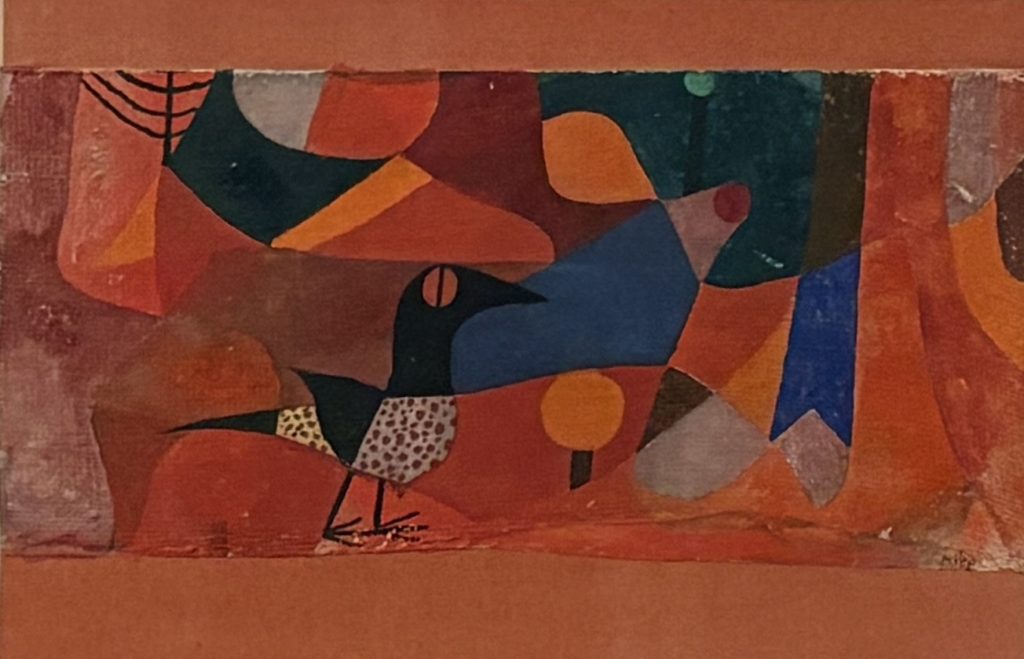
Look at this little black bird alone in a wild world of red, blue, and orange shapes. You have to wonder what it’s thinking.
Paul Klee, Figure in a Garden
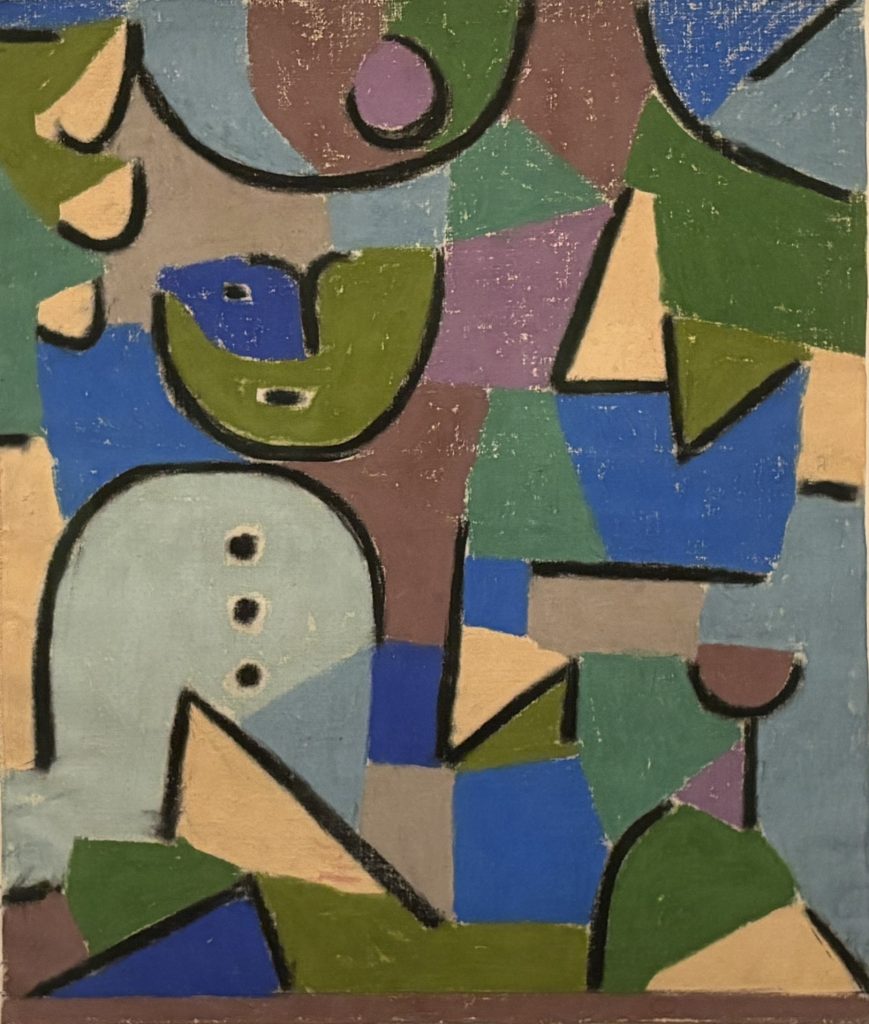
When Gregg saw Figure in a Garden, he was reminded of the piece he painted back in 2000 after seeing the work in reproduction. It was pretty special to finally see the actual piece. The black outlines and subtle shades inspired For Paul Klee.
Gregg Simpson, For Paul Klee
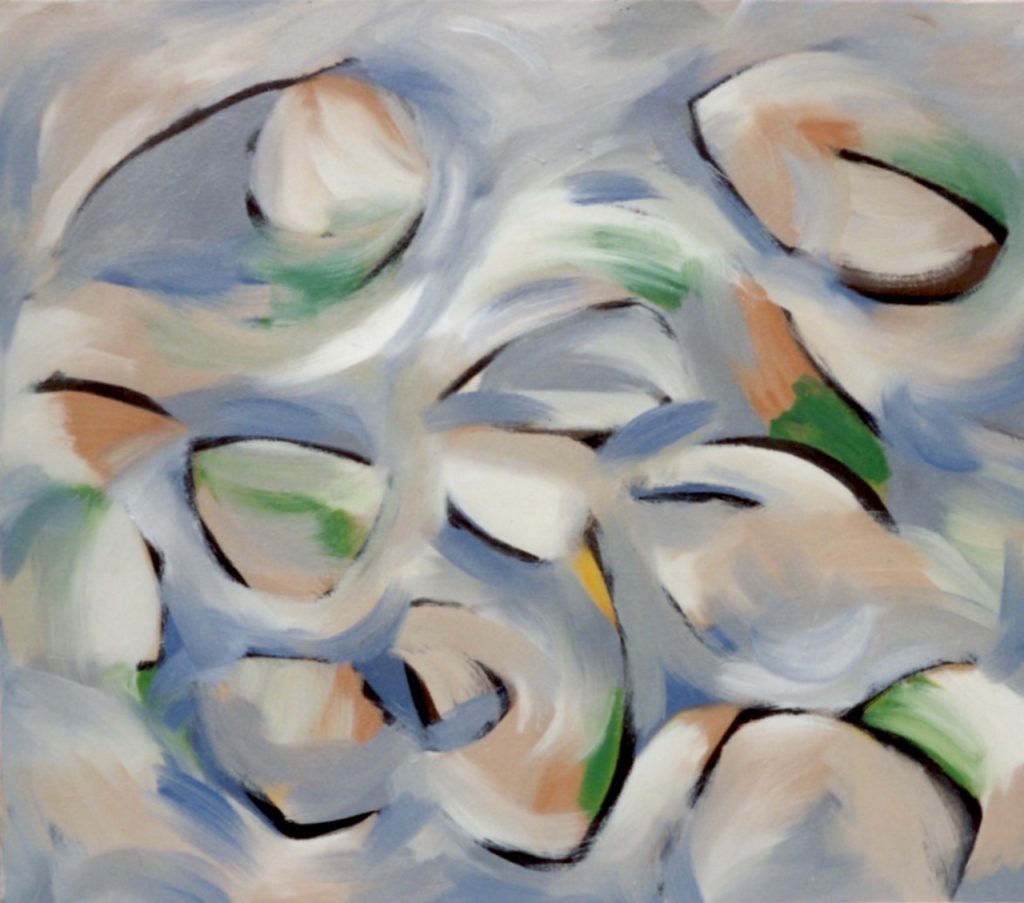
The Zentrum Paul Klee in Bern used this piece as part of their promo when the museum opened. The piece mixes elements of landscape with figuration into an abstract language that swirls across the canvas.
Wassily Kandinsky
The Schlossmuseum has several superb examples of Kandinsky’s earlier work, before it evolved into the pure abstraction he’s known for.
Kandinsky believed colour worked on the soul the way music works on the ear, and he talked about painting in terms of tones and chords. His colour sense is incredible. Standing in front of these, you can almost hear them.
Wassily Kandinsky, Study for Murnau with Church II

In this early work by Kandinsky, you can see his palette emerging and how, pretty soon, he’ll start abstracting the shapes even further until he gets to a painting like the one below.
Wassily Kandinsky, Lyrical

The music idea wasn’t just a metaphor. This colour woodcut of a horse and rider, the motif that gave the Blue Rider its name, was made for an album of his poems and prints called Klänge. In English, Sounds.
Gabriele Münter
I was particularly taken with the work of Gabriele Münter, whom I had not known. Münter was right at the centre of the Blue Rider. In 1911, after a Munich artists’ association rejected one of Kandinsky’s paintings, she, Kandinsky, and Marc walked out and mounted the first Blue Rider exhibition themselves.
Münter was born in Berlin in 1877, moved to Munich in 1901 to study art, and met Kandinsky the following year when she enrolled in his painting class. She spent the next dozen years as his partner. In 1909 she bought a house in Murnau (the Münter-Haus that you can visit). The editorial meetings for the Blue Rider almanac were held there, and it became the place where the whole circle gathered in summer.
Murnau is also where her style snapped into focus: flat areas of strong colour, bold dark outlines, and a clear debt to the local tradition of reverse glass painting, which she took up herself and shared with the others.
The Schlossmuseum holds more than 80 of her paintings, drawings, and prints, so even without visiting her house, we got plenty of Münter.
Gabriele Münter, Towards Evening

This painting was the first of hers I encountered in the museum, and I snapped a photo of it before I even knew who had painted it. The way she uses colour reminds me of Gauguin but with even more energy and texture. The golden light of evening is really captured in this painting. You can almost feel the exhaustion of the figure returning from a hard day’s work.
Gabriele Münter, Javanese Woman in the Mountains

This serenely beautiful painting shows the vulnerability and the strength of the young girl posing in front of an alpine landscape. The way Münter depicts the girl hugging her knees like a child could only have been painted by a woman who remembers what it feels like to be a young girl on the brink of womanhood.
Alexej von Jawlensky
Before he picked up a brush, Alexej von Jawlensky was an officer in the Russian Imperial Guard. In 1908 he spent a now-famous painting summer in Murnau with his partner, the painter Marianne von Werefkin, along with Kandinsky and Münter. All four came out of it painting differently.
His colours are some of the loudest in the building: saturated, fierce, and outlined in dark strokes. Later he formed the Blue Four with Klee, Kandinsky, and Lyonel Feininger, and turned to a long series of meditative faces, which he described as prayer in colour.
Alexej von Jawlensky, Violet Turban

Jawlensky’s big-eyed woman with her intense stare and riotously coloured outfit completely fills the small painting. He had met Matisse a few years before painting this piece, and the influence shows in his use of colour to evoke feeling.
Also in the Blue Rider Rooms
The Schlossmuseum casts a wider net than its four stars. A few more worth hunting down:
Franz Marc, Sleeping Animals

Works by Franz Marc are also included in the collection. This painting of sleeping horses in a forest of spikes and swirls feels to me like a juxtaposition of peace with passion.
August Macke, Before the Hat Shop

As Marc’s closest friend, August Macke introduced him to his patron. He was killed in the first weeks of the war in 1914 at the age of 27. This painting depicts an ordinary subject made extraordinary by the way in which Macke flattens the picture plane and juxtaposes the complementary colours of red and green.
Robert Delaunay, Sketches for Homage to Blériot
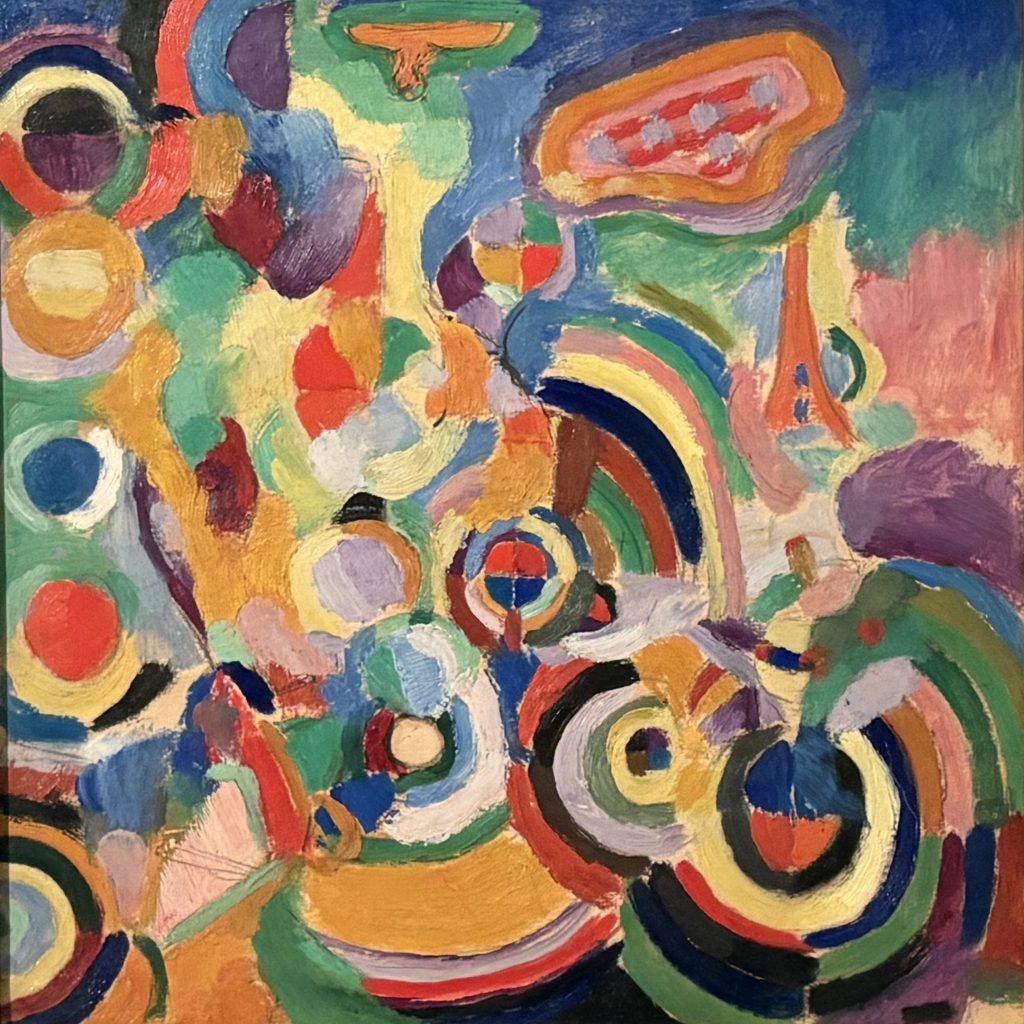
The French painter Robert Delaunay broke forms into rings and shards of colour. Marc, Macke, and Klee were all inspired by Delaunay.
Heinrich Campendonk, Cow with Calf

The youngest of the circle, Heinrich Campendonk has his own museum in nearby Penzberg, which is another good reason to stay one or two nights in the area. I wish we’d had time to go. His work has a playful quality that I found appealing.
Upper Floors
At the top of the Schlossmuseum are displays related to the history of the building, the oldest parts of which go back to the medieval castle. Rough stone walls and old timber beams are left exposed, and one richly painted room now holds a cabinet of antiquities and curiosities.


Back to Munich
Our adventure wasn’t yet over when we left the Schlossmuseum. Following directions given by one of the attendants, we thought the stroll to the train station would take ten minutes.
Make that at least 30 minutes, and throw in a few dead ends and detours. Google Maps was not our friend.
When we finally arrived at the station, we were done in. If you go, get the museum to call you a taxi to take you to the station.
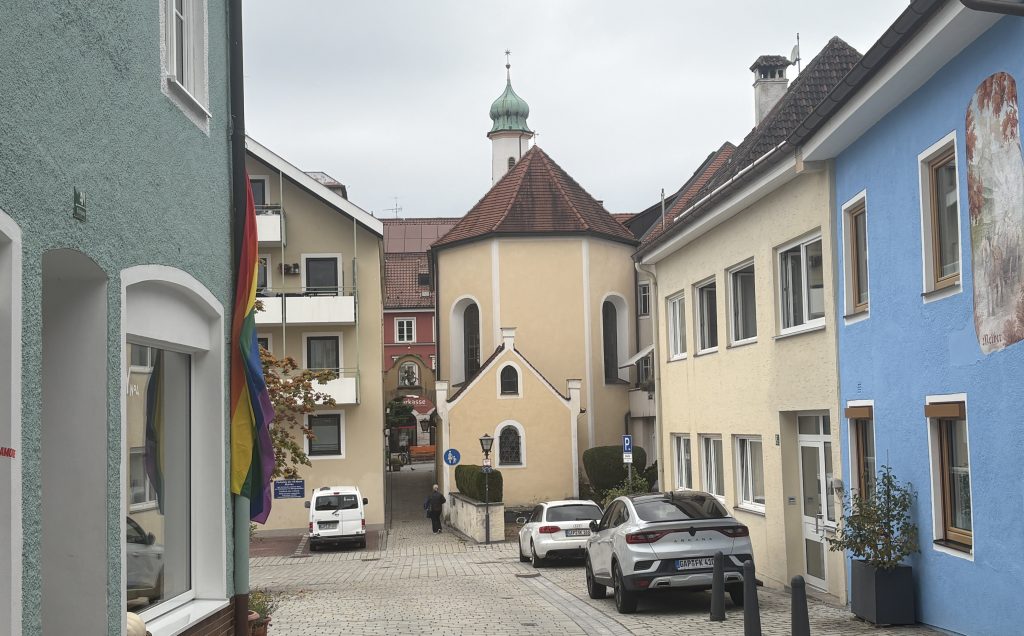
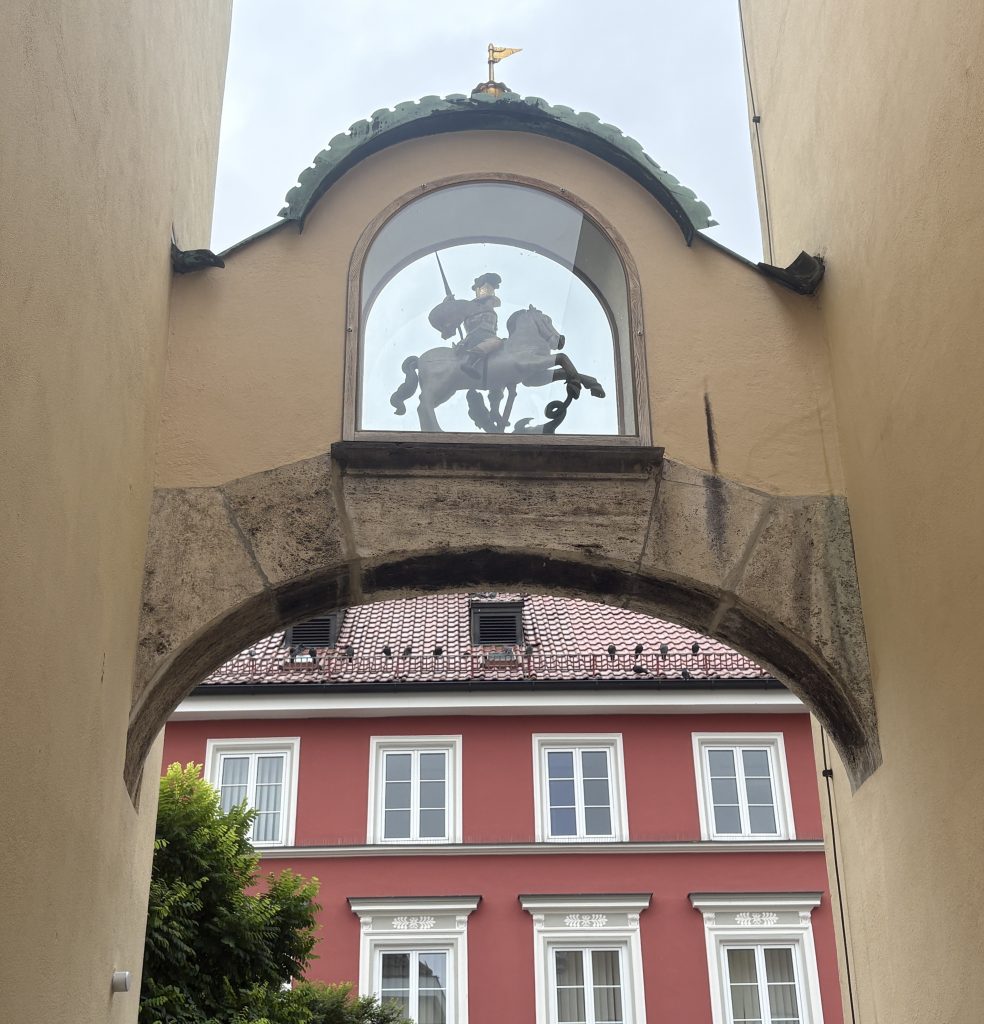
We even passed under an archway guarded by Saint George on horseback, which felt like the Blue Rider seeing us off.
Where to Stay in Murnau
We did Murnau as a day trip, and I don’t recommend our version. If I went again, I’d stay at least two nights and rent a car to explore the area.
On our meandering way back from the Schlossmuseum to the train station, we passed Hotel Angerbräu, a family-run hotel in the centre of town with a stepped gable much like the Schlossmuseum’s and a signpost to the museum right outside. It has its own art gallery, a wine bar, and a small spa with panoramic views. After our day, that last part sounds especially good.

Check rates at Hotel Angerbräu.
If You Have More Time in Murnau
Next time, I’ll stay long enough to see more of the Blue Land, the area around Murnau that gave the Blue Rider painters so much to paint. Here’s what’s on my list:
- The Münter-Haus, where Gabriele Münter and Kandinsky spent their summers and the Blue Rider almanac took shape.
- The Obermarkt, Murnau’s main street, lined with colourful facades designed by the architect Emanuel von Seidl.
- The Griesbräu, the brewery inn where Kandinsky and Münter used to eat.
- The Staffelsee, the lake just west of town, for a swim or a boat ride in summer.
- The Murnauer Moos, one of the largest unspoiled moorlands in Central Europe, with walking trails and big mountain views.
For maps, walking routes, and a Blue Rider art trail that leads you to the spots the painters painted, check the Murnau tourist office website.
Blue Rider Day Trip from Munich: FAQs
Yes, but it takes planning. Both are about an hour from Munich by regional train, but there’s no direct train between Kochel and Murnau, so plan on a taxi between them (about 20 minutes). Start early, do Kochel first, and give yourself more time than we did.
Take the regional train to Kochel am See, about an hour. Check the DB Navigator app, since some connections change in Tutzing. The museum is a 20 to 25 minute walk from the station.
About a 15 minute walk if you know the way, mostly uphill toward the old town. Going back, we got lost and it took us more than 30 minutes. Ask the museum to call you a taxi, or call one yourself: Avanti Taxi is +49 8841 687996.
The area around Murnau and the Staffelsee, named for the Blue Rider painters who painted its lakes and mountains in intense blues.
Marc fans should go to Kochel. For Kandinsky, Klee, Jawlensky, and Münter, choose Murnau, which is also easier to reach by train.
Yes: the Lenbachhaus in Munich, the Museum Penzberg, the Buchheim Museum in Bernried, and the Münter-Haus in Murnau.
Drive if you can, and stay two nights. The train works for a day trip, but connections between the towns are awkward.
Yes, a café with a lovely garden. The walnut cake alone is worth the trip.
Keep Exploring Germany with Artsy Traveler
- Best of Berlin: A Cultural Deep Dive for Arts-Loving Travelers
- Best Artsy Sightseeing in Germany
- What to See in Cologne & the Rhine Valley
- Best Tips for Visiting Beethoven House in Bonn
- Where to Stay in Germany: My Best Picks
- The Best Novels Set in Germany for Arts-loving Travelers
Carol M. Cram writes novels inspired by the arts; runs Artsy Traveler, an arts-focused travel blog, and Art In Fiction, a curated database of 2,700+ novels inspired by the arts; and hosts The Art In Fiction Podcast. She has also authored 60+ textbooks on computer applications and taught at Capilano University for over two decades. Carol lives with her husband, artist Gregg Simpson, on beautiful Bowen Island near Vancouver, BC.

 See all my novels