Notre-Dame Cathedral in Paris has—literally—risen from the ashes and is again open to the public.
If you’re visiting Paris, carve out an hour or so to go inside the recently reopened Notre-Dame de Paris and admire what surely must be the most incredible restoration job in modern history.
In this post, I describe my recent visit to the newly opened Notre-Dame Cathedral.
If you’re visiting Paris, go. You won’t regret it.
Notre-Dame Cathedral Tickets: Make a Reservation
But before you charge off to the historic center of Paris–the first arrondisement on the Île de cité–make a reservation. Entrance to the cathedral is free, but if you make a reservation, you skip the long lineup of people who did not.
I couldn’t figure out why anyone would visit without making a reservation because doing so was so simple. A few hours before visiting the cathedral, I went to the official website and was given the choice of a 4 pm entry.
Check Your Reservation Time
The reservation is good for just twenty minutes past the allotted time. I arrived at 4:10 and walked straight through the main entrance with zero waiting.
To my left was a very, very long line snaking around several loops filled with people who hadn’t made a reservation. Maybe I was just lucky to have gotten a same-day one. The website noted that it releases reservations throughout the day. As a result, you may need to check back frequently.
A Miracle of Gothic Architecture
Once inside the cathedral, prepare to be amazed. Seriously amazed. I’ve visited Notre-Dame Cathedral many times since my first trip to Paris way back in 1970, and I’ve always enjoyed it.
But on this visit, I was jaw-droppingly blown away.
To think that only five years earlier in April 2019, the nave was a smoking ruin with portions of the ceiling caved in and the spire collapsed.
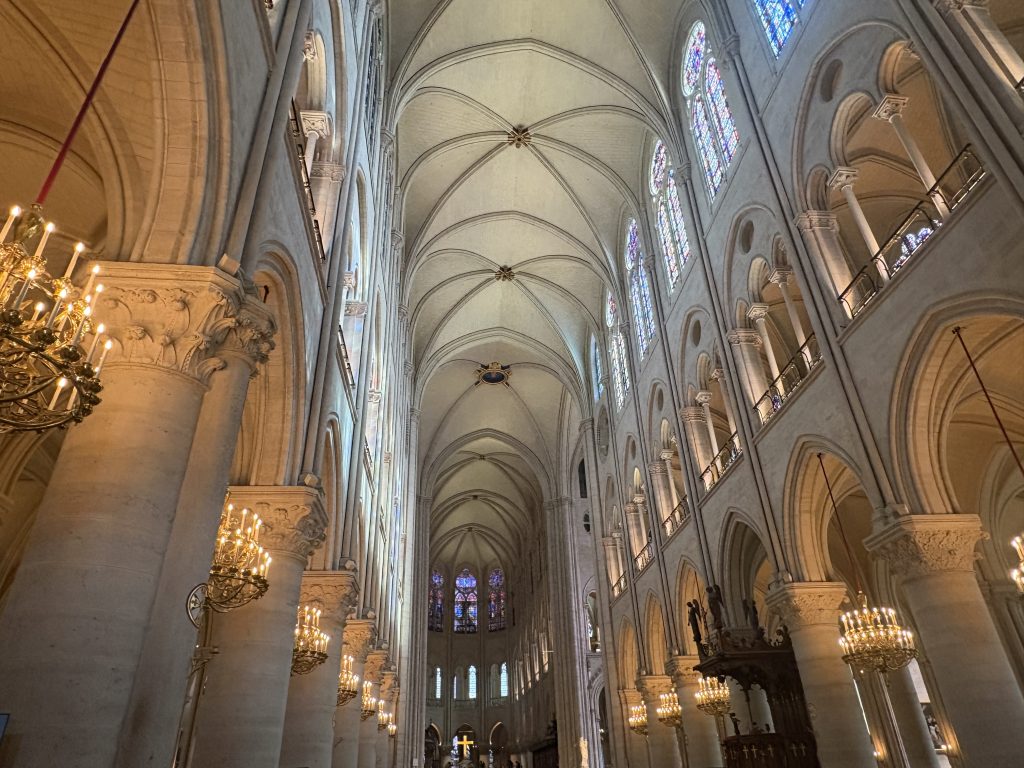
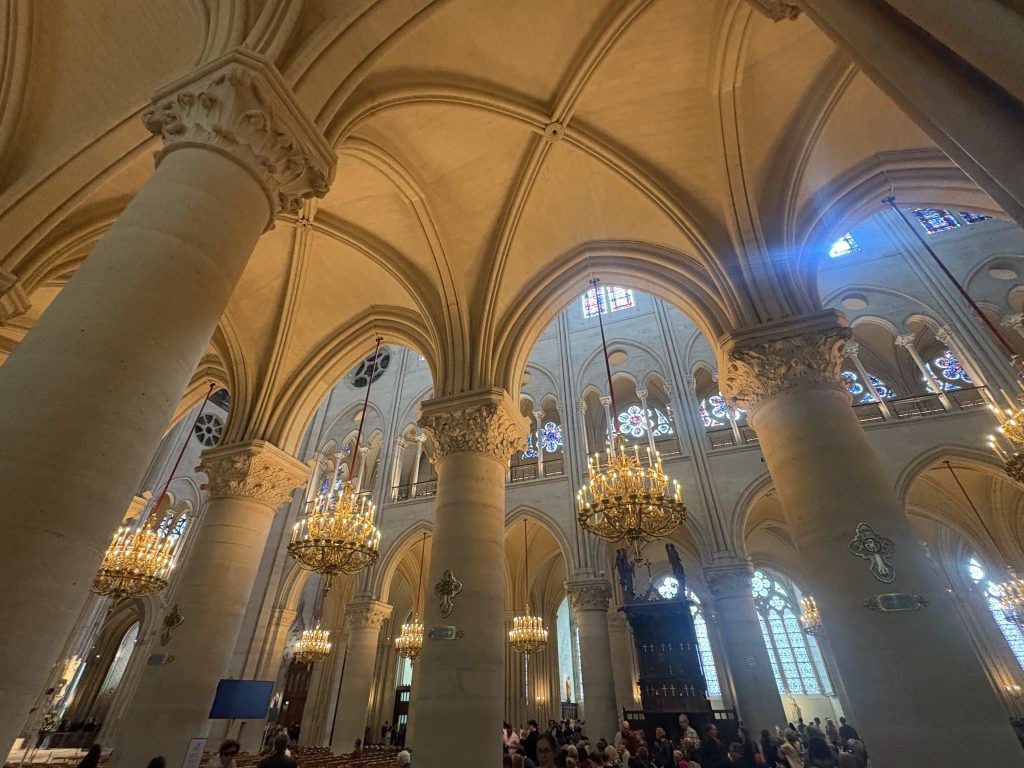
And now? The restored stone is so blindingly white that it looks brand new—which of course it kind of is!
A Brand New Cathedral
Gone is the gravitas imparted by stone columns that have soared to the vaulted ceiling for a thousand years. The new Notre-Dame Cathedral no longer feels ancient.
But, surprisingly, that doesn’t matter as much as I thought it would. I’m so impressed by the skill employed to rebuild the cathedral in less than five years, that I didn’t mind the newness.
Finding Your Way Around the Cathedral
The first challenge upon entering the cathedral is jockeying for position at the start of the nave to snap a picture without heads in the way. Everyone is holding a phone aloft to take the same picture, and of course I do too.
Once the first pictures are taken, it’s time to being the slow shuffle up the left aisle to the front of the cathedral and back down the other side. It’s slow going with plenty of bottlenecks, but whatever. That just provides more time for more snapping of photos of the columns and arches from every angle.
In the side chapels on the left aisle are hung several modern works, most notably one by Matisse. Another highlight are the beautiful stained glass windows. I can’t even being to imagine how they were salvaged and then restored.
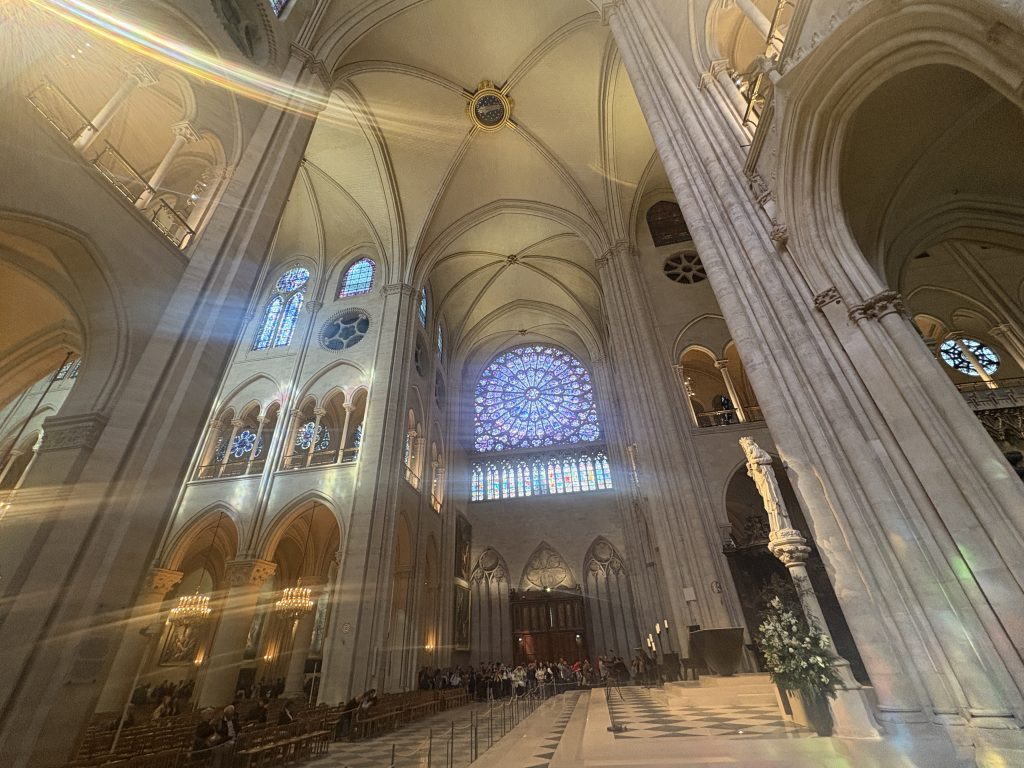
At the transept are the two giant rose windows. Both glow with restored vigor, their colors dancing off the white pillars.
What’s That Smell?
As I make the slow progress around the perimeter of the cathedral, I become aware of a lingering scent of burning. Usually, cathedrals smell of old stone.
The “new” Notre-Dame Cathedral smells of fire, a fitting reminder of its trauma.
Restoration Project Displays
After touring the cathedral, take a stroll along the street immediately to the left of the cathedral as you face it. Giant billboards document the restoration work with pictures and enough startling stats to keep you in awe. It’s heartening to witness the results of hundreds of skilled workers coming together with a common purpose.
The “new” Notre-Dame Cathedral restored my faith in humanity’s ability to accomplish great things with astonishing skill and dedication.
Tours of Notre-Dame Cathedral
If you’re not lucky like I was and can’t get last-minute tickets to enter Notre-Dame without lining up, consider one of these GetYourGuide guided tours. You’ll learn all about the history of this iconic cathedral along with information about the terrible fire and the remarkable restoration.
My latest go-to place to stay in Paris is the Citadines Saint-Germain-des-Prés Paris. You can’t beat the location right on the Seine and steps from Boulevard Saint-Michel.
The rooms are almost spacious (by Parisian standards) and include a tiny kitchen and a work area. Free coffee is available 24/7 in the lobby which is staffed with helpful people.
Conclusion
Have you visited Notre-Dame Cathedral in Paris since its restoration and re-opening? Drop your suggestions for other travelers in the Comments below.
What is the “best of the Musée d’Orsay”? That’s a matter of opinion for sure!
What I think are the best pieces, and what others think is pretty subjective!
But I can confidently say that every artsy traveler who visits the Musée d’Orsay in Paris will not be disappointed.
A visit to the Musée d’Orsay is always a high point for me, no matter how many times I walk through the grand hall on the main floor and ride the escalators to view the outstanding collection of Impressionist and post-Impressionist art on the 5th floor.
The Musée d’Orsay is more than a must-see for the artsy traveler. It’s akin to a pilgrimage! It certainly ranks as one of my all-time-favorite European museums. In this post, I share some of what I consider the top masterpieces.
Musée d’Orsay at a Glance
Favorite Artist: It’s a tie between Manet and Morisot
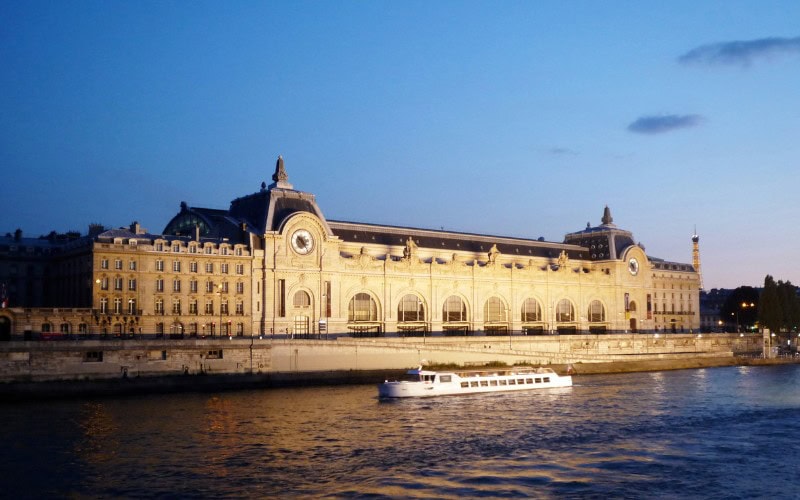
The map below shows the location of the Musée d’Orsay (#1) in Paris. Also shown is the location of the Louvre for Renaissance, Baroque and 19th-Century art (#2), the Cluny for medieval art (#3), and the Pompidou for modern art (#4).
Always reserve a time to visit the Musée d’Orsay to avoid standing in long lines. You can reserve directly from the museum’s website, or purchase tickets through resellers such as Tiquets.com or GetYourGuide.
Once you’ve entered the museum, consider whether to pick up an audio guide.
Two types of audio guides are available. You can hire one at the museum that will include commentary on the contents of both the permanent collection and the main temporary exhibition on during your visit. Alternatively, you can download an audio guide onto your mobile phone that includes commentary only on the main temporary exhibition.
Touring the Top Masterpieces at the Musée d’Orsay
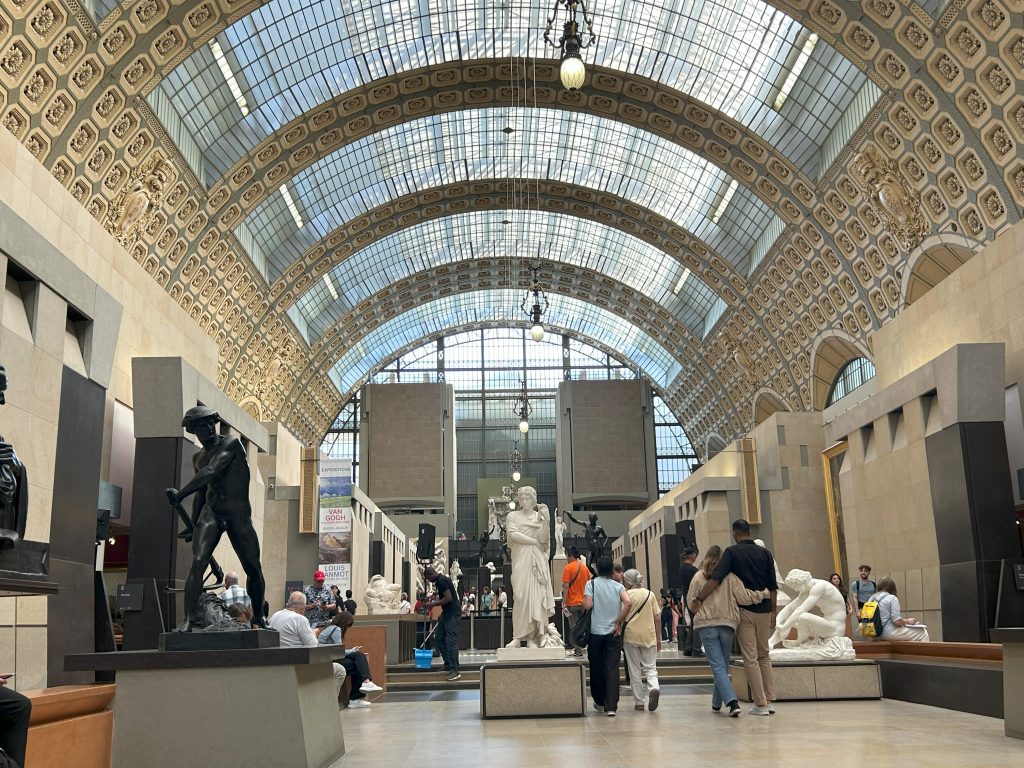
The Musée d’Orsay’s collection is housed in a converted railway station. As such, part of its attraction is the massive atrium that stretches the length of the museum and is filled with light and sculptures.
Long galleries run either side of the atrium and contain mostly academic paintings from the 19th century. Some of these rooms are skippable, unless you’re a fan of the overly florid, heroic style popular during the mid-19th century.
However, make sure you pop into the galleries to the left that include several masterpieces by Gustave Courbet and Jean-François Millet.
Most visitors head for the far end of the atrium and take the escalators to the fifth floor where they find one of the world’s largest collections of impressionist paintings, in addition to an impressive number of paintings by post-impressionists.
A series of rooms includes works by all the late-19th century biggies–Manet, Monet, Renoir, van Gogh, Morisot, and more.
The following highlights of what see is presented according to artist rather than the order in which you’ll encounter them while walking through the museum. All of the works mentioned are in the collection on the fifth floor.
Edouard Manet
The collection includes several iconic pieces by Edouard Manet. I zeroed in on two of them as representative of my favorite aspects of his work. I like the way he flattens the planes and uses a fairly neutral palette.
Even bright colors such as red and blue have gray undertones. Manet’s work always seems much more understated than the work of some of his contemporaries like Monet and especially Renoir.
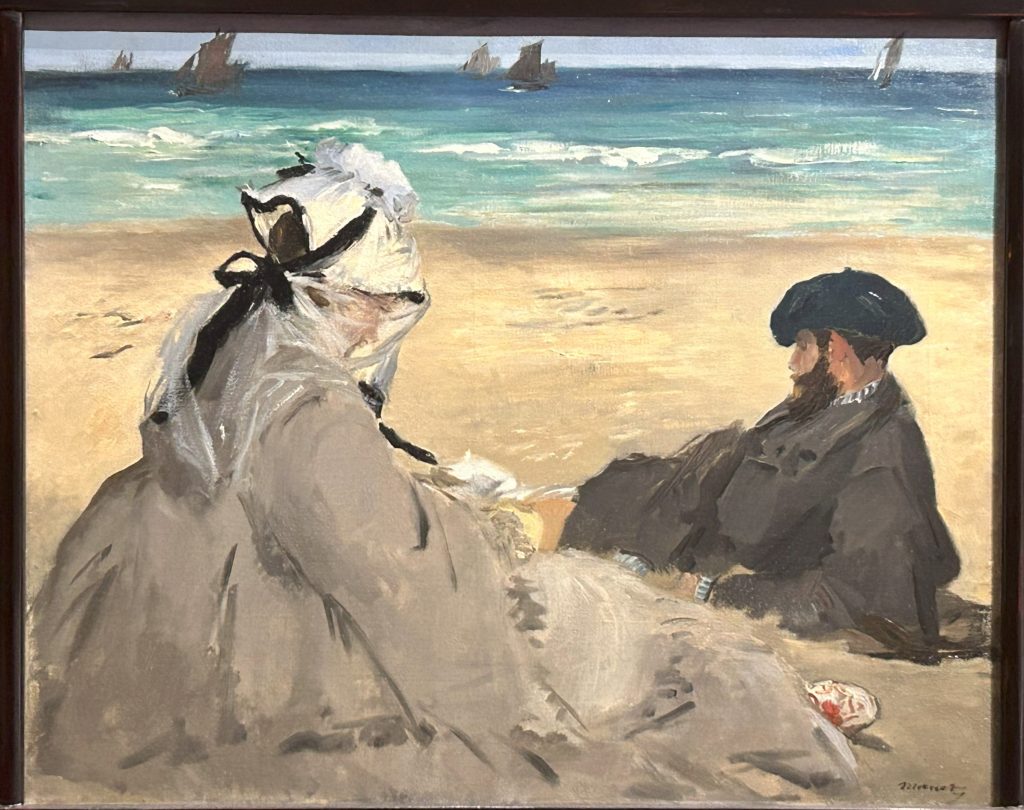
Sur la Plage by Manet
Manet’s wife and brother sit on the beach—she is reading and he is staring out at the boats sailing along the English Channel. By making the sky take up a very small percentage of the painting, the focus is on the beach itself and the figures.
Manet’s sketchy, fluid brushstrokes makes the scene look like a snapshot in time, as though at any moment the figures will shift position.
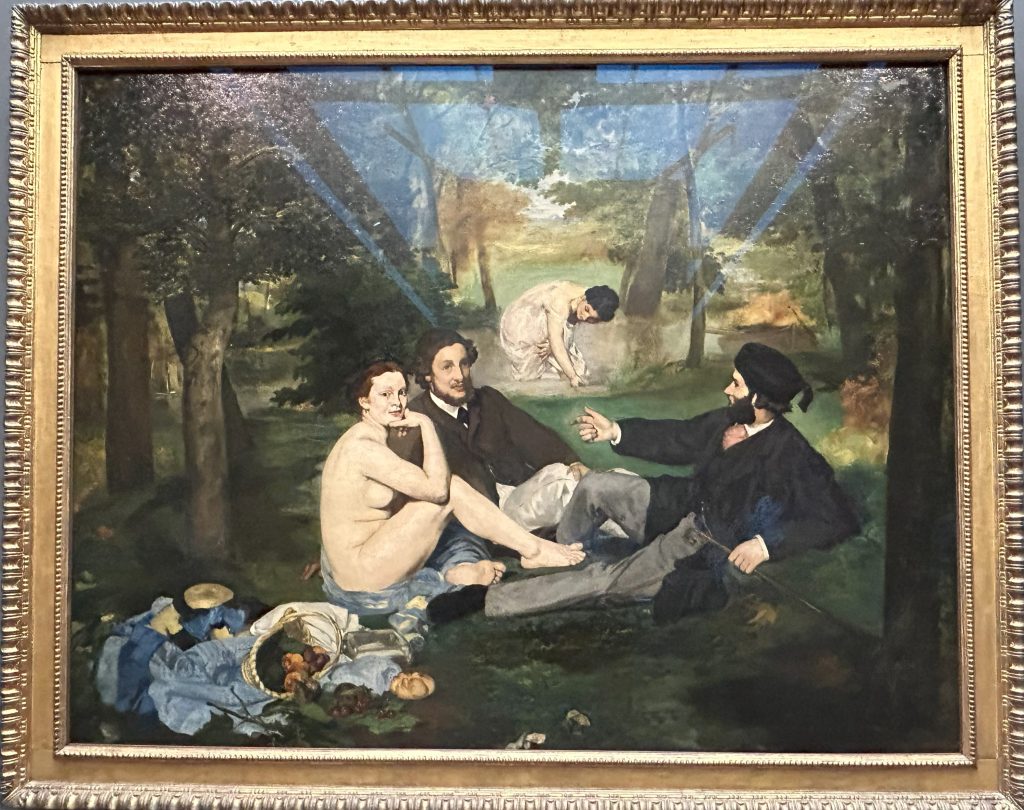
Dejeuner sur l’herbe by Manet
If I had to choose the most famous painting in the Musée d’Orsay, I think it would have to be Manet’s Dejeuner sur l’herbe. It’s also one of my favorites.
I’m certainly not alone in loving this piece, which has been reproduced countless times and analyzed within an inch of its life.
Manet painted it in 1863 and included it in the Salon des Refusés along with other artists who were excluded from the Salon (the exhibition of all the accepted painters of the day).
Manet’s large painting shocked critics and the public because it represented such a marked departure from the academic tradition of only depicting mythological figures as nudes.
In this painting, there is a naked woman next to two men wearing modern dress. She looks brazenly out at the viewer as if to dare them to be shocked. The work was deemed to be obscene not only because of its subject matter but because of its loose brushstrokes, contempt for the rules of perspective, and violent contrasts.
Nowadays, we consider it a masterpiece, and it is certainly arresting.
Paul Gauguin
Gauguin’s paintings always make me smile. He combines bright colors in sometimes startling ways and depicts his figures and his landscapes with a flattened perspective that gives them a pleasing immediacy, as though they could easily step out of the canvas.
Gauguin’s work is exhibited alongside several other painters of the Pont-Aven School.
On a recent trip to Europe, I spent a week in Pont-Aven, mostly because Gregg (husband and usual travel companion and also artist) is fascinated by the work that was done there by painters such as Gauguin, Bernard, and Sérusier, and wanted to be inspired by the same landscape that inspired them.
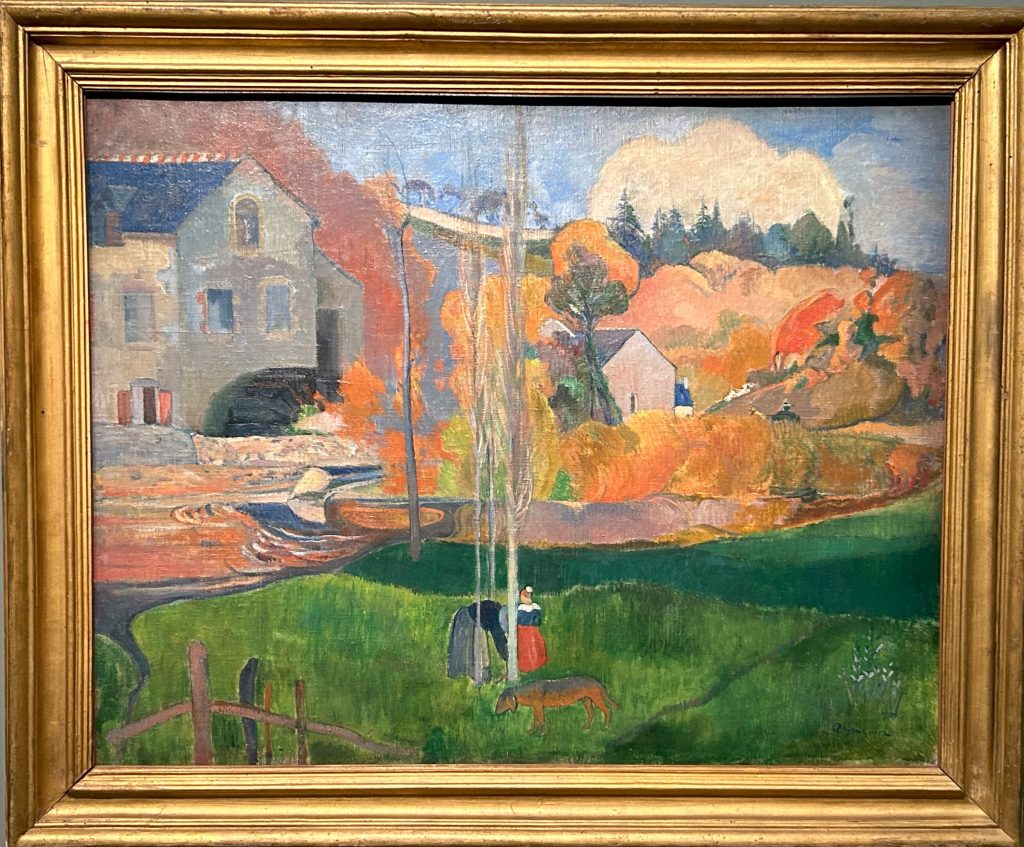
Paysage de Bretagne by Gauguin
This beautiful landscape of a typical scene in Brittany practically glows. The red and orange bushes on the mid-section contrast intensely with the blue sky and bright green foreground.
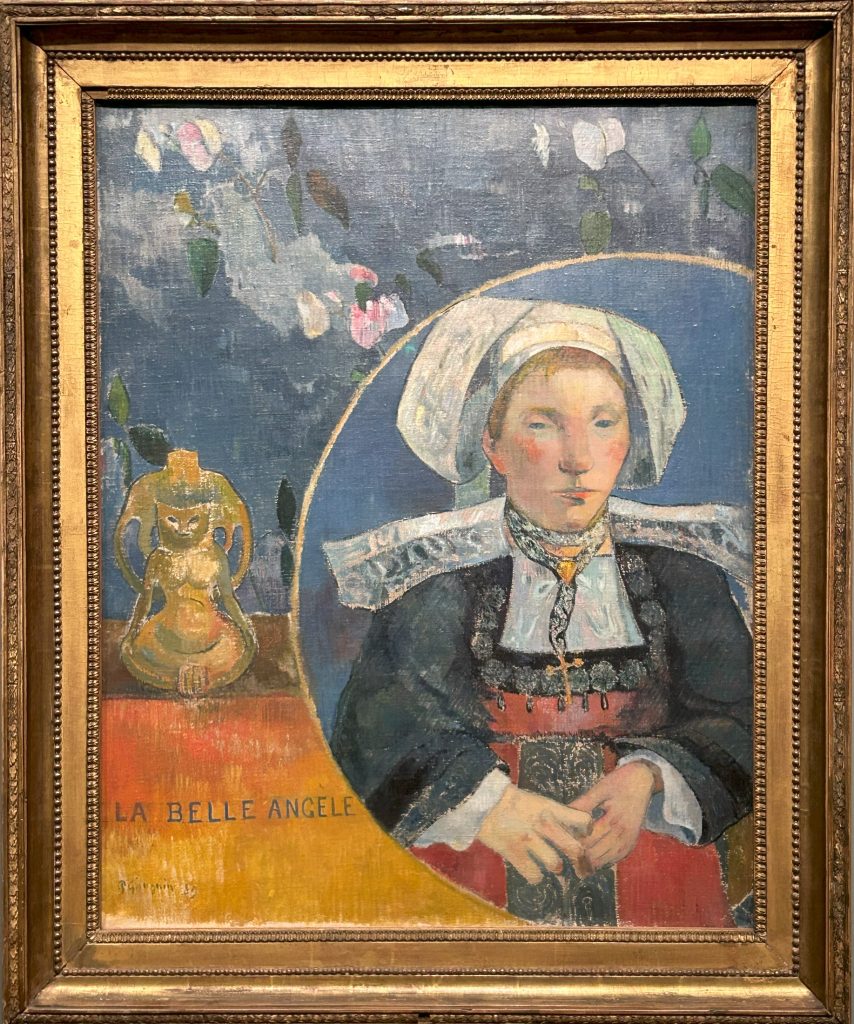
La Belle Angèle by Gauguin
Gauguin completed this portrait of Marie-Angélique Satre in 1889. He depicts the woman in traditional dress in a composition reminiscent of both Japanese prints and medieval stained-glass windows.
Perhaps as a nod to his Peruvian heritage (his mother was born in Peru), Gauguin includes a Peruvian-inspired piece of pottery next to his model.
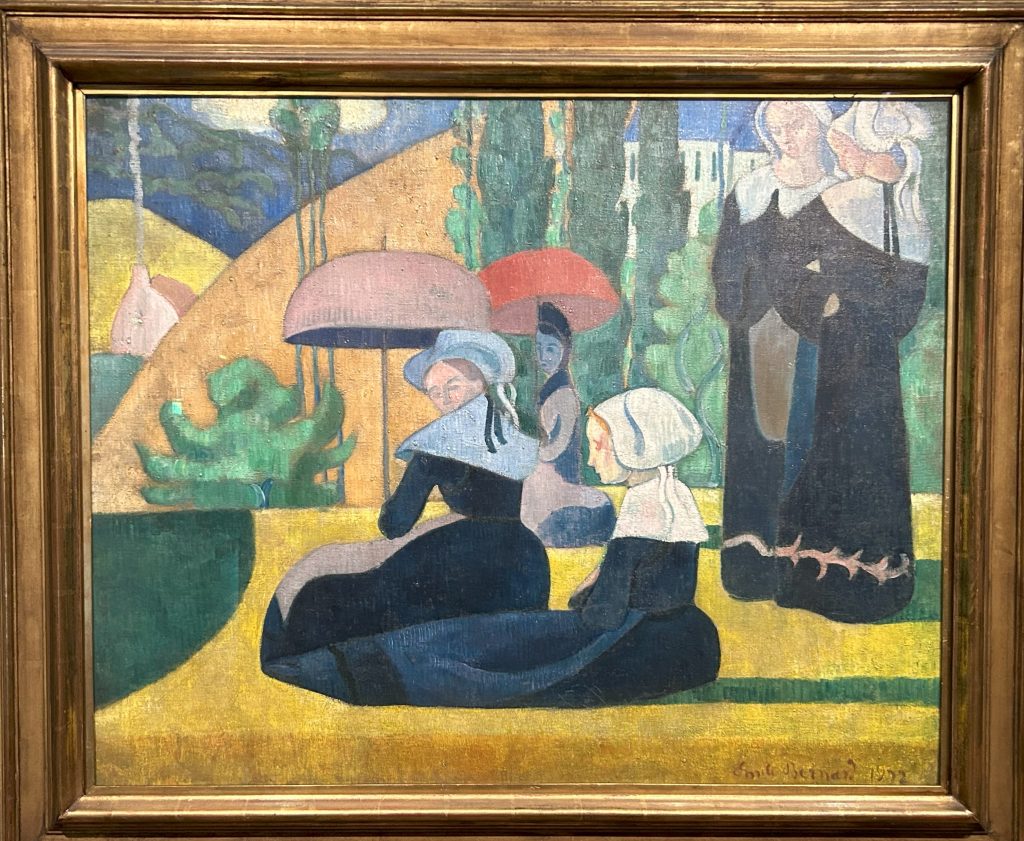
Émile Bernard
Bernard was another painter in the Pont-Aven School. Called Les Bretonnes aux ombrelles, this striking depiction of Breton women wearing traditional dress shows how Bernard, as a post-impressionist, ignored perspective, instead filling both the foreground and the background with his figures, bringing them into prominence.
I’m reminded of medieval paintings where the figures take precedence over perspective.
Paul Sérusier
Another member of the Pont-Aven School, Sérusier has become one of my faves from this period. His work almost borders on abstraction and I love how he uses color.
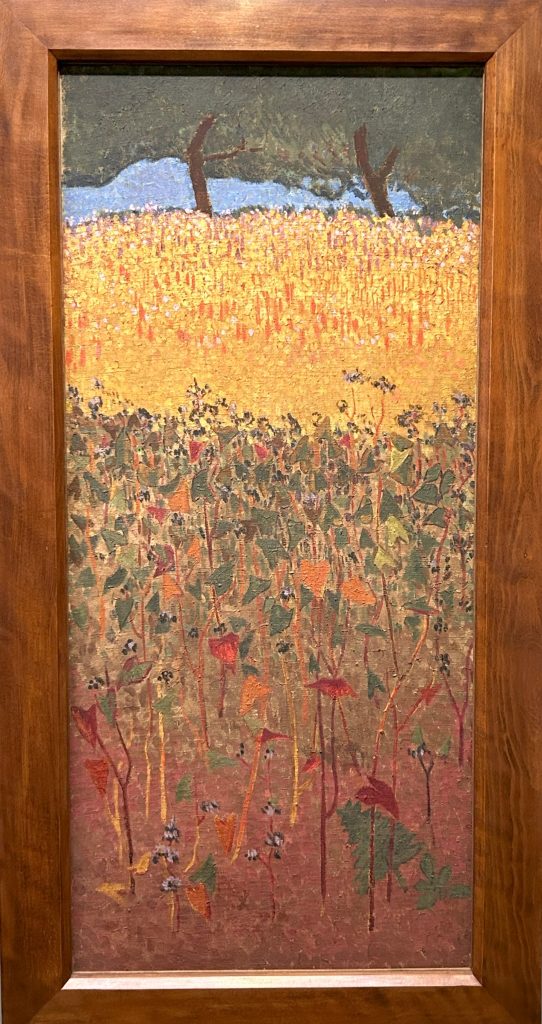
Le champ de blé d’or et de sarrasin by Sérusier
This golden field takes up almost the entire painting, with just a bit at the top for the sky. I feel like I could walk straight into it and be instantly enveloped in a riot of flowers.
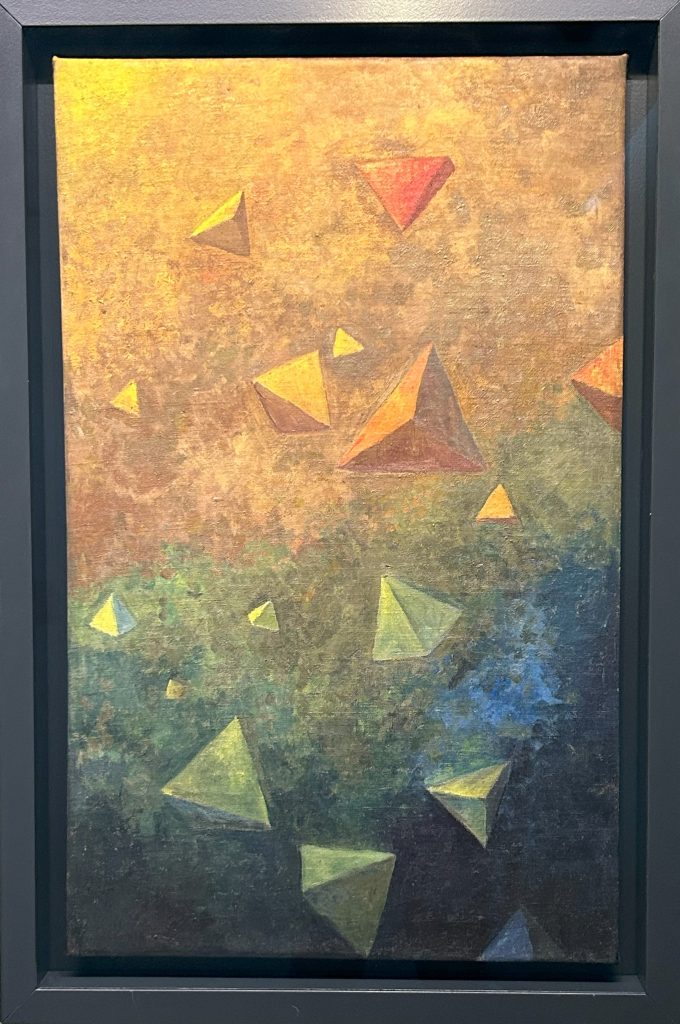
Tetrahedra by Sérusier
Painted around 1910, this piece showing floating objects in a formless space is part of a cycle of pictures by Sérusier that pushed the boundaries of Symbolism towards abstraction.
Sérusier believed that geometric forms were sacred and in this painting he depicts his thinking on the origins of life and the universe. The chromatic range of colors progresses towards the light, passing from the coldest to the warmest shades.
The painting is just a delight!
Vincent van Gogh
It’s never difficult to spot a painting by van Gogh in the Musée d’Orsay since there’s always a clutch of people holding cameras aloft in front it.
There are several van Goghs—all fabulous—but I include here just two that I particularly love.
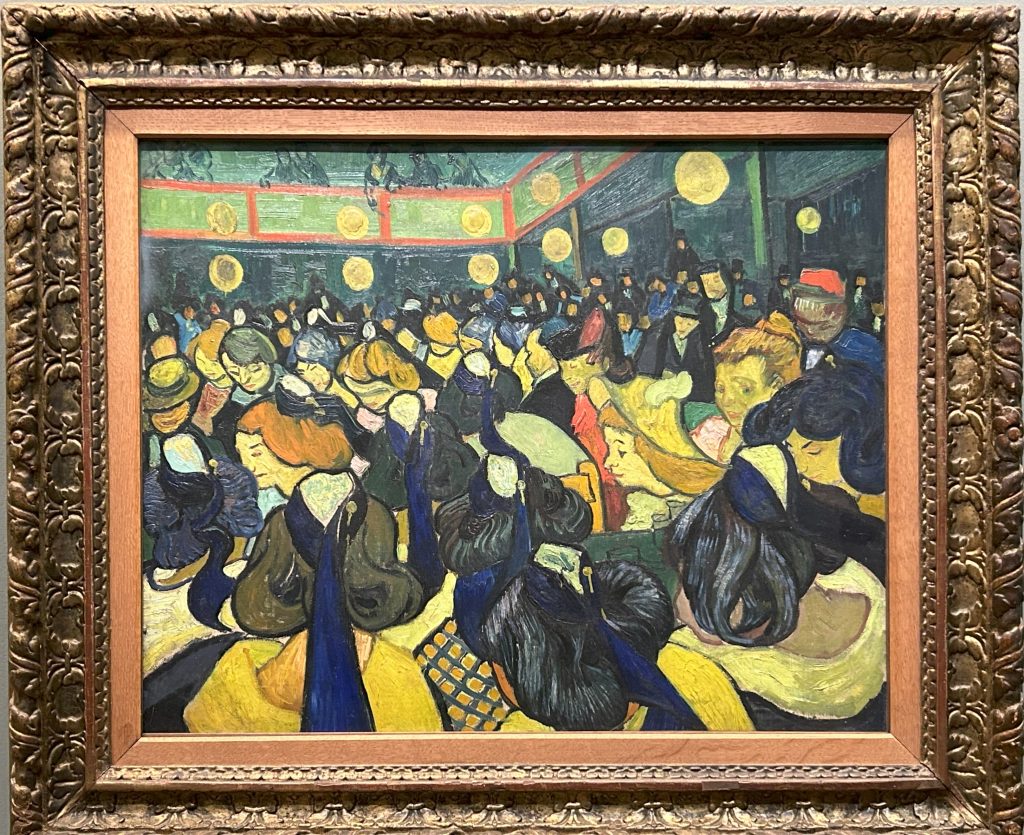
La Salle de danse à Arles by van Gogh
I was surprised to discover a painting by van Gogh that I’d never seen before. At first, I thought it was by Gauguin because the way the figures are depicted and the colors used remind me of his work.
But nope – it’s van Gogh. What an energetic, lively piece this is! Van Gogh really captured the almost frenzied crush of people, the women wearing Arlesian headdresses, their expressions blank.
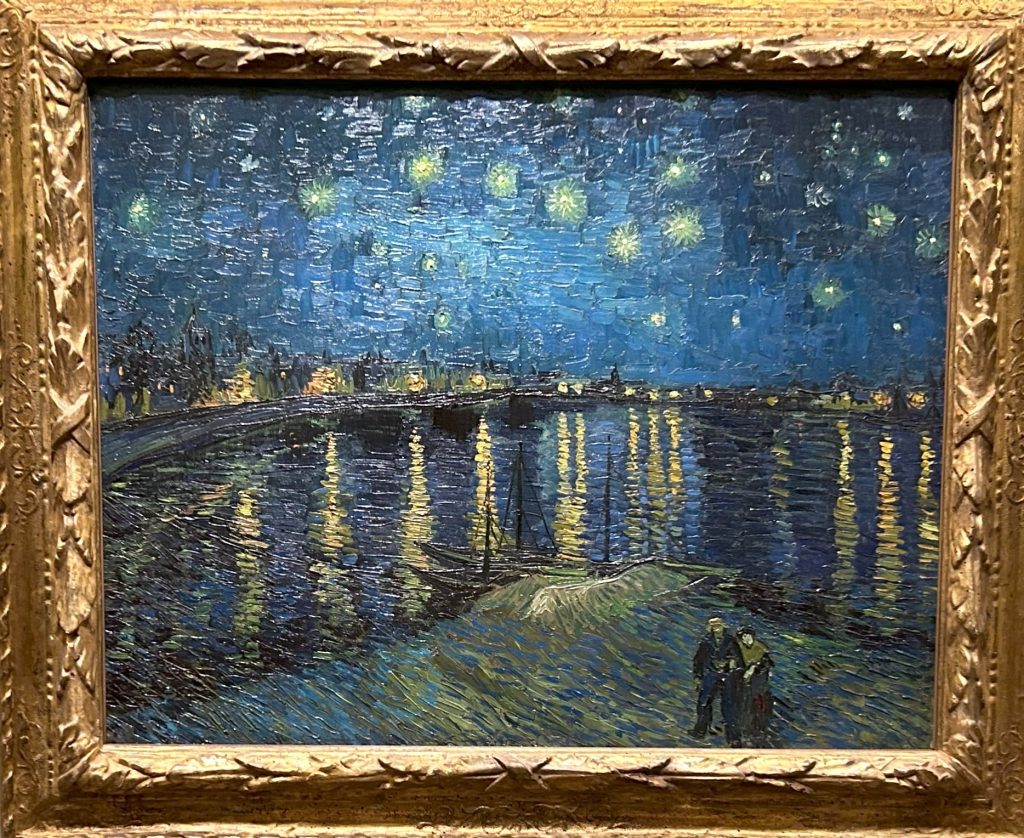
The Starry Night by van Gogh
Van Gogh painted a few versions of Arles on a starry night. This one is not quite as well known, but it’s still fabulous. Van Gogh worked by candlelight to complete a night view of Arles illuminated by gas lamps and the Great Bear constellation glittering in the sky.
Henri Toulouse-Lautrec
Although Toulouse-Lautrec hailed from a wealthy family in Albi in the southwest of France, he became famous for his gritty depictions of real Parisians, many of whom were down on their luck, lonely, and marginalized. I’m particularly intrigued by two of his pieces depicting prostitutes.
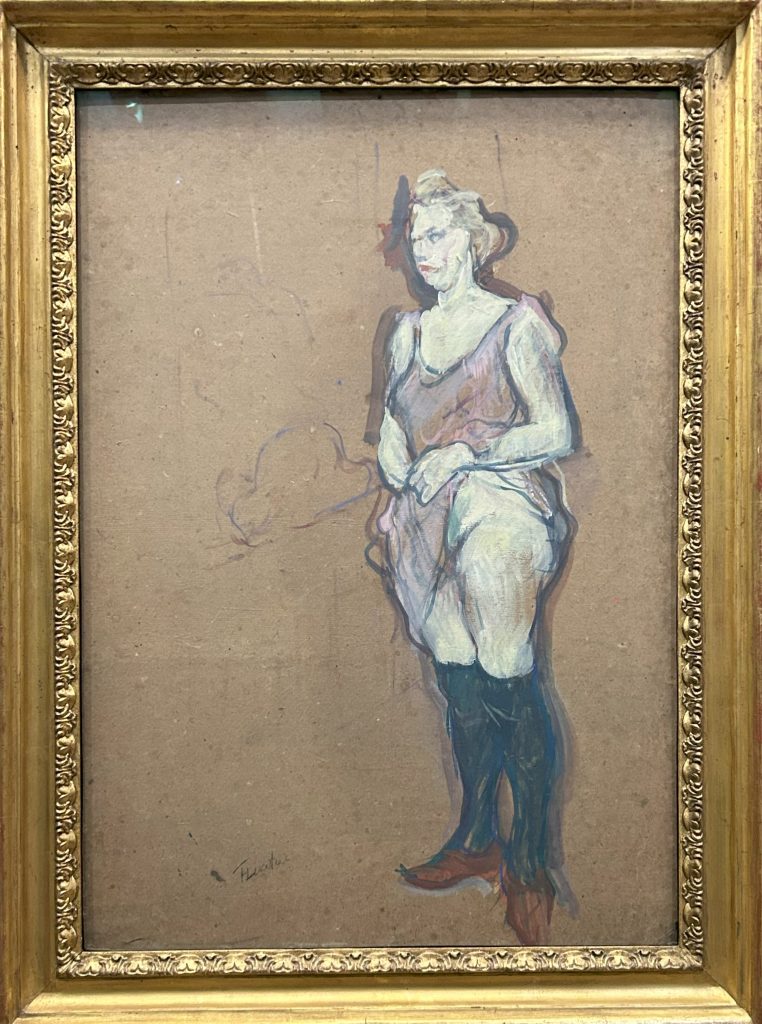
Blonde prostitute, also known as Study for the Medical Inspection by Toulouse-Lautrec
The partially-clothed model is Gabrielle, a prostitute in a Parisian brothel. She’s getting ready to be inspected for venereal disease. Her expression could be interpreted as angry or stoic in the face of what must have been a very demeaning procedure.
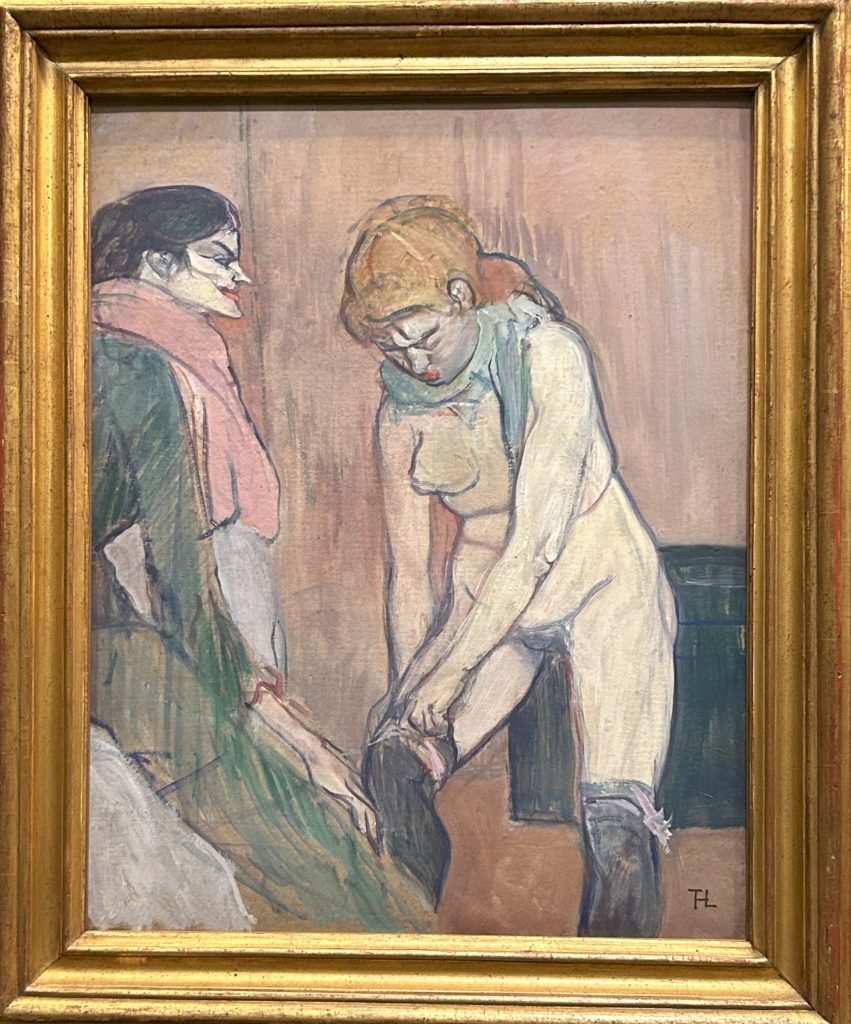
Woman Pulling Up Her Stocking by Toulouse-Lautrec
Toulouse-Lautrec was a frequent visitor to the brothels and was able to sketch the prostitutes in all manner of poses. This drawing shows an everyday act—pulling on stockings—under the watchful eye of the brothel’s Madame.
If you’re headed to southwest France, drop into Albi and tour the marvelous Musée Toulouse-Lautrec.
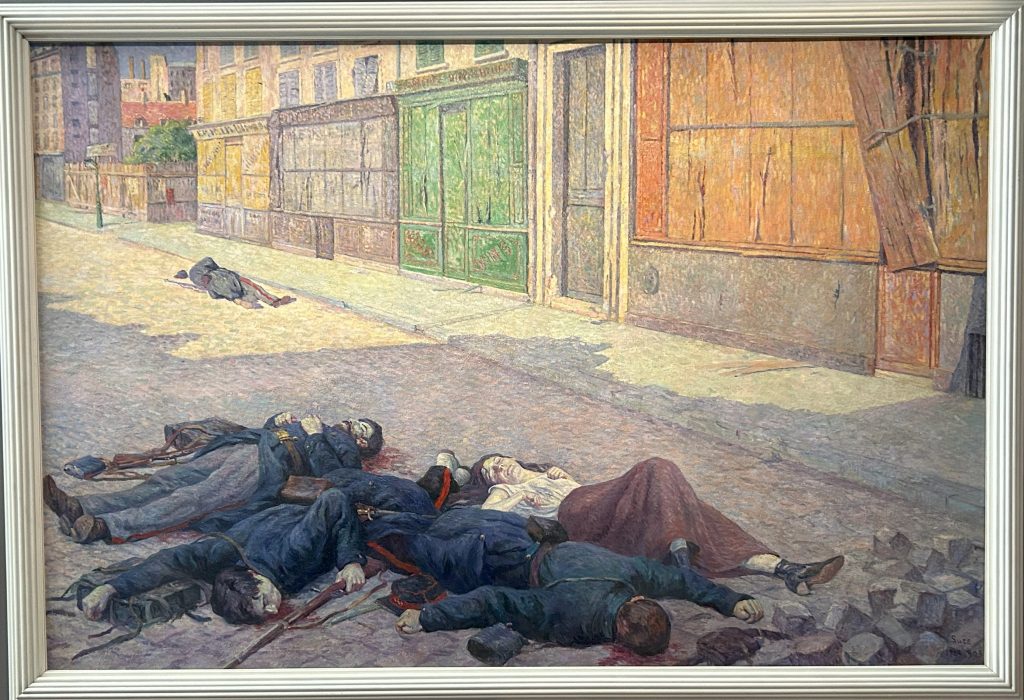
Maximilien Luce
This artist may not be as well known as many of the others in the collection, but this piece is a striking depiction of the violence that stalked Paris on and off throughout the 19th century.
This particular scene shows the aftermath of Bloody Week (May 21 to 28, 1871) when the Paris Commune was brutally suppressed and hundreds of people were shot down in the streets.
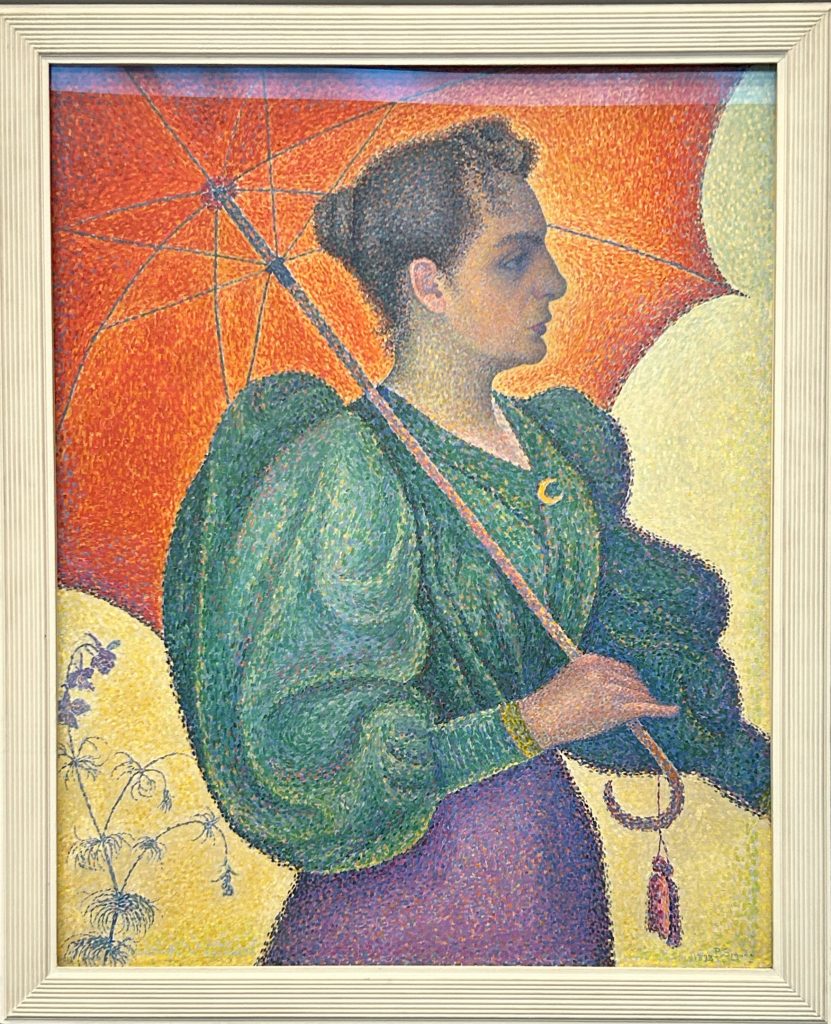
Paul Signac
This gorgeous portrait of Signac’s wife uses very sharp contrasts between complementary colors: yellow with purple, and orange-red with green. It’s a very stylized composition that shares an affinity with Art Nouveau posters.
Berthe Morisot
I’ve long been a fan of Impressionist painter Berthe Morisot and am delighted to discover several paintings that I hadn’t seen before on display at the Musée d’Orsay.
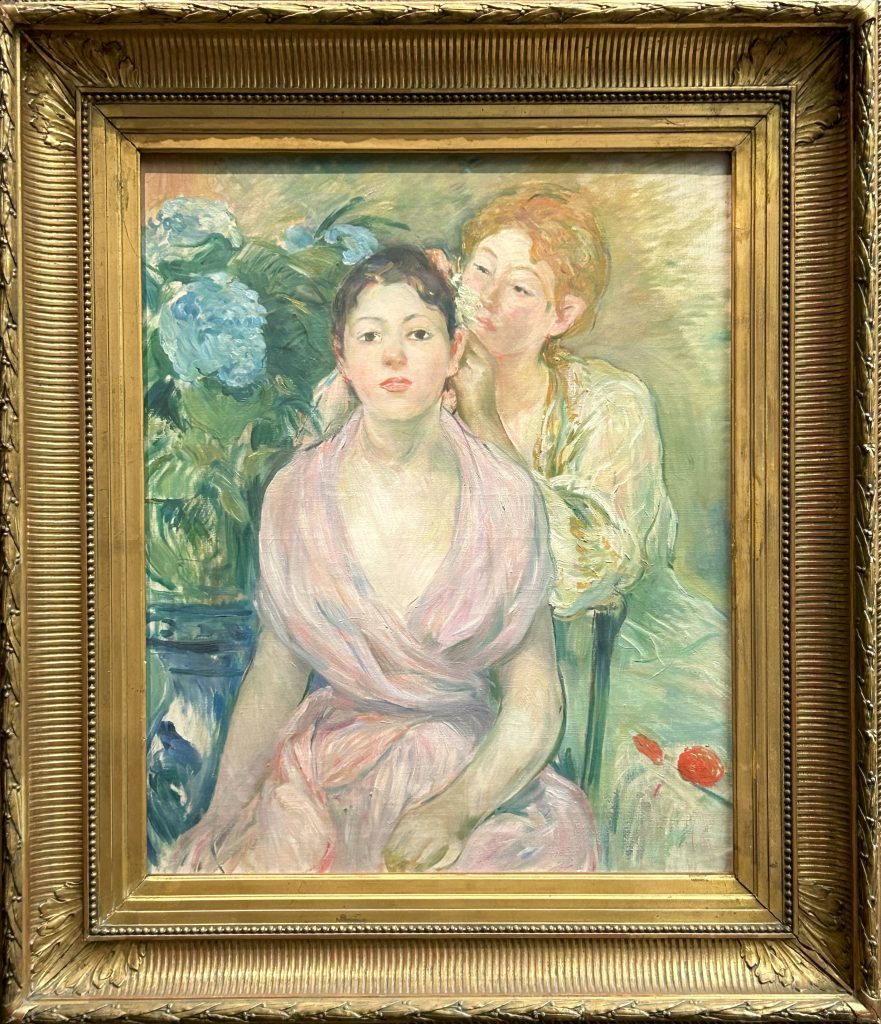
Les Deux Soeurs by Morisot
This painting depicts two dreamy-looking young girls just emerging from adolescence. The blossoming hydrangea symbolizes their imminent emergence into womanhood.
Morisot is considered by many (myself included) to be one of the most impressionist of the Impressionists. She uses very loose brushstrokes and almost abstract backgrounds to convey a real sense of immediacy.
Her paintings look so fresh and alive. I like them so much more than works by painters such as Renoir that can look too over-worked and florid.
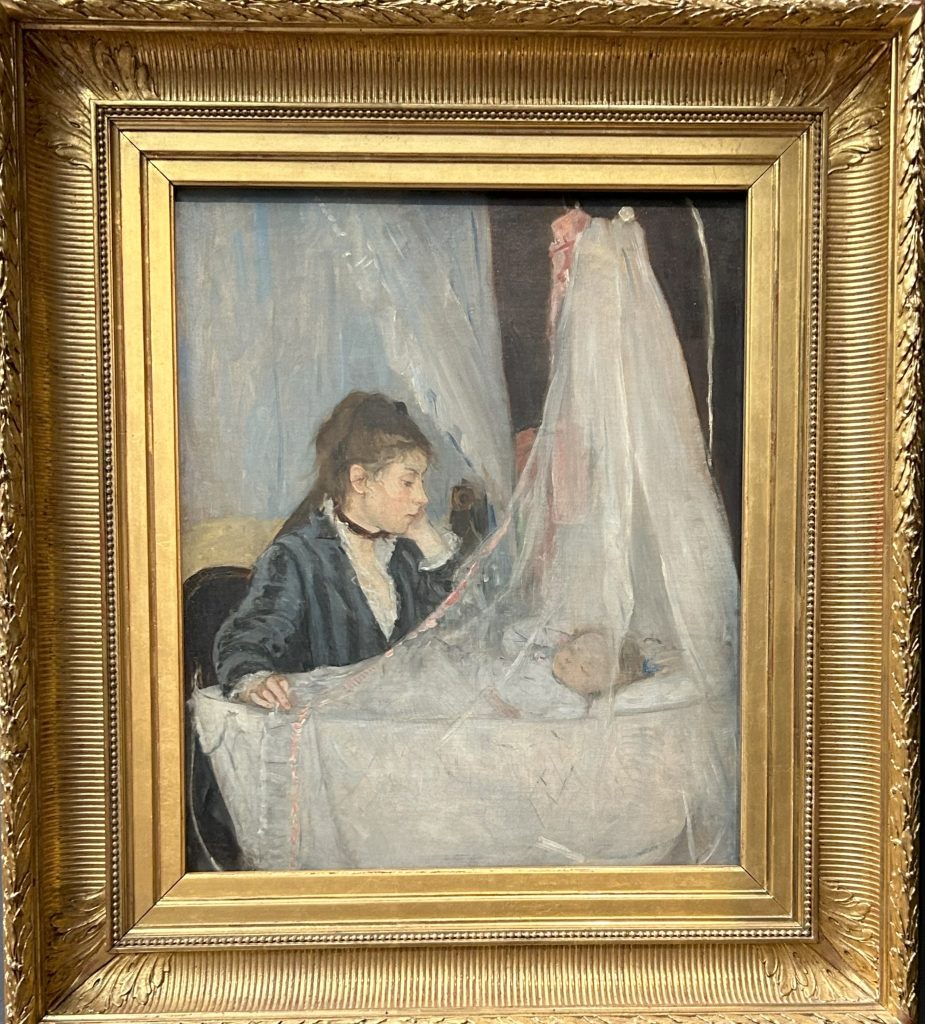
Le Berceau by Morisot
This portrait of Morisot’s sister gazing at her newborn child is so tender and domestic. And the way Morisot conveys the sheerness of the fabric draped around the baby’s crib is incredible–again proving just how skilled (and under-appreciated) a painter she was.
Paul Cézanne
Cézanne’s works are so redolent of the south of France that I can almost feel the heat coming off the canvases. His palette of warm greens and oranges perfectly captures the landscape around Aix-en-Provence.
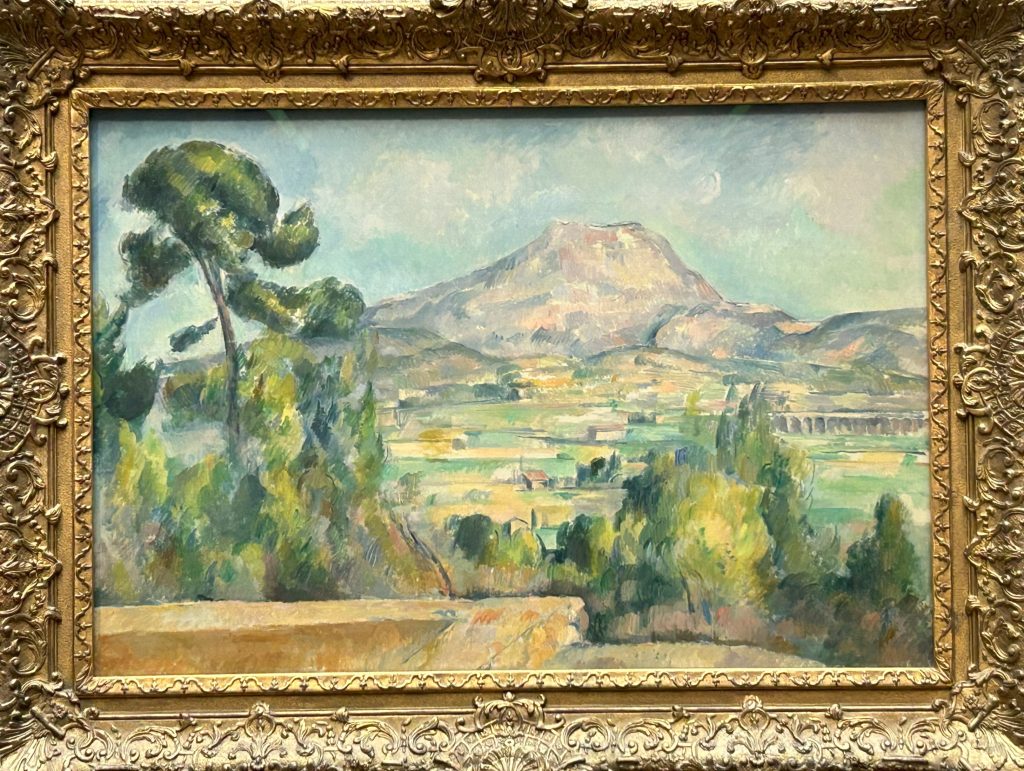
Montagne Sainte-Victoire by Cézanne
Here’s one of many versions of Mont Sainte-Victoire near Aix-en-Provence. It’s such a bright, cheerful painting that perfectly captures the heat and space of one of France’s most beautiful landscapes.
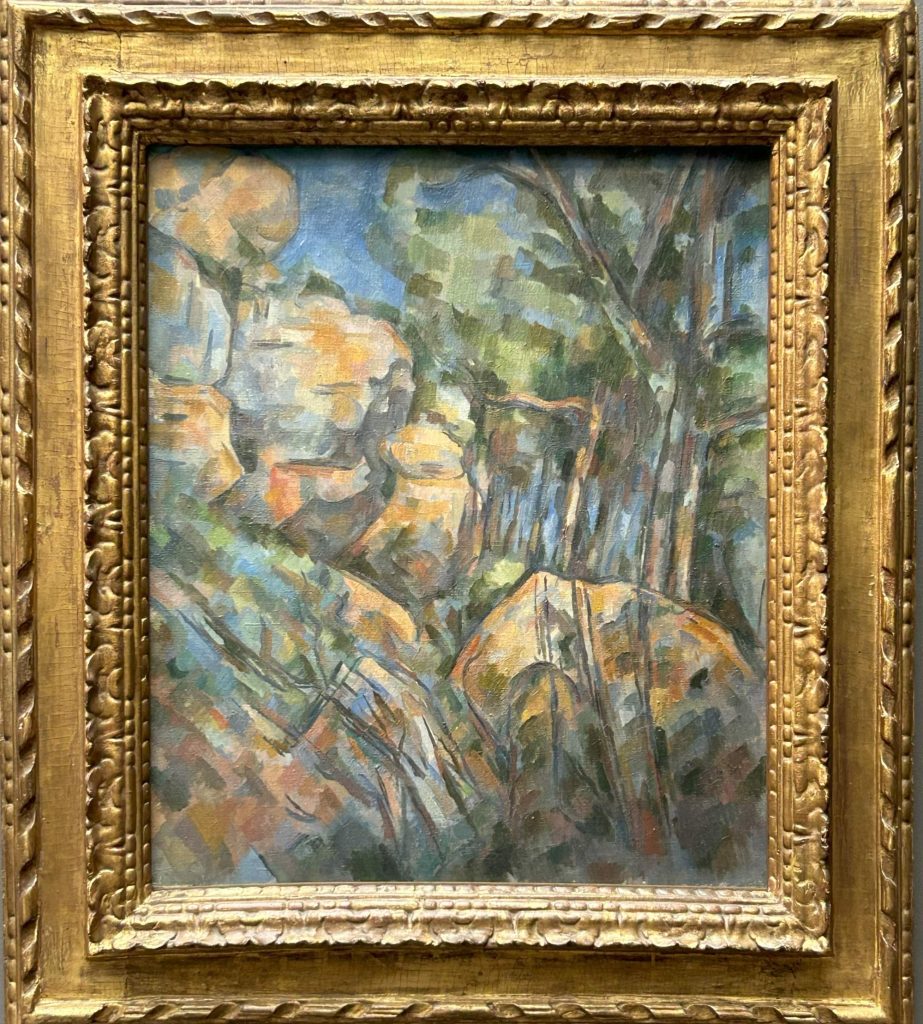
Rochers près des grottes au-dessus du Château-Noir by Cézanne
This piece perfectly captures the profusion of rocks and dense foliage in the countryside around Aix-en-Provence, where I’ve spent a fair bit of time over the years. No wonder painters who came after Cézanne credit him with being the father of Cubism.
Gustave Courbet
One of the most controversial paintings in the Musée d’Orsay is L’Origine du Monde by Gustave Courbet, a foremost proponent of realism. This piece was acquired by the museum in 1995, but wasn’t displayed publicly until quite recently.
When you see it, you’ll know why! It’s an amazing painting!
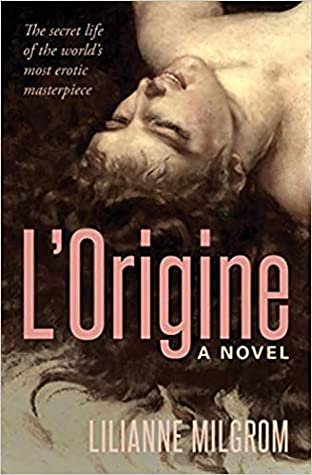
I have a soft spot for this painting because I read an excellent novel called L’Origine by Lilianne Milgrom and interviewed her on the Art In Fiction Podcast (my podcast featuring interviews with authors of arts-inspired novels!).
Lilianne’s novel tells the story of the painting from its commission by the Turkish-Egyptian diplomat Khalil-Bey to its acquisition by the Musée d’Orsay.
Claude Monet
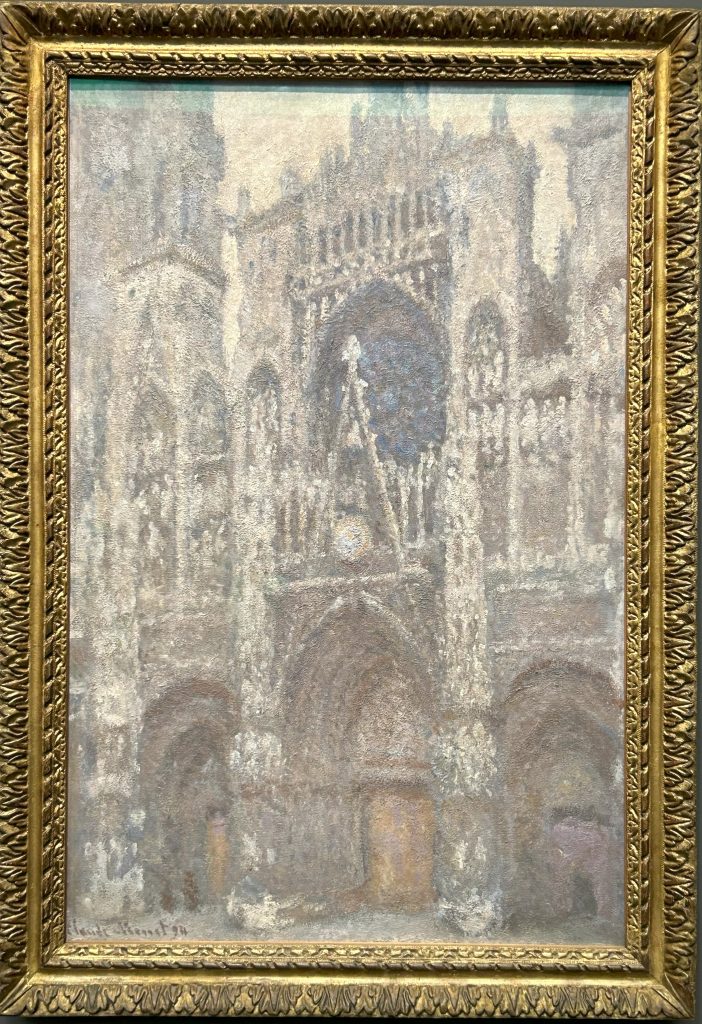
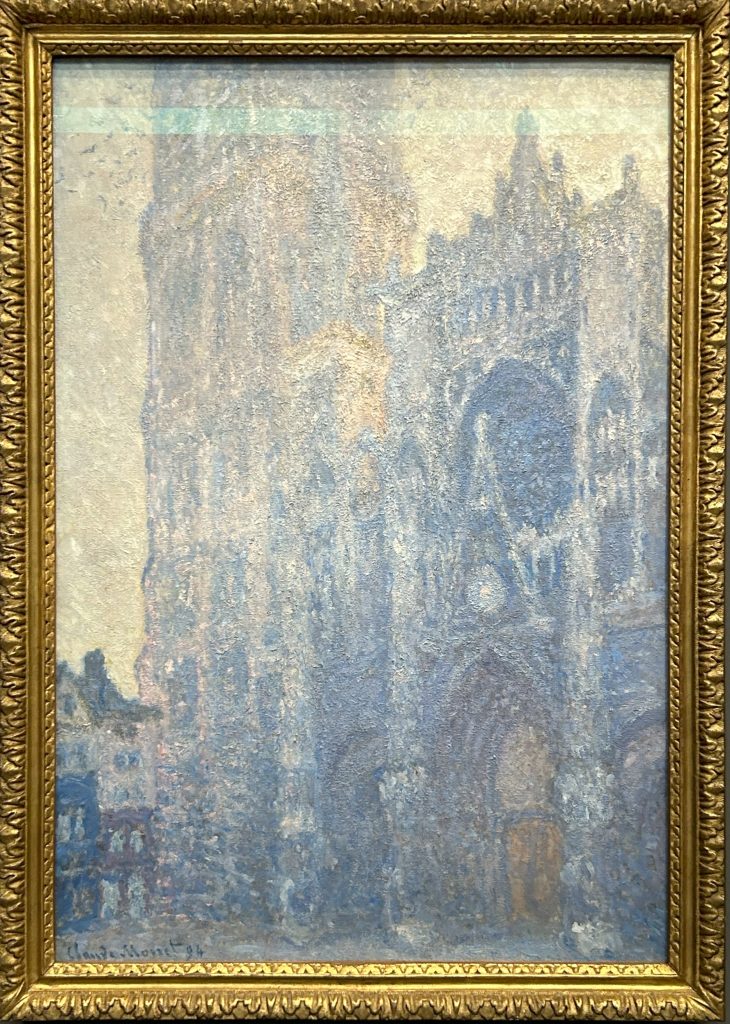
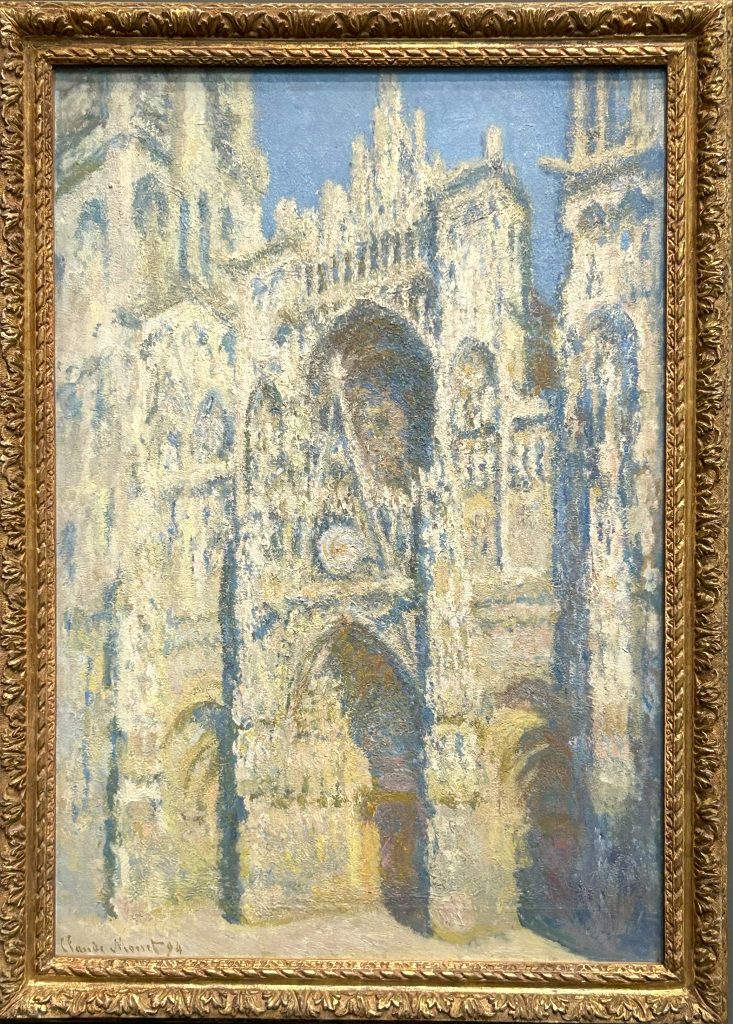
One entire wall is taken up with a series of five paintings showing views of Rouen Cathedral that Monet painted at different times of day. Here are three of them.
Mary Cassatt
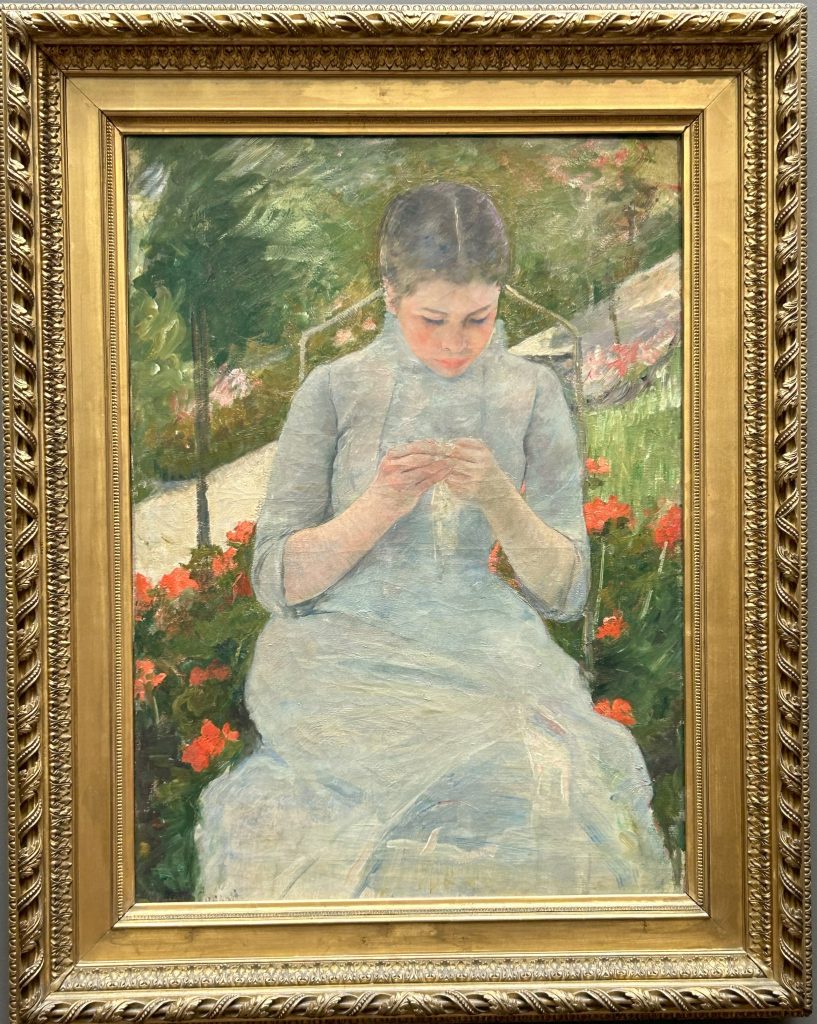
Cassatt joined the Impressionist group after moving to Paris from America in the 1870s.
In this painting, she depicts the young girl, using very subtle white tones to stand out against the brightly colored background. While the clothing is almost sketched in, the face and hands are rendered with gorgeous precision.
Edgar Degas
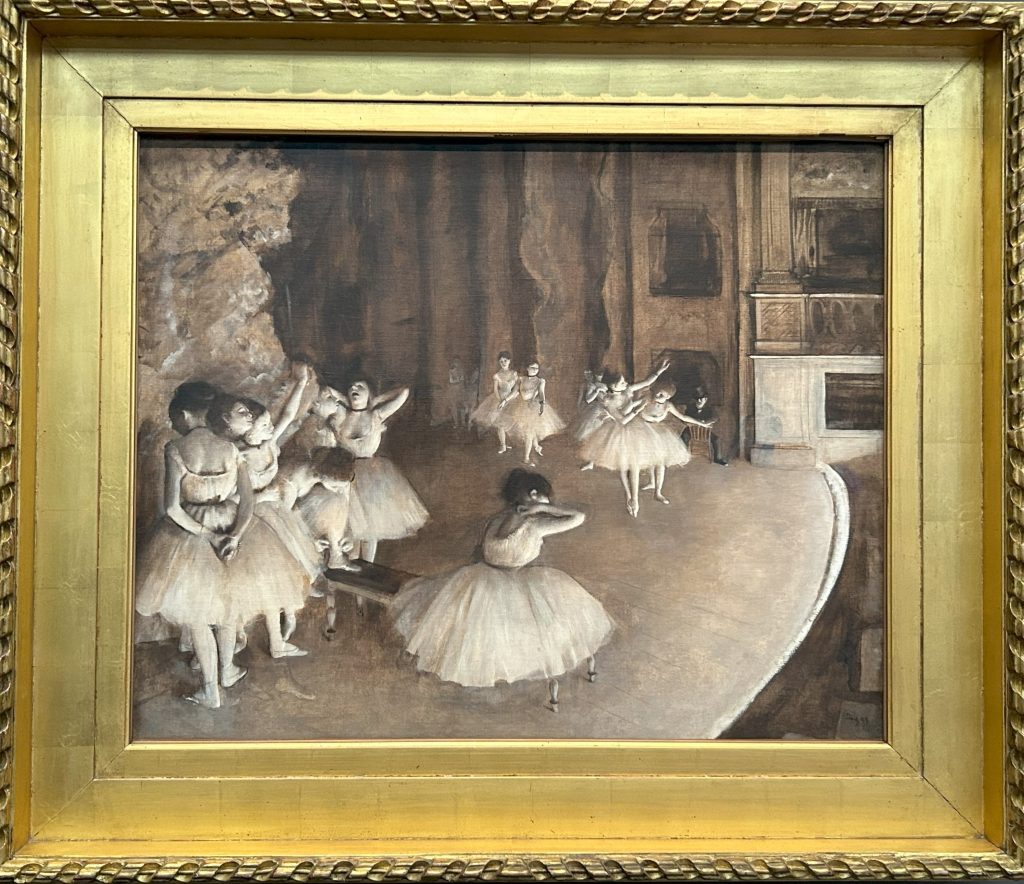
Degas is most famous for his paintings of ballet dancers at the Paris Opera, and the Musée d’Orsay has several examples, including this one showing dancers practicing on stage.
The figures are in various attitudes–some dancing, some stretching, one even scratching her back. Degas uses subtle tones and ethereal brushwork to convey filmy tutus and barely hinted-at expressions.
Auguste Renoir
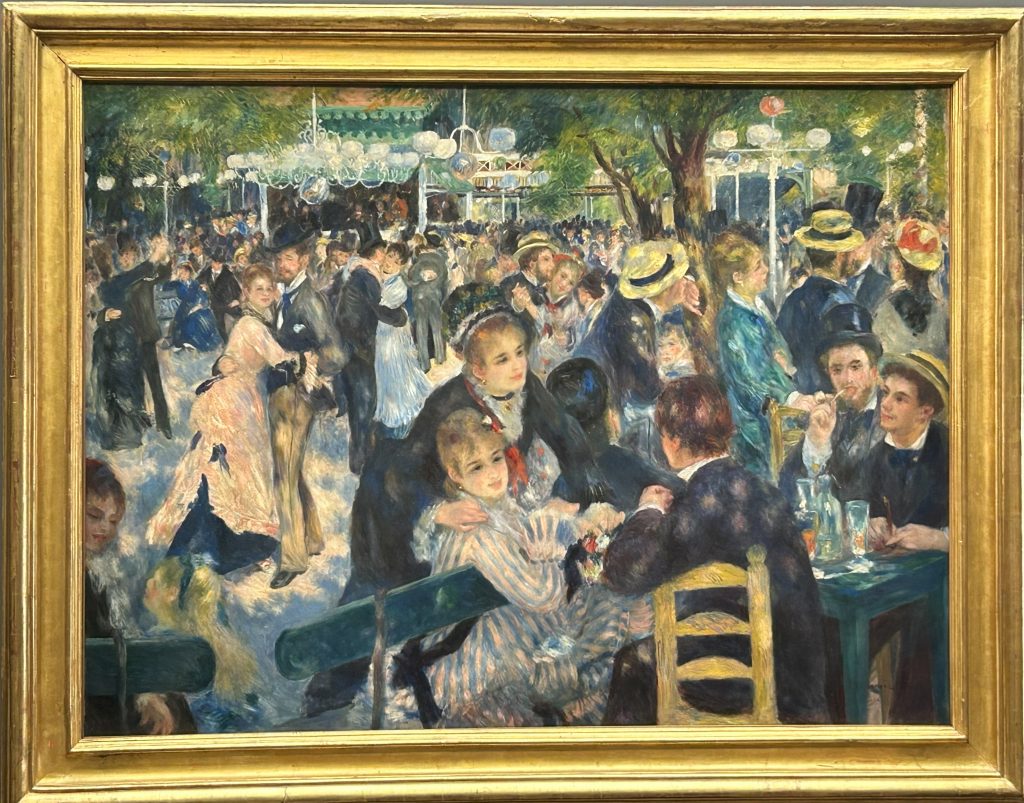
I’m not a huge fan of most of Renoir’s work. He’s an important painter but I find his figures a little too florid. The exception is, for me, this piece called Danse du Moulin de la Galette, arguably one of the most famous of Renoir’s paintings.
It depicts the famous guinguette–an open-air drinking establishment with food and dancing–that was located at the foot of a former windmill on the Butte de Montmartre in Paris.
The dance is attended by the working class in Paris, such as shop assistants, artists, workers, and just regular folks. The play of light and shadow bring the painting to life, making the viewer feel like they could step in and take a turn around the dance floor.
Gustave Caillebotte
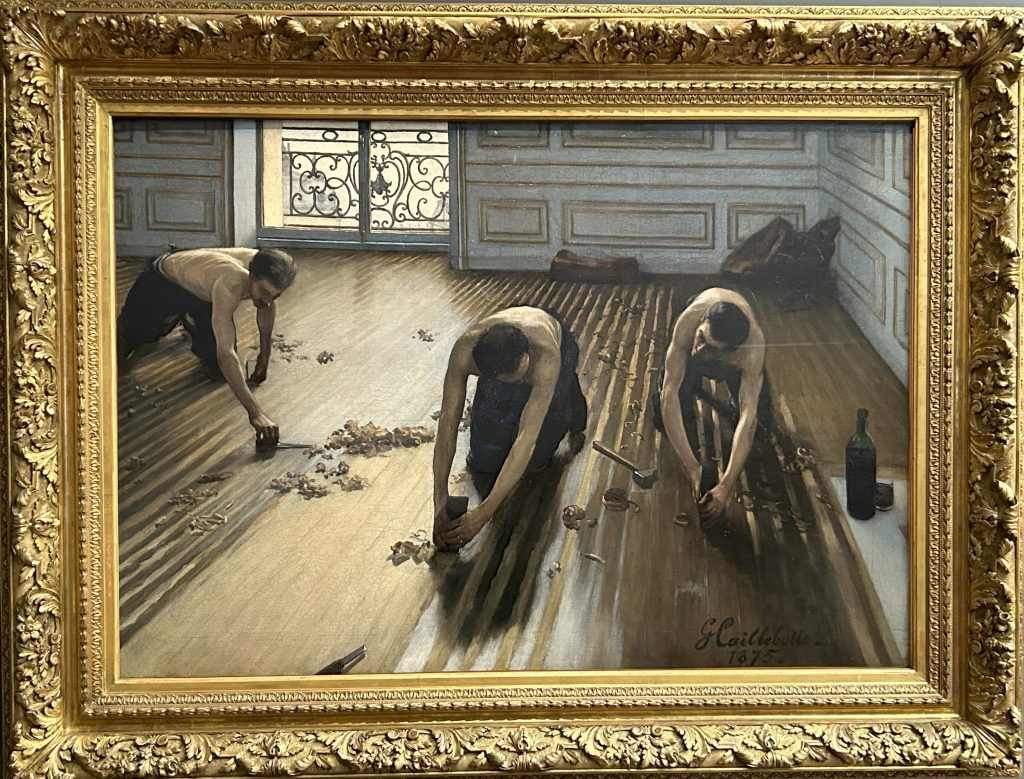
I first saw and was entranced by this painting in the Musée d’Orsay several years ago. Its subject matter is so different from the other paintings in the collection. It’s not a portrait or a landscape, but instead a depiction of three working men (The Floor Scrapers) who are busily scraping a floor in a fine Haussmann-style apartment in Paris.
Critics at the time condemned the painting’s subject matter as vulgar. Few would agree with that assessment nowadays! There is something so compelling about the concentration of the men and the way in which Caillebotte uses such a limited palette to convey so many tones of browns and grays.
And check out how the light spills in from the window!
Love Among the Recipes at the Musée d’Orsay
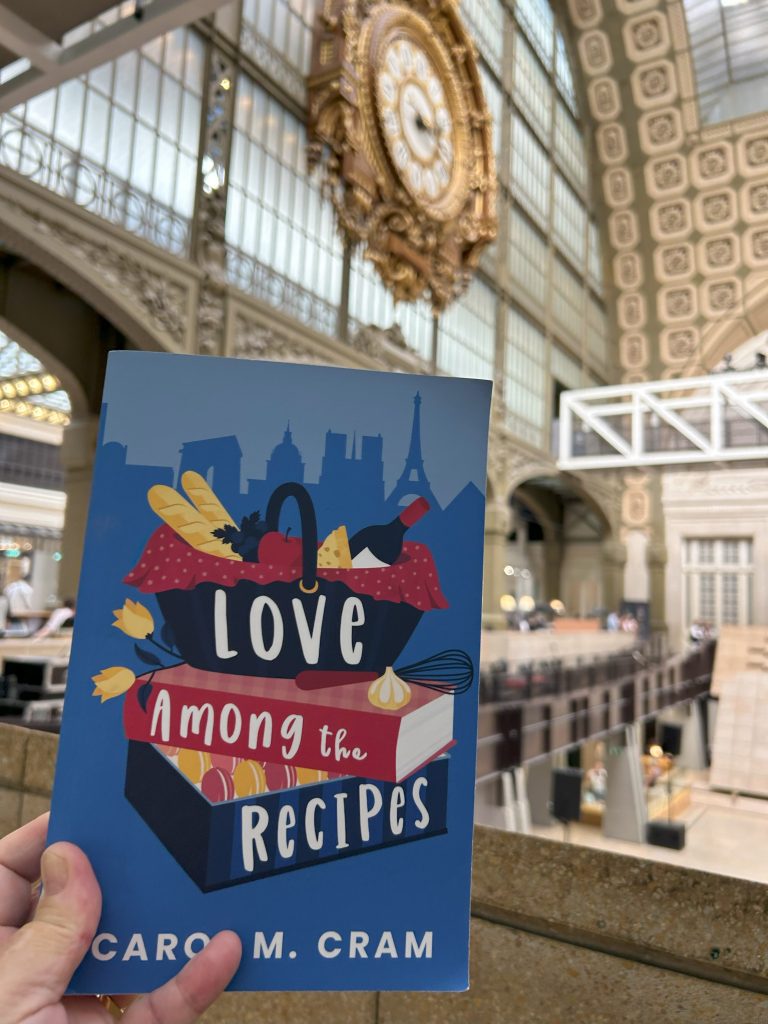
After touring the Musée d’Orsay, I couldn’t resist taking a shot of Love Among the Recipes, my fourth novel (set in Paris), in front of the great clock.
The museum plays a role in the novel, with one of its most important scenes taking place on the 5th floor in front of a painting by Mary Cassatt!
Practical Information
The Musée d’Orsay can sell out so buy your tickets online at least a day or two before you plan to travel to Paris (possibly more during the busy summer months).
Here are four options to consider for staying in Paris. All are on the Left Bank, which is my preferred location.
The Hotel de l’Université is a reasonably-priced (for Paris) hotel is on a quiet side street in the sixth arrondisement, a few blocks from the lively area around rue Bonaparte and Boulevard Saint-Germain.
In the fourteenth arrondisement, I recommend the Hôtel A La Villa des Artistes, which is stylish and in a great location close to some of Montparnasse’s most famous restaurants.
IIn the fifth arrondisement, I recommend the Hôtel Le Clos Médicis which has a great location about a block from the Luxembourg Gardens near the Boulevard Saint Michel.
If you’re looking for an apartment, this HUGE apartment on rue de Sevres on the Left Bank (#5 on the map at the beginning of this post) is pricey,but excellent value because of its size and central location. Compared to a typical hotel room in Paris, it’s almost a bargain (not that bargain is an appropriate word for any accommodations in the center of Paris).
Conclusion
If you’re an art lover, then I suggest making the Musée d’Orsay the first major art museum you visit in Paris, even more important then the Louvre.
The Musée d’Orsay’s collection is smaller and much more accessible than the vast collection in the Louvre and the crowds are considerably smaller. A visit there is well worth several hours of your time on even the shortest visit to Paris.
Have you visited the Musée D’Orsay? What are some of your favorites? Share in the comments below.
When it comes to concerts and performances, Europe is like a chocolate box brimming over with artsy flavors. Venues in every city and town showcase a wide range of musical styles, from classical to traditional to rock.
In addition to music concerts, you’ll find plenty of theater and dance performances, along with festivals and special events.
Gregg and I reminisce most often about the many wonderful performances we’ve enjoyed during our European travels. Some of our favorite memories are of performances we stumbled across, often as a result of chatting with local artists and fellow travelers, noticing posters and flyers, and checking out “What’s On” pages on local websites.
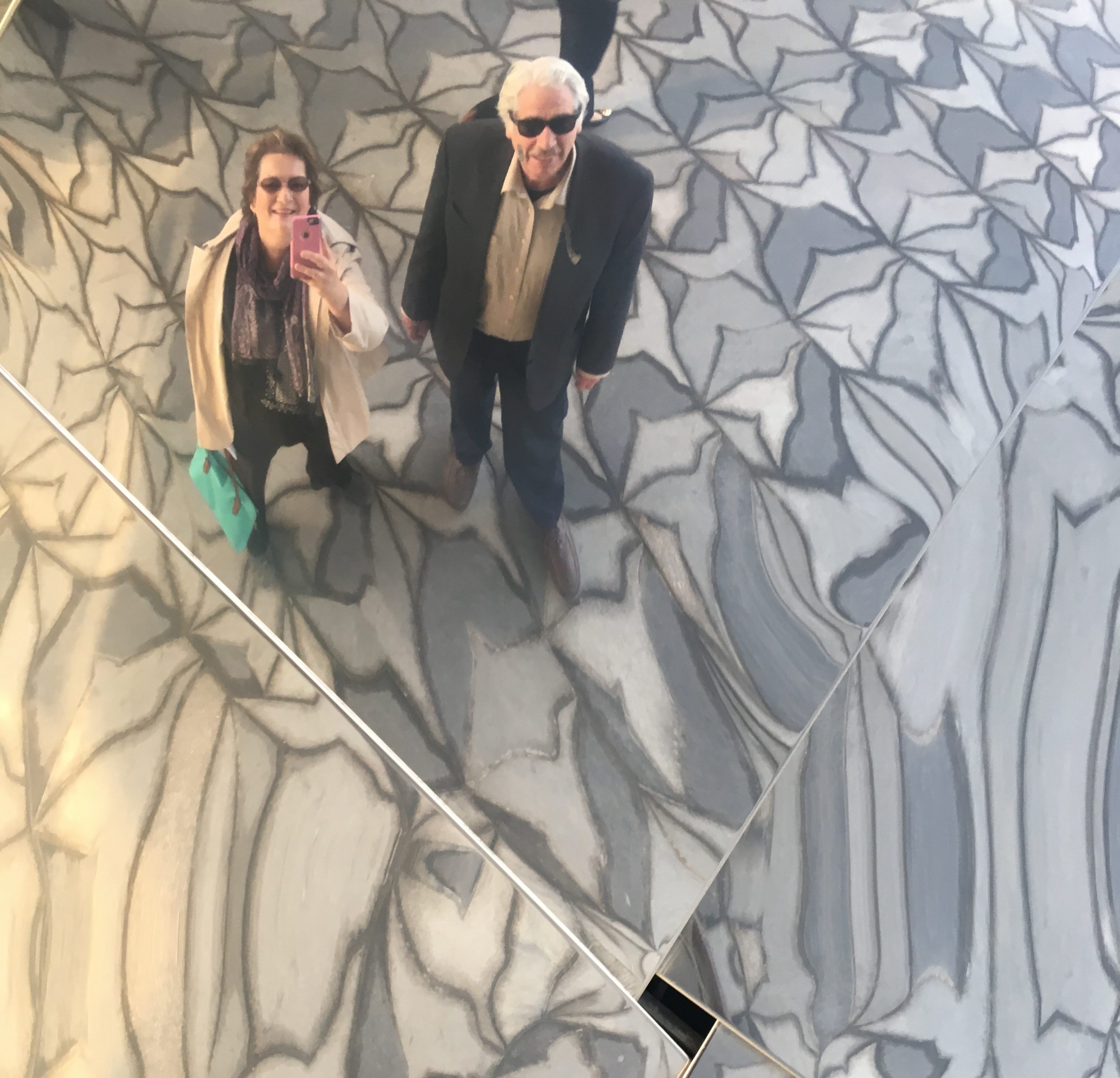
Gregg and I reflected in the ultra-modern façade of the Paris Philharmonie
Overview
While I’m always open to serendipity when it comes to choosing performances and concerts, I also believe in planning ahead. I suggest that as soon as you know the dates of your trip, go online and search for concerts, performances, festivals and other live events that will be on while you’re traveling.
A search for “musicals in London”, “classical concerts in Paris”, or “dance performances, Seville” should yield good results. You can also use generic searches such as “what’s on in Berlin” or “concerts in Vienna” and then narrow down the choices to focus on the music genres that interest you.
In this post, I share some of the memorable concerts and performances we’ve enjoyed, listed by city.
Amsterdam
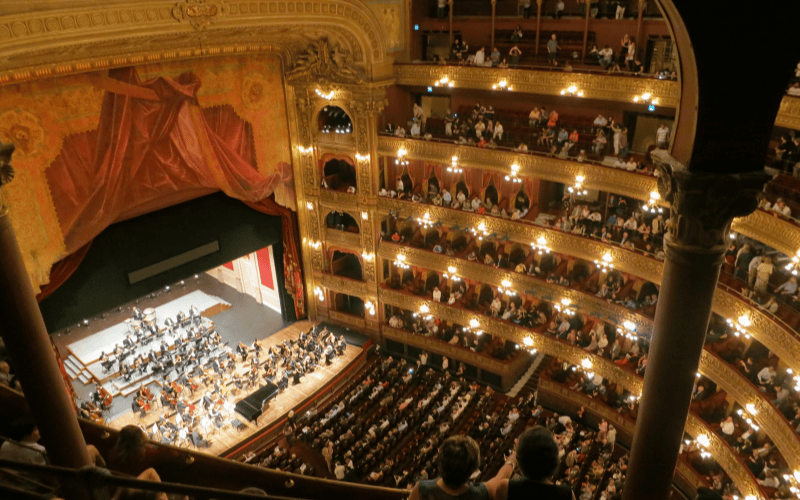
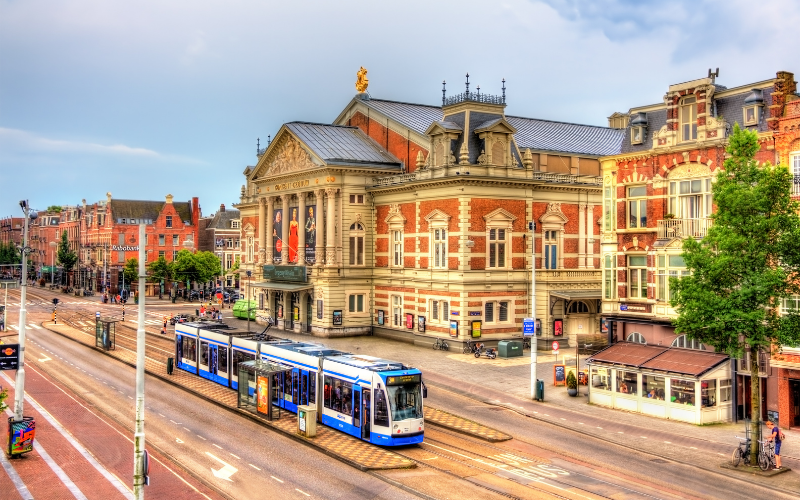
One of Europe’s most beautiful concert halls is Amsterdam’s Concertgebouw, located across from the Museumplein. Free lunchtime concerts are held on Wednesdays in the small concert hall adjacent to the main hall.
On a recent visit to Amsterdam, we enjoyed a lively performance by two vibraphonists. Check the website to find out what’s on when you’re in Amsterdam. You’ll join locals and very few other tourists for a marvelous (and free!) musical experience.
The Concertgebouw in Amsterdam
Barcelona
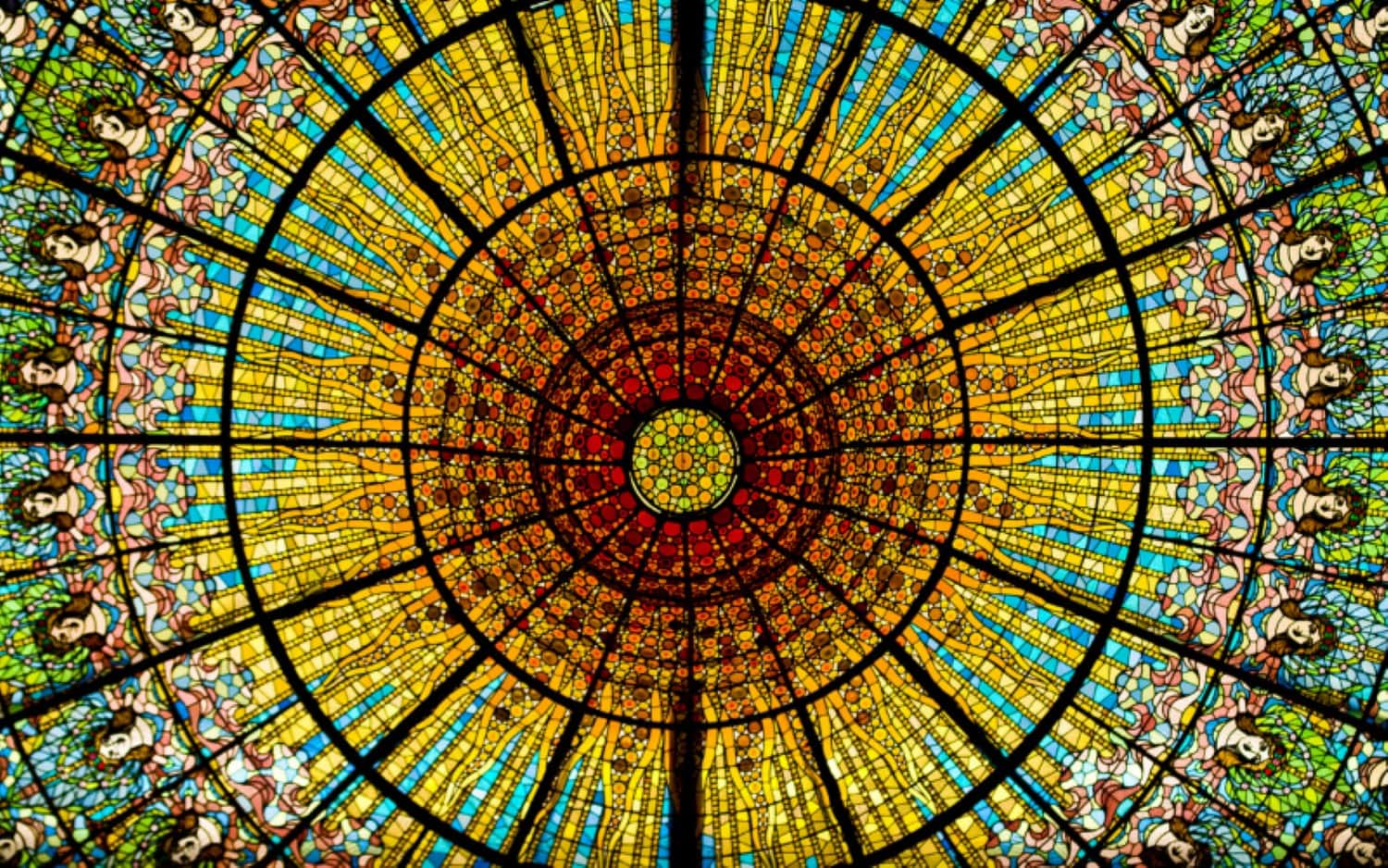
The Ópera y Flamenco performance at the astonishingly exquisite Palau de la Música Catalana is not to be missed. Even if Ópera y Flamenco is not playing when you’re visiting Barcelona, check out the Palau de la Música Catalana website to see what’s on and, if possible, get tickets. A visit to the Palau de la Música will quite simply blow your mind!
The magnificent stained glass at the Palau de la Música Catalana
Built between 1905 and 1908 by the modernist architect Lluís Domènech i Montaner, the Palau de la Música Catalana is designated as a UNESCO World Heritage Site. If you can’t get tickets to a performance, you can still take a tour of the building.
Berlin
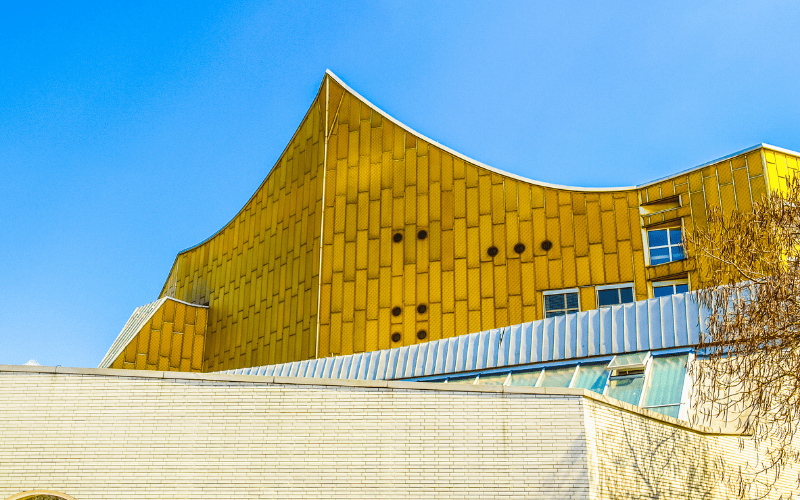
If you’re a classical music fan, check out what’s on at the impressive home of the Berlin Philharmonic (Berlin Philharmoniker). The building itself is fabulous with wonderful acoustics and worth touring even if you can’t see a concert there. We enjoyed an awe-inspiring performance of Stravinsky’s Rite of Spring performed by the Deutsches Symphonie-Orchester Berlin.
The Berlin Philharmoniker
Check out the concert calendar and buy tickets from the Berlin Philharmoniker website.
Cologne
While we usually book tickets well in advance, we’re always open to attending concerts on the spur of the moment. One such memorable concert was at the Kölner Philharmonie, a magnificent concert hall a stone’s throw from Cologne’s famous cathedral and in the same complex as the wonderful Ludwig Museum.
We had just finished visiting the Romano-Germanic-Museum (a must-see!) and were walking past the Kölner Philharmonie when we noticed a poster for the evening’s concert. The programme appealed to us and so we inquired at the box office about tickets. The very friendly, English-speaking attendant told us that tickets were available and at a price we considered incredibly reasonable, at least compared to what we were accustomed to paying in Vancouver.
Two hours later, we took our seats in one of the most dazzling modern concert halls I’d ever been in. Built in 1986, the Kölner Philharmonie is constructed like an amphitheatre and provides near-perfect acoustics. Even the size and padding of the seats have been selected to ensure constant acoustics regardless of whether the seat is occupied.
Marvelous Leipzig is a must-visit for classical music lovers, particularly if you adore (like I do!) the music of Johann Sebastian Bach. Read my post about our visit to the Bach Museum (I still swoon when I think of it!).
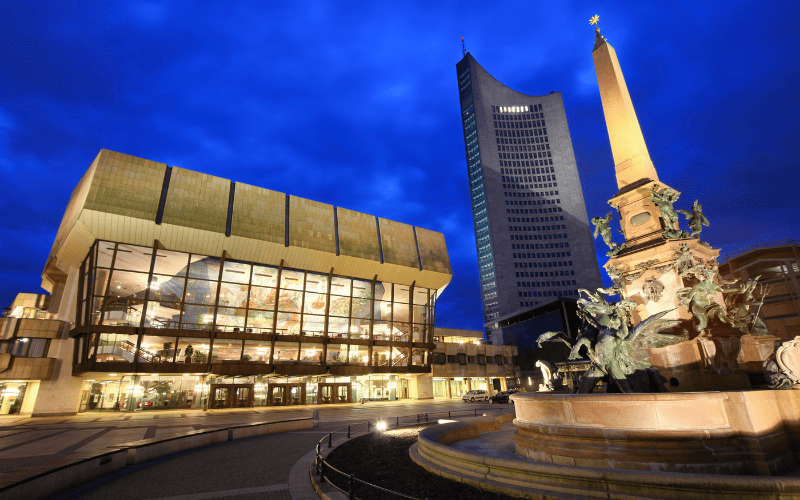
While in Leipzig, we attended a wonderful concert at the famed Gewandhaus where the young Clara Wieck (who became Clara Schumann and the inspiration for my second novel, A Woman of Note) debuted as a solo pianist in 1828. Many other famous musicians have played at Gewandhaus and for that reason I was curious to see a performance there.
Gewandhaus concert hall in Leipzig, Germany
The ultra-modern Gewandhaus concert hall is nothing like the venue Clara played in, and is, in fact, the third concert hall to bear the name Gewandhaus, the first being built in 1781, the second in 1884 (designed by famed architect Martin Gropius), and the current hall in 1981.
We snagged tickets to a solo piano concert of music by Mozart and Chopin. What a treat, and, at less than $30CDN per ticket, probably the best value for a concert I’ve ever enjoyed. At the interval, we thought the concert was over. The pianist had played for so long that we couldn’t imagine he’d be able to perform any longer. As we prepared to leave, a local woman came up to us and told us in careful English that it was only the break and that we needed to stay for the second half. Gratefully, we returned to the concert hall to enjoy another ninety minutes of jaw-dropping music performed by the very hard-working pianist.
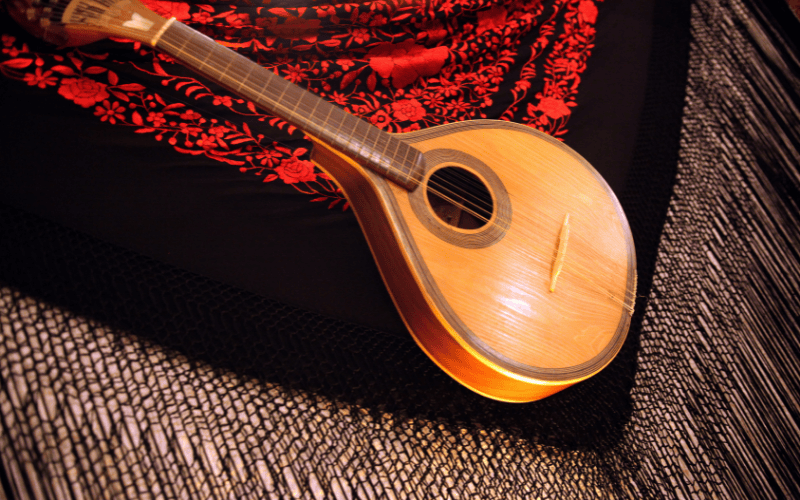
When you’re visiting Lisbon, make time for a fado performance (or two). We favor the smaller clubs with intimate performances over the more touristy offerings.
Our favorite place for fado in Lisbon is Restaurante Canto do Camões on Travessa da Espera in the Bairro Alto. It’s low-key, with a friendly owner, good food, reasonable prices, and lots of fado. When we were there, singers dropped in, performed a few songs designed to rip our hearts out, collected a few euros from the proprietor, and then left, presumably to go sing in another place. Sadly, Restaurante Canto do Camões is now closed permanently; however, you’ll find other small restaurants that feature fado in the Bairro Alto and the Alfama.
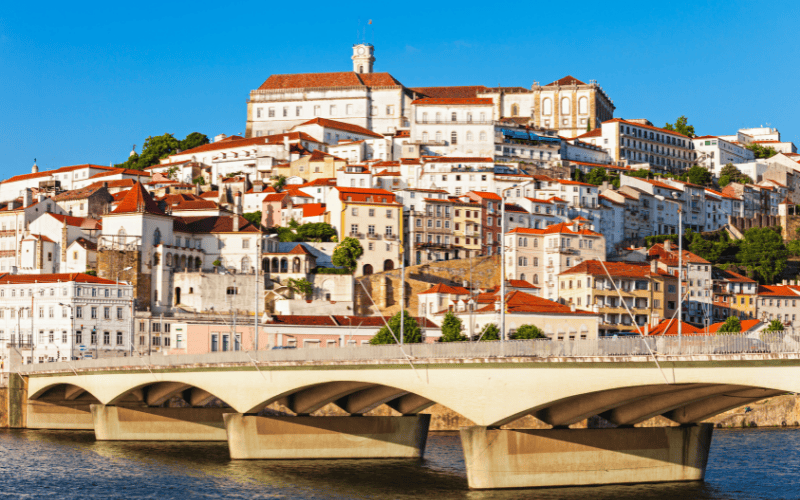
You can also see fado performances in Porto and Coimbra. In Porto, we loved the performance at the Casa da Guitarra, which also included a glass of port. In Coimbra, fado is only sung by men. We saw a troupe of men who sing wearing traditional costumes at À Capella, a 14th-century chapel that includes a bar and tapas with the live fado serenades.
Coimbra is a charming town and a great place to enjoy fado
London
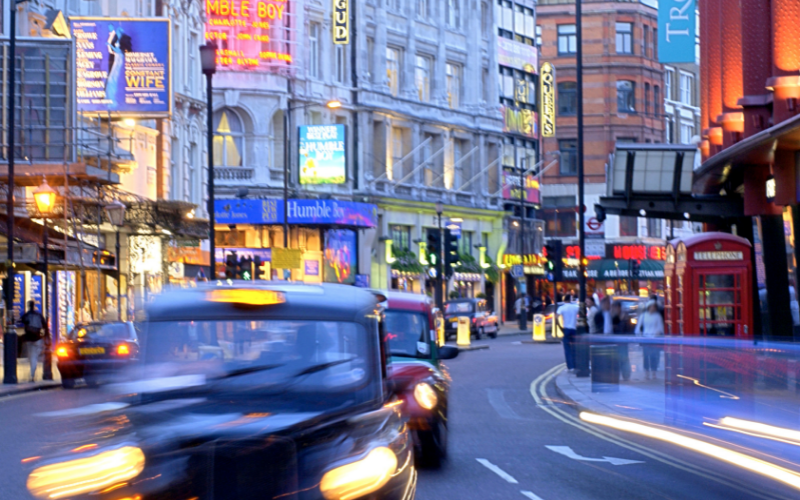
The first thing I do after booking a trip to London is check out what’s playing in the West End and what’s on at the National Theater and the Globe. I’ve enjoyed so many memorable performances in London, starting in the 1970s when I was a student at Reading University, a 40-minute train ride from the bright lights of the West End. In those days, performances in London were so reasonably priced that even a student could afford them! Even now, I find that prices for musicals in the West End are far below what I’ve paid in New York.
London’s busy West End has plenty of great theaters
Go to the London Theatre website, see what’s on and get tickets well in advance. You can also take your chances during your trip and purchase last-minute tickets, often at a reduced rate. However, I don’t recommend doing this for a performance that you really want to see.
But if you are flexible and open to seeing what’s playing, you could well get lucky. On a trip to London in 2018, I got a ticket for Mamma Mia on the day of the performance for just 40 GBP.
Before going to the theater, enjoy an early dinner at one of the many restaurants in the West End advertising pre-theatre menus.
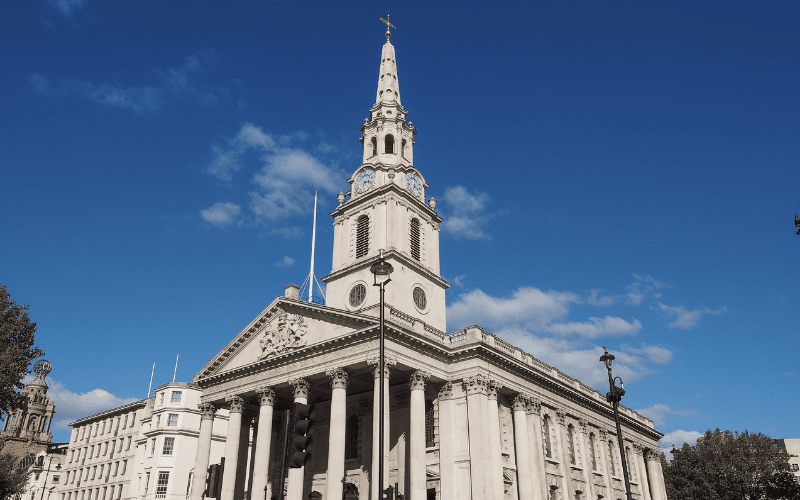
And while planning your entertainment options in London, don’t forget to check out what’s on at venues such as the Albert Hall and the Barbican Centre. Another option is the lunchtime and evening concerts at the achingly lovely St Martin-in-the-Fields near Trafalgar Square.
Saint Martins-in-the-Fields next to Trafalgar Square in London hosts classical music concerts
Paris
We love going to concerts in Paris. Spectacular venues such as the Opéra Bastille, the Paris Philharmonie and Sainte-Chapelle enhance the musical experiences, and the quality of the performances is always first-rate. Here are just a few of the venues to check out, particularly if you are a classical music lover.
Opéra Bastille
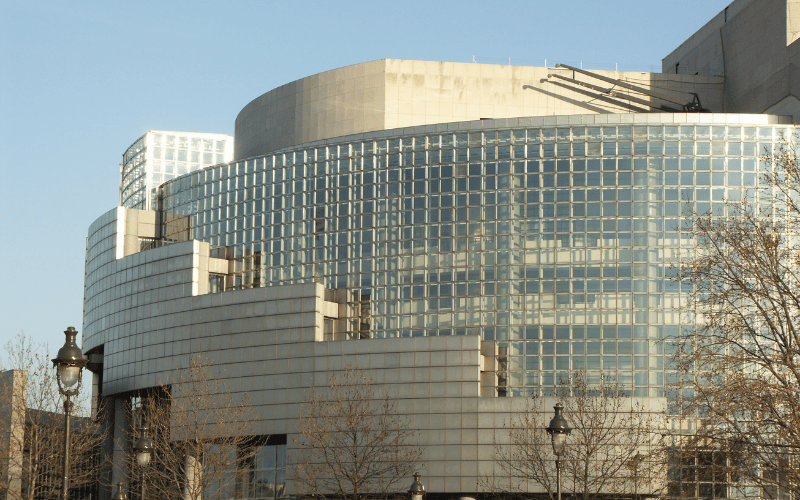
Seeing an opera in Paris is definitely a cool experience, and one that we hope to repeat as restrictions continue to lift. One of our most memorable opera experiences was seeing Götterdämmerung at the Opéra Bastille. Talk about mind-exploding!
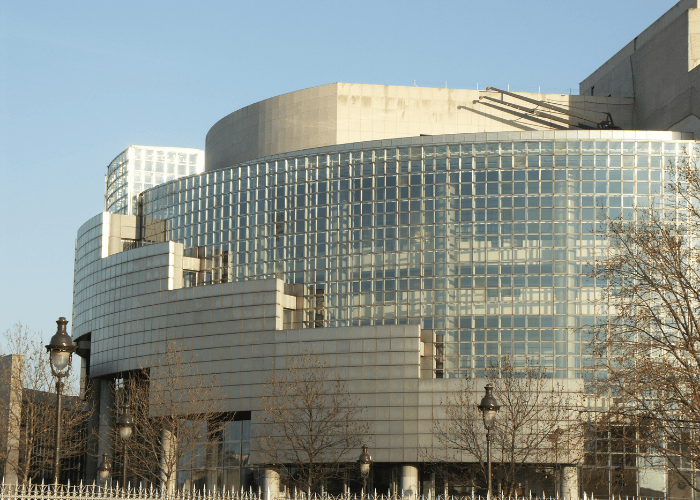
Opéra Bastille in Paris
The Opéra national de Paris presents operas at two venues—the ultra chic and modern Opéra Bastille and the sumptuously decorated and historic Opéra Garnier. Check the website for the Opéra national de Paris.
Paris Philharmonie
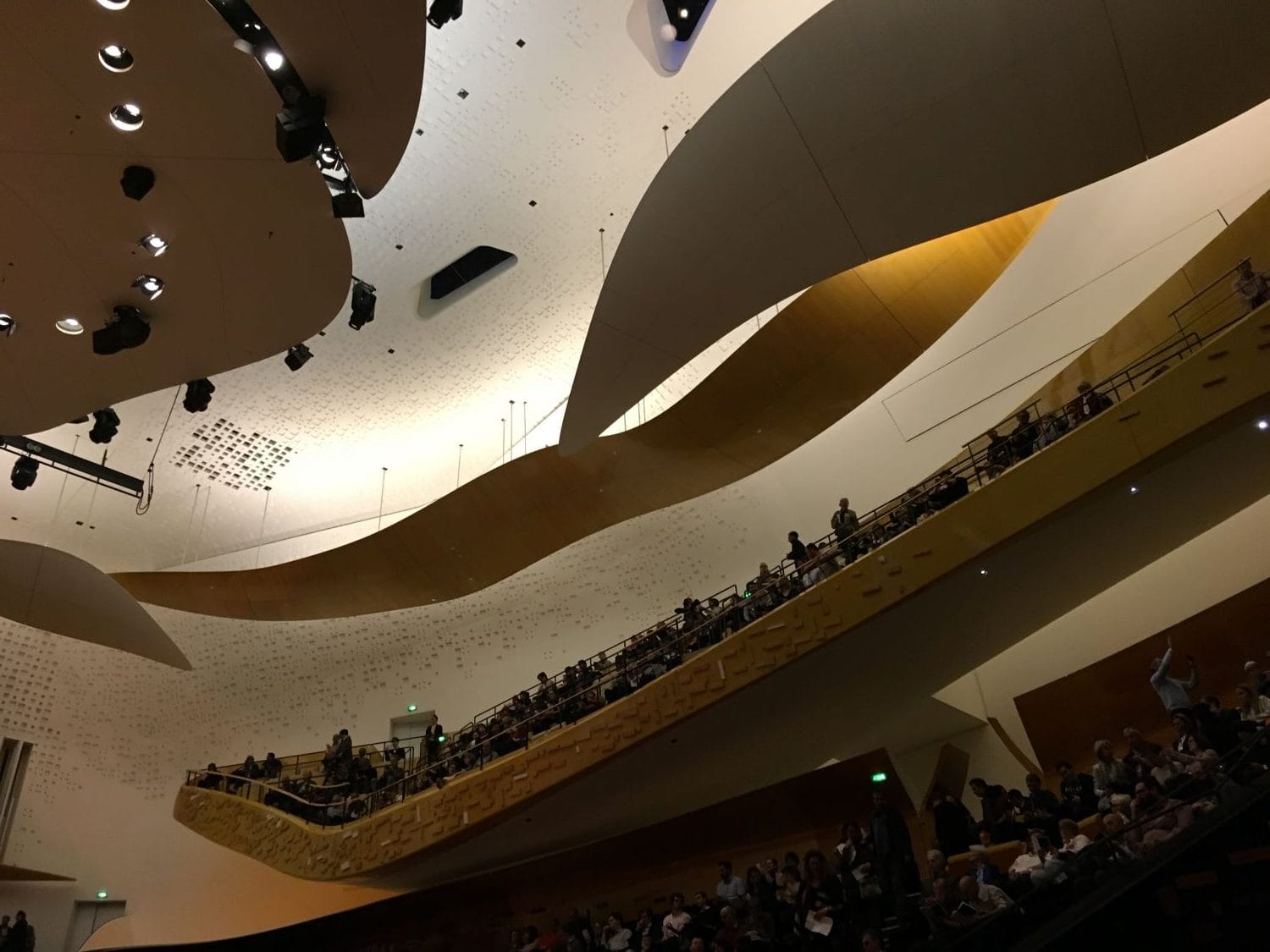
The Philharmonie de Paris is just breathtaking! Located in Parc de la Villette in the northeast of Paris, the Philharmonie is a complex of buildings that also house exhibition spaces and rehearsal rooms. We attended a performance in the symphonic concert hall—a 2,400-seat über-modern venue designed by Jean Nouvel and opened in January 2015. It was a stunning experience.
Interior of the Paris Philharmonie
Check the website for upcoming performances and events.
Piano Concerts at Église Saint-Julien-le-Pauvre
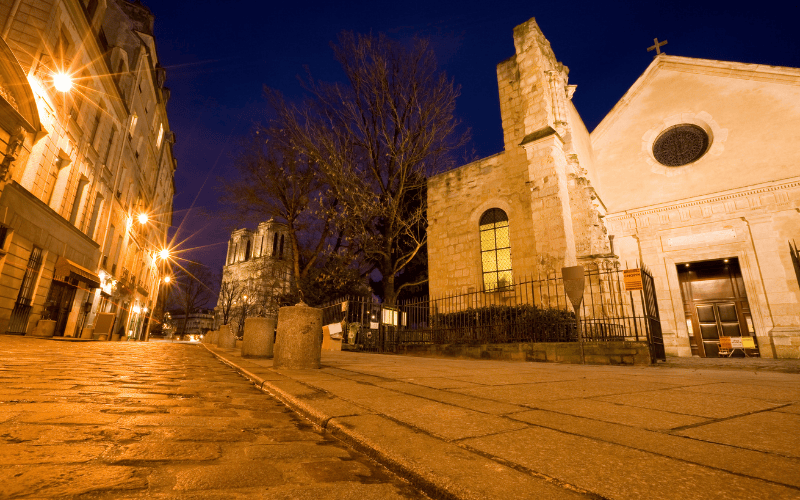
Located just across the Seine from Notre-Dame Cathedral in the 5th arrondissement, the Église Saint-Julien-le-Pauvre is one of the oldest churches in Paris. Concerts featuring either solo piano or duos (e.g., violin and piano or cello and piano) are frequently held there—and they are well worth attending. We’ve been to several. Tickets are reasonably priced, the venue is deliciously ancient and atmospheric, and the quality of the playing is first-rate.
Saint-Julien-le-Pauvre is just across the Seine from Notre-Dame Cathedral
Check the website for upcoming concerts and keep an eye out for posters in the area (that’s how we discovered what was on).
Sainte-Chapelle Concerts
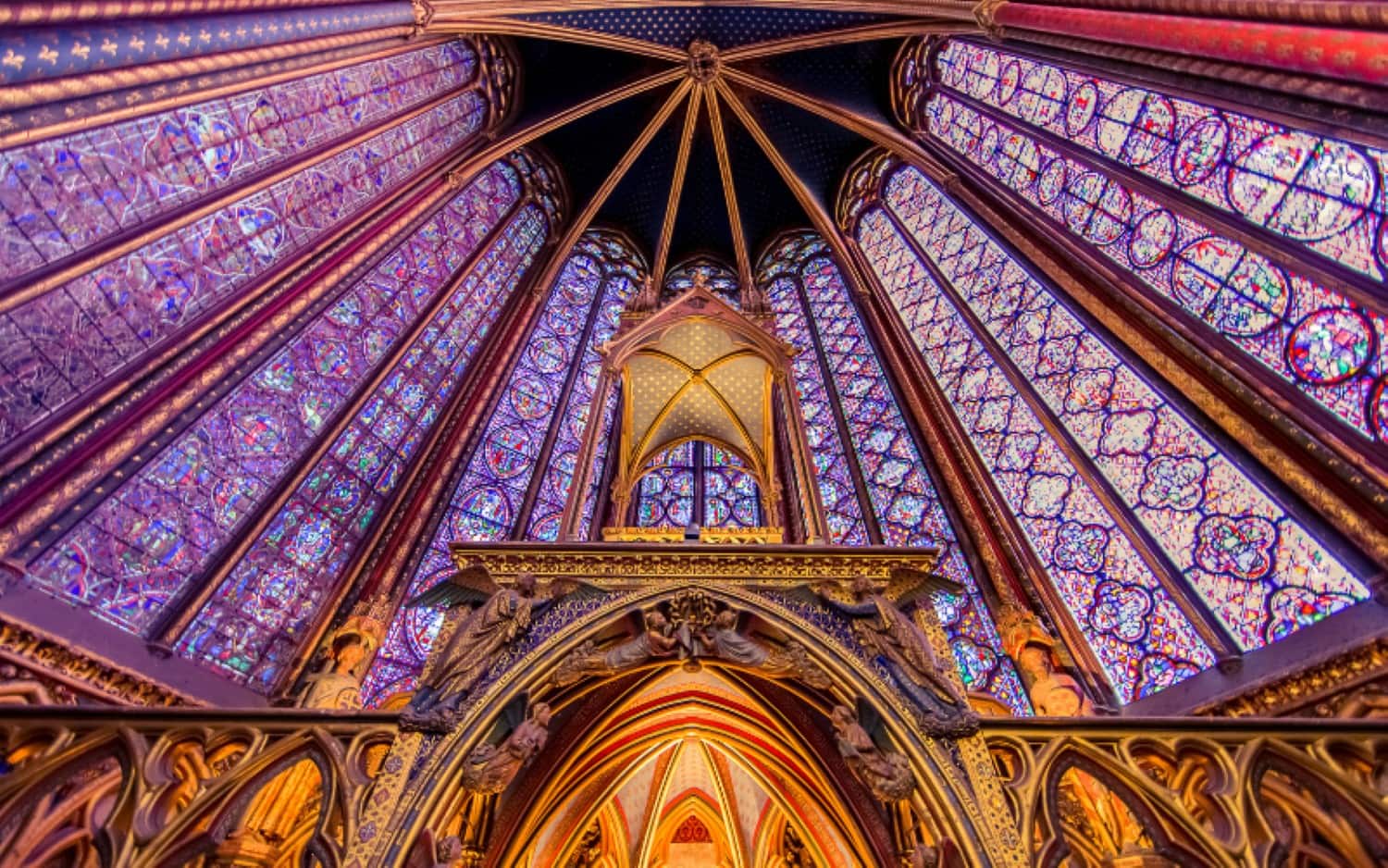
Fancy spending an hour or two staring up at sublimely beautiful stained glass supported by impossibly slender columns while listening to sublimely beautiful classical music? Then check out the website for Sainte-Chapelle’s concerts and purchase tickets for a performance. You won’t be disappointed!
Imagine listening to music surrounded by this view!
We’ve enjoyed several concerts at Sainte-Chapelle and have always been transported into ever higher planes of awesomeness. A favorite evening out is to enjoy the performance at 7 pm and then to wander starry-eyed through the cobbled streets of Île de la Cité to Île Saint-Louis and dine at one of the many small bistros in the area. Artsy traveling doesn’t get much better!
Seville
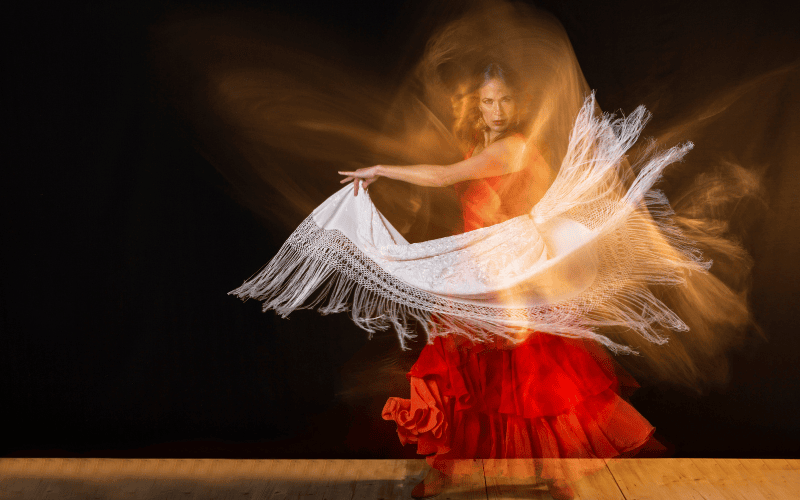
We’re firm fans of flamenco. See my post describing the flamenco performance we enjoyed on our first visit to Seville. In Seville, you can see flamenco at several venues. I recommend two.
A flamenco performance will captivate you!
Flamenco Museum
From the website, purchase the combo ticket that includes the museum and a late afternoon flamenco performance that will leave you breathless.
Los Gallos
Situated in a charming little courtyard in the heart of Seville, Los Gallos is an intimate venue with world-class talent. Sip the Sangria included in the ticket price and prepare to be blasted into the stratosphere.
Stratford-upon-Avon
Every time I visit England, I do my best to squeeze in a trip to Stratford-upon-Avon to see a performance by the Royal Shakespeare Company. I have been fortunate to see many wondrous performances there, including productions of Romeo and Juliet and Hamlet that both starred the incomparable David Tennant.
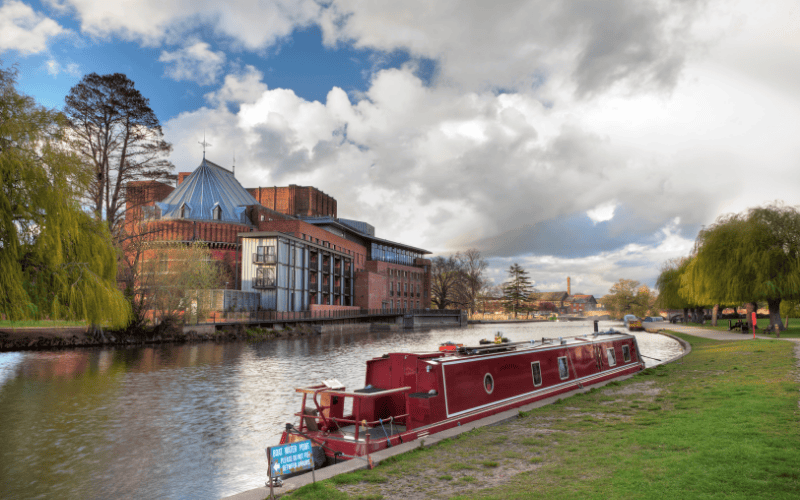
Main theatre at Stratford-upon-Avon
When I was a student at Reading University, a two-hour drive southeast of Stratford-upon-Avon, I frequently made the trek to see a performance. I was studying for a degree in English Literature so taking in as many Shakespeare productions as possible was almost mandatory.
You can see Shakespeare productions at the Globe in London and the experience is highly recommended. However, I must admit that I prefer the productions at Stratford-upon-Avon. The seating is more comfortable, and the quality is top-notch. I liken seeing a production by the Royal Shakespeare Company as the auditory equivalent of looking at high-quality cut crystal. Every word and gesture is crisp and perfect.
When you go up to Stratford-upon-Avon to slake your Shakespeare yen, you also get the bonus of having time to wander the charming streets of Stratford. Sure, it’s a bit touristy, but so what? I love touring Shakespeare’s birthplace, paying my respects at his grave in the church, and watching the swans glide by on the River Avon.
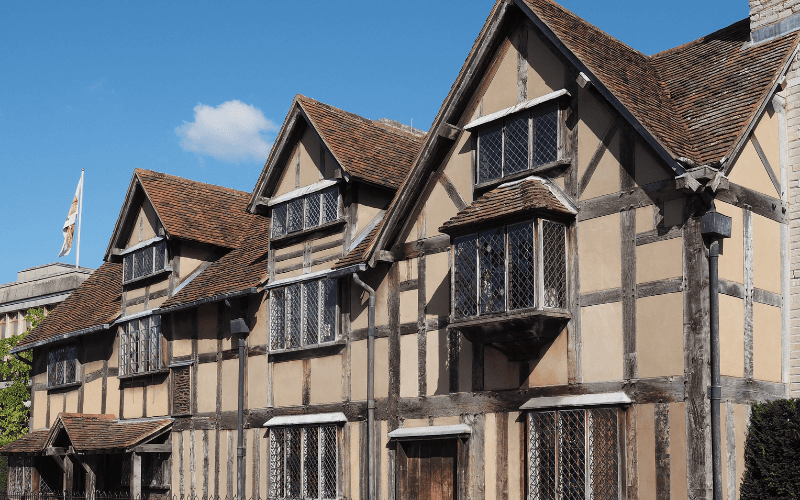
Shakespeare’s birthplace in Stratford-upon-Avon
In August 2022, I’ll be visiting Stratford-upon-Avon again, this time to catch a performance of Richard III. Although admittedly not my favorite of Shakespeare’s History plays, I know I’ll see a production to remember.
Visit the RSC’s website for details about upcoming productions in Stratford-upon-Avon and London.
Venice
On one visit to Venice, we were strolling through the quiet streets after dark when we noticed a young man dressed in 18th-century garb and carrying a violin case hurry past. We caught up to him and asked if he was a musician. He told us he was on his way to play a concert of 17th- and 18th-century music in a church. Did we like music like that?
Is Vivaldi Venetian?
Yes!
We followed him to the church and half an hour later were sitting beneath a mural painted by Titian and listening to a selection of Venetian classical music favorites. Bliss! The orchestra was clad in 18th-century garb and the performance was obviously aimed at tourists, but that didn’t affect the quality of the musicianship or the depth of our enjoyment.
Hearing Baroque music in Venice just makes sense!
After the concert, we floated out into a warm evening to find ourselves moments later at the edge of the Grand Canal. A barge filled with another group of musicians in period dress slid past, the music wafting through the balmy air like the rustling of silk stockings.
Magical!
In Venice, several venues feature classical music concerts. Check out the Music in Venice website for programs and dates.
Verona
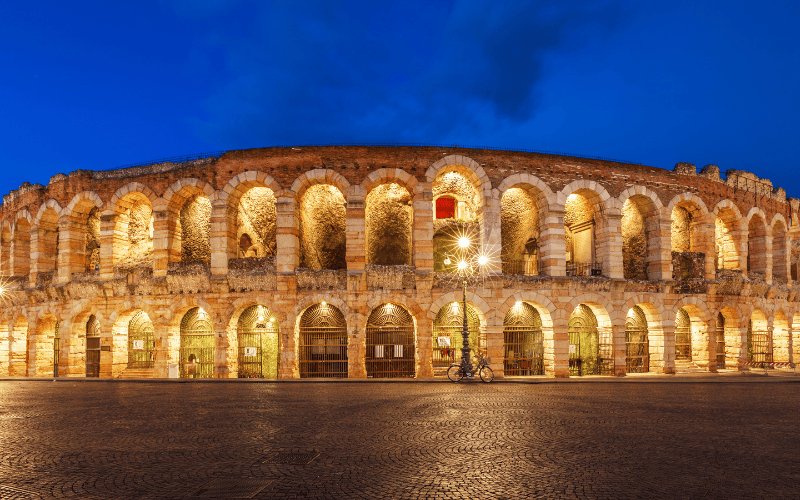
The Arena di Verona, the Roman amphitheatre in Verona, Italy, periodically presents operas to hundreds of fans who are mostly perched on the edge of very hard, very ancient Roman stone steps. We know because several years ago, we were such fans. To read about an evening that has become synonymous with disaster in our family, check out Meltdown in Verona.
Our experience aside, attending a performance at the Roman arena in Verona could be the magical experience we’d expected. The detailed RM Europa Tickets website contains information about all the opera festivals in Europe in 2022. You’ll find opera festivals in almost all European countries, along with a detailed list of venues and schedules, including the Arena di Verona.
Arena di Verona
Vienna
You can’t walk two feet in Vienna’s Stephansplatz without tripping over a bewigged young person trying to sell you tickets to a performance of Strauss, Mozart, or both. Vienna has several venues featuring tourist-oriented shows designed to showcase the oldie goldies of several of its most famous composers, particularly Johann Strauss.
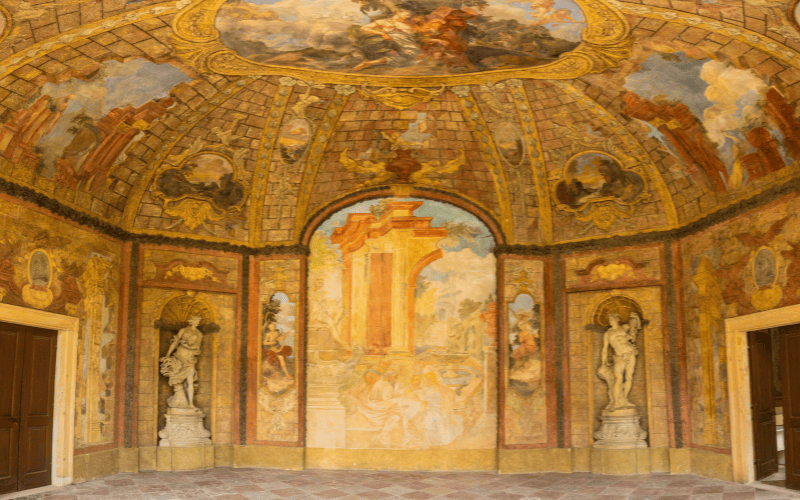
The last time I visited Vienna, traveling solo, I attended a delightful string quartet concert at the gorgeous Sala Terrena, an intimate and heavily decorated venue in the center of the city. Mozart allegedly lived in the building in which the Sala Terrena is housed when he first came to Vienna as a young man. While you wait for the concert to begin, feast your eyes on the riotous Baroque frescoes and look out especially for the leopard! For more about my experience at the Sala Terrena concert, check out my post on Music in Vienna.
Some of the frescoes at the Sala Terrena in Vienna
On the same trip to Vienna, I took the tram and then a bus out to Schloss Laudon (Water Palace) in the bucolic countryside surrounding Vienna to attend a concert that was part of the five-day Schloss Laudon festival. I discovered the festival while planning my trip to Vienna and was very glad I managed to snag a ticket for a performance that featured an early Beethoven piano trio in the style of Haydn and a marvelous rendition of Tchaikovsky’s piano trio.
Hamburg
In Hamburg, get tickets to see a performance at the ultra-modern Elbphilharmonie, one of the world’s most stunning concert halls.
Conclusion
Before you travel, check websites for venues and performance times and budget as much money as you can spare for live entertainment. You’ll be making memories that last a lifetime.
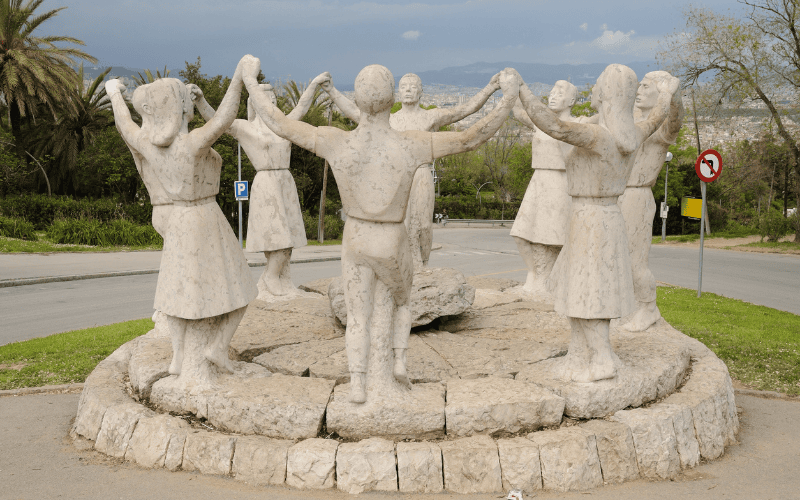
And keep a lookout for local folk performances that are often free, with some even encouraging participation. You’ll typically find these advertised in flyers and on posters. Watch a flag-waving demonstration by young people dressed in medieval garb in Siena, dance the Sardana in front of Barcelona Cathedral along with hundreds of locals and tourists, watch a concert featuring ancient instruments in a tiny chapel in Les Baux de Provence, and more!
Keep your eyes and ears open; you never know what’s around the next corner.
Statue commemorating the Sardana in Barcelona
Have you attended concerts while traveling in Europe? Share your experiences and recommendations in the Comments below. Here are some more posts that feature information about concert-going in Europe:
Each region in France has much to offer, and over the years, I’ve traveled in just about all of them.
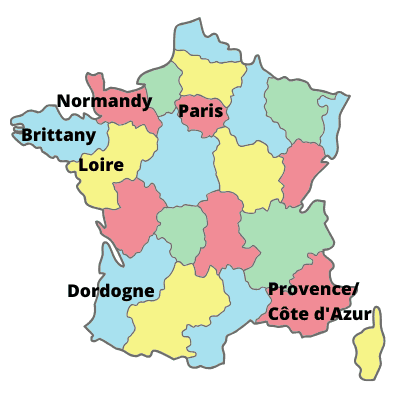
But if I had to narrow down my choices to just six different regions that I recommend to artsy-inclined travelers, I’d choose Normandy, Brittany, the Loire, the Dordogne, Provence/Côte d’Azur, and of course, Paris.
This post presents an overview of my six favorite regions to visit in France with links to more detailed posts.
If you want to fully explore these regions, consider renting a car. My post on Driving in Europe gives you some pointers gleaned from our three decades of experience exploring Europe by car.
Recommended regions to explore in France
Normandy
Rolling fields, picture-perfect villages, and searing World War II history make Normandy in northern France an awesome destination.
I lived for two months at an artist-in-residence place in the Perche region of Normandy a few years ago. When my husband, artist Gregg Simpson, and I weren’t being artists/writers in residence, we spent several happy days exploring this under-touristed area.
Favorite Places in Normandy
The Perche Region
This far-off-the-beaten-track area has no big sites, but the countryside is lovely. Take a detour through it while driving up to the coast.
World War II Beaches
As a Canadian, I was moved by the museum at Juno Beach where Canadian troops landed on D-Day. You should also visit the Caen Memorial Museum, which is considered the best World War II museum in France. I found it fascinating.
Honfleur and the Satie Museum
Honfleur is a mecca for artists with lots of galleries and beautiful architecture. Linger at a cafe in the harbor and then don’t miss the quirky Satie Museum–an artsy-traveler must-see.
Bayeux and the Bayeux tapestry
The clever way in which the tapestry is exhibited is almost as captivating as the tapestry itself. And the town of Bayeux is just delightful. Plan to spend at least half a day exploring.
Mont St. Michel
It’s crowded and touristy, but go in the late afternoon to enjoy the sunset after the crowds leave.
Étretat
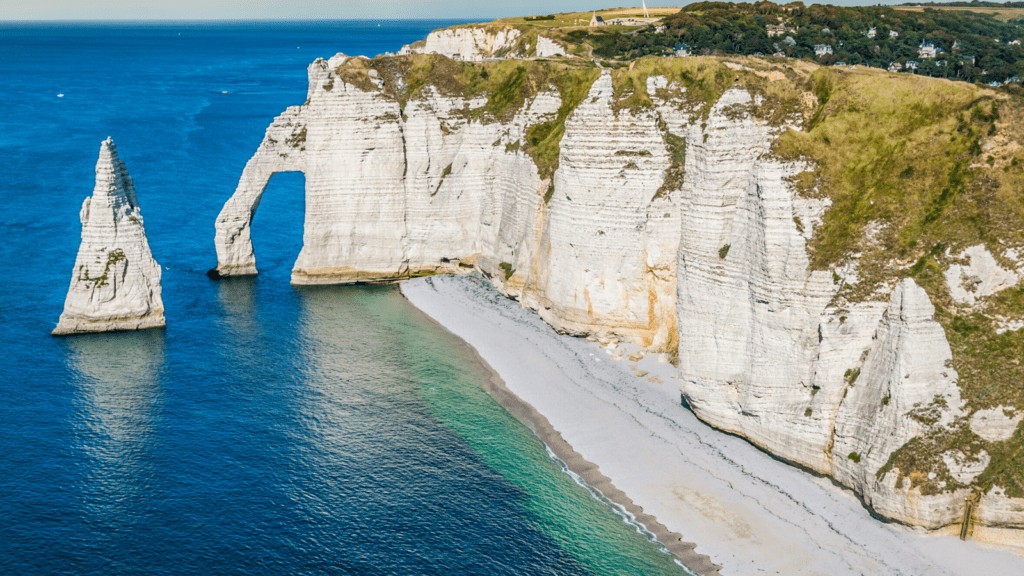
These stunning white chalk cliffs were a favorite of Monet and other Impressionist painters. Wander along the cliff tops of this incredible coastline and marvel at the fascinating shapes sculpted by the wind.
The stunning area of Étretat was a favorite of Monet’s
I adore Brittany. Every time I visit the area, I say We really ought to spend more time in Brittany.
I recommend visiting Brittany in the summer when the weather is pleasantly warm rather than torrid like it is farther south. Beautiful sandy beaches vie for your attention with craggy coves and spectacular rock formations.
Favorite Places in Brittany
Rennes
This charming town with its half-timbered houses is a real delight. Stay the night and enjoy wandering around its virtually empty and picturesque streets.
Pont-Aven
This charming village is a pilgrimmage destination for art lovers. In the 1880s, it was a mecca for such notable artists as Gauguin and Serusier. Walk in their footsteps in the Bois d’Amour (the Wood of Love) and see why they loved the area so much. I recently spent a week there; check out my post: Savoring Life in Pont-Aven: City of Artists.
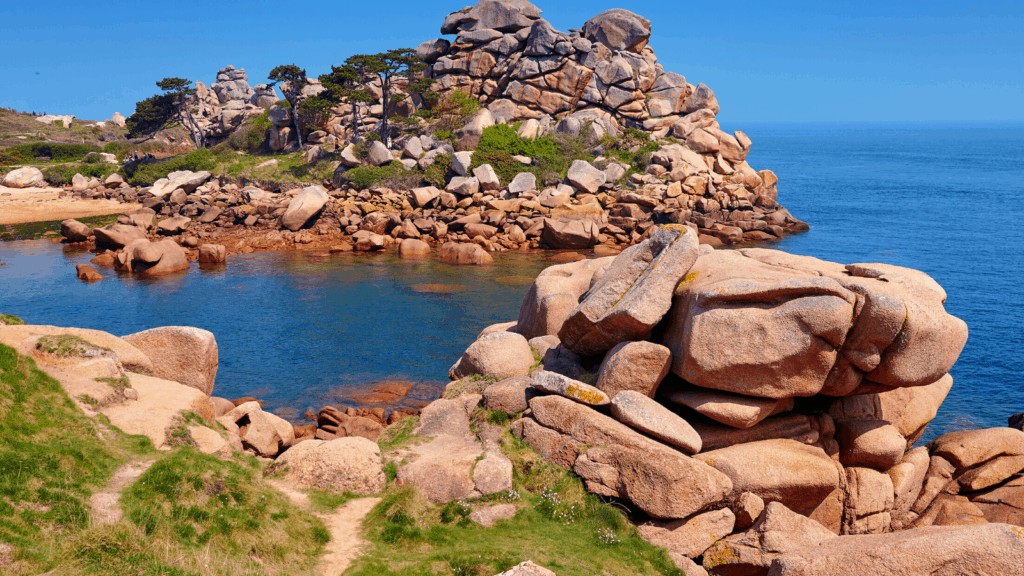
Cote de Granit-Rose
This rugged coastline in northern Brittanny is a photographer’s dreamscape. Stay a few days to enjoy the seaside and the fabulously shaped rocks.
Carnac and other prehistory sites
Brittany is home to France’s most concentrated collection of Celtic and prehistoric sites. Standing stones abound in this history-steeped region. Check out my post on Prehistory Sites in Europe that includes several places in Brittany.
Saint-Malo
This walled town recently made famous by All The Light We Cannot Seemakes a great home base for exploring the northern coast.
Côte de granit rose in northern Brittany
Consider at least a week’s stay in Brittany, or better still, three or four days on the north coast around Trégastel and three or four days on the south coast near Carnac.
The Loire Valley
Châteaux are exceedingly thick on the ground in the Loire Valley thanks to the Loire Atlantique region being the playground for the kings of France until kings rather suddenly went out of fashion.
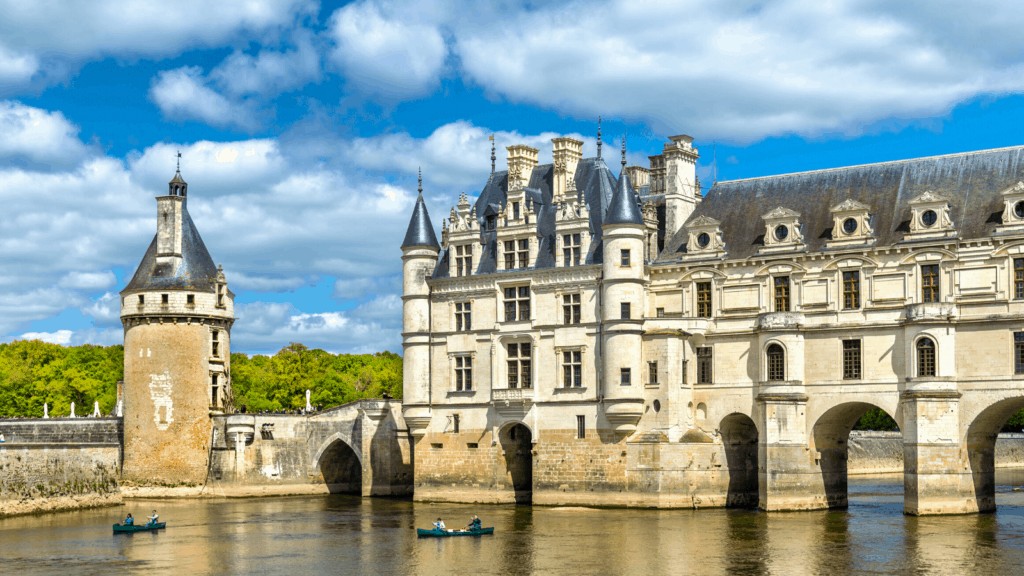
Château of Chenonceau in the Loire Valley
Favorite Places in the Loire Valley
Spend a week here to tour not only the big (and crowded) blockbuster châteaux like Chambord and Chenonceau, but also the more intimate, even quirky ones like Villandry and Azay-Le-Rideau.
Rochemenier Cave Village (Rochemenier Village Troglodytique)
Visit the cave dwelling village museum to discover the underground houses inhabited for centuries. This place is amazing!
Château de Chenonceau
It’s hard to choose the most beautiful chateau in the Loire Valley, but Chenonceau with its graceful arches spanning the River Cher is definitely a contender.
Château de Chambord
This is the largest chateau in the Loire and also the most crowded. It’s definitely impressive, but go early or late in the day.
Château Azay-le-Rideau
This is one of my favorite chateaux in the Loire Valley. It’s incredibly photogenic!
Chinon
Registered as a UNESCO World Heritage Site, Chinon makes a great home base for exploring the eastern Loire Valley, and it also famous for its wine, castle, and historic town.
Chartres Cathedral
The cathedral has incredible stained glass windows. Visit on a day trip from Paris or en route to the chateaux in the Loire Valley.
In addition to châteaux-hopping, consider an extended stay in the Loire Valley because, let’s face it, the region is drop-dead gorgeous. Rent a bike or go on a walking tour to immerse yourself in the fairy tale landscape. Also, the food in the Loire is exceptional (and that’s saying something!).
If your time is limited, consider a day trip from Paris to tour at least a few of the châteaux.
The Dordogne Valley
The Dordogne is an excellent choice for two reasons: prehistoric caves and amazing food. Spend at least a week exploring the beautiful towns and villages of this interesting region of France.
Favorite Places in the Dordogne Region
Les Eyzies
This charming little town is home to the National Museum of Prehistory, a must-see if you’re interested in the prehistoric history of the Dordogne.
The charming village of Montignac near Lascaux makes an excellent home base for exploring the area.
Sarlat-la-Canéda
This medieval town hosts an indoor food market, and a glass elevator in the bell tower offers city views. Wander around its ancient streets in the early morning to catch the sunshine bouncing off the yellow sandstone buildings.
Bergerac
Famous for its vineyards and old town center, Bergerac is close to fortified medieval towns called bastides, with Monpazier and Eymet. being particularly noteworthy examples.
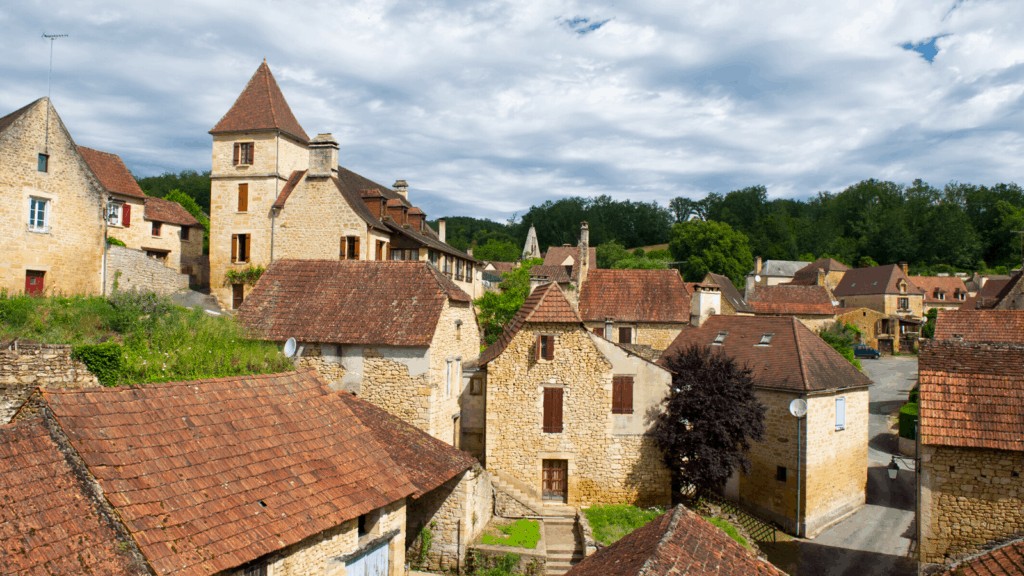
If you have a hankering for gorgeous scenery mixed with compelling prehistory sightseeing followed by long, slow dinners where duck often plays a role, then meander down to the Dordogne.
Gorgeous villages are waiting to be explored in the Dordogne
Provence
I dare you to say Provence without sighing!
Ah, Provence! See?
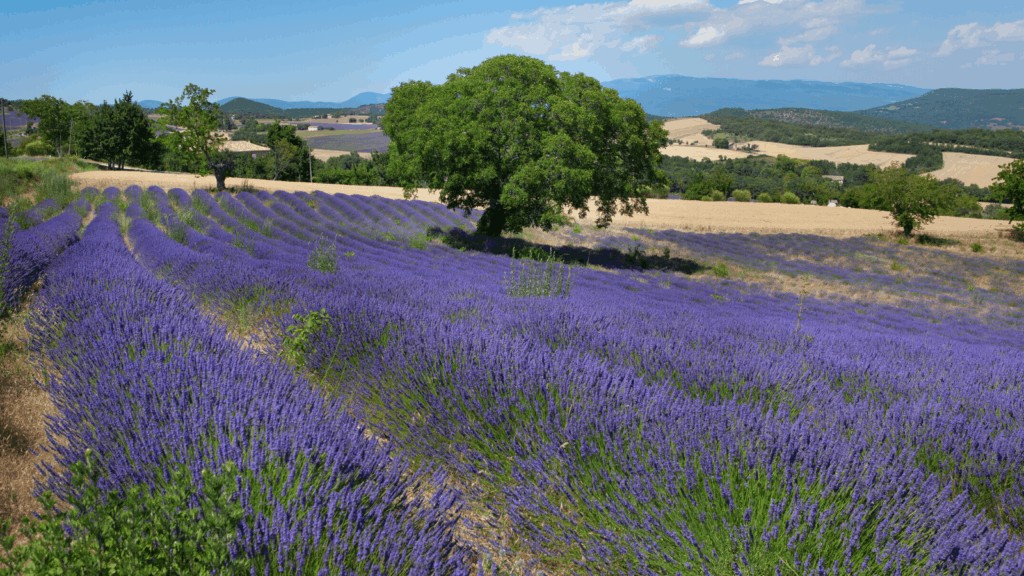
Enjoy lavender fields like this in the Luberon region of Provence
Like Tuscany, Provence has earned its reputation as one of Europe’s most beautiful regions. Settle in for a good long visit to discover why so many artists made their homes here (Picasso, van Gogh, Renoir, Cezanne, Lèger, Matisse, and I’m sure I’m forgetting a bunch).
I think it has a lot to do with the light. Every time Gregg and I visit Provence, Gregg is inspired by the unique way in which light floods a landscape of sharp contrasts—soft greens and lavenders, hard whites and ochers, startling blues.
Favorite Places in Provence
Luberon
This is still one of my favorite regions of Provence. Don’t miss Roussillon with its ocher cliffs, along with the hill towns Bonnieux and Gordes. In recent years, the Luberon has become rather “chichi”, as in scores of well-heeled people driving nice cars and living in lavender-coated villas, but the food is still wonderful, the weather warm, and the landscape stunning.
Avignon
The Pope’s Palace in Avignon is a lot of fun to explore. The last time I was there, a Picasso exhibition was on. Before you go, check to see if any special art exhibitions are featured.
Van Gogh lived here for only a few months but that was enough to put Arles on the map for art lovers. It’s a delightful town, worth a few days of your time to just kick back, relax, and enjoy the ambiance.
Aix-en-Provence
Home of Cezanne, Aix-en-Provence is a great place to kick back and spend a week. Don’t miss the wonderful Hotel de Caumont Art Center which almost always has excellent art exhibitions, drive out to Chateau La Coste and wander around the vineyards and forest paths to look at striking modern sculpture, and drop into the Fondation Vasarely to see Vasarely’s geometric masterpieces.
Gorges du Verdon
Provence is a region of mountains with many tiny, twisty roads leading up into the Alpes Maritimes and into the French Alps. Take some time to explore the rugged Gorges du Verdon.
The French Riviera
Spend at least some of your time with the beautiful people. Cannes is a good choice for a home base.
Another central option is Nice, or my favorite, Menton, which is very close to the Italian border.
And while you’re in the area, visit some of the many single-artist museums such as the Fondation Leger in Biot and the Matisse Museum in Nice.
Provence is big enough to deserve a two-week stay, or at least a week divided in two. I suggest enjoying the stunning countryside in the Luberon region for a week and then driving down to the French Riviera to hang with the beautiful people (and see a ton of art) while basking in the Mediterranean sun.
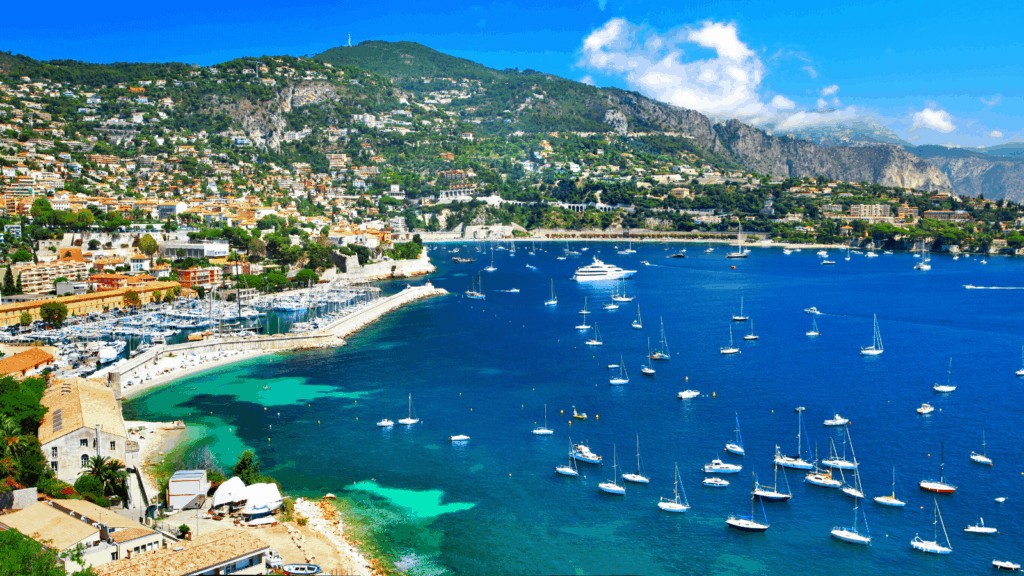
Spend some time on the fabled Riviera in the south of France
Paris and the Île de France
If you’re planning your first visit to France, Paris will likely be on your itinerary. It’s a must-see city in Europe if you are in any way artsy inclined.
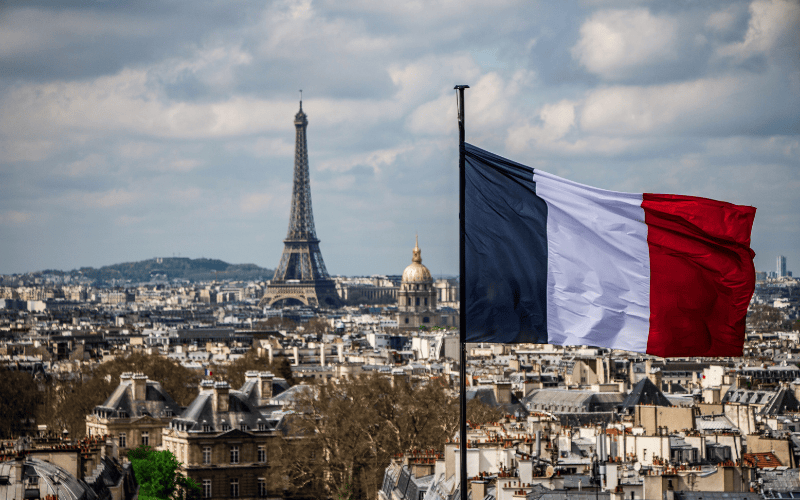
Paris is home to dozens of art museums and galleries in addition to the big-ticket sights like the Eiffel Tower (go early or late to avoid the crowds), the Arc de Triomphe, and the Champs-Élysées.
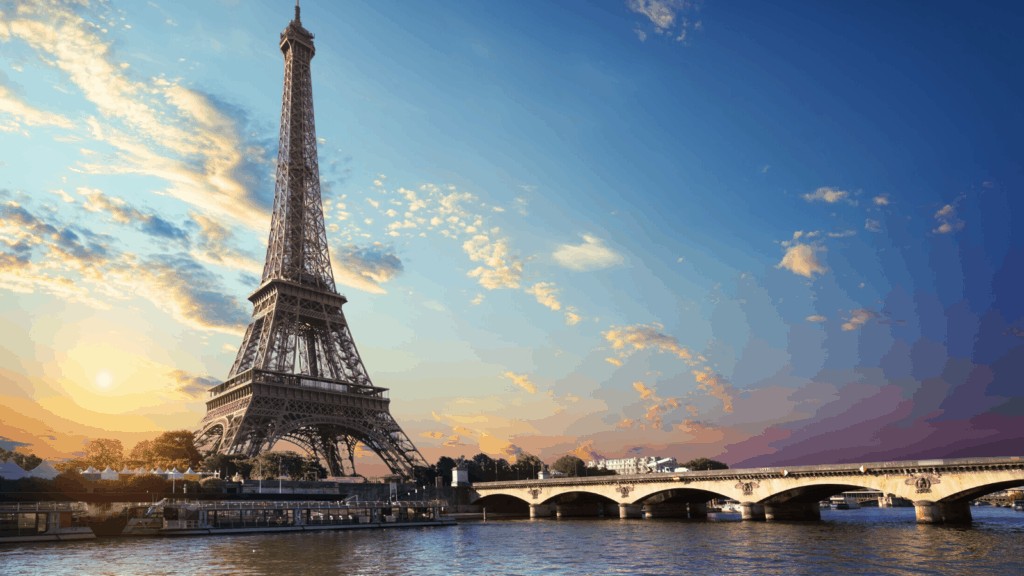
Le Tour Eiffel–see it early or late to avoid crowds
To truly appreciate Paris, rent an apartment and settle in for the long haul. For the entire month of March one year, Gregg and I stayed in an apartment in Montparnasse. He spent his mornings painting and I spent my mornings writing, and then we set out almost every afternoon to explore the artsy delights of Paris.
Favorite Places in Paris and the Île de France
Musée d’Orsay
With its world renowned collection of paintings from the late 19th century, the Musée d’Orsay is a who’s who of famous painters: Van Gogh, Monet, Manet, Morisot, Renoir, Gauguin… You name it!
This museum is always on my must-see list every time I visit Paris.
L’Orangerie
Here’s where you’ll see Monet’s waterlily paintings. The experience of walking through the two rooms surrounded by his tranquil and very large paintings is sublime.
Luxembourg Gardens
This is Paris’s playground that many visitors never see. Go there to relax and people watch.
Musée Cluny
I adore medieval art and the collection at the Cluny AKA the Musée national du Moyen Âge is one of the world’s best. Don’t miss the Lady and the Unicorn Tapestries.
Pompidou
For early to mid-20th century modern art, there’s few better places then the Centre Pompidou. Check out iconic works by Miro, Dali, Ernst, Pollock, and a lot more. It’s a treasure trove!
Île de France
There’s lots to see in a day trip from Paris including Versailles (the gardens go on forever and the Hall of Mirrors is jaw-dropping), Monet’s gardens at Giverney, and the chateau and forest of Fontainebleau where artists of the Barbizon school back in the 19th century did a lot of plein air painting.
I’ve never ran out of things to see in Paris. In fact, a stopover in Paris has been on my itinerary for almost all of our dozen-plus trips to Europe.
Here are some suggestions for things to see, skip-the-line tickets, and tours in Paris.
Other Regions in France
I’ve limited myself to just six of the best regions to visit in France (in my opinion!), but if you have the time, there’s a lot more to explore. Every region in France has a great deal to offer.
In Eastern France, tour the Alsace region, pop into lovely Strasbourg, take a canal trip in Burgundy (check out the wine route!), and visit Dijon with its half-timbered buildings and great food.
While touring Southeast France, check out the Alps, with Mont Blanc a highlight.
In Western France, don’t miss Bordeaux, Bayonne (the Basque Museum is marvelous), Biarritz, and Toulouse, then venture down to the Pyrenees.
Also check out the walled city of Carcassone (go early or late to avoid crowds) and Albi, famous for the Toulouse-Lautrec Museum.
And on your way to Provence, explore the Auvergne in central France and then stop by charming Lyon where you’ll find lots to see and a wonderful culinary tradition.
Conclusion
What is your favorite region in France? Share your suggestions for other artsy travelers in the comments below.
I love Paris so much that I set my fourth novel there. Love Among the Recipesis about a cookbook author who reinvents herself by moving to Paris. The novel is also my love letter to Paris–one of my favorite cities in the world.
In Love Among the Recipes, cookbook author Genna McGraw writes a cookbook/guidebook that matches Parisian sights such as the Eiffel Tower with recipes for bistro-style French dishes such as steak haché.
The next time you visit Paris, use this post to visit the places featured in Love Among the Recipes. Included are descriptions of the sights along with links to some of their matched recipes.
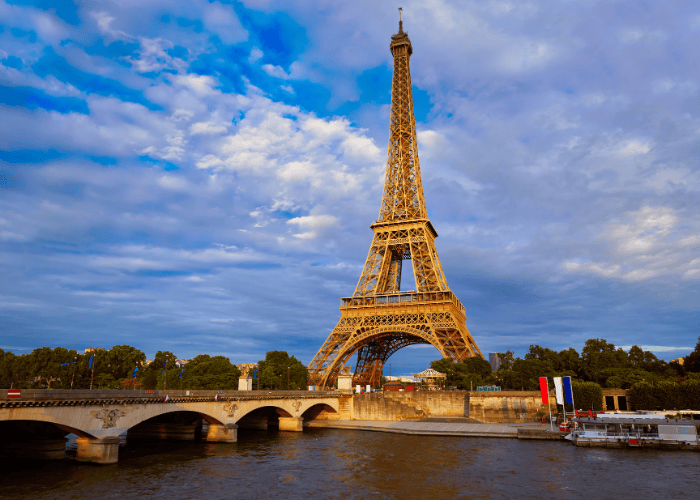
No visit to Paris is complete without a visit to the Eiffel Tower! This iconic monument symbolizes the City of Light. For the most romantic experience, ascend the Eiffel Tower at night.
In Love Among the Recipes, the Eiffel Tower is the first sight Genna visits soon after her arrival in Paris. From the second level, she enjoys both the view and the passing parade of tourists. She also comes up with the idea for the first recipe for her cookbook/guidebook–Steak Haché et Frites.
Here’s how Genna describes this staple of the menu enfant–the children’s menu:
One beef patty, grilled and crispy, accompanied by a mound of light, hot, salty, and crunchy french fries—the best fries in the world. Steak haché et frites was as basic as cooking got in France.
The Eiffel Tower–the most iconic structure in Paris
Get tickets to the Eiffel Tower in advance to avoid very long lines. The Eiffel Tower is open year round from 10:30 am to 6:30 pm (9:30 am to 11:45 pm from June 1 to September 1).
Arc de Triomphe
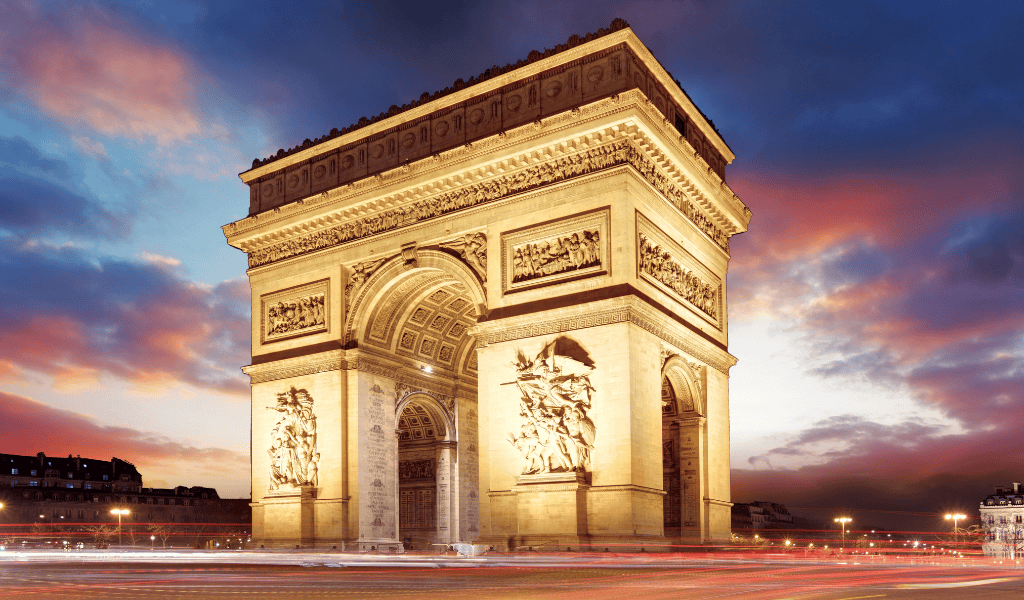
The Arc de Triomphe stands proudly in the middle of the Place Charles de Gaulle (formerly known as the Place de l’Étoile), oblivious to the traffic swirling around it. I know whereof I speak. In the days before Google Maps and GPS, we took a wrong turn and were swept into the Place Charles de Gaulle. Gregg had to circumnavigate the unusually large roundabout (twelve exits!) numerous times before finally crossing a frightening number of lanes to reach our exit. I still break out into a cold sweat when I think of that drive.
Begun in 1806, the Arc de Triomphe honors soldiers who fought in the French Revolutionary and Napoleonic Wars. Directly under the arch is the Tomb of the Unknown Soldier who was killed in World War I.
You can wander around and under the Arc de Triomphe for free, but you’ll pay to climb the stairs to the top. The glorious view of the Place Charles de Gaulle, Champs-Élysées, the Tuileries, and the Eiffel Tower in the distance is well worth the price. WARNING: Don’t even think about trying to cross the Place Charles de Gaulle! Use the pedestrian tunnels located around its perimeter to lead you safely under the traffic.
The Arc de Triomphe marooned in the middle of a river of speeding cars
L’abbaye de Saint-Germain-des-Prés
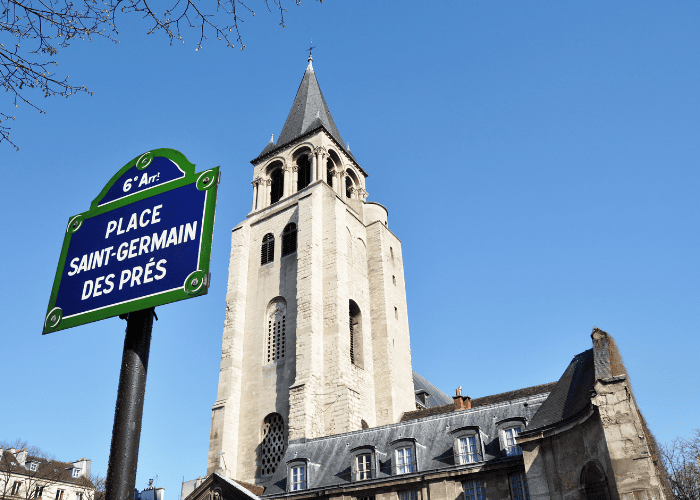
Dating from the 6th century, the Abbey of Saint-Germain-des-Prés is the oldest church in Paris and contains some notable frescoes. The current church was built in the 12th century, with the distinctive spire added in the 19th century. The abbey is also where the heart of philosopher René Descartes is buried.
In Love Among the Recipes, Genna rents an apartment on the top floor of a building steps from the Abbey of Saint-Germain-des-Prés. I modeled her apartment on one I stayed in with my family in 1995. The needlepoint reproduction of La Grande Odalisque by Ingres that hangs in Genna’s apartment was inspired by a similar (and equally hideous) version that hung in the apartment we rented.
Close to the church are two famous cafés in which several scenes take place: Les Deux Magots and Café de Flore. While sitting at a table overlooking the church, Genna decides to pair it with a recipe for French Onion Soup. This version comes from My Parisian Kitchen.
The Abbey of Saint-Germain-des-Prés
Les Invalides
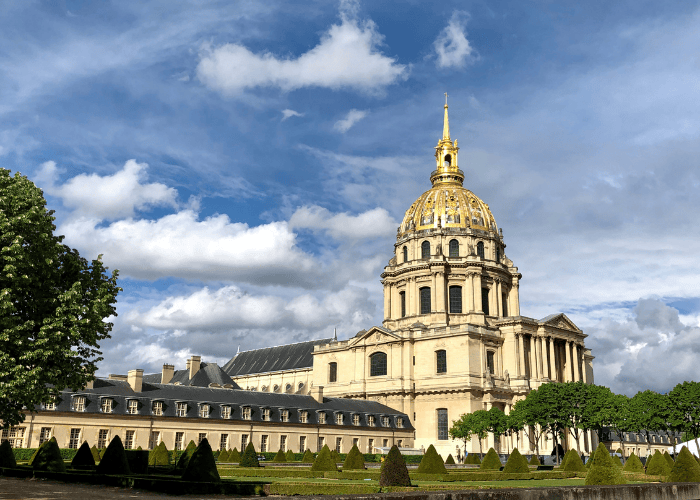
Napoleon’s mammoth tomb and an impressive military museum (Musée de l’Armée) is housed in Les Invalides and is worth a look for Napoleon buffs.
When life starts to go sideways for Genna in Love Among the Recipes, she makes a tearful visit to her grizzled but kindly landlord and most loyal taste-tester. After pouring her heart out to him while savoring shots of fine Napoleon brandy, Genna pairs Les Invalides and its Napoleonic associations with Steak Diane Flambéed in Brandy. This recipe is created by Emeril Lagasse and comes from the Food & Wine website.
Les Invalides, home to the tomb of Napoleon
Les Invalides is open daily from 10 am to 6 pm, except for January 1, May 1, and December 25. Get priority entrance tickets here.
Notre-Dame Cathedral
The partial destruction of Notre-Dame Cathedral in 2019 broke the hearts of many cathedral lovers, including me. Some of my most memorable moments in Paris were spent in the vicinity of Notre-Dame. Several times, I attended music concerts in the cathedral and was blown away by the sublime sound and medieval atmosphere.
In Love Among the Recipes, which is set several years prior to the fire, Genna matches Notre-Dame Cathedral with Lemon Sole with Butter Sauce. Here’s the description she wrote for her cookbook/guidebook:
A visit to Notre-Dame Cathedral takes you into the heart and soul of France. Emerging from a recent cleaning, the cream-colored stone glows in the spring sunshine, much as it did when it was first built a millennium ago.The cathedral sits on an island in the middle of the Seine, until modern times the principal artery for commerce. For centuries, fish from the river nourished the well-fed clerics who kept the great cathedral running.From soul to sole, this recipe for grilled lemon sole swims in a light cream sauce made tart by thin slices of melted lemon. Serve with a fluffy rice pilaf studded with pistachio nuts for a heavenly experience.
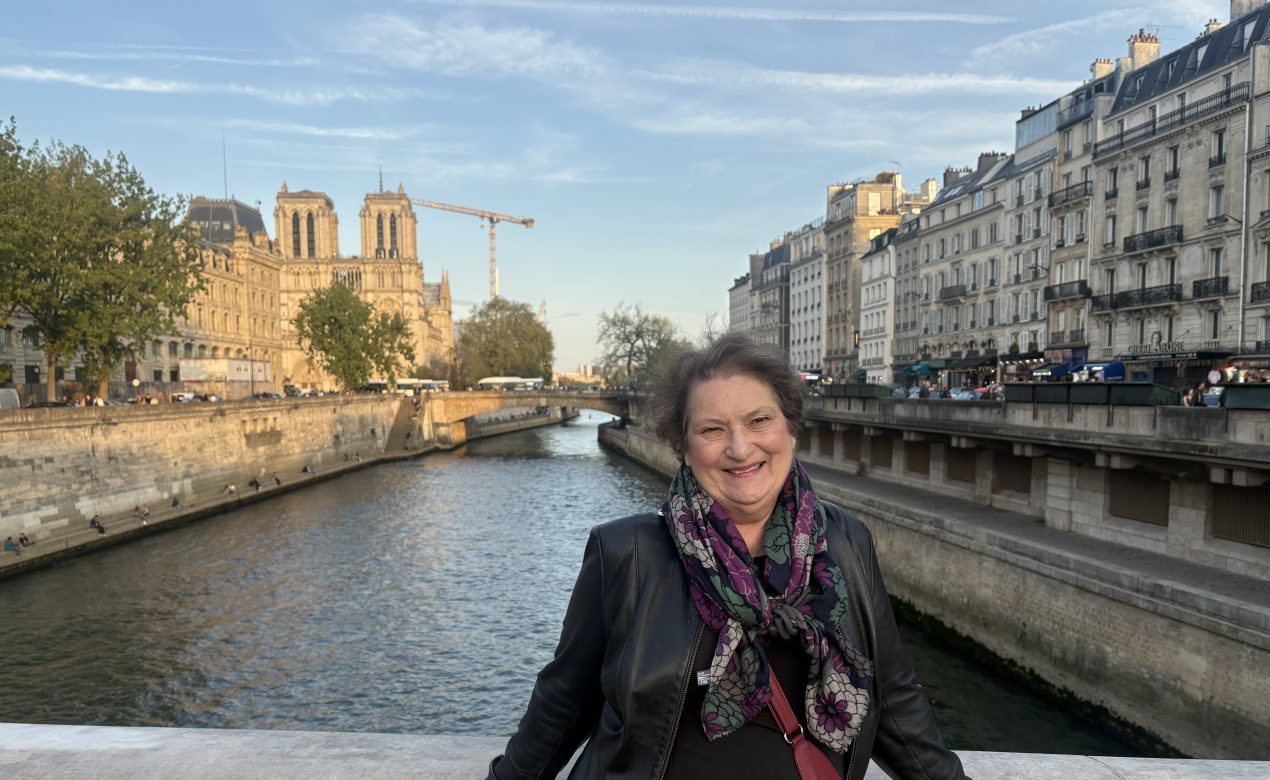
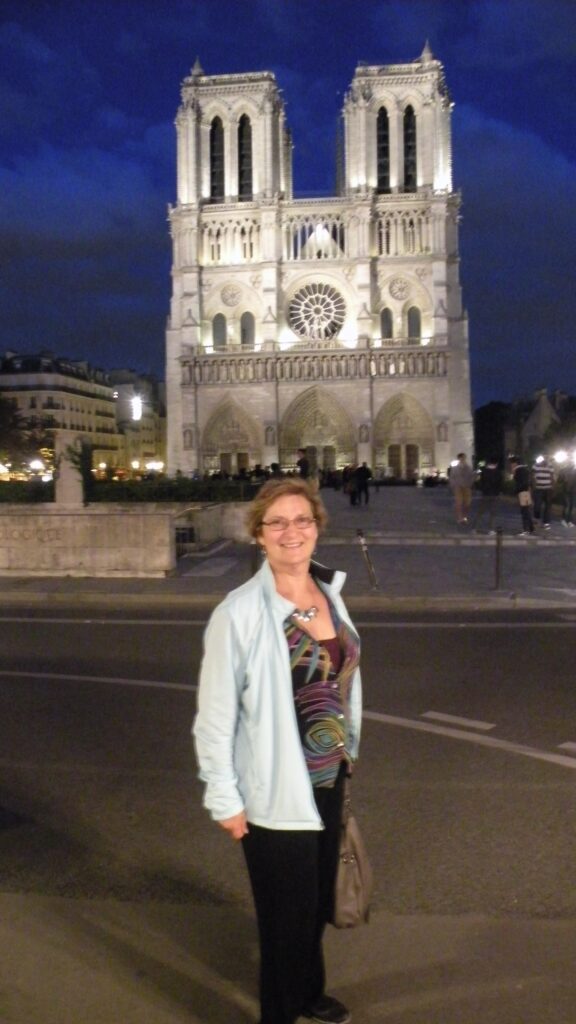
Me in front of Notre-Dame Cathedral on a spring evening
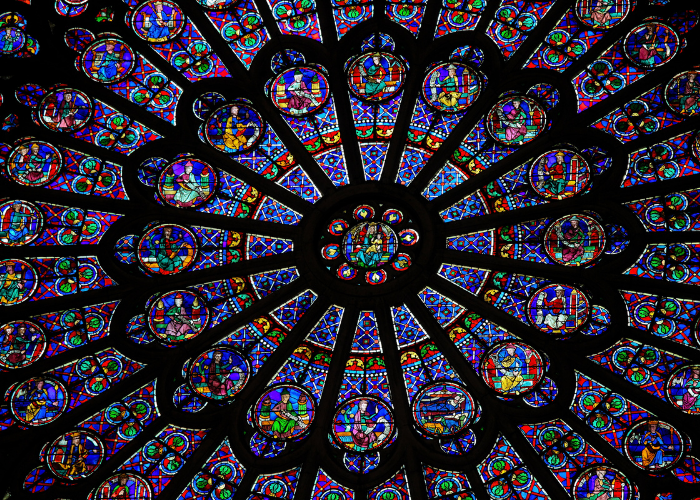
Rose Window in Notre-Dame Cathedral
The rose window at Notre-Dame Cathedral is one of Europe’s most stunning examples of Gothic stained glass. Miraculously, the rose window survived the 2019 fire. In Love Among the Recipes, Genna pairs a classic Strawberry Tart with the rose window. This recipe comes from Recipe Girl.
Sainte-Chapelle
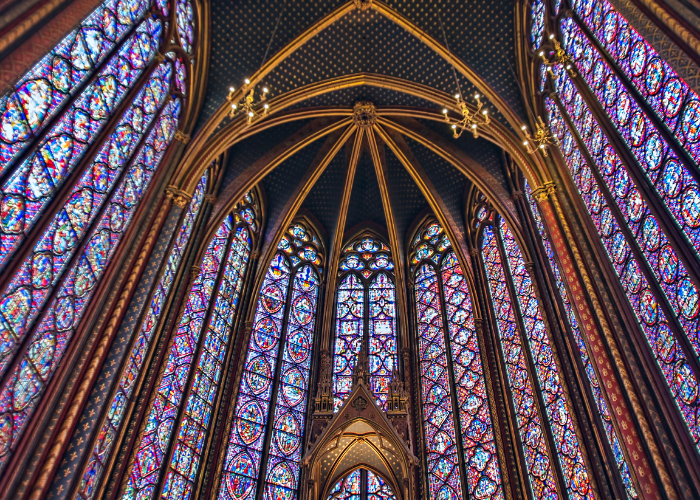
Sainte-Chapelle on the Île de la Cité ranks as my all-time favorite religious structure. I first visited when I was 14 years old while on my epic trip around Europe with my mom, and I always pop in every time I’m in Paris. The joyful release I experience when stepping from the dark, winding staircase into the bright and airy stained-glass heaven of the upper chapel never gets old. I include Sainte-Chapelle in my post about the top cathedrals in Europe.
Sainte-Chapelle is open from 11 am to 7 pm and reservations are required. Get tickets for priority access.
Tour Saint-Jacques
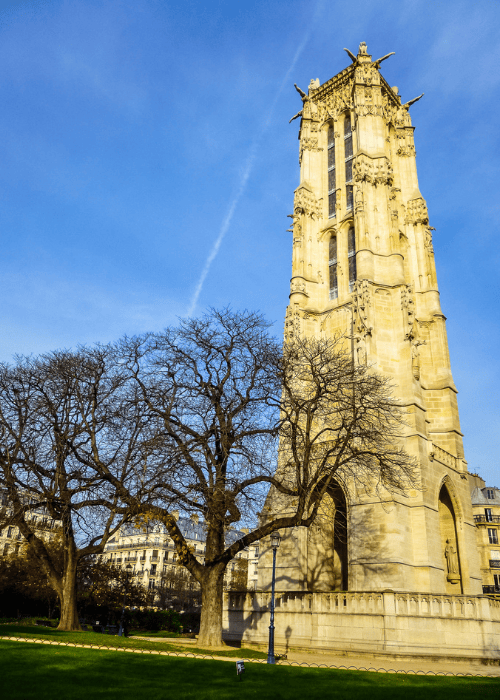
Located in the 4th arrondissement, the Tour Saint-Jacques is a fabulous example of the flamboyant Gothic style. It was originally part of a church built in the 16th century which was destroyed during the French Revolution. I always enjoy catching sight of the statue-encrusted Tour Saint-Jacques while walking around the area. The tower’s connection to butchers (the original church was called Eglise Saint-Jacques-de-la-Boucherie) inspires Genna to pair it with homemade sausages.
Genna liked the contrast of the ornate tower with the lowly sausage, a dish perfect for an everyday dinner. She could include directions for making the actual sausage. A homemade sausage made from freshly ground meats in the cook’s own kitchen and blended with a rich mix of seasonings was surely one of life’s great gastronomic pleasures.
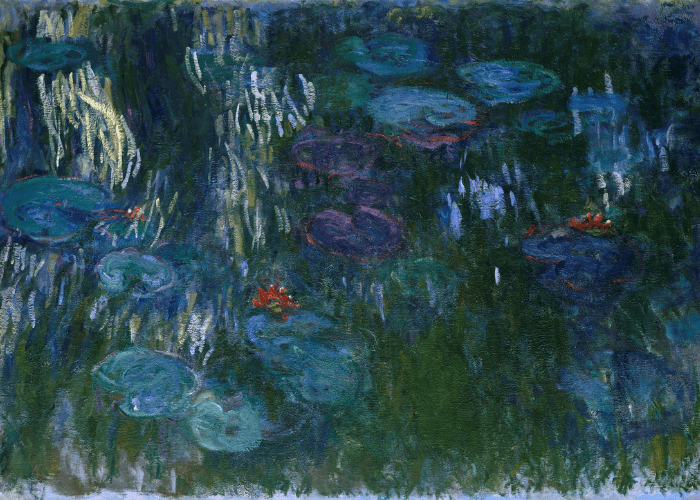
Viewing the eight giant canvases Claude Monet painted of the water lilies in his garden at Giverny never fails to exhilarate me. Two purpose-built rooms contain four canvases each. Stepping into the rooms is like stepping to the edge of a tranquil pond in a cool forest glade.
In Love Among the Recipes, the water lily paintings have a particularly dramatic effect on Marsha, a young woman whom Genna befriends from her French class. While Marsha blisses out in front of the paintings (collectively called Les Nymphéas), Genna settles onto a bench and thinks about Vichyssoise. Here’s what she writes:
Made with tender young leeks, pale yellow potatoes, heavy cream, and black pepper, a bowl of chilled Vichyssoise on a hot summer day will transport you to Monet’s world, where your soul receives the solace that only nature can supply.
Detail from a painting of water lilies by Claude Monet
Musée de Cluny
As I’ve written in my post Paris for Art Lovers: Cool Art Museums You May Not Know, the Cluny (otherwise known as Musée national du Moyen Âge) is my favorite art museum in Paris. I spend at least a few hours of every trip to Paris wandering through the dark rooms overflowing with medieval treasures. That’s my idea of paradise–that and stopping for a glass of wine at a local bistro after my visit.
Genna also loves the Cluny, particularly the stunning Lady and the Unicorn tapestries. While enjoying coffee with Parisian hottie Pierre Leblanc, Genna’s description of why she paired the famous tapestries with Duck Confit comes replete with some seriously suggestive double entendres.
This recipe for Duck Confit to match with the Lady and the Unicorn tapestries comes from Serious Eats.
The sixth tapestry: À mon seul désir Photo: Wikipedia
The Cluny Museum is open every day except Monday from 9:30 am to 6:15 pm. Ticket office closes at 5:30 pm. Evacuation of the rooms begins at 5:45 pm.
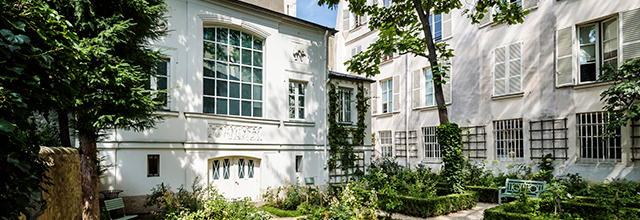
Musée Delacroix
The Musée Delacroix is housed in Delacroix’s former home and is considered a rare gem in the heart of the 6th arrondissement. The collection includes over a thousand artworks by Delacroix along with objects that belonged to him, and artworks created by artists who admired him.
In Love Among the Recipes, Genna visits the Musée Delacroix the day before she hosts a dinner party for her new friend Marsha and Marsha’s insufferable boyfriend. She pairs the Musée Delacroix with a rich and flavorful Bœuf Bourguignon:
The idea for bœuf bourguignon came to her as she was touring rooms that once housed Delacroix’s living quarters and studio. When she thought of Delacroix, she thought of clutter and heat, of fallen soldiers and distressed maidens densely painted in browns and ochers and reds. Delacroix’s large canvases were too big, too full, too heroic—and a good match for the richness of a well-cooked bœuf bourguignon.
The museum is open Wednesday to Monday, from 9:30 a.m. to 5:30 p.m., with a night opening until 9 p.m. on the first Thursday of the month.
Musée d’Orsay
I never tire of visiting the Musée d’Orsay. It teems with masterpieces created between 1848 and 1914, and includes scores of great paintings by Manet, Morisot, Monet and more. Genna matches three recipes to various aspects of the venerable museum.
To avoid the crowds, buy your tickets in advance and go early in the day. Head first for the fifth floor so you can enjoy the most popular paintings accompanied by few visitors. Take your time wandering from room to room and then stop by the café behind the large clock–the original from when the Musée d’Orsay was a train station.
Musée d’Orsay as a Whole
When Genna visits theMusée d’Orsay with her daughter, Becky, she pairs cassoulet with the museum. She explains her choice to Becky, who has arrived unexpectedly in Paris, bringing with her an attitude and a secret:
“I was watching all the people crowding into the galleries and I couldn’t help thinking of them as so many ball bearings all rolling along together, one indistinguishable from the next. Then from there I went to beans—white haricot beans that are smooth and round and meaty. And from there, I thought of richness—the paintings, which led me to think of chunks of homemade garlic sausage and duck confit legs simmered in wild garlic and . . .”
“Stop!” Becky held up her hand. “I get the picture. The cassoulet mixes all kind of colors and textures with herbs and beans, just like the museum combines paintings and people.”
“Exactly!” At this rate, they’d start wearing matching stretch pants and pink T-shirts with Mother on one and Daughter on the other.
Here’s a recipe for cassoulet, a tasty recipe from southwest France, on Jo Cooks.
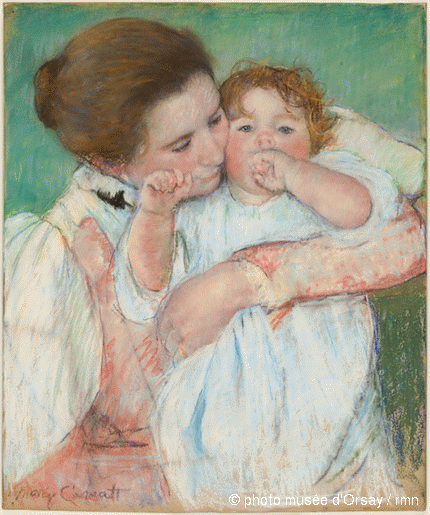
Mère et enfant sur fond vert, Musée d’Orsay
Becky is fascinated by the painting Mère et enfant sur fond vert by Mary Cassatt. Later in the novel, Genna pairs the painting with clafoutis, a delicious and simple fruit pudding suitable for serving to children.
Mère et enfant sur fond vert by Mary Cassatt from Musée d’Orsay
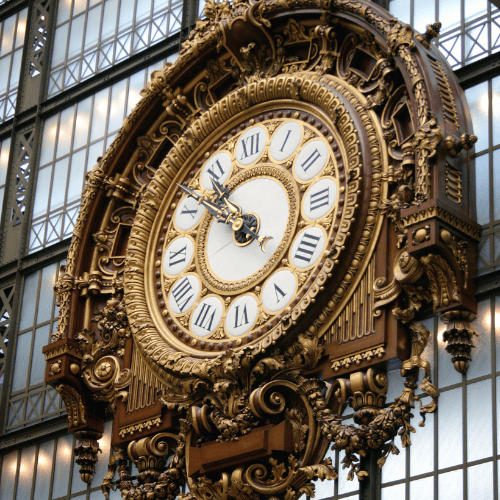
Great Clock at the Musée d’Orsay
Genna pairs the great clock that dominates the façade of the Musée d’Orsay with a classic French apple tart–a tarte aux pommes. This recipe for Apple Tart comes from My Parisian Kitchen.
The clock in theMusée d’Orsay
Make sure to buy tickets to visit the Musée d’Orsay in advance so you can skip the line-up. The museum is open from 9:30 am to 6 pm daily except Mondays.
Musée du Louvre
The Louvre is massive, over-crowded, expensive, and magnificent. The key to visiting the Louvre with ease is to focus on one or two areas at most. There’s a great deal of art in the Louvre, and while all of it is amazing, some pieces are more amazing than others.
In Love Among the Recipes, Genna pairs recipes with three different parts of the Louvre: the Denon wing, La Grande Odalisque by Jean-Auguste-Dominique Ingres, and a charming terra cotta piece from the antiquities exhibits in the Sully wing.
Denon Wing
When you enter the pyramid and descend the escalator to the center of the Louvre, you’re faced with three wings: Sully, Richelieu, and Denon. Most visitors make a beeline for the Denon wing because that’s where some of the most famous artworks in the world are displayed, including the Mona Lisa by Leonardo da Vinci. Unless you have a burning desire to stand in a massive crowd bristling with pickpockets so you can peer over the tops of heads to see a tiny, glass-enclosed painting on a single wall, I’d give Mona a miss. If you do want to see her, arrive early, or drop by just before the museum closes.
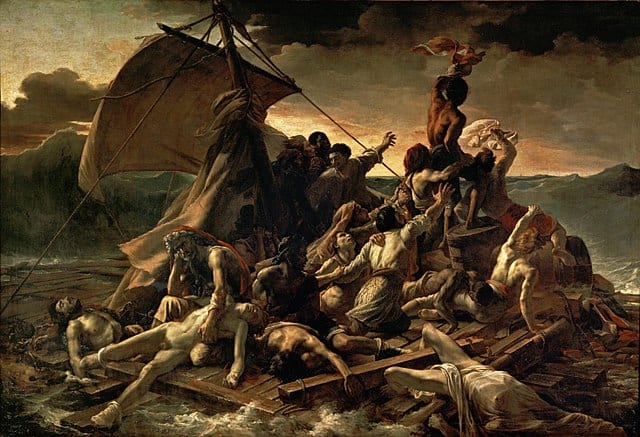
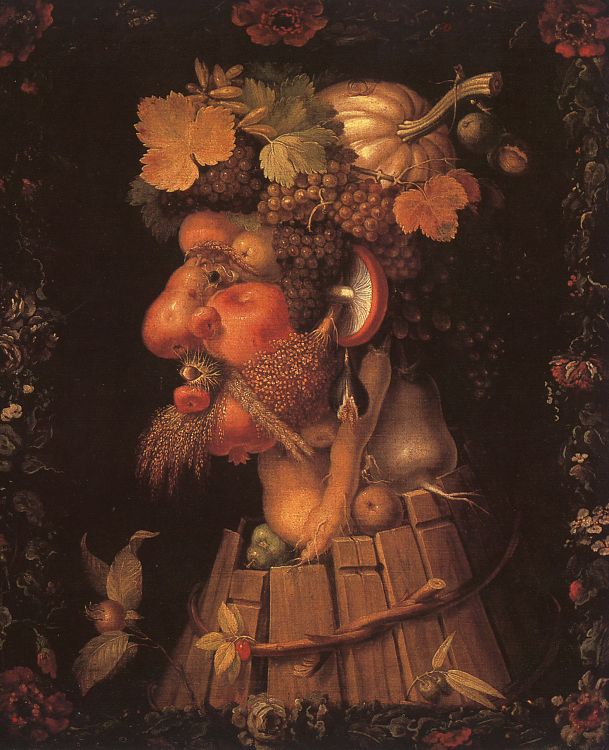
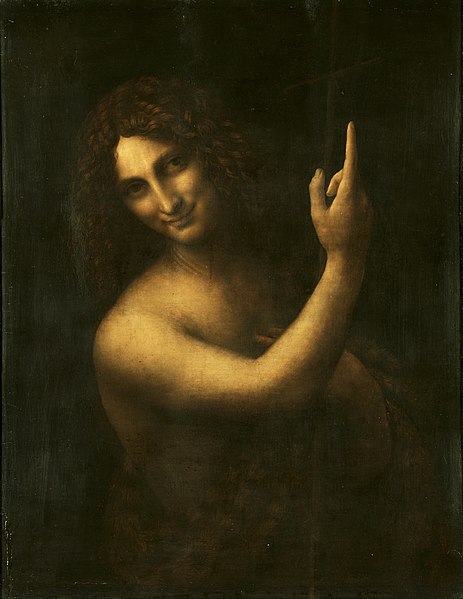
Instead, head for the far end of the Denon wing and work your way back. You’ll pass several remarkable pieces, including:
The Raft of the Medusa by Théodore Géricault, Public domain, via Wikimedia Commons
Autumn by Giuseppe Arcimboldo, Public domain, via Wikimedia Commons
Liberty Leading the People by Eugène Delacroix, Public domain, via Wikipedia Commons
Saint John the Baptist by Leonardo da Vinci, Public domain, via Wikimedia Commons
The rich, deep-red walls of the Denon wing inspire Genna to match it with a recipe for Shrimp-Stuffed Salmon. When she serves the dish at a party, the consequences are devastating–and a pivotal moment in Love Among the Recipes. Here’s a link to a recipe for a similar dish on Jamie Oliver’s website.
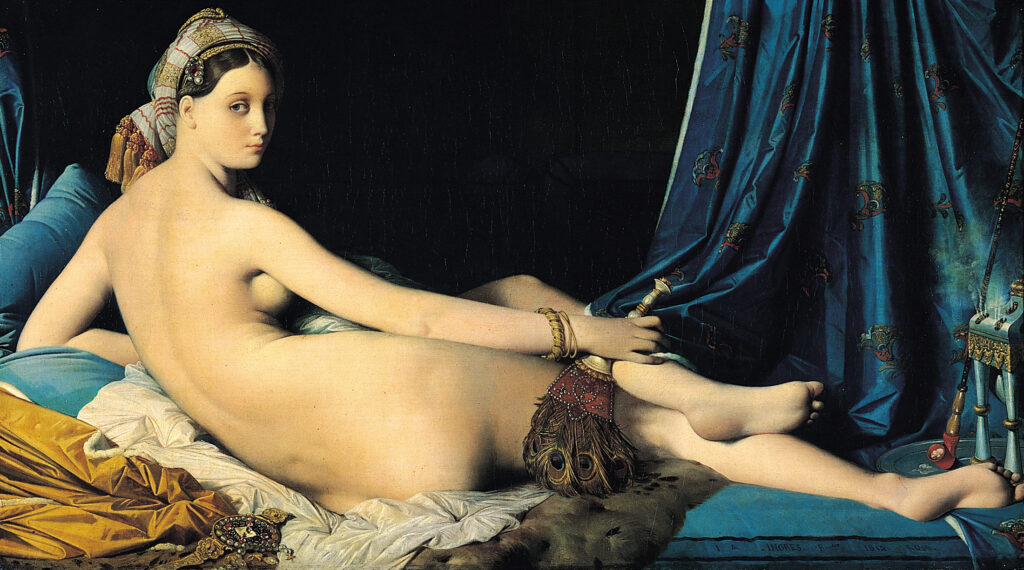
La Grande Odalisque by Ingres
Your stroll through the French masterpieces in the Denon wing also takes you past La Grande Odalisque by Ingres. The enigmatic image of the nude courtesan plays a prominent role in Love Among the Recipes. In one of the final scenes of the novel, Genna matches the painting with a recipe for tagine–a warm and spicy Moroccan dish of lamb cooked with apricots and nuts. This recipe for Tagine and Couscous comes from Easy Peasy Foodie.
Jean-Auguste-Dominique Ingres, Public domain, via Wikimedia Commons
Greek, Roman, and Egyptian Antiquities
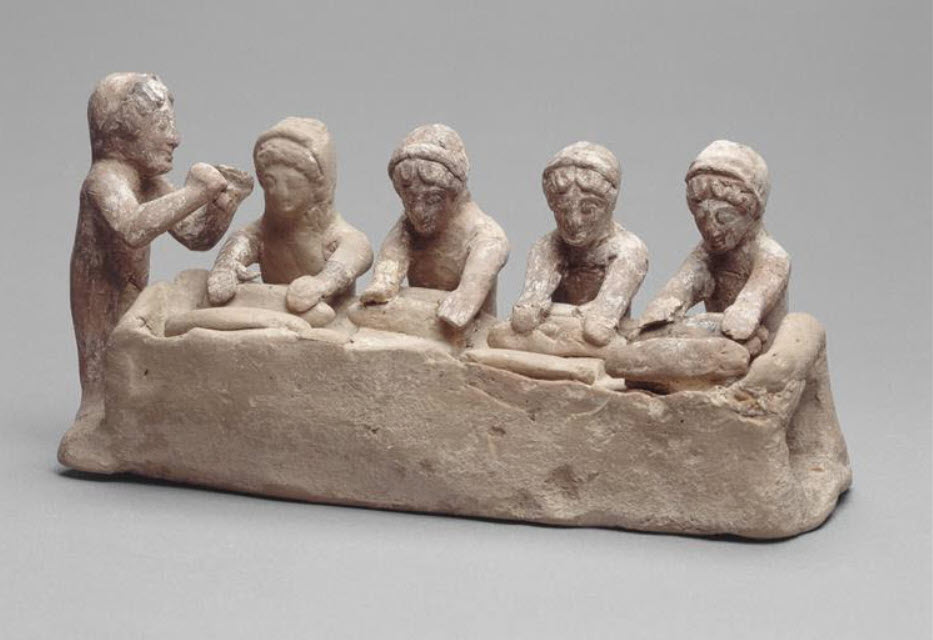
While perusing the fabulous collection of antiquities in the Sully wing, Genna comes across a small terra-cotta carving depicting a row of bakers:
Genna trailed past glass cases brimming with cooking pots and spear tips, wrought gold bracelets and bronze helmets. Her attention was arrested by a roughly hewn terra-cotta piece showing a row of figures seated at a bench, kneading what appeared to be dough. Thanks to her progress in French class, she easily deciphered the description. The object represented bakers making bread. The preparation of food was rarely represented in art, and almost never in the art of antiquity. Genna tried to imagine the artisan who had sculpted the little piece and for what reason. It was neither well-formed nor beautiful. A child with Plasticine could have done better. But at over 2,500 years old, the piece was remarkable.
Take virtual tours of the Louvre. Make sure to buy tickets to visit the Louvre in advance so you can skip the line-up. The museum is open from 9 am to 6 pm daily except Tuesdays.
Quai Branly Museum
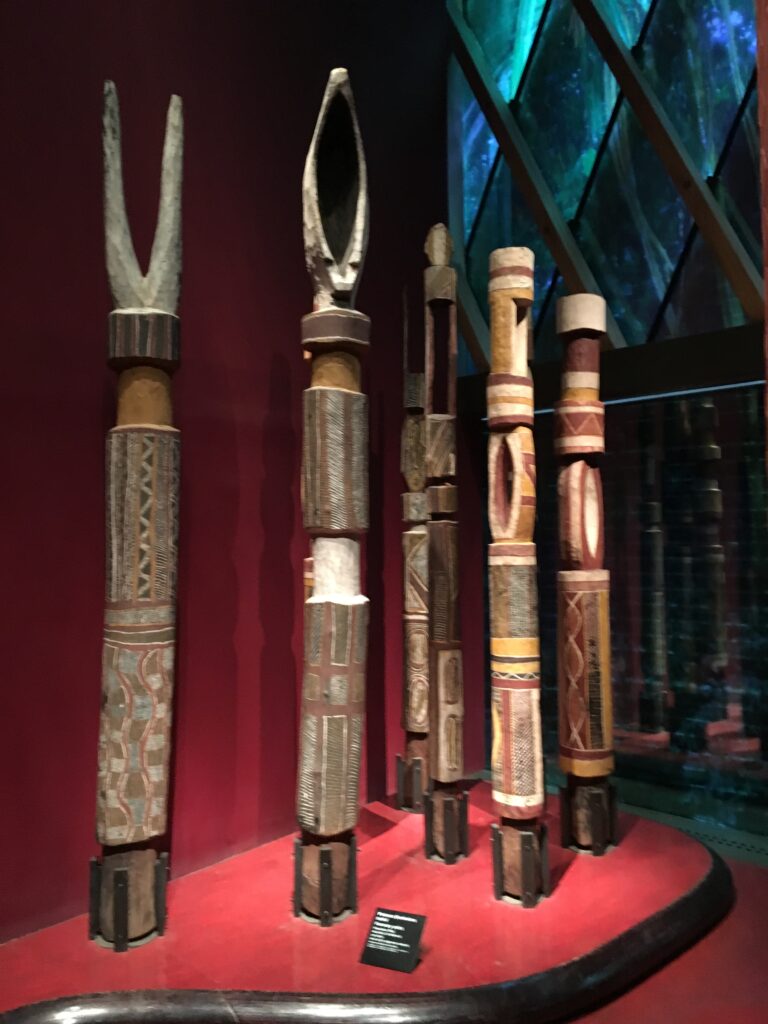
Also know as the Musée du Quai Branly Jacques Chirac, the Musée Quai Branly deserves a place on your Paris itinerary, particularly if you enjoy art and objects created by indigenous cultures from around the world. The collection is displayed in four distinct areas representing Africa, Asia, Oceania, and the Americas. Read more about the Musée du Quai Branly in my post Paris for Art Lovers: Cool Art Museums You May Not Know.
Genna visits the Branly with Becky, just after Becky inadvertently shares news of a seriously life-altering event. While prowling the dimly lit exhibits, Genna decides on a recipe for Chocolate Mousse. This one comes from My Parisian Kitchen.
Here’s what Genna writes:
No one who has gazed awestruck at an intricately carved exorcism mask from Sri Lanka or the complex geometric rugs woven by Berber tribeswomen could doubt that the objects on display in the Musée du Quai Branly represent human ingenuity in all its diverse glory. Intrepid visitors glide from the Congo to the Sahara, across India and around Polynesia, into the vast lands of Asia and on across the Pacific to the plains of North America and the secret jungles of Brazil. A delicately constructed chocolate mousse should explode with flavor with the same intensity so richly captured in the Branly’s dark passageways.
Display in the Africa area in the Musée Quai Branly
The museum is open Tuesday to Sunday from 10:30 am to 7:00 pm (Thursdays until 10:00 pm). Get tickets in advance to avoid lines.
Situated in the trendy Marais district, the Musée Picasso is close to the apartment Marsha buys in Love Among the Recipes. When Marsha takes Genna to see the apartment, Genna is bowled over by its size and elegance, while poor Marsha is distraught.
Genna pairs a recipe for bouillabaisse, the classic Mediterranean fish stew, with the museum devoted to the work of Picasso, who was born in Málaga on Spain’s Mediterranean coast. Her decision to include bouillabaisse in her cookbook/guidebook prompts her to host a dinner party for the new friends she’s made in Paris. The events at this party lead to the climax of the novel.
The Picasso Museum is open Tuesday to Friday from 10.30 am to 6 pm and weekends from 9.30 am to 6 pm. The museum is popular, so buy tickets in advance.
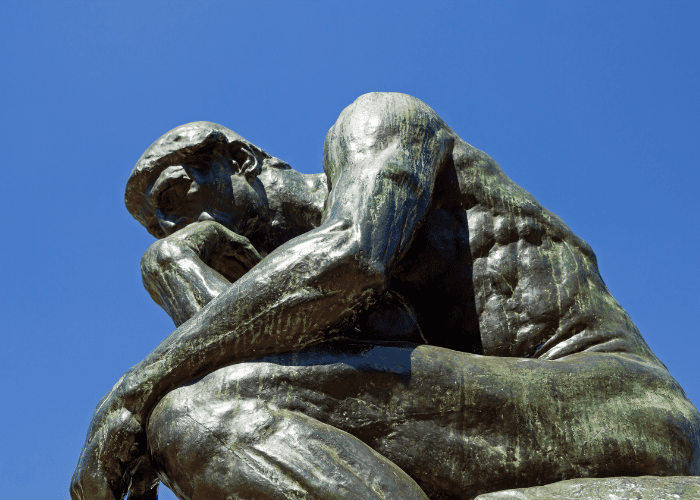
When Genna visits the Musée Rodin, she is entranced by the many large and small versions of Rodin’s famous Kiss sculpture and by the sophisticated beauty of the museum and its grounds. She contemplates The Thinker, admires the sculptures in the sumptuously appointed chandeliered rooms, and comes up with crème brûlée to match with the museum. Here’s what she writes:
A silky crème brûlée topped with a sheen of caramelized sugar cracked open by one smart rap of the spoon made the perfect ending to a meal. It combined hard and soft together in one dish, like one of Rodin’s sculptures. The cold marble came alive with the heat generated by the two bodies wrapped around each other. What looked solid became malleable and alive.
The Musée Rodin is open Tuesday to Sunday from 10 am to 6:30 pm. Buy tickets in advance and skip the lines.
Pompidou Centre
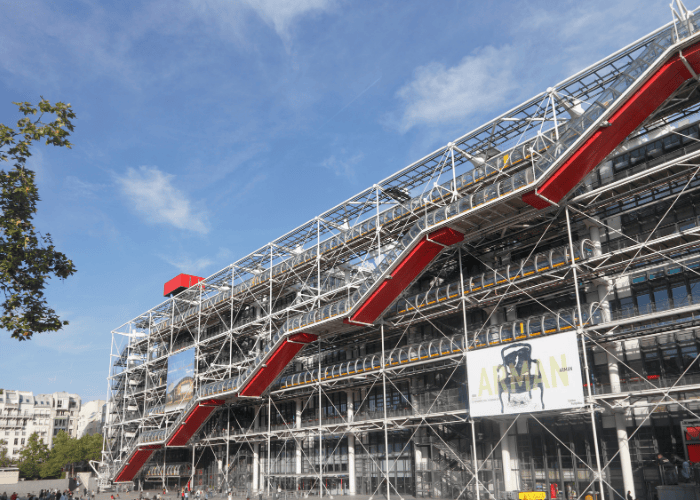
The fourth floor of the Pompidou Centre houses an incredible collection of early-to-mid-20th-century modern art. It’s one of my husband Gregg’s favorite art museums. As a painter, he loves admiring the work of the artists who have inspired him–from Max Ernst to Matisse to Pollock.
Pompidou Centre is the most visited museum in Paris
Buy tickets to the Pompidou Centre in advance to avoid line-ups, open every day except Tuesdays from 11 am to 8 pm.
Stravinsky Fountain, Centre Pompidou
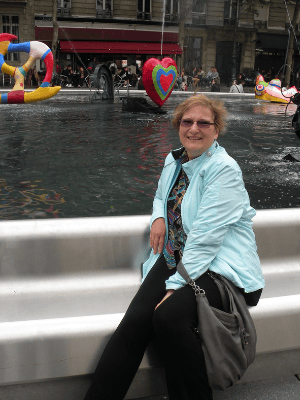
Adjacent to the Pompidou Centre is one of the most striking and fun fountains I’ve ever seen. Created by Niki de Saint Phalle, the Stravinsky fountain was a huge favorite with my daughter, Julia, when she was a child.
Immediately before her rose the whimsical Stravinsky Fountain—a favorite of her children on their family trip to Paris. Sixteen sculptures, including a treble clef, a pair of swollen red lips, and various brightly painted amorphous shapes, rotated, swiveled, and shot water at odd angles. Genna defied anyone to stand next to Niki de Saint Phalle’s extraordinary creation on a hot summer’s day and not smile.
The quirky, colorful cheeriness of the Stravinsky Fountain inspires Genna to pair it with a scrumptious fruit flan that she describes as: Slices of yellow peaches, green kiwis, and creamy white pears, glistening blueberries, and rosy-red strawberries and raspberries and cherries would be arranged in perfect spirals on top of a custard filling spread over a crunchy sugar crust, the whole creation bathed in a glaze of equal parts sherry and Cointreau.
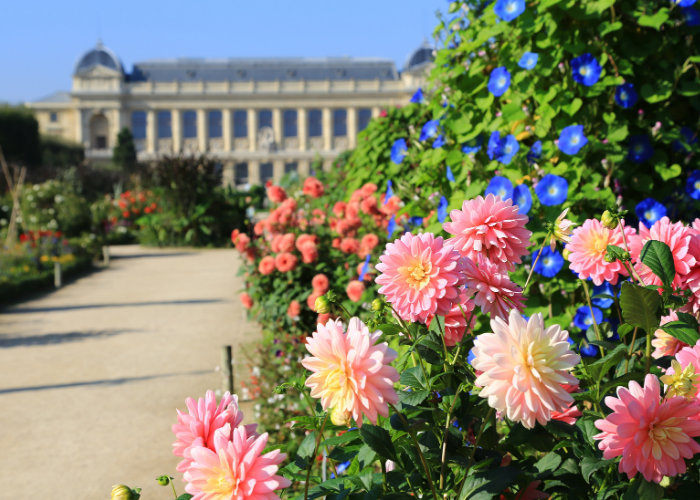
The Jardin des Plantes in the 5th arrondissement is a marvelous place to spend an afternoon. If you enjoy prowling through natural history museums (as I do), then allocate a day to explore the Gallery of Evolution, the Gallery of Mineralogy and Geology, the Gallery of Paleontology and Comparative Anatomy, and the Gallery of Botany.
Le Jardin des Plantes is open from 7:30 am to 6:30 pm, with most of the galleries opening at 10 am.
Luxembourg Gardens
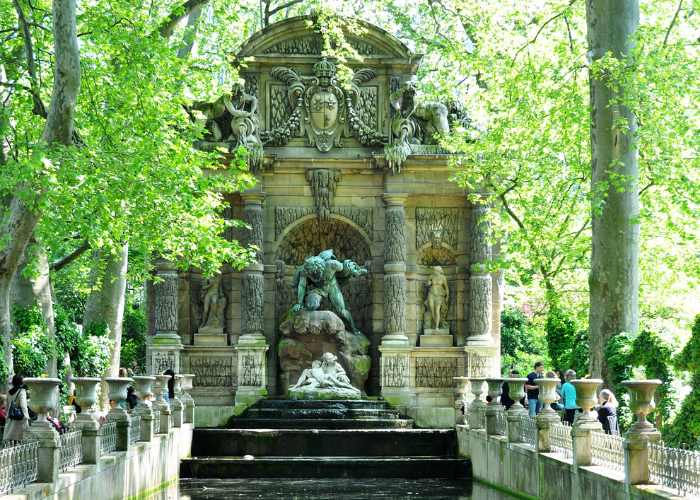
The Luxembourg Gardens holds a special place in the hearts of my family. We spent many happy hours at the awesome playground when our daughter was young, and in recent years have always enjoyed strolling through its shaded walkways and lounging by the round pool.
Genna also has very positive associations with the Luxembourg Gardens and goes there with her daughter, Becky. The variety of facilities within the gardens inspire Genna to create a recipe for pot-au-feu.
Fountain at the Luxembourg Gardens
Monet’s Garden at Giverny
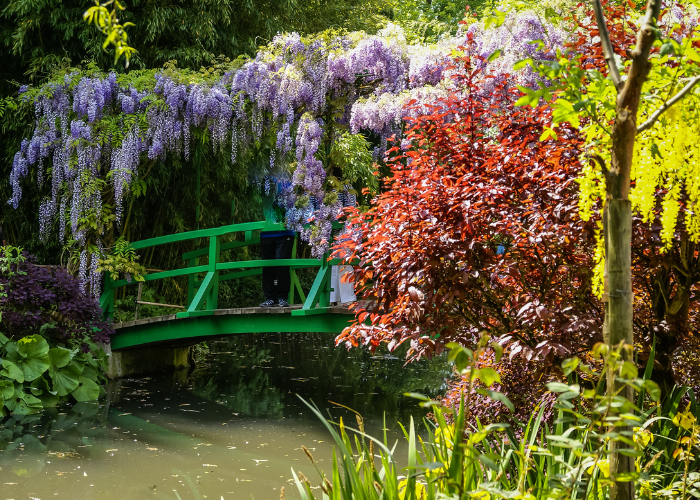
An hour outside Paris is Giverny and the house that artist Claude Monet lived in for several decades. The garden he created–depicted in many of his paintings–attracts millions of visitors every year.
In Love Among the Recipes, Genna visits Giverny with Bill Turner. The first glimmer of romance is sparked amid the leafy green walkways and dreamy views of water-lily-studded ponds. While gazing over one of these ponds, Genna decides on a light and fluffy asparagus soufflé. This recipe comes from Simply Recipes.
One of the charming green bridges in Monet’s garden at Giverny
Parc Buttes Chaumont
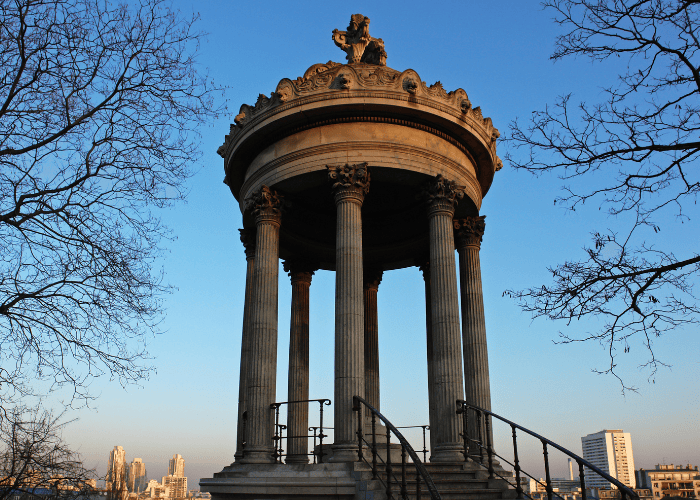
This wonderful neighborhood park in the 19th arrondissement is the fifth largest park in Paris and almost completely bypassed by tourists. Wander several kilometers of pathways and admire the evocative Temple de la Sibylle perched on a cliff overlooking the lower garden.
In Love Among the Recipes, Genna pairs the park–a favorite with families–with a family-friendly recipe for Chicken & 40 Cloves of Garlic that she serves to an appreciative Monsieur Leblanc, her landlord. This version comes from Jo Cooks.
Temple de la Sibylle in Parc Buttes Chaumont
Parc de la Villette
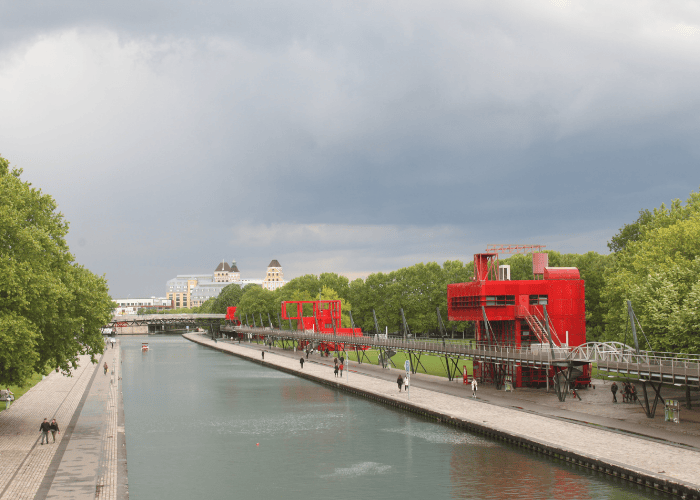
This massive park, also in the 19th arrondissement, is full of interesting things to see and do. It’s home to one of the largest concentrations of cultural venues in Paris, including the Cité des Sciences et de l’Industrie, Europe’s largest science museum; three major concert venues, including the Philharmonie de Paris; and La Géode, an Omnimax theater. Also in the park are ten themed gardens, including the Jardin du Dragon, along with 26 follies–large, bright red metal sculptures.
In Love Among the Recipes, Genna visits Parc de la Villette with Pierre Leblanc and later tells him she’s pairing the park with a Pork Terrine with Roasted Red Peppers and Hazelnuts. Here’s an excerpt from her conversation with Pierre:
“A layered terrine of pork pâté with roasted red peppers and a layer or two of nuts all pressed into a perfect rectangle. When you cut the terrine into thick slices, all the layers are exposed.”
“Like the structures of the park in nature.”
“Exactly!” Genna put down her fork and grinned at Pierre. “You are an amazing inspiration, Pierre. That’s the second good connection I’ve made, thanks to you.”
Three of the follies in Parc de la Villette
Parc Monceau
This delightful park in the 8th arrondissement contains a number of interesting follies, including a miniature ancient Egyptian pyramid, a Roman colonnade, antique statues, a pond full of water lilies, a Dutch windmill, a minaret, and an enchanted grotto. Far off the tourist path, the Parc Monceau is the perfect place for an after-lunch stroll.
The Paris Métro is efficient, fast, and cheap. You can’t beat it as the quickest way to cross the city when you don’t want to take a taxi driven by a French driver with a death wish. If you have more time to get where you’re going, take busses so that you can watch the passing parade of Parisian sights and people. But if you’re in a hurry, descend to the Métro, check your route on the illuminated maps, and enjoy the ride.
While waiting in the Métro, Genna is struck by its relationship to the humble pissaladière, a pizza-like flatbread criss-crossed with anchovies and studded with olives. This recipe comes from Serious Eats.
Île de la Cité
Before fire devastated Notre-Dame Cathedral in 2019, one of my favorite things to do on a warm evening was to stroll around the magical Île de la Cité. Repairs to the cathedral are progressing, but we likely won’t see the cathedral in all its floodlit glory for quite some time.
In Love Among the Recipes, Genna pairs Île de la Cité with Rainbow Trout as a result of a tip from the irascible but kind-hearted and seriously committed foodie, Monsieur Leblanc. The recipe is from Dinner with Julie.
Near the Île de la Cité on a chilly spring day
L’Opéra Bastille
I was fortunate to see a performance of Wagner’s Götterdämmerung at L’Opéra Bastille a few years ago. A remarkable structure, the opera house in the Place de la Bastille in the 12th arrondissement was inaugurated in 1989 and is the home of the Paris National Opera.
In Love Among the Recipes, Genna is inspired by the wrapped and layered exterior of the opera house to create a recipe for veal cutlets in parchment (Escalopes de veau en papillote).
L’Opéra Bastille
Les Halles
Back in the day (and as recently as 1971), Les Halles was Paris’s central fresh-food market. Now, the market is part of a massive underground shopping mall. Les Halles is usually an area I traverse through long tunnels when changing lines at the Châtelet–Les Halles Métro stop. It’s one of the largest underground stations in the world that connects three of five RER lines and five of the sixteen Métro lines.
Thanks once again to the refined palate of Monsieur Leblanc, Genna pairs Les Halles with a recipe for Rabbit in Mustard Sauce.
Plaza above Les Halles
Montmartre
Montmartre overlooks Paris atop a large hill in the 18th arrondisement. It’s dominated by the ice-cream-cone domes of the Basilica of the Sacré-Cœur and includes plenty of charming cafés and an artsy atmosphere. However, each time I’ve visited, the crowds have been intense and so I usually haven’t stayed long. On the other hand, the views across the Paris skyline from Sacré-Cœur are magnificent, and I do remember our daughter at the age of nine enjoying the carousel at the base of the basilica.
Basilica of the Sacré-Cœur with the carousel at its base
Place du Tertre in Montmartre
The Place du Tertre teems with sidewalk cafés, street artists, locals, and tourists. At the beginning of the 20th century, the area was home to many famous painters, including Picasso and Modigliani. The home and studio of Renoir and Suzanne Valadon are also nearby.
The lively and cheerful area is a perfect match for macarons–the crispy, chewy, gloriously colorful confections that take pride of place in every French patisserie. This recipe comes from Serious Eats.
Place du Tertre in Montmartre
Place de la Concorde
The busy Place de la Concorde symbolizes monumental Paris. Stand in the middle of it and you can see many of the most famous sites in Paris, from the giant Ferris wheel to the Egyptian obelisk to the Eiffel Tower in the distance. Genna chooses the elegant French cookies called madeleines to pair with the Place de la Concorde.
Place de la Concorde
Tuileries Gardens
After trudging through the Louvre in search of great art, nothing beats taking some “me” time in one of the metal chairs arranged around fountains in the Tuileries Gardens. The flower beds overflow with color, the crowds swish past, and all is right with the world.
In Love Among the Recipes, Genna and Bill relax in the Tuileries before heading across the river to the Right Bank and Bill’s posh hotel on the Rue Saint-Honoré. Before they leave the gardens, Genna matches the Tuileries Gardens with Salade Niçoise, a hearty salad brimming with fresh anchovies, hard-boiled eggs, green beans, tuna, tomatoes, and potatoes. As Genna says, “every bite is a new combination of salty and crunchy.” This recipe comes from Serious Eats.
Gregg relaxing in one of the metal chairs in the Tuileries Gardens
Versailles
Versailles, the sumptuous palace of French kings and queens, is worth the day trip from Paris, but arrive early to avoid the crowds! Tour the palace first and then spend the rest of your time wandering around the grounds. You can easily walk all day and not come close to exploring all 2,000-plus acres of what is considered the world’s largest royal domain.
I find the interior of Versailles too over the top and opulent for my taste, but it is worth seeing. I remember experiencing terrible claustrophobia trapped in a heaving mass of tourists in the famous Hall of Mirrors, which is why I suggest getting to the palace as soon as it opens. Outside the palace, the grounds and fountains are truly spectacular. Schedule your visit on a day when the fountains are playing. Check the Versailles website for times.
Genna visits Versailles with Pierre Leblanc, and together they come up with Caesar Salad as the perfect dish to pair with the royal residence. This recipe comes from Serious Eats.
Hall of Mirrors in Versailles
Book your tickets well in advance and skip the line for the Palace of Versailles. The Palace is open every day except Monday from 9 am.
Have you read Love Among the Recipes? Share your thoughts in the Comments section below.
Have you considered taking a cooking class while traveling in France? Paris is the place for cooking classes, but you’ll also find classes in other French cities such as Lyon.
Several years ago, guest poster Liz Reding moved with her husband Michael to France and settled in the charming city of Lyon. Every few months, she and Michael take trips to explore different areas in Europe.
One of the things Liz likes to do when she travels around Europe from her new French home is to take cooking classes.
Here’s what Liz has to say about taking cooking classes in Paris and Lyon.
Cooking in France by Liz Reding
Is cooking art? If you’ve ever seen a great chef at work or eaten a beautifully plated meal, I think you’ll agree that cooking is an art form.
Maybe you love to cook, maybe you don’t … but you have to eat, right? So, doesn’t it make sense to spend time perfecting your cooking skills?
Some might say, YES… but not while I’m on vacation. I say, YES, especially while I’m on vacation!
The quality of the local produce, cheese, seafood, and meat in French markets is outstanding. When you take a class taught by a local chef at a cooking school, you learn how to use local ingredients to prepare regional favorites.
Cooking Classes in Paris
Thanks to the ongoing popularity of French cuisine and French cooking, several culinary schools offer short-duration classes designed for travelers.
Paris is the undisputed center for cooking classes in France. Consider spending a morning or an evening taking a class. You’ll meet interesting people and learn new skills and cooking methods.
Several kinds of cooking classes are available in Paris. In some classes, you focus on how to make specific dishes, such as macarons or baguettes, while in others, you cook several dishes which you then enjoy along with a glass or two of wine.
The Market Class
My favorite type of cooking class is the Market Class.
Choose a market class that starts early in the morning and includes lunch or one that starts later in the afternoon and includes dinner.
You’ll start a market class by meeting up with the chef at a local outdoor market. With the help of the chef, you’ll choose whatever is seasonally available and then return to the kitchen to start cooking.
Several hours later, you’ll sit down to the wonderful three-course lunch or dinner that you and your classmates prepared. A glass or two of wine is often included, along with wine-tasting tips.
In some market classes, the chef decides ahead of time what you’ll make. You pick up the ingredients and then head to the cooking school to start learning and cooking. No surprises!
Seafood in a Paris market; photo credit: Liz Reding
Other classes take more of a let’s see what we can find approach. You go to the market with the chef and see what’s fresh.
Will it be crayfish or lamb? New asparagus or an oozing camembert? Fresh tomatoes from Provence or foie gras from the Dordogne?
The chef accompanies you around the stalls and helps you make the selections.
Either type of class is a wonderful experience, but the laissez-faire version is more exciting and a test of the chef’s ability to create a yummy menu on the fly.
If you have a food allergy or other dietary restrictions, let the chef know. He or she will either tell you how to modify the recipe or will provide an alternative.
Recommendations in Paris & Lyon
I’ve taken four cooking classes in Paris (a baguette-making class and three market classes) as well as in Lyon, France, where I live. All the classes were conducted in English.
In the French baguette class, I learned an important lesson—read the reviews of the cooking class before you sign up! Two of the three ovens weren’t working which made the experience less enjoyable than it could have been.
Fresh baguettes made in the baguette class; Photo credit: Liz Reding
Nevertheless, I did learn how to make baguettes the old-fashioned way by smacking the dough against a granite surface. In my kitchen at home, I was able to adapt the baguette recipe and make it in my mixer with a dough hook. The results were fabulous!
Some of the cooking techniques I learned in cooking classes were fun but not useful. For example, I learned how to strain potatoes through a screen, but why would I want to?
No matter what type of class you take or where you take it, you’ll always learn new techniques and new recipes. And at the end of the class, you can relax and enjoy the meal you helped make, often with people from around the world.
Paris Cooking Classes
Here are the three cooking schools I attended in Paris. Typically, a cooking class that includes a meal costs between €150 and €200 per person. Some cooking schools offer group rates. If you’re traveling with a group, you may be able to save money by booking a private class.
I highly recommend adding a cooking class to your itinerary.
If you’re really into cooking classes, consider going on a cooking retreat. Plenty of options are available in places such as Tuscany and Provence.
About Liz Reding
Liz Reding is a retired computer textbook author who lives in Lyon, France. Born in Manhattan and having lived in Boston and New Mexico (Santa Fe and Albuquerque), she and her husband are discovering the joys of traveling and exploring the world. She enjoys learning French, cycling, and cooking nutritious meals.
Conclusion
Have you taken a cooking class while traveling? You can find them all over the world! I took a cooking class in Rome that I write about in Cooking in Roma with InRome Cooking.
Share your experiences in the comments below.
And here’s some more inspiration for cooking classes in Japan, Morocco, and Madrid.