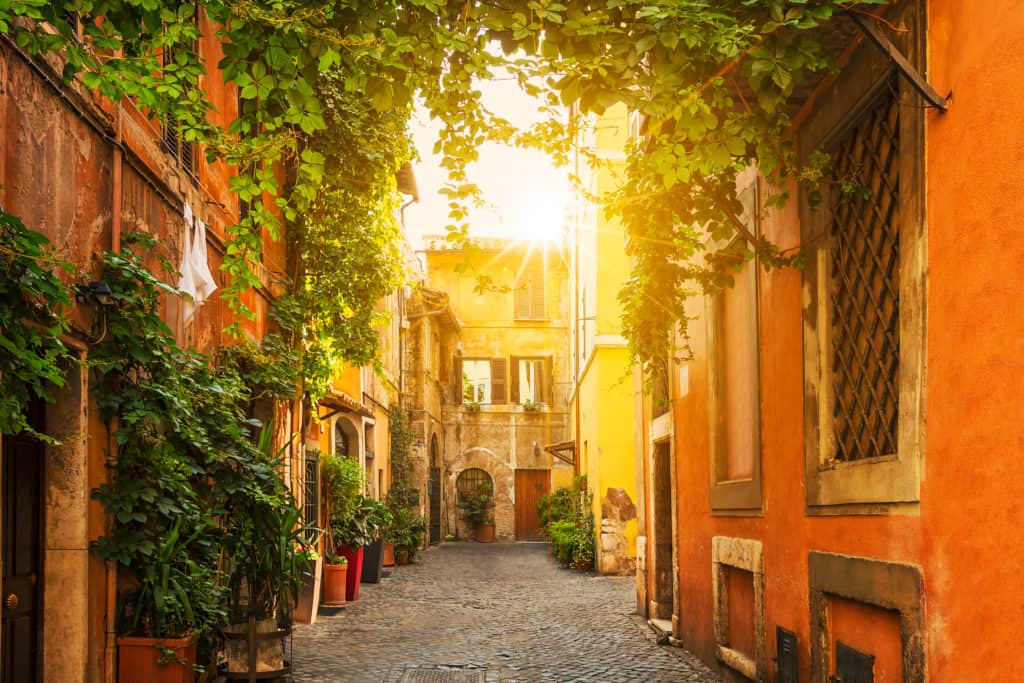
If you’re a fan of English Romantic poets, then you must make a pilgrimage to the Keats-Shelley House in Rome.
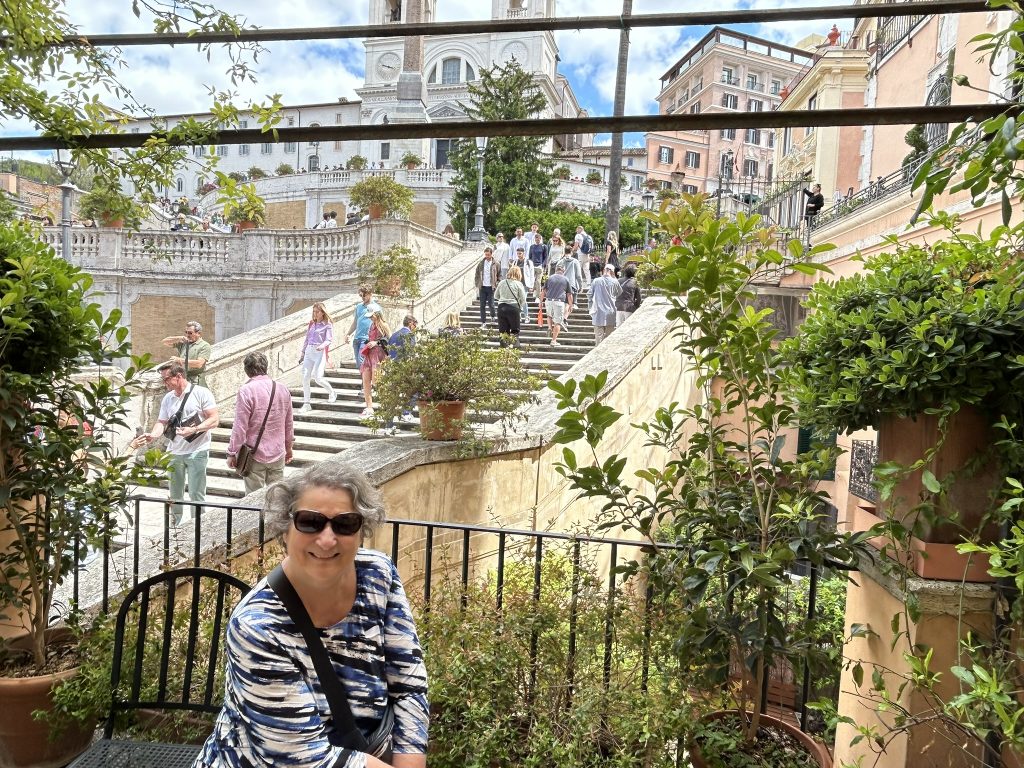
This lovely little literary museum is nestled right next to the world- famous Spanish Steps. Thousands of visitors mill around the piazza in front of the steps, climb the steps, and take pictures of the steps.
Yes, the steps are very attractive, with lots of flowers and a striking two-tower church at the top.
But in the end, the steps are, well, steps. If you go to the Spanish Steps, take a quick pic and then veer right to visit the Keats-Shelley House. You’re in for a first-rate Artsy Traveler experience.
Best For: Literature lovers, poetry enthusiasts, niche cultural travelers
Time Needed: 45–60 minutes
Location: Piazza di Spagna, directly beside the Spanish Steps
Why Go: Authentic period rooms, moving memorials to Keats, rare manuscripts, and a contemplative escape from Rome’s crowds
Opening Times: Monday–Saturday: 10:00–13:00 & 14:00–18:00; Closed Sundays and public holidays
Cost: General admission: €8–€10 (varies by exhibition); Reduced tickets available for students and seniors
Literary Leanings
If you’ve been reading the Artsy Traveler blog for awhile, you know that I write arts-inspired historical novels. My first three historical novels feature a painter (The Towers of Tuscany), a composer (A Woman of Note), and an actress (The Muse of Fire). My latest novel, The Choir, revolves around a singer.
So, as a novelist, I’m a lover of literature, and what could be more literary than two of the greatest Romantic poets?
Also, back in the day when I went to university in England, I took my degree in English Literature. As a result, I studied a lot of poetry, particularly by Shelley.
So to enter rooms where Keats and Shelley hung out is a pilgrimage.
Touring the Keats-Shelley House
The Keats-Shelley House is extremely easy to find thanks to its location next to the Spanish Steps. You’ll also see the banner hanging outside.
The Keats-Shelley House is open from 10 AM to 1PM, and 2-6 PM, and offers a special rate for seniors 65+ and students.
The ticket attendant got on my good side by telling us we didn’t qualify for the senior’s rate because it’s only for people over 65. Awww. That was kind of her.
But needless to say, I corrected her and got the reduced rate.
Enter the museum and climb to the first floor where you’ll find the tiny gift shop (more on that later) and the ticket desk.
After paying the entrance fee, turn right to tour a series of beautiful rooms containing a great many treasures and curiosities connected to the lives and works of several of the Romantic poets and their associates.
You’ll see letters written by Keats, Shelley, Bryon, Mary Shelley, Wordsworth, and other luminaries from the time. The evenness of their penmanship puts most modern folks to shame!
Also on display are drawings, snippets of poetry, paintings, and other memorabilia. The explanations are clear and informative.
Why The Poets Loved Italy
Back in the 18th and 19th centuries, with a decade or two off during the beginning of the 19th century for the Napoleonic Wars, Italy was a mecca for poets and writers from northern climes, including the Romantic poets from England, and Goethe from Germany.
These writers loved Italy’s warm weather, easy-going life, and the inspiration to be found in so many centuries of history. What attracted them to Italy back then isn’t very different from what attracts me to Italy today.
It’s a very special country with so much to offer. No wonder I keep coming back year after year!
Rooms in the Keats-Shelley House
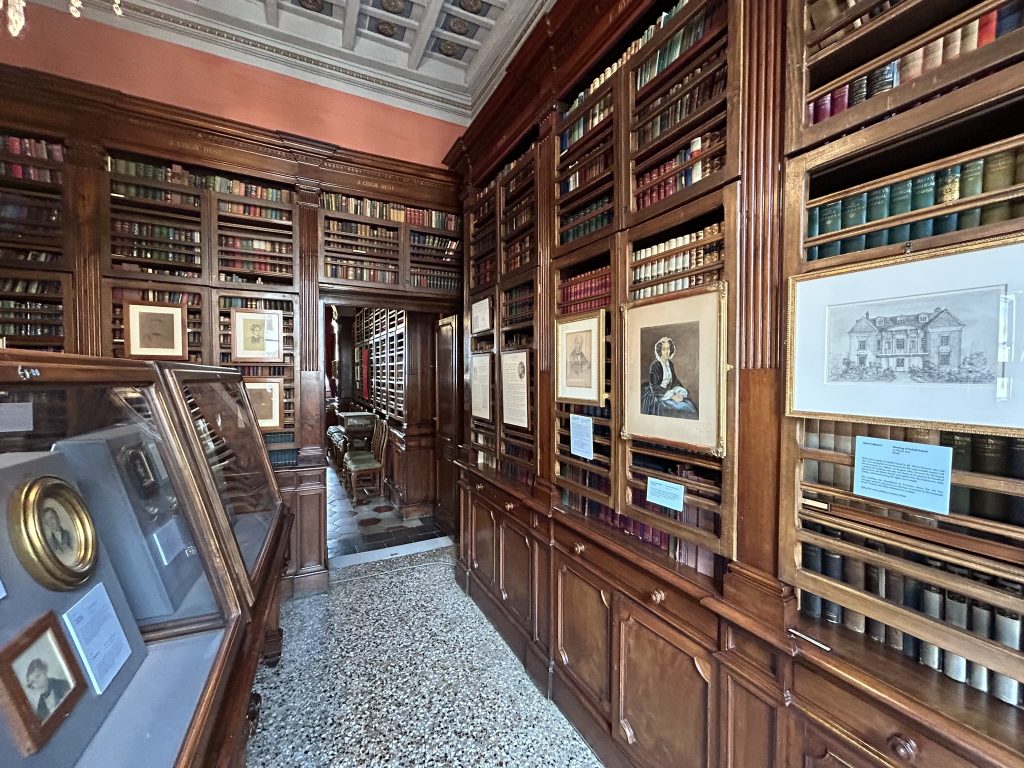
The Keats-Shelley House includes a library of more than 8,000 volumes. It’s considered one of the finest libraries of Romantic literature in the world.
Thoughtfully presented displays provide a lot to read as you prowl around the rooms. You could spend a great deal of time here!
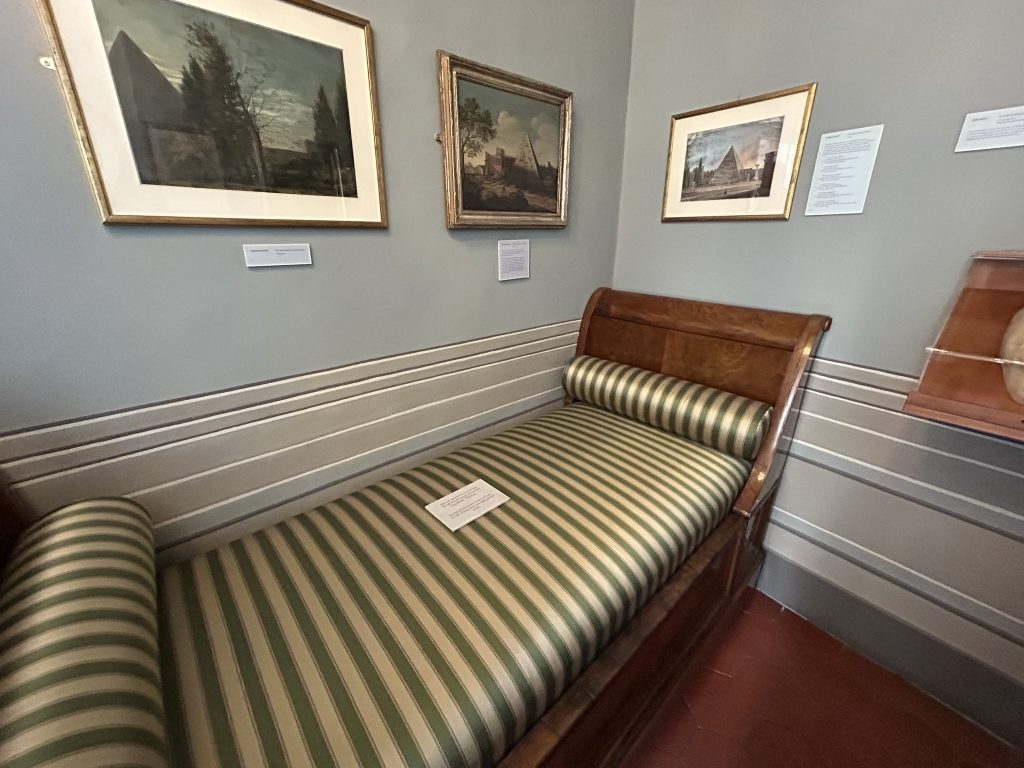
The tour through the rooms ends at the tiny bedroom where John Keats died on February 23, 1821, at just 25. It’s astonishing how he was able to compose so much sublime poetry in so few years. The museum includes plenty of information in English and Italian about Keats, his life, his tragic death, and of course his poetry.
Was it a vision, or a waking dream? Fled is that music:—Do I wake or sleep?
From Ode to a Nightingale
Here is the bed on which Keats died.
Byron’s Bicentenary
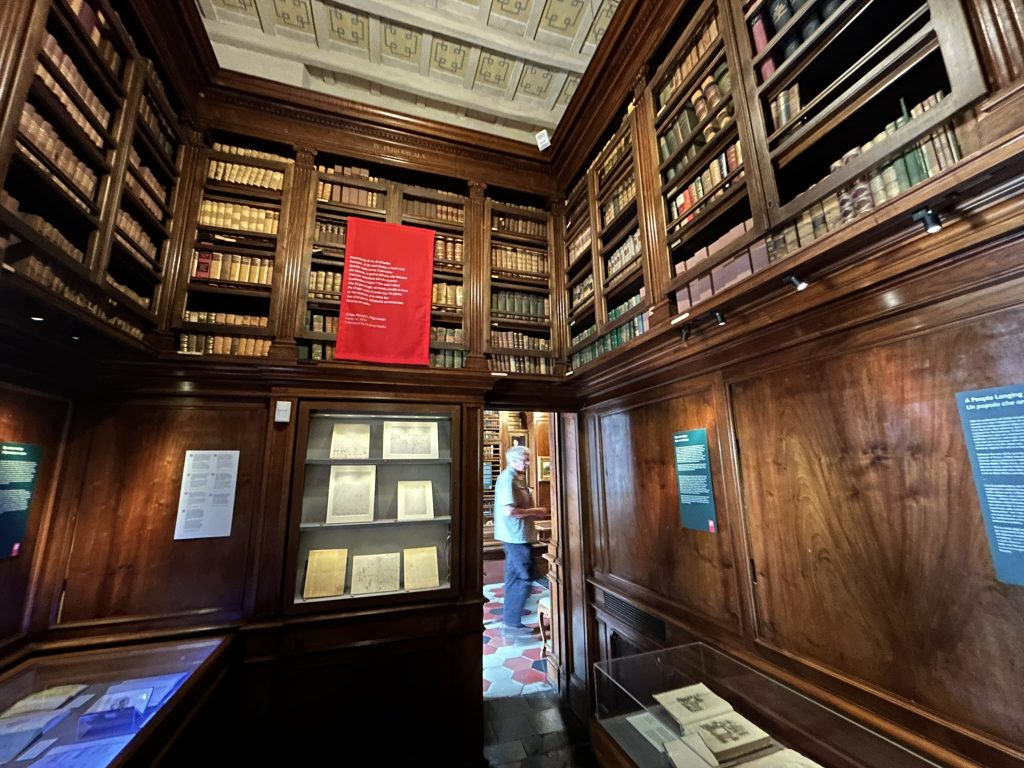
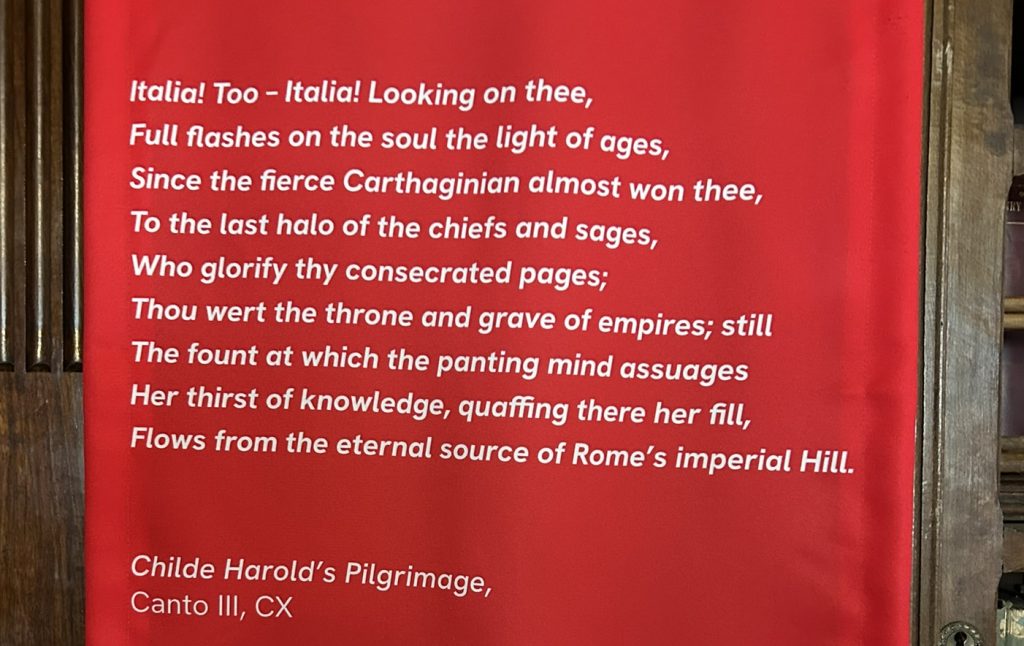
At first, I was mystified by the several banners related to Byron on display in the main library. After all, it’s the Keats-Shelley House. The very friendly and knowledgeable attendant told us that the House is celebrating the Bicentenary of Byron’s death in 1824.
His poetry was figured prominently on red banners. I hadn’t read Byron for many years, so it was a real treat to reacquaint myself with some of his poetry.
We had a great chat with the attendant about the poets, Mary Shelley and her mum Mary Wollstonecraft, and the arts in general.
I mentioned that I’d interviewed Samantha Silva, author of Love and Fury about Mary Wollstonecraft on The Art In Fiction Podcast. Since the attendant was obviously interested in the era, I figured she might want to read the novel (highly recommended, by the way). She was delighted to learn about it and promised to look up the podcast.
I also told her about my novels and gave her one of my bookmarks because, well, marketing.
The Terrace at the Keats-Shelley House
A highlight of a visit to the Keats-Shelley House is walking out onto the sweet little terrace overlooking the Spanish Steps. Imagine Keats and the gang sitting out there on a warm May afternoon sipping tea and talking poetry!
It’s pretty cool to think that the view Keats saw was similar to the view we see today.
The house included drawings of the Piazza Spagna and the steps in the early 19th century, and indeed, not much has changed if you look beyond the ground-floor shops.
The Gift Shop
After thoroughly enjoying touring the rooms, we exited via the gift shop. I couldn’t resist buying a cloth bag with a Grecian Urn on it, homage to Keats’s Ode to a Grecian Urn.
I also studied the collection of fridge magnets. We’ve taken to buying them most places we visit. Back home, our fridge door is getting pretty full up, but there’s always room for one more, or in this case, three.
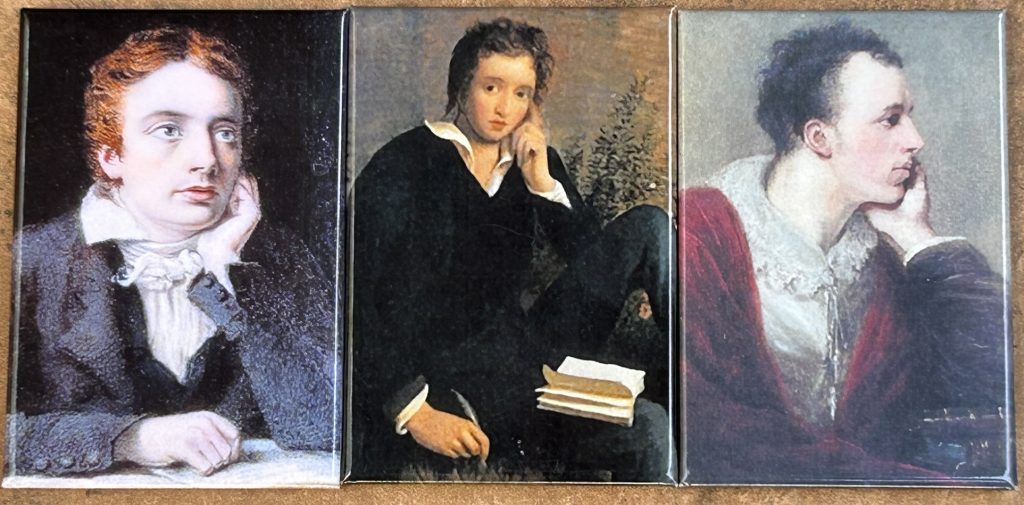
I couldn’t decide which magnet to buy–Keats, Shelley, or Bryon–and so I bought all three.
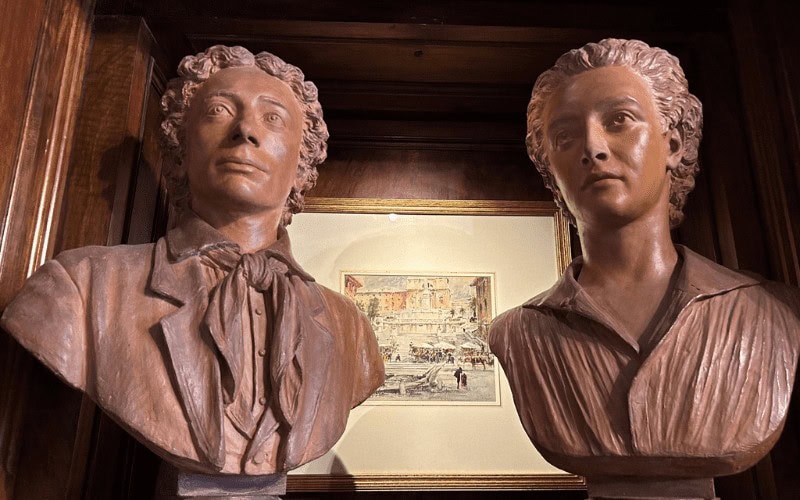
Here they are: Keats on the left, Shelley in the middle, and Byron on the right. These guys were all in their twenties and early thirties when they were hanging out together, and all three died young.
They’re rather like the rock stars of their time, living with unbridled passion and energy that burned out quickly, but wow, what a legacy they each left in their wake!
Keats-Shelley House FAQs
Here are some questions I’ve been asked about visiting the Keats-Shelley House in Rome:
Is the Keats-Shelley House worth visiting?
Yes, especially if you enjoy literature, history, or quiet, meaningful museums. The house offers a moving glimpse into Keats’s final days and showcases rare artifacts from Keats, Shelley, Byron, and other Romantic poets.
How long does it take to visit the Keats-Shelley House?
Most visitors spend 45–60 minutes exploring the rooms, reading the displays, and browsing the library and exhibitions.
Where is the Keats-Shelley House located?
It’s at the base of the Spanish Steps in Piazza di Spagna. Looking up the Steps, you’ll find the entrance immediately to the right.
What is the significance of the Keats-Shelley House?
The museum preserves the room where John Keats died in 1821 and houses one of the world’s finest collections devoted to the English Romantic poets.
Is the museum suitable for kids?
Yes, but it’s a quiet, contemplative space. Teens studying literature usually enjoy it most.
What else can you combine with this visit?
The Spanish Steps, Piazza di Spagna, Babington’s Tea Rooms, the Propaganda Fide complex, the Trinità dei Monti, and Via Condotti.
Artsy Tours in Rome
I couldn’t find any literary-themed tours in Rome on GetYourGuide, so here’s a selection of tours related to music to locations mentioned in Dan Brown’s Da Vinci Code series.
Note that I include tours listed on the GetYourGuide website because I’ve taken and enjoyed many of their tours.
Carol M. Cram is the author of five award-winning novels inspired by art and the women who shaped it, the creator of Artsy Traveler, an arts-focused travel blog, the founder of Art In Fiction, a curated database of 2,600+ novels inspired by the arts, and the host of The Art In Fiction Podcast. She lives with her husband, artist Gregg Simpson, on beautiful Bowen Island near Vancouver, BC.
You’ve arrived in Rome! Maybe you’ve been lucky enough to catch a glimpse of the Colosseum as your taxi whisks you to your accommodations.
There it is! It’s huge! OMG!We’re in the Eternal City!This is SO cool!
Yes, the Colosseum is amazing, and visiting it is one of the great travel experiences of a lifetime, but only if you do it right.
You don’t want to be one of those first-time visitors who shows up without a timed-entry ticket or joins an overcrowded tour that rushes you past the very things you came to see.
Before you visit one of Rome’s most iconic destinations, check out these Colosseum mistakes to avoid, and learn some smart, practical tips for how to visit the Colosseum without wasting time, money, or energy.
Think of this post as your personal list of Colosseum dos and don’ts, including essential Colosseum skip-the-line tips, advice on the best tickets, and what to expect once you’re inside.
Also enjoy my first-person account of a Colosseum tour that did not go so well. Learn from my mistakes!
Best entrance: Stern Gate for guided tours; main entrance for standard tickets
Visit duration: 2–3 hours for all three sites
Common mistakes to avoid: Arriving without a timed ticket, starting at the Forum first, booking a mid-day tour, not bringing ID for tickets, not understanding what each ticket includes
Since my first visit to Rome a few decades ago, I’ve popped into the Colosseum four times. Three of those visits were great.
The most recent one was a nightmare.
The Colosseum itself hasn’t changed much apart from some restoration work over the decades. It’s still a massive ruin that, while impressive, bears little similarity to the magnificent original built over two thousand years ago.
Earthquakes, looting, and the general wear and tear of two millennia, not to mention the shuffling feet of millions and millions of visitors, have taken a toll.
What has changed for visitors in recent years is just how incredibly crowded the Colosseum has become. The Colosseum ranks as the number-one tourist attraction in Rome. Even St. Peter’s and the Vatican aren’t that crowded (although they are pretty much overrun).
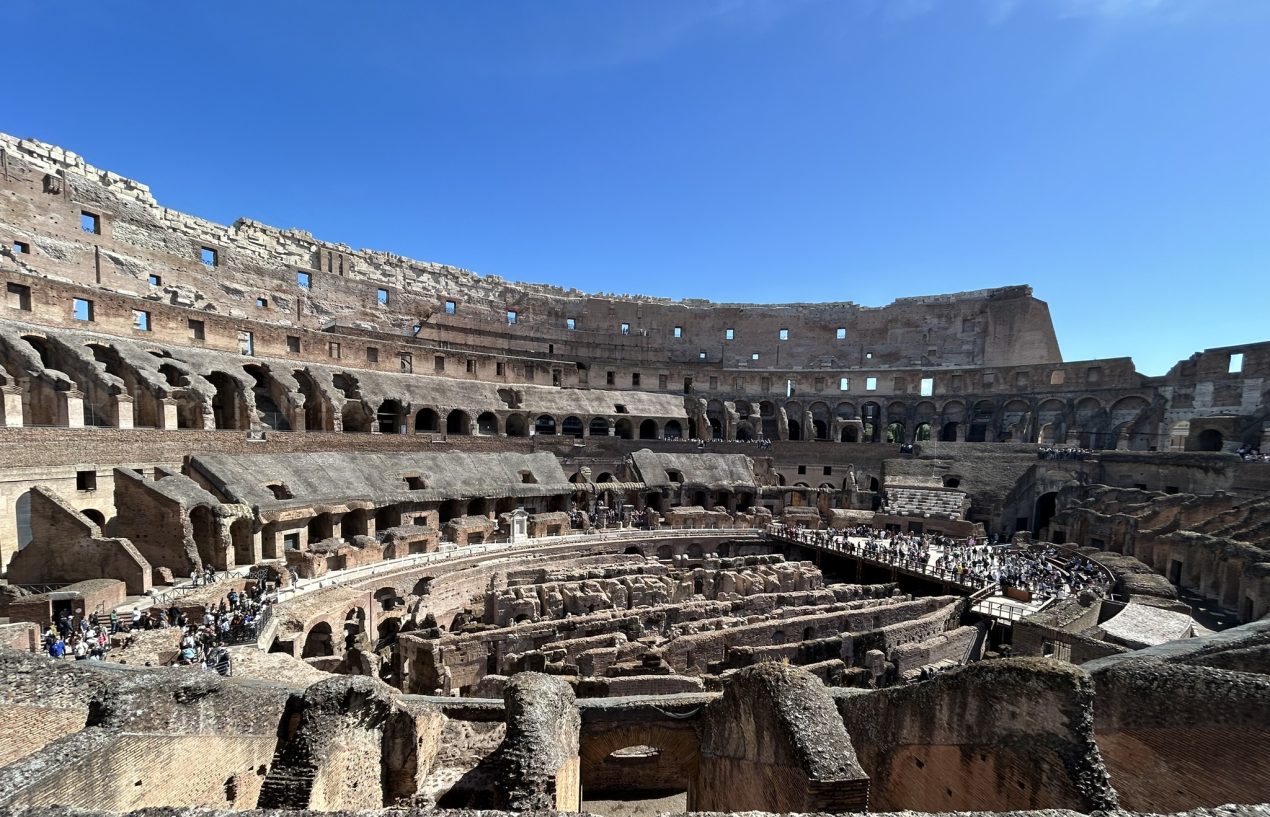
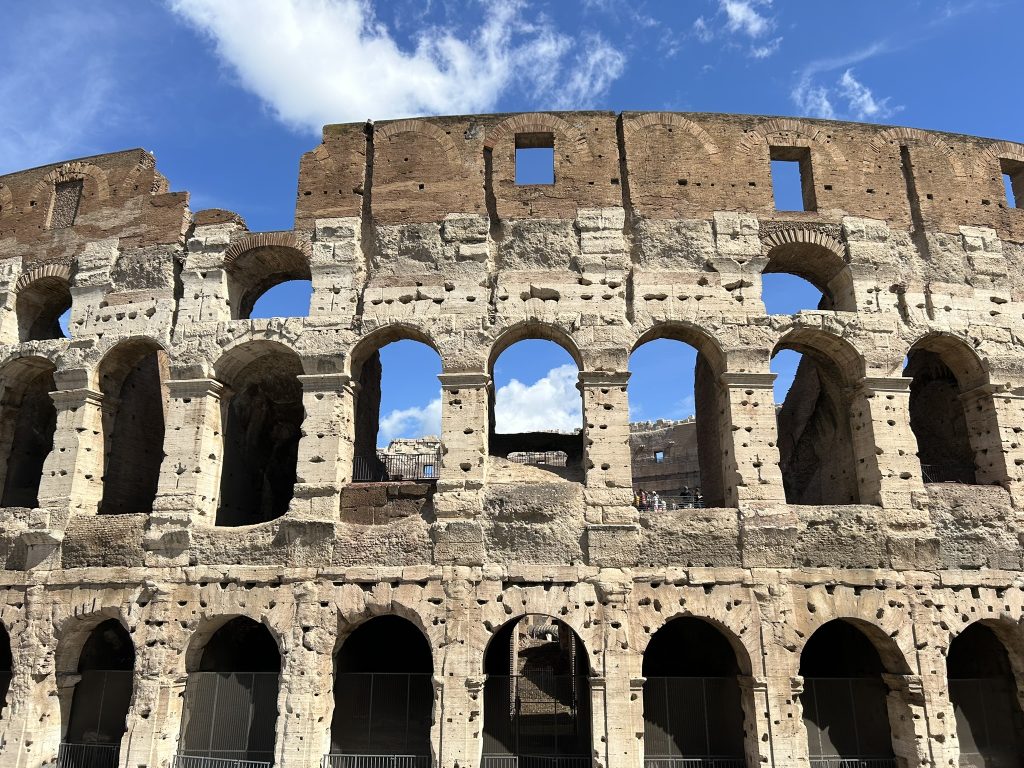
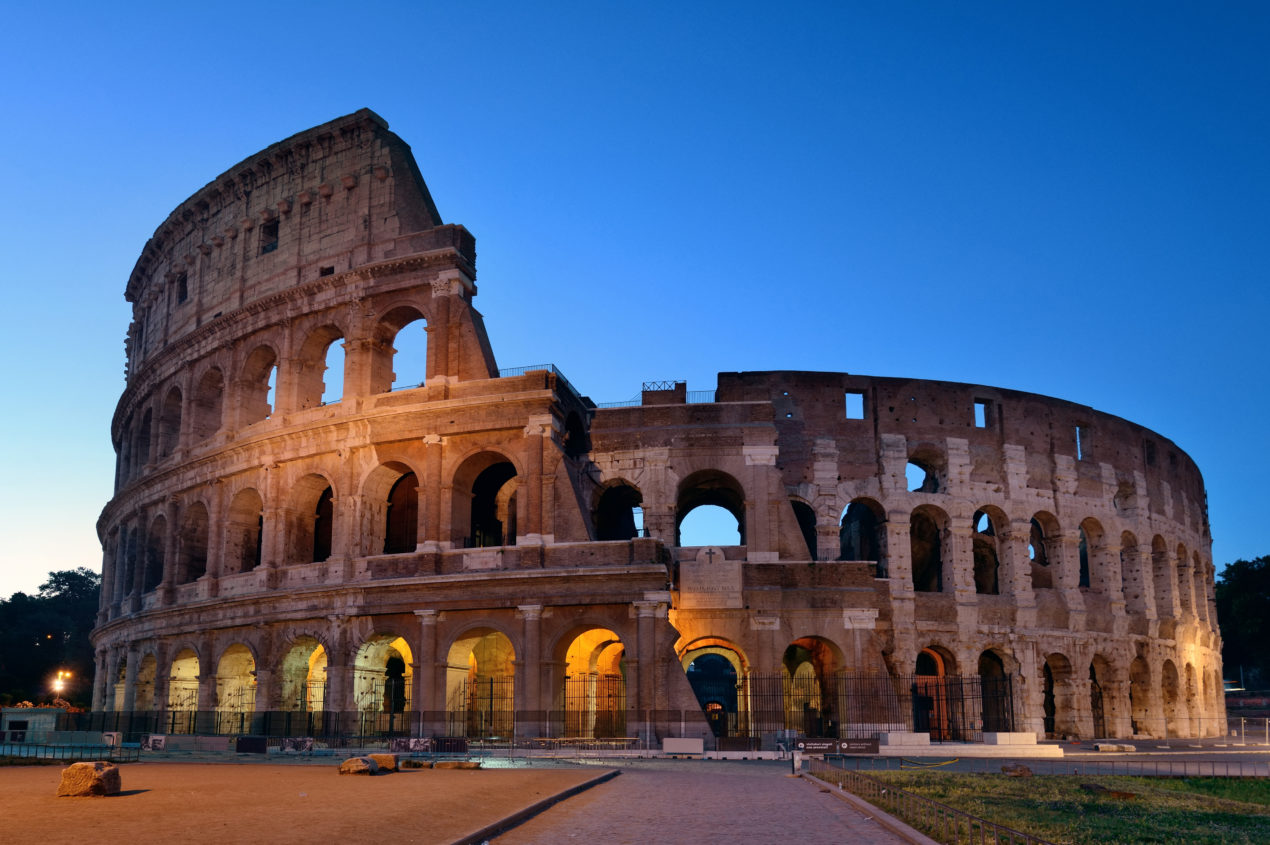
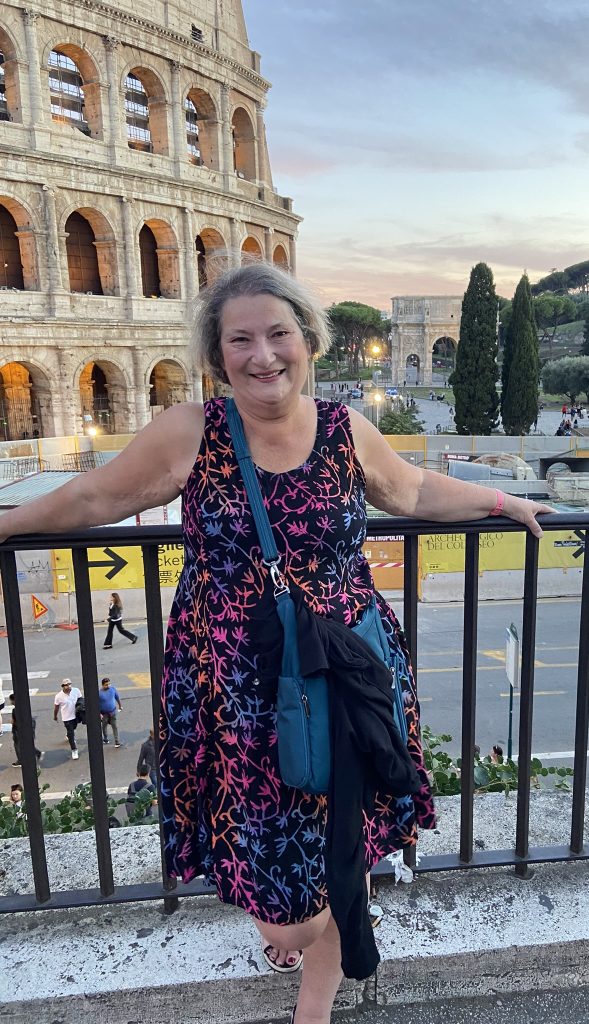
The Colosseum is amazing, for sure. But is it worth your time to go inside when you can snap a photo like the one below with zero effort?
Planning a trip to Rome? Artsy Traveler has you covered. From the Colosseum to photography tours to opera evenings, I publish new posts every week on the best cultural experiences Europe has to offer. Subscribe to the Artsy Traveler weekly update and never miss a post. Subscribe here.
Should You Visit Rome and Not Go to the Colosseum?
Gasp! Should you? If you want to enjoy this marvelous city and you’re visiting between April and October, then, quite frankly, you may want to skip visiting the Colosseum.
In this post, I’ll describe my latest visit. You can then decide for yourself if it’s worth several hours of your precious sightseeing time.
Or, would you be better off skipping the crowds and heading for some of the city’s quieter and infinitely more lovely sights such as the cozy Keats-Shelley House near the Spanish Steps?
Signing Up for a Colosseum Tour: Smart Idea or ?
As a savvy traveler (or at least so I like to think!), I know that the early visitor beats the crowds. The two-hour guided tour of the Colosseum I sign up for starts at 8 am and guarantees first entry into the site.
I imagine wandering through deserted passageways, the morning sun slanting pleasingly across the ancient ruins. The only sounds are the murmurs of the guide, a few tweeting birds, and perhaps the whispers of long-gone gladiators wafting up from the cells beneath the arena.
I mean, who starts sightseeing so early in the morning? Certainly, I’ll have the place to myself along with a handful of other intrepid travelers willing to sign up for an early-morning tour.
My Experience with a Colosseum Tour in May
Here’s how my “first entry” tour of the Colosseum panned out. Your experience may be different (and I hope it is!).
Finding the Tour
Promptly at 7:50 am, I arrive at the meeting point across the street from one of the entrances to the Colosseum and the Roman Forum. A crowd of at least fifty people, all proffering cell phones, is my clue that I’m in the right place.
I wait patiently for the beleaguered guide to check my phone, declare me valid, and press a small white sticker onto my chest. It’s now about 8:10 am, so obviously the tour doesn’t actually start at 8 am.
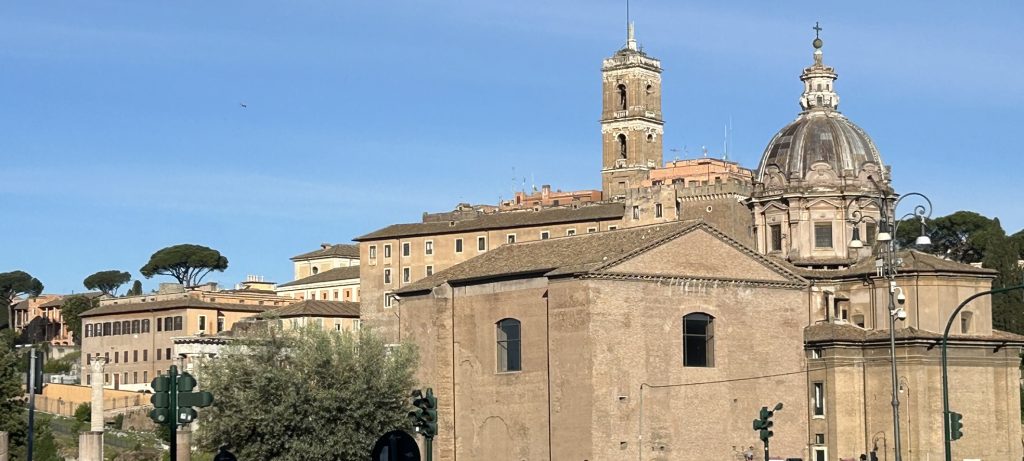
While waiting, I snap a photo of the Roman Forum across the street. It looks splendid in the early morning sun on one of the first really warm days I’ve experienced in Rome in early May.
Waiting to Enter the Colosseum
Several minutes later, we are ushered across the road to the entrance gate and told that the ticket takers open at 8:30 and that we will be first! (said with enthusiasm, like it is a rare treat and not what we’ve signed up for).
Ticket takers? I’d neglected to read the fine print of the tour. The cost of the tour I purchased does not include the cost of entry into the archaeological site which includes the Forum and Palatine Hill in addition to the Colosseum.
A word of warning: Check what’s included in your tour and choose a tour that includes the entry cost so the guide already has your tickets.
Lesson learned, I prepare to wait in line until the ticket booths open at 8:30–another fifteen minutes. Fortunately, I’m near the front of the line and the guide has assured us that we’ll be first into the Colosseum.
Isn’t that worth waiting a few extra minutes for?
Remember the tweeting birds, the silence of the ancient stones, the gladiator ghosts reminiscing about gladiator fights, the glorious isolation!
Buying a Ticket to the Colosseum
At precisely 8:40 am, the ticket takers open the two wickets and the first people in line eagerly step forward to buy their tickets. Yahoo! The line will surely go quickly and I’ll be inside the Colosseum communing with history and getting tons of inspiration for my next novel in no time flat.
8:50 am: The first people in line are still at the ticket booth.
9:00 am: The first people in line are still at the ticket booth. Oh wait! One of the groups has left and another couple has stepped forward. But at the other booth, the same four people are still talking with the attendant. What can they be talking about? What’s the holdup? Are they sharing recipes? Have they discovered a long-lost cousin? What gives?
The guide comes by and tells us to have our passports out and ready to show the ticket takers. What? I don’t have my passport with me although fortunately I do have my driver’s license. I ask the guide if that will do. Yes. Phew.
Important: Take along a copy of your passport when you visit sites and take tours in Rome.
Another five minutes go by and the first group of four finally leaves the booth. They are looking weary but relieved. I want to ask them what went down, but of course I don’t dare risk losing my place in line.
The next group steps forward. I take to counting to gauge how long they stay at the booth. Sixty seconds, another sixty, another sixty…five minutes and they’re done. Another ten minutes goes by during which a few more groups get to the booth and then several minutes later step away, tickets in hand.
The per-wait time is marginally decreasing.
Progress is being made.
My Turn Getting Tickets for the Colosseum
Finally, it’s my turn. I’m about to find out why it takes almost five minutes to process each person in a line that is now stretching back to the road and a considerable way along it. Did all these people book a group tour that required them to buy tickets?
I find out later that yes, they are all group tour people. The “regular” people who just want a ticket to the Colosseum without a tour buy their tickets at another booth. I’ll soon discover that many, many hundreds of them get inside the Colosseum long before we arrive.
So much for us being first!
Anyway, I’m at the booth.
“One for the Colosseum, per favore.”
“One?”
“Si.”
The attendant shakes her head as if to say what kind of a loser visits the Colosseum all by themselves first thing in the morning? I don’t share that my husband has elected to do the smart thing and spend a leisurely morning enjoying cappuccino and a walk about the chic ‘hood we’re staying in up near the Piazza del Popolo.
Instead, I push my driver’s license under the glass barrier, and she places it in front of her keyboard. Then, with two stiff fingers, she laboriously starts to type. No wonder this whole process is taking forever! She has to physically enter the ID for every single person in line, and she can’t touch-type.
Oh dear.
After about two minutes (possibly a record), she hands me back my driver’s license, I pay with my credit card, and then I go stand with my fellow line-waiters for the tour to begin.
It’s now 9:30 am, and remember: I arrived at 7:50 for the first entry tour. Sigh.
Starting the Tour of the Colosseum–Almost
Promptly at 9:45 am, only 1 hour and 45 minutes past the tour start time, our guide leads those of us who have Colosseum tickets marked 9:15 am to another loooooong line.
This is the line for all the Skip-the-Line group tours. As I said, it’s long.
Security Line at the Colosseum
We wait for another twenty minutes while the guide explains why progress that morning has been unusually slow. I’m at least heartened to find out that the current process is not normal. Apparently, there was a security incident (bomb scare?) a few days earlier, and since May 1 (it’s May 3rd), new procedures using a new security firm are being instituted.
Unfortunately, thorough testing is lacking so chaos reigns as the Colosseum ticket takers are obliged to enter everyone’s ID information into the computer and new security personnel are stationed at the entrances to the actual Colosseum to again check IDs and tickets.
Entering the Colosseum
We finally reach the front of the Skip-the-Line group tour line and enter the outer perimeter of the Colosseum.
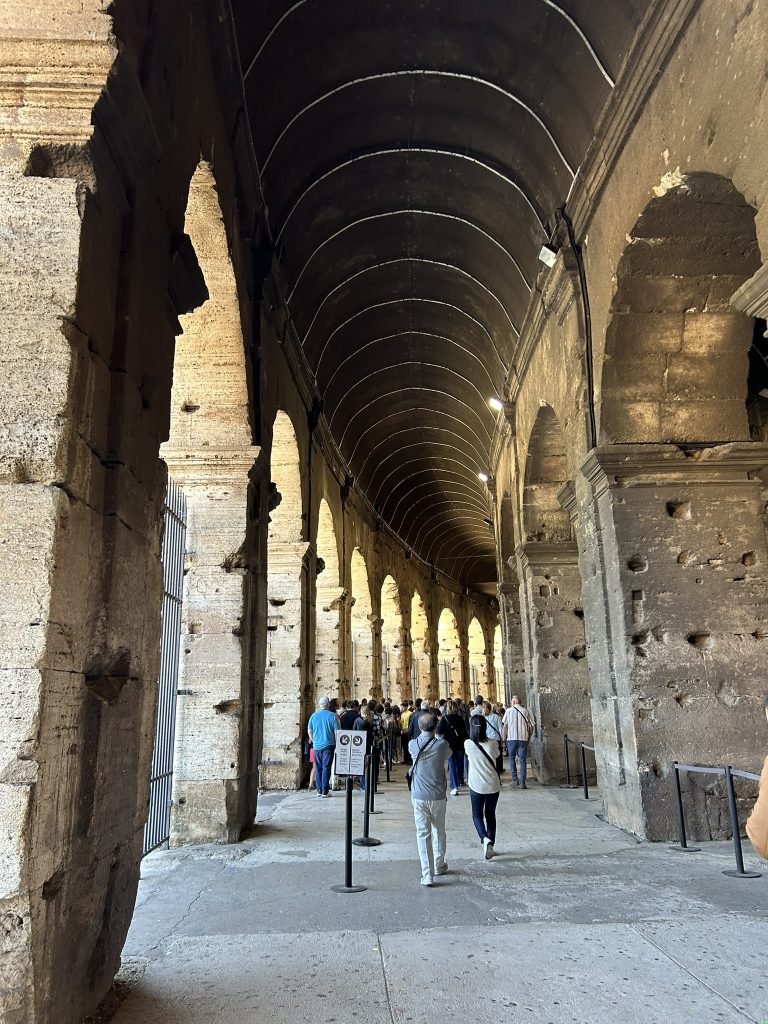
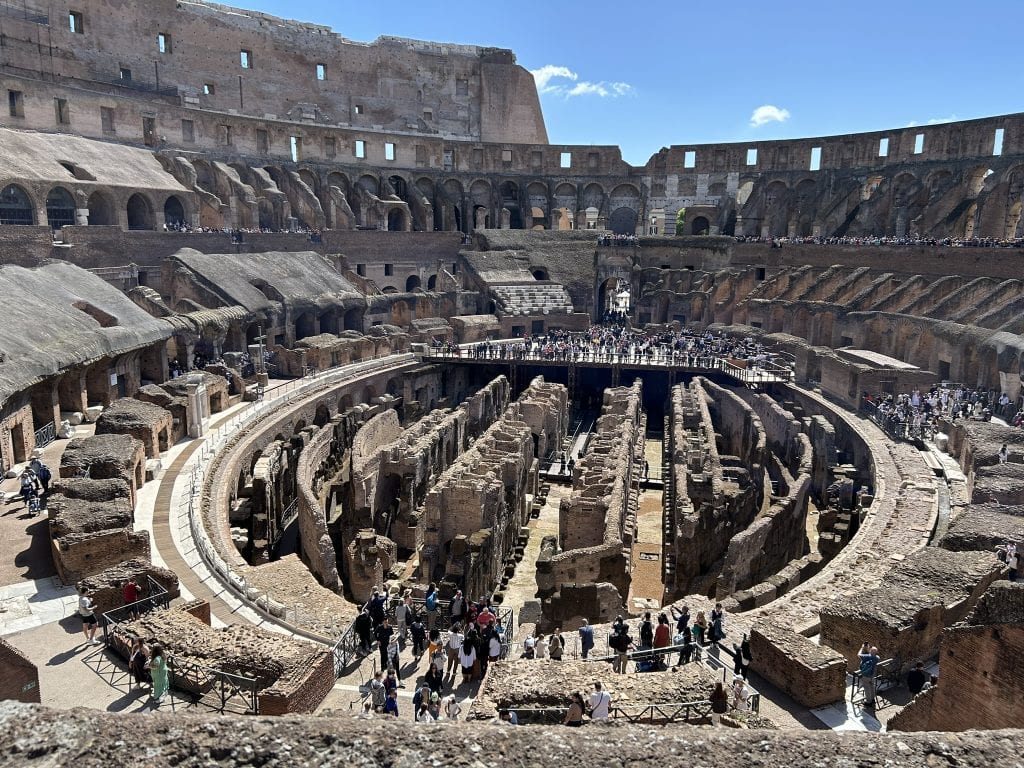
It’s big. Really big—much bigger than it looks from the road with massive columns that soar way up into the blue Roman sky. Inside, the arches are truly impressive. Roman engineering is a marvel.
The guide starts her spiel while leading us to yet another line. She tells us that construction of the Colosseum began between 70 and 72 CE during the reign of the Emperor Vespasian. Before then, the area had been a lake on the grounds of Nero’s Domus Aurea (golden house).
Nero was not popular, to say the least, and so the decision to replace his private lake with a public amphitheater hosting thousands of locals was a great way to erase him from recent history.
The next line moves a little quicker. The security people check IDs and then we line up for the security screening. As usual, people walk through the scanner with their pockets bulging with euros so back they must go while everyone waits. Sigh.
Not Everyone Loves Rome
The guide takes a break from her history lesson and cheerfully asks two people in the group where they are from. They reply that they are from Austria and that they will never again come to Rome because it is horrible and dirty.
I am offended on behalf of both myself and the guide who smiles gamely but I can see is a trifle nonplussed. I mean, rude much? Apparently, the Austrians booked a hotel that is less than stellar and that has colored their whole opinion of one of my favorite cities in the world.
I want to tell them that the place we’re staying at is absolutely wonderful. It’s clean, spacious and in an excellent location. Here’s the link to our serviced apartment called Viam 6B. It is one of the best places we’ve stayed in Rome, ever.
Perhaps the Austrians decided to cheap out. Rome is a fabulous place to visit, but accommodations are not budget friendly. Mind you, that’s true of just about every destination in Europe in recent years. The days of Europe on $5 a day (or even $100 or $200 a day) belong to the mid-20th century.
The guide decides not to ask the rest of the group about their experience. The mood is already a bit iffy considering we’ve all stood in lines for more than two hours for our first-into-the-Colosseum tour and haven’t actually started touring the Colosseum.
We are in it, but only just.
Climbing to the Top of the Colosseum
And then, finally, we’re in and the tour officially begins. The guide talks to us for quite a while about the history of the Colosseum and then invites us to trudge up three flights of very steep steps to look out over the arena.
We emerge into a surging Sargasso Sea of visitors all packed cheek by jowl along the railing much like the spectators must have done during the Colosseum’s heyday.
Everyone’s snapping selfies (something that wasn’t done during the days of the Roman Empire) and I suppose communing with their inner gladiator.
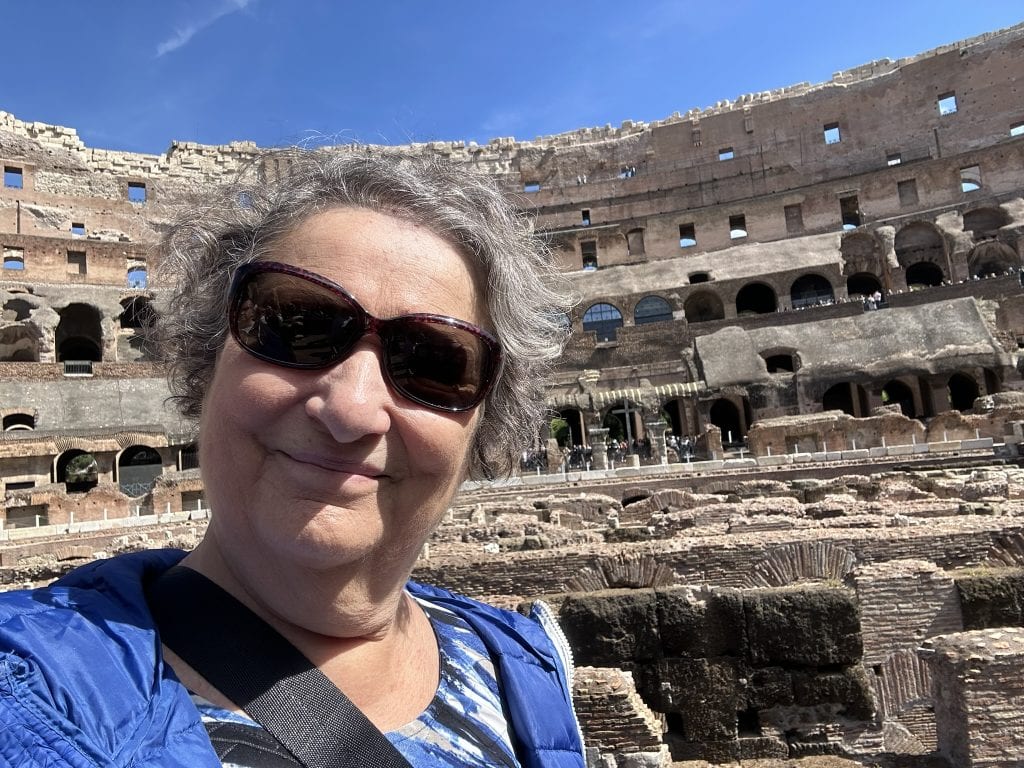
We walk and walk and walk some more around the perimeter to a slightly less crowded stretch of railing and get our one minute of time to snap pics of the ancient amphitheater. Of course I take a selfie.
Yes, it’s an impressive place, for sure. In its day, up to 70,000 screaming Romans watched gladiatorial combat, executions, triumphal celebrations, and other spectacles. Today, approximately 16,000 people visit the Colosseum every single day.
So although the place feels very crowded to me, it is positively empty compared to what it would have been back when the arena floor was covered in sand to better absorb the blood.
The guide talks about how wild beasts were starved for days before being let loose to gnaw on convicts, Christian martyrs, and anyone else the Emperor didn’t like. It’s the odd interesting fact such as this that you get from a guided tour.
Is A Guided Tour of the Rome Colosseum Worth the Wait?
Should you opt for a guided tour of Rome’s most famous monument, check it out on your own, or forget about it and do something that doesn’t involve rubbing shoulders (literally) with thousands of strangers?
You may have guessed my opinion, which is Door #3. The entire tour/ordeal lasted about three hours, with the least amount of time devoted to the tour and the most to waiting for the tour.
Now, to be fair, the extra security measures ate up a good chunk of those three hours. I don’t know whether these measures will be the norm going forward, in which case be prepared for waits, or whether they’re temporary. You’ll have to check that out before you book.
I don’t blame the tour guide for all the waiting. She was doing her best in difficult circumstances and to her credit remained cheerful and upbeat throughout. I gave her a 5-euro tip which appeared to surprise her, but hey, I figured she’d earned it.
Most people either didn’t tip or gave her 5 euros for their entire party which I thought was rather cheap of them. Tips are not required, but it’s a good idea to give the guide a little extra considering they probably don’t get paid all that much, and it’s a challenging job at the best of times.
When To Visit the Colosseum
The moral of the story is that however you slice it, sites like the Colosseum are really, really popular. You can try to beat the crowds, but I don’t think in any universe you’ll avoid waiting in long lines.
My advice? Either visit the Colosseum during the off-season (November to March) when crowds are thinner, or forget about it and go see some of the city’s other awesome sites.
Touring the Colosseum On Your Own
What about the second option—seeing the Colosseum on your own? I think it may be marginally the better option because you don’t need to arrive at a location two hours ahead of when you get in. Instead, you buy your skip-the-line ticket in advance and then go straight to the ticket line.
Once you’re inside the Colosseum, there’s really not a whole lot to see after you’ve walked as far as you’re allowed around the top tier and taken numerous pictures of the arena below. If your ticket includes an audioguide, you can stand and listen for a while, but all in all, an independent visit to the Colosseum is maybe 30 minutes (not counting waiting in line to get in).
Tickets & Tours Comparison
If you do opt for a tour, GetYourGuide has plenty to choose from. Choose a tour that includes a ticket to the Colosseum and the Forum so you don’t have to line up to buy your ticket separately. Also, you may be better off booking a tour in the late afternoon or opt for one of the evening tours instead.
Here are some options:
Standard Colosseum Ticket
Includes
Colosseum (upper level viewing areas vary)
Roman Forum
Palatine Hill
Timed-entry slot
Best for
First-time visitors who want the classic highlights without extras
Why choose it
Simple, affordable, and gets you into the three major sites
If you like tours then yes, especially during busy seasons. You might skip long lines, and you will learn the stories behind the ruins and navigate the site more efficiently. But read about my experience and decide for yourself if a tour is for you.
How long does it take to visit the Colosseum?
Plan for 2–3 hours to visit the Colosseum, Roman Forum, and Palatine Hill. As mentioned, the Colosseum itself doesn’t take long to check out unless you’re doing a tour of the Underground and Arena Floor.
Do I need to bring ID for my Colosseum ticket?
Yes; tickets are often name-specific and security may request ID. Bring a copy of your passport.
What is the difference between the Arena Floor and Underground tour?
Arena Floor = access to the reconstructed stage Underground = staging corridors, elevators, hypogeum (most historical depth). Both are cool and usually require a tour. Here’s an option with GetYourGuide.
What’s the best time of day to visit the Colosseum?
I didn’t have much luck arriving early, so I suggest late afternoon when the crowds thin and lighting is beautiful.
Are Colosseum tickets refundable?
Most are not; double check when booking and avoid third-party sellers without reviews.
Other Sites in Rome
Rome is chock-a-block full of amazing things to see and do. Here are some of my favorite sites in Rome. You’ll note that I don’t include big ticket items like the Vatican Museum, St. Peter’s, the Pantheon, and the Trevi Fountain, all of which are overrun with visitors.
These are just a sampling. There are also a ton of fabulous churches, some with Roman foundations. A really cool thing to do is take a photography tour of Rome’s churches with Rome Photo Fun Tours. Check out my post to read about my experience (highly recommended).
My Favorite Activity in Rome
My favorite Rome activity is walking around the various neighborhoods and avoiding the bottleneck areas around the Pantheon, Piazza Navona, St. Peter’s Square, and especially the Trevi Fountain.
If you want to experience any of those places crowd-free, either swing by late at night or go for a very early morning stroll.
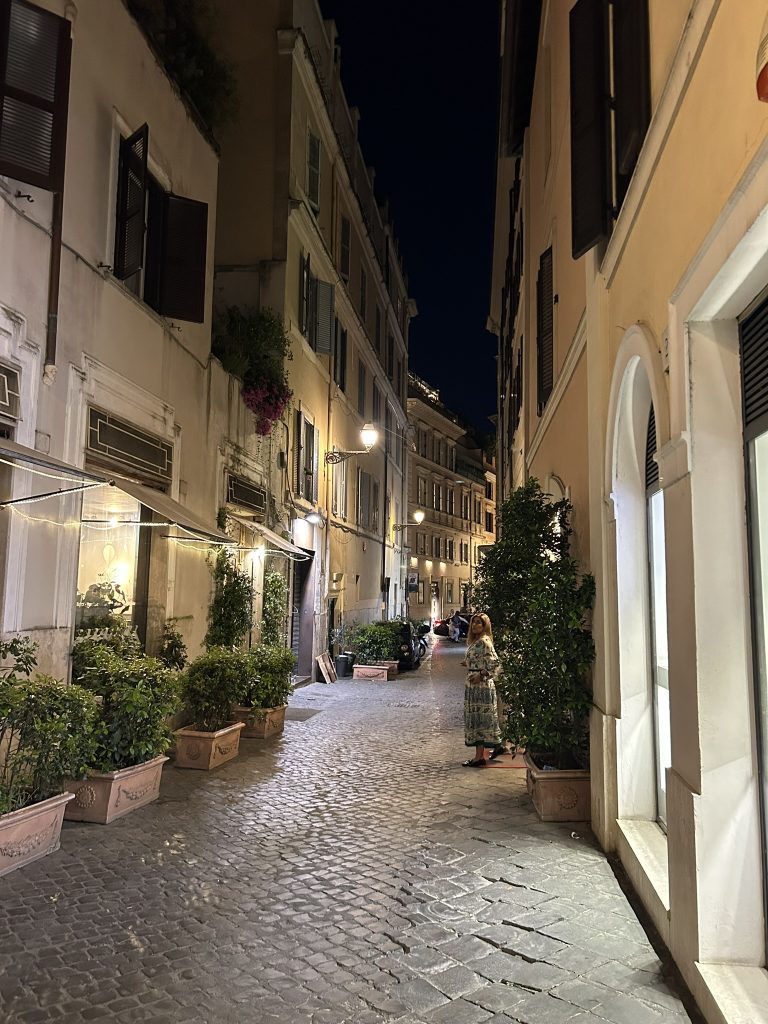
Here’s a shot taken on our way home after a scrumptious dinner in a restaurant on an atmospheric side street just steps from where we stayed at Viam 6B, not far from the Spanish Steps.
Accommodation Options in Rome
I’ve visited Rome numerous times and have always found excellent accommodations, generally in serviced apartments.
Here are four of my favorites from my two most recent trips to Rome:
Sant’Angelo Apartments in the Jewish Ghetto area of Rome, very close to a lot of Roman ruins in addition to the Capitoline Museum and the Piazza Venezia, site of the Victor Emmanuel monument. The apartment was very atmospheric and in an excellent location for exploring ancient Rome.
Viam 6B, located between the Spanish Steps and the Piazza Popolo, is in a very upscale and chichi part of Rome with lots of designer stores. Our apartment at Viam 6B was very modern and comfortable and included a beautiful outdoor terrace. Viam 6B is also staffed which is helpful for getting directions and ordering taxis.
Torre Capranica is located right smack in the middle of old Rome, steps from the Pantheon and the Piazza Navona. Each of the stylish apartments is contained within a medieval tower. Our apartment on the third floor had a great view of the piazza below. This place is awesome!
Monti Apartments is located in the wonderful Monti neighborhood not far from the Colosseum. This place is spacious, well-equipped, and has an elevator. Its central location is perfect for touring all over Rome.
More Tour Options for Rome
Touring major sites such as the Colosseum and Vatican in Rome can get tiring. Why not take a break and opt for a more relaxing experience, such as this food tour of the lively Trastevere district (one of my favorite areas of Rome)?
If you enjoy walking tours, I recommend the tours offered by GuruWalks. Here are a few of the tours available in Rome.
Recommended Novels to Read Before You Go
The Wedding Shroud by Elisabeth Storrs follows Caecilia, a young Roman woman married off to an Etruscan nobleman to seal a fragile truce between Rome and Veii in 406 BC. Living among a culture that offers women freedoms unthinkable in her own, she finds herself caught between loyalty to Rome and an unexpected love for the city that’s become her home. A vivid look at the world of rival city-states and cultural clashes that Rome would eventually absorb and outlast, centuries before its emperors built the Colosseum to showcase the empire that resulted.
The Deadliest Fever by June Trop follows Miriam bat Isaac, a budding alchemist and amateur sleuth in first-century CE Alexandria, investigating a damaged Torah mantle at the city’s Great Synagogue that hints at something far more dangerous than vandalism. As she digs into who’s responsible, she finds the people closest to her aren’t quite who they seem. Set in the same decades the Flavian emperors were raising the Colosseum across the empire in Rome, the novel is a reminder of how vast and varied daily life was across the Roman world at the time.
To see all my posts about Italy, check out the Visiting Italy page. Here are more posts about Rome, one of my favorite cities in the world. I’ve visited eight times, and I’m not done yet!
About Carol Cram
Carol M. Cram is the author of five award-winning novels inspired by art and the women who shaped it, the creator of Artsy Traveler, an arts-focused travel blog, the founder of Art In Fiction, a curated database of 2,600+ novels inspired by the arts, and the host of The Art In Fiction Podcast. She lives with her husband, artist Gregg Simpson, on beautiful Bowen Island near Vancouver, BC.
Fancy taking a cooking class while you’re visiting Rome?
I highly recommend the experience. I’m a huge fan of taking cooking classes when I travel around interesting locales that have unique cuisines.
So far, I’ve taken a market class and a French sauces class (sweet and savory) in Paris, a tapas class in Madrid, and a pasta & tiramisù class in Rome.
In this post, I share my experience taking a Pizza, Gelato, and Suppli-Making class in Rome.
Choosing a Class in Rome
Most cooking classes available in Rome are variations on the pasta/tiramisù class I took on a previous trip to Rome. Fortunately, after a bit of searching on GetYourGuide, I discovered a pizza and gelato-making class.
Perfect! I signed up on Tuesday for the class on Friday.
EnjoyCooking.com with Crown Tours
I’d taken the pasta/tiramisù class with InRome Cooking, which I highly recommend. But this time, I decided to go with EnjoyCooking.com for the sake of variety and having a new company to write about on Artsy Traveler.
EnjoyCooking.com partners with Crown Tours to offer cooking classes in a lovely, brick-arched space next door to their tour office and across the street from the Colosseum.
The day before the class, I got a WhatsApp call from the company. The family that had signed up to take the same class had canceled, leaving me on my own.
Did I want to postpone the class to the evening slot? I couldn’t because that evening, we were having the opening of my husband Gregg Simpson’s art exhibition at Il Leone Galleria in Rome. I was assured that they were happy to still offer the class at the 10 am time slot even if I was on my own.
Lucky me!
Arrival at EnjoyCooking.com
I arrived on Friday morning and was ushered into the cooking space. There was room for eight people so it was much more intimate than the class I took at InRome Cooking which hosted twelve.
To my delight, there was one other woman in the class. Over the course of the next three hours, we bonded and had an awesome time.
Chef Marco!
But the biggest surprise was meeting the chef. In walked Marco, the same chef who had taught the pasta/tiramisù class at InRome Cooking.
I couldn’t believe it! I told him I’d taken his class and showed him the blog post. He was so excited!
Back again with Chef Marco, this time at EnjoyCooking.com
So that was a great way to kick off the morning.
Over the next three hours, Chef Marco led my new friend and me in a lively, hands-on and informative class. I’m always amazed at how much I learn about cooking technique in these classes.
Gelato Making
We started with gelato. To my relief, I discovered that the ice cream maker I’d purchased several years ago could be dragged out, dusted off, and used to make gelato.
We heated several pints of fresh milk in a pot over an electric hot plate. Marco informed us that the milk should be as fresh as possible, so fresh that it would spoil after three days.
Of course, getting milk that fresh is next to impossible in North America unless you live on a farm, which I don’t. But the next best thing is high quality organic milk.
We heated the milk and whisked in sugar followed by ten egg yolks and lemon zest to make limone gelato. The lemons had come from the Amalfi coast and smelled divine.
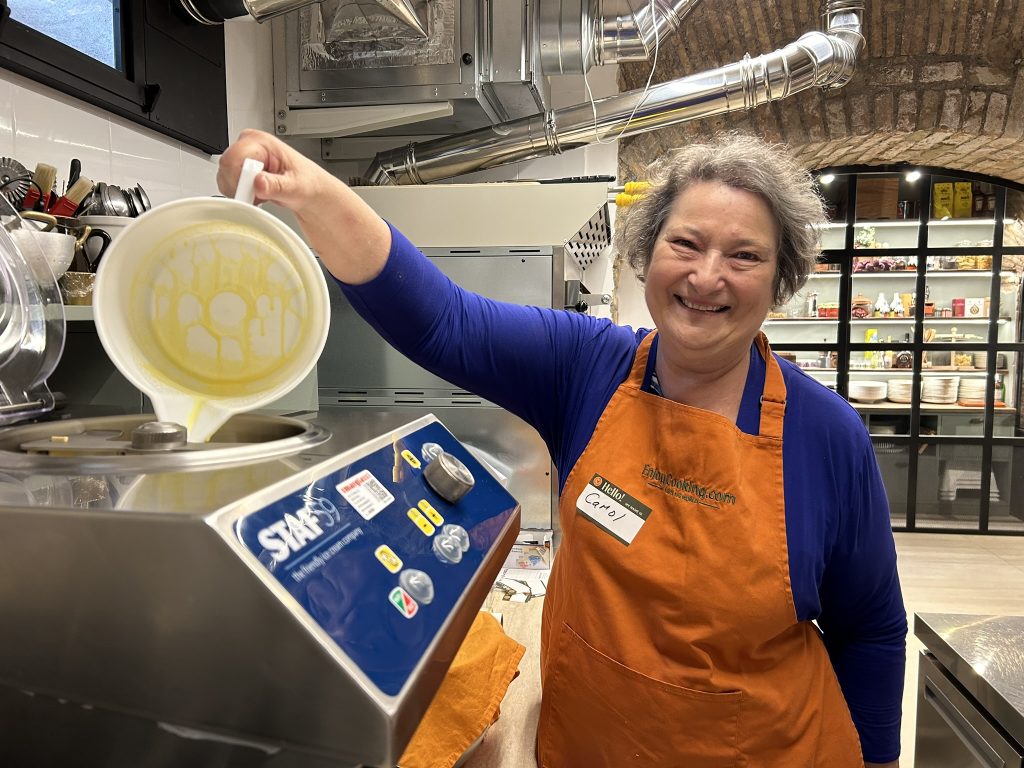
After mixing the gelato, we poured it into the commercial gelato maker that would produce perfect gelato within thirty minutes.
What an impressive looking machine!
Marco informed us that we would also make raspberry sorbetto to go along with the limone gelato. Sorbetto is even faster and easier to make than gelato.
We mixed water with raspberries and once the gelato was made, we poured it into the gelato-maker (after the limone gelato was done, of course).
Here’s a video of the raspberry gelato being extruded from the gelato maker—an exceedingly beautiful and satisfying sight.
Suppli-Making
I had never heard of suppli, a Roman street food that is widely available throughout the city.
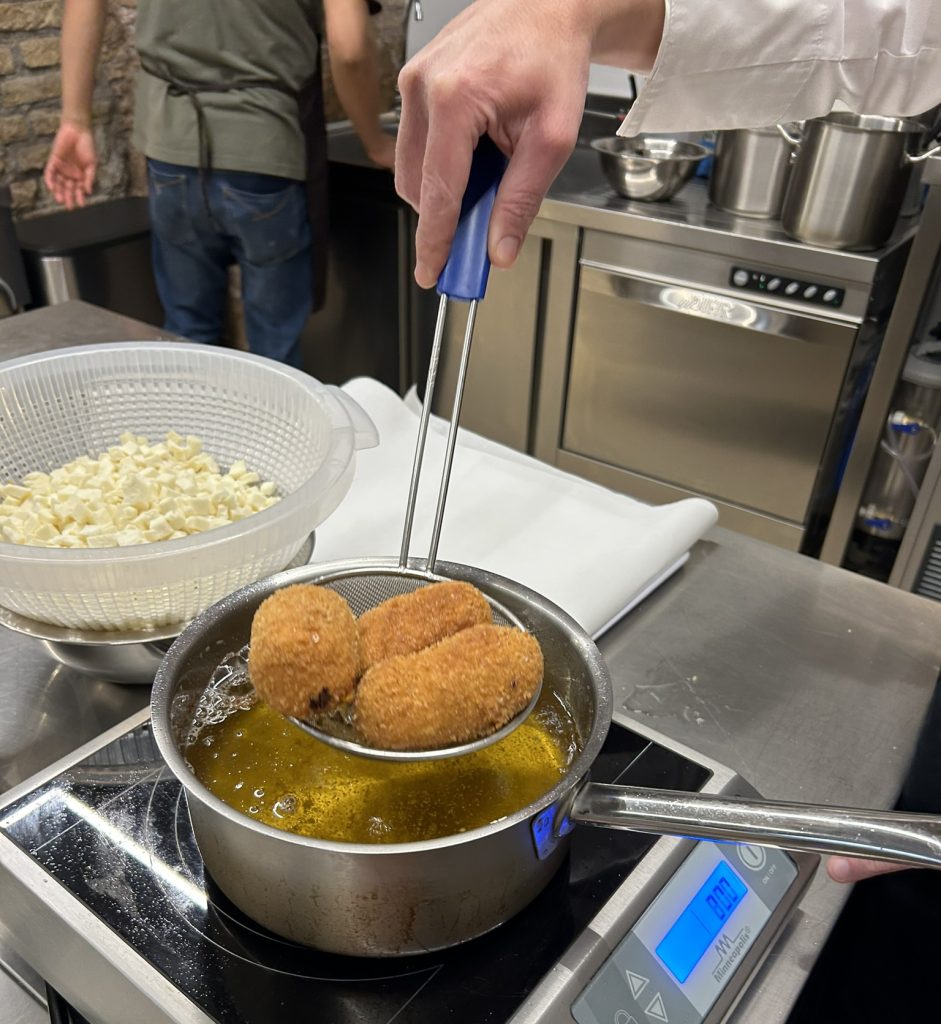
Marco showed us how to take rice cooked in tomatoes and form it around fresh cubes of mozzarella cheese, then bread and deep fry it. The result was a log-shaped rectangle that when still hot and pulled apart stretched the warm mozzarella cheese.
It was yummy but a bit rich for me at only 11 am!
But when in Rome…!
Pizza-Making
The main event of the cooking class was making pizza the proper way—like they make piazza in Napoli where Marco is from.
I learned that the pizza dough should be rested for two hours after mixing and then rested in the refrigerator for up to three days.
That was new to me. I’d always let my piazza dough rise for about an hour, if that, and then cooked it. Apparently, doing so results in dough that is still fermenting when it hits your tummy. Not good!
Mixing the Pizza Dough
We mixed the dough and kneaded it for about six minutes, a very satisfying process. The dough was light and very elastic.
It was then put away to rest and presumably used for a class the next day. Marco then produced dough that had already rested and risen for a day, and we proceeded to learn how to shape the dough into a pizza.
Handling the soft, pliant dough was such a pleasure. We didn’t learn how to throw it in the air, but we did learn a few tricks to apply back home.
Baking the Pizza
Another tip I learned was to slather on the tomato sauce first, bake the pizza for about six minutes in a home oven (much less in a high-temperature commercial oven) and then add the toppings and cook for another three to four minutes.
I also learned that certain toppings such as prosciutto should not be cooked, but added after the pizza comes out of the oven.
I was told that, for best results, I should get a pizza stone, so that’s going on next year’s Christmas list!
Topping the Pizza
After baking the pizza with the sauce, we were offered a wide array of toppings to dress our pizza. My companion chose mozzarella cheese and fresh sausage.
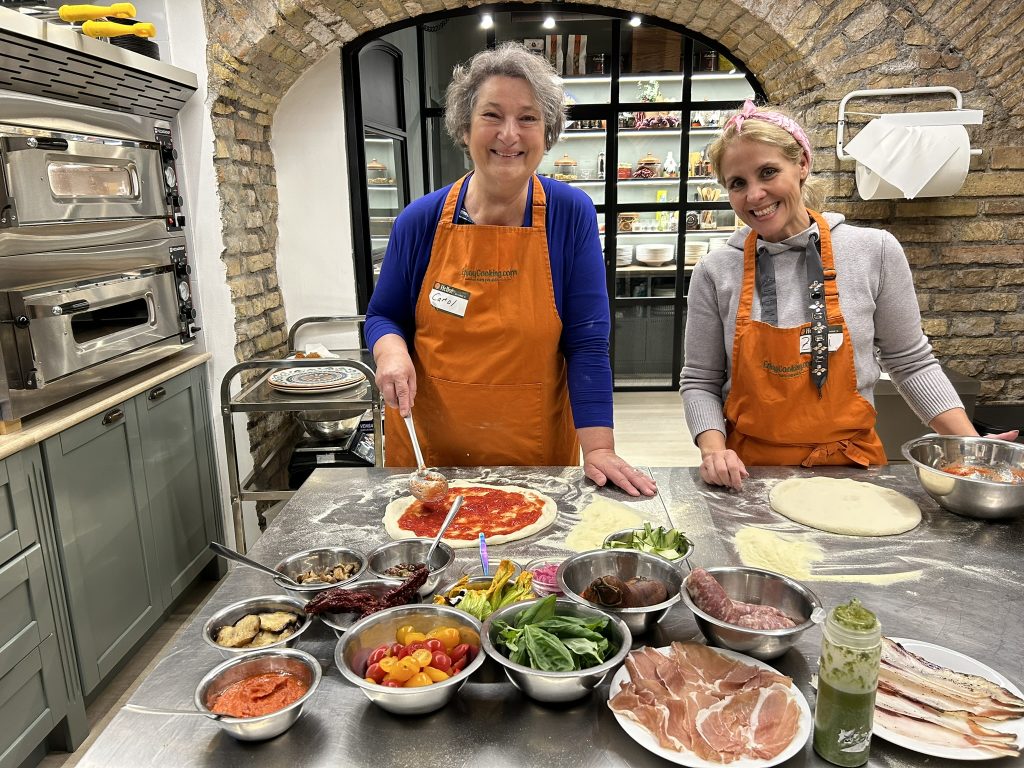
I chose anchovies, mushrooms, olives, and of course mozzarella cheese. Here we are, making our pizzas in front of the scrumptious assortment of toppings.
Finishing the Pizzas
The pizzas went back in the oven and voila! Within minutes they were being served to us.
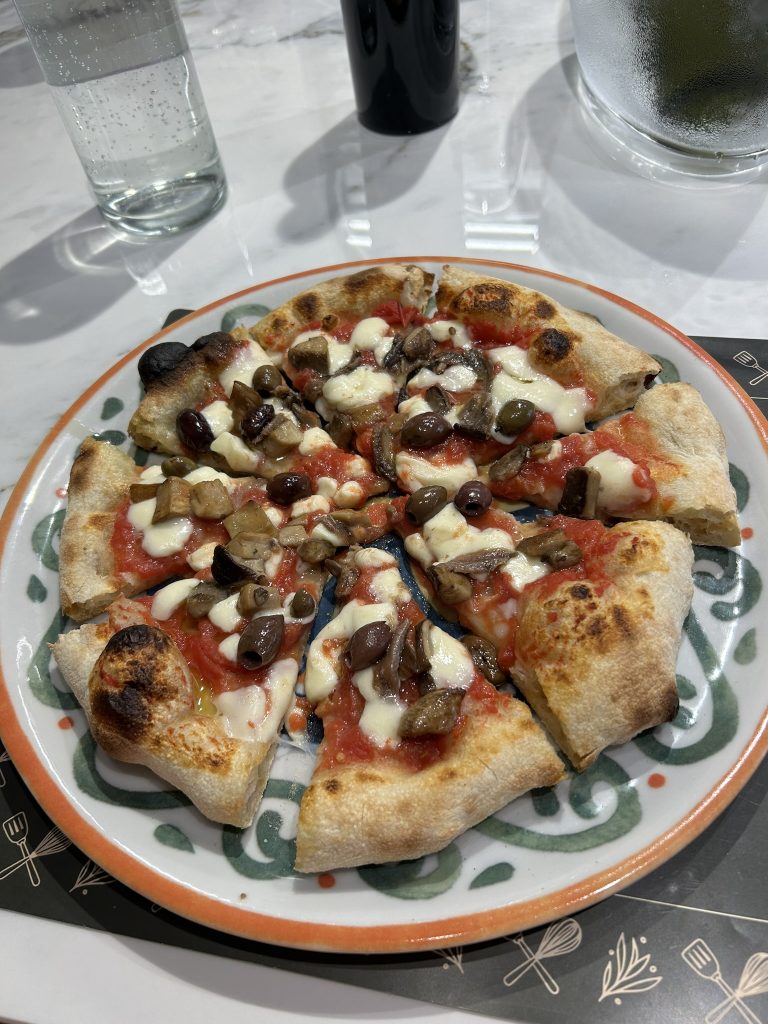
The first bites were wonderful, the crust slightly charred and very puffed up (the sign of a good pizza) and the toppings fresh. I managed to get through three pieces before giving up.
Marco thoughtfully put the remainder in a pizza box for me to take home to Gregg.
After pizza, we were served the gelato we’d made earlier. OMG!
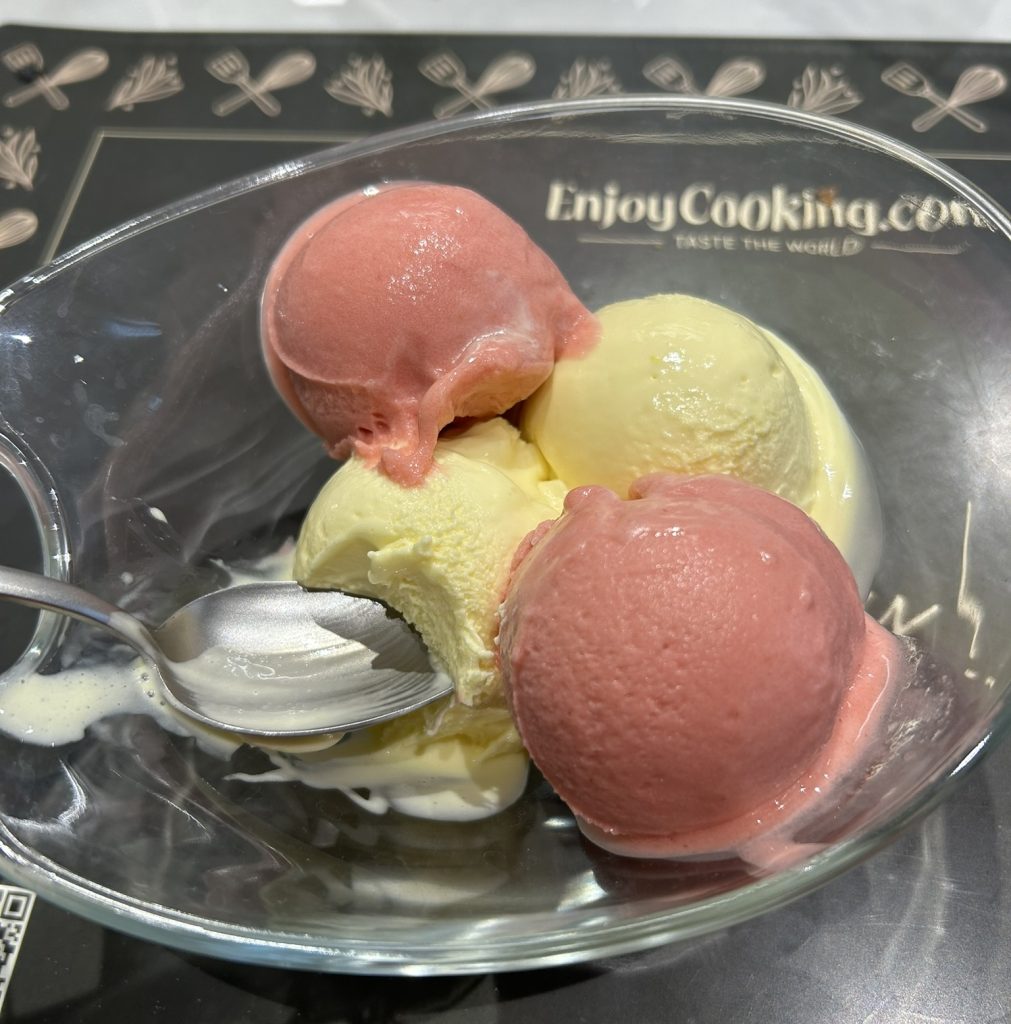
The limone gelato, in particular, was to die for. I don’t think I’ve ever tasted a fresher and more delightful-tasting gelato. It puts the run-of-the-mill gelatos found in gelato stores to shame. As Marco said, it’s all about using the freshest ingredients.
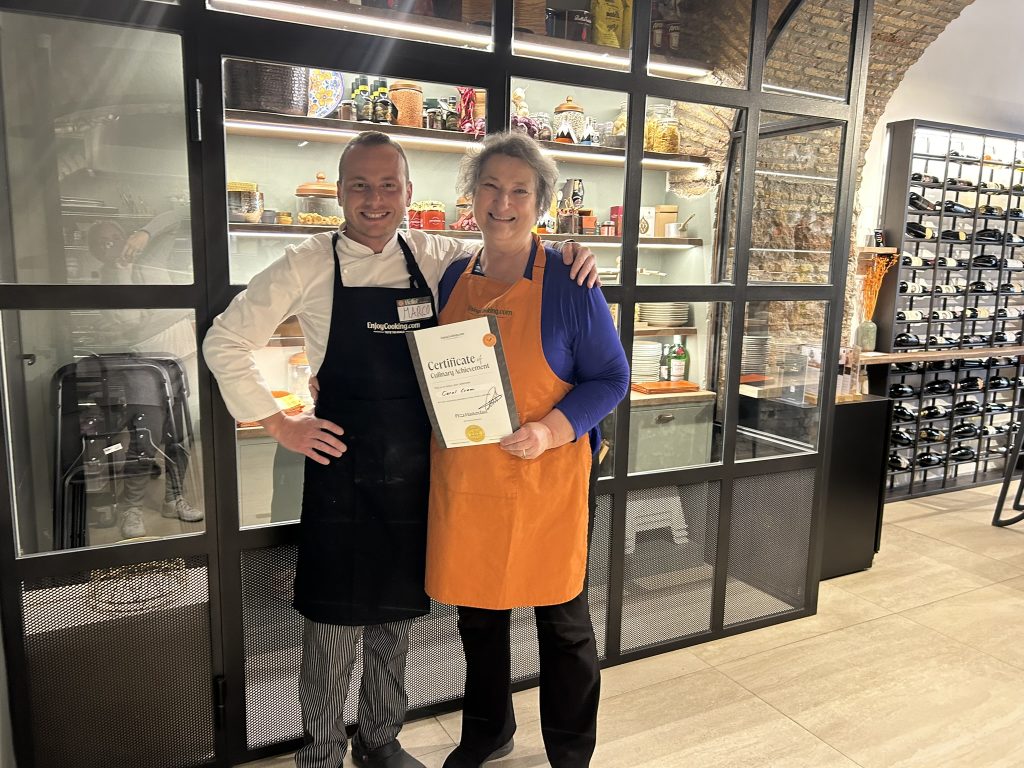
The class ended with my receiving my certificate and posing for a picture with Marco. I was thoroughly satisfied with my second Rome cooking experience in EnjoyCooking.com and Crown Tours.
A smile was on my face as I threaded my way through the crowds of tourists streaming past the Colosseum and Forum on my way back to our comfy little apartment in the Jewish Ghetto.
Thank you, EnjoyCooking.com and Marco for an excellent experience.
EnjoyCooking.com Class
Here’s a link to the cooking class I took through Crown Tours. As mentioned often on Artsy Traveler, I’m a big fan of GetYourGuide.
Carol M. Cram is the author of five award-winning novels inspired by art and the women who shaped it, the creator of Artsy Traveler, an arts-focused travel blog, the founder of Art In Fiction, a curated database of 2,600+ novels inspired by the arts, and the host of The Art In Fiction Podcast. She lives with her husband, artist Gregg Simpson, on beautiful Bowen Island near Vancouver, BC.
Culinary tourism is definitely a thing, and nowhere more so than in Italy.
Food tours and cooking classes abound and for good reason. Italy and food go together like, well, Italy and food.
The popularity of Stanley Tucci’s series Searching for Italy about food in Italy is proof that eating and cooking continue to be two of the many artsy reasons to travel in Italy.
Is cooking an art? Absolutely!
And so, while spending a week in Rome, I decided to take a cooking class. I’d taken a cooking class in Paris, and one of my guest posters, Liz Reding, has written a post about her cooking class experiences in France and Spain.
It was time for Italy to take a turn. The three-hour cooking class (more like three and half by the time we finished eating) at InRome Cooking was a bargain at only €75 (the price varies depending on which class you choose). Considering I enjoyed three delectable courses, learned a lot of valuable cooking tips and got plenty of hands-on practice, the fee was very reasonable.
I chose a 3-hour cooking class with InRome Cooking. Here’s the link to register if, after reading this post, you’re interested in taking the class.
Full disclosure: the link takes you to Tiqets.com, one of my affiliates. That means I get a small percentage of the ticket price if you register.
Cut to the chase: I highly recommend taking a 3-hour class with InRome Cooking. The time flew by and not only did I learn a lot, but I also enjoyed a fabulous meal that I’d cooked myself with some help from my new friends and Chef Marco.
About InRome Cooking
InRome Cooking operates out of three locations:
Flagship school on Corso del Rinascimento in a converted 17th-century palace very close to the Piazza Navona and overlooking the Italian parliament. This is the location for the Hands-on Pasta Making Class & Tiramisù class I took.
A sleek and stylish terraced building near the Pantheon on Via Giustiniani
A cooking school located in the Pope’s organic farm at the papel palace of Castel Gandolfo outside Rome
My Experience with InRome Cooking
In this post, I write about my experience taking a 3-hour class at the Corso del Rinascimento location.
InRome Cooking offers several classes, either shared or private.
I chose the Hands-on Pasta Making Class & Tiramisù for two reasons. First, my husband, Gregg Simpson, had recently discovered the delectable delights of tiramisù and so I thought it would be good to learn how to make it. And second, I have a pasta maker gathering dust in my cupboard, and felt it was high time I learned how to use it correctly.
Both goals were met during the course of the evening.
Registering for a Class with InRome Cooking
I registered for the class about three days in advance. The registration process through Tiqets.com was quick and efficient. Within seconds, I had my ticket downloaded and ready to present. I’d advise you register well in advance. I was probably lucky to get a spot because the class of just twelve participants was full.
Arriving at InRome Cooking
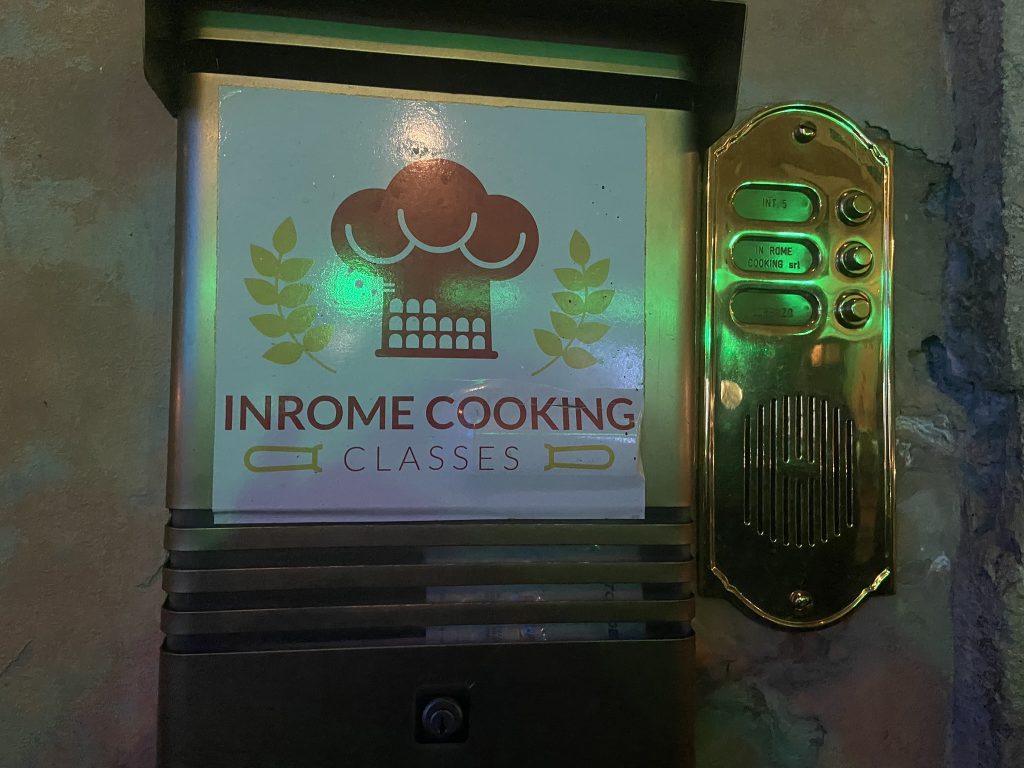
Promptly at 5:20, I arrived at InRome Cooking located at Corso del Rinascimento, 65 after passing it and then doubling back. You have to look closely to see the rather small InRome Cooking sign on the door.
InRome Cooking next to the buzzer at Corso del Rinascimento, 65
For a few moments, I was flummoxed but soon figured out that I needed to ring the buzzer to be let in. A voice answered (phew!), the buzzer buzzed, and I climbed two flights of marble stairs in the converted 17th-century palazzo. I do like a nice palazzo.
I was met at the top of the stairs by Chef Marco holding a clipboard and smiling broadly. He ushered me into a gorgeous, light-filled kitchen and introduced me to my companions for the evening: a mother and son from Arizona; a mother and son from Sweden; a mom and dad and son from San Francisco; and two couples from Toronto.
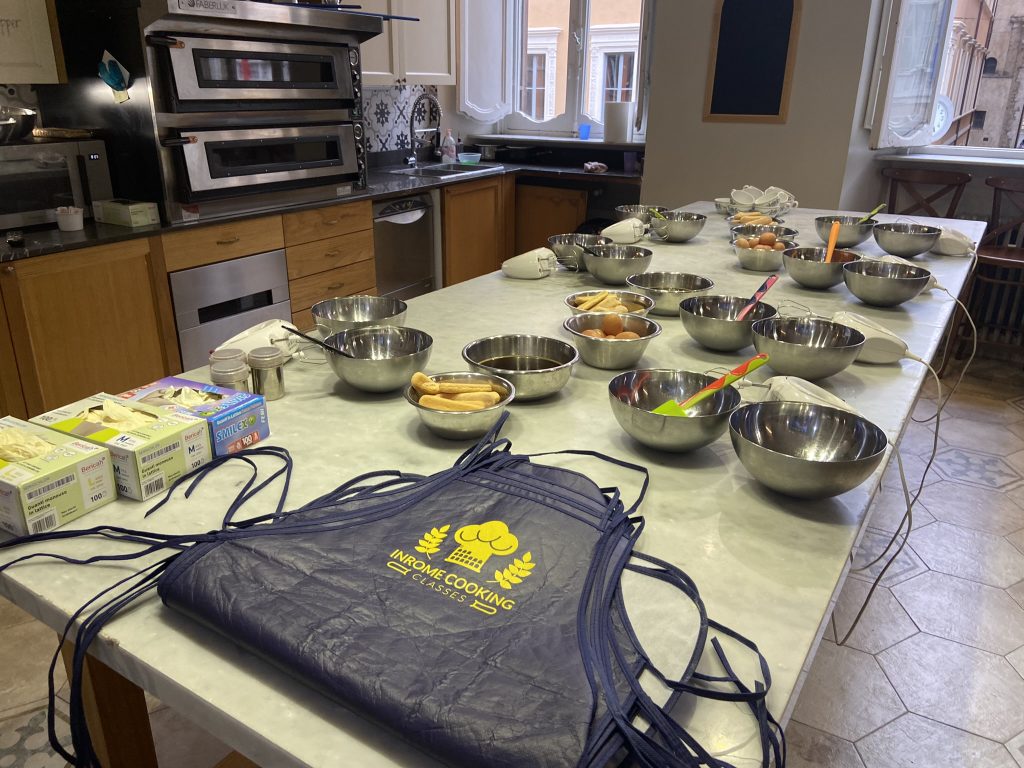
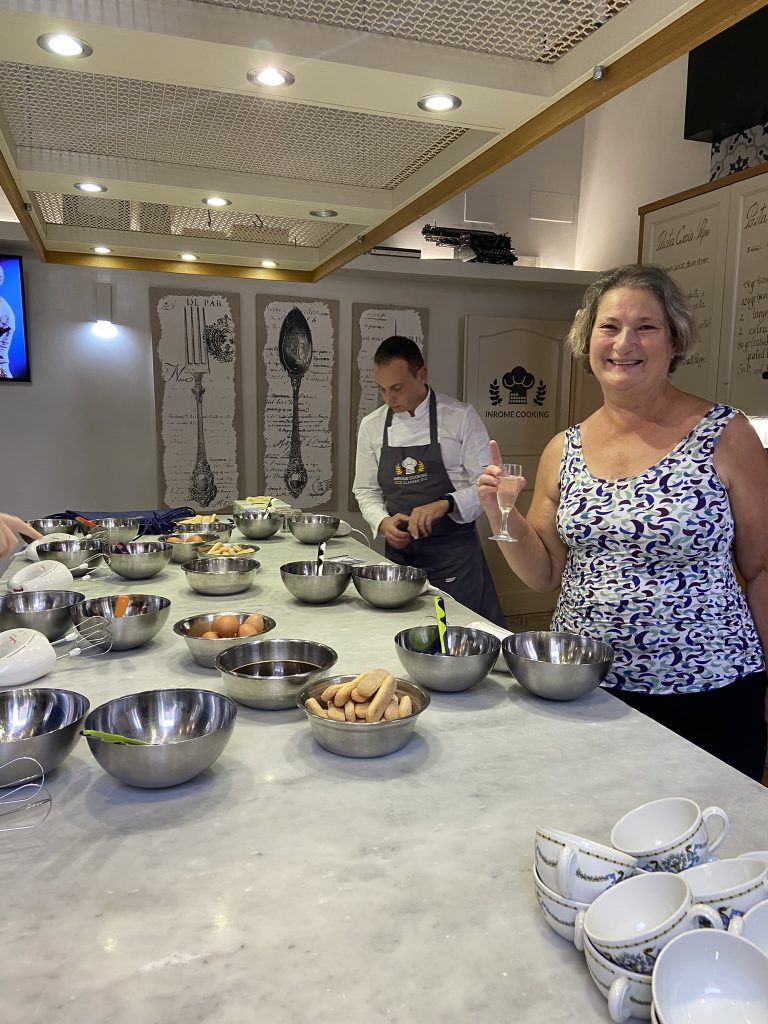
The InRome Cooking kitchen with ingredients set out for making tiramisù
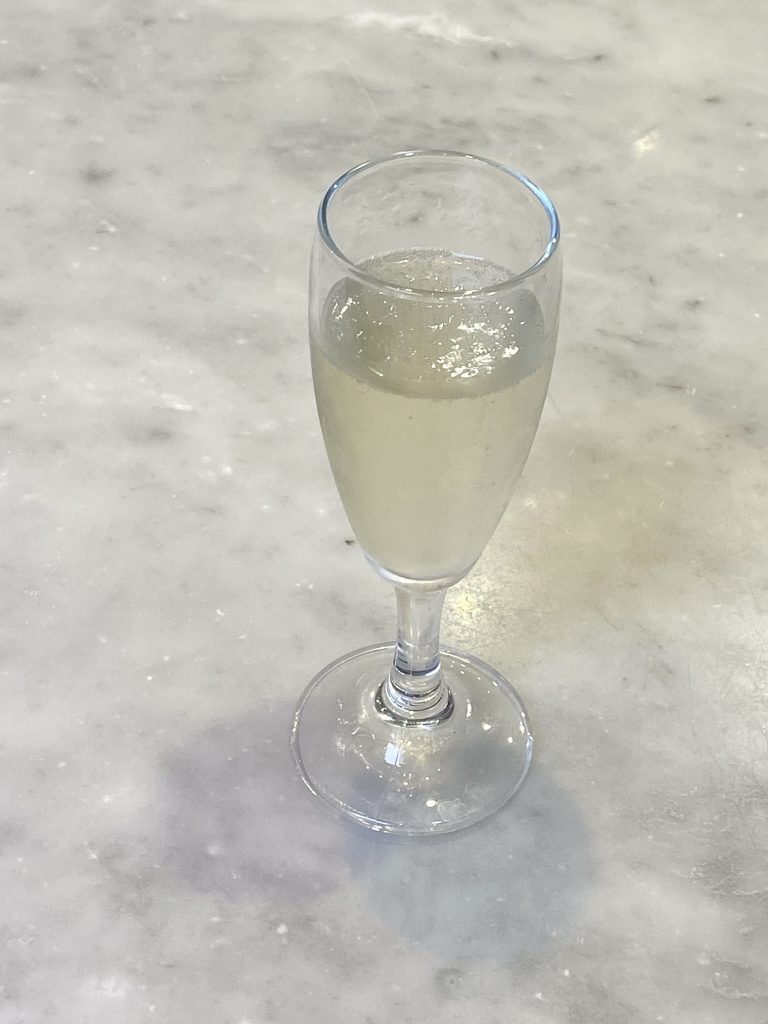
The evening began promptly at 5:30 with a welcome glass of prosecco. We were then placed around the large table already laden with the ingredients and utensils we’d need to make tiramisù.
Prosecco!
Me with Chef Marco
Making Tiramisù
We started by making dessert so it would have time to set by the end of the evening.
Chef Marco paired us up and told us to get cracking (literally!). We each separated an egg to get two yolks. The whites were whisked away by the sous chefs to be beaten and later folded into the tiramisù. We then set to work beating the gorgeous yellow yolks.
Marco told us that fresh eggs are essential for tiramisù (or indeed any cooking). They shouldn’t be much older than a few weeks and preferably from local hens. I’m lucky to live on an island where fresh eggs are readily available.
Throughout the evening, Marco emphasized that great cooking starts with the very freshest of ingredients. You don’t need many ingredients to create a wonderful dish when each ingredient is top quality.
Tiramisù Ingredients
For the tiramisù, we used only six ingredients: fresh eggs, sugar, mascarpone cheese, ladyfingers (called savoiardi), cold coffee, and unsweetened cocoa powder for the topping. Tiramisù translates literally as “pick-me-up”, a direct result of the espresso used in the recipe.
Tiramisù Method
Under Marco’s expert tutelage, we beat sugar into the egg yolks until the color was a rich and creamy light yellow. The more we beat, the creamier the eggs became. I’d say we worked at it for at least five minutes. Fortunately, Marco supplied links to recipes at the end of the class so I didn’t need to make notes.
After beating the eggs and sugar, we stirred in very generous dollops of mascarpone cheese. Marco emphasized that precise measuring is not necessary in Italian cooking. A generous tablespoon looked to me more like two or three level tablespoons. But then, is there such a thing as too much marscapone?
The next step was folding in generous spoonfuls of whipped egg yolks.
Layering the Tiramisù
With our creamy, eggy, cheesy concoction all mixed and ready to go, we were ready to build our tiramisù. Marco handed each of us a lovely big tea cup (I suppose coffee cup would be more accurate!) and demonstrated the next steps.
First, I took a ladyfinger biscuit and dipped it quickly into the bowl of cold espresso. Down and up, no lingering. The ladyfinger should absorb the coffee but not be dissolved by it. I then broke the ladyfinger in two and placed it at the bottom of the cup.
Next, I spooned in half of the creamy, eggy, cheesy mixture and then dipped and broke another ladyfinger. Finally, I slathered on the rest of the creamy stuff.
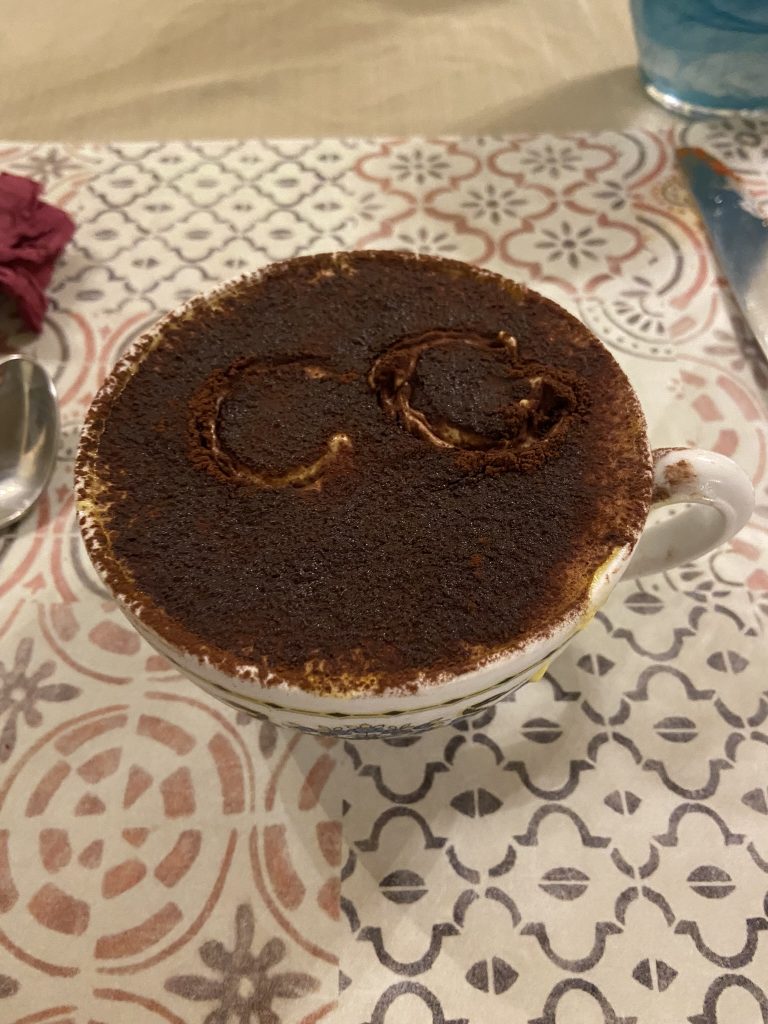
One more step! We were given shakers of pure, unsweetened cocoa to sprinkle on top of the tiramisù and directed to carve something meaningful into the cocoa so we’d know which one was ours.
Here’s my first (and extremely delicious) attempt at tiramisù with my initials etched in with a toothpick:
Tiramisù made at InRome Cooking
Making Pasta
The tiramisùs were whisked away and the large workspace cleaned by the staff while I mingled for a while with the other guests and enjoyed another glass of prosecco. Two of the people from Toronto had been to Bowen Island where I live, and one had a friend who had just written her first historical novel. Coincidentally, it was about a subject that intrigued me after visiting the Back to Backs National Trust property in Birmingham. Small world.
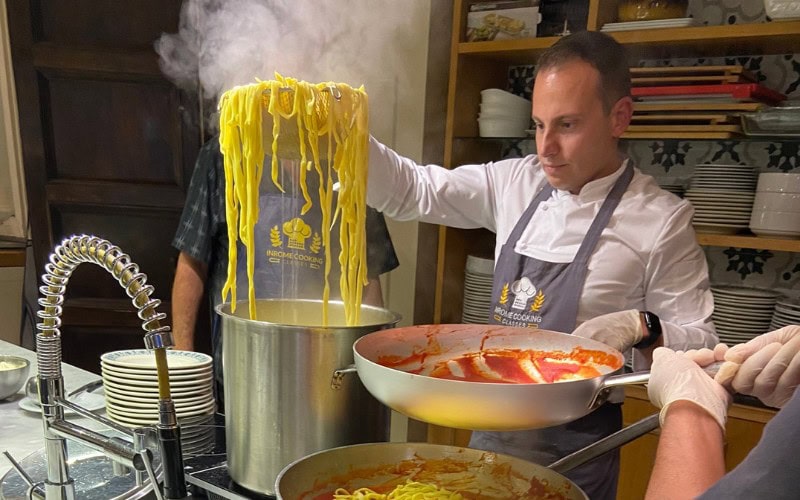
We were to make two kinds of pasta: cacio e pepe and Amatriciana. It turned out we wouldn’t be making the sauces; Marco demonstrated that. Our job was to make the pasta.
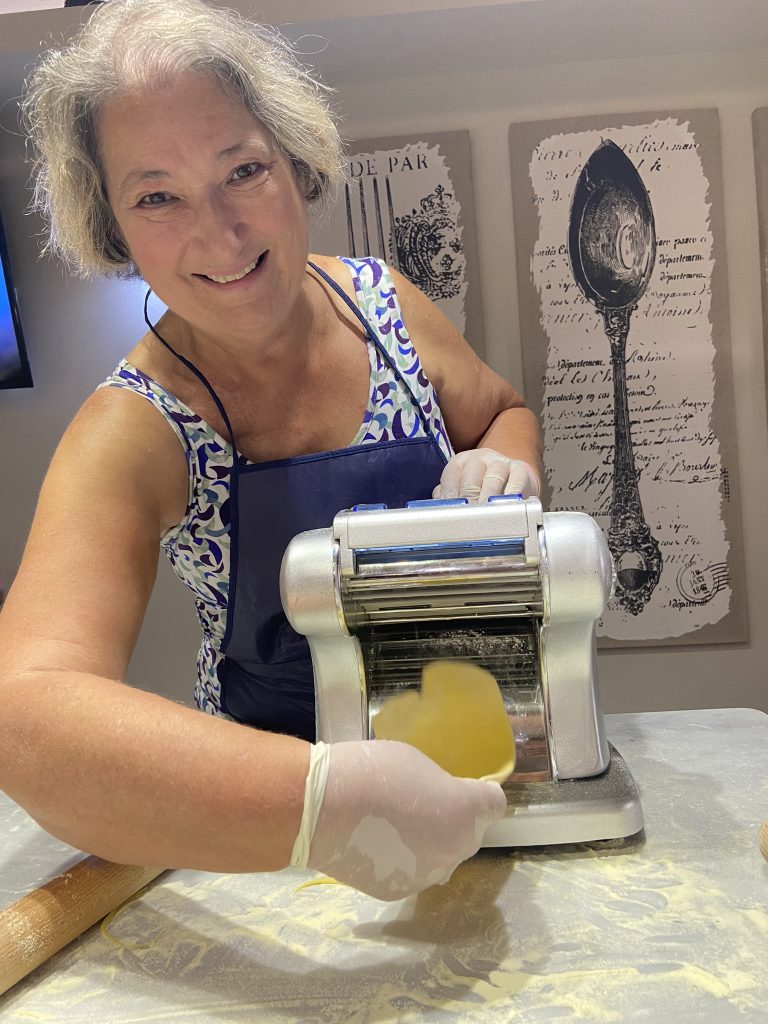
Marco showed us how to mix the two flours and then to knead in the olive oil to make a beautiful, yellow dough. The next step was to pass the dough through the rollers of the pasta maker several times to flatten it and then through the cutters.
The pasta makers were equipped with two cutters, one to make spaghetti which we later ate with the cacio e pepe sauce and the other to make fettucine, which we ate with the amatriciana sauce.
Flattening the pasta
Making the Sauces
As he had all evening, Marco emphasized the importance of using just a few, top-quality ingredients.
Amatriciana Sauce
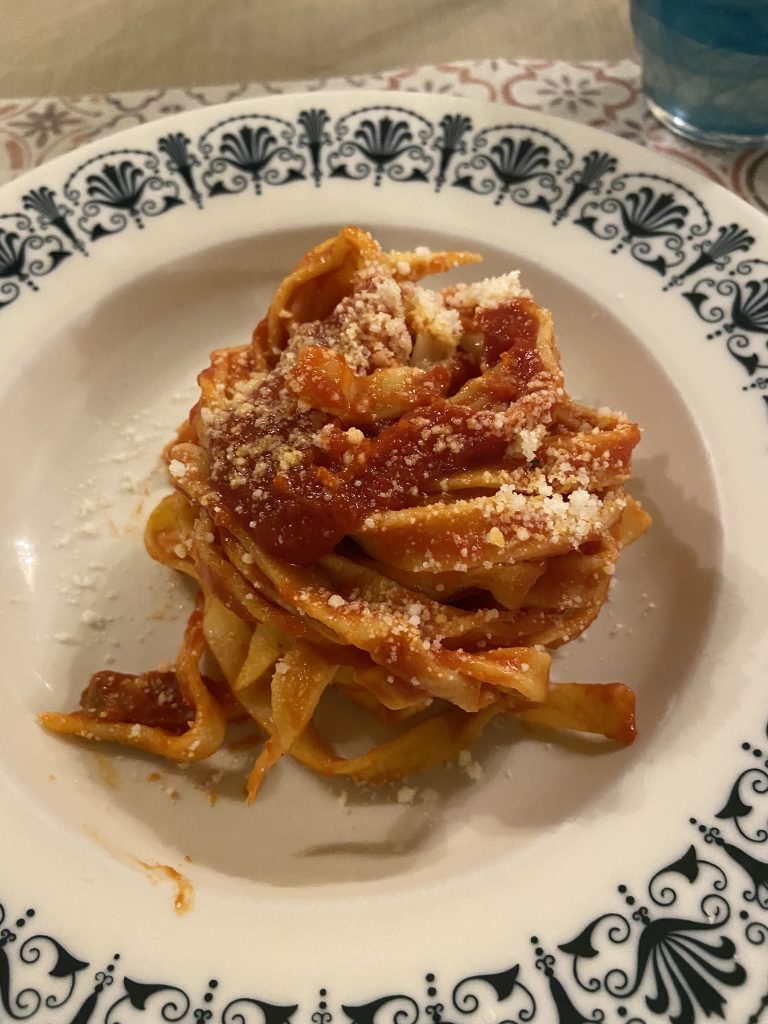
Amatriciana sauce consists of only three ingredients: Mutti tomato sauce (only containing Italian-grown tomatoes, of course), small pieces of pork cheek that have been very slowly cooked to release the fat and flavor, and romano cheese.
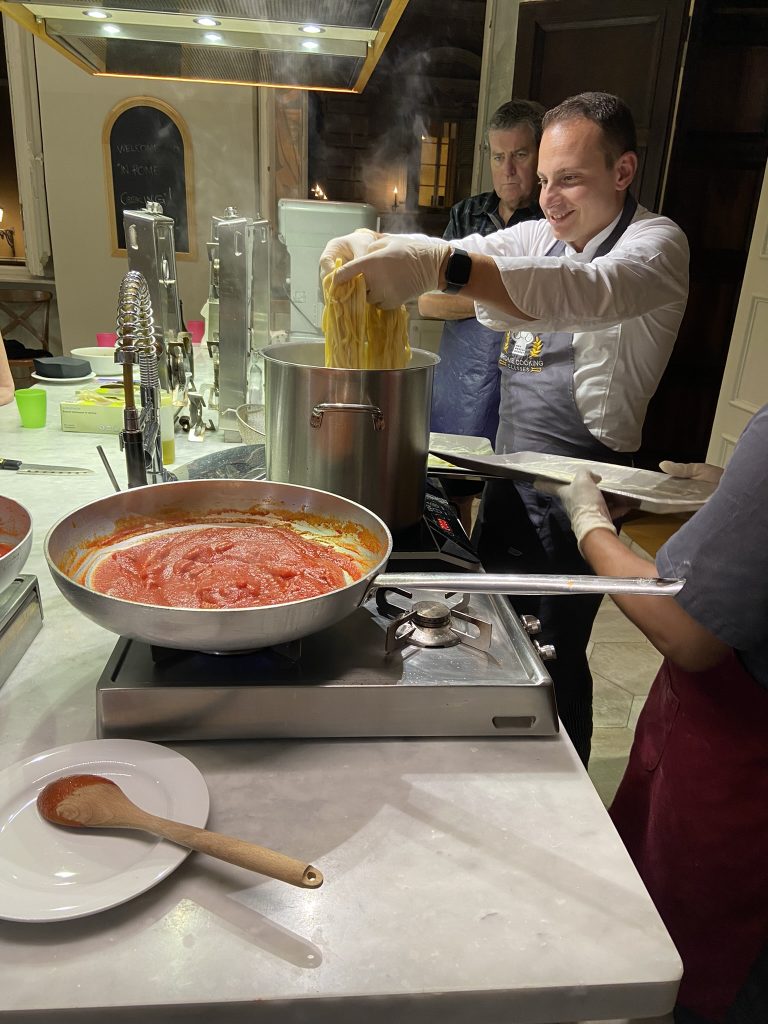
Marco cooked the fettucine we’d just made for a very few minutes and then showed us how to combine the pasta with the three-ingredient sauce. It smelled amazing!
Cacio e pepe Sauce
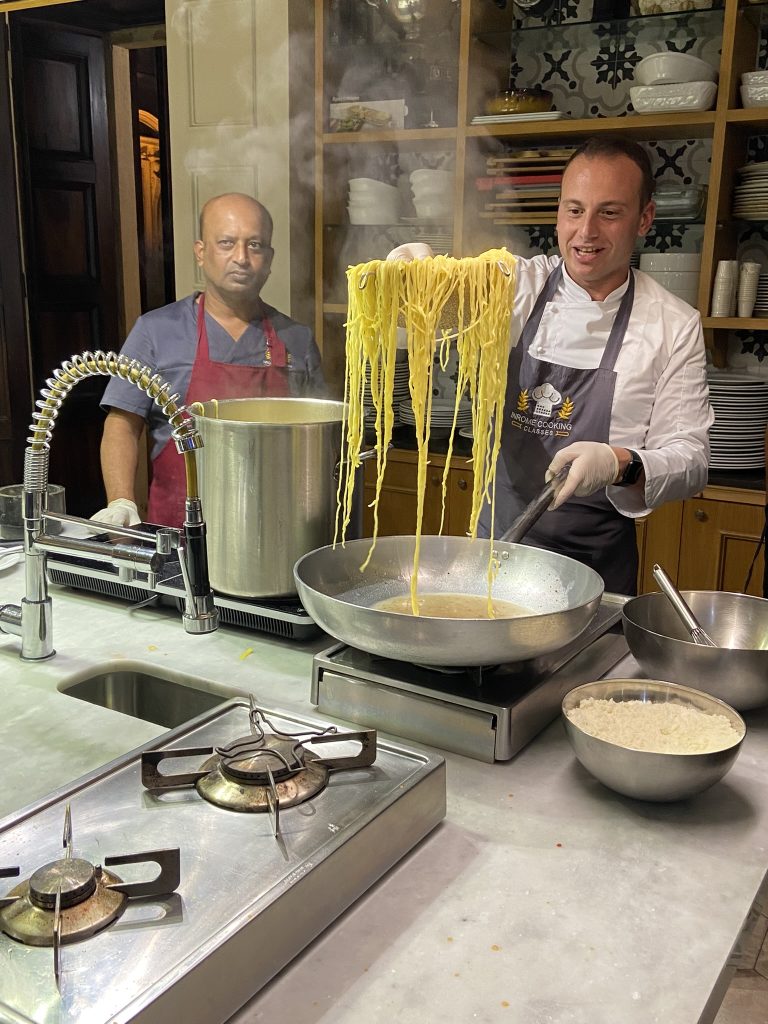
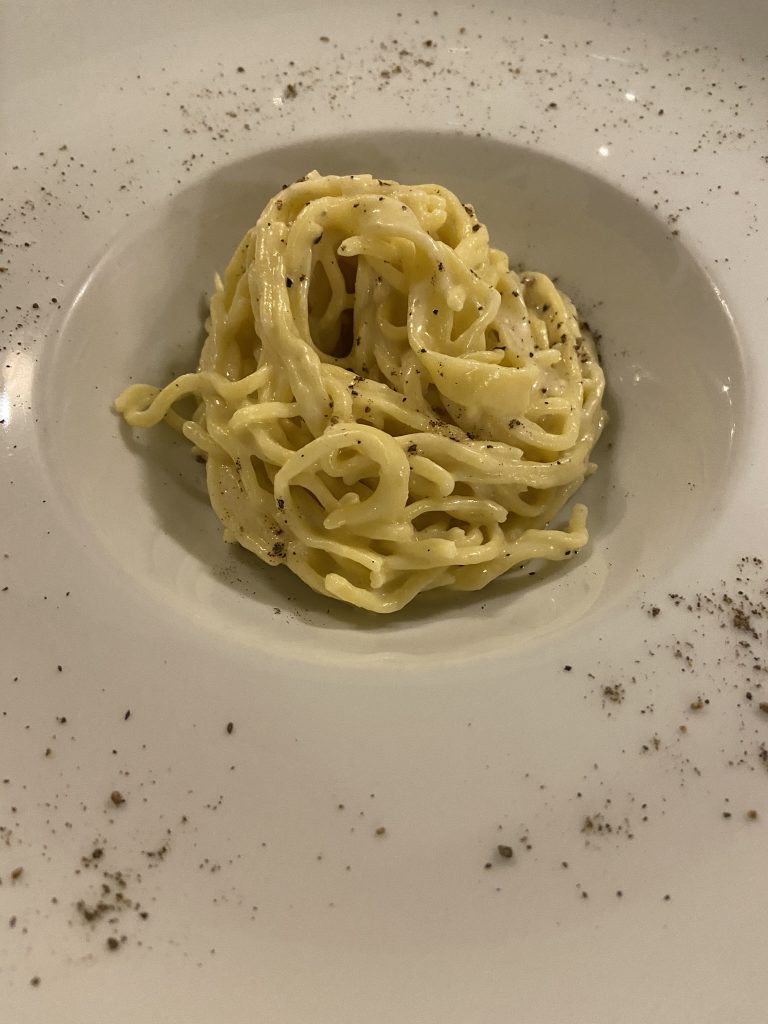
This sauce is a Roman specialty and is the simplest of all. Only two ingredients are used: romano cheese and freshly ground pepper. That’s it! Marco demonstrated how he makes the sauce by stirring the starchy water from the boiled pasta into the cheese to make a rich, creamy sauce. He then added the fresh pepper. The result was to die for!
Making Amatriciana
Making Cacio e pepe
Eating the Results
Following the demonstrations of how the pasta is combined with the two sauces to make Amatriciana and Cacio e pepe, we were invited into the adjacent dining room, complete with a , Renaissance-style ceiling. I joined the table of Canadians and enjoyed pleasant conversation about travel and food while enjoying the fruits of our evening’s labors.
Amatriciana
Cacio e pepe
Rome Walking Tours
GuruWalk lists pay-what-you-please walking tours that connect tourists with tour guides all around the world. Check out their tours of Rome!
Carol M. Cram is the author of five award-winning novels inspired by art and the women who shaped it, the creator of Artsy Traveler, an arts-focused travel blog, the founder of Art In Fiction, a curated database of 2,600+ novels inspired by the arts, and the host of The Art In Fiction Podcast. She lives with her husband, artist Gregg Simpson, on beautiful Bowen Island near Vancouver, BC.
The walnut tree is the reason the Church of Santa Maria del Popolo was built.
Every Roman citizen knew about the tree and the large number of black crows–an unnatural number–that clung to its branches every day. And it was common knowledge that the tree had everything to do with the Emperor Nero.
In the Renaissance, people wondered why the crows always flocked to that particular tree. It was unnerving, especially to the merchants and officials who used the Flaminia roadway which led north out of Rome. They had to pass right by the tree because the city’s walled gate was next to it.
They were convinced that the shiny, black, rustling tree caused bad luck. Mishaps on their various journeys only confirmed this. They became so fearful of the evil that inhabited the area that they finally demanded the Church fathers do something about it.
Every Roman citizen knew about the tree and the large number of black crows–an unnatural number–that clung to its branches every day. And it was common knowledge that the tree had everything to do with the Emperor Nero.
In the Renaissance, people wondered why the crows always flocked to that particular tree. It was unnerving, especially to the merchants and officials who used the Flaminia roadway which led north out of Rome. They had to pass right by the tree because the city’s walled gate was next to it. They were convinced that the shiny, black, rustling tree caused bad luck. Mishaps on their various journeys only confirmed this. They became so fearful of the evil that inhabited the area that they finally demanded the Church fathers do something about it.
Origins of Santa Maria del Popolo
There are many reasons why the churches in Rome were built and many reasons for their chosen locations. The church of Santa Maria del Popolo is located on the site of the walnut tree that grew over the very spot where the despised Nero’s body had been unceremoniously buried some 1500 years earlier. Nero obviously now haunted the place; people had seen him there. Only a church built on that spot would calm the populace. And it needed to be made important. If the Pope recognized the church, it would become a Basilica.
The order eventually came down from Pope Paschal II. The situation had become a social scandal, and this was his official solution. Important artists must be commissioned to decorate its side chapels and ceiling. The artistic works created for it would need to spring from such important themes that even God would notice it.
For the project, the Church recruited renowned artists Caravaggio, Raphael, and Bernini, who all enjoyed fame during their lifetimes. (Well, Caravaggio was definitely known, but not necessarily for his art.) If you’re unfamiliar with these gentlemen artists of the 16th century, I must tell you that they are very famous in the art world. Legendary, even.
What’s Special about Santa Maria del Popolo
In situ is Latin for “in place” and is the term given for paintings, mosaics, frescoes, and sculptures that are still in the exact spot for which they were commissioned, for where they were designed to be. It is always special when one views something in situ, especially a major work.
And that is why I love Santa Maria del Popolo. It lays claim to two Caravaggio paintings, sculptures by Bernini, and a mosaic ceiling designed by Raphael. These creations have remained undisturbed in their precise positions. They could have easily been moved to some world-class museum or other, to bolster their daily visitation numbers and be celebrated at members-only cocktail events that the press would cover with uneducated glee. But something even more amazing happened: the works stayed where they were and as a result are almost unknown.
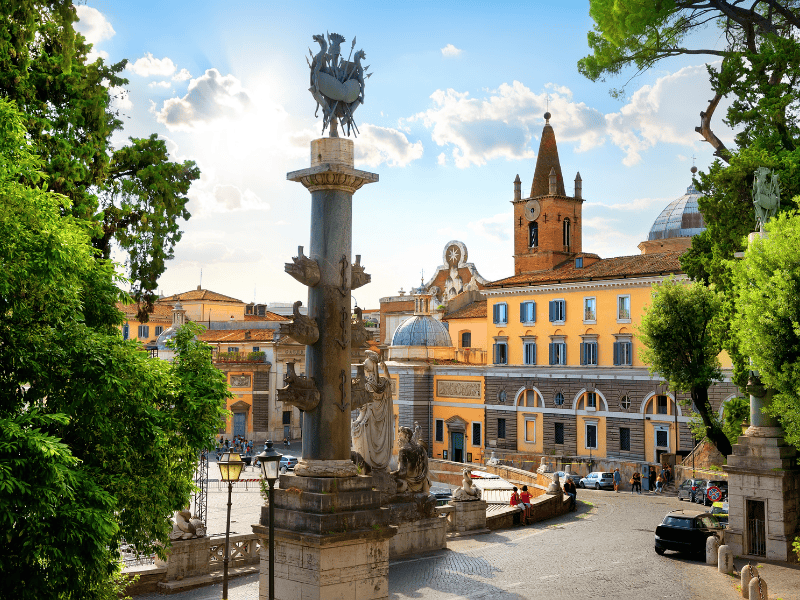
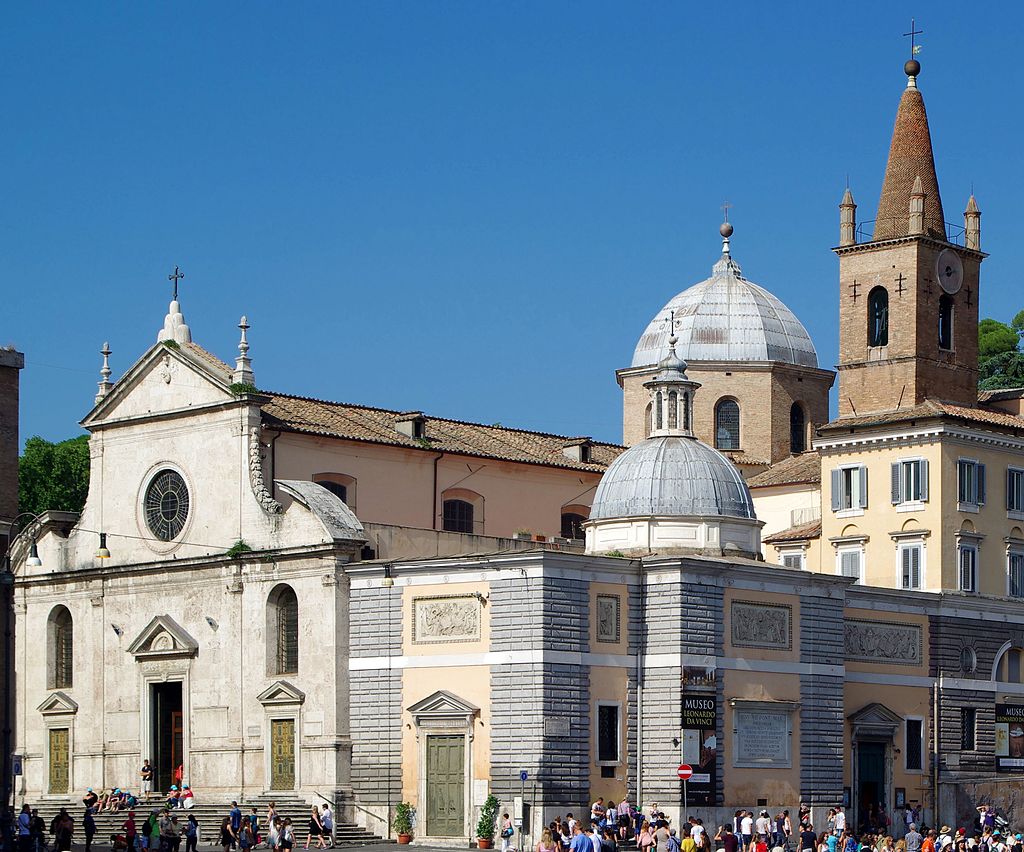
Location of Santa Maria del Popolo on the Piazza del Popolo
Located a bit out of the way at the north end of Piazza del Popolo, Santa Maria del Popolo sits quietly, without banners or signs. One would never know that it displays mind-boggling, priceless art. The masterpieces are not featured in any special way. You must actually go looking for them.
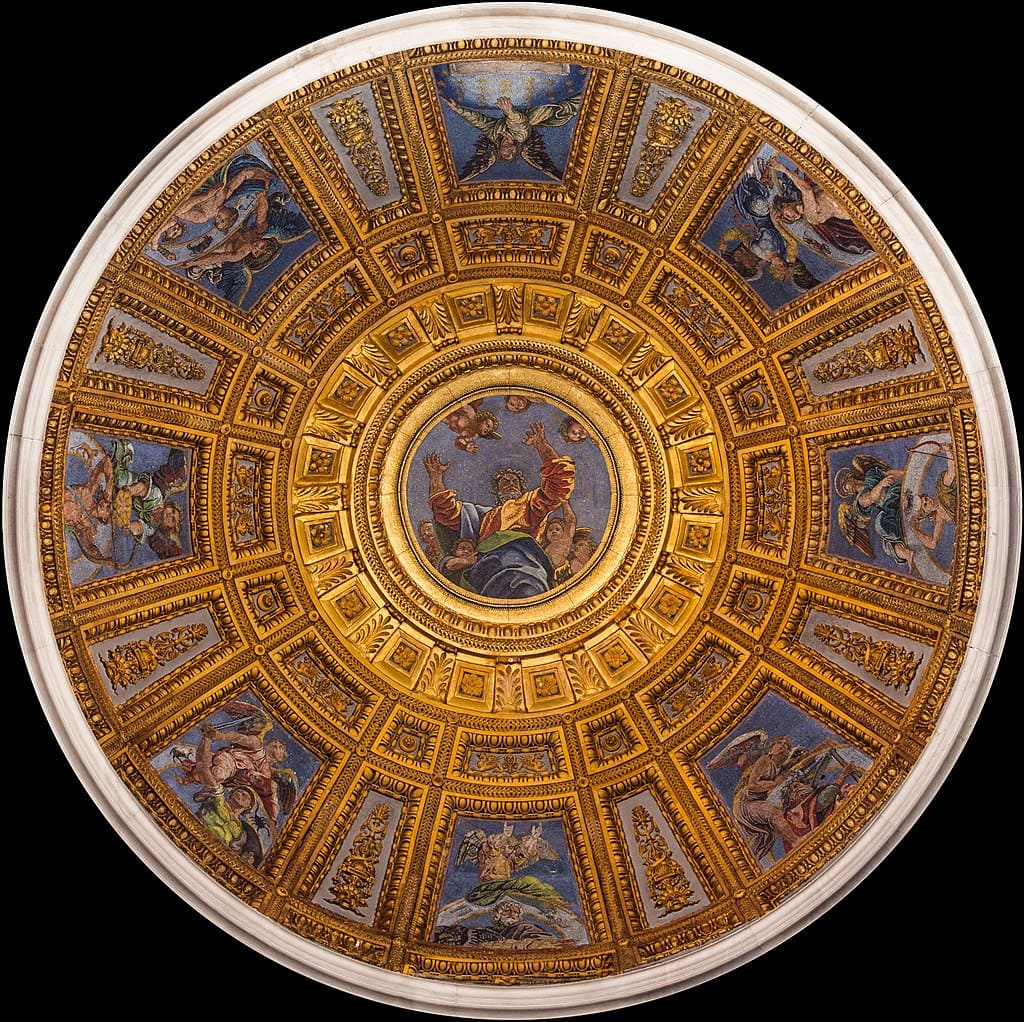
In the Chigi Chapel, you’ll find products of the genius of both Raphael and Bernini. Raphael obviously based his mosaic ceiling on the most important theme he could think of, The Creation of the World. It is so incredible that even as you are staring at it, your eyes tell you that it’s a painting, not a mosaic.
Raphael, CC0, via Wikimedia Commons
Statues by Bernini
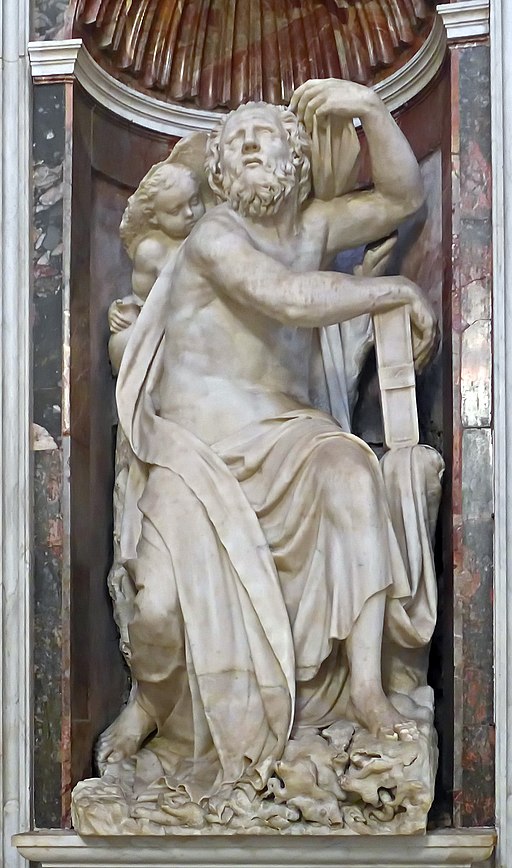
All the amazing statues in this chapel are by Bernini. If you’re not familiar with Bernini, you’ll want to check out more of his beautiful statues, mostly notably those in the Borghese Gallery in the lovely Borghese Gardens in Rome.
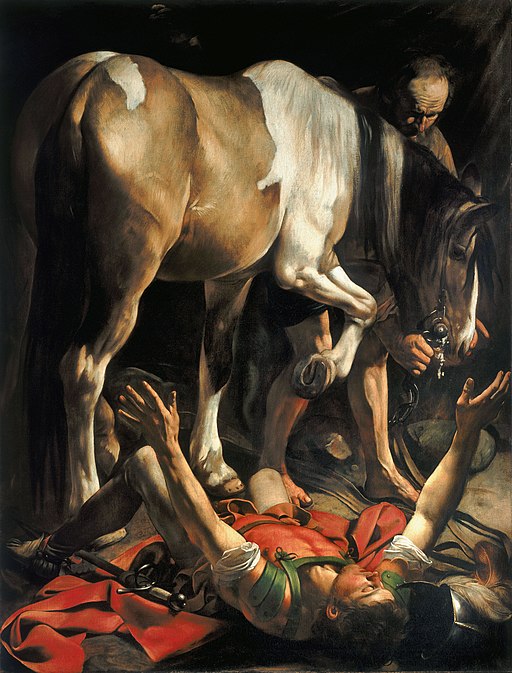
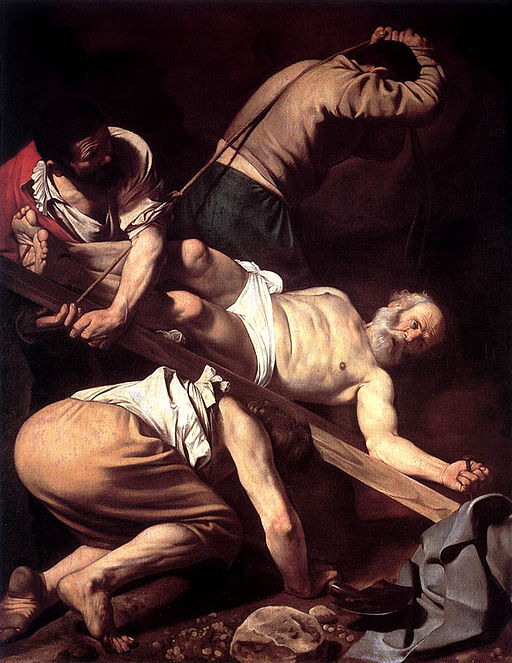
In the Cherasi chapel, you’ll find the two astounding canvas paintings by Caravaggio positioned directly opposite one another—the sensual Conversion on the Way to Damascus and the gut-wrenching Crucifixion of Saint Peter.
Conversion on the Way to Damascus, Caravaggio, Public domain, via Wikimedia Commons
The theme of Peter (as in the apostle Peter of Vatican fame) being crucified upside down in Rome as the Bible describes is not a theme that many artists favor. Perhaps that’s because it is simply too horrific. Caravaggio was not afraid of much, it appears, and clearly threw caution to the wind.
Crucifixion of Saint Peter, Caravaggio, Public domain, via Wikimedia Commons
Visiting Santa Maria del Popolo
You’ll be surprised at the lack of visitors inside the Basilica; you may well be the only one. The reason is simply that most people don’t know about the place or what makes it special, even after being featured in Dan Brown’s Angels and Demons.
The Church of Santa Maria del Popolo is located at 12 Piazza del Popolo, next to the north stone gate and is free to enter. It’s open daily with sporadic hours; check their website for the days of your visit: rome.net/santa-maria-del-popolo. Avoid visiting on a Sunday during Holy Mass because you won’t be allowed to freely wander. Phone: Intl. calling: (011) 39-06-631-0836 / Local calling: 06-631-0836
Happy travels,
Andie Easton
Read about Andie Easton and her wonderful series of books!
GuruWalk lists pay-what-you-please walking tours that connect tourists with tour guides all around the world. Check out their tours of Rome!
About Carol Cram
Carol M. Cram is the author of five award-winning novels inspired by art and the women who shaped it, the creator of Artsy Traveler, an arts-focused travel blog, the founder of Art In Fiction, a curated database of 2,600+ novels inspired by the arts, and the host of The Art In Fiction Podcast. She lives with her husband, artist Gregg Simpson, on beautiful Bowen Island near Vancouver, BC.
Three days in Rome is not enough. I say this as someone who has been many times and still finds new things to love.
Rome doesn’t reveal herself to the impatient; she rewards the curious, the unhurried, and anyone willing to get slightly lost when around every corner lies another ancient ruin, Baroque fountain, or tempting trattoria.
But three days is what you’ve got, so let’s make them count.
This itinerary covers the essential sights — the Colosseum, the Vatican, the Pantheon without turning your holiday into a sightseeing death march.
There’s still time for espresso in a sun-drenched piazza, a wander through the Trastevere, and a very good gelato. Maybe two.
Best time to visit: April-May and mid-September to October for lighter crowds and pleasant weather
Ideal number of days: 3 full days to cover the highlights at a relaxed pace
Must-book tours/passes: Skip-the-line Colosseum & Roman Forum, Vatican Museum & Sistine Chapel, city sightseeing bus or metro day pass
Best neighbourhoods to stay: Monti (close to Colosseum), Trastevere (evening/night charm), near Spanish Steps / Piazza del Popolo (central and elegant)
Daily walking estimate: ~5-8 km each day (comfortable shoes essential)
Where to Stay in Rome for 3 Days
Here are the three areas I recommend while visiting Rome:
Monti – right by the Colosseum & Forum and well served by buses and taxis; book an apartment and settle in as a temporary local.
Piazza Navona – a bit crowded, but right in the center of the action. Check out Torre Capranica for a great stay in a 14th century renovated tower.
Spanish Steps / Piazza del Popolo area – more elegant, great for exploring via foot, upmarket hotels. I loved Viam 6B – spacious suites, some with terraces.
Why Visit Rome?
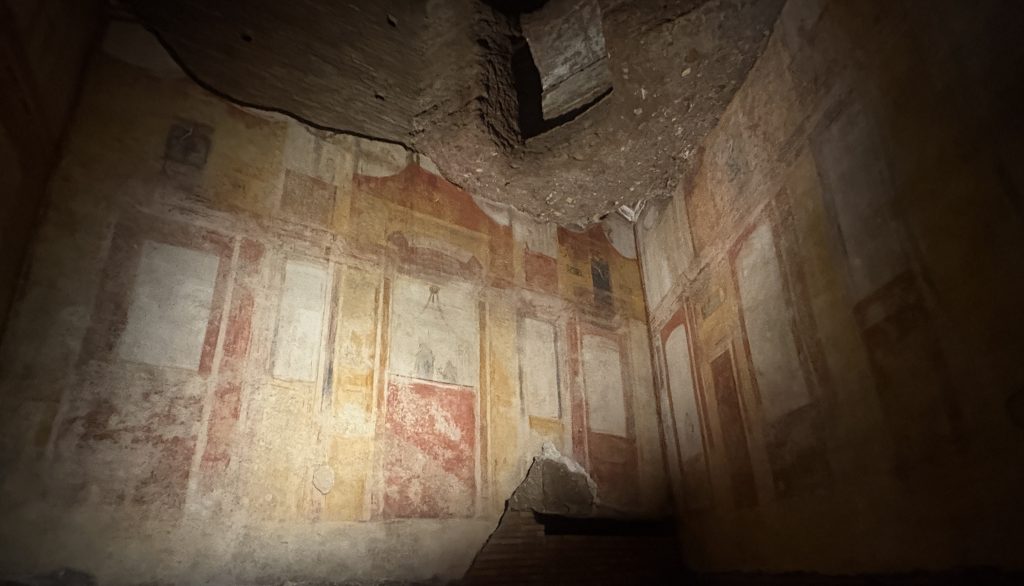
Visit Rome because it was the center of the ancient world for centuries, and the evidence is everywhere — a Roman column appearing without warning around a corner, the foundations of a temple embedded in a restaurant wall, the ghost of Nero lurking in the underground rooms of the Domus Aurea.
Visit Rome because the Jewish Quarter has stumblestones commemorating murdered Jews, and standing quietly in front of them is one of the most moving things you can do in a city full of moving things.
Visit Rome to wander through museums that are somehow half-empty. The Etruscan Museum at Villa Giulia is one of the great art museums of the world and on my visits I’ve practically had it to myself.
Visit Rome to hear opera arias sung live at a venue overlooking the Trevi Fountain, or to stumble into an art opening in a gallery attached to an ancient library near the Piazza Navona. These things just happen in Rome.
Visit Rome to stroll home through deserted medieval streets at night and feel, briefly, like the city is entirely yours.
Don’t even think about trying to “do” Rome in a single day, or worse, in a rushed afternoon between flights. You’ll only see the crowds, the heat, and the chaos, and you’ll miss everything that makes Rome so special.
Rome is so much more than lines at the Colosseum and overpriced cappuccinos near the Trevi Fountain.
Avoid Rome in the middle of the summer if at all possible. Temperatures can soar into the 40’s, which makes sightseeing miserable. Crowds overrun major sites, and people can get very grumpy.
Choose the shoulder seasons to visit Rome: April and May or September and October. I’ve also visited Rome in December, and it was marvelous. Sunny days and crisp, cold nights allowed for exhilarating sightseeing with far fewer crowds.
No matter when you visit, you’ll need advance tickets for the big-ticket sites: the Colosseum & Forum and the Vatican Museum. Here are some options:
There are three ways to get to Rome: by car, by train, and by plane.
Driving to Rome
Do not even attempt to drive in Rome. First off, you’ll get a ticket and a hefty fine for driving into the ZTL (the Traffic Limited Zone) and second, you may get overwhelmed by the heavy traffic.
We drove once into Rome to an apartment I’d rented near the Vatican. Fortunately, we didn’t drive into the ZTL, but we did get into a horrendous traffic jam. As soon as I saw a “P” for Parking, we pulled into the garage and parked the car for the full week of our stay.
If you’re driving, park your car on the outskirts of Rome in a secure lot. I use the Parclick app (highly recommended) to find a suitable parking lot at a reasonable price.
Choose a secure, staffed lot with a good rating, navigate to it, park your car, give the keys to the attendant, and then take a taxi to your accommodations in Rome.
Avoid the temptation to stay at a cheaper hotel on the outskirts, even if it includes free parking. You’ll spend half your day commuting to and from central Rome, which is not a great use of your sightseeing time.
See below for more about recommended neighborhoods in central Rome.
Arriving in Rome by Train
If you’re taking the train, you’ll arrive at Rome Termini train station. From there, take a taxi to your accommodation.
Arriving in Rome by Plane
Rome’s Fiumicino Airport is about 30 km from central Rome. The easiest way to get from the airport to your accommodation is to take a taxi for a flat rate of €48 for all journeys that end within the Aurelian Walls, which is pretty much anywhere within the city center.
The fastest way if you don’t have a lot of luggage is to take the Leonardo Express, which runs every 15 minutes and takes around 32 minutes to get to Termini station.
Here are some options for purchasing your transport from the airport into Rome in advance:
On a solo trip to Rome, I booked a private transfer from the airport to my accommodation near the Borghese Gardens. A guy carrying a sign with my name on it met me, picked up my case, ushered me outside to his air-conditioned car, and an hour later after negotiating a ferocious traffic jam, dropped me at the door of my accommodation.
I didn’t have to worry about finding the taxi rank or watching the meter chug ever higher since my private transfer was a fixed price.
I’m a big fan of prebooking private transfers, especially when arriving after a long flight into an unfamiliar city. Daytrip offers point-to-point transfers throughout Italy with fixed pricing, professional drivers, and you can add a sightseeing stop along the way if you fancy it.
Getting Around Rome
You’ll walk a lot in Rome, and that’s part of the fun! When you get tired, hop on a bus or the metro, or take a taxi.
I often take taxis because they are easy to find at taxi ranks and are reasonably priced. Taxi drivers skillfully weave through the dense traffic–better them than me!
Busses in Rome are also a good bet. Use your phone to familiarize yourself with the bus routes. I prefer riding the bus to riding the metro (which has limited routes) because then I can watch Rome go by.
You can also choose the Hop-On Hop-Off Bus, which can be good value with access to three circuits with a single ticket. Here’s a link from GetYourGuide:
With only three days in Rome, you need to be strategic. Consider purchasing a pass that also includes public transport. Here’s one that includes skip-the-line access to the Vatican, personalized planning assistance, and entry to the Roman Forum among other sites.
My three-day Rome itinerary provides suggestions about what to do and see if you arrive around lunchtime on day one and then spend two full days and three nights in Rome.
Day 1: Ancient Rome
You could easily spend several days just focusing your sightseeing energies on ancient Roman sites and museums. They’re everywhere!
Top of the list are the Colosseum and the Forum, along with the Pantheon and if you have time, at least one museum. My top choices are the Etruscan Museum (my favorite), the Capitoline Museum and the National Roman Museum.
Another highlight is the Domus Aurea. You must reserve well in advance of your visit.
Colosseum and Forum
Visit the Colosseum and wander through the Forum fairly late in the day when the crowds may have lessened.
Also known as the Flavian Amphitheatre, the iconic Colosseum has become the symbol of Rome. Construction of the Colosseum began in AD 72 by order of the Emperor Vespasian and was completed in AD 80. It was the largest colosseum in the world, with a capacity of 50,000 spectators.
Seeing it now, you’ll be hard-pressed to believe it held that many people.
To be honest, I was a bit underwhelmed the first time I saw the interior of the Colosseum. My imagination couldn’t quite conjure the scenes of wild animals tormenting terrified Christians, which is probably just as well.
That said, you have to see it at least once. I recommend you purchase a skip-the-line ticket in advance. You can also choose a tour, although my experience of taking a guided tour of the Colosseum was not great. See my post How Not To Tour the Colosseum for details.
Another option for your first day in Rome is to book a sunset tour of the Colosseum that takes you to the Colosseum’s underground corridors, the arena, and the first ring of the seating area. Here’s an option from GetYourGuide:
The Domus Aurea is in the vicinity of the Forum and Colosseum. I visited the Domus Aurea in 2001, not long after it opened in 1999 and was able to wander freely around the massive excavated rooms. The site closed in 2005 and reopened in 2007, with more galleries added in 2015. The number of visitors is now restricted.
Built by the Emperor Nero in 64 AD, the Domus Aurea had 300 room, occupied about 50 hectares, and was used exclusively for parties. That Nero was some kind of party animal. Little is left of the palace’s former glory, but a tour there is recommended to learn about a fascinating period in Roman history.
Visit the Domus Aurea by guided tour. Most tours include a virtual reality installation in the Sala della Volta Dorata that I found fascinating. You’ll be transported to an ancient, rich, and magical world.
Tip: Book the Domus Aurea tour as far in advance as possible. Choose a time later in the day and then follow the visit with a late-afternoon/early-evening tour of the Colosseum and the Forum.
Pantheon
The area around the Pantheon in central Rome is always hopping. Visit later in the day when the crowds are thinning, or wait and visit the Pantheon on your second day in Rome when you explore medieval Rome and the Piazza Navona.
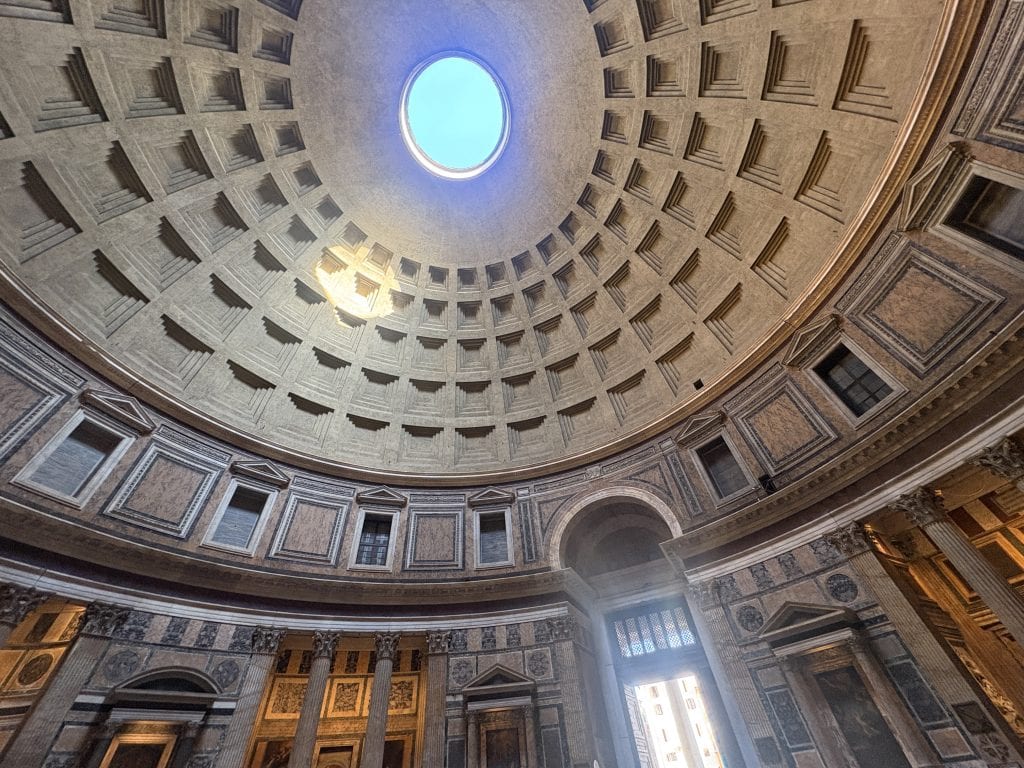
The Pantheon is remarkable for its dome, which is still the world’s largest unreinforced concrete dome. Thanks to continuous use for two millennia, the Pantheon is one of the best-preserved buildings from ancient Rome. Originally a temple, the Pantheon is now a church.
See the Pantheon on your own or, for a few euros more, take a guided tour.
After touring the Pantheon, treat yourself to a gelato and watch the world go by from one of the cafés bordering the piazza in front of the Pantheon. I still remember fondly the fig gelato I sampled while visiting the area.
Avoids Crowds and Check Out a Museum
If you prefer to avoid crowds, I’m going to get radical here and suggest you skip touring the Colosseum and the Forum altogether, especially if the weather is hot.
Instead, visit one or two of these three awesome museums, each of which will give you plenty of insights into ancient Roman and Etruscan art and artifacts in air-conditioned comfort with virtually no crowds.
Capitoline Museum (Musei Capitolini)
Twin palaces designed by Michelangelo house one of the world’s oldest public art collections and are a must-visit for lovers of classical sculpture. Highlights include the bronze equestrian statue of Marcus Aurelius, the Capitoline Wolf, and the mesmerizing Dying Gaul.
National Roman Museum (Museo Nazionale Romano)
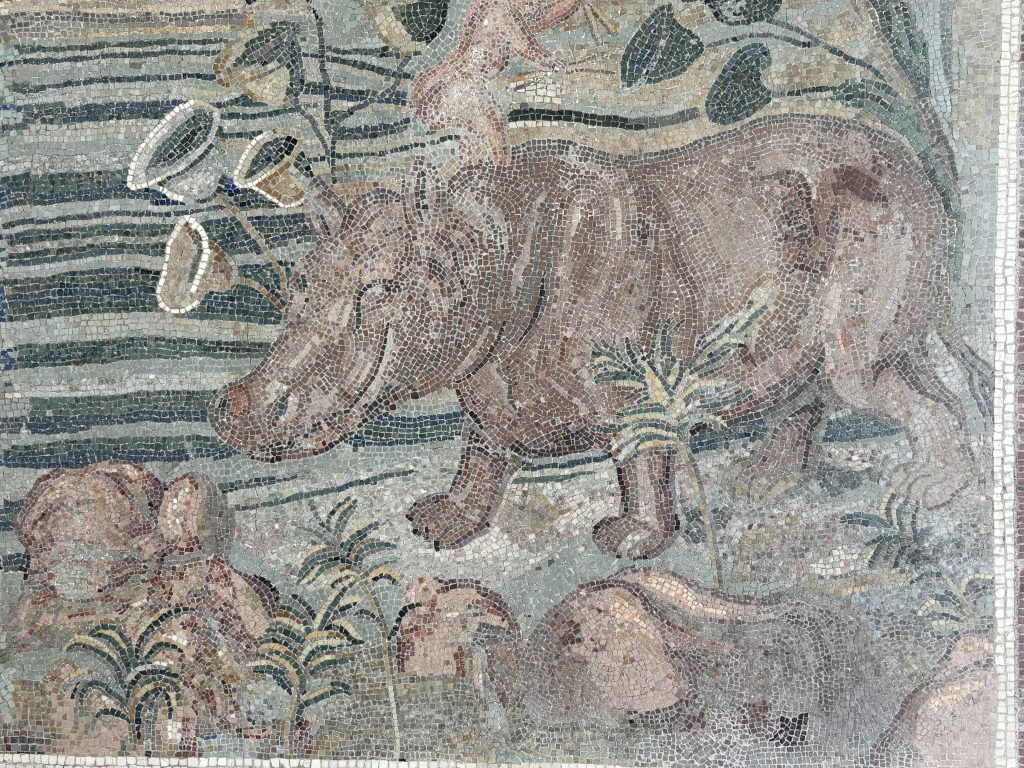
Spread across several locations including Palazzo Massimo alle Terme, Palazzo Altemps, Baths of Diocletian, and Crypta Balbi, the National Roman Museum traces daily life, art, and luxury in ancient Rome. Highlights include exquisite mosaics, frescoes from the Villa of Livia, and hauntingly lifelike marble portraits of emperors.
If you only have time for one branch, visit Palazzo Massimo near Termini Station. It’s manageable, beautifully curated, and blissfully uncrowded.
Here’s one of many magnificent mosaics at the Palazzo Massimo:
National Etruscan Museum of Villa Giulia (Museo Nazionale Etrusco di Villa Giulia)
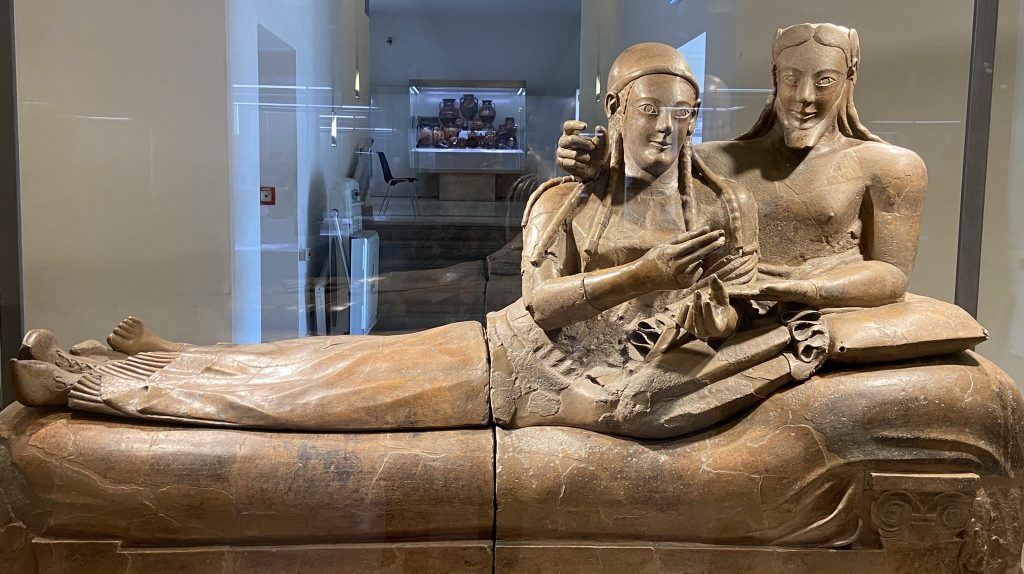
Tucked away in a graceful Renaissance villa built for Pope Julius III, the Etruscan Museum offers a fascinating glimpse into Italy before Rome’s rise. Its collection of jewelry, pottery, and tomb sculpture reveals the elegance and sophistication of this early civilization.
A highlight is the Sarcophagus of the Spouses, a terracotta masterpiece radiating warmth and humanity. The museum’s peaceful gardens provide a refreshing pause from the bustle of central Rome.
Day 2: Catholic Rome
Rome bristles with churches, some dating back to Roman times and most containing priceless works of art, particularly from the Renaissance and Baroque eras. You can’t see all the churches in one day, nor should you try!
Focus first on St. Peter’s Basilica and the Vatican Museum and then go back across the Tiber to visit San Pietro di Vincoli and the Basilica of San Clemente.
St. Peter’s Basilica and the Vatican Museum
A visit to St. Peter’s Basilica and the Vatican Museum requires stamina. Line-ups are inevitable even with advance tickets.
You also can’t avoid the long, sweaty trek through room after room of the Vatican Museum before you finally arrive at tha e Sistine Chapel.
But the trek is worth it. Just make sure you buy your tickets for the Vatican Museum well in advance.
Sistine Chapel & Vatican Museum
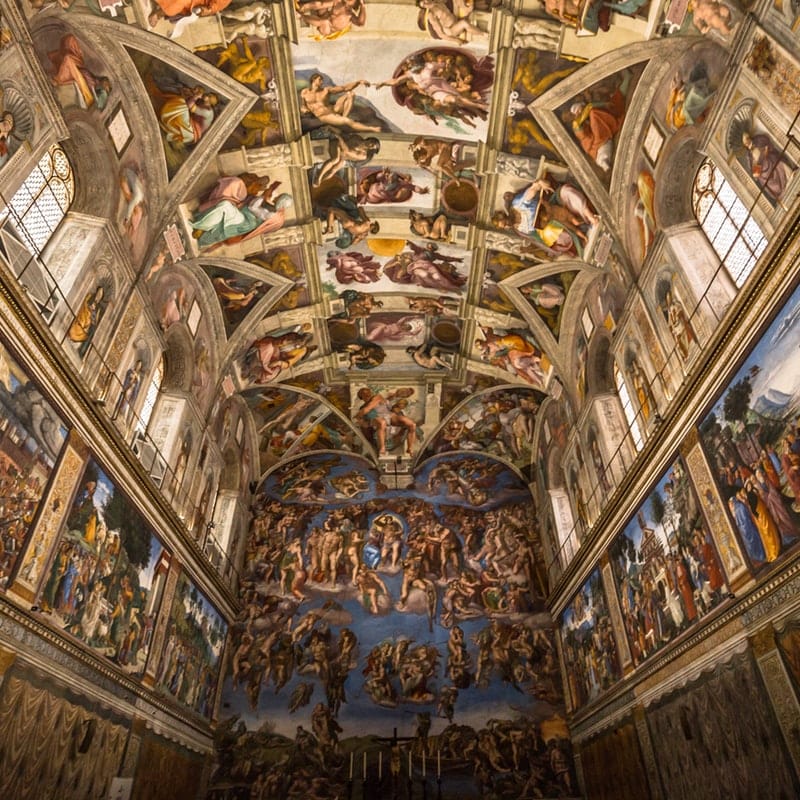
The Sistine Chapel heaves with tourists. There’s no escaping them (and you are one of them!) so just tilt your head back and admire Michelangelo’s ceiling.
My favorite memory of the Sistine Chapel is when I heard a woman behind me say to her companion, “Do y’all think it was done by hand?” I resisted the temptation to turn around and tell her it was paint by numbers.
Buy your tickets in advance to visit the Sistine Chapel and the Vatican Museum.
The Sistine Chapel was restored by Pope Sixtus IV, famous for his patronage of the arts. He also makes an appearance in the TV series Medici, which I write about in a post over on my sister website, Art In Fiction. Pope Julius II is responsible for commissioning Michelangelo to cover the ceiling with his magnificent frescoes between 1508 and 1512.
The Sistine Chapel is not the only attraction at the Vatican Museum, albeit the most famous. Follow the crowds through room after room after room of paintings, maps, sculptures, and more. A highlight is Raphael’s painting, The School of Athens.
St. Peter’s Basilica
St. Peter’s Basilica is a must-see because it is humongous. My favorite part is viewing the size of various world cathedrals marked in the nave. Washington’s National Cathedral is marked at 139 meters, which is about half the length of St. Peter’s nave.
The last time I visited St. Peter’s, the organ was at full volume and wow! Transfixing, for sure.
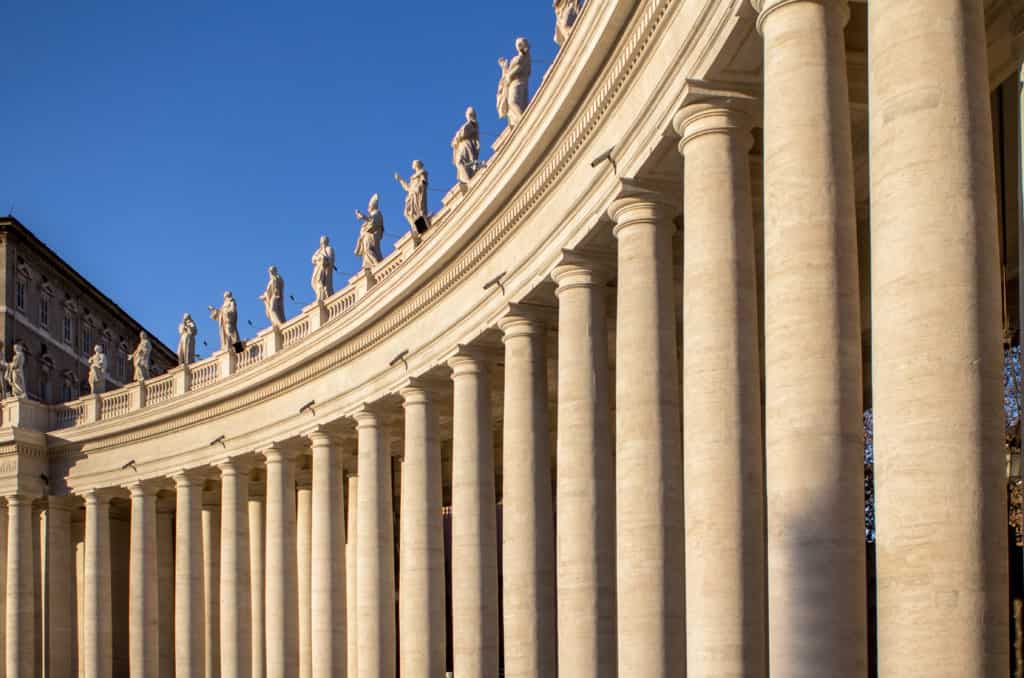
I love the exterior of St. Peter’s. A gorgeous double sweep of Bernini columns embraces two sides of the square.
A section of the Bernini columns at St. Peter’s Basilica
Castel Sant-Angelo
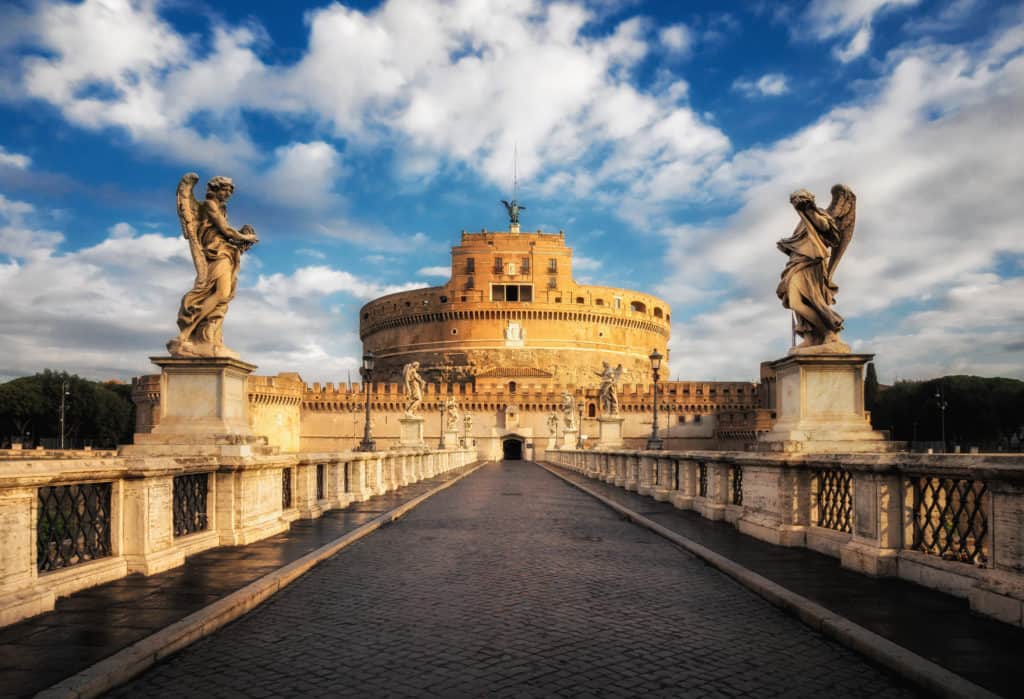
On your way back over the Tiber to central Rome, you’ll pass by the Castel Sant’Angelo. Also known as the Mausoleum of Hadrian, the site technically belongs with the ancient Rome Day 1 itinerary. However, its location near St. Peter’s and the Vatican makes it a good stop on Day 2.
Originally built to be the mausoleum for the Roman Emperor Hadrian and his family, the structure was later used by the popes as a fortress and castle and is now the Museo Nazionale di Castel Sant’Angelo.
The museum is a worthwhile stop, primarily because of the view of Rome seen from the top. Go at sunset for some great photo ops. The area around Castel Sant’Angelo teems with tourists, so seeing a view like the one below is virtually impossible!
Castel Sant’Angelo in Rome
Cross the bridge from the Castel Sant’Angelo and plunge back into medieval Rome. Stay around the Piazza Navona for the rest of the day, enjoying gelatos and people-watching, or continue your Catholic Rome wanderings by visiting two more churches.
Take a bus or a taxi back towards the Colosseum area to find San Pietro in Vincoli.
San Pietro in Vincoli
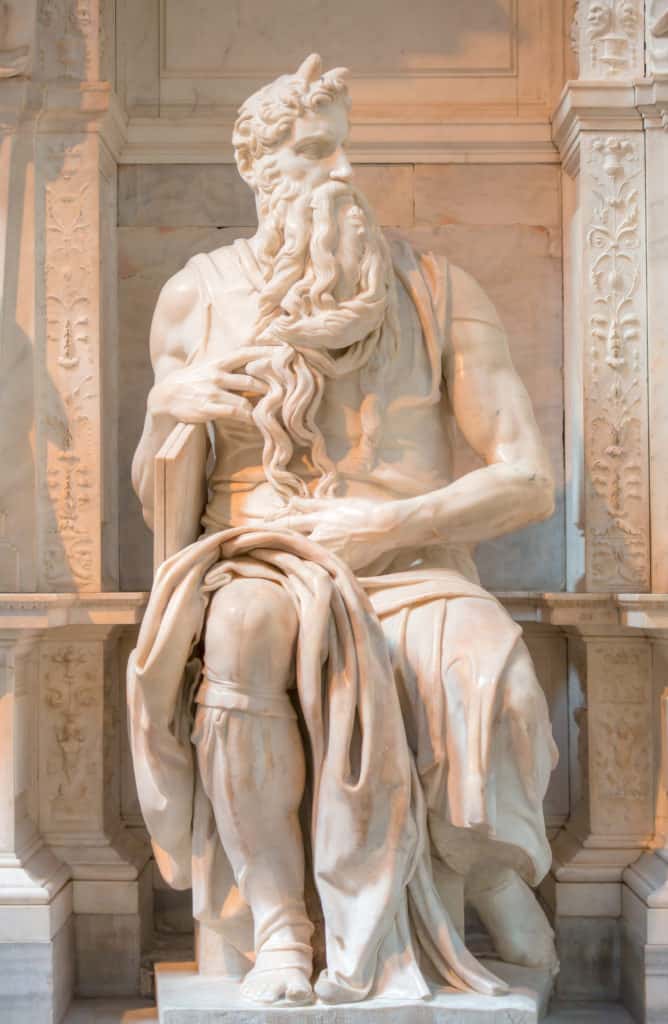
Not far from the Colosseum are a few churches worth visiting, particularly San Pietro in Vincoli (Saint Peter in Chains) where Michelangelo’s statue of Moses dominates the side altar.
Whenever I’ve visited this church, it’s been quiet and uncrowded. I love standing in front of the Moses statue and admiring the way Michelangelo sculpted Moses’s hands. Truly remarkable.
Marble statue of Moses sculpted by Michelangelo in the San Pietro in Vincoli church in Rome
Basilica of San Clemente
Located not far from the Colosseum, the Basilica of San Clemente appeals to me because it was built on the site of a house containing a shrine of the Roman god Mithras. An underground passage leads to the excavated foundations of the 2nd-century Roman house. A relief on the altar shows Mithras, the Persian sun god, killing a bull.
The underground area is super dark and creepy, providing great scope for the imagination.
Photography Tour of Rome’s Churches
If you really love churches and photography, take a Photography Tour of Rome with Rome Photo Fun tours instead of shuffling through the Vatican.
Rome is not all churches and ruins. It also has the marvelous Borghese Gardens, the atmospheric Trastevere region, and the achingly pastoral Appian Way, several metro stops from the center of the city.
See the Galleria Borghese and the Borghese Gardens in the morning, zip out to the Appian Way for lunch and a lovely afternoon stroll, then end your day with dinner in the Trastevere neighborhood across the Tiber from central Rome.
Borghese Gardens and the Galleria Borghese
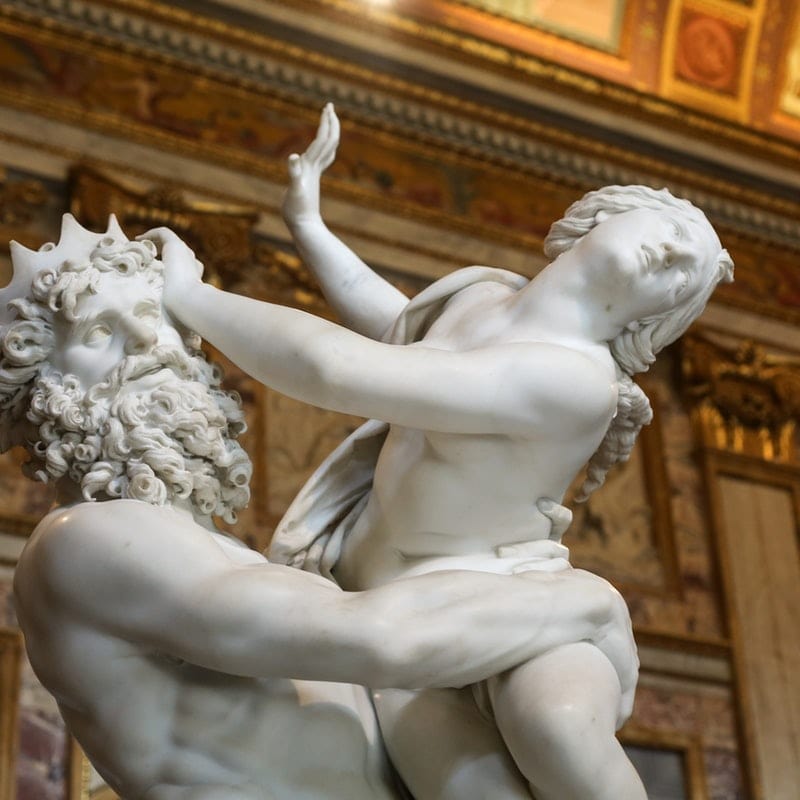
Head to the Borghese Gardens and tour the Galleria Borghese. You must get tickets ahead of time. This stunning gallery reopened recently after being renovated. You’ll see some of the masterpieces of the Baroque age, including works by Caravaggio and the famous sculptures of Apollo and Daphne and The Rape of Proserpina by Bernini.
Check out the way Pluto’s fingers press into Proserpina’s flesh and then remember that you’re looking at marble.
The Rape of Proserpina by Bernini in the Galleria Borghese: Buy tickets in advance
Amazing!
After partaking of the Baroque delights at the Galleria Borghese, spare an hour or so to wander around the gardens of the Villa Borghese. On a solo trip to Rome a few years ago, I stayed in a bed-and-breakfast about a block from the park and enjoyed early-morning strolls alongside Roman joggers.
Appian Way
In the afternoon, depending on the weather and your energy level, consider taking the metro out to the Appian Way (Via Appia Antica).
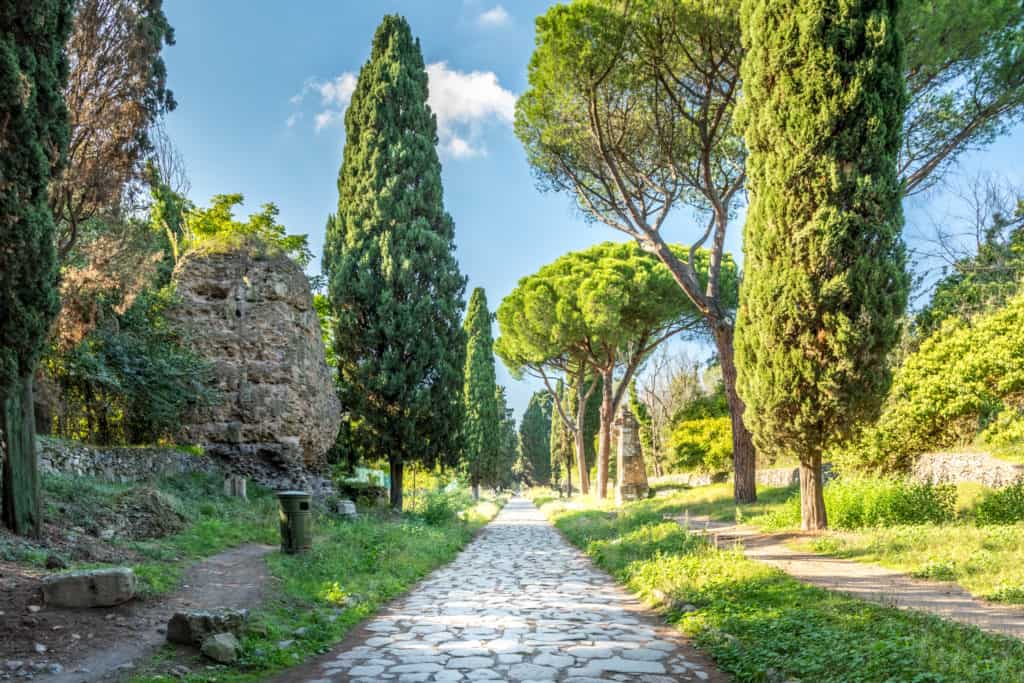
You’re transported from noisy modern Rome to an Arcadian landscape of plane trees and cypresses lining the original Roman road. Rent a bike or just stroll along the stone roadbed, imagining Roman chariots rumbling past.
Gregg and I spent a magical afternoon there, communing with the ghosts of the Roman rich people whose tombs line the road. The peace and quiet soothed nerves that can get a bit overstimulated by the hustle and traffic of downtown Rome.
The beautifully pastoral and peaceful Appian Way outside Rome
Trastevere
Spend an evening strolling the quiet streets of the Trastevere neighborhood. The working-class area still feels authentic and Roman. Find a small restaurant overlooking one of the piazzas and settle in for dinner.
Trastevere is located on the same side of the Tiber as St. Peter’s Basilica, about a ten-minute bus ride alongside the river.
Cobbled street in the charming Trastevere area of Rome
If you fancy doing your Trastevere evening properly, Winedering has some excellent wine and food experiences in the neighbourhood.
An American fashion intern chasing her big break in Rome accidentally destroys the wrong stranger’s laptop, then finds herself sharing a house (and simmering tension) with her professor’s insufferably grumpy son. A breezy summer romance with a very Roman backdrop.
Orphaned young and driven to prove himself, Raphael arrives in Rome to find Michelangelo already there, and Pope Julius II pits the two against each other on opposite walls of the Vatican. A rivalry-fueled portrait of ambition and Renaissance Rome at its most cutthroat.
Rome FAQs
Here are answers to questions I’m most frequently asked about visiting and enjoying Rome:
Is three days enough for Rome?
Not really, but it’s better than two days! If you focus on the major sights (Colosseum/Forum, Vatican, Pantheon) and book skip-the-line tours, you can get a great overview in three full days. Just make sure you don’t over-do it. Better to skip a site and relax with an Aperol Spritz in a bar frequented mostly by Italians than to spend your time in hot, sweaty line-ups.
What is the best order for sites in Rome in three days?
See Ancient Rome (Colosseum, Forum) sites on Day 1, preferably later in the day when the crowds may be thinner. Explore the Vatican and the Historic Centre (Pantheon, Piazza Navona) on Day 2. On Day 3 check out neighbourhoods (Trastevere, Appian Way) or tour some galleries (the Etruscan Museum is my favorite).
Do I need a Rome transport pass for just 3 days?
If you plan to use metro/bus/or hop-on tours frequently, a 48-hour transport pass can save money and time. Otherwise pay-as-you-go may suffice. If you want to conserve your energy, I suggest getting around with taxis. They cost more than the bus, but they are fast, easy to find and fun to ride. Watch the crazy traffic go by from the comfort of a car driven by a pro.
What’s the best area to stay in Rome for walking around the city?
Staying in Monti or near the Spanish Steps gives you easy walking access to many major landmarks; Trastevere offers a charming evening atmosphere but is farther from sites in central Rome. Staying right down near the Piazza Navona is an excellent choice if you don’t mind crowds and like to be close to the action.
Tours in Rome
Here are some tours offered by Tiqets.com:
And here are some tours offered through GetYourGuide:
Fancy a walking tour? The tours offered through GuruWalks are a good bet. Here are their tours in Rome.
Where to Stay in Rome
If you’re staying in Rome for more than two or three nights, consider renting an apartment. I’ve had good luck with VRBO and booking.com.
When you stay in an apartment, you live like a temporary local, buying food from the local markets, and getting to know neighborhood restaurants and cafés.
Here are some good options:
The Sant’Angelo Apartments in the Jewish Ghetto area of Rome is very close to a lot of Roman ruins in addition to the Capitoline Museum and the Piazza Venezia, site of the Victor Emmanuel monument. The apartment I rented was quite spacious and the location can’t be beat for exploring ancient Rome.
I also recommend Viam 6B located between the Spanish Steps and the Piazza Popolo, a very upscale and chichi part of Rome with lots of designer stores. The apartment was very modern and comfortable and features a beautiful outdoor terrace.
I loved Torre Capranica just around the corner from the Pantheon in a crowded but exciting part of Rome. This 14th century renovated tower is staffed by friendly people and includes an elevator.
Daytrip offers private transfers from Rome to Florence, Naples, and beyond with fixed pricing, no meter watching, and you can add a sightseeing stop (or two) along the way.
Keep Exploring Italy with Artsy Traveler
Here are more posts to give you a taste of Italy, or check out Visiting Italy to see the full list of posts about Italy.
Carol M. Cram is the author of five award-winning novels inspired by art and the women who shaped it, the creator of Artsy Traveler, an arts-focused travel blog, the founder of Art In Fiction, a curated database of 2,600+ novels inspired by the arts, and the host of The Art In Fiction Podcast. She lives with her husband, artist Gregg Simpson, on beautiful Bowen Island near Vancouver, BC.