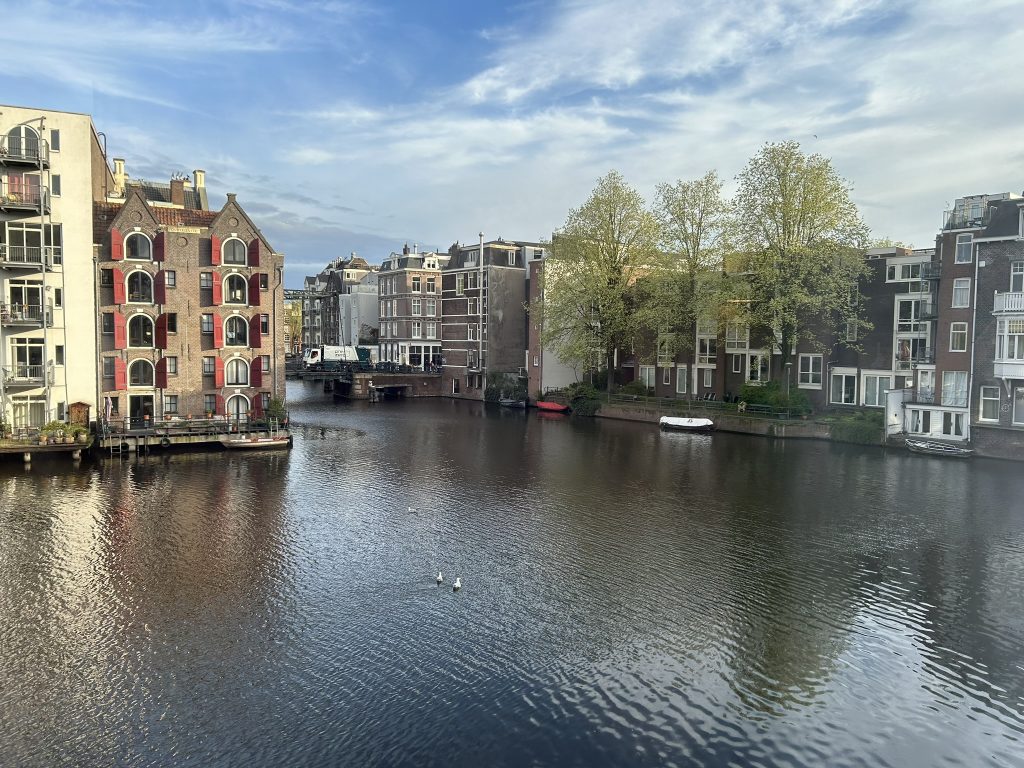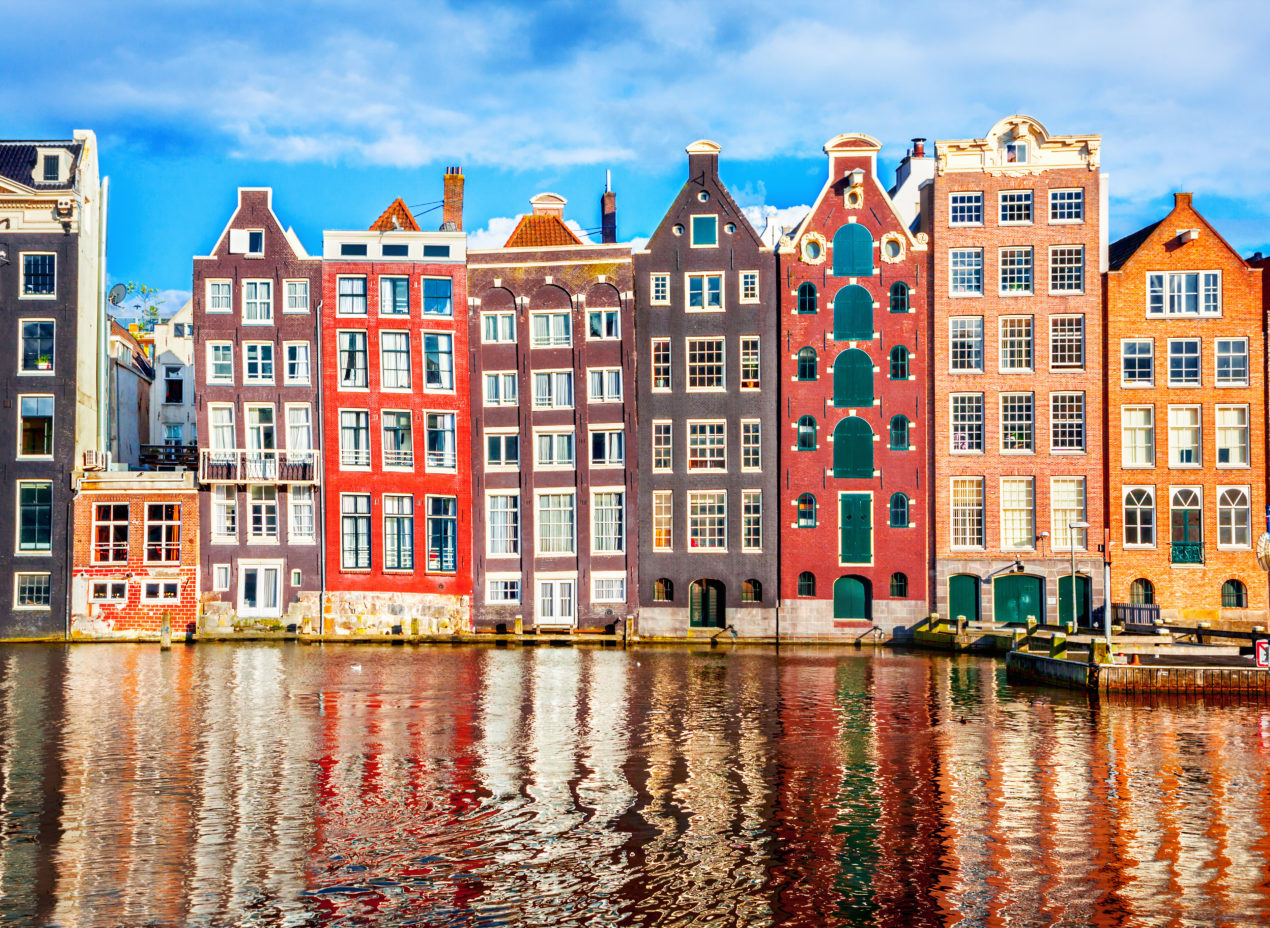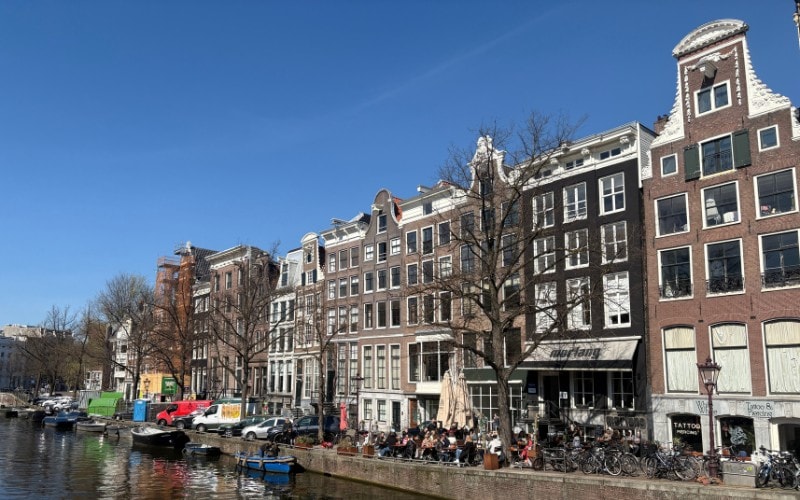
canal in Amsterdam

Exploring Amsterdam’s Anne Frank House and Begijnhof

The Anne Frank House in Amsterdam attracts visitors from all over the world, and for good reason. A visit to the secret hiding place where Anne Frank and six other people hid for two years from the Nazis is both sobering and inspiring.

With authoritarianism on the rise in many countries around the world, Anne’s ordeal and tragic end are more relevant than ever.

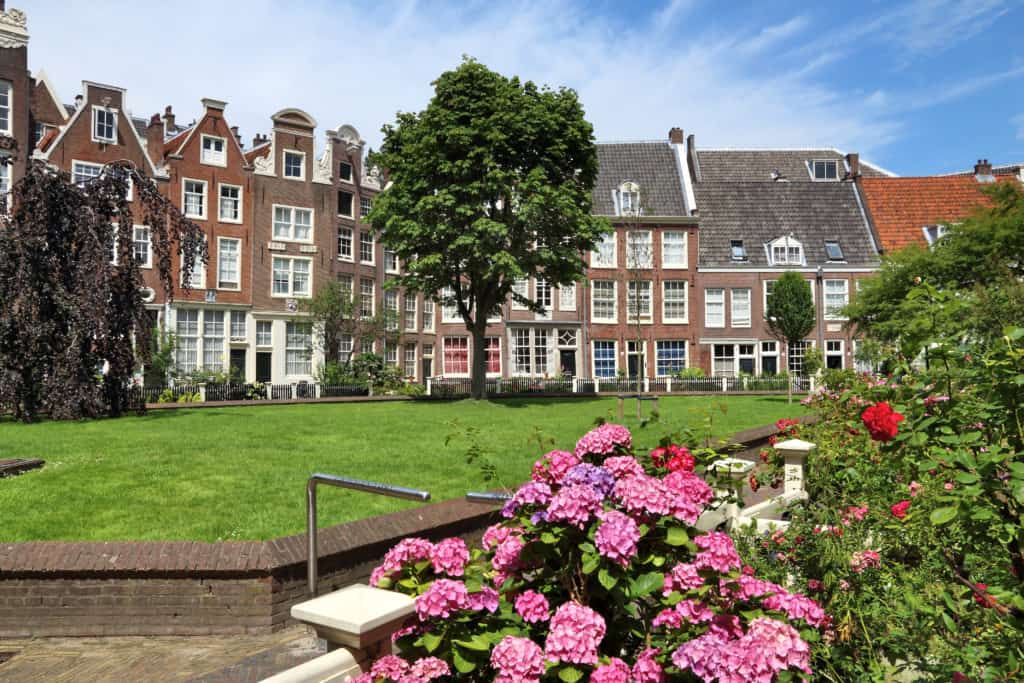
Before or after your visit to the Anne Frank House, give yourself a sightseeing break by taking a stroll into the Begijnhof (#3 on the map below). In this tranquil courtyard in the middle of bustling Amsterdam, you can “set a spell” and enjoy a calming break. It’s the perfect place to either prepare for your visit to Anne Frank House or to quietly recover.

In this post, I describe my visit to Anne Frank House and share photos of the Begijnhof on a breezy, sunny April day.


Trip map created with Wanderlog, a trip planner on iOS and Android

Visiting Anne Frank House

Anne Frank House (#2 on the map above) is located on Prinsengracht Canal at Prinsengracht 263-267 in Amsterdam. It’s about a twenty-minute easy walk from where I’m staying at the Clayton House Hotel American (4) on the Singelgracht.

The entrance to the museum is around the corner, at Westermarkt 20. Tickets cost €16.50 for adults (as of January 2026).

Getting Tickets for Anne Frank House

You can only visit Anne Frank House with a ticket purchased online from the official website. Every Tuesday at 10 am CET all tickets become available for a visit six weeks later.

When I went online to purchase my ticket six weeks before my visit, only a handful of spots were still available. This was likely because I live in the Pacific time zone and many hundreds of people were out of bed earlier than I was and snagged tickets.

As it turned out, I got the date wrong, but more on that in a sec.

Entering Anne Frank House

At precisely ten minutes before the time I thought I’d booked, I arrive at Anne Frank House on Prinsengracht Canal in Amsterdam. I open my phone, check my eticket and discover, to my horror, that the date on the ticket is April 3 not April 8.

How did that happen? Months ago, I’d marked the date on my calendar on which I could order my ticket, and then somehow nabbed a 4 pm time slot on the wrong date.

Sigh.

Instead of turning away in defeat, I join the queue of people awaiting their 3:45 timed-entry slot and show my ticket to the attendant. With pleading eyes and my best I’m-a-stupid-tourist, self-deprecating smile, I tell him I got the date wrong.

He squints at my ticket, shakes his head, and then asks me how many people I am. I tell him one. He looks relieved and tells me to wait. He talks into his walkie talkie in rapid Dutch and looks concerned. Just as I am about to lose hope, he tells me to wait a bit longer while he scans in the rest of the people in the group.

After another hurried Dutch convo, he nods and says he’ll let me in. I thank him profusely, then enter the ground floor of the warehouse that houses the annex on the top floor where Anne and six other people lived for two years.

Previous Visit to Anne Frank House

I’d visited the Anne Frank house once before, in 1970 when I was fourteen years old, almost the same age as Anne. I remember being profoundly affected by the experience, which was my first contact with the horrors of war.

I’d read The Diary of Anne Frank the year before, and like most young girls at that time, I’d identified with Anne.

Navigating the Displays

The Anne Frank House provides a thoughtfully organized experience. After checking my coat, I pick up an audioguide and am instructed to point it at a digital access point in the wall in every room I enter.

Along with about a dozen other visitors allowed in, I enter each room, pause to listen to the commentary and then move on.

With everyone in my group listening to their own audioguides, the visit is eerily quiet. Also, visitors are not allowed to take photos, which affords a more relaxed and respectful experience. 

As I progress from room to room and floor to floor, the audioguide tells the heartbreaking story of Anne Frank and the other people in hiding, including her father, Otto, her mother, and her sister, Margot; the people who helped the seven people survive in their hiding place for two years; and plenty of context about how Germany invaded the Netherlands and mandated the persecution of Jews.

Learning Anne’s Story

The first thing that hits me as I start listening to Anne Frank’s story is that Anne was only two years younger than my mom. When Anne went into hiding in 1942, she was 13 years old; my mom, living halfway across the world in a small town in British Columbia, Canada, was 15.

My mother led a long and very productive life, dying at the age of 93 a few years ago, whereas young Anne died in 1944. The stark contrast between Anne’s life and my mom’s really hit me. Anne should have been able to live a long life like my mother had.

Progressing from Room to Room

The rooms are dimly lit and feature displays about life in Amsterdam at the beginning of the war and the ever more onerous constraints put on Jews as the Nazi occupation continued. Quotes from Anne’s writings are featured in most of the commentaries.

Several displays chronicle the preparations that Anne’s father, Otto, made to take his family and the family of one of his employees into hiding.

The feeling as I progress through each room is one of increasing desperation and urgency. If not for Otto’s foresight and the help of people in his company, the Frank family would not have survived as long as they did.

Like so many Amsterdam houses, the building is tall. I climb several flights of steep stairs, pausing at each level to listen to more commentary.

Note that if you have mobility issues or trouble climbing steep stairs in very narrow stairwells, you may have to give Anne Frank House a miss.

Entering the Annex

Finally, I reach the bookcase that for two years hid the secret annex. 

The commentary now stops so people can climb the last flight of steep stairs behind the bookcase to the handful of tiny rooms shared by seven people for two years.

The rooms are completely bare now and for a few moments, it’s tempting to think they aren’t that small. Then the photographs on the walls showing the rooms furnished with cots and chairs and a table drive home just how terribly cramped life in these rooms must have been.

During the day, the inhabitants couldn’t talk above a whisper and had to walk very carefully to avoid being heard by people working in the warehouse below.

It’s sobering, to say the least.

Ending the Tour

After touring the rooms, I descend to view more displays about what happened to Anne and her family after the Gestapo discovered the annex and shipped everyone off to concentration camps.

Anne and her sister and mother died in Bergen-Belsen Concentration camp, with only Otto Frank surviving.

I learn that Anne’s diaries were found by one of the women who had helped them survive while in hiding. One of the displays shows the diary (or a facsimile, more likely) with Anne’s handwriting.

In addition to describing the two-year ordeal, Anne wrote short stories and even started writing a novel. She wanted to be a writer and indeed is now celebrated as one of the Netherlands’ most famous authors.

Warning about Fradulent Ticket Providers

Here’s a warning on the Anne Frank House official website about fraudulent ticket providers:

Please note that there are fraudulent websites with URLs similar to the one used by the Anne Frank House. These sites are aimed at credit card fraud or the sale of invalid tickets. Tickets for the Anne Frank House can only be purchased through this website. Commercial parties offering Anne Frank House tours do not provide access to the Anne Frank House. 

The best a commercial tour can do is take you around areas of Amsterdam on an Anne Frank walking tour. Here’s one from GetYourGuide, billed as an introspective walking tour through Anne Frank’s life. Explore the Jewish history of Amsterdam and the horrors of German occupation during World War II with a local guide.

Powered by GetYourGuide

Begijnhof

Either before or after your visit to Anne Frank House, check out the Begijnhof. It’s located about a ten-minute walk from Anne Frank House and well worth a detour.

The Begijnhof is a tranquil inner courtyard surrounded by 164 dwellings dating back to the 14th century and owned by the Beguines, a female Roman Catholic religious order. For centuries and up to the present day, only single women have lived in the houses bordering the courtyard.

The Beguines were women who dedicated their lives to helping the needy even though they did not belong to a church order. However, they took a vow of chastity and renounced their private lives.

The women who today live in Begijnhof must put up with tourists entering their courtyard to snap pictures. Fortunately, signs caution visitors to stay quiet and respectful.
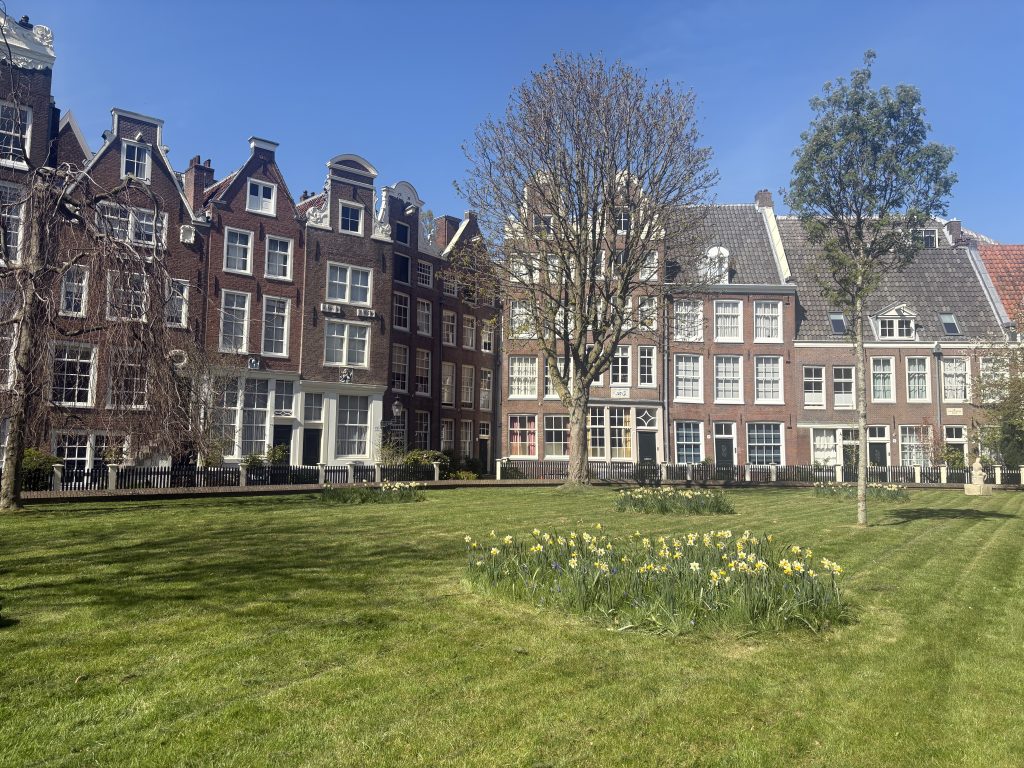
Tranquil courtyard of old Amsterdam houses in the Begijnhof
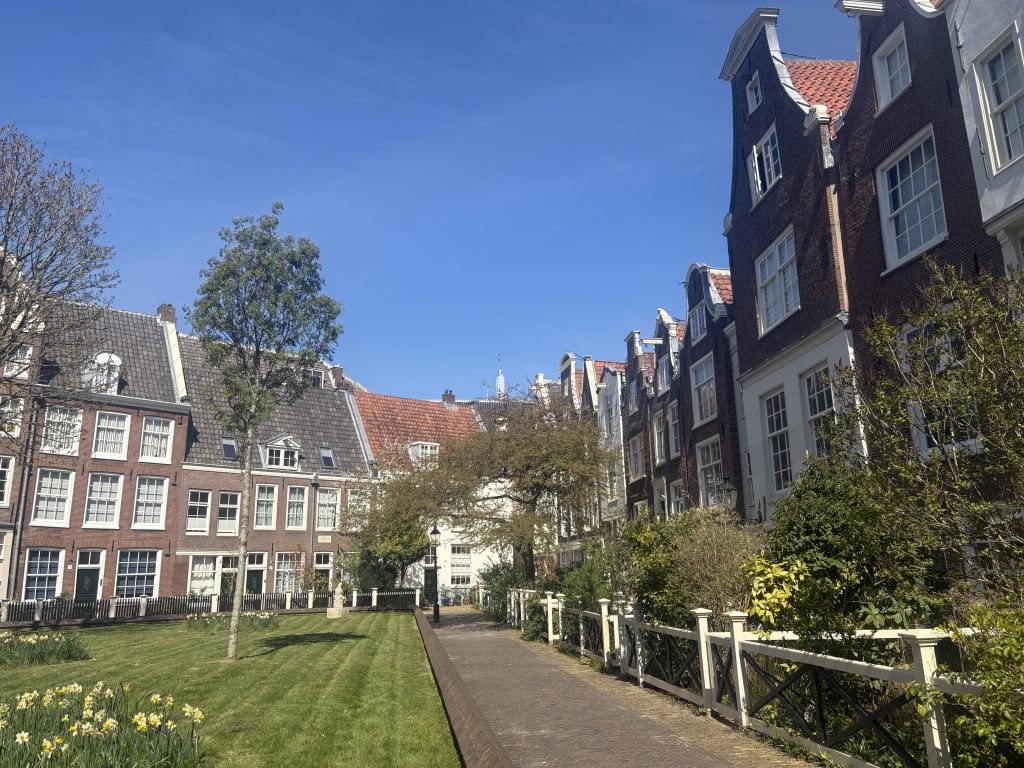
A view of a row of tranquil old Amsterdam houses in the Begijnhof

House number 34 is a wooden house reputed to be the oldest house in Amsterdam, built during the 16th century. Informative plaques provide information about the inhabitants of the Begijnhof back in the day, and visitors can enter the two churches.

The 15th-century Engelse Kerk (English Church) was where the Beguines attended mass until the Protestant takeover in the 16th century when the church was transformed into the English Reformed Church. You can also enter the Catholic Houten Huys.

The Begijnhof is not what I’d call an attraction in Amsterdam. It’s more of an oasis, a serene respite from the crowded sidewalks and whizzing bikes in Amsterdam’s lively Centrum.

Taking time out of a busy sightseeing day to sit quietly on a bench overlooking the green lawn surrounded by beautifully preserved 17th- and 18th-century Amsterdam narrow houses is one of the best ways I know to get off the beaten path and just relax.

You can enter the Begijnhof for free between 8 am to 5 pm every day.


Staying in Amsterdam

I recommend the Clayton Hotel Amsterdam American (#4), a venerable old hotel with a gorgeous art deco restaurant, friendly staff, and comfy rooms. The location, about a ten-minute walk from the Rijksmuseum (#1) and overlooking the Singelgracht, can’t be beat.

Another great choice is Mokum Suites (#5) on a very picturesque stretch of the Herengracht and close to the lively Rembrandtplein. From your suite, you can watch the canal boats slide past.
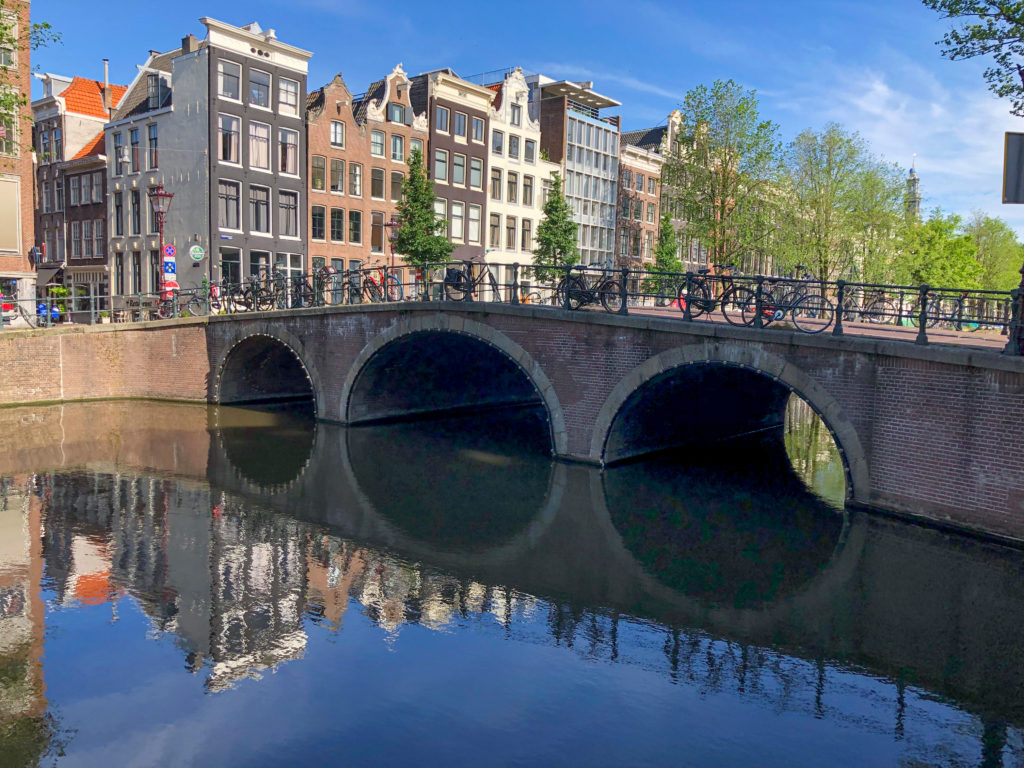
The architecture of Amsterdam and its iconic canals

Keep Exploring Amsterdam with Artsy Traveler

Carol Cram
About Carol Cram

Carol M. Cram is the author of five award-winning novels inspired by art and the women who shaped it, the creator of Artsy Traveler, an arts-focused travel blog, the founder of Art In Fiction, a curated database of 2,600+ novels inspired by the arts, and the host of The Art In Fiction Podcast. She lives with her husband, artist Gregg Simpson, on beautiful Bowen Island near Vancouver, BC.
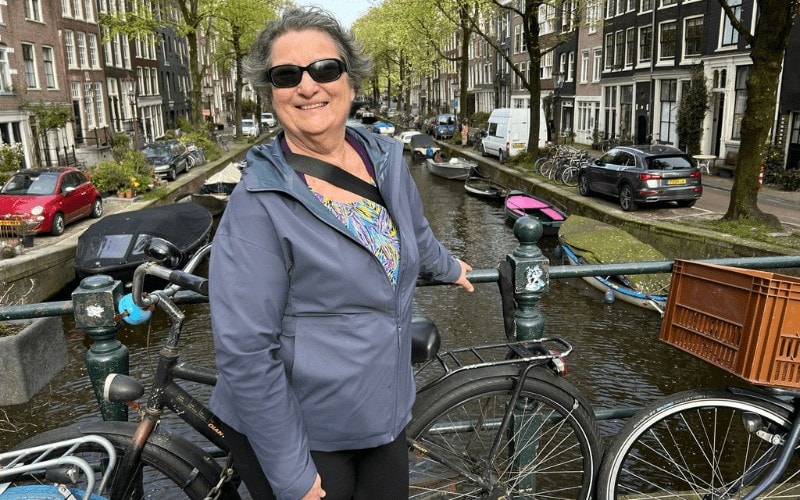
Carol Cram in Amsterdam

Small Museums in Amsterdam: Rembrandt House and the National Maritime Museum

I love Amsterdam so much it’s my default first stop on almost every European trip. Since 1970, when I got my introduction to Europe with my mom, I’ve been back at least ten times.

You’d think I’d have tracked down every small museum in Amsterdam by now, but two managed to hide from me until my most recent visit: the National Maritime Museum and the Rembrandt House Museum.


Finding These Small Museums on the Map

First is the National Maritime Museum (#1 on the map below) and second is the Rembrandt House Museum (Rembrandt Huis – #2). Both deliver excellent bang for your euro. The map below also shows the location of my recommended hotel (#3) and for context, Amsterdam’s two heavyweight museums: the Rijksmuseum (#4) and the Van Gogh Museum (#5).

This map was created with Wanderlog, the best trip planner app on iOS and Android

National Maritime Museum

Despite all my visits to the city, I’d never heard of Amsterdam’s excellent Maritime Museum. On my latest trip, the taxi drove us right past the massive replica of an 18th-century Dutch three-master sailing ship (the Amsterdam) moored in the harbor. I asked him what it was and he told us it was part of the National Maritime Museum. Intrigued, I looked it up when we got to the hotel, which turned out to be only a six-minute walk away.

Arriving at the National Maritime Museum

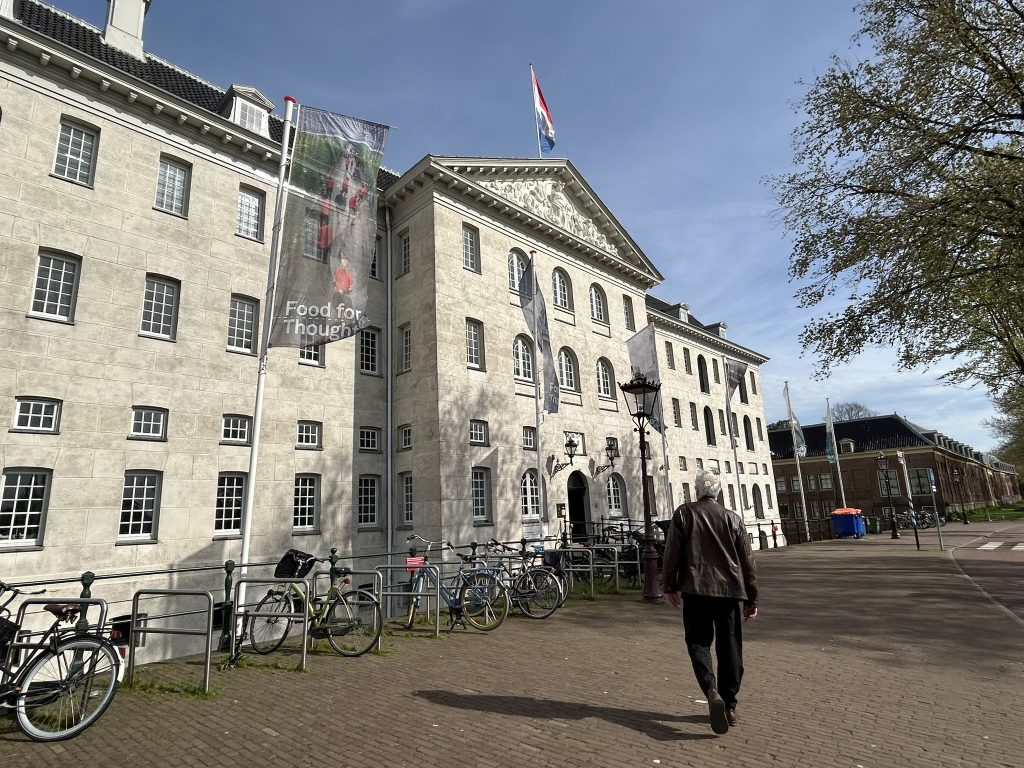
The National Maritime Museum is housed in a stately three-story building on the edge of Amsterdam’s massive harbor and adjacent to the Amsterdam ship moored in the harbor. After entering at the south side of the building, we walked into a spacious covered atrium with entrances leading to the north, west and east.

Outside the National Maritime Museum in Amsterdam, one of my two recommended small museums in Amsterdam
Outside the National Maritime Museum in Amsterdam

Touring The Amsterdam

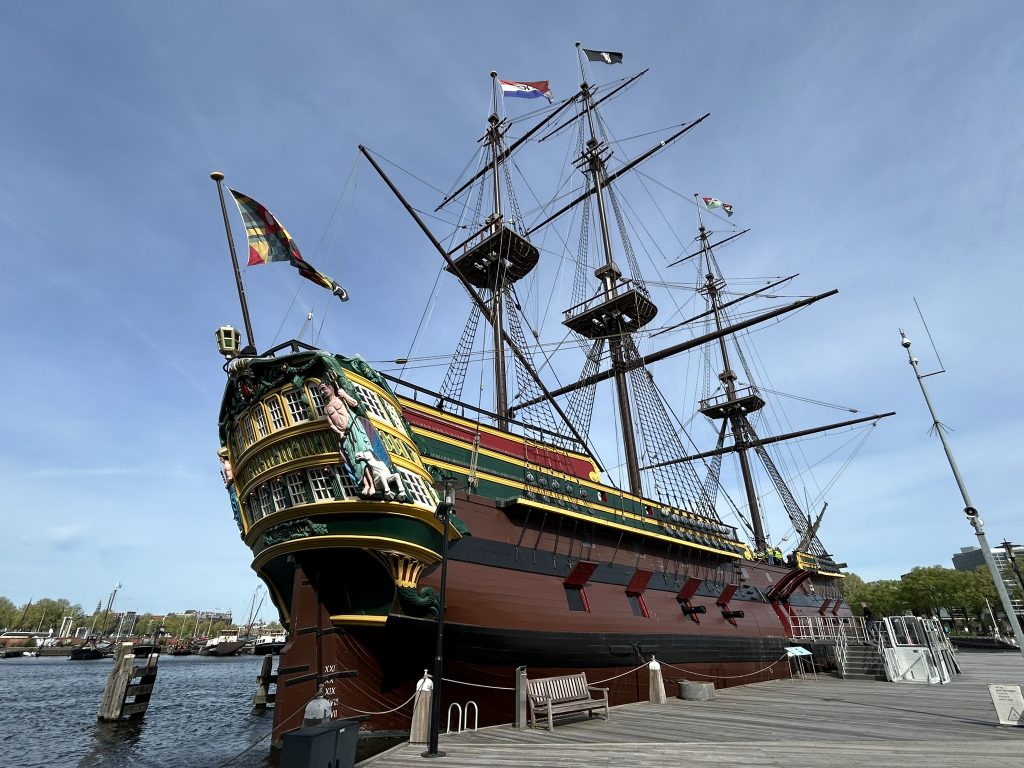
We headed first for the north door that led straight out to a wharf and the docked replica of the Amsterdam. What a sight! The huge hull rose several stories above our heads, above which soared three masts.

Old style three masted ship moored at the Maritime Museum in Amsterdam
A replica of the East Indiaman Amsterdam at the National Maritime Museum

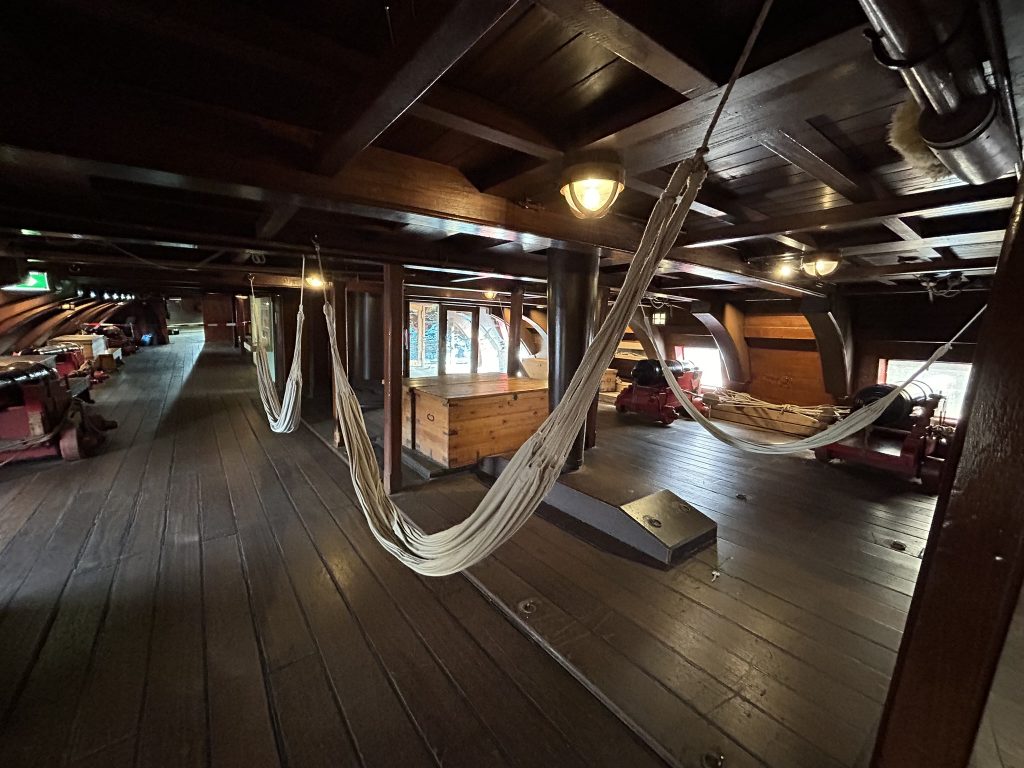
We boarded the ship and were immediately engulfed by a posse of schoolchildren all wearing yellow safety vests and swarming through the sailors’ quarters. Apart from the kids, the quarters looked spacious until I realized the space would house a crew of 191 sweaty sailors. The smells and swells on a rough day at sea would not have been pretty.

Interior of Amsterdam tall ship at the National Maritime Museum in Amsterdam
Sailors quarters in the Amsterdam tall ship at the National Maritime Museum in Amsterdam

Information about the Amsterdam

Throughout the ship, descriptions in both English and Dutch provided fascinating glimpses into the history of the original Amsterdam and Dutch trade back in the 17th and 18th centuries. I learned that on one voyage, the Amsterdam carried one captain, 191 sailors, 128 marines, 11 artisans, and 3 women passengers for a total of 334 people. That’s a lot of bodies to squeeze onto a ship that, while large, wasn’t that large. I found it a bit crowded with a school group of maybe 30 kids!

Eating on the Amsterdam

In the galley at the front of the ship, the cook would prepare meals for everyone on board, who would then take turns eating in groups of seven. The captain and passengers got the best and freshest food, leaving the crew to half starve and fall prey to diseases such as typhus, dysentery, and scurvy. It must have been pretty grim, particularly since long voyages to destinations in the East Indies took many, many months.

Women Dressed as Men

I was particularly taken by a description of women dressed as men who sailed on the Dutch ships. Some were forced by circumstances to earn money; some were likely trying to escape an unhappy marriage; some maybe just wanted adventure. Unfortunately, any woman who was trying to pass herself off as a man on a ship was severely punished.

In 1770, a woman called Margereta Reymers dressed as a man and joined the crew of the East Indiaman Schoonzicht under the name Hans Hendrik Reymers on a ship sailing to Asia. Margereta was discovered two months into the voyage and put ashore at Cape Town where a man who had promised to marry her left her pregnant.

Eventually, Margereta managed to find a place on a ship returning to the Netherlands. Her daughter was born at sea. No one knows what happened to Margereta and her daughter. Hmmm—therein lies an interesting idea for a novel!

The Maritime Museum Exhibits

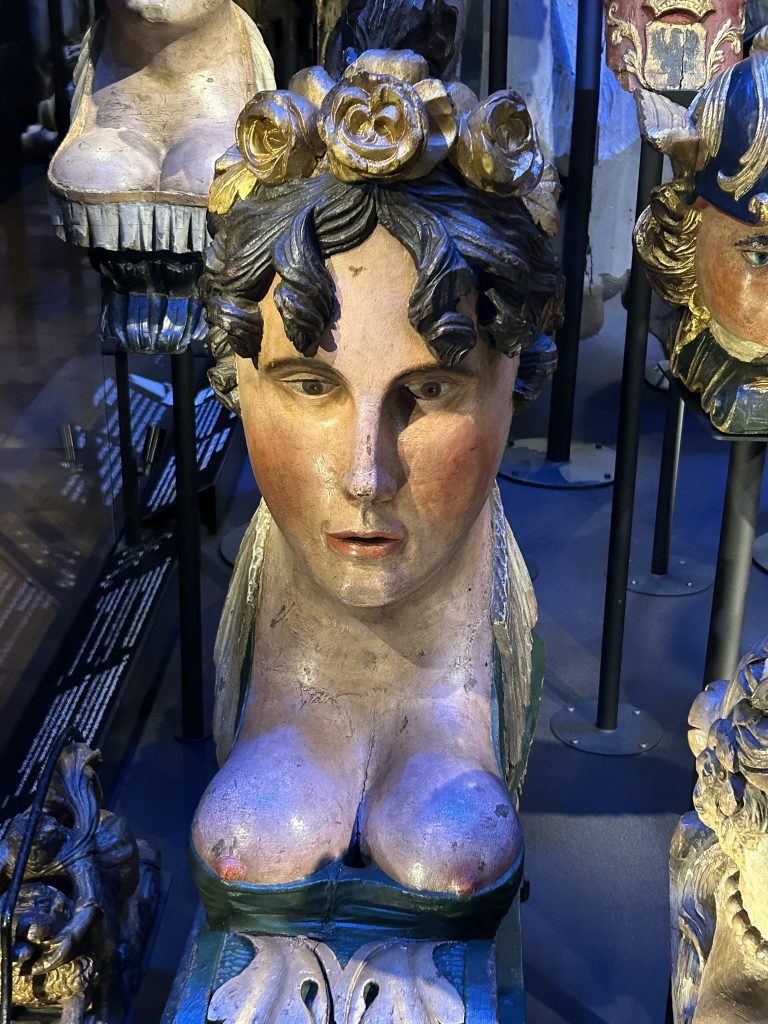
The museum itself is quite vast and beautifully curated. If you are into ships, navigation, and sailing, you could spend many happy hours there. I particularly enjoyed the displays of figureheads and model ships.

For more information about the National Maritime Museum, check out their informative website: https://www.hetscheepvaartmuseum.com/

After touring the National Maritime Museum, we enjoyed lunch in a typical Dutch pub, then headed to the Rembrandt House Museum, about a ten-minute walk from our hotel.


The Rembrandt House Museum

Unlike the National Maritime Museum, I had heard about the Rembrandt House Museum, but had never managed to visit it. I thought it would be a rather dusty old place with little to recommend it beyond the fact that Rembrandt once lived there.

I discovered that I was wrong and that the Rembrandt House Museum is well worth an hour of any artsy traveler’s time.

Renovated Museum

The museum has been recently renovated to include an adjacent building containing the entrance area, a gift shop (of course), and two floors of exhibition space.

We entered the airy modern foyer, purchased our tickets and picked up our audioguides. We don’t usually opt for audioguides, but the man at the desk told us they were essential to our enjoyment of the museum and so we dutifully donned the earphones and headed for door leading into the house that Rembrandt called home for 19 years.

Touring Rembrandt House

For the next hour or so, we drifted from room to room and up several sets of winding stairs to explore the nooks and crannies of what was, and still is, a large and comfortable home. Rembrandt was flying high when he and his wife purchased the house. He was receiving many commissions in addition to earning a sizable chunk of his income from teaching wannabe Rembrandts.

But regrettably, Rembrandt was not the best of businessmen. After nineteen years of enjoying the good life, Rembrandt’s many creditors forced him to sell just about everything not nailed down and move across town.

Rembrandt’s Misfortunes are History’s Gains

I learned that it was thanks to Rembrandt’s financial misfortunes that his house has been so immaculately recreated. When Rembrandt was forced to liquidate all his assets, he left behind an extremely detailed inventory of the house contents. Historians were able to use this inventory to faithfully recreate the rooms in his house so that today we can wander through them secure in the knowledge that they look more or less the same as they did in Rembrandt’s day—except with electric light and tourists listening to audioguides.

The comprehensive audioguide provided us with a wealth of information about each of the rooms we entered, from grand salon to the room of curiosities to Rembrandt’s gorgeously bright and airy painting studio. In each room, audio commentary described the room and its uses, and provided information about Rembrandt’s life and work.

Rembrandt House Highlights

Box Beds

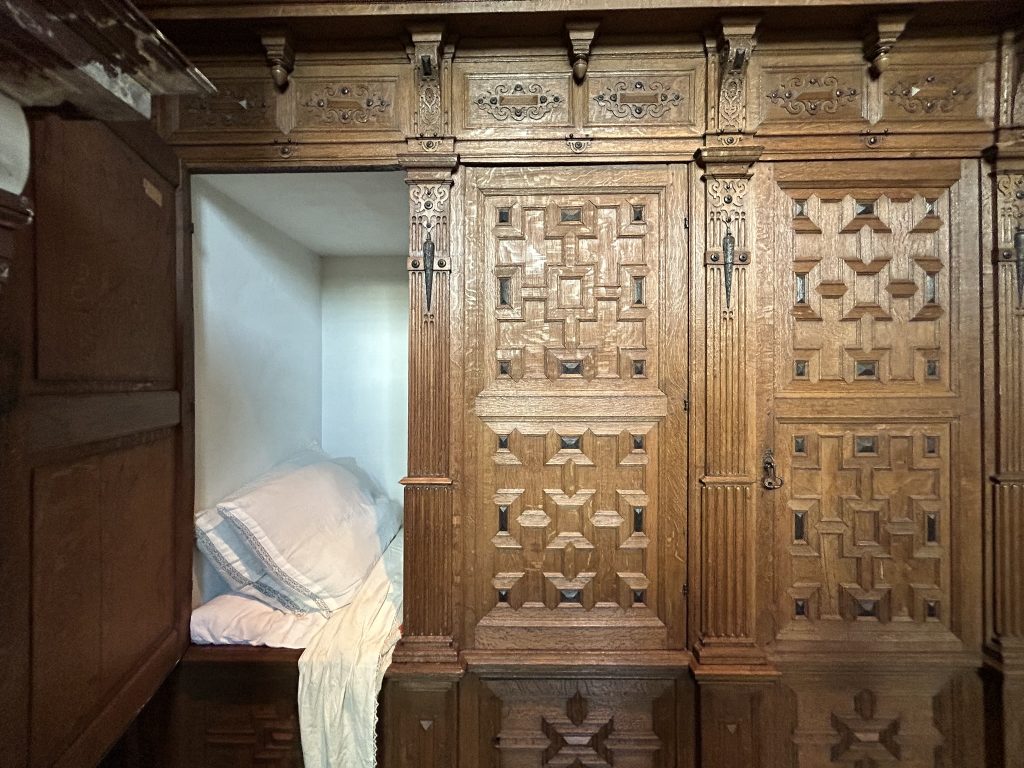
One of several box beds in the house was situated in the main salon and, like every box bed in the house (there were several), was much shorter than would seem reasonable to accommodate an average-sized human. I learned that back in Rembrandt’s time, people slept sitting up and so had no need of a bed that extended their full height. Apparently, the prevailing medical wisdom of the day dictated that sleeping completely prone was very bad for the health. Peering into the box beds, I shuddered at the thought of actually sleeping in one. If you are at all prone to claustrophobia, you wouldn’t last ten minutes.

The box bed shown below was in the main salon and would have been for visitors.

Box bed in Rembrandt Hour in Amsterdam, my favorite small museum in Amsterdam
Box bed for visitors

Etching Studio

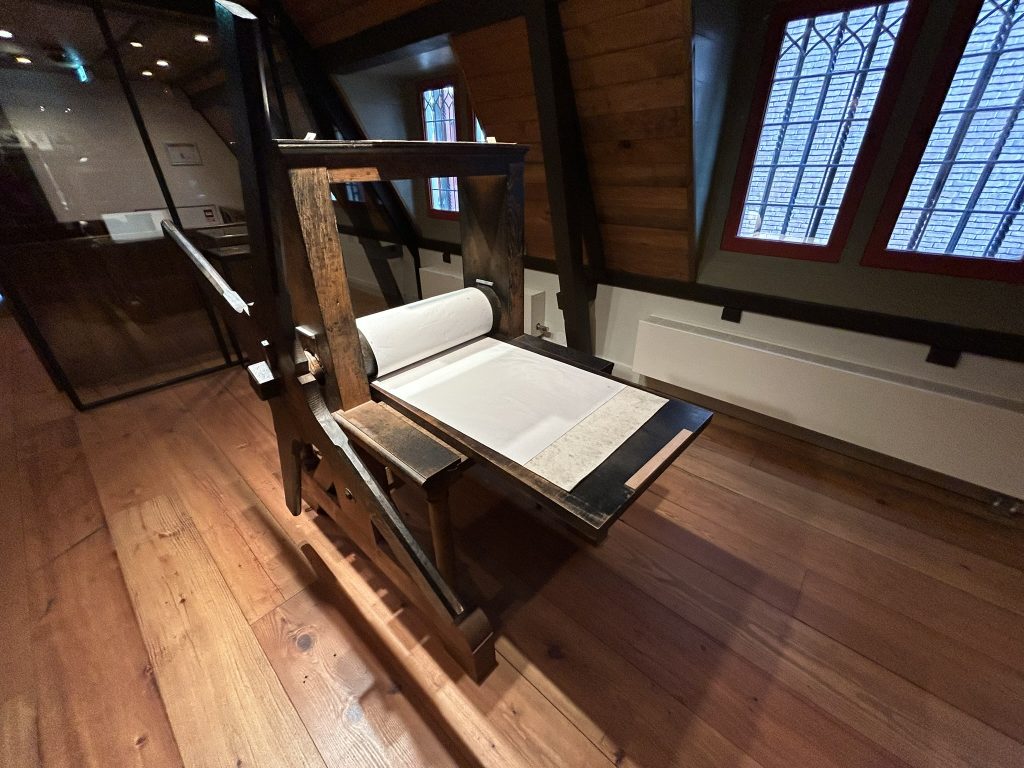
Rembrandt was known for his etchings, many of which he made in the etching studio. Nowadays, a rubber-gloved attendant demonstrates the art of etching.

Unfortunately, we missed her demonstration but it was likely very similar to the one we saw at the house of Albrecht Dürer in Nuremberg. In fact, the setup of the Rembrandt House Museum reminded me of the Dürer museum. You can read about our visit there in my page about Artsy Sightseeing in Germany.

Printing press in Rembrandt House museum etching room

Painting Studio

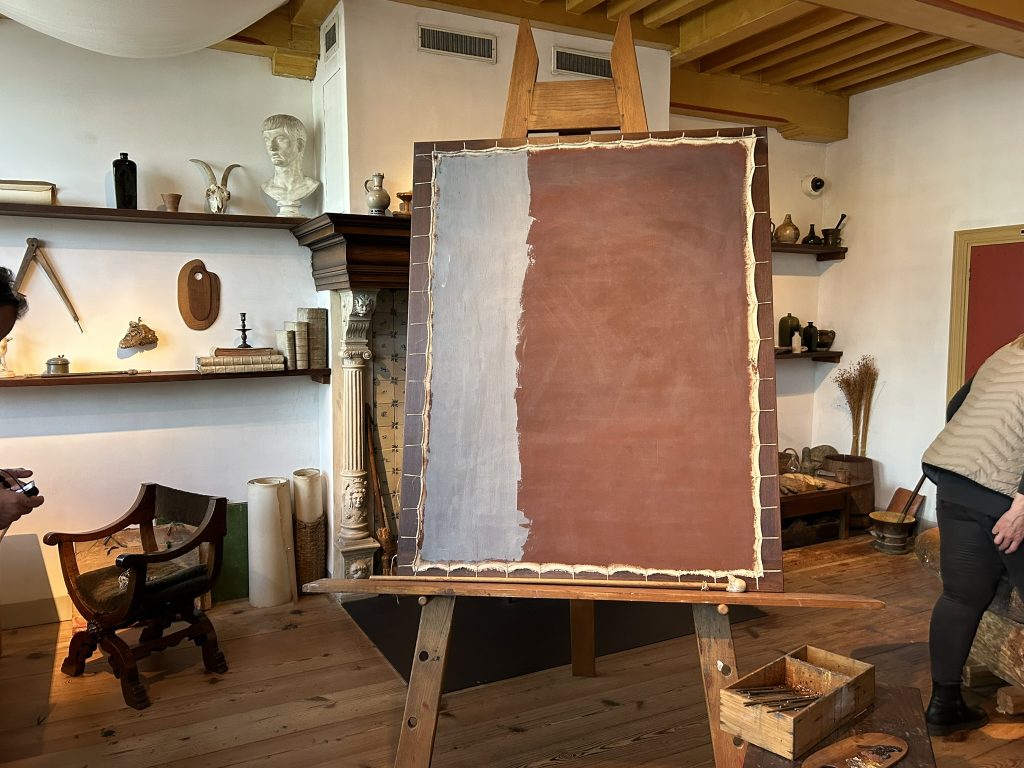
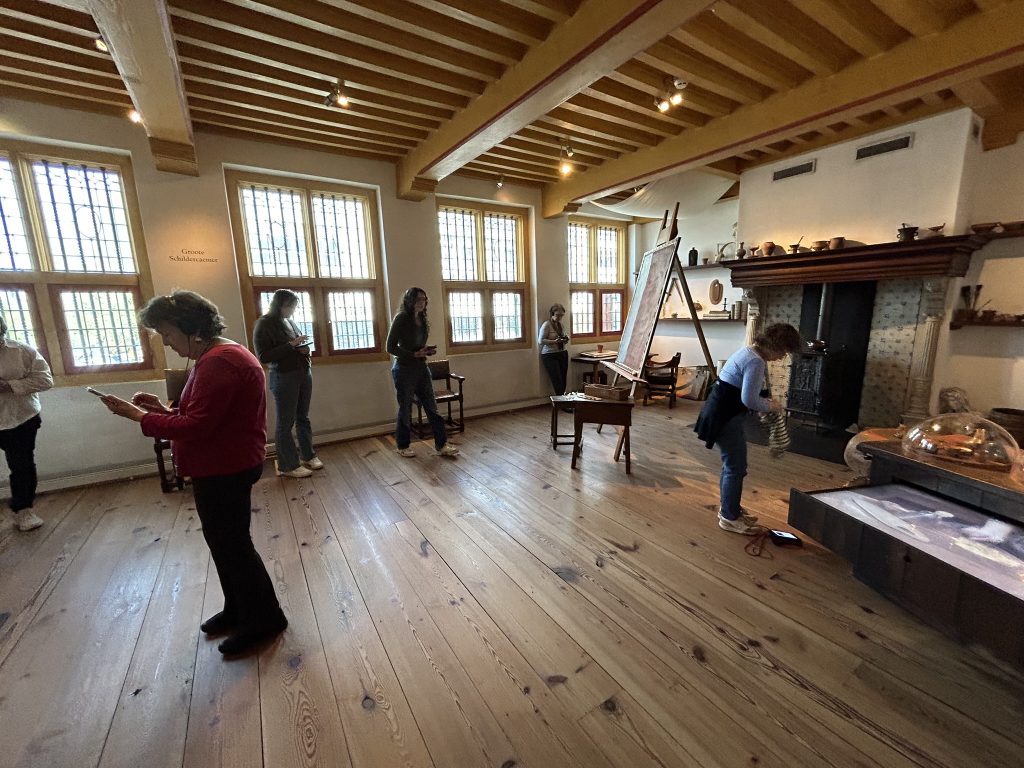
Stepping into Rembrandt’s large painting studio feels quite magical. Although now filled with visitors all listening intently to their audioguides, it’s salutary to remember that you are actually treading the same floor boards and looking out the same windows as Rembrandt did four hundred years ago.

The room faces north, an aspect favored by painters because the light varies, the least throughout the day. The studio is at the top of the house and so would have been as bright and airy as any room in a 17th-century house could be.

Easel where Rembrandt worked at the Rembrandt House Museum in Amsterdam
Large painting studio where Rembrandt painted aat the Rembrandt House Museum in Amsterdam

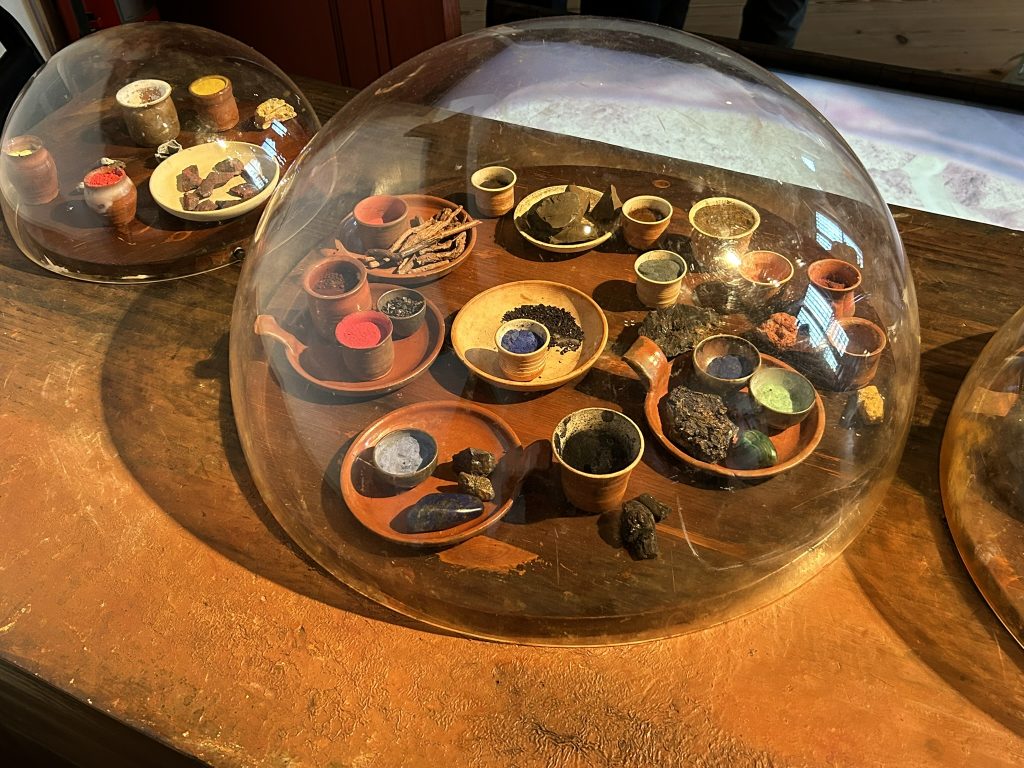
The studio includes a large video screen showing a demonstration of how Rembrandt and his assistants made pigments. I’m familiar with the process of grinding and mixing the pigments from my research for my debut novel, The Towers of Tuscany.

But whereas my characters in 14th-century Italy mixed their pigments with egg yolks, Rembrandt and his contemporaries mixed pigments with linseed oil.

Colors used to make paint at the Rembrandt House Museum in Amsterdam

Small Painting Studio

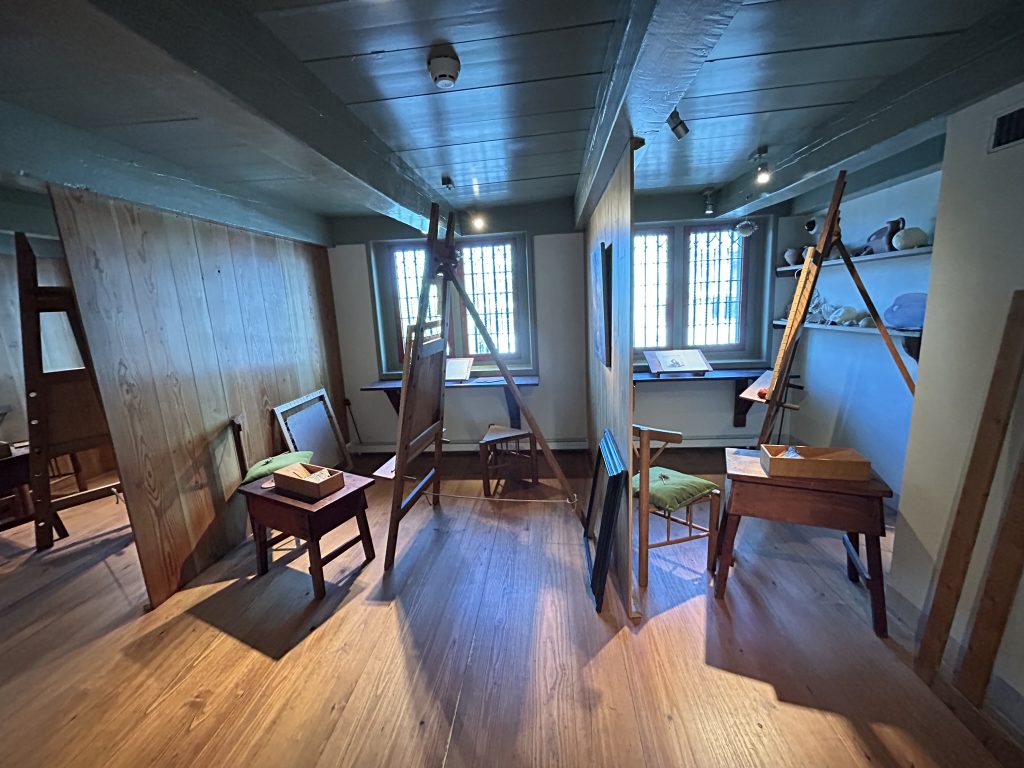
I was quite taken with the second painting studio which was partitioned into four sections to accommodate four students.The whole set-up looked so modern. Apparently, Rembrandt made 30% of his annual income from students, but even that income wasn’t enough to keep him afloat. I wonder what became of the students after Rembrandt had to liquidate?

But check out these studios. Many artists would feel quite at home in one today!

Student cubicles at the Rembrandt House Museum in Amsterdam

The Room of Curiosities

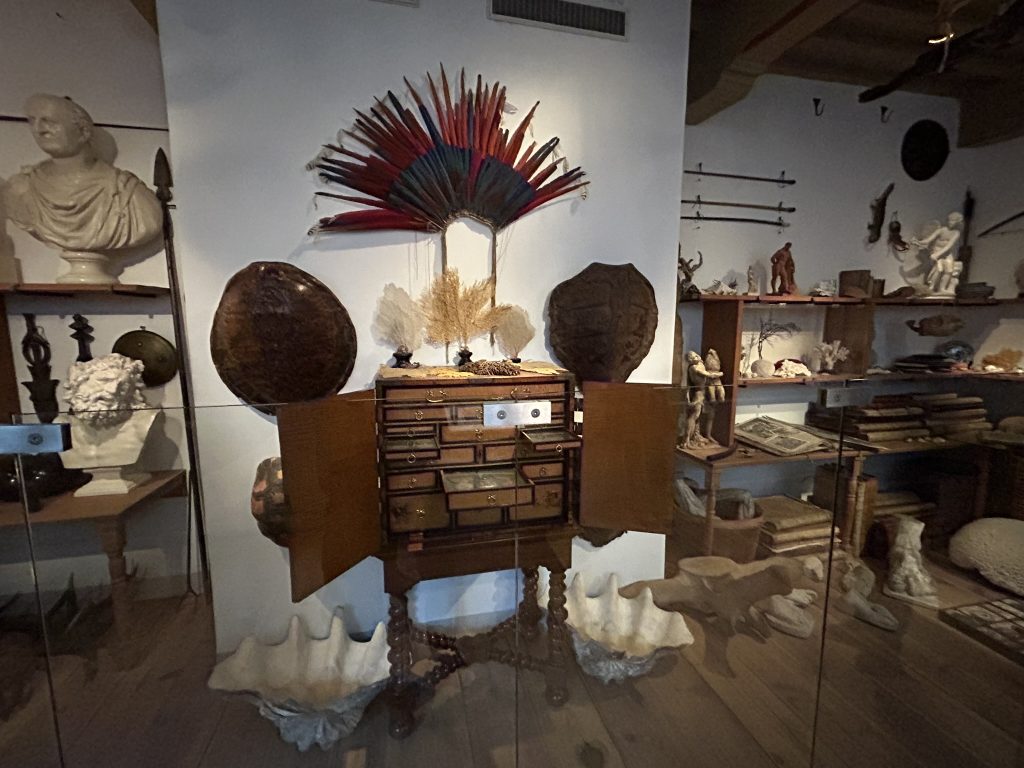
Like many people of his time, particularly artists, Rembrandt was an avid collector. His many collections fill the room of curiosities, from parrot feathers and stuffed caimans and armadillos, to tortoise shells, butterflies, rocks, and a hundred other exotic bits and pieces he accumulated over the years. Amsterdam, of course, was a port, and so Rembrandt was able to acquire objects from around the globe that had been brought to Amsterdam by the sailors.

Room of Curiosities at the Rembrandt House museum in Amsterdam

Exhibition Center

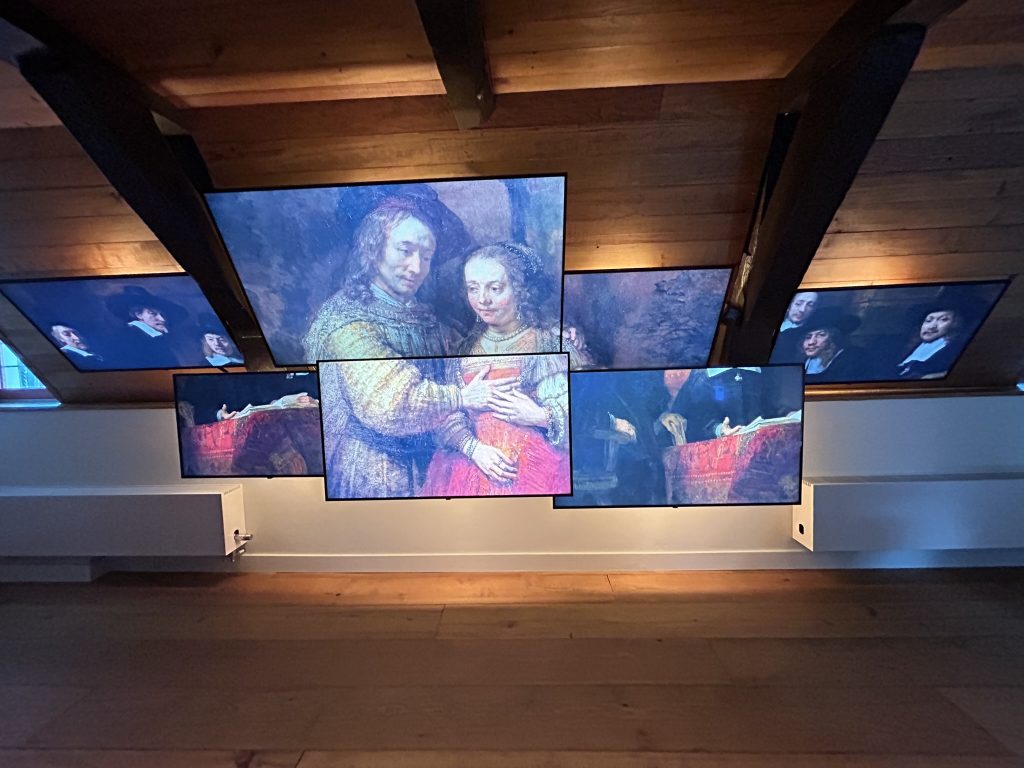
After touring Rembrandt’s house, we funneled back into the exhibition center. There wasn’t much on when we were there, but I did appreciate the projection of a montage of Rembrandt’s greatest hits.

Montage of Rembrandt's works at the Rembrandt House Museum in Amsterdam


Wandering Around Amsterdam

Amsterdam is a fantastic city for walking, so long as you keep a very sharp eye out for cyclists. They go very, very fast! I wonder how many tourists who stepped off a curb without looking ended up in Emergency.

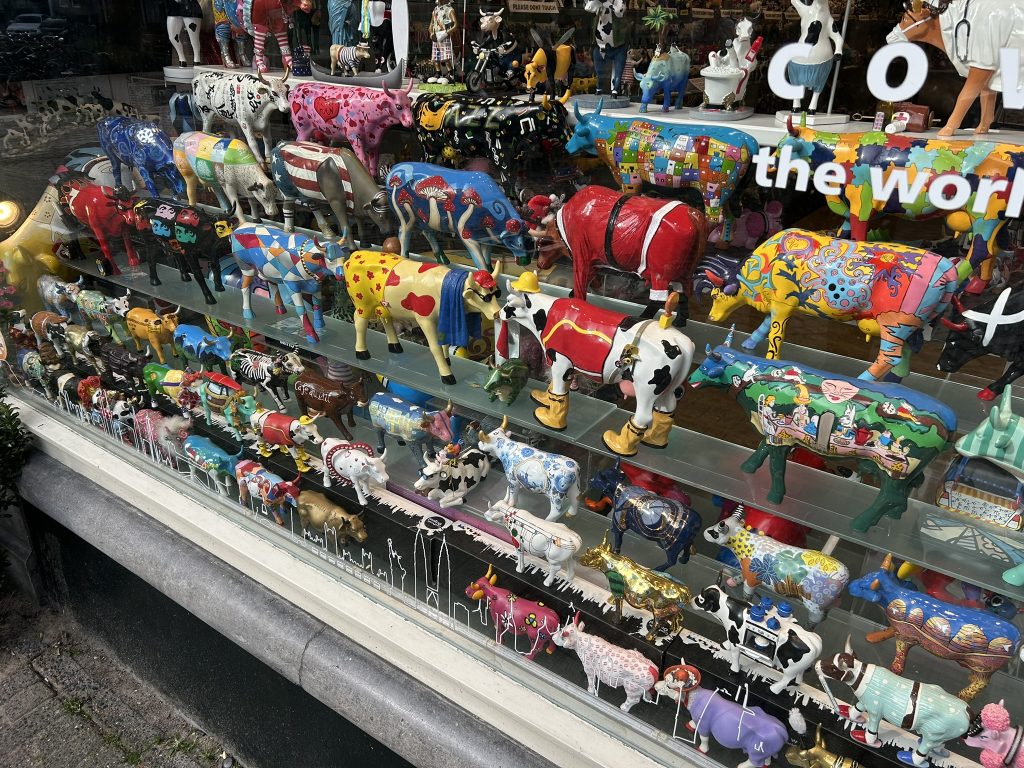
The city has an admirably eclectic variety of stores carrying everything from Old Master knock-offs to rubber duckies to high fashion to painted cows. I adore window shopping in Amsterdam.

Painted cows in a shop in Amsterdam

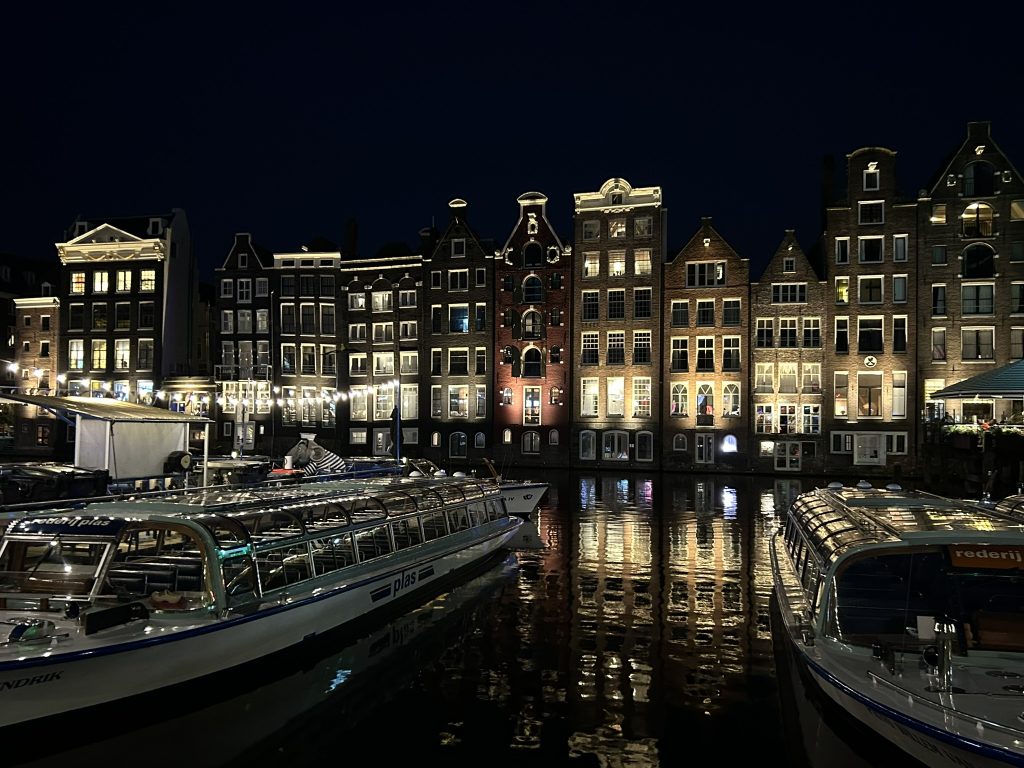
Amsterdam at night is magical! The side streets are quiet, the canals serene in the moonlight, the bike traffic considerably calmed. You can wander for hours, imagining yourself into a cityscape that hasn’t changed appreciably for four hundred-odd years.

View of Amsterdam's iconic houses at night


The Girl Who Adored Rembrandt by Belle Ami

A time-travel thriller in which psychic art historian Angela Renatus is drawn into a chase to uncover the truth behind a priceless, stolen Rembrandt family portrait.

The Rembrandt Secret by Alex Connor

A historical thriller in which a serial killer’s gruesome trail across London and New York uncovers the hidden truth behind one of Rembrandt’s most famous works.


Tickets & Tours: Rembrandt House & National Maritime Museum

Both museums are easy to walk into without a reservation, but if you’d rather not risk it, or you want a guide to connect the two stops for you, here are some options at different price points.

Rembrandt House Museum Entrance Ticket

Includes

  • Rembrandt House Museum entry fee
  • Multimedia audio tour in 16 languages
  • Access to the etching and painting studios

Best For

Independent travelers happy to wander at their own pace

Why Choose It

The only museum in the world entirely devoted to Rembrandt, and the audio guide is worth putting on, not just a rental you feel obligated to use

From $22 per person

Book with GetYourGuide

National Maritime Museum Skip-the-Line Ticket

Includes

  • Entrance ticket to the National Maritime Museum
  • Visit to the replica 18th-century ship Amsterdam
  • Audio tour in 11 languages

Best For

Anyone pairing both museums from this post into one day

Why Choose It

This is the ticket to the ship itself, the tall-masted Amsterdam replica moored in the harbor, not just the museum building behind it

From $23 per person

Book with GetYourGuide

Most Immersive

Private Rembrandt Walking Tour & Optional Museums

Includes

  • Private walking tour through Rembrandt’s Old Town with an Art History Expert-Guide
  • Optional skip-the-line Rijksmuseum ticket (4 and 5-hour options)
  • Optional skip-the-line Rembrandt House ticket (5-hour option)

Best For

Readers who want a guide connecting the dots between Rembrandt’s house and his art

Why Choose It

Turns the two stops in this post into one guided story, starting at the Oude Church where Rembrandt married Saskia and ending in front of The Night Watch

From $229 per person

Book with GetYourGuide

Rijksmuseum Entry Ticket

Includes

  • Museum entry and permanent exhibition access
  • Cloakroom and free WiFi

Best For

Readers extending their day to the “heavyweight” museum from the map above

Why Choose It

Skip-the-line access to The Night Watch and the rest of Rembrandt’s major works, a natural add-on after seeing where he actually lived

From $31 per person

Book with GetYourGuide

Other Tours in Amsterdam

There’s so much to see in Amsterdam for the artsy traveler! I highly recommend booking one of the GetYourGuide tours, if only to skip the line at the most popular museums. I’ve consistently found GetYourGuide tours to be good value, and have taken them in Rome, Venice, Paris, Madrid, and Sirmione.

Here are links to GetYourGuide tours in Amsterdam.

Powered by GetYourGuide

Also, check out a walking tour with GuruWalks. They offer these tours in Amsterdam:


Staying in Amsterdam

Over the years, I’ve stayed at many different places in Amsterdam, from Airbnbs to hotels on the outskirts. To my surprise the Holiday Inn Express – City Hall in Amsterdam, steps from the harbor and within walking distance of old Amsterdam, was a perfect choice.

The view of the canal from our window was endlessly fascinating (depending on the time of day and the shifting April weather), the room was comfortable, and the staff friendly and helpful.

View of canals from the window of a room at the Holiday Inn Express - city Hall in Amsterdam
View of canals from a room at the Holiday Inn Express – City Hall in Amsterdam

I also appreciated the large urn full of citrus fruits and water in the lobby. Every time I came into the hotel, I helped myself to a refreshing glass of citrus water.

Here are other options for staying in Amsterdam. I recommend you resist the temptation to opt for the cheaper places outside the city center. Amsterdam is worth the splurge. Book a place as close to the ring of canals as you can and enjoy many happy hours of wandering, particularly after dark.


Keep Exploring Amsterdam with Artsy Traveler

For more about Amsterdam, check out these posts:

Carol Cram
About Carol Cram

Carol M. Cram is the author of five award-winning novels inspired by art and the women who shaped it, the creator of Artsy Traveler, an arts-focused travel blog, the founder of Art In Fiction, a curated database of 2,600+ novels inspired by the arts, and the host of The Art In Fiction Podcast. She lives with her husband, artist Gregg Simpson, on beautiful Bowen Island near Vancouver, BC.
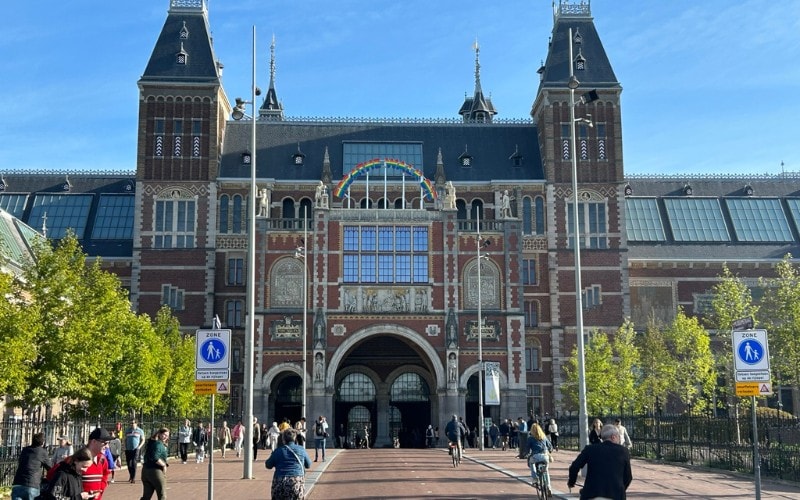
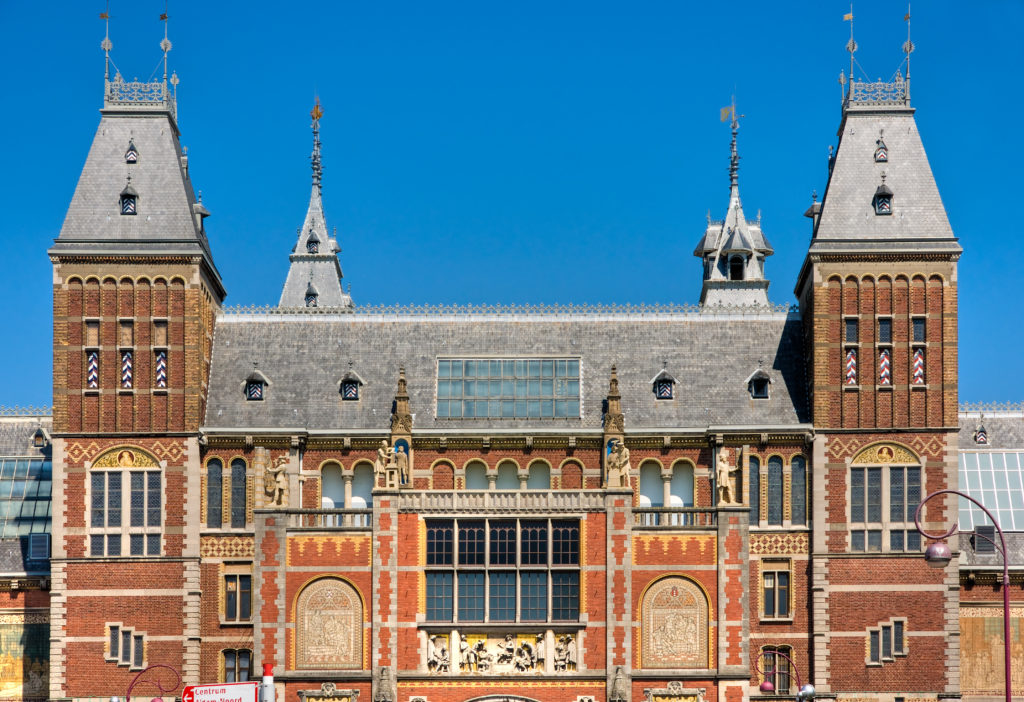
Exterior of the Rijksmuseum in Amsterdam

Rijksmuseum, Amsterdam: My Favorites After 50 Years of Visiting

On my first visit to Amsterdam in 1970, I remember the Dutch National Museum (the Rijksmuseum) as a gloomy, rather dingy place. The famous Night Watch by Rembrandt was so dark as to be virtually invisible, and I don’t recall seeing any of the amazing objets d’art I’ve seen on more recent visits.

Refurbished and renovated, the new Rijksmuseum is a total delight. It’s even more amazing than the Van Gogh Museum, although I suppose it’s not fair to compare.

While most people associate the Rijksmuseum with its stunning collection of paintings by Dutch Old Masters (Rembrandt, Vermeer, Frans Hals and the gang), you’ll see so much more during your visit. 

Yes, check out the most famous paintings (more below), but also spend time enjoying the hundreds of other objects on display, from medieval art to porcelain to model ships to doll houses.

And what I really love is that the Rijksmuseum is not overwhelming. To me, it’s a perfectly sized major museum to keep me entertained for a good two or three hours, with a wee break to sample a coffee and a piece of cake in the airy cafeteria and, of course, to check out the gift shop.


Rijksmuseum at a Glance


Rijksmuseum: Quick Facts


Location of the Rijksmuseum

The map below shows the location of the Rijksmuseum (#1) in Amsterdam’s Museumplein, easily reached from the Centrum via trams 2 or 12. Also shown is the location of the Van Gogh Museum (#2) next door, and the location of the charming apartment we stayed in on tiny Sint Nicholastraat in the lively Centrum area (#3). Called Here’s Lucy, it’s highly recommended if you’re looking for a private one-bedroom apartment, and it’s a much better deal than any hotel I’ve ever stayed at in Amsterdam.

The location, not far from Amsterdam Central Station and the Damrak, is pretty much perfect.

Map courtesy of Wanderlog, a trip planner on iOS and Android

Rijksmuseum Tours & Tickets: Compare Your Options

The Rijksmuseum sells out regularly — book ahead. Here’s how the main options compare:

Entry Ticket

From $31  |  ⭐ 4.7 (31,757 reviews)

Self-guided access to the permanent collection. Explore at your own pace — the Night Watch, the Milkmaid, the ship models, all of it. Best for independent travelers who prefer to wander.

Book Entry Ticket →

Most Popular

Small Group Tour + Ticket

From $103  |  ⭐ 5.0 (45 reviews)

2.5-hour guided tour with an art historian, max 12 guests. Ticket included. Covers the Dutch Golden Age highlights — Rembrandt, Vermeer, and beyond. Perfect for first-time visitors.

Book Group Tour →

Semiprivate Tour with Art Historian

From $97  |  ⭐ 4.6 (10 reviews)

2-hour guided tour, max 5 guests. An art historian leads you through the Dutch Golden Age — not just the famous works but the social and historical stories behind them. Ticket included.

Book Semiprivate Tour →

Private Tour with Art Historian

From $194/group  |  ⭐ 5.0 (2 reviews)

2-hour fully private tour tailored entirely to your interests. Skip-the-line entry included. Your guide adapts the route on the fly — ideal for couples or families who want depth over breadth.

Book Private Tour →

Prices shown in USD and subject to change. This post contains affiliate links — if you book through them, I earn a small commission at no extra cost to you.


Medieval Art: One of the Rijksmuseum’s Hidden Highlights

The first room I enter features art from the Middle Ages—and wow! I have a soft spot for art from this period that spans from 1100 to about 1500, and the Rijksmuseum has a superb and varied collection. Here are a few of the knockout pieces.

Wood Sculptures

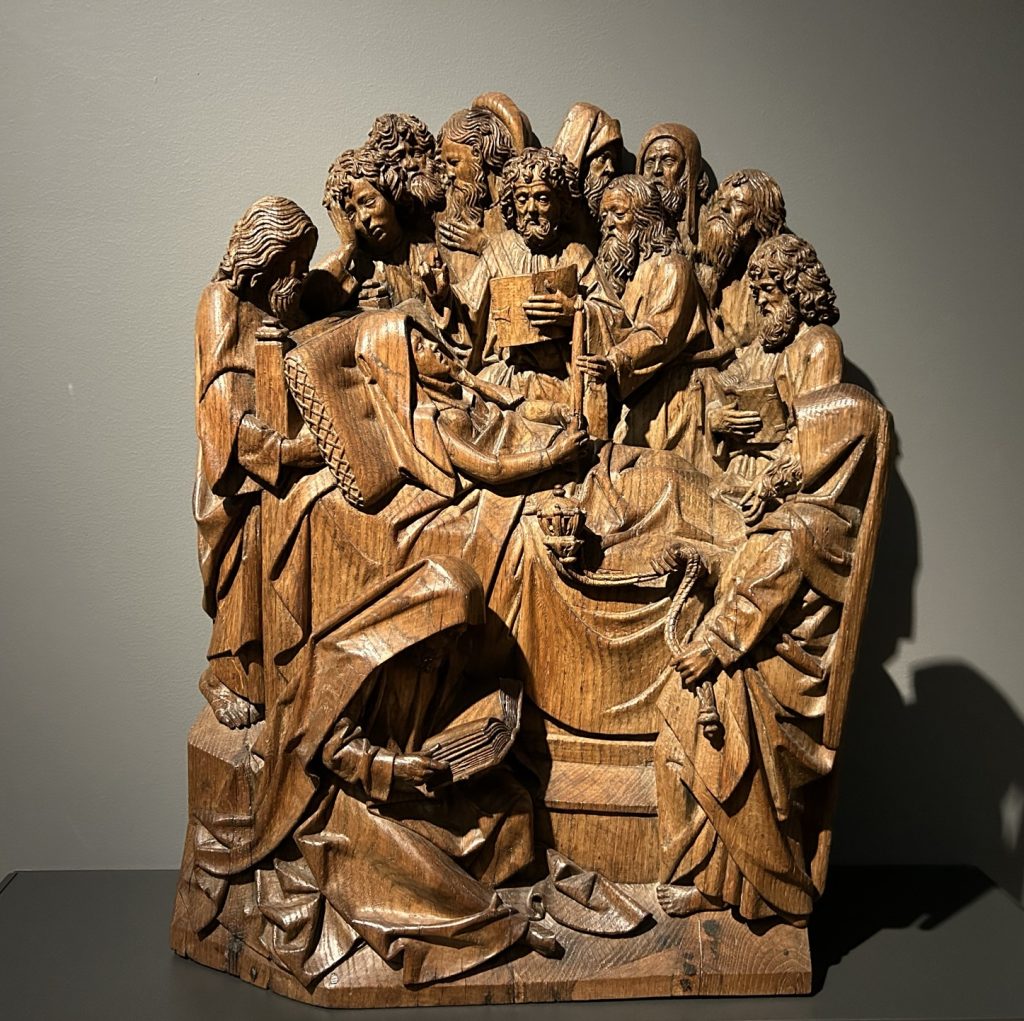
The figures in this wood sculpture were created in 1475 from a hunk of oak and formed part of a large altar. It depicts the adoration of the newborn child by the Virgin, Joseph and the angels. Check out the detail and the expressions on the faces.

Wood sculpture of jesus and apostles in the Riiksmuseum in Amsterdam

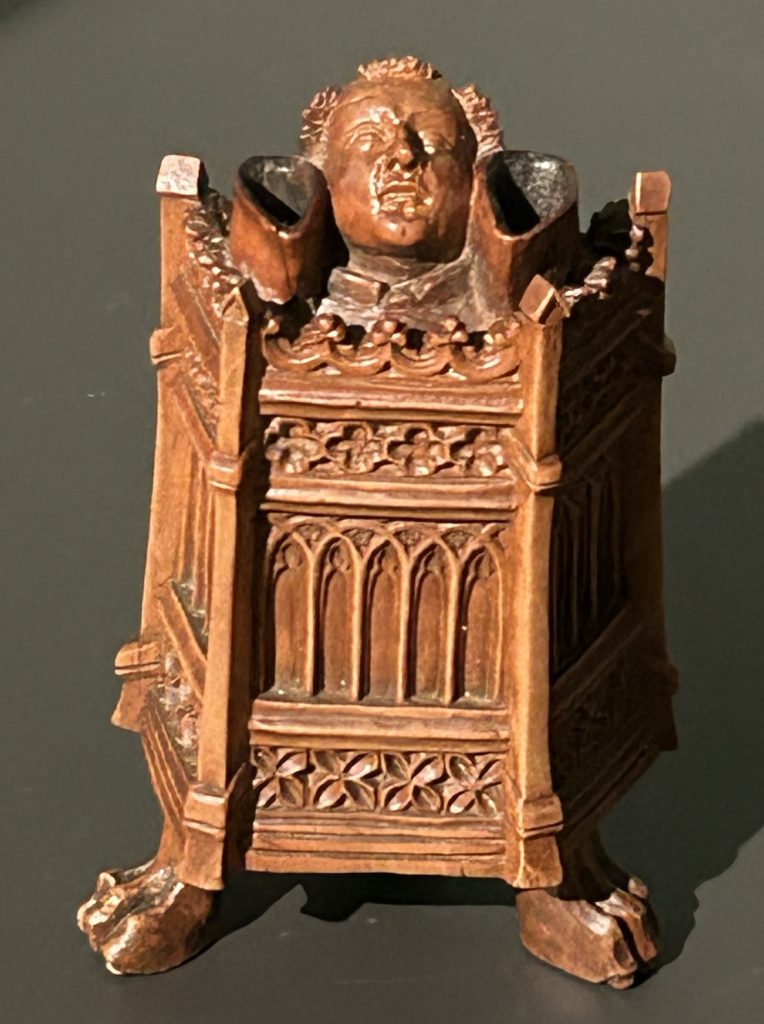
This amusing sculpture from around 1380 of a monk who can barely see over the edge of the pulpit is actually a medieval ink pot. The scribe dipped his pen or quill in the sleeves of the monk’s habit.

Medieval wood sculpture of monk in pulpit s in the Riiksmuseum in Amsterdam

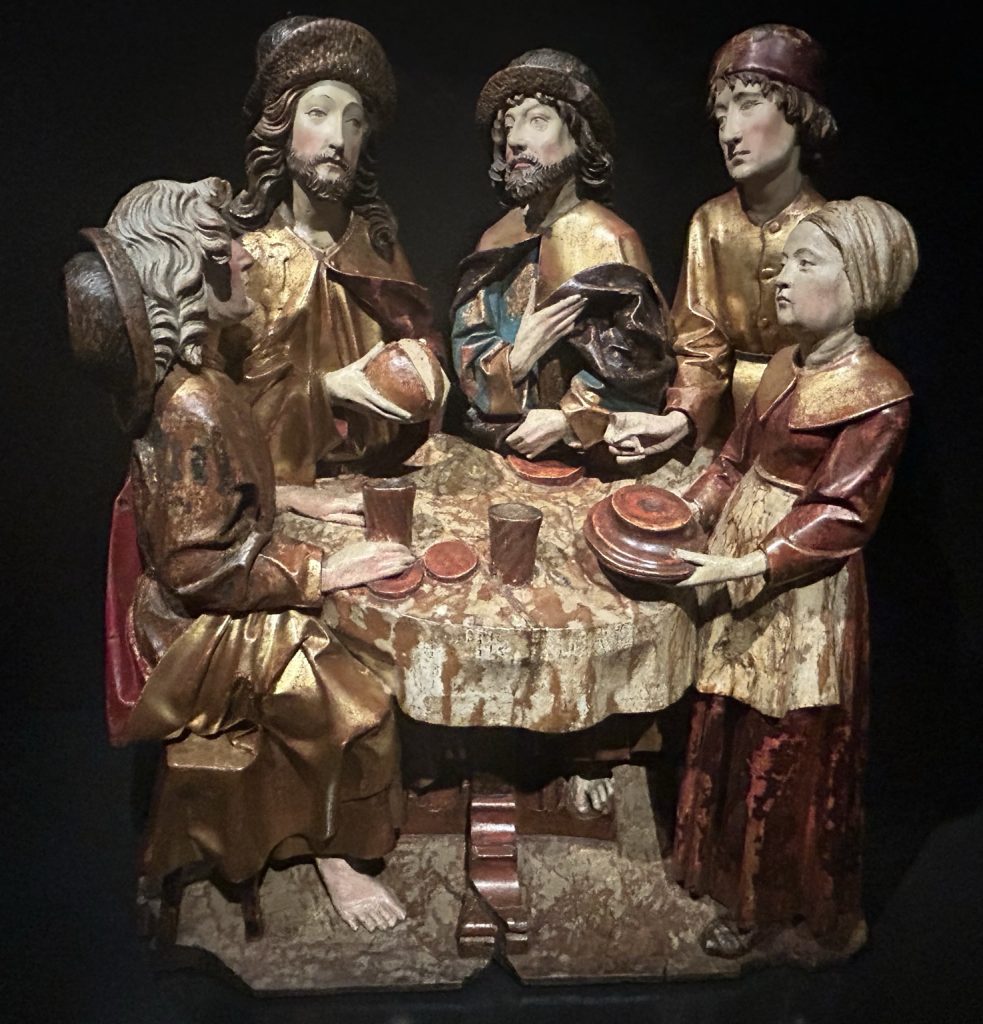
And look at this gem of a sculpture that dates from 1520, closer to Renaissance than medieval. It’s one of three related pieces. This one depicts the celebration of Mass with Christ. Check out the bread Christ holds in his hands and the impassive look on the servant girl’s face.

Wood sculpture of Jesus with apostles at dinner n the Riiksmuseum in Amsterdam

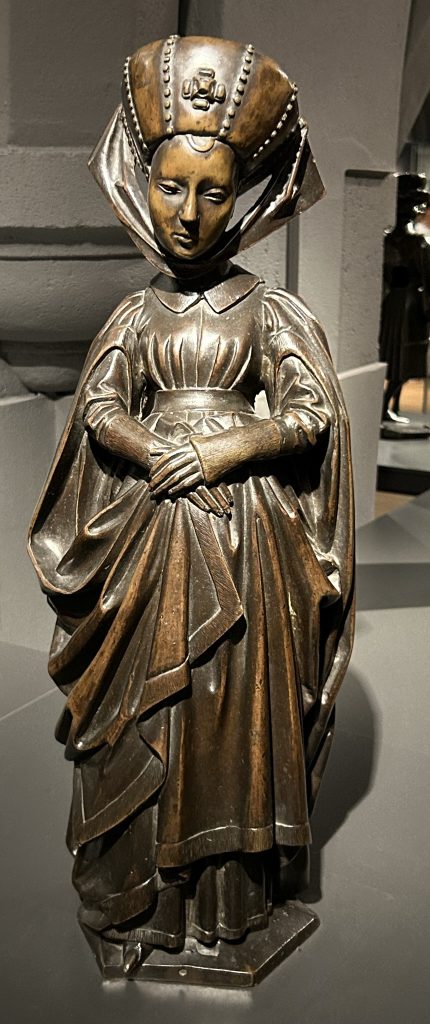
One of the reasons I like medieval art so much is because it depicts the elaborate gowns worn by both men and women, but particularly women.

This wooden sculpture is one of 24 similar-sized sculptures that ringed the tomb of Isabella of Bourbon, the wife of Charles the Bold, Duke of Burgundy. She died in 1465. The figures represented mourning family members and ancestors and were known as “weepers”.

Medieval statue at the Riiksmuseum in Amsterdam

Renaissance Paintings

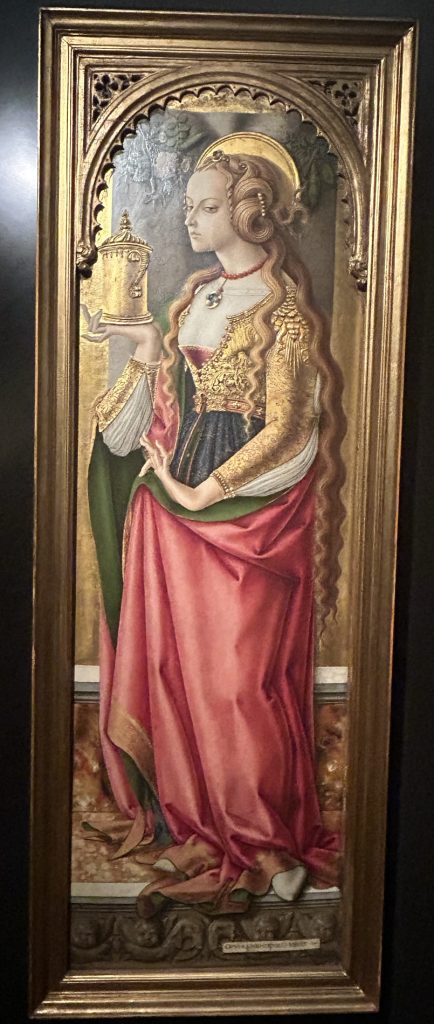
While most of the paintings in the medieval and Renaissance rooms at the Rijksmuseum were created in the low countries, this depiction of Mary Magdalene comes from Italy and is an example of the International Gothic style.

I’m quite taken by the elaborate coiffure and the beautiful way in which the red gown is rendered.

Gothic painting in the Riiksmuseum in Amsterdam

This landscape depicts an episode in the conquest of America and was painted in 1535 not long after the conquest.

The painting is the first to depict Spanish soldiers subduing the people who lived in the “new world”. Jan Jansz Mostaert, the painter, created a traditional European landscape and then added a few exotic elements—a monkey, a porcupine, and some parrots— to show that the landscape was not in fact European.

Painting of soldiers in the New World at the Riiksmuseum in Amsterdam

Dutch Ships: The Rijksmuseum Highlight Most Visitors Overlook

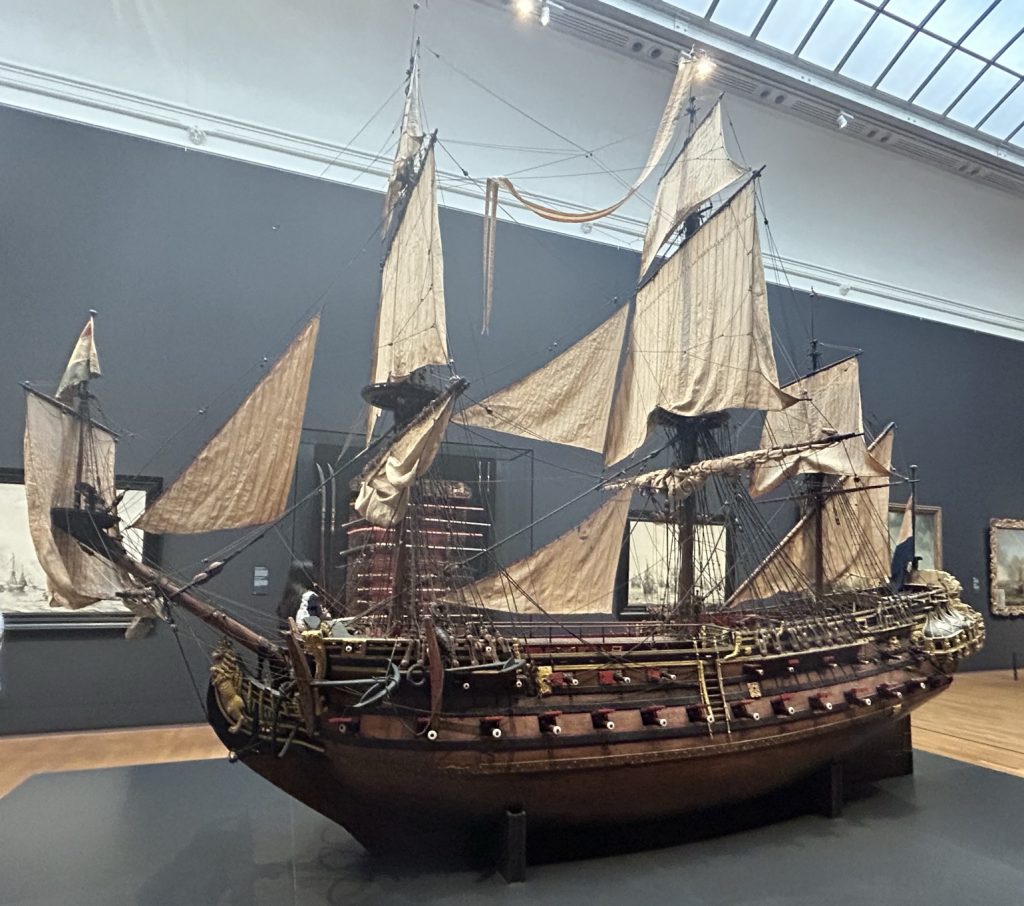
Several rooms are devoted to displaying models of Dutch ships. They are remarkable!

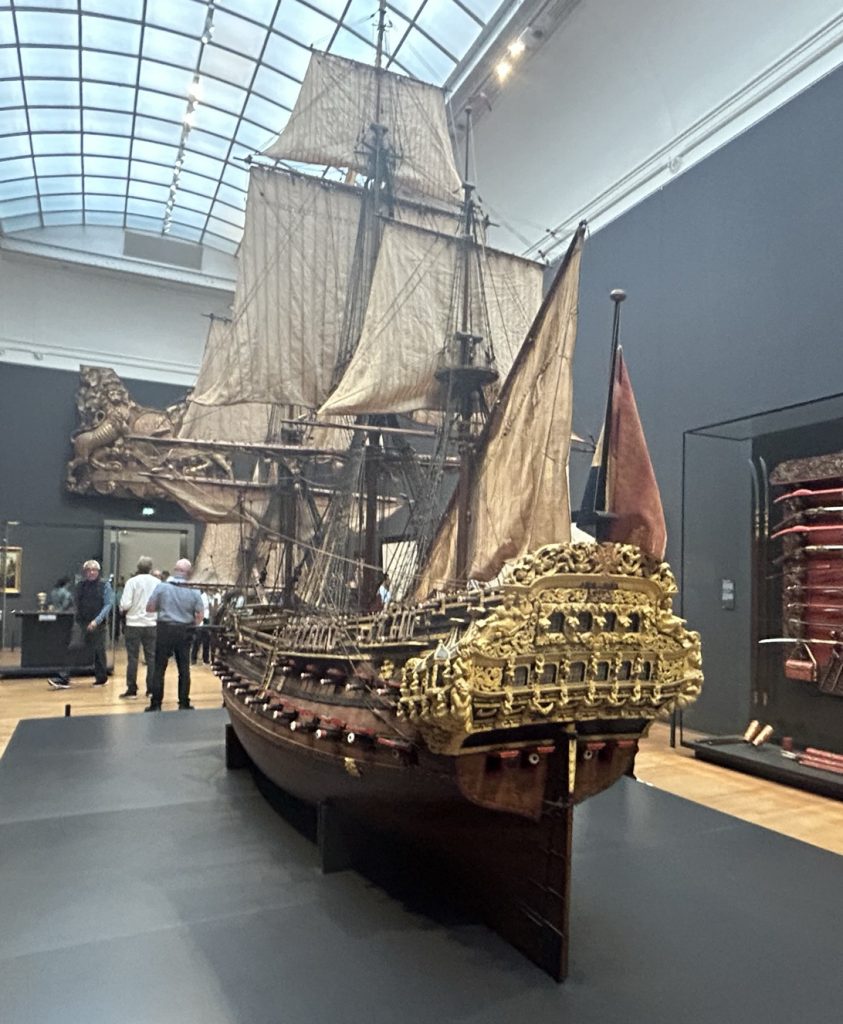
This model of a late-17th-century Dutch warship was made at the same dockyards where real warships were built. It’s about one/twelfth life-size. The real ship would have had 74 guns.

I am taken by the elaborate decoration and the sheer size of the stern area where presumably the captain would have his quarters. I doubt conditions were quite so luxurious for the regular sailors.

Model of a Dutch warship in the Riiksmuseum in Amsterdam
Model ship in the Riiksmuseum in Amsterdam

Here’s another view of the many ship models in the Rijksmuseum.

Room of ship models in the Riiksmuseum in Amsterdam

Masterworks: Tje Rijksmuseum’s Most Famous Paintings

Most visitors to the Rijksmuseum make a beeline for the “Gallery of Honour” which includes several paintings by Rembrandt van Rijn and Johannes Vermeer, probably the two most famous Dutch artists.

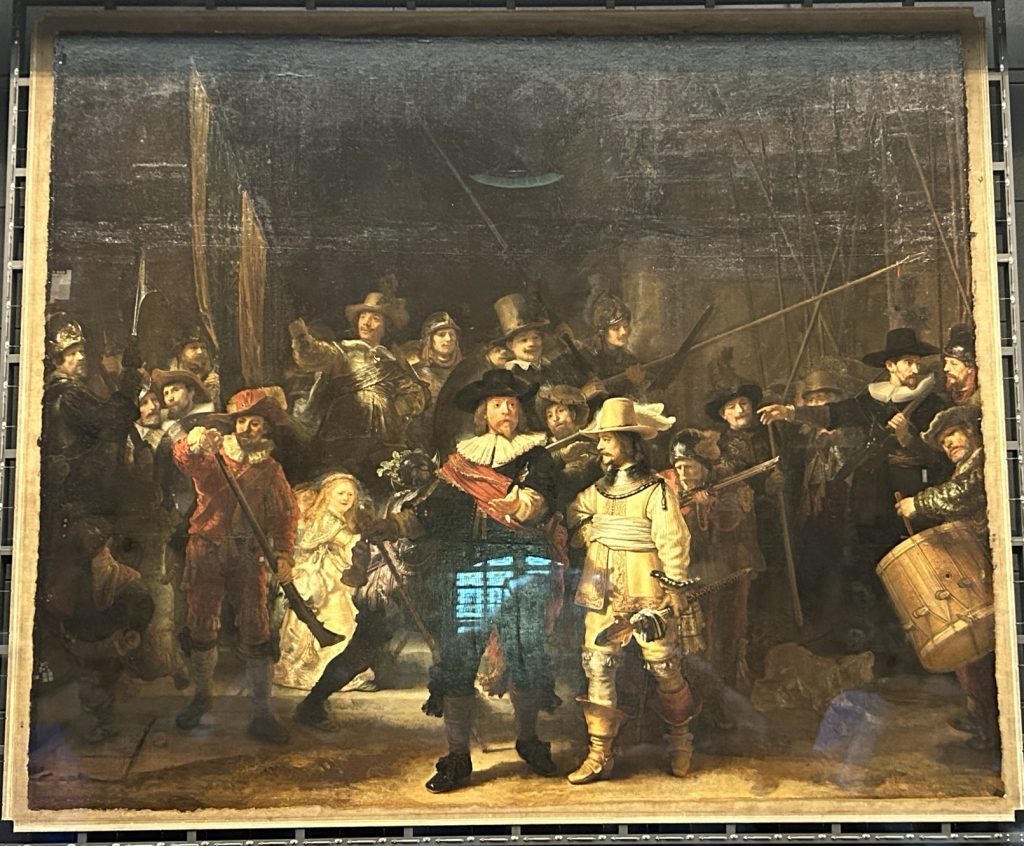
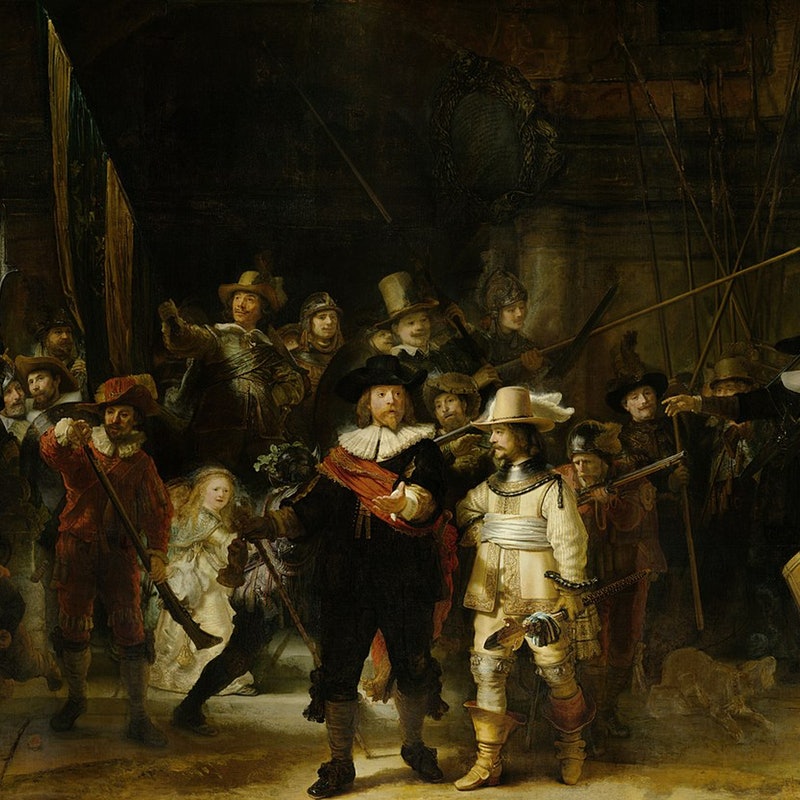
The Night Watch by Rembrandt

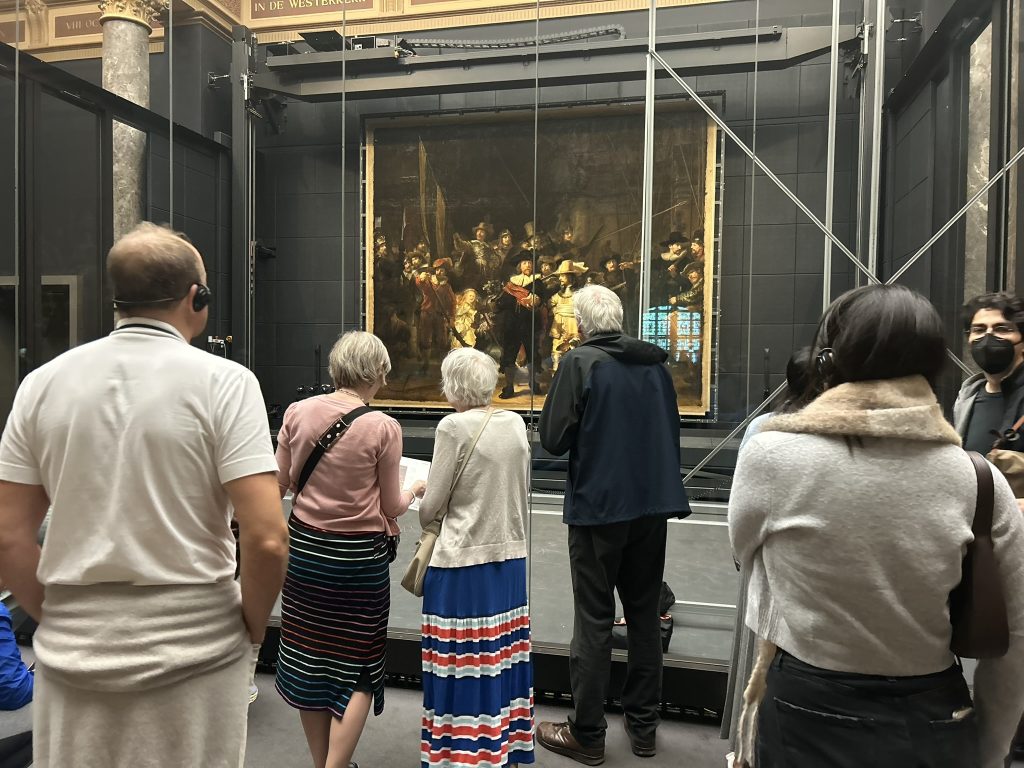
The Night Watch is displayed in a temperature-controlled structure so we can’t get very close. It’s an impressive artwork, and certainly much more enjoyable to look at now than when I first saw it at the age of 14 when it was almost black.

Here’s my husband, Gregg (the guy in black), checking it out.

The Night Watch at the Riiksmuseum in Amsterdam

And here’s a close-up sans viewers.

Night Watch at the Riiksmuseum in Amsterdam

Thanks to glare, it’s almost impossible to get a decent shot, but you get the idea.

Rembrandt’s control of light and shadow in the painting is remarkable. There’s so much life and movement in the painting. Everyone is doing something.

I like the drummer to the right and the little girl to the left of the guy with the red sash.

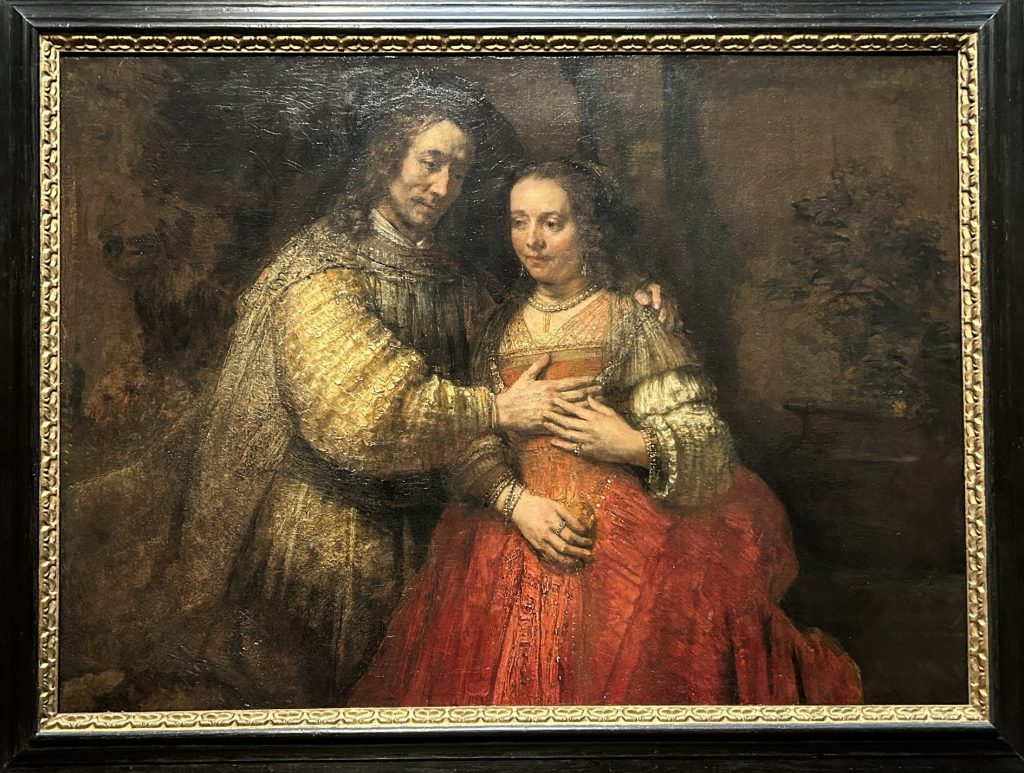
The Jewish Bride by Rembrandt

In this beautiful portrayal of a newly married couple, Rembrandt used thick, impasto paint and worked it with a palette knife to create a glittering and sculptural relief.

There is a bittersweet quality to this painting. The man looks to be quite a bit older than his bride. While richly dressed, she looks very uncertain about what the future might hold for her.

Rembrandt's Jewish Bride at the Riiksmuseum in Amsterdam

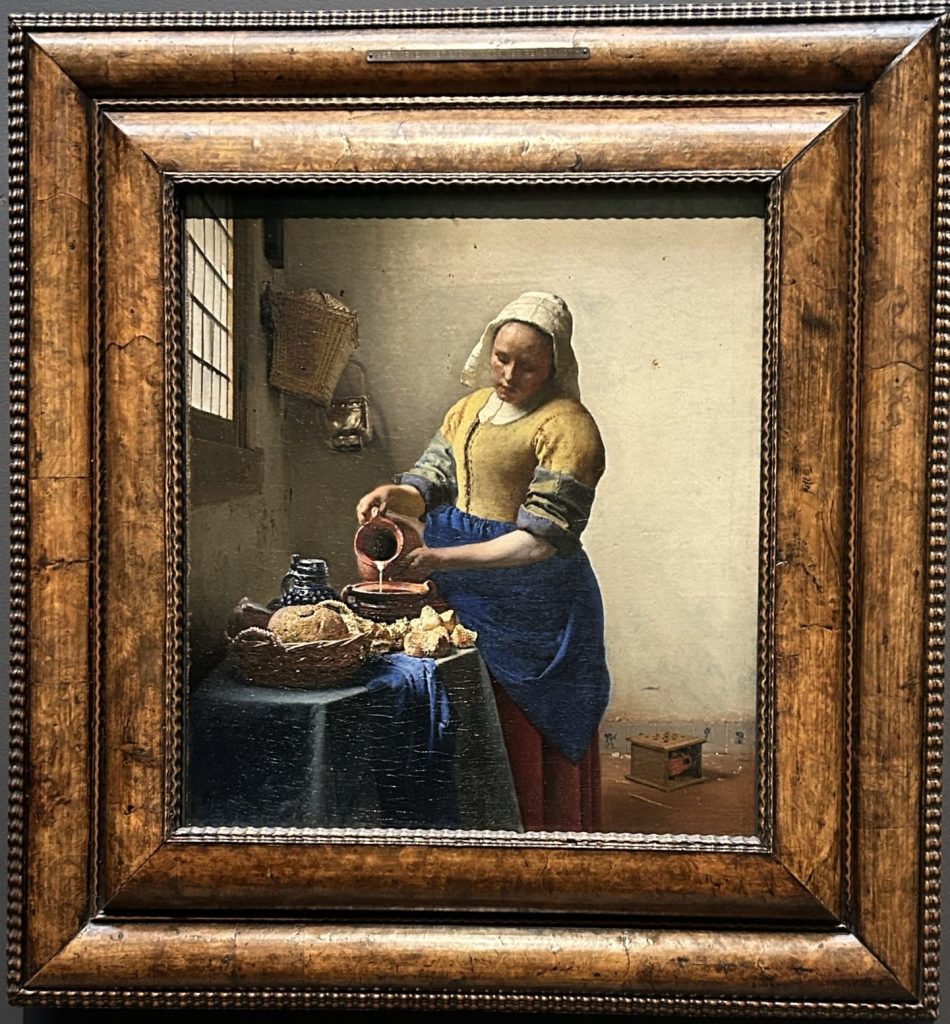
The Milkmaid by Vermeer

The small, intimate paintings by Vermeer are among the Rijksmuseum’s highlights. You’ll realize that when you see knots of people clustered around each Vermeer painting as they listen to tour guides or audioguides. 

I managed to sneak through and get this picture of The Milkmaid, which I’ve always had a soft spot for, perhaps because the subject is so humble and yet so exquisitely rendered.

She is totally intent upon her task, unaware she will be looked at by millions for centuries to come. This painting also shows how Vermeer was a master of light.

You really “get” how great Vermeer was when you compare his paintings to those of most of his contemporaries. While most are competently painted, they don’t glow like Vermeer’s paintings do. He didn’t complete many paintings in his life, but each one was a masterpiece.

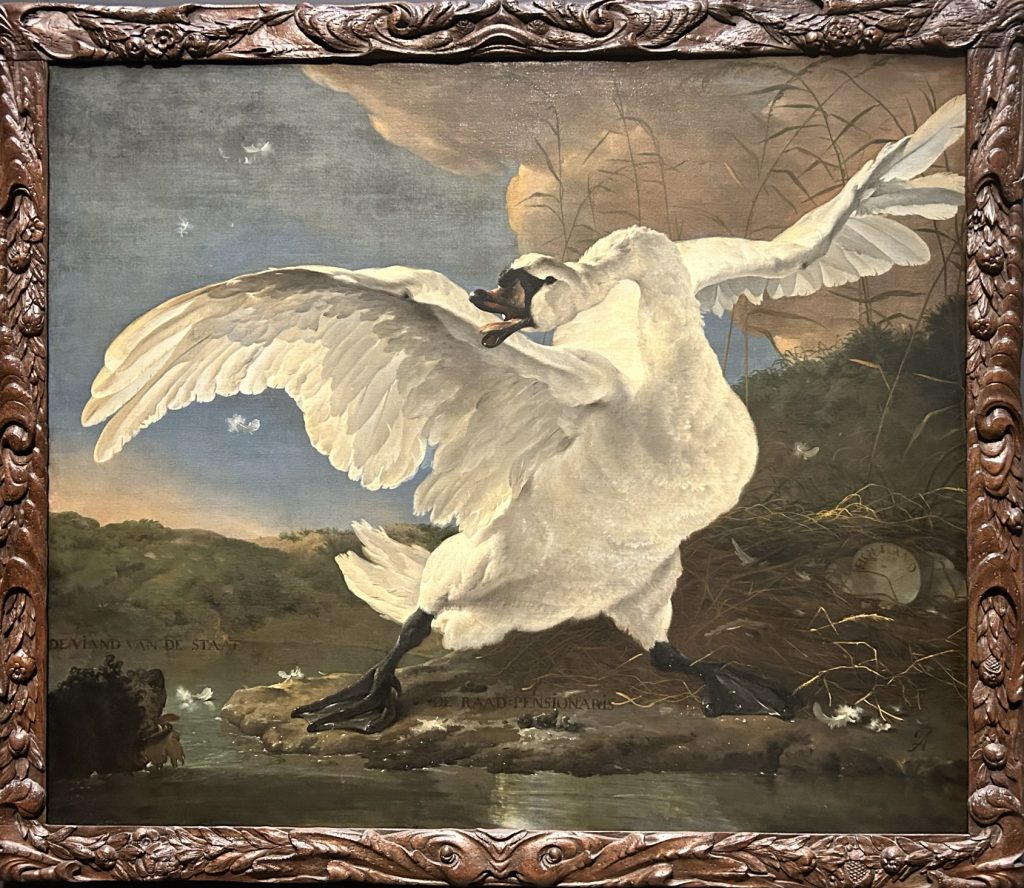
The Threatened Swan by Jan Asselijn

This painting by Jan Asselijn is an oil on canvas from 1650. It’s reproduced on bags, mugs, tea towels and other products in the gift shop so obviously it strikes a chord with people.

The painting depicts a swan fiercely defending its nest against a dog. In later centuries, the scuffle was interpreted as a political allegory, the white swan symbolizing the Dutch statesman Johann de Witt who was assassinated in 1672 while protecting the country from its enemies.

This meaning was attached to the painting when it became the first work to be accepted into the collection of the Nationale Kunstgalerij, the forerunner of the Rijksmuseum, in 1800. I’m guessing that the Dutch liked the image of their nation as a swan furiously defending itself.

Threatened Swan in the Riiksmuseum in Amsterdam

Still Lifes: Some of the Best Paintings at the Rijksmuseum

I’ve developed a real fondness for still life paintings of flowers, kitchen scenes, fruit, and the like.

I’m not sure why, but there’s something kind of comforting about super-realistic paintings of everyday things. And the Dutch are masters of the genre.

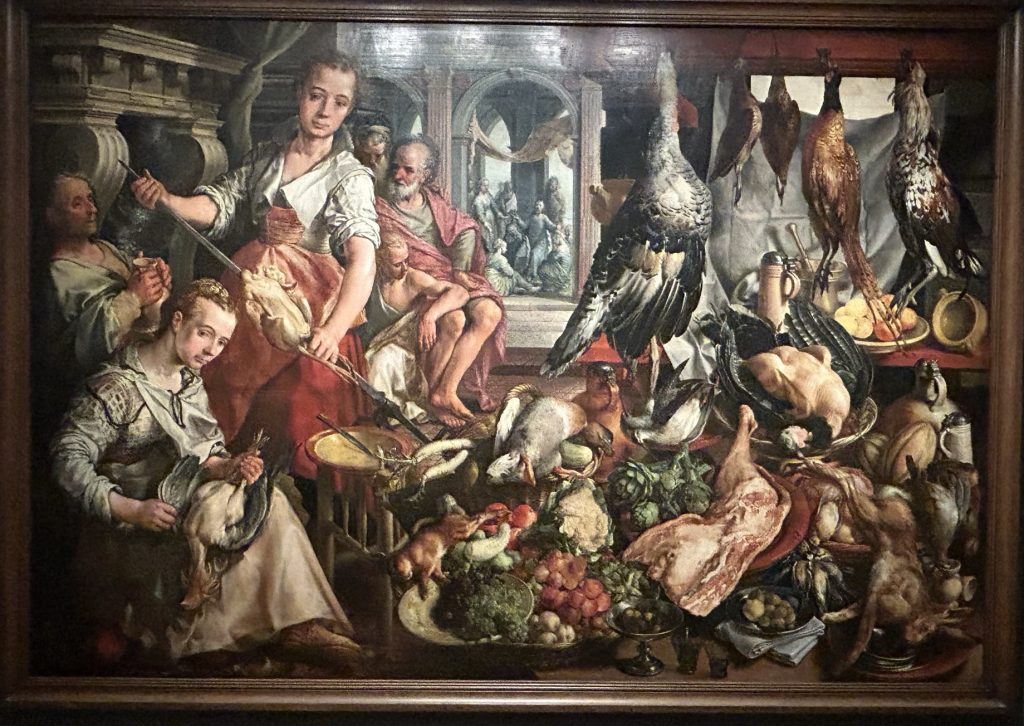
The Well-Stocked Kitchen by Joachim Beuckelaer

This piece by Joachim Beuckelaer painted in Antwerp in 1566 depicts Christ’s visit to Mary and Martha, although that’s hard to figure out because the action takes place in the background while in the foreground is a profusion of richly painted vegetables, fruit, meat, poultry, and pots and pans.

The contrast between the foreground and the background conceals the message of the painting: do not give in to earthly temptations.

Large still life at the Riiksmuseum in Amsterdam

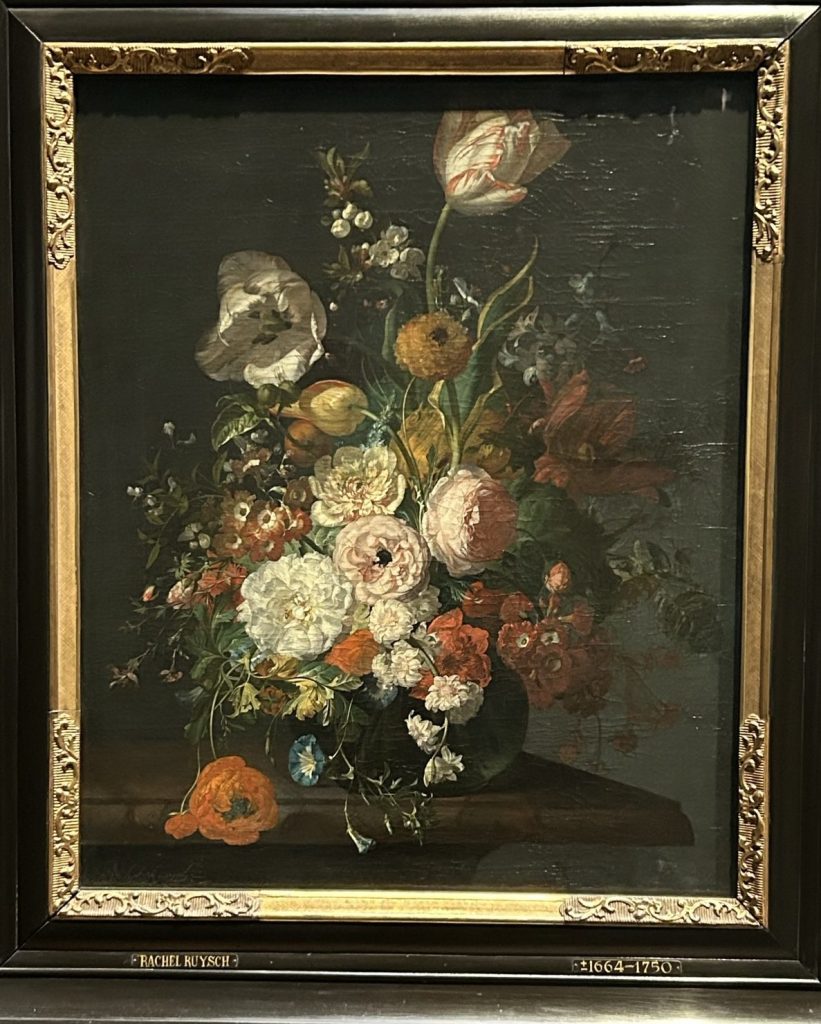
Still Life of Flowers in a Glass Vase by Rachel Ruysch

I’m thrilled to discover that this stiff life was painted by a female artist I hadn’t heard of. Her name is Rachel Ruysch and I have discovered that she was big news in her time.

In fact, she was the most famous female artist of the period. Patrons loved her monumental, sumptuous flower still lifes like this one and paid big guilders to own one. Even after marrying and having ten children, Rachel Ruysch continued to not only paint, but also to sign her paintings with her own name. Now she’s an artist I want to know more about.

Rachel Rausch still life in the Riiksmuseum in Amsterdam

Later in the gift shop, I buy a stunningly illustrated book about still lifes from the Dutch Golden Age that includes quite a few of Ruysch’s paintings.

Unfortunately, the text is in Dutch, but I can still enjoy looking at the paintings and drawings, most of which are by women artists. It appears that still lifes—and flower paintings in particular—were popular subjects for female painters of the period.

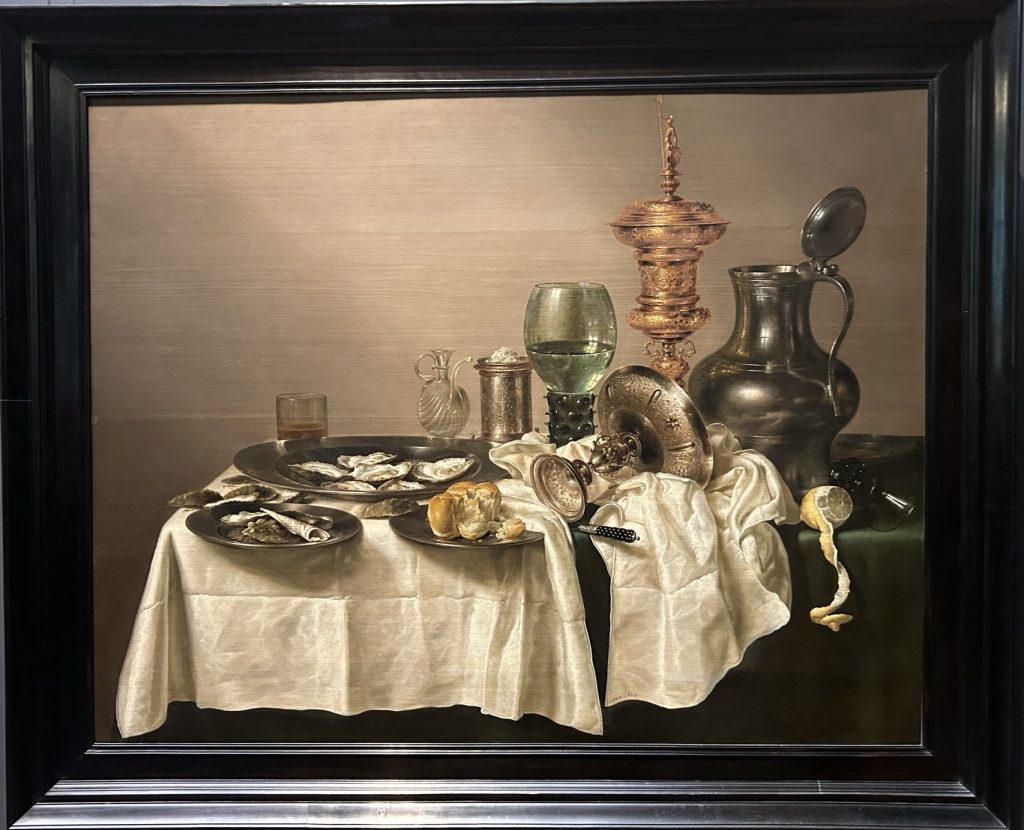
Still Life with Gilt Cup by Willem Claesz Heda

This painting includes an astounding array of grey tonalities. Heda’s palette is subtle—pewter, silver, damask, glass, mother-of-pearl, with a few yellow and ochre accents thrown in for good measure. He specialized in near-monochromatic still lifes that were known as “tonal banquet pieces”.

Monochromatic still life in the Riiksmuseum in Amsterdam

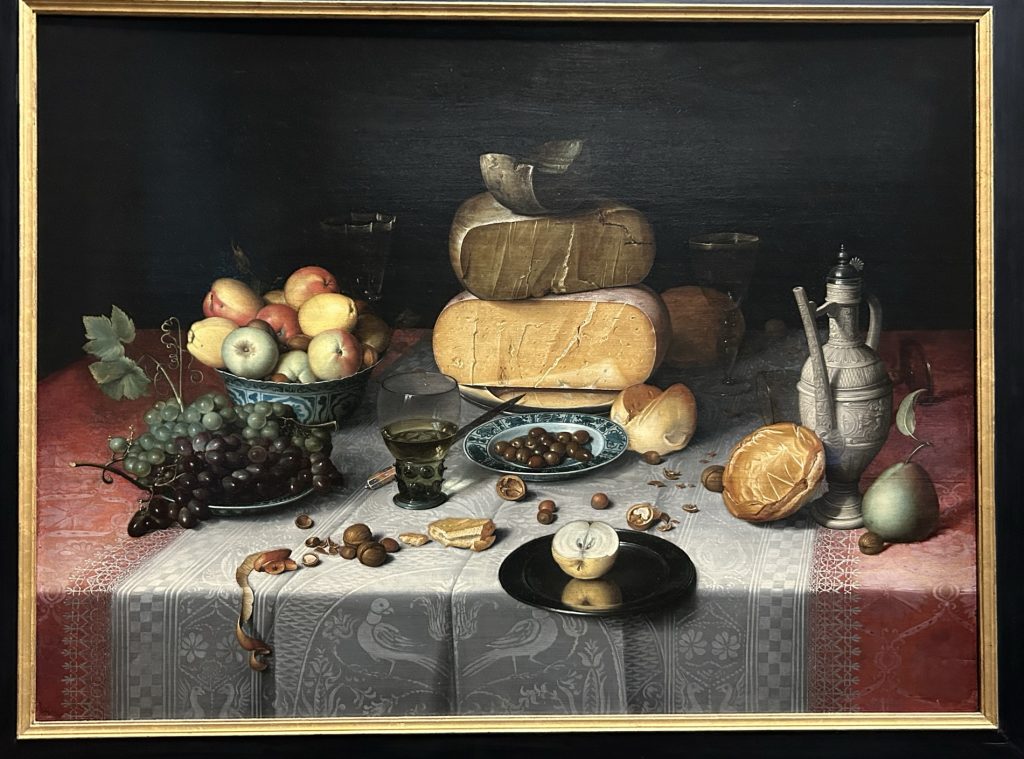
Still Life with Cheese by Floris Claesz van Dijck

Van Dijck really brings the subjects in his painting to life. Check out the ridges in the slabs of cheese and how the pewter plate extending over the edge of the table seems to come right out of the painting.

Floris van Dijck was considered one of the pioneers of Dutch still-life painting.

Still life with cheese in the Riiksmuseum in Amsterdam

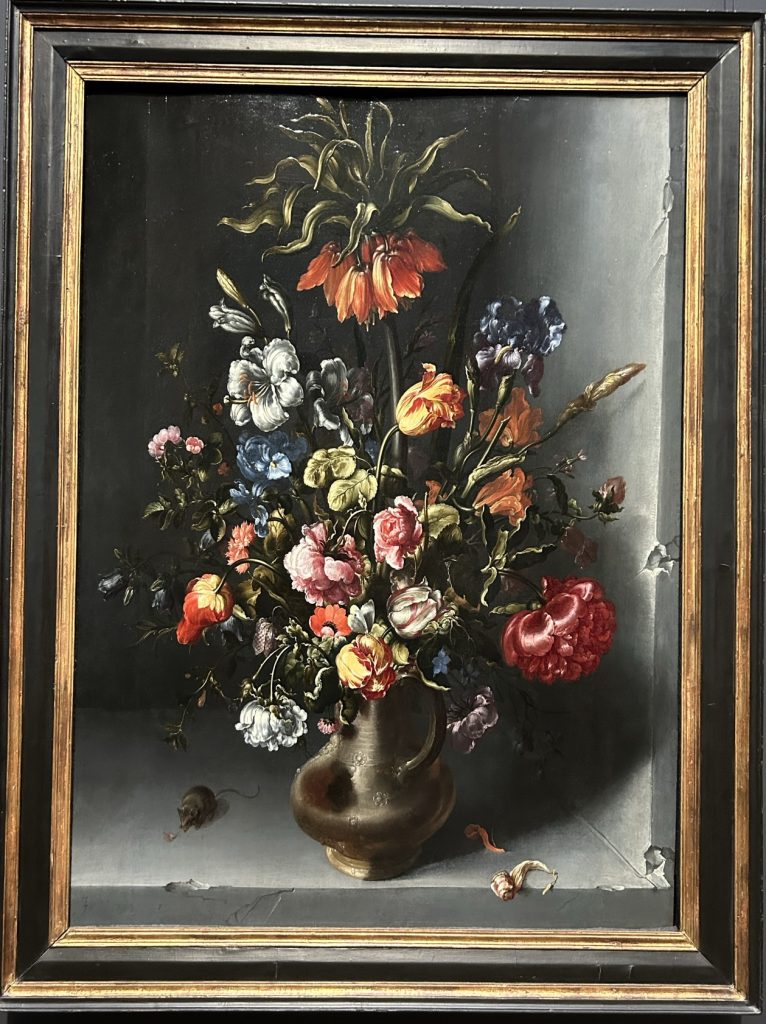
Flower Still Life with a Crown Imperios Fritillary in a Stone Niche by Jacob Woutersz Vosmaer

This impressively named painting is an exceptionally large example of a still life. There’s a tactile quality to the flowers that makes them look like they are moving.

And then there’s the wee mouse and the cracks in the wall—real life intruding on the luscious beauty of the flower arrangement.

Flower still life at the Rijksmuseum in Amsterdam

Other Notable Artists at the Rijksmuseum

Check out works by other Dutch masters including Frans Hals and Jan Steen. The Merry Drinker by Frans Hals is a perennial favorite.


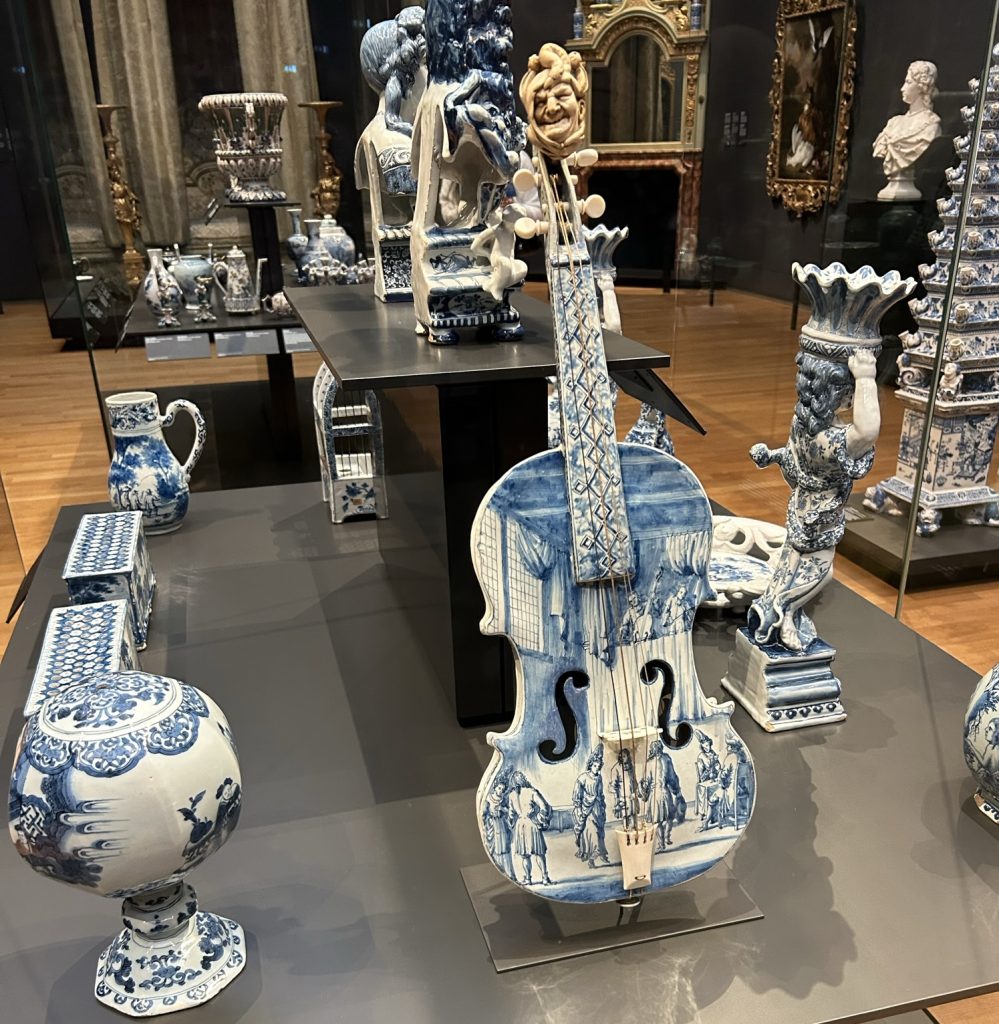
Porcelain: A Rijksmuseum Highlight Worth Slowing Down For

The Rijksmuseum collection includes a lot of porcelain and china.

My eye is caught by this tin-glazed earthenware violin. It cannot be played and was made purely as a decorative object. The violin is considered to be an absolute masterpiece of Delft earthenware—and no wonder.

Porcelain violin at the Riiksmuseum in amsterdam

The Rijksmuseum Doll Houses: Don’t Walk Past These

One of the rooms in the Rijksmuseum is devoted to showcasing two extraordinary dollhouses. They’re both HUGE! And the detail in the rooms is astonishing.


What to Know Before You Visit Rijksmuseum

The Rijksmuseum can sell out so buy your tickets online at least a week before you plan to travel to Amsterdam (even more during the busy summer months). Most visitors appear to get the audioguide which probably enhances the viewing experience. We did not, preferring to discuss the pieces as we looked at them. Click one of the options below to purchase your ticket.

Here’s an option that includes a guided tour:

Powered by GetYourGuide

Practical Planning

For practical planning details including timed entry, ticket prices, and what to see first, Art Visit Guide’s Rijksmuseum guide covers everything you need before your visit. Their honest take on crowd patterns will help you make the most of your time there.


Where to Stay in Amsterdam

I visit Amsterdam frequently and so have stayed in a lot of different areas. My favorite area by far is the Centrum. You’ll pay more for proximity to the canals and the action, but it’s worth it!

Here are three options:

  • Mokum Suites overlooking the Herengracht canal and near the Rembrandtplein is fabulous. From my window on the 1st floor, I had a view over the canal.
  • Here’s Lucy is an apartment on a tiny side street very close to the Damrak, a perfect and yet quiet location in busy Amsterdam.
  • Holiday Inn Express – City Hall is a chain hotel but excellent value in a good location. Staff are friendly and you may even get a view of a canal!

Check the map for even more options:


A Light of Her Own by Carrie Callaghan

A vivid portrait of Judith Leyster, a 17th-century Dutch painter whose work was lost to history until 1893, working in the shadow of Rembrandt and an unforgiving religious establishment.

Still Life by Dodie Bishop

Gifted painter Clara Peeters defies convention to train under a renowned master in 17th-century Amsterdam, risking a hard-won patronage and her own safety to keep painting. Inspired by a real, long-overlooked artist.


Keep Exploring Great Art Museums with Artsy Traveler

Carol Cram
About Carol Cram

Carol M. Cram is the author of five award-winning novels inspired by art and the women who shaped it, the creator of Artsy Traveler, an arts-focused travel blog, the founder of Art In Fiction, a curated database of 2,600+ novels inspired by the arts, and the host of The Art In Fiction Podcast. She lives with her husband, artist Gregg Simpson, on beautiful Bowen Island near Vancouver, BC.
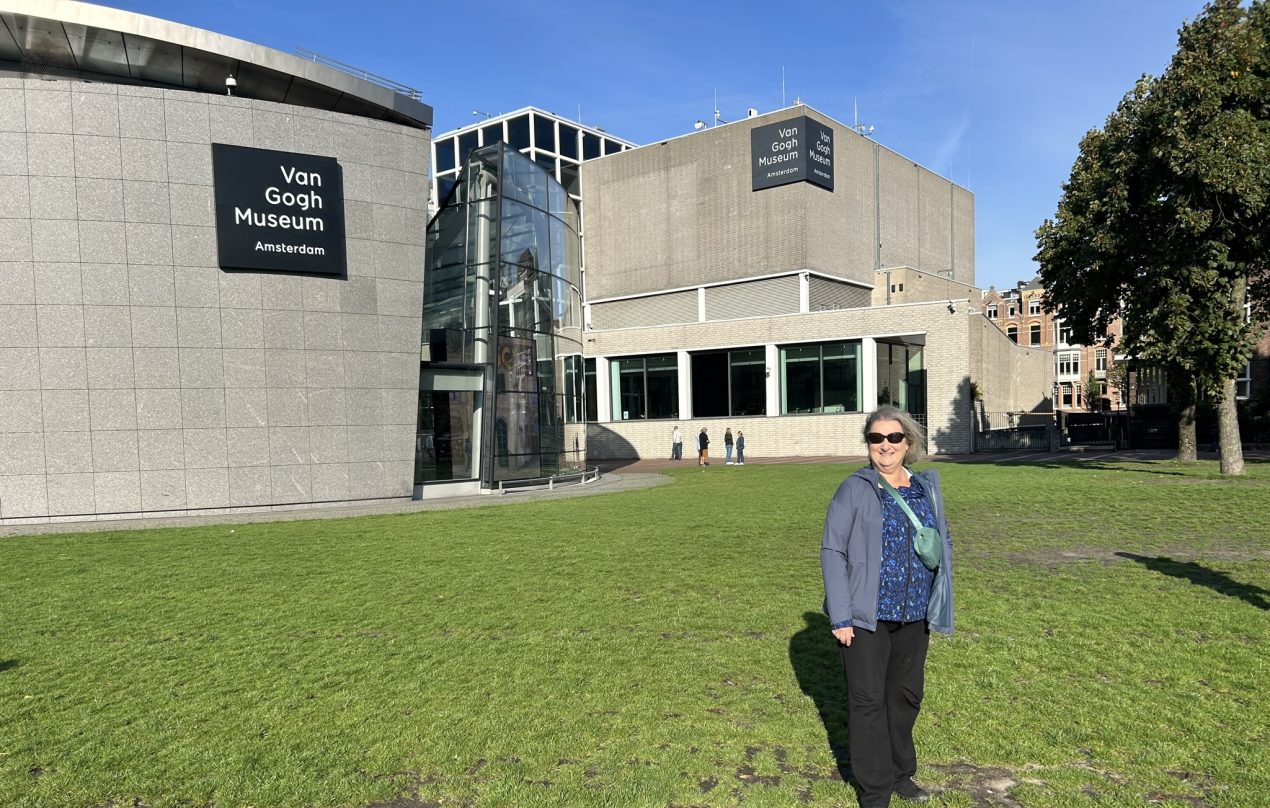
Carol Cram at Van Gogh Museum in Amsterdam

The Van Gogh Museum Amsterdam: A Personal Guide to Its Greatest Treasures

I remember the first time I saw the Van Gogh Museum, almost 50 years ago. Compared to the gingerbread façade of its neighbor, the Rijksmuseum, the Van Gogh Museum is sleek and modern, and when I first saw it in 1974, it was fringed with massively tall sunflowers. I burst out laughing. How appropriate!

The Van Gogh Museum houses the world’s most extensive and lovingly presented collection of work by the Netherlands’s fave artist, Vincent van Gogh.

During his lifetime, van Gogh didn’t get much love from his home country, but that oversight has been more than made up for in recent decades. Vincent van Gogh, who barely sold a painting during his life, is big business now.


Overview of the Van Gogh Museum

The Van Gogh Museum is well worth several hours of your time on even the shortest visit to Amsterdam. The only downside is that the world holds millions of van Gogh lovers and even with daily limits on visitors, a good chunk of them will be at the museum at the same time you are.

It does get tiring dodging the crowds, particularly if you, like me, enjoy taking photos of the pieces and reading all the captions.

Most people are listening to audioguides and sometimes stand immobile for long periods in front of each painting. When several of them are congregated in front of a popular piece such as The Sunflowers, you’ll have to wait awhile to get your viewing turn.

But hey, it’s worth it. These are original paintings by Vincent van Gogh! Artsy traveling doesn’t get much better. And when you’re done, you can tour no fewer than three gift shops (there may have been more) loaded to the gunwales with van Gogh schlock.

On this trip I resisted, but I do own a very nice van Gogh pen that I purchased on a previous visit.

In this post, I share my favorite pieces at the Van Gogh Museum, a must-visit for Amsterdam-bound artsy travelers—make sure you reserve tickets well in advance (more on that later).

The map below shows the location of the Van Gogh Museum in Amsterdam’s Museumplein, easily reached from the Centrum via trams 2 or 12.

Map thanks to Wanderlog, a trip planner app on iOS and Android

Also shown is the location of the Rijksmuseum next door, and the location of the charming apartment I stayed at on tiny Sint Nicholastraat in the lively Centrum area. Called Here’s Lucy, it’s highly recommended if you’re looking for a private one-bedroom apartment; it was a much better deal than any hotel I’d ever stayed at in Amsterdam. It’s situated not far from the Central Station and the Damrak is pretty much perfect.


Overview of the Van Gogh Museum

As the name suggests, the Van Gogh Museum is dedicated to exhibiting and celebrating the work of Vincent van Gogh, one of the world’s most beloved artists.

It opened in 1973, three years after my first visit to Amsterdam and a year before my second visit to Amsterdam at the age of 18. I remember being so excited to tour the museum in 1974 when I was already a firm van Gogh fan.

Message at the entrance to the Van Gogh Museum in Amsterdam

The museum is the most visited museum in the Netherlands, and one of the most visited museums in the world. And no wonder! The collection is organized on four floors and includes pieces from several of van Gogh’s contemporaries, including Monet, Gauguin, Pissarro and others.

The intention is to show van Gogh’s work in context and according to various themes, including self-portraits, early work, landscapes, and portraits.

Van Gogh produced hundreds of paintings and drawings over the course of just one decade, from 1880 to 1890. The collection at the Van Gogh Museum shows van Gogh as an artist intent on improving himself and his art while also being deeply engaged with the artistic developments of his day.

View of the Museum

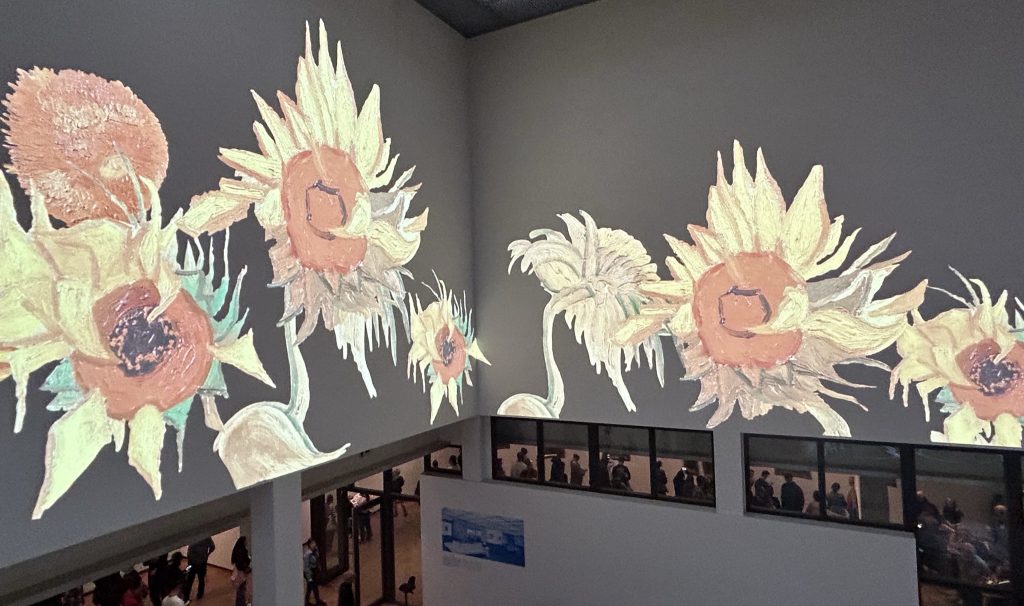
A central atrium extends from the ground floor to the fourth floor and is dominated by a staircase and projections of details from van Gogh’s paintings that change regularly. The exhibition spaces run around three sides of the building.

Interior of the Van Gogh Museum with sunflowers projected


Self-Portraits of Van Gogh

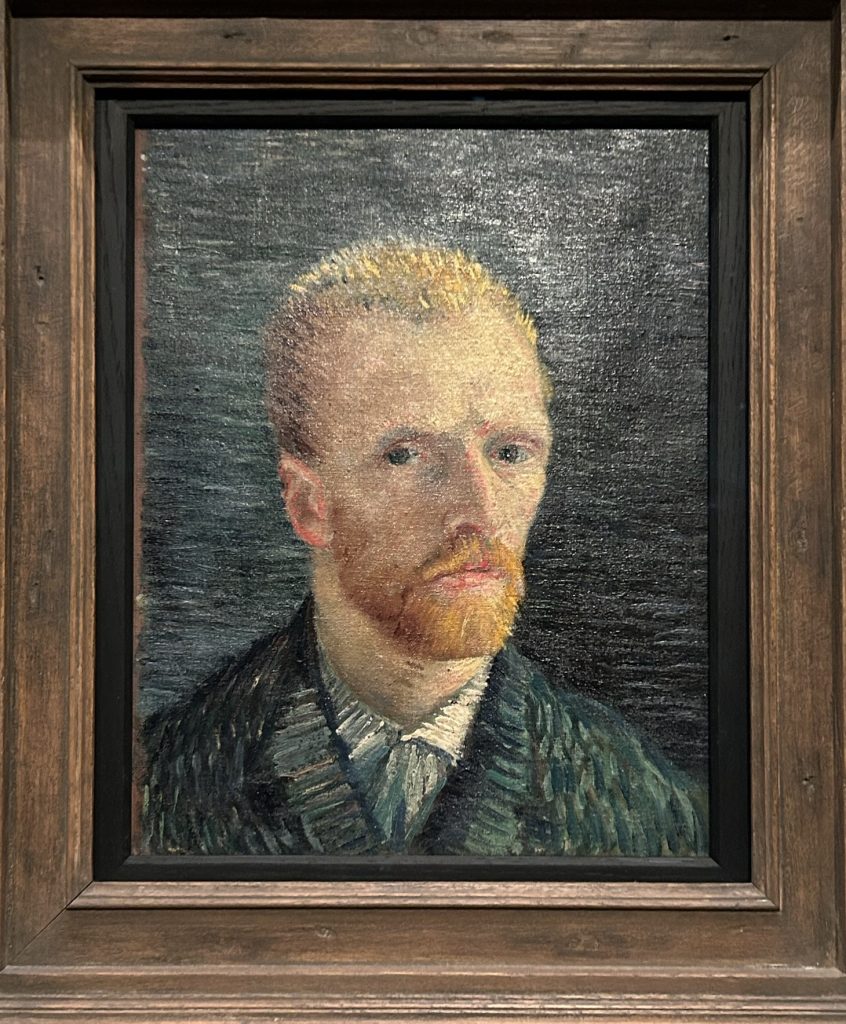
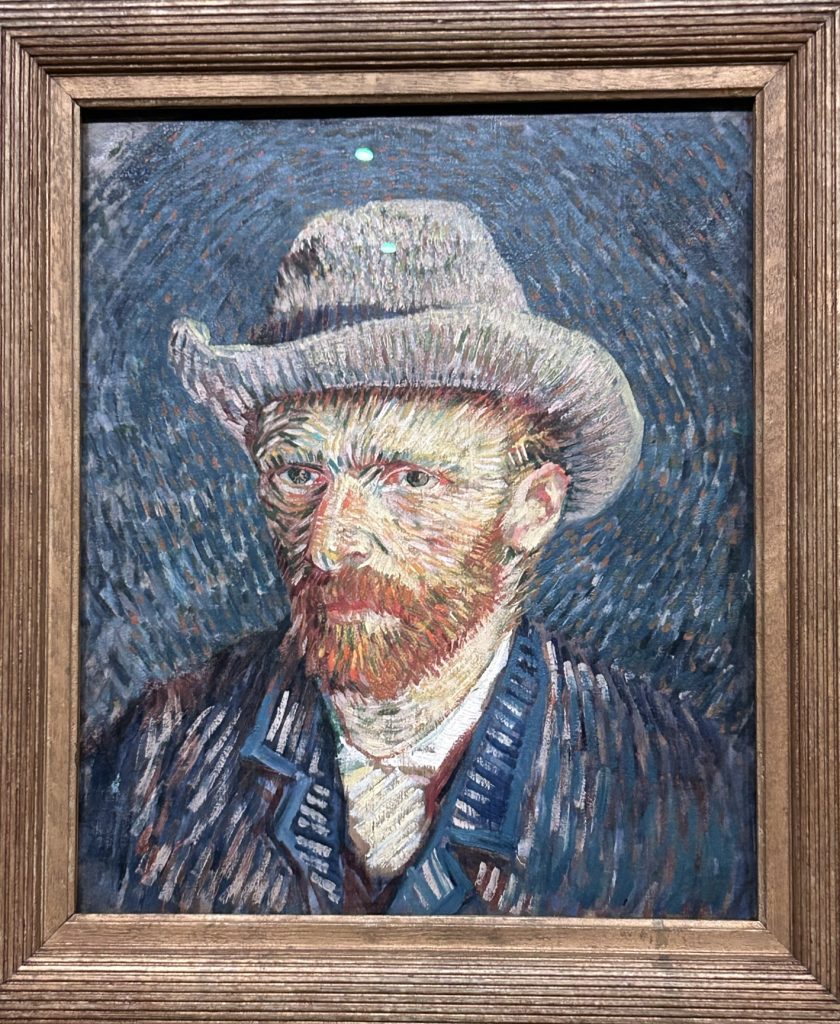
The first room we entered featured a good collection of van Gogh’s self-portraits. These are two of my favorites. I like the contrast in how he handled the brushstrokes in these two works, and the intensity of his stare.

Self portrait of Van Gogh at the Van Gogh Museum in Amsterdam
Self-Portrait, 1887
Self portrait of Van Gogh at the Van Gogh Museum in Amsterdam
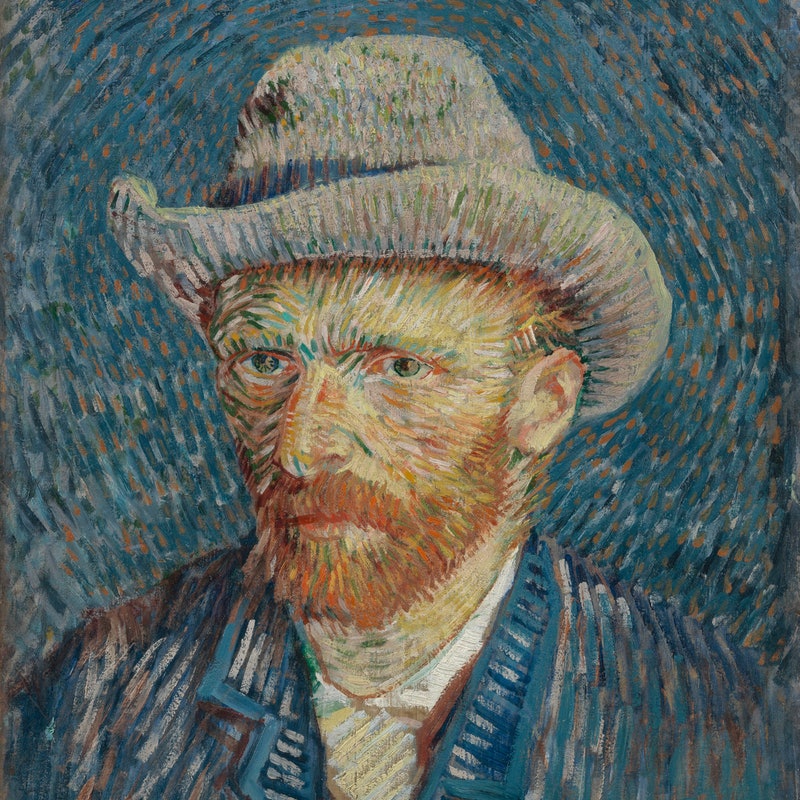
Self-Portrait with Grey Felt Hat

Van Gogh didn’t start painting seriously until he was 27 when he set to work to learn the rudiments of painting, mostly by studying the art of other artists. He was a great admirer of French 19th-century painters such as Jean-Francois Millet and Jules Breton who portrayed peasant life in the countryside.


Early Work

Most of van Gogh’s early work that he completed before he went to Paris and then finally to Provence feature a very limited, even dreary palette. They have almost an Old Master feel to them.

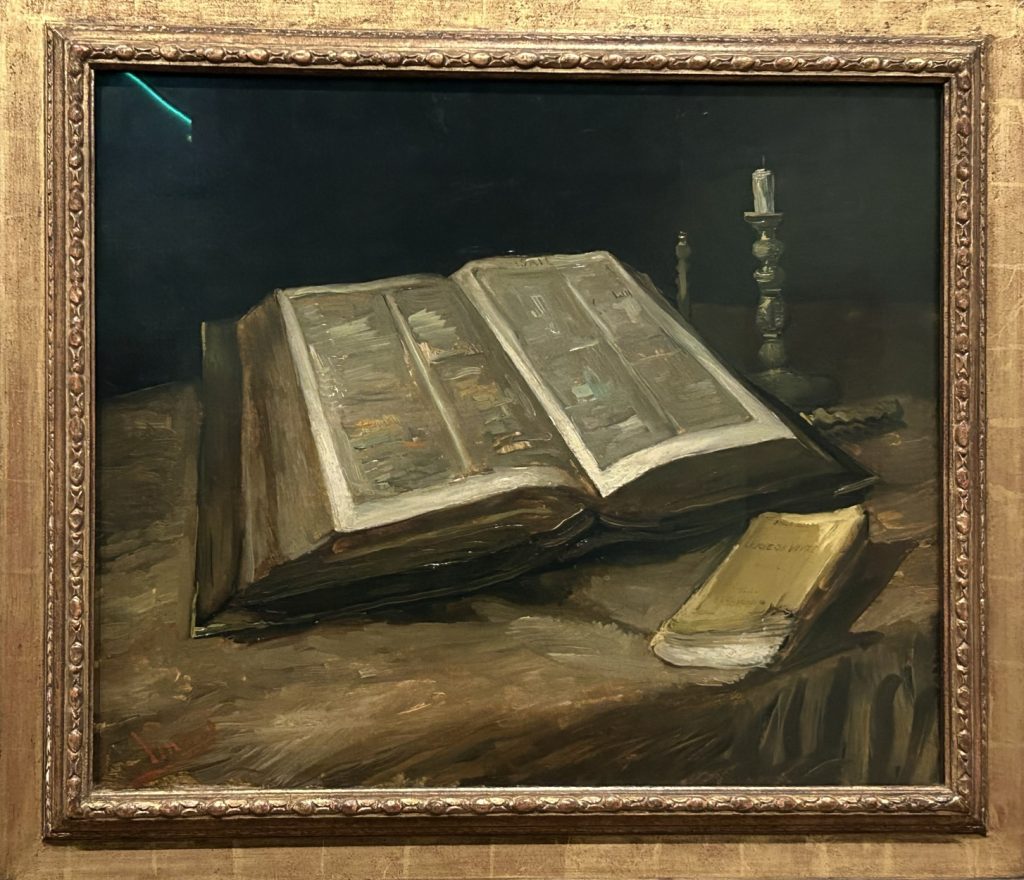
Still Life with Open Bible

I particularly enjoyed a painting of his recently deceased father’s bible set next to van Gogh’s copy of La joie de vivre by Emile Zola, a ‘bible’ of modern life. The intention of the painting is to juxtapose the religious and traditional mores of his father with van Gogh’s more modern sensibilities. I was intrigued by how he rendered the open pages of the bible with rough brush strokes.

Bible and Zola painting by Van Gogh featured in The Van Gogh Museum in Amsterdam

The Potato Eaters

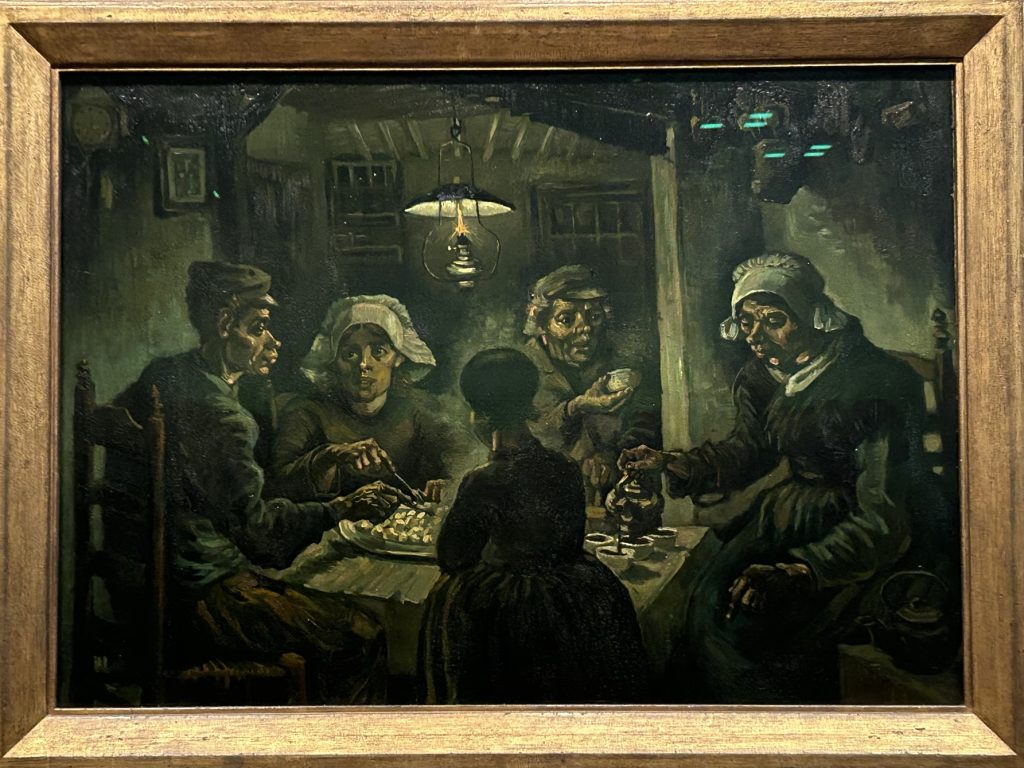
One of van Gogh’s most famous works from his early period is The Potato Eaters. The darkness of the painting and the almost grotesque roughness of the figures exemplifies the harshness, even despair, of peasant life. Van Gogh wrote that a true peasant painting should smell of bacon, smoke, and steaming potatoes.

The Potato Eaters by Van Gogh featured in The Van Gogh Museum in Amsterdam
The Potato Eaters

Van Gogh in Paris

The gallery devoted to works that van Gogh created while living in Paris also includes several works by his contemporaries, including Monet and Degas.

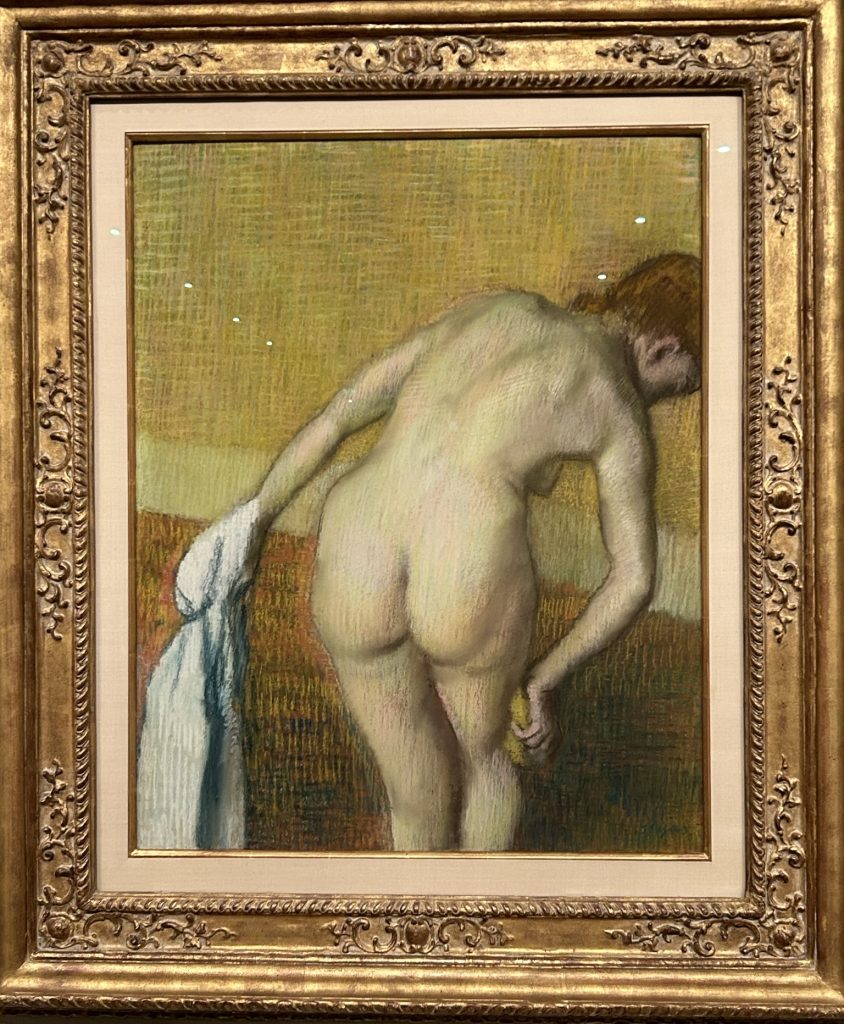
Nude Bathing by Degas

This nude by Degas is executed in numerous shades of pastel crayon and is one of several nudes that Degas exhibited in Paris and which van Gogh saw and greatly admired.

Nude bathing by Degas at the Van Gogh Museum in Amsterdam

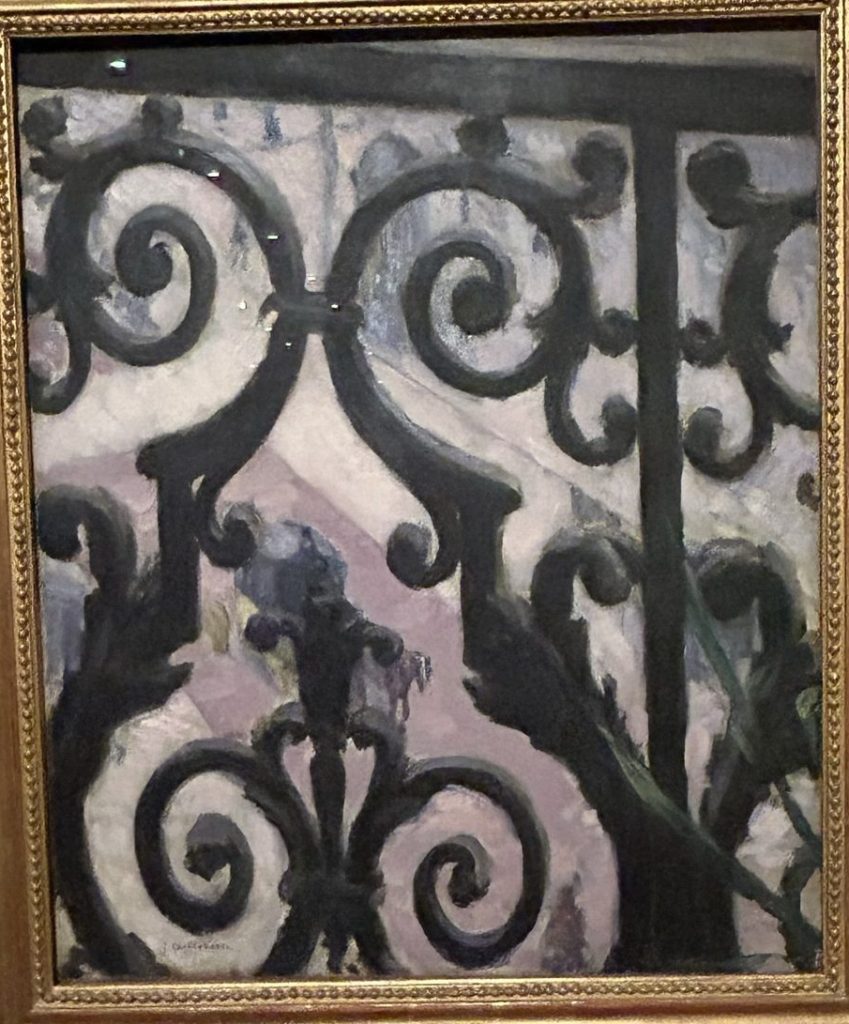
View Seen Through a Balcony by Gustave Caillebotte

Another work by one of van Gogh’s contemporaries is the painting by Gustave Caillebotte of a Paris street seen through a wrought-iron balcony. I’ve seen several of Caillebotte’s paintings at the Musée d’Orsay in Paris and like his work.

View Seen Through a Balocny by Gustave Caillebotte

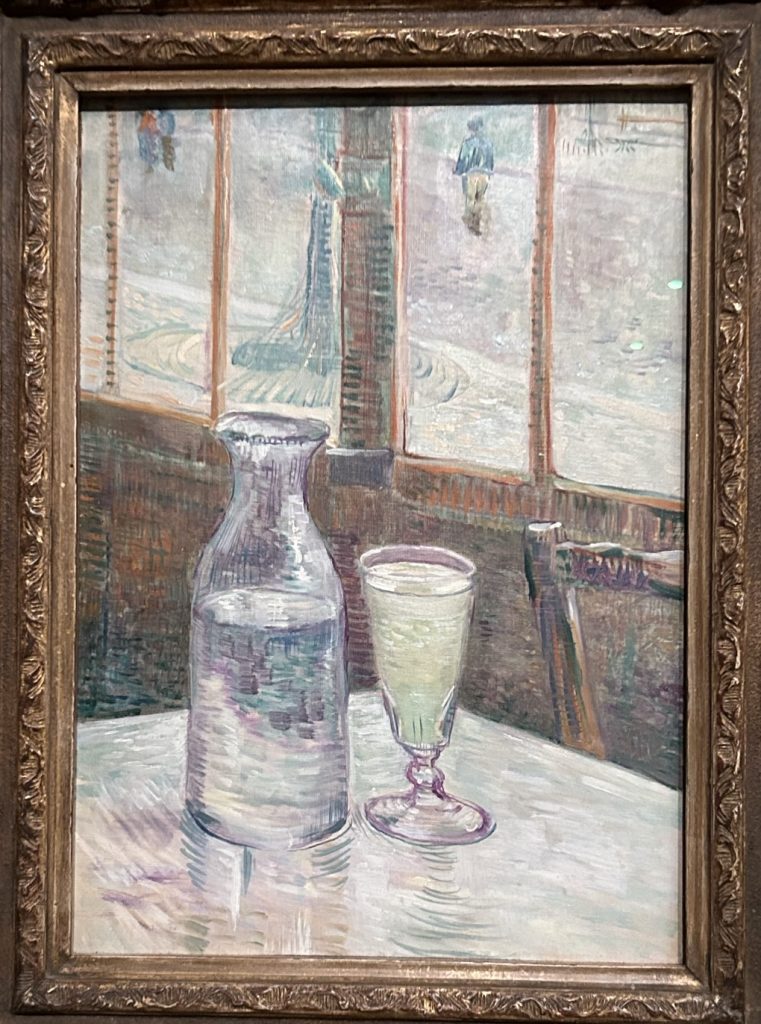
Café Table with Absinthe

And here’s a painting that van Gogh did while living in Paris. It depicts a glass of absinthe in a café. Already his palette is starting to lighten up with more pastel colors and looser brushstrokes.

Absinthe in a Paris Cafe by Vincent Van Gogh at the Van Gogh Museum in Amsterdam

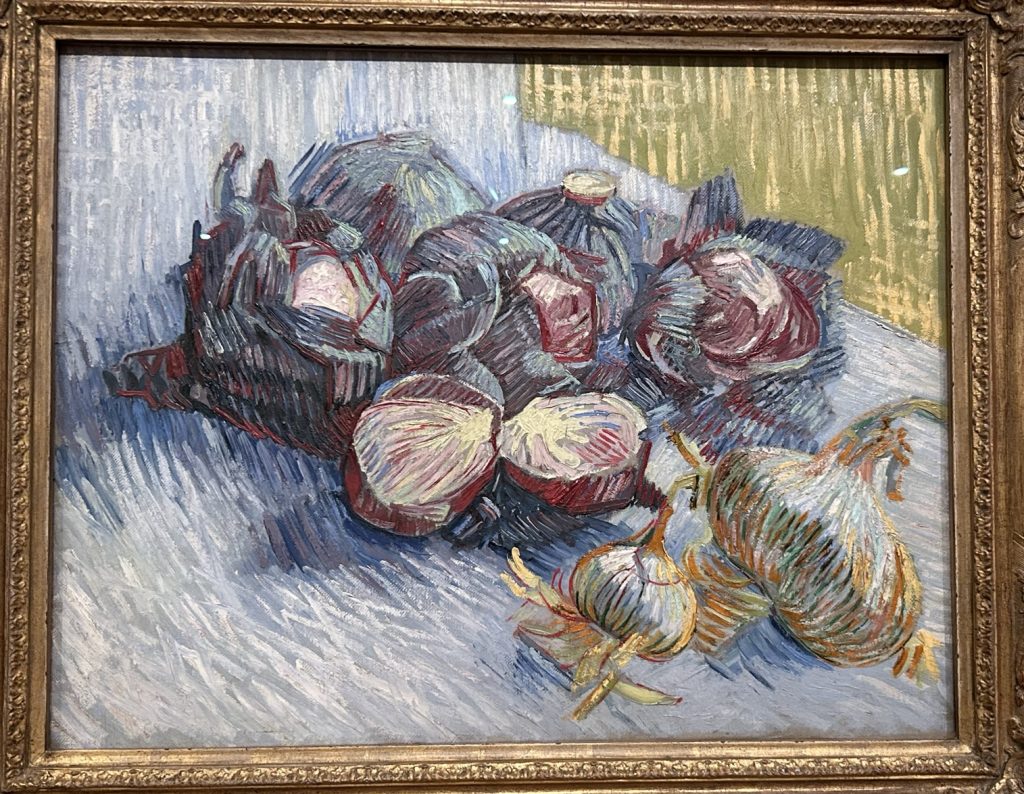
Still Lifes – Red Cabbage and Garlic

I don’t associate van Gogh with still life paintings except, of course, for his flower paintings. This painting of red cabbages and onions is a revelation. I love the blue, red, and gold palette and the vibrancy of his brushstrokes. This still life is anything but still. Van Gogh was apparently intent on studying color contrasts in the painting, the complementary colors of yellow and blue reinforcing each other. He was well aware of color theory and how different color combinations work together to produce different effects and even emotions.

Cabbages and onions painting by Van Gogh at the Van Gogh Museum in Amsterdam


Portraits

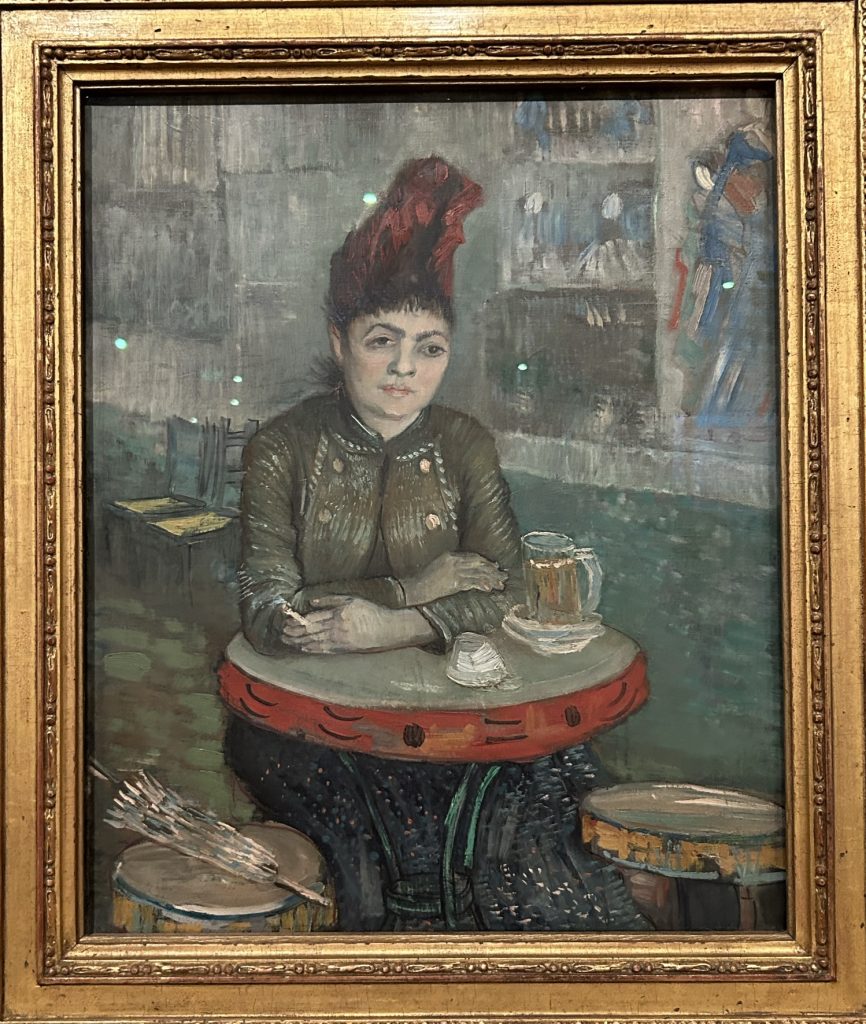
Several of van Gogh’s most famous paintings are portraits of people he met and interacted with—regular people such as a bar maid, a postman, and his landlord. The Van Gogh Museum includes a few of his portraits, although not any of the super-famous ones.

Woman in the Bar

This painting of a solitary woman in a Paris café is a great example of how van Gogh used regular people he encountered every day as his models. The look on her face is so relatable, staring into the middle distance, lost in her own thoughts. Is she annoyed? Pensive? Or just bored?

Woman in a bar painting by Van Gogh in the Van Gogh Museum in Amsterdam


Van Gogh in the South of France

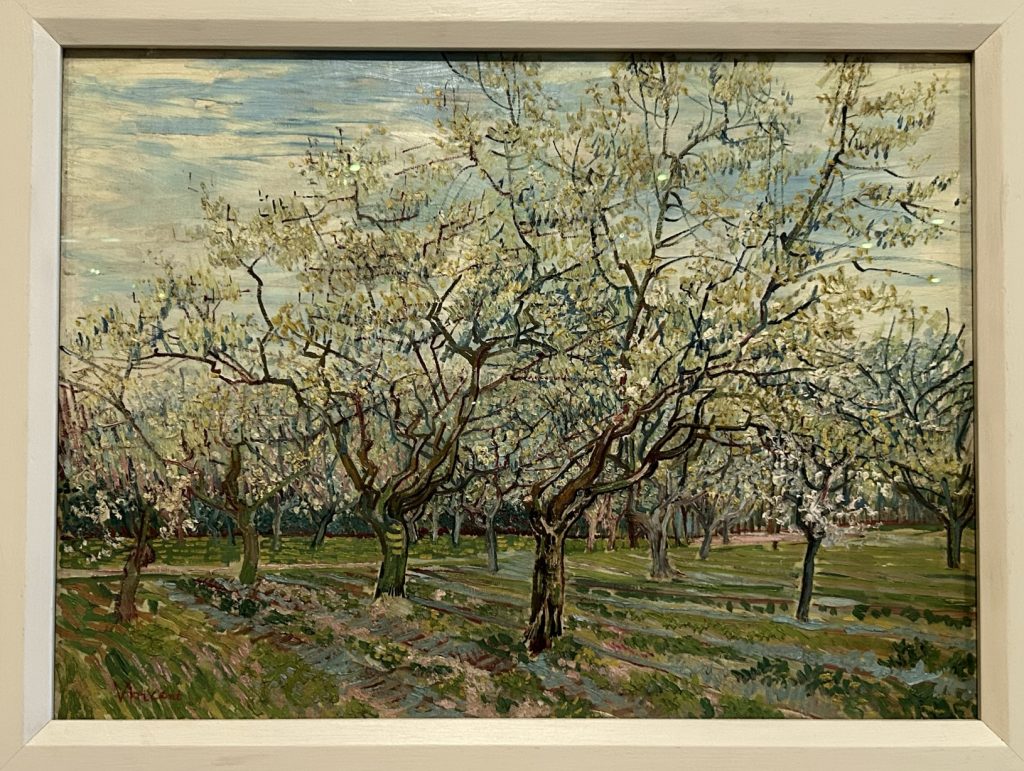
Van Gogh left bustling Paris for the south of France in late winter, arriving just as the trees were beginning to blossom.

The White Orchard

Here is one of three paintings he did not long after arriving in Arles. I’m entranced by the movement of the trees and the joyous freedom of the brushstrokes. It’s as if van Gogh had been released from prison and poised on the edge of a whole new adventure, which indeed he was.

The White Orchard painting by Van Gogh at the Van Gogh Museum in Amsterdam

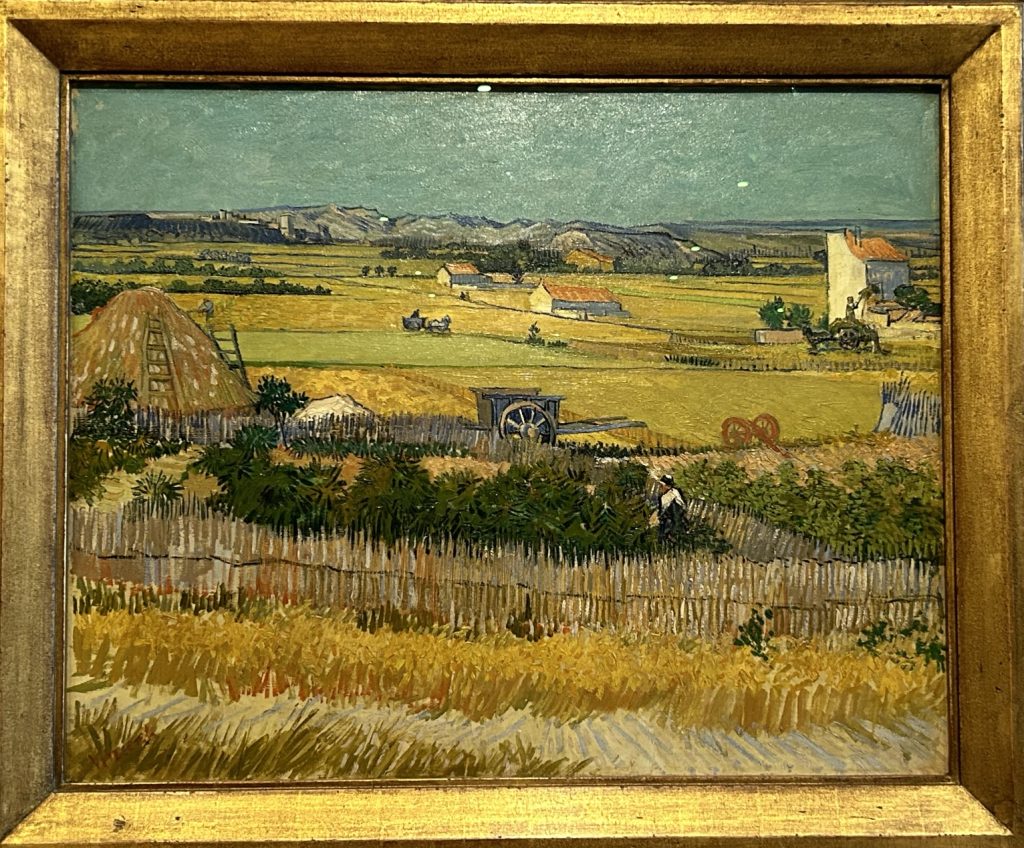
The Harvest

I felt very verklempt when I saw this painting, the very first van Gogh I ever saw and the first painting that launched me into a lifetime of loving art. I saw it at Expo 67 in Montreal when I was 11. A pretty uneventful childhood spent in Vancouver had not prepared me for modern art. I was blown away, first by The Harvest by van Gogh and then in the same exhibition at Expo 67 Lavender Mist by Jackson Pollock. It’s no wonder I’ve ended up spending my life with a painter!

The Harvest makes me feel happy every time I see it. I’m not sure why. Perhaps it’s the bands of color and texture or maybe the balancing of the complementary colors of gold and blue. It just feels totally right. I look at it and I feel glad to be in the world.

The Harvest by Vincent Van Gogh at the Van Gogh Museum in Amsterdam

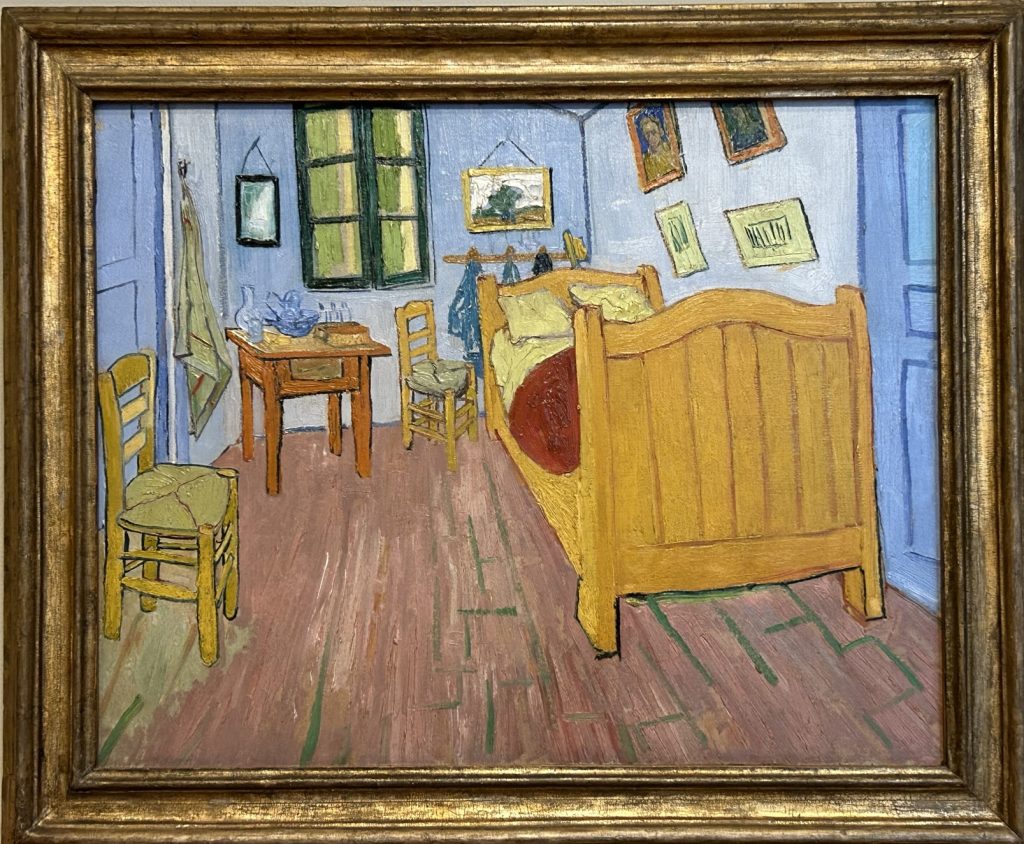
The Bedroom

How many times have I seen this iconic piece in reproductions and on mugs and mousepads, puzzles and pens? And yet seeing it in “real life” is still a thrill. There’s something so endearing about a man who paints his humble little bedroom and manages to infuse it with such warmth and loneliness. And again, it’s his use of complementary yellows and blues that makes the painting so satisfying to look at.

Sunflowers

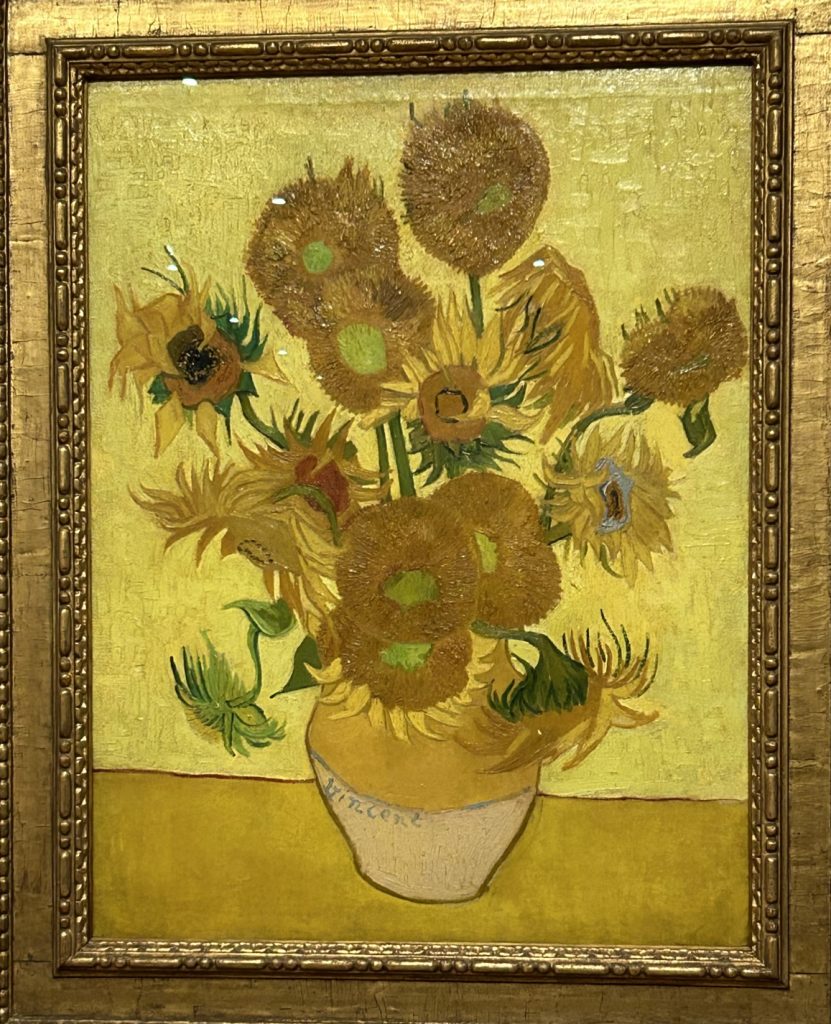
And another iconic favorite! Composed of just three shades of yellow, this Sunflowers (he painted several versions) glows like lemons in the sun. The sunflowers are in various stages of dying and yet the painting is beguilingly cheerful.

The Sunflowers by Vincent Van Gogh at the Van Gogh Museum in Amsterdam

The Yellow House

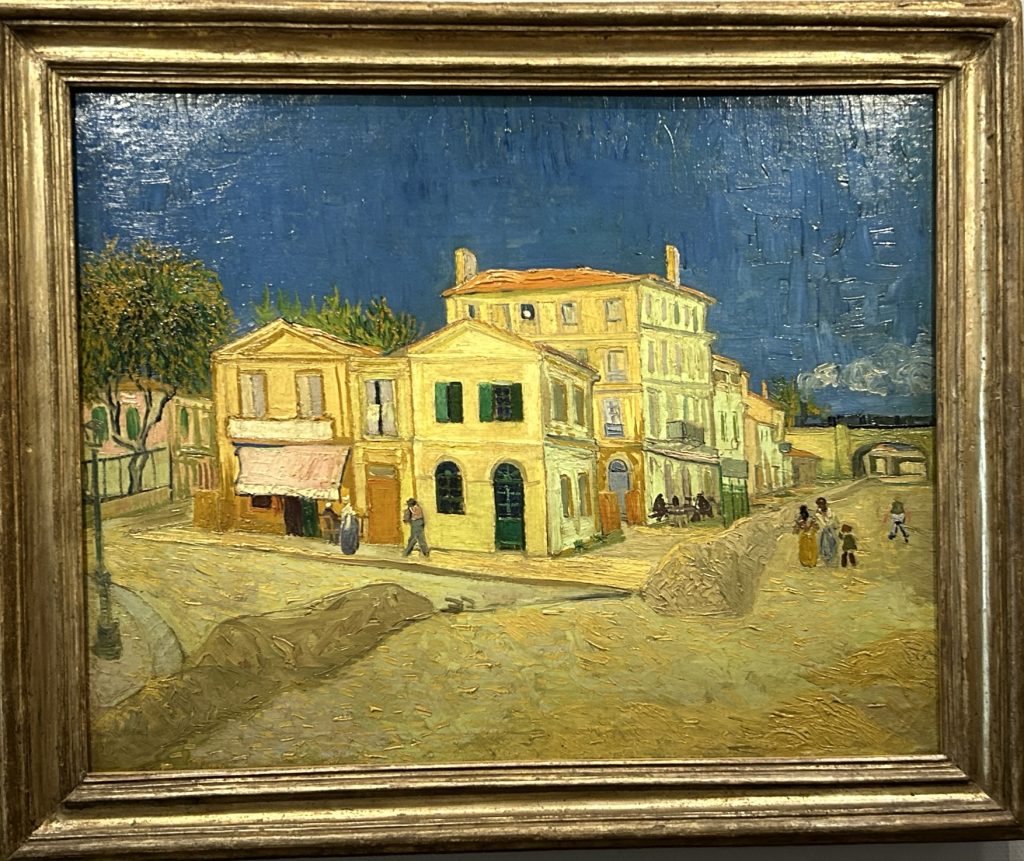
And here’s yet another study in blues and yellows! Gosh, he’s good. Van Gogh manages to capture heat shimmering against the walls of the houses in Arles. He was hoping to turn his yellow house into an artist colony but only Gauguin came, and stayed for just two months. Poor Vincent led a rather solitary existence.

The Yellow House by Vincent Van Gogh at the Van Gogh Museum in Amsterdam


Japanese Influence

Van Gogh was a huge fan of Japanese art, as were many of his contemporaries, and several pieces were directly influenced by it.

Almond Blossoms

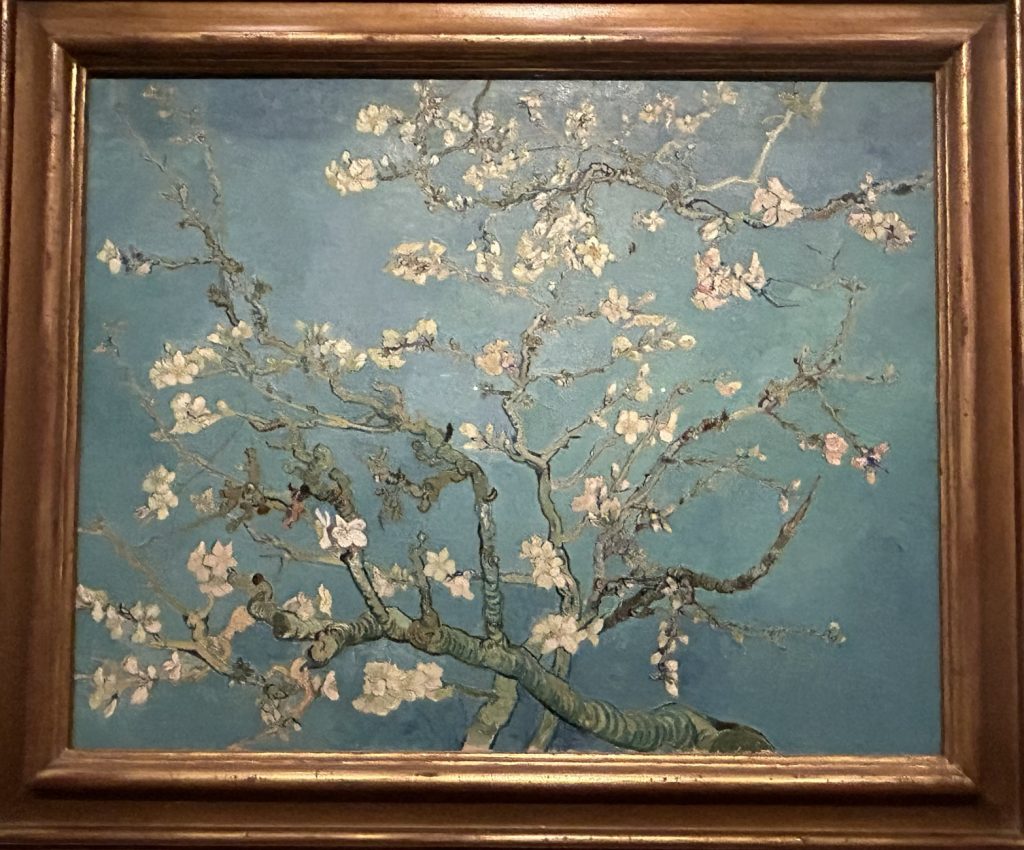
He painted this gorgeous, Japanese-print-inspired piece depicting almond blossoms against a blue sky to celebrate the birth of his nephew and namesake, Vincent, the son of his beloved brother, Theo. It’s almost abstract in its focus only on the blossoms and the sky with no other landscape elements. Van Gogh himself recognized the piece as one of his best, and he wasn’t wrong!

Almong Blossoms by Vincent Van Gogh at the Van Gogh Museum in Amsterdam

The Sower

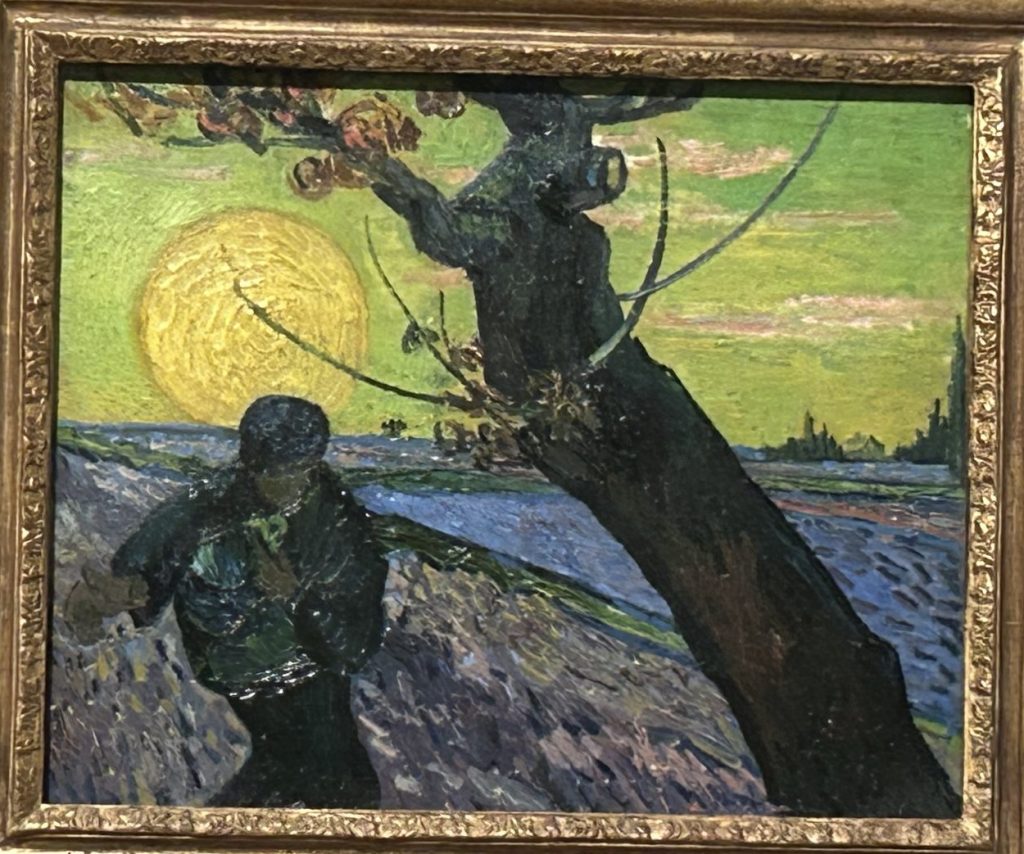
And finally, here is The Sower, one of van Gogh’s smallest and yet most well-known paintings. It has so much movement and energy. I can sense the man purposefully planting his seeds, completely trusting that they will come up in the spring. In this painting, the sky is green instead of blue which casts an eerie glow over the scene, giving it an almost foreboding look, although the sower seems oblivious to anything beyond the sowing of his seeds.

The Sower by Vincent Van Gogh at the Van Gogh Museum in Amsterdam

,


Practical Information

The Van Gogh Museum sells out many days in advance. Get your tickets online at least two weeks before you plan to be in Amsterdam (possibly more during the busy summer months). Most visitors appear to get the audioguide which probably enhances the viewing experience. We did not, preferring to discuss the pieces as we looked at them. Every so often, you can discreetly eavesdrop on a guided tour. All of the ones I came across the morning we toured the museum were in English. Click one of the options below to purchase your ticket.


Tour Options


Following Van Gogh by Tea Gudek Šnajdar

Written by an Amsterdam-based art historian and museum educator, this novel follows the life and work of Vincent van Gogh through the places he lived and painted.

Louise and Vincent by Diane Byington

A fictionalized account of the friendship between Louise Riesener, a French portrait painter, and Vincent van Gogh, whom she met in Paris in the 1880s.


Keep Exploring Great Art Museums with Artsy Traveler

Carol Cram
About Carol Cram

Carol M. Cram is the author of five award-winning novels inspired by art and the women who shaped it, the creator of Artsy Traveler, an arts-focused travel blog, the founder of Art In Fiction, a curated database of 2,600+ novels inspired by the arts, and the host of The Art In Fiction Podcast. She lives with her husband, artist Gregg Simpson, on beautiful Bowen Island near Vancouver, BC.
2 Days in Amsterdam: An Artsy Traveler’s Itinerary

I almost always land in Amsterdam at the start of my twice yearly (at least in recent years) trips to Europe.
Within minutes of checking into my hotel, I’m out walking along canals, dodging bikes (they’re fast!) and finding a cafe for my first European beer of the trip.

Although I’ve visited so often, I still spend at least a day (and usually two) in Amsterdam revisiting my favorite museums, finding new ones (the more obscure the better) and just soaking up the vibe.

For the artsy traveler, Amsterdam rewards that kind of unhurried attention. Stay at a hotel on one of the outer canals, such as the Herengracht, Prinsengracht, or Keizersgracht, and you can walk almost everywhere.

Here are my suggestions for two full days.


Orientation to Amsterdam

The map below shows the places mentioned in this post. Click a number on the map for more information.

Trip map created with Wanderlog, an itinerary planner on iOS and Android

Day 1 in Amsterdam

First thing in the morning, after fortifying yourself with a breakfast where good bread and Gouda cheese will likely play a role, head to the Museumplein.

Tour either the Van Gogh Museum (#1 on the map) or the Rijksmuseum (#2) as soon as it opens. Don’t try touring both museums in one day or you’ll risk art overload.

Buy your tickets online well ahead of your visit. I suggest visiting one major museum on one morning and the other the next morning or later that afternoon.

Avoid going to either museum in the middle of the day when both are mobbed (particularly the Van Gogh Museum).

Here’s information about the Van Gogh Museum, with details about the Rijksmuseum provided under Day 2.

Van Gogh Museum

Armed with the ticket you pre-purchased, arrive at the Van Gogh Museum at your appointed time (preferably as early as possible).

The Van Gogh Museum lives up to the hype as one of Europe’s most visit-worthy art museums. It offers a wonderful overview of van Gogh’s work, from his early years to the very end.

The museum contains the world’s largest collection of van Gogh’s art, including such signature pieces as Sunflowers, The Potato Eaters, and a personal favorite, Wheatfield with Crows, one of his last paintings. Download the app provided by the museum. It’s a good one.

Buy tickets in advance for the Van Gogh Museum

Check out my detailed overview of the Van Gogh Museum and my suggestions for touring.

In the afternoon (weather depending), take a canal cruise and visit Anne Frank House.

Anne Frank House

I first visited Anne Frank House (#3) when I was fourteen, the same age Anne Frank was when she was murdered, and again quite recently: Exploring Amsterdam’s Anne Frank House and Begijnhof.

Walk behind the bookcase that concealed the hiding place to view the unbelievably cramped spaces. It’s impossible to imagine how Anne and seven other people lived there for two years.

You must buy your ticket online for a specific timeslot up to two months in advance to visit the Anne Frank House. Tickets sell out fast so check the website a full two months before you plan to visit Amsterdam.

Don’t delay or you may be disappointed.

Canal Cruise

Take a canal cruise (#4) while in Amsterdam. If the skies are clear, go later in the afternoon when the light turns golden. During the summer months, consider an evening cruise. You’ll get a different perspective on Amsterdam as you glide past gabled houses and under bridges crusted with lights.

On your first evening, venture into the lively Centrum. Enjoy a beer at a canalside restaurant, then wander back to the quieter canals to avoid marauding bands of partying Brits.

The people of Amsterdam are working hard to take back their city from the invasion of large groups often from England. Here’s an interesting article about overtourism in Amsterdam.

If you steer clear of the streets around the station (the infamous Red Light District) and stick to the canals in the outer rings of the Centrum (the Keizersgracht, Herengracht, and Prinsengracht), you’ll find plenty of peaceful walks, lively and safe squares like the Rembrandtplein (#5), and attractive canal vistas.


Day 2 in Amsterdam

Depending on which of the two art biggies you visited on Day 1, visit the other on Day 2. Again, make sure you purchase your ticket ahead of time and choose a time either early in the day or later in the afternoon to avoid the crowds.

Rijksmuseum

If you enter the Rijksmuseum (#2) when it opens at 9 am, you’ll have it all to yourself. On a recent visit there in April, we barely saw another person for a good hour after entering around 9:15.

When we left around noon, the line-up extended out into the rainy Museumplein.

Satiated by great art and in cheery spirits after our leisurely stroll through near-empty galleries, we pitied the sad-looking tourists huddled under dripping umbrellas. Don’t be one of those tourists!

Facade of the Rijksmuseum in Amsterdam in the Netherlands--the top site for travelers to Amsterdam
Rijksmuseum in Amsterdam

The Rijksmuseum houses some of the greatest Dutch art in Europe. You’ll find numerous works by Rembrandt, Vermeer, and Frans Hals in more than thirty galleries that feature art from the Dutch Golden Age.

A special room is devoted to displaying Rembrandt’s The Night Watch, a vast improvement from when I first saw the painting back in 1970. Then, the painting was so dark and ill-lit that my 14-year-old self left unimpressed.

Now, the painting holds pride of place in a special gallery that most of the time teems with camera-toting tourists. Remember: go early and contemplate Rembrandt’s masterpiece in blessed solitude.

The Night Watch by Rembrandt: buy tickets in advance for the Rijksmuseum

Paintings from the Golden Age are just some of the attractions at the Rijksmuseum.

I was taken by the Medieval/Renaissance collection (1100 to 1600) displayed in beautifully lit and organized galleries. Since most visitors make a beeline for The Night Watch, you’ll find the medieval galleries comfortably empty. Enjoy numerous paintings, sculptures, objets d’art, furniture, and even tapestries.

As the premier museum in the Netherlands, the Rijksmuseum has even more to offer, including special exhibitions. These usually require an additional ticket so check ahead.

For more about the Rijksmuseum, check my dedicated post detailing more fabulous things see during your visit.

Lunchtime Concert at the Concertgebouw

If you’re in Amsterdam on a Wednesday, drop in to the Concertgebouw (#5) across the street from the Museumplein for a free lunchtime concert. You’ll be one of the few tourists there enjoying classical music alongside locals.

We saw an amazing concert of two vibraphonists, one Dutch and one Italian. Arrive well ahead of time to ensure you get a seat. The concerts are popular and fill up fast.

Check the Concertgebouw website for details about the free lunchtime concerts.

H’ART Museum

When we’re in Amsterdam, we almost always pay a visit to the H’ART Museum (#6), which was formerly known as the Hermitage Museum. The H’ART Museum is an art museum where famous works of art and stories from around the world are brought together in one-of-a-kind exhibitions.  

In our experience, this large museum overlooking the Amstel River has never been crowded and is a delight to walk around. At the back, enjoy lunch in the courtyard garden, a calm oasis in this bustling city.

Begijnhof

Another calm oasis is the charming Begijnhof (#7) courtyard surrounded by old-style Dutch homes that date to the 14th century, although most of the façades were replaced in the 17th and 18th centuries. The wooden house (Houten Huys) at Begijnhof 34 is the oldest house in Amsterdam.

Step into the Begijnhof chapel to view a series of panels that tell the story of the Miracle of Amsterdam.

 Begijnhof courtyard of characteristic Amsterdam homes
Lovely Begijnhof courtyard of characteristic Amsterdam homes

Walk Along the Canals

Apart from viewing art, one of my favorite things to do in Amsterdam is to wander along the main canals. Cross bridges, browse the shops, and snap picture after picture of the fabulous narrow houses, many dating from the Dutch Golden Age in the 17th century.

Take your time getting to know the quieter parts of this lovely city. Walk over to Vondelpark (#8) and join other people at play.

If you’re feeling brave, rent a bike. But be warned: locals ride fast! When you’re walking, always check that you’re not in a bike lane or you risk hearing the clang of a bell attached to a sturdy bike ridden upright by an angry Dutch person.


The Miniaturist by Jessie Burton

Set in 1680s Amsterdam, a young bride is given an eerily accurate cabinet-sized replica of her own house by a mysterious miniaturist, and the pieces that keep arriving start to predict her family’s future.

The Anatomy Lesson by Nina Siegal

The story behind Rembrandt’s famous Amsterdam painting, told through the corpse on the table, the surgeon, and the household that has to make room for a dissection happening under their own roof.

Eating in Amsterdam

On at least one evening, enjoy a Rijsttafel meal. This Indonesian import consists of up to forty small dishes, including egg rolls, sambals, satay, fish, fruit, vegetables, pickles, nuts, and more, accompanied by rice. The variations of taste, texture, and heat make rijsttafel (in Dutch, “rice table”) an eating adventure.

Beware! Some of the food is super-spicy!


Staying in Amsterdam

In my experience, Amsterdam is one of Europe’s most expensive cities. Plan on spending at least €300-€400 per night for a decent hotel in a central area of Amsterdam. We’ve found that splurging for a good hotel in an attractive area is well worth it.

Occasionally, we’ve stayed farther out at cheaper hotels in nondescript neighborhoods and have regretted the decision.

The Mokum Suites on Herengracht is a wonderful choice as is the apartment called Here’s Lucy, right in the heart of Amsterdam. You can walk everywhere.

The map below shows options for hotels in Amsterdam.


Compare Amsterdam Tours and Tickets

MOST IN-DEPTH

Rijksmuseum Masterpieces Guided Tour

INCLUDES
  • Timed entry ticket to the permanent collection
  • 2.5-hour small-group tour with an art historian guide
  • Rembrandt, Vermeer, and Frans Hals highlights
BEST FOR

First-time visitors who want the Dutch Golden Age explained, not just viewed

WHY CHOOSE IT

A guide brings context to The Night Watch and beyond that you’d otherwise miss

From $103

Book with GetYourGuide

Official Van Gogh Museum Guided Tour

INCLUDES
  • 60-minute tour led by an official museum guide
  • Entry ticket included
  • Sunflowers, The Potato Eaters, and self-portraits
BEST FOR

A focused introduction without committing a whole morning

WHY CHOOSE IT

An official guide unpacks van Gogh’s life and the stories behind each work

From $51

Book with GetYourGuide

N°1 Food & Culture Walking Tour

INCLUDES
  • 3.5-hour walking tour with 10 tastings
  • Stroopwafel, bitterballen, herring, cheese, and more
  • Flower Market, Begijnhof, and Royal Palace en route
BEST FOR

A break from museums that still feels like exploring the city

WHY CHOOSE IT

A local guide and generous tastings make this an easy highlight of any trip

From $90

Book with GetYourGuide

Sunset Canal Cruise with Optional Drinks

INCLUDES
  • 1-hour evening cruise, skip-the-line boarding
  • Golden-hour views of the gabled canal houses
  • Optional drinks package
BEST FOR

Capping off Day 1 the way the post itself recommends

WHY CHOOSE IT

An affordable, low-commitment way to see Amsterdam from the water

From $30

Book with GetYourGuide


Keep Exploring Europe with Artsy Traveler

Here are more posts on Artsy Traveler about recommended sightseeing in Europe:

Carol Cram
About Carol Cram

Carol M. Cram is the author of five award-winning novels inspired by art and the women who shaped it, the creator of Artsy Traveler, an arts-focused travel blog, the founder of Art In Fiction, a curated database of 2,600+ novels inspired by the arts, and the host of The Art In Fiction Podcast. She lives with her husband, artist Gregg Simpson, on beautiful Bowen Island near Vancouver, BC.