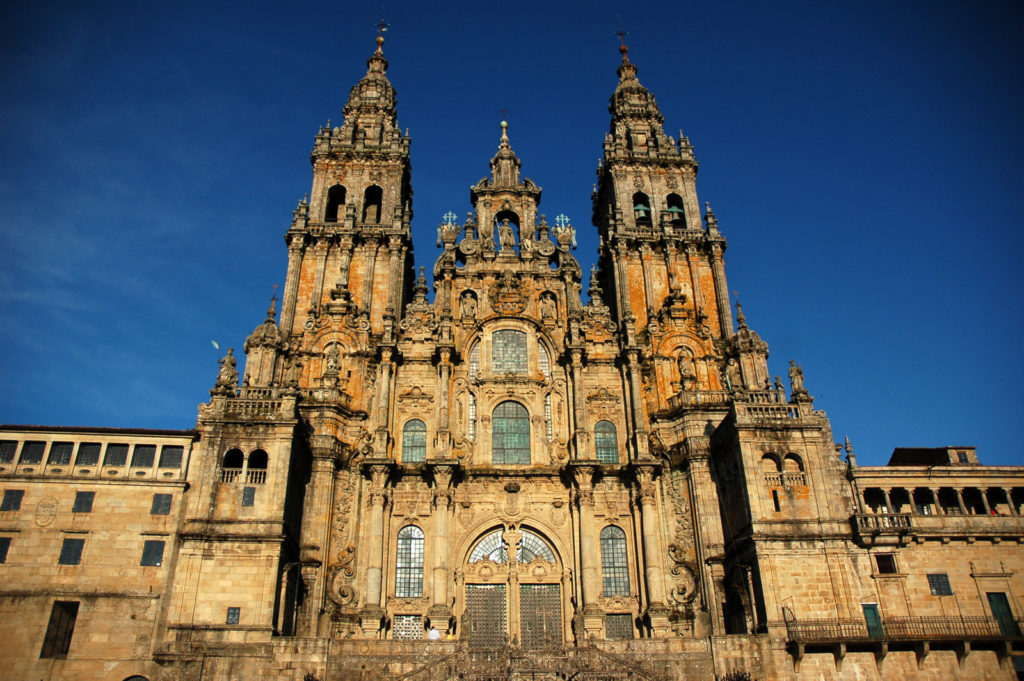
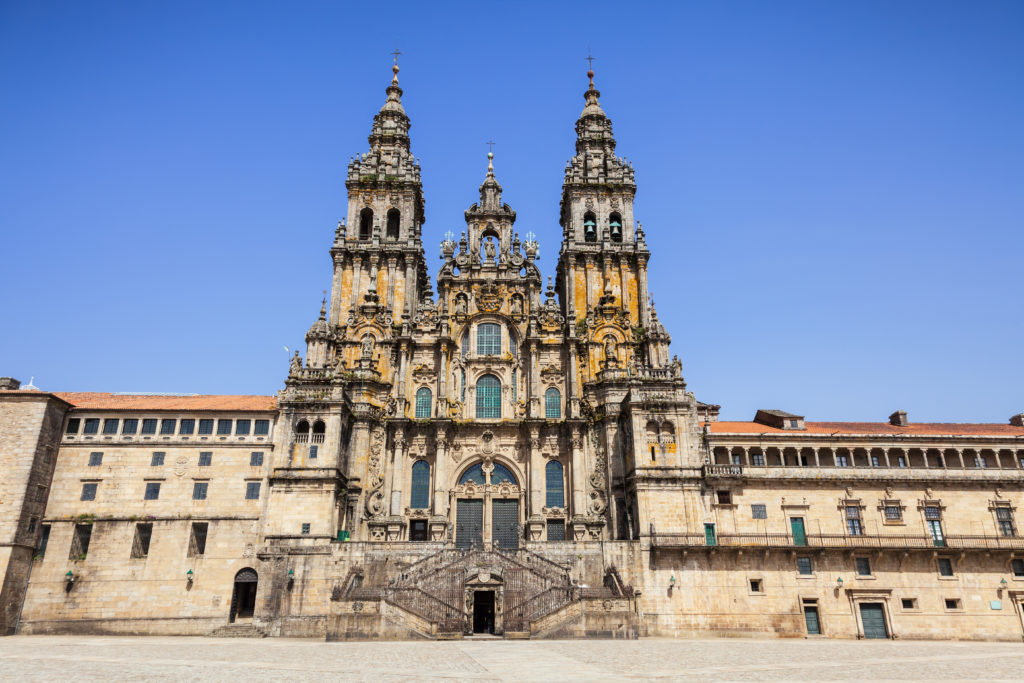
Cathedral of Santiago de Compostela viewed from Praza do Obradoiro

10 Best Things to Do in Santiago de Compostela

My husband Gregg Simpson, a visual artist, has had two solo exhibitions at the Museo Eugenio Granell in Santiago de Compostela, which means I’ve had the pleasure of spending real time in this city rather than just passing through as a tourist.

What I discovered is that Santiago rewards the traveler who stays a few extra days beyond the cathedral visit.

Yes, the cathedral is extraordinary and watching pilgrims complete their Camino in the plaza in front of it is one of the more moving things I’ve witnessed as a traveler.

But the surrealist Granell Museum, the Galician food scene, the bagpipe-playing troubadours in the streets, and the day trips to the wild Atlantic coast are what make Santiago a destination in its own right rather than just a famous finishing line.

In this post I share my top ten highlights, along with recommendations for where to stay and tours to take.

This guide is part of my ongoing series on artsy and independent travel in Spain, where I share my best tips for exploring the country’s creative cities, historic sites, literature, theater, and cultural experiences.


Slowing Down in Santiago de Compostela

During a visit of two or three days, you’ll slow down and get into the vibe of a city that has been a mecca for pilgrims for centuries. The city is compact, walkable, and pilgrim-central.

Throughout the day, people stream into the city, headed for the cathedral and the end of their Camino. I’ve never seen so many backpacks, walking staffs, and dust-crusted hiking boots in my life.

In recent years, the Camino has become a bucket list must-do for millions and, as a result, can become crowded. But everyone I spoke with raved about the experience, whether they walked for two weeks or two months.

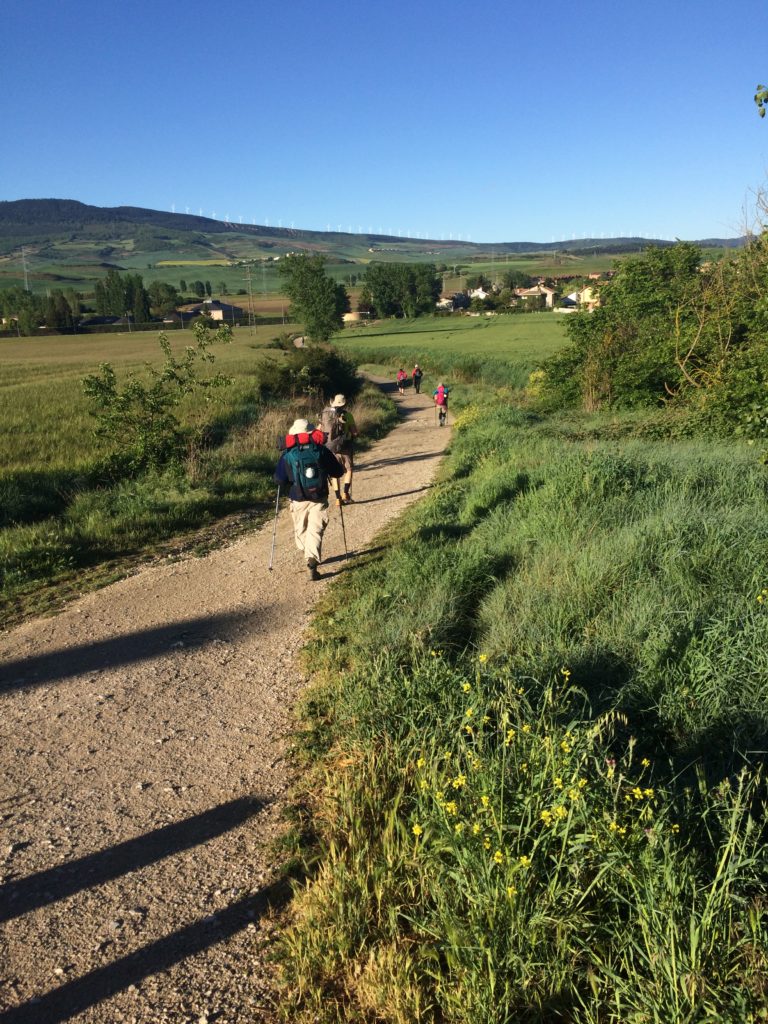
For an engaging description of walking the Camino starting in Pamplona, see the post Walking the Way from Pamplona to Santiago de Compostela: A Camino Journal by guest poster Elizabeth Petrie.


Highlights at a Glance

  • Wander the compact historic center to explore the charming, pedestrian-only streets.
  • Visit the Cathedral of Santiago de Compostela to watch pilgrims hugging Saint James, and stay for a service.
  • Tour three excellent small museums: Cathedral Museum, Museum of the Camino & Galician Culture, and Museo Granell.
  • Stroll around Alameda Park to enjoy views over Santiago de Compostela and quirky sculptures.
  • Take a day trip to explore the coast at Rías Baixas or Finisterre.
  • Sample Galician food and stay at Hotel Virxe da Cerca by Pousadas de Compostela.

Quick Facts

  • Location: Northwest Spain, capital of Galicia
  • Best time to visit: May–June and September–October for mild weather and fewer crowds
  • Getting around: On foot; Santiago’s historic center is largely pedestrianized.
  • Language: Spanish and Galician (Galego) are both widely spoken; most visitor-facing staff also speak some English
  • Weather: Expect changeable weather year-round; light rain is common, so pack a waterproof jacket and good walking shoes.
  • Food Culture: Seafood-driven cuisine with excellent value; menus often feature daily market catches and regional wines like Albariño.

#1: Cathedral of Santiago de Compostela

The Cathedral of Santiago de Compostela dominates the skyline of the city. For pilgrims completing the Camino, the cathedral is the ultimate goal. Built in the late 11th century, this cathedral is a stunning example of Romanesque architecture, with later Gothic and Baroque additions.

If you can, attend a service. A highlight is the swinging of the enormous censer (the Botafumeiro) across the transept. At least eight people, known as tiraboleiros, are required to maneuver the censer into place and set it swinging.

There is usually a long line behind the main altar of people waiting to hug a statue of St. James the Apostle (bottom picture below), a deeply symbolic ritual for pilgrims.


#2: Plaza in Front of the Cathedral

One of my favorite things to do in Santiago de Compostela is to stand in the middle of the Praza do Obradoiro in front of the cathedral and watch the pilgrims enter. Some are overcome with emotion after having finally completed their Camino.

Settle in for a while and watch people hugging and laughing as they pose in front of the cathedral. You may even be asked to take someone’s picture. I have on several occasions.

Pilgrims celebrating in Praza do Obradoiro after completing the Camino de Santiago

The festive atmosphere makes the plaza one of Europe’s most engaging spots for people-watching.


#3: Cathedral Museum

The cathedral museum is definitely worth an hour or two of your time. You’ll explore the cloister, treasury, chapter house, and rooftop terraces, and gain insight into the cathedral’s long construction history.

Highlights include medieval sculptures, tapestries, and close-up views of the cathedral’s architecture, along with excellent views over the plaza.

I took a guided tour of the cathedral and museum and was able to skip lines and learn about the cathedral’s history. If you want a more in-depth experience than you’ll get on your own, I recommend taking the tour.

Powered by GetYourGuide

#4: Museo Eugenio Granell

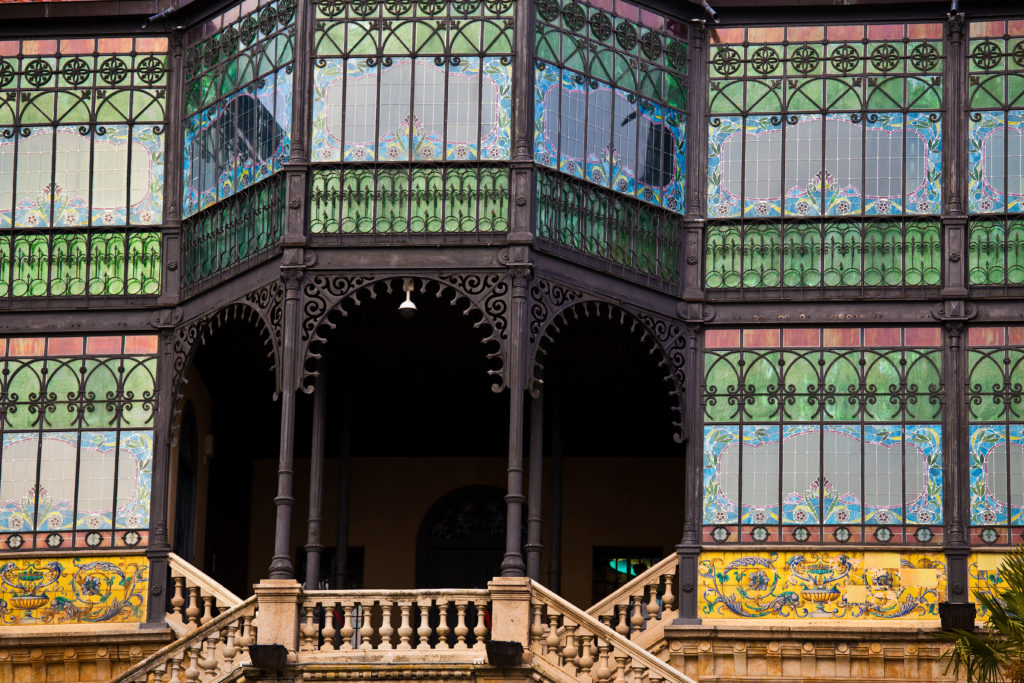
On the plaza Praza do Toural in the heart of Santiago de Compostela, a former palace houses the quirky Museo Eugenio Granell. In several large rooms, exhibitions feature works by both contemporary and historical artists. A common thread connecting the exhibitions is an interest in surrealism.

Exterior of the Museo Eugenio Granell on Praza do Toural in Santiago de Compostela

In the permanent exhibition, you’ll see works by painters such as Eugenio Granell himself, along with pieces connected to Picasso, Miró, and other surrealists. Eugenio Granell was a Spanish surrealist painter, writer, and political exile who spent many years in Latin America before returning to Spain.

Here are three of Granell’s paintings exhibited in the Museo Granell.

Twice in the last ten years, my husband, Gregg Simpson, has had solo exhibitions of his paintings at the Museo Granell. Here are some shots of his most recent exhibition:

Carol Cram and Gregg Simpson at the exhibition of Gregg Simpson's art at the Museo Eugenio Granell

Pop into the Museo Granell and go up to the first floor to view the current exhibition, and then tour the permanent exhibition and the library.


#5: Alameda Park

Parque da Alameda is a splendid place to stroll. Covering more than 8 hectares, the park is beautifully landscaped and contains all sorts of interesting features, including tree-lined promenades, viewpoints, and decorative ironwork.

I was particularly taken with the many quirky sculptures dotted around the park.

During the week we stayed in Santiago de Compostela, we walked in the garden every evening, often lingering to enjoy classic postcard views of the cathedral’s towers and to check out some magnificent trees.

Beautiful trees in Alameda Part

#6: Museo do Pobo Galego (Camino & Galician Culture)

Housed in the former convent of San Domingos de Bonaval, this museum provides insight into Galician culture, traditional crafts, music, and rural life to help visitors better understand this beautiful corner of Spain.

The triple-helix staircase alone is worth the visit.


#7: Food Mecca

Santiago de Compostela has become quite the gourmet mecca in the last few decades. It boasts several excellent restaurants featuring local cuisine.

Sample specialties such as octopus (pulpo a la gallega, tender, simply seasoned with olive oil and paprika, and served on wooden plates). At the end of the meal, treat yourself to a glass of licor café, a sweet coffee liqueur that goes down very easily. Below is the meal I enjoyed. The only other times I’ve had octopus, it has tasted like rubber. Not so this octopus! It was melt-in-your-mouth delicious.

You’ll find several Michelin-starred restaurants to try, including Casa Marcelo, A Tafona, and Restaurante Dos Reis. Prices are high, but the quality is worth it.


#8: Shopping and Strolling

Small shops in the streets around the cathedral contain a wide range of souvenirs. Alongside a lot of Camino-branded schlock (pilgrim socks, anyone?), you’ll find several excellent shops selling handmade jewelry, Galician ceramics, linen, and local food products.

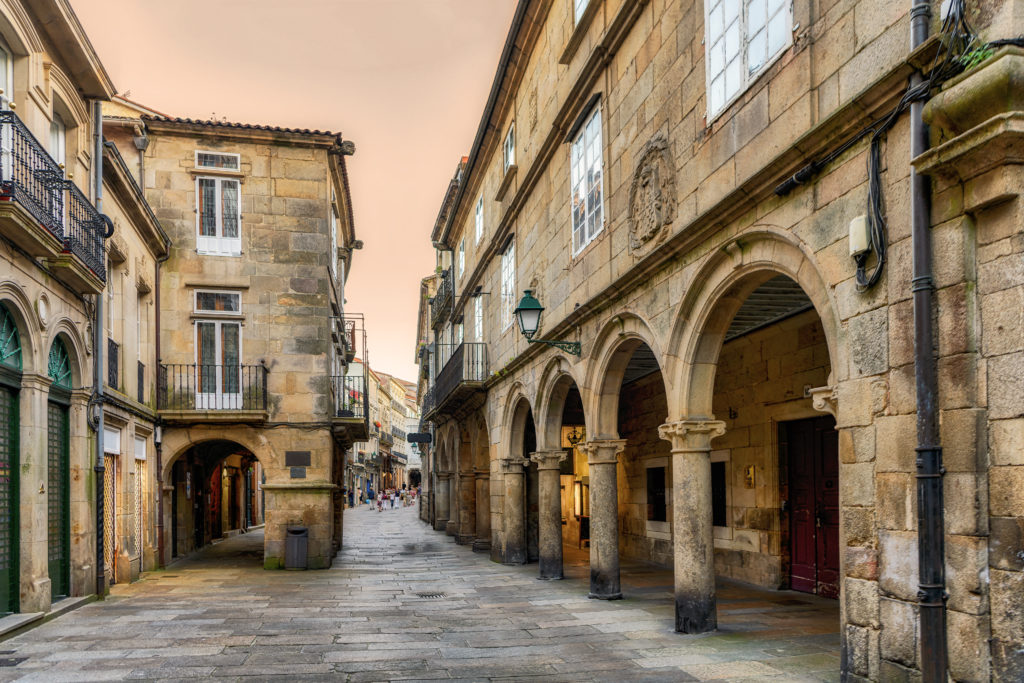
I also recommend strolling around the streets, especially in the early morning and in the evening. The central street leading up to the cathedral is often packed with pilgrims, but veer off onto some of the smaller streets and you’ll have the arcades and cobblestones to yourself.


#9: Day Trip to the Coast

Santiago de Compostela in Galicia is close to several stunning coastal destinations including Rías Baixas, Combarro, and O Grove.

Beautiful coastal scenery in Galicia

The tour I took included a boat trip in the Ría de Arousa, where I sampled more than my fair share of ultra-fresh mussels that had been pulled from the bay moments before being served, accompanied by white wine.

Fresh mussels served on a boat in the Ría de Arousa

Later in the afternoon, I visited the charming seaside town of Combarro, famous for its horreos (raised stone granaries).

Even in a torrential downpour, the tiny shops selling local crafts and souvenirs were thronged. I bought a little clay figure of a witch, a nod to Galicia’s folklore and Celtic roots.


#10: Folk Music and Dancing

While wandering around Santiago de Compostela, you may run into a troupe playing music and performing traditional dances. The sound of bagpipes (gaitas) may make you think you’re in Scotland, but bagpipes are also central to Galician music.

Northwest Spain has strong Celtic roots, and this heritage is still very much alive. I came across this group performing in the plaza in front of the cathedral, a fitting welcome to the many pilgrims ending their camino.


Places to Stay in Santiago de Compostela

I chose an apartment in Santiago de Compostela that was conveniently located around the corner from the Museo Granell, a five-minute walk from Parque da Alameda, and a scant ten-minute walk through traffic-free streets to the cathedral.

On an earlier trip I stayed at the Hotel Virxe da Cerca by Pousadas de Compostela, located next to the Plaza de Abastos market and an easy walk to the cathedral in the old town. I loved hanging out on the terrace, sipping wine and enjoying the view. The rooms were traditional, with heavy furniture and lots of space. Highly recommended!

Santiago de Compostela attracts thousands of visitors every year, so you’ll find plenty of accommodation options.

Check the map for more places to stay in Santiago de Compostela.


Tours In and Around Santiago de Compostela

Here are three tours offered by GetYourGuide, including a food tour, a night tour of Santiago de Compostela, and a tour of Finisterre.

Powered by GetYourGuide

Santiago de Compostela FAQs

Is Santiago de Compostela worth visiting if you’re not walking the Camino?

Absolutely. While the Camino brings pilgrims to the city, Santiago de Compostela offers much more than its role as the Camino’s endpoint. Its compact historic center, excellent museums, lively food scene, and beautiful green spaces make it a rewarding destination even if you’ve never walked a single kilometer of the Camino.

How many days should you spend in Santiago de Compostela?

Two to three days is ideal. This allows enough time to explore the cathedral and its museum, visit several smaller museums, enjoy the food scene, and relax in the parks. If you plan to take a coastal day trip, add an extra day.

What is the best time of year to visit Santiago de Compostela?

Late spring (May–June) and early fall (September–October) are the best times to visit. The weather is generally mild, and there are fewer crowds than in peak summer. July and August are lively but can be crowded due to Camino traffic and festivals. Expect rain at any time of year; it’s why Galicia is so green compared to most of the rest of Spain.

Is Santiago de Compostela walkable?

Yes. The historic center is compact and largely pedestrianized, making it easy to explore on foot. Most major sights, including the cathedral, museums, restaurants, and shops, are within short walking distance of one another.

Do you need to book cathedral tickets in advance?

Entry to the cathedral itself is free, but tickets are required for the cathedral museum, cloister, rooftop, and special areas. Booking in advance is recommended during peak travel seasons, especially in summer.

What should you wear when visiting the cathedral?

As an active place of worship, the cathedral has a modest dress code. Cover shoulders and knees, and avoid wearing a hat inside. Comfortable walking shoes are essential, especially if you’ll be exploring the old town’s cobblestone streets.

What food is Santiago de Compostela known for?

Santiago is famous for Galician seafood, especially octopus (pulpo a la gallega), mussels, clams, and scallops. Other local specialties include empanadas, cheeses like tetilla, and almond-based desserts such as tarta de Santiago.

Is Santiago de Compostela expensive?

Compared to cities like Barcelona or Madrid, Santiago de Compostela is moderately priced. Dining out and accommodations are generally good value, although prices increase during peak Camino months.

Can you take good day trips from Santiago de Compostela?

Yes. Santiago is an excellent base for exploring Galicia. Popular day trips include the Rías Baixas coast, Combarro, Finisterre, and local wineries. Guided tours are convenient, especially if you don’t have a car.


Final Thoughts on Visiting Santiago de Compostela

Santiago de Compostela is a city that rewards slowing down. Beyond its famous cathedral and its role as the endpoint of the Camino, you’ll find thoughtful museums, a relaxed food culture, and green spaces that invite lingering rather than rushing.

It’s a place where pilgrims, students, artists, and locals share the same streets, creating an evocative atmosphere that feels deeply rooted in history.


Keep Exploring Spain with Artsy Traveler

Carol Cram
About Carol Cram

Carol M. Cram is the author of five award-winning historical novels inspired by art and the women who shaped it, the creator of Artsy Traveler, an arts-focused travel blog, the founder of Art In Fiction, a curated database of 2,500+ novels inspired by the arts, and the host of The Art In Fiction Podcast. She also authored 60+ textbooks on computer applications and taught at Capilano University for over two decades. She lives with her husband, artist Gregg Simpson, on beautiful Bowen Island near Vancouver, BC.

View of the Centro Botin, a modern art museum in Santander, Spain

Santander, Spain: Best 3 Museums for Art and History Lovers

If you’re looking for an off-the-beaten-path Spanish destination with three excellent museums, you can’t go wrong with Santander on Spain’s northern coast.

This relaxed city in the province of Cantabria doesn’t overwhelm you with blockbuster attractions. Instead, it rewards you with a handful of thoughtfully curated museums, an appealing waterfront setting, and a distinctly local vibe.

Located about an hour west of Bilbao on Spain’s north coast, Santander makes an easy stop on a Northern Spain road trip or a short cultural break on its own.

I spent two nights here and one full day exploring what I consider the three best museums in Santander: a standout prehistory museum, a modern-art center overlooking the harbor, and a maritime museum that reflects the city’s long relationship with the sea.

If you only have time for one museum in Santander, make it the Museo de Prehistoria—it’s a winner.

This post is part of my guide to artsy & independent travel in Spain, where I share my best tips for exploring Spain’s creative cities, historic sites, literature, theater, and cultural experiences.


Santander Quick Facts

  • Location: Northern Spain, on the Bay of Biscay
  • Region: Cantabria
  • Population: Approximately 175,000
  • Best time to visit: April–June and September–October
  • Vibe: Relaxed, coastal, local, and refreshingly untouristy

Why Visit Museums in Santander?

I had no idea what to expect when I included Santander as part of my Northern Spain itinerary, and was delighted to discover an untouristy Spanish city that is well worth a two-night stay.

There are no headline-grabbing monuments here. Instead, the appeal lies in the laid-back pace, good food, walkable waterfront, and, most appealing, a trio of well-curated museums that are easy to visit without risking museum fatigue.

If you’re looking for cultural sightseeing without pressure, Santander fits the bill beautifully.


1. Museo de Prehistoria y Arqueología de Cantabria

I have a long-standing interest in prehistoric civilizations, particularly in the art and artifacts they left behind, so this museum was at the top of my Santander list.

The Museo de Prehistoria y Arqueología de Cantabria does not disappoint. Its beautifully designed exhibitions take visitors from the earliest evidence of human occupation in the region through Roman times and into the Middle Ages.

This is one of the best prehistory museums I’ve visited, and I don’t say that lightly.

First, it’s compact: all the exhibits are displayed on a single level, making it easy to navigate without feeling rushed or overwhelmed.

Second, it’s comprehensive. You move through a series of dimly lit rooms tracing human presence in Cantabria from hundreds of thousands of years ago through medieval times.

Even better, I had the museum almost entirely to myself, which made the experience even more absorbing.

Touring the Museum

All information is presented in several languages, including excellent English translations. In addition, interactive quizzes add a playful educational element.

One quiz challenged visitors to identify the era of three different skulls based on jaw structure, forehead slope, and brain cavity size.

I confidently guessed that the skull with the largest brain cavity belonged to Cro-Magnon. Wrong; it was Neanderthal. Those guys had us beat by many hundreds of thousands of years.

The prehistory section is first-rate. I learned a great deal about stone tools and early weapons and about artifacts related to Cantabrian cave art.

Several dioramas such as the one shown below bring the humanity of our early ancestors to life.

Life size model of a prehistoric man featured at the Museo Prehistorica in Santander, Spain

Also notable are the displays related to cave art in the region. Santander is a short drive from Santillana del Mar, where the Cave of Altamira is located. This cave is a must-see for art enthusiasts. The quality of the artwork and the comprehensive museum rivals my two other favorite cave painting sites in Europe: Lascaux and Chauvet.

Here’s one of the displays showing a cave painting of a deer.

Cave drawing showing an ibex outlined in red at the Museo Prehistorica in Santander, Spain

Steles

One large room is devoted to displaying some of the Cantabrian steles. These are considered one of history’s great enigmas. Little is known about who made the giant steles, when they were made and, most importantly, why they were made.

It’s suggested they were carved between the late first century BCE and the third century CE, but no one knows for sure.

What we can see is that they are very impressive and beautifully presented.

Group of three stele, large carved discs whose origins are unknown, displayed at the Museo Prehistorica in Santander

Romans

Just when I’ve decided I’ve seen the highlights of the museum, I wandered into the Roman area. It’s marvelous!

One highlight is a projection of a Roman bath populated by local nobles and their servants. Sit on one of the benches provided and enjoy the show. Sound effects such as running water and the murmuring of the “actors” add to the realism.

Projection of a scene in a Roman household with figures wearing togas and elaborately painted walls from ancient Roman times.

This rich history of this area of Spain deserves plenty of time to enjoy. Take your time in this museum; it rewards your attention with some of the most thoughtfully-curated exhibits I’ve seen at similar museums in Europe.

Practical Information: Museo de Prehistoria

  • Time required: 1.5–2 hours
  • Accessibility: Flat layout, easy to navigate
  • Languages: Spanish and English
  • Hours: Tuesday to Sunday from 10:00 to 14:00 and 17:00 to 20:00; closed Mondays
  • Location: Mercado del Este, Santander

2. Centro Botín (Botín Art Centre)

You can’t miss the Centro Botín. Like some sort of giant cylindrical bug, it rises above Santander’s attractive waterfront, casting shade over pedestrians below. I wouldn’t call it beautiful, not like Bilbao’s Guggenheim, but it is undeniably distinctive.

Before arriving in Santander, I was unfamiliar with the Centro Botín, and was surprised to look down from our room on the 7th floor of the Bahía Santander Hotel and see the museum dominating the waterfront.

View of the Centro Botin in Santander from the 7th floor of the Hotel Bahia; the view includes the harbor and mountains beyond.

I discovered that the museum is worth visiting for both its temporary exhibitions as well as its setting above Santander Harbor. While you won’t find a long list of internationally famous names, the exhibitions are often thoughtful and engaging.

Special Exhibition: Maruja Mallo

During our visit, we saw an extensive exhibition devoted to Maruja Mallo, a Spanish artist active in the 1930s.

Her painting La Verbena (1927) is a joyous depiction of a fair, bursting with movement and energy. Mallo includes herself in profile behind two women running freely in the foreground, an image often interpreted as a statement about women’s access to public space.

Painted called La Verbena by Maruja Mallo displayed in a special exhibition at Centro Botin in Santander, Spain

I’d previously seen this painting at Madrid’s Reina Sofía, and it was a pleasure to encounter it again within the context of Mallo’s broader body of work.

Permanent Collection

The small permanent collection at the Centro Botín includes several strong works by 20th-century Spanish artists, including a luminous painting by Joaquín Sorolla.

Sorolla, an Impressionist painter active in the late 19th and early 20th centuries, is famous for his ability to capture light, particularly in beach scenes and in images of figures near water.

Painting by Sorolla of three children on the beach.

After exploring the galleries, step outside onto one of the viewing platforms to take in excellent harbor views. At ground level, a stylish café is the perfect place to linger by the water.

Here’s Gregg (husband, travel companion and artist) standing on one of the platforms overlooking the view.

View of one of the outdoor platforms of the Centrol Botin in Santander that juts out over the water of the harbor

Practical Information: Centro Botín

  • Location: Santander waterfront, next to Jardines de Pereda
  • Time required: 1–1.5 hours
  • Accessibility: Fully accessible throughout
  • Languages: Spanish and English
  • Hours: Tuesday to Sunday from 10:00 to 20:00; closed Mondays
  • Website: https://www.centrobotin.org

3. Maritime Museum of Cantabria

A scenic twenty-minute walk along the harborfront brings you to the Maritime Museum of Cantabria. If maritime history and marine life interest you, it’s well worth a visit.

The upper floor focuses on Santander’s seafaring past, with historic photographs, ship models, and displays tracing the region’s relationship with the sea. Here is a series of models showing the shipbuilding process back in the day.

I also appreciated the display showing the human side of maritime history. This photograph of local women selling fish particularly appealed to me because it reminded me of the working-class Yorkshire women who inhabit my fifth novel, The Choir. Imagine the lives of these hard-working women who still found time to braid their hair into neat styles while working punishing hours every day.

Photograph of women iin 19th century dress selling fish in Santander.

On the lower level, you’ll find a small aquarium with several dimly lit tanks showcasing local marine species.

We took a taxi to the museum from the Hotel Bahía and then walked back along the pedestrian-only waterfront path. On a sunny, breezy April day, this stroll was one of the highlights of our stay and a great example of Santander’s commitment to attractive public spaces.

Practical Information: Maritime Museum

Location: Avenida de Severiano Ballesteros, Santander (harborfront)


Public Art in Santander

Art is not confined to museums in Santander. Public art in the form of intriguing sculptures are scattered along the walkway bordering the harbor. I especially enjoyed these sculptures depicting bathers. So creative!

You’ll also find several striking sculptures in the park near the Centro Botín, including a Miró and a group of elongated figures that look particularly atmospheric at night.


Walking Around Santander

Santander is a compact, walkable city with an interesting cathedral, several indoor markets, and a lively food scene. The people we met were very proud of being Cantabrian and were eager to share information about local delicacies.

Northern Spain feels distinctly different from the south with its flamenco and vast distances. Here’s a typical street in Santander that is a good example of the windows found in buildings all over this region.

Row of houses with distinctive windows in Santander

Walking Tour of Santander

I recommend taking a walking tour of Santander. This small-group tour from GetYourGuide promises the best of Santander in two hours: its bay, its history, and its most emblematic corners.

Powered by GetYourGuide

Beyond the Museums: Exploring Outside Santander

If you have time, the coastal landscape outside Santander is well worth exploring. Jagged cliffs, deep blue water, and very few people make this stretch of the Cantabrian coast ideal for peaceful cliffside walks.


Tours and Day Trips Near Santander

Santander makes a perfect homebase for exploring several noteworthy areas within a short drive.

Santillana del Mar

Santillana del Mar is charming and historic, and easily reached from Santander. If you’re short on time, consider a day trip from Santander, but if you have your own wheels, stay the night. The main attraction here is the Caves of Altamira. Here, you’ll find stunning cave paintings accessible by guided tour from the visitor center that is also an excellent small museum.

If you can, get the English tour. I was mistakenly booked on the Spanish tour and since my Spanish is extremely limited, I didn’t learn much. But I did get to take some great pictures of the cave art.

Cave drawings of animals at Altamira near Santillana del Mar in Northern Spain.

Here’s a guided tour of the caves with GetYourGuide that is offered in English:

Powered by GetYourGuide

Tours Around Santander

Here are three tours with GetYourGuide that explore the areas around Santander:

Powered by GetYourGuide

Keep Exploring Spain with Artsy Traveler

Santander may not shout for attention, but for arts and history lovers seeking a relaxed stop in Northern Spain, its museums make a compelling case for lingering a little longer. Here are more posts about traveling in Spain:

Carol Cram
About Carol Cram

Carol M. Cram is the author of five award-winning historical novels inspired by art and the women who shaped it, the creator of Artsy Traveler, an arts-focused travel blog, the founder of Art In Fiction, a curated database of 2,500+ novels inspired by the arts, and the host of The Art In Fiction Podcast. She also authored 60+ textbooks on computer applications and taught at Capilano University for over two decades. She lives with her husband, artist Gregg Simpson, on beautiful Bowen Island near Vancouver, BC.

How to Spend a Perfect Artsy Traveler Day in Madrid

Madrid was a revelation. I had the opportunity to spend two weeks there while Gregg Simpson (husband, artist, frequent travel partner) had an art exhibition and I wondered what I’d do with myself.

I needn’t have worried. Madrid has so much to offer the Artsy Traveler that even after two weeks, I had plenty of reasons to return..

And while Madrid’s infectious energy rewards as much time as you can give it, you can, in one well-planned day, savor an enjoyable slice of what makes Madrid distinctive.

My Perfect Day itinerary distills that experience into one well-planned day that captures what makes Madrid distinctive. You’ll balance art, relaxed wandering, and memorable meals — and save the best for last with a flamenco performance that will leave you breathless.

Treat my Perfect Day itinerary as a framework rather than a checklist. Swap elements as you like, linger where curiosity pulls you, and leave room for serendipity. That is often when the most rewarding travel moments happen.


What Is a Perfect Artsy Traveler Day?

A Perfect Day itinerary is my answer to a question I get asked often: if you only have one day in a city, what should you do? Not what the guidebooks say you should do, but what will actually make you glad you went?

Each Perfect Day itinerary is built around the things I love most when I travel: museums worth lingering in, neighborhoods worth getting lost in, meals worth slowing down for, and at least one experience that couldn’t happen anywhere else. I leave out the obligatory sights that everyone photographs (but sometimes don’t even enjoy), and I include the things that made me want to stay longer.

These itineraries are frameworks, not schedules. If you find a café you want to sit in for an extra hour, get comfy and order another coffee or glass of wine. If a museum pulls you in deeper than you expected, let it.

Your goal is to craft a day that feels genuinely yours rather than tick off bucket list sites just to say you did them.

If you love this approach, see the full list of cities at the end of this post.


Highlights of a Perfect Artsy Traveler Day in Madrid

  • Begin the day with a quiet walk through a historic park or garden.
  • Visit one of Madrid’s major art museums. I recommend the Thyssen-Bornemisza Museum.
  • Enjoy lunch and people-watching in Plaza Major.
  • Take a hands-on cooking class focused on Spanish cuisine.
  • Rest and recharge before an evening out.
  • Attend a flamenco performance.
  • End the day with a late dinner and an evening stroll through the centro.

Map of Madrid: Perfect Artsy Traveler Day

The map below shows the locations mentioned in this post. Click a number to read more.

Map thanks to Wanderlog, a trip planner app on iOS and Android

A few days or even weeks before embarking upon your Perfect Day in Madrid, go online to secure tickets to your chosen art museum(s). Consider the Museo Nacional Thyssen-Bornemisza or the Prado. Also, get tickets in advance for a flamenco performance; you’ll find plenty of venues to choose from in Madrid.

Ready? Let’s go explore a Perfect Day in Madrid.


Morning in Madrid

When I travel, I love to get up early and spend an hour or two wandering around my neighborhood before stopping at a café for coffee.

On my recent trip to Madrid, I stayed across the street from the Jardines Sabatini, the lush gardens surrounding the opulent Royal Palace, so that’s where I’ll start.

Early Morning Walk through the Jardines Sabatini

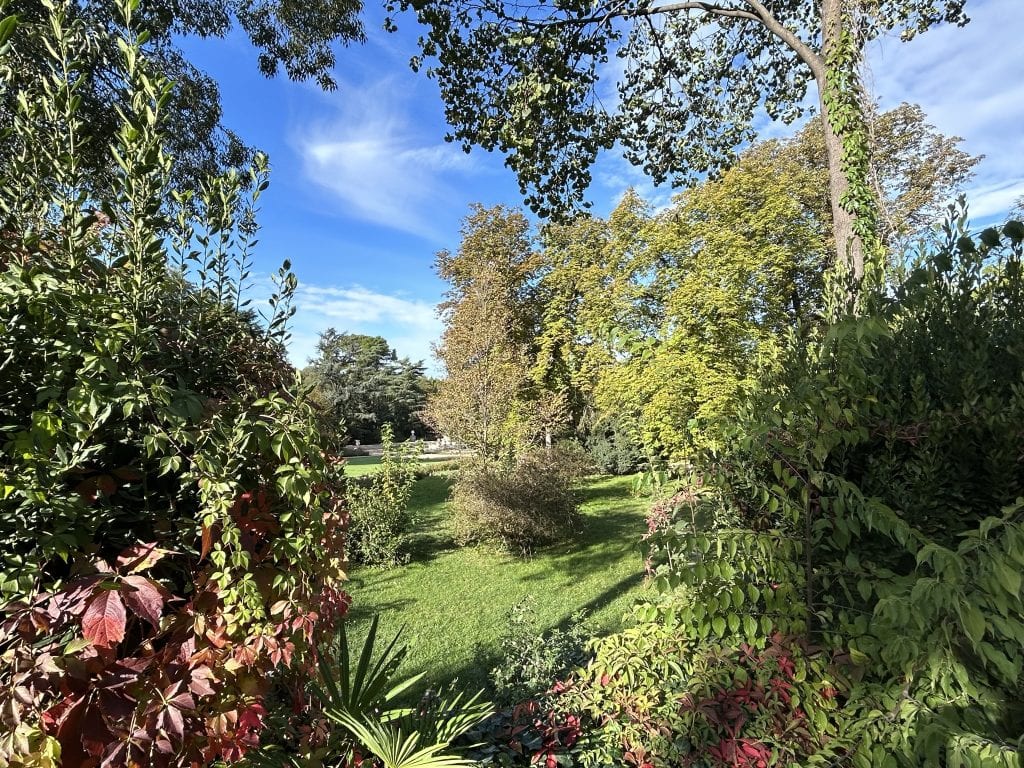
The Jardines Sabatini (#1) are magical. In the early morning, you’ll enter through an iron gate that is locked at night and immediately have the twisty paths and gorgeous foliage all to yourself.

The Jardines Sabatini in Madrid
The peaceful, beautifully landscaped Jardines Sabatini in Madrid

After a brisk walk, find a stylish café near the Royal Palace for a breakfast of pastry and, of course, coffee.

Taxi to the Museo Nacional Thyssen-Bornemisza

Taxis in Madrid are very affordable, and Übers even cheaper. Five minutes after using my phone to book an Über, I’m being whisked into the crazy Madrid traffic for the 10-euro trip. It’s money well spent.


Mid-Morning in Madrid

Visit to the Museo Nacional Thyssen-Bornemisza in Madrid

Although not as well known as the Museo Prado (another excellent pick for an artsy day in Madrid), the Museo Nacional Thyssen-Bornemisza (#2) has a wonderful collection and is not quite as overwhelming as the Museo Prado.

Start on the main floor with a visit to the stunning collection of 19th-century art, mostly by Impressionists. While the Thyssen doesn’t contain many super-famous pieces like the Musée d’Orsay does, it features a lot of variety and some stunning paintings.

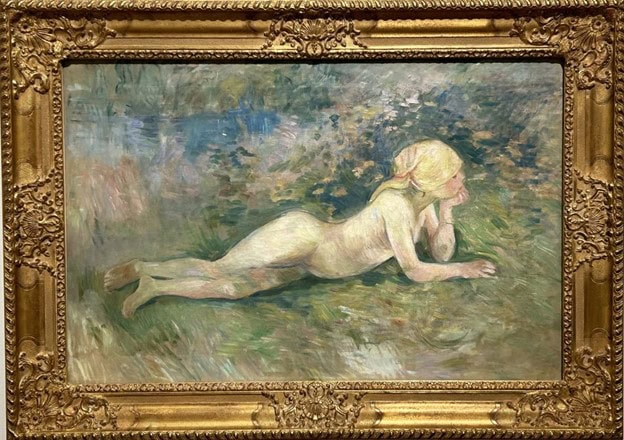
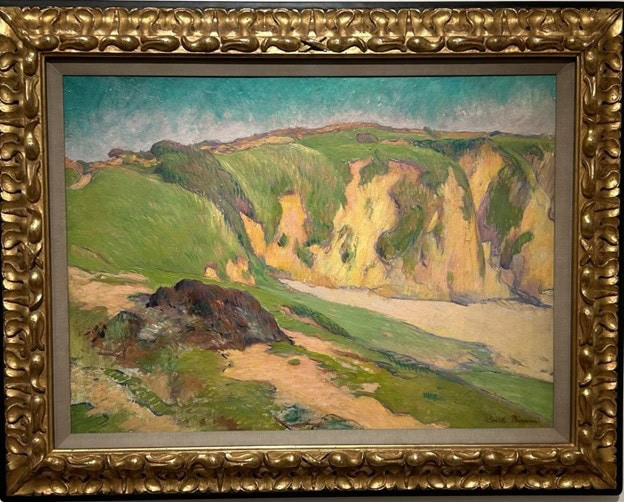
Here are two of my favorites.

Reclining Nude Shepherdess, 1891, Berthe Morisot at the Museo Nacional Thyssen-Bornemisza
Reclining Nude Shepherdess, 1891, Berthe Morisot
The Cliffs at Le Pouldu, 1884, Émile Bernard at the Museo Nacional Thyssen-Bornemisza
The Cliffs at Le Pouldu, 1884, Émile Bernard

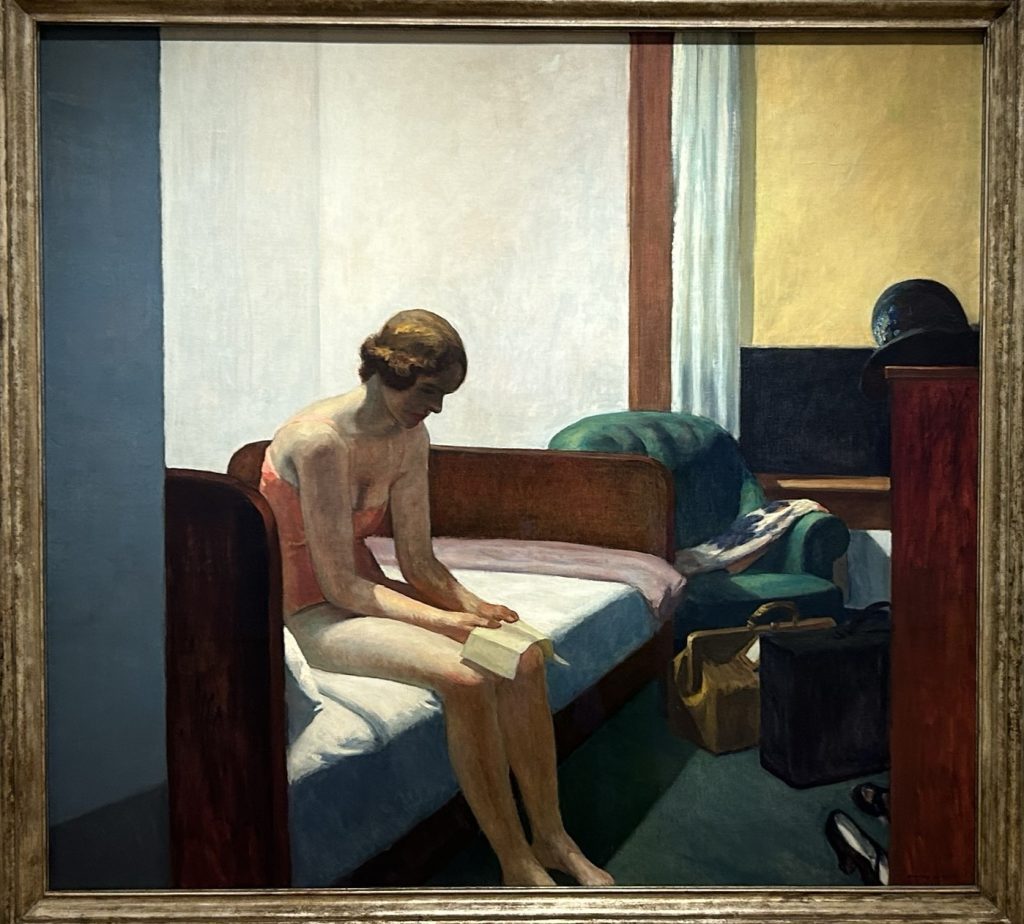
The Thyssen also houses a comprehensive collection of works from the 15th century right up to the mid-20th century. Here’s an interesting piece by American painter Edward Hopper.

Hotel Room, Edward Hopper, 1931 at the Museo Nacional Thyssen-Bornemisza
Hotel Room, Edward Hopper, 1931

TIP: Before traveling to Madrid, check what’s on and be sure to get your tickets for the major museums such as the Prado, the Thyssen-Bornemisza, and the Museo Reina Sofía (home of Picasso’s Guernica) well in advance.

Powered by GetYourGuide

Lunch in Madrid

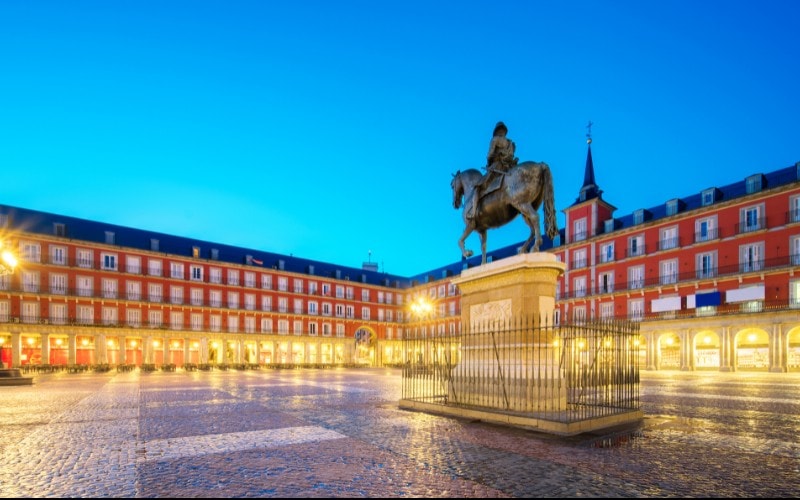
After leaving the Thyssen, catch another taxi into the heart of Madrid—the Plaza Mayor (#3)— for lunch and people-watching.

Normally, I advise fellow travelers to avoid high-rent areas like the Plaza Mayor when looking for places to eat, but sometimes, it’s okay to break that rule and settle in at one of the many outdoor cafés.

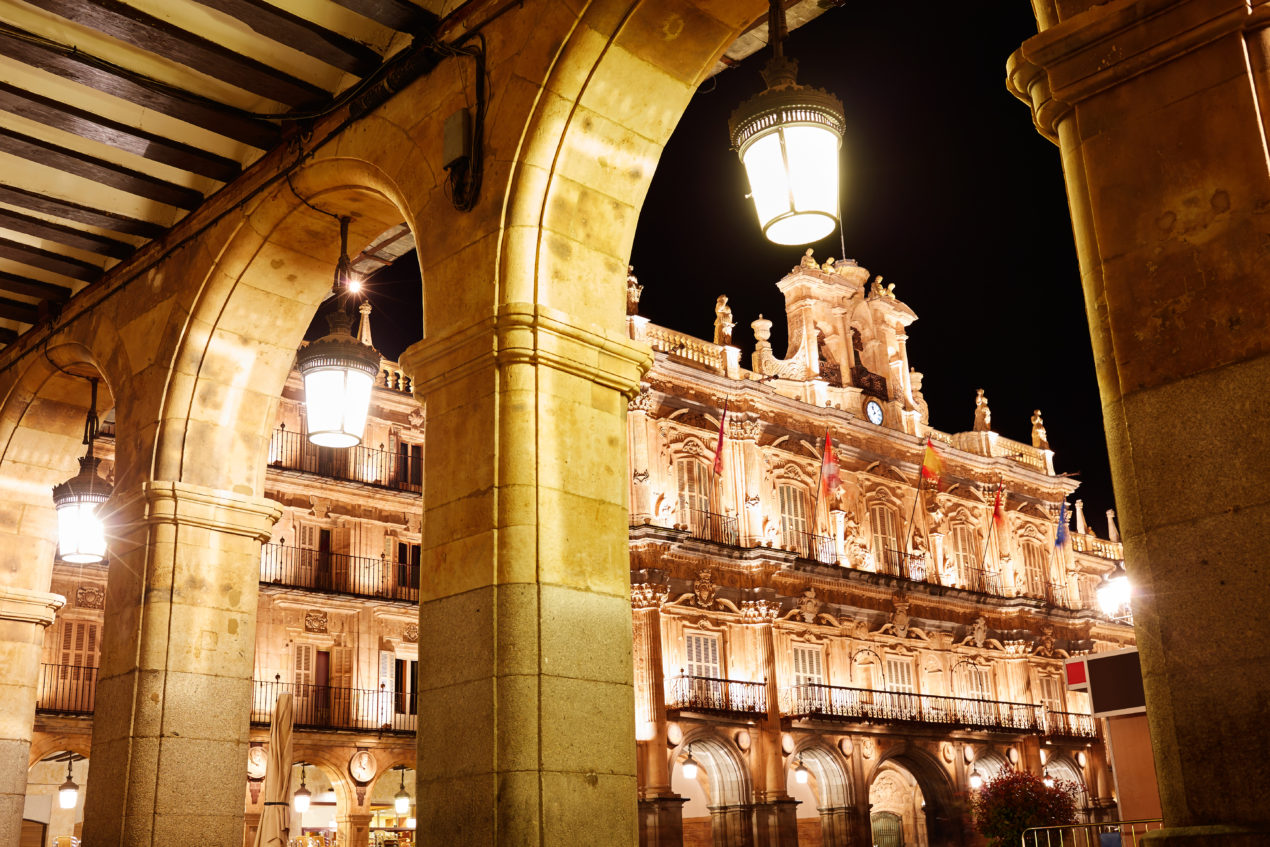
Why? Because the view of the surrounding buildings is just too spectacular to miss, and the ambiance can’t be beat. The Plaza Mayor is a must-see public space.

Construction was begun in the 17th century by King Philip III. His bronze equestrian statue stands in the middle of the massive square.

The Plaza Major in Madrid
The enormous Plaza Major in the center of Madrid is perfect for people-watching.

Return to the Plaza Major in the evening on your Perfect Day or another day to enjoy a drink in the shadow of the floodlit buildings.


Afternoon in Madrid

After your plaza break, browse the souvenir shops in the area, and then head for a tapas cooking class.

A Tapas Cooking Class

I highly recommend taking a cooking class in Madrid. Here’s my experience taking the class during which I learned to make ten tapas.

The 2.5-hour cooking class starts promptly. I tie on my apron and join an international group of fellow travelers to listen to the chef.

She’s a dynamic presenter who is obviously passionate about food and cooking.

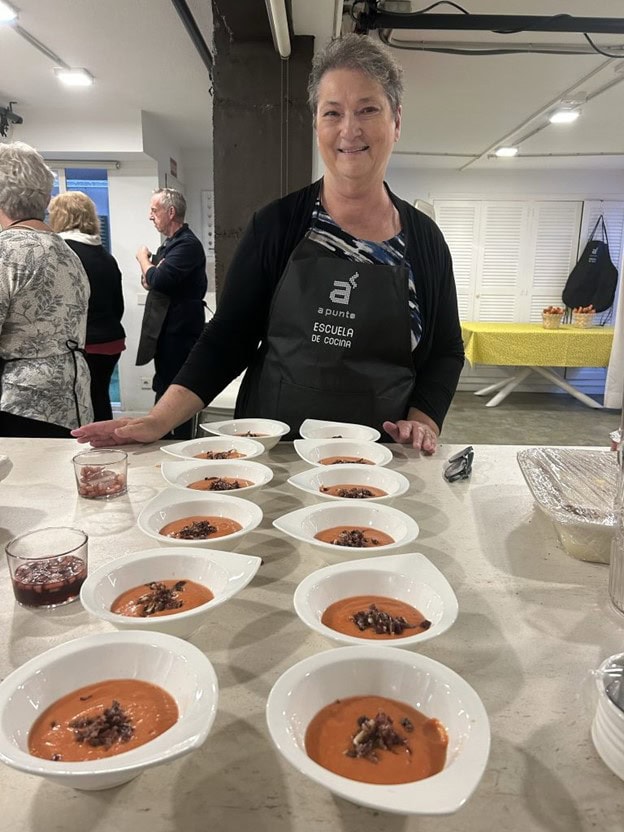
She assigns a dish to each person. My job is to make a cold tomato soup. I cut up garlic and a lot of fresh tomatoes, then whirl them in the blender. I then add several pieces of bread which help the soup thicken and finally, I drizzle in about a quarter of a bottle of olive oil.

After much blending, the result is smooth, fresh, and very red. And the taste! Wowza!

Carol Cram at a tapas cooking class in Madrid
Making fresh tomato soup at a tapas cooking class in Madrid

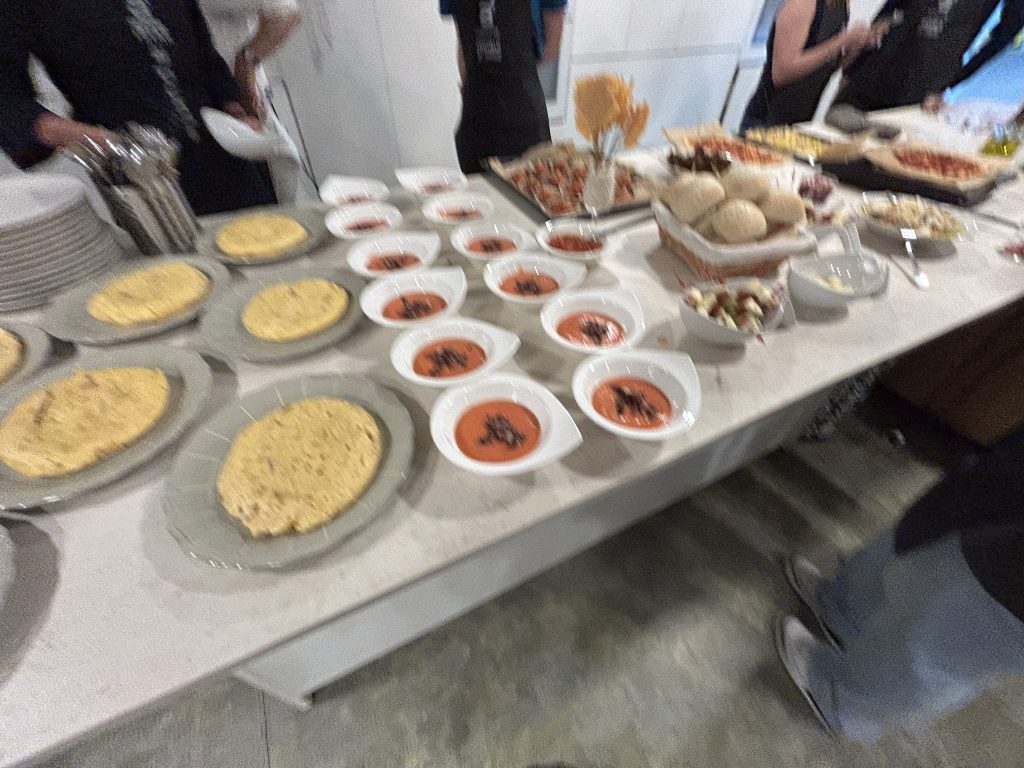
I also help to make a Spanish omelet made with potatoes—a little heavy for my taste.

Other tasty treats included flat-breads spread with various sauces, skewers of quince (a kind of solidified jam) with melon, and Parmesan cheese lollipops. The food is hearty and there’s plenty of it.

The group barely makes a dent on eating all the food we prepared. I hope there was someone to give the leftovers to.

Selection of tapas made at the cooking class in Madrid
Powered by GetYourGuide

Evening in Madrid

In Madrid, dinner isn’t served until about 9 pm (and even that’s considered a tad early) so after your cooking class, I suggest returning to your hotel for a short rest before joining the throngs of strolling Madrileñoson on your way to a concert.

The people of Madrid love to stroll throughout the evening. Whole families, with babies in strollers and toddlers rushing about, are on the move. People are smiling and laughing.

When you join them, you’ll feel like you’re a part of the community despite being a visitor.

Flamenco Concert

As any Spaniard will tell you, Madrid is not the historic home of flamenco. That honor goes to Seville. However, several venues offer flamenco performances that are well worth the money.

The one I choose includes a plate of olives and other snacks and a glass of wine or a soft drink.

Female flamenco dancer dancing in front of a guitar player.
A flamenco performance is a highlight of any trip to Spain.

As is the case with every flamenco performance I’ve seen, the dancers are incredible and the music exhilarating. I never tire of going to flamenco shows when I’m traveling in Spain!

Powered by GetYourGuide

Read more about seeing flamenco shows in Spain.

Late Dinner

And finally, it’s time for a late Madrid dinner. I confess that I find the Spanish cuisine a little too heavy. Potatoes, ham, and beef dominate, and you won’t find many fresh vegetables. Salads do not appear to be a thing in Spain, at least not in my experience.

The food is, however, tasty and there’s a lot of it.

TIP: Order fewer dishes than you think you’ll want. Portions in Spain are generally very large. Two dishes are usually enough for two people.

Here’s an article that describes the various options on a Spanish menu.

Stroll Home

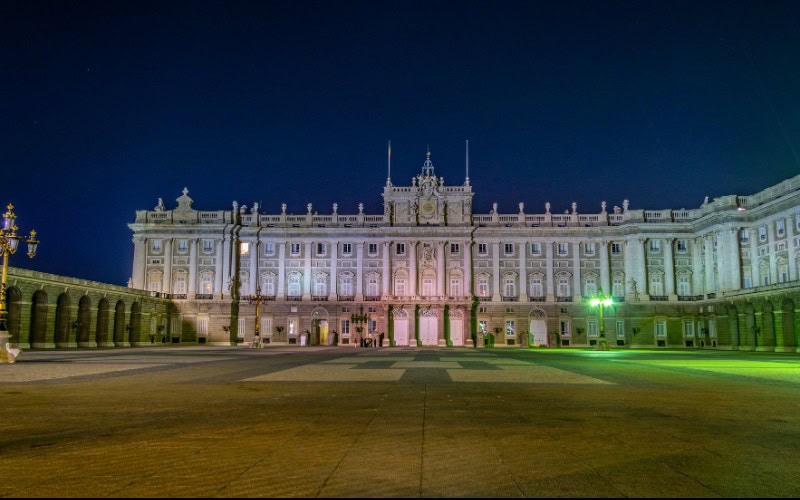
End your Perfect Day in Madrid with a stroll through the medieval streets of the centro to the wide plaza in front of the floodlit Royal Palace.

It’s a gorgeous building that is reminiscent of Buckingham Palace in London, likely because it dates from a similar era.

The royal palace in Madrid at night
The royal palace in Madrid is floodlit at night.

Here’s a post about the two weeks I spent in Madrid: Exploring Fascinating Madrid–Europe’s Best-Kept Secret for the Artsy Traveler


Where to Stay in Madrid

I favor hotels and apartments near the centro or just on the edge of the ZTL (traffic limited zone) if you’re driving. Here are two of the places I’ve stayed:

  • ApartoSuites Jardines de Sabatini: Located just to the west of the center of Madrid and across the street from the Royal Palace (the rooftop terrace overlooks the palace). I stayed twelve nights and could not have been more satisfied with my choice. The hotel is stylish and well appointed and the staff are extremely helpful and friendly, always smiling and saying hola every time we leave or enter the lobby.
  • NQN Aparts & Suites: This place is right in the centro and is perfect if you don’t have a car. You can walk to almost everything. The suites are small but modern and well appointed.

Tours of Madrid

If you enjoy taking tours while traveling (and I recommend them as a great way to see more in less time), then check out tours from GetYourGuide and Tiqets.com and the free walking tours offered through GuruWalk.

Powered by GetYourGuide


All Perfect Day Itineraries

Browse every city featured in the Perfect Day series below.

How to Spend a Perfect Artsy Traveler Day in Venice

How to Spend a Perfect Artsy Traveler Day in Venice

Every time I visit Venice, I spend the first hour or two smiling so broadly my face aches. Even with ...
Statue of Mozart in front of a treble clef picked out in red flowers in Vienna

How to Spend a Perfect Artsy Traveler Day in Vienna

If you love music, then put Vienna on your Artsy Traveler bucket list. Here is where Beethoven, Mozart, and Haydn ...
Nyhavn colorful houses and harbor in Copenhagen.

How to Spend a Perfect Artsy Traveler Day in Copenhagen

I love Copenhagen! The last time I visited, I found myself wishing I could move there so I too could ...
How to Spend a Perfect Artsy Traveler Day in Florence

How to Spend a Perfect Artsy Traveler Day in Florence

Florence reeks of the Renaissance probably more than any other city in Europe. In fact, I sometimes think it's becoming ...
How to Spend a Perfect Artsy Traveler Day in Athens

How to Spend a Perfect Artsy Traveler Day in Athens

During a perfect Artsy Traveler day in Athens, you'll balance cultural sightseeing with relaxed wandering and memorable meals. My itinerary ...
How to Spend a Perfect Artsy Traveler Day in Madrid

How to Spend a Perfect Artsy Traveler Day in Madrid

Madrid was a revelation. I had the opportunity to spend two weeks there while Gregg Simpson (husband, artist, frequent travel ...
Eiffel Tower in Paris

How to Spend a Perfect Artsy Traveler Day in Paris

During a perfect Artsy Traveler day in Paris, you’ll balance cultural sightseeing with relaxed wandering and memorable meals. My itinerary ...

Carol Cram
About Carol Cram

Carol M. Cram is the author of five award-winning historical novels inspired by art and the women who shaped it, the creator of Artsy Traveler, an arts-focused travel blog, the founder of Art In Fiction, a curated database of 2,500+ novels inspired by the arts, and the host of The Art In Fiction Podcast. She also authored 60+ textbooks on computer applications and taught at Capilano University for over two decades. She lives with her husband, artist Gregg Simpson, on beautiful Bowen Island near Vancouver, BC.

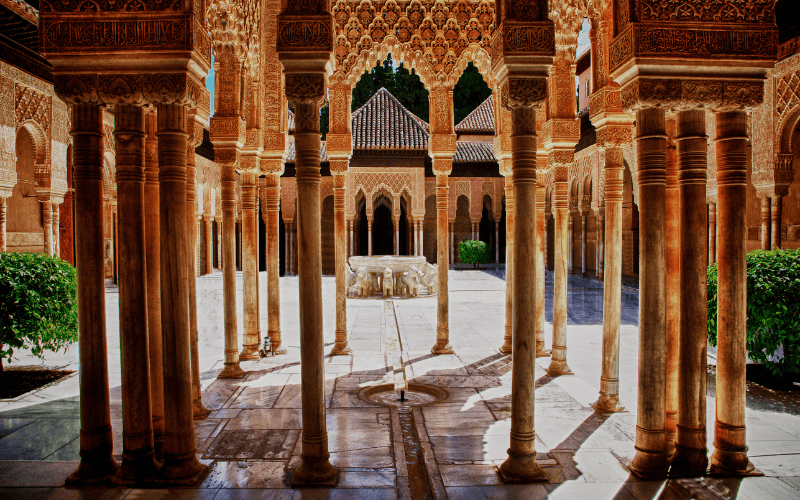
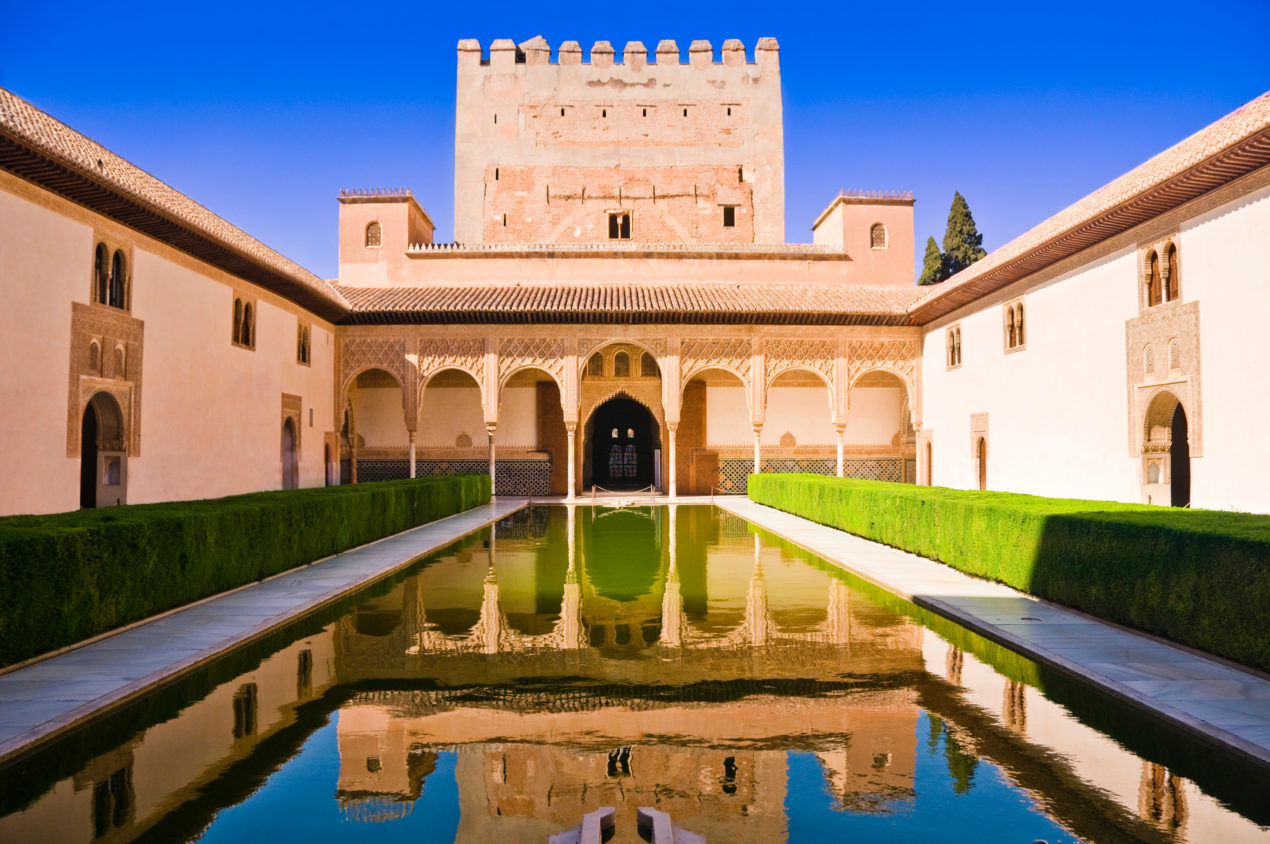
Courtyard in the Alhambra in Spain

Best Artsy Sightseeing in Spain

When it comes to artsy favorites, Spain has more than its fair share of wonderful sights and experiences. From amazing flamenco to mind-bending modern art to soul-expanding palaces and cathedrals, Spain is a treasure that keeps on giving.

Every time I travel to Spain, I discover new layers of a culture that stretch back millennia.

In this post, I share some of my favorite artsy experiences in Spain.

This post is part of my guide to artsy & independent travel in Spain, where I share my best tips for exploring Spain’s creative cities, historic sites, and cultural experiences.


Map of Spain: Suggested Artsy Favorites

The map below shows the locations of the artsy sightseeing favorites mentioned in this post. Click a number to read more about the location.


Flamenco–a Definite Artsy Favorite!

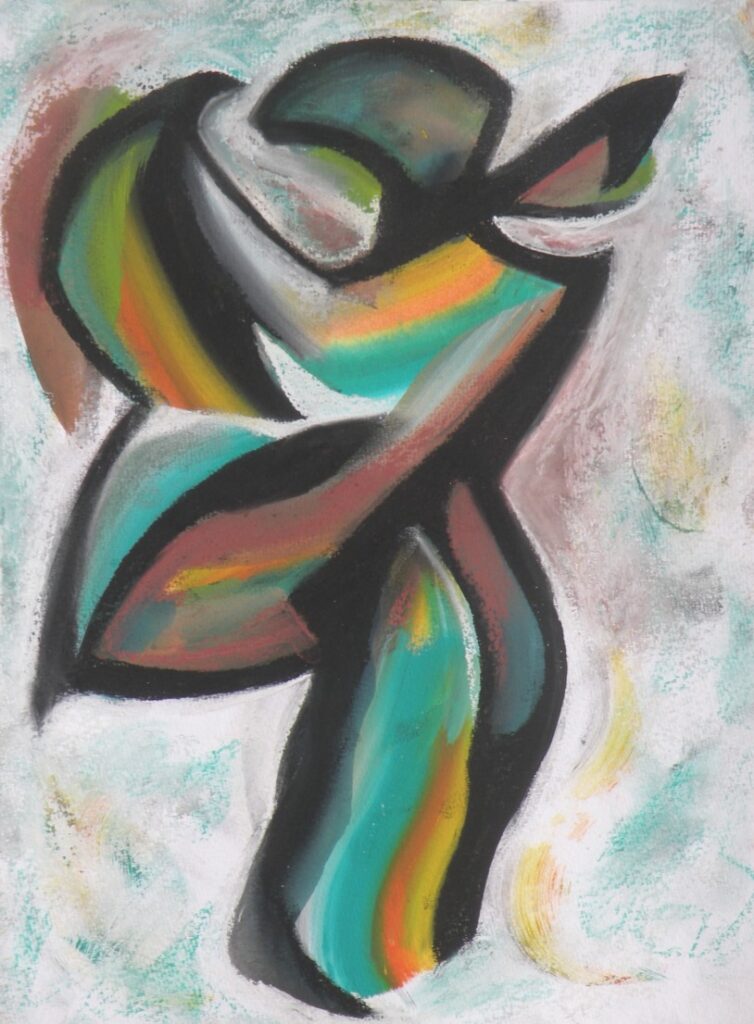
My husband Gregg and I are crazy for flamenco and see it every chance we get when we travel in Spain. In fact, Gregg loves it so much that he created a whole series of pastel drawings based on his experiences seeing flamenco in Spain.

Abstract pastel drawing in pink and blue tones showing a flamenco dancer with swirling skirts
Flamenco Abstraction 7 by Gregg Simpson
Abstract pastel drawing in blue and green tones showing a flamenco dancer with swirling skirts
Flamenco Abstraction 6 by Gregg Simpson

We’ve experienced flamenco in Seville, Cordoba, and Barcelona.

Flamenco in Seville

Seville is the place to go to see a wide variety of flamenco shows, although we’ve also seen good shows in both Barcelona (even though it’s not flamenco country) and Cordoba.

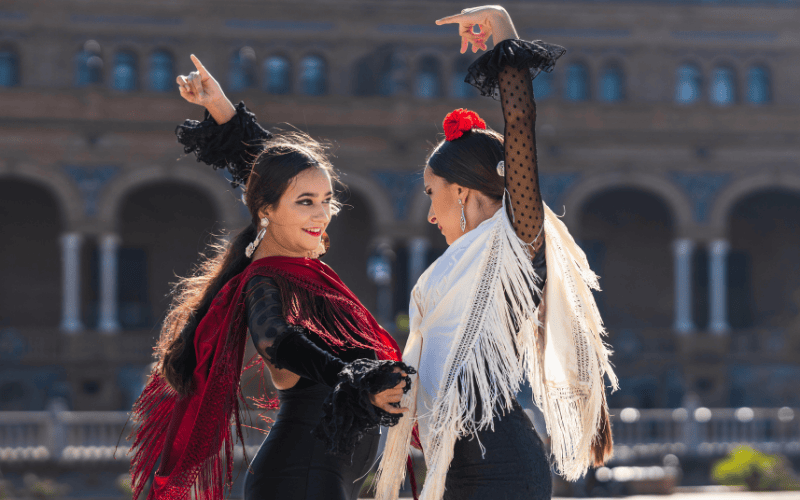
When you’re in Seville (#1 on the map), start with the Flamenco Dance Museum. Purchase the combo ticket that includes the museum and a late afternoon flamenco show. On your second night in Seville (and seriously, spend at least two nights and preferably three in this most Spanish of cities), attend a flamenco show at Los Gallos.

Two female flamenco dances dancing outside against a backdrop of rounded columns in Seville.
Flamenco dancers in Seville

The Flamenco Dance Museum exhibits a marvelous collection of flamenco-related objects, films, and paintings and explains the history of flamenco and the meaning of the various terms. Baile is dance, Bailaor is dancer, cantaor is singer, palmas is the rhythmic hand-clapping that accompanies flamenco song and dance, and duende is the soul force that inspires the art of flamenco.

The flamenco dancers and musicians at the Flamenco Museum put on a heart-stomping hour-long concert. Get your tickets in advance. The room was packed!

Options for Seeing Flamenco in Seville

The show at Los Gallos is intimate and incredible. We’ve seen it twice and both times we were completely blown away.

Seeing Flamenco in Barcelona

Catalan Barcelona (#2) is not a center for flamenco. However, we saw our first performance of flamenco there at the Palau de la Música. Called Opera y Flamenco, we enjoyed an utterly spellbinding evening of opera arias by a tenor and a soprano, flamenco dancing by a man and woman, and traditional flamenco singing by a woman. A band of about eight that included guitars, piano, cello, violins, and drums blew the roof off.

I was having heart palpitations by the end. Rarely, if ever, have we experienced such an awe-inspiring evening of music. The flamenco dancing was enough to turn even the most hardened non-romantic into a giant goose bump.

The concert we saw may not be playing when you’re in Barcelona but definitely make room in your itinerary to tour the Palau de la Música or take in a concert. The stunningly ornate modernista building will take your breath away. I write more about it in Favorite Concerts & Performances in Europe.

Seeing the Palau de la Música in Barcelona


Historical Art in Spain: A Must-See for the Artsy Traveler

Historical art in Spain takes in a lot of centuries, going as far back as 30,000 years ago and beyond. Spain has several cave art sites and is world-renowned for its master artists, including Velasquez, El Greco, and Goya, among others.

Cave Art

So far, we’ve visited only one cave art site in Spain—La Pileta (#3) near Ronda in southern Spain. The hour-long tour in the dimly lit cave took us past paintings that are at least 30,000 years old. Reservations are required; check the website to book your tour time. The drive up a steep and winding road to the entrance of the cave is half the fun of a visit here.

We learned about the Caves of Pileta (Cueva de la Pileta) from the owner of the beautiful little hotel we stayed at out in the countryside near Ronda (see Where to Stay in Spain: My Best Picks).

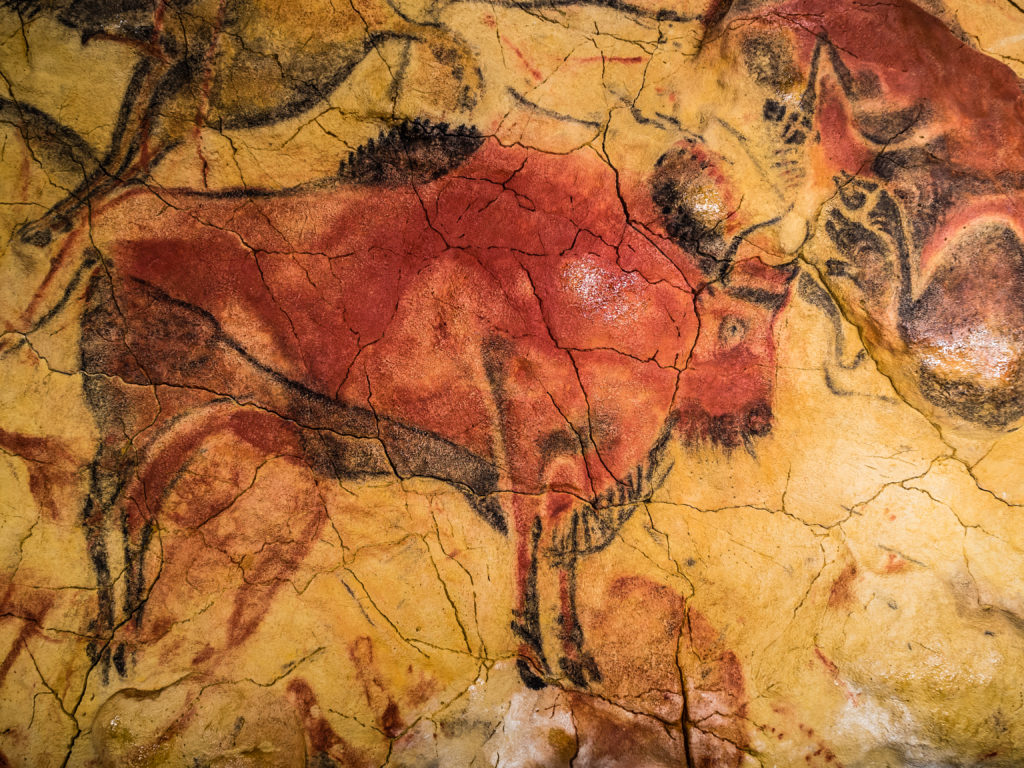
We’re big cave art fans and plan to visit the ‘queen’ of the cave art sites –the Cave of Altamira (Cueva de Altamira) in northern Spain near the charming town of Santillana del Mar. Featured are charcoal drawings and polychrome paintings of animals and human hands.

Detail of the replica of paintings of the Cave of Altamira

The Cave at Altamira is the premier site for exploring prehistoric art in Spain. Buy tickets in advance from the website.

The Prado

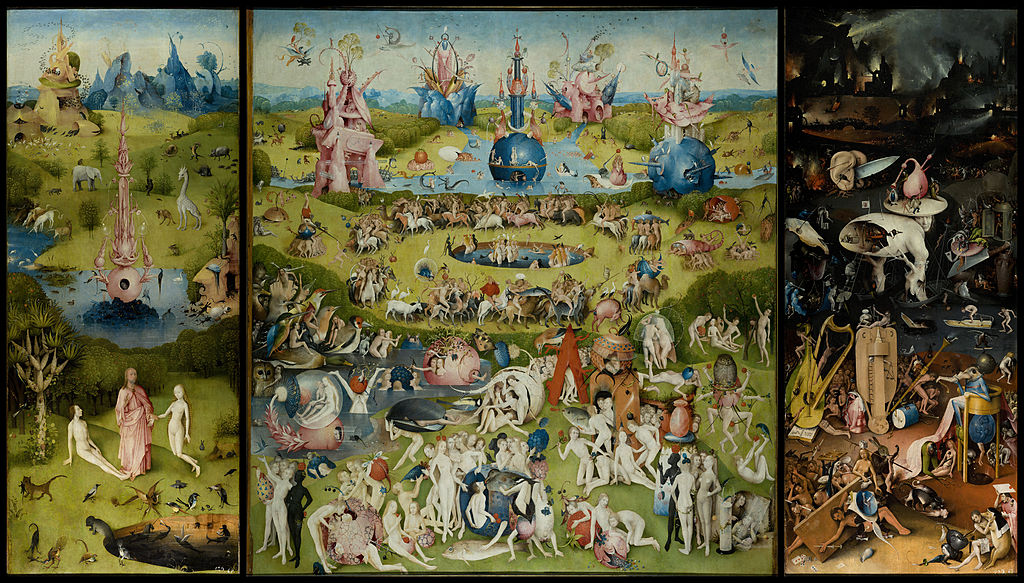
The Prado in Madrid (#4) is one of the world’s major art galleries, on a par with the Louvre and the Rijksmuseum. We enjoyed touring the Prado which exhibits many of the biggies, including Bosch’s The Garden of Earthly Delights, Velasquez’s Las Meninas, Goya’s 6th of May, and a whack of Raphaels, Rubenses, Durers, El Grecos, et al.

The Garden of Earthly Delights by Bosch High Resolution 2

Shown above is the Garden of Earthly Delights by Hieronymus Bosch, surely one of the coolest paintings ever!

Although large, the Prado is not as daunting as the Louvre and certainly not as crowded. You can get fairly close to masterpieces that you’ve seen in art books for years. There’s no doubt that the real thing is, well, the real thing! There’s no comparison to a reproduction.

Put the Prado at the top of your artsy must-see list when you visit Madrid.

Options for Touring Art Museums in Madrid


Modern Art for the Artsy Traveler

Spain is home to several modern art museums, the most famous being the Reina Sofia and the Guggenheim Bilbao. Don’t miss either one if you’re a modern art fan.

Reina Sofia

The Reina Sofia (#5) is the major modern art museum in Madrid and houses Picasso’s Guernica along with assorted works by Miró, Dalí, etc. Guernica did not come to Spain until the 1980s after the death of Franco. Now it has pride of place in a room of its own.

The painting is massive and far more powerful in real life than in reproduction. You’ll sense how enraged Picasso felt as he painted it.

The Reina Sofia is a well-designed gallery that combines a modern area with the arched hallways and barred windows of an old hospital. In many of the rooms, a film representative of the period is playing. Most were from the silent era which made following them a lot easier.

The Reina Sofia is included in my post showcasing Awesome Modern Art Museums in Europe: Best Bets for the Artsy Traveler.

Guggenheim Bilbao

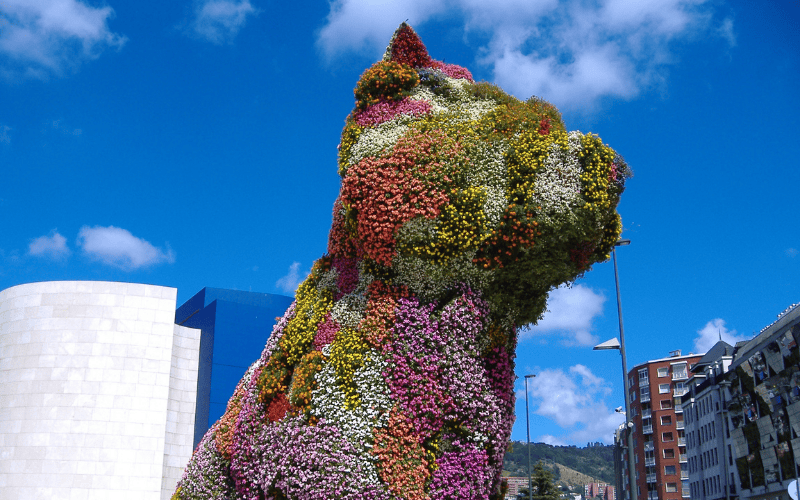
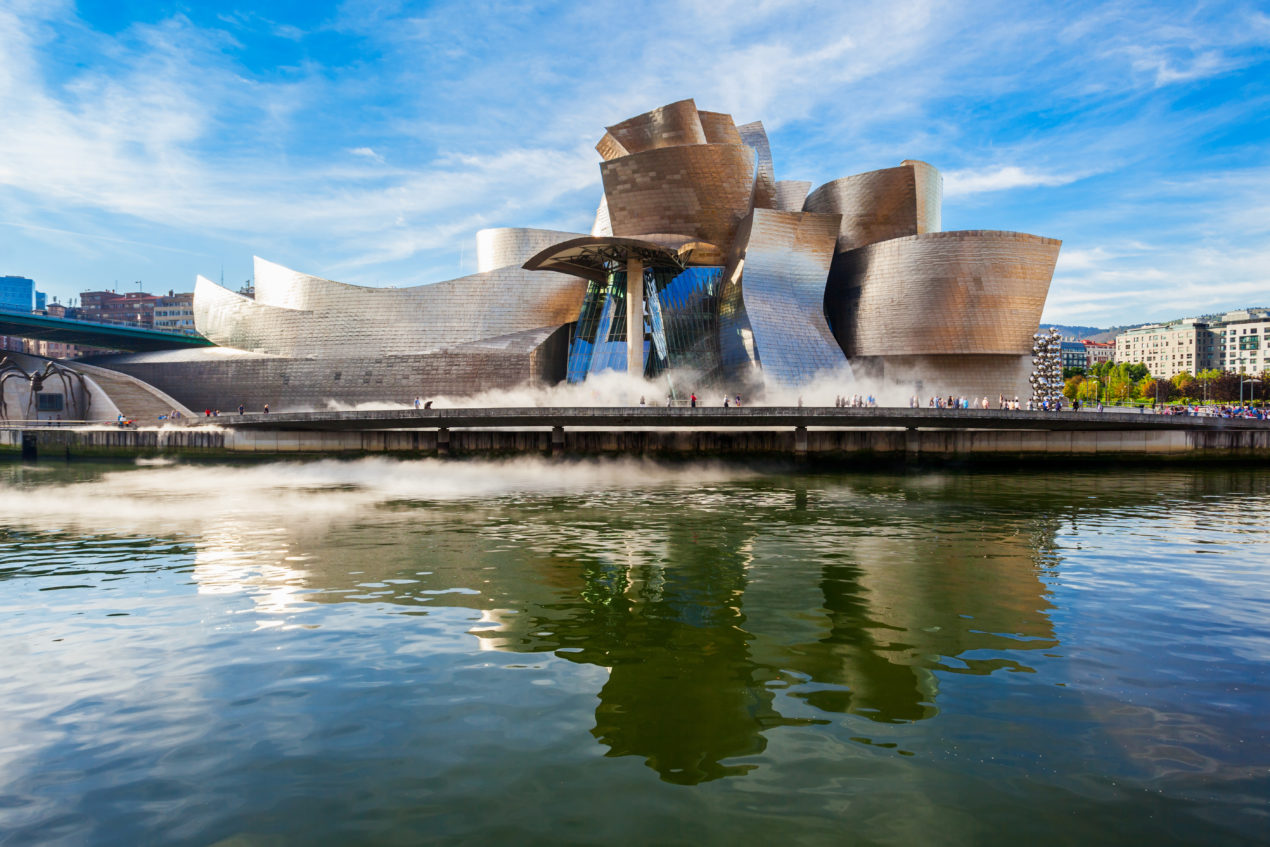
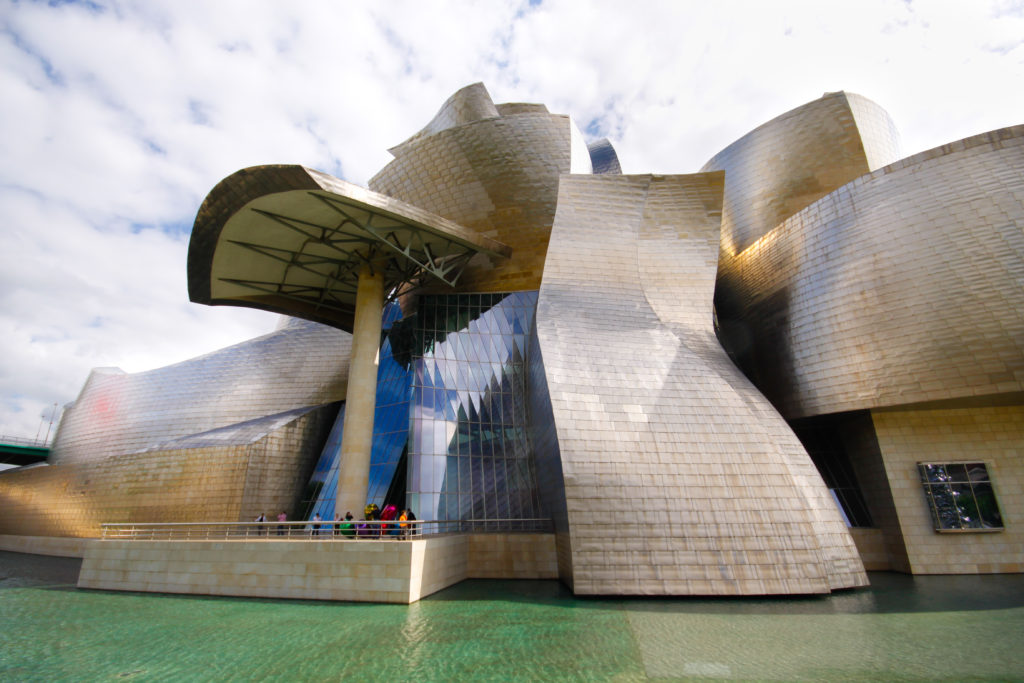
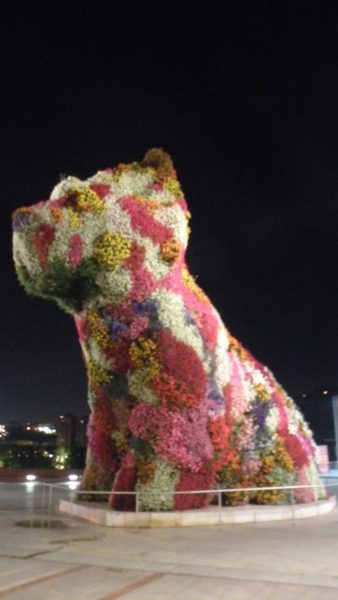
The Guggenheim Museum in Bilbao (#6) is hands down one of my very favorite modern art museums in Europe. The building itself is fabulous as are the many sculptures surrounding it, including the beloved Puppy. He’s the massive Highland Terrier created by Jeff Koons and made from living flowers that guards the entrance to the museum.

Puppy stands guard outside the Guggenheim Bilbao

The Guggenheim Bilbao is included in my post showcasing the Awesome Modern Art Museums in Europe: Best Bets for the Artsy Traveler.

Options for Touring the Guggenheim Bilbao

Museums Dedicated to Individual Artists

Several of the most famous artists of the 20th century were born in Spain including Pablo Picasso, Joan Miró, and Salvador Dalí. Each has museums dedicated to their art along with pieces in most major collections.

Picasso Museum

For more Picasso, visit the exquisite Picasso Museum (Museu Picasso) (#7) in the Barri Gòtic, the medieval center of Barcelona. Picasso truly was a master of it all—a painter, printmaker, ceramicist, sculptor, stage designer, and even a poet and playwright. The Museu Picasso includes over 4,000 works artfully displayed.

Miró Foundation

A visit to the Miró Foundation (Fundació Joan Miró (#8)) in Barcelona is just plain fun. Located in the Parc de Montjuïc, it’s a subway or bus ride from the Plaça de Catalunya and well worth an afternoon of your time. I write more about it in my post Two Packed & Fabulous Days in Trendy Barcelona.

Dalí Museum

If you’re driving from southwest France into Spain, consider stopping in Figueres to visit the majorly quirky Dalí Theatre-Museum (#9). If you are a Dalí fan (I confess I am not), the museum is a worthwhile stop. The area also has other Dalí sites including the Salvador Dalí House in Portlligat near the charming little town of Cadaques.


Cathedrals to Awe the Artsy Traveler

In this very Catholic country, you’ll find lots of churches and cathedrals, many dripping with gold brought back from the New World by the conquistadors.

Learn more about them in these posts.

Options for Touring Cathedrals in Spain

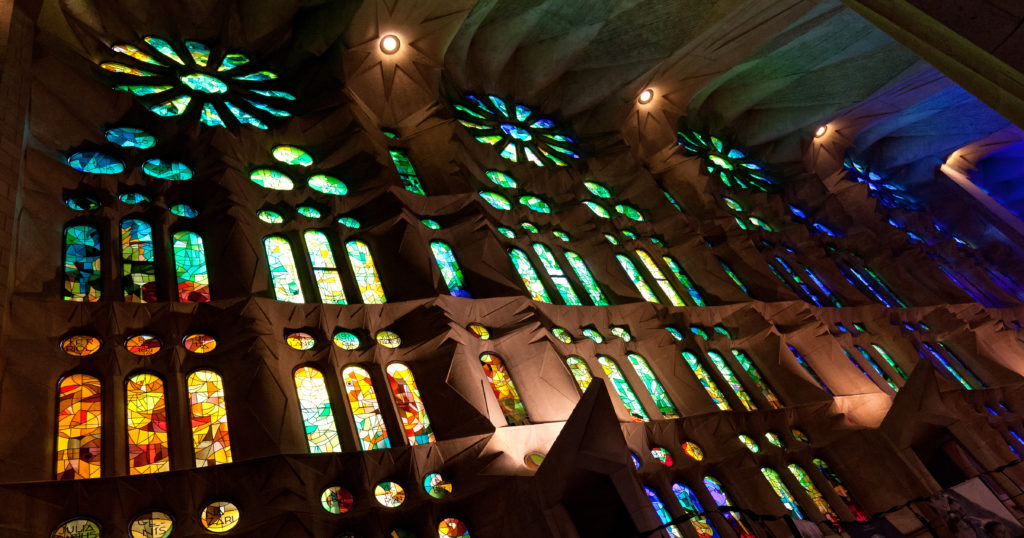
My favorite cathedral, hands down, is the Sagrada Familia in Barcelona. Still unfinished after decades of building, the Sagrada Familia is so incredibly quirky at the same time as being heart-stoppingly stunning. The stained glass floods your senses, blocking out the sounds of fellow travelers. Stop, sit, and let your soul be stirred.

Stained glass windows in the Sagrada Familia in Barcelona - an artsy favorite
Interior of the Sagrada Familia in Barcelona

Palaces–Artsy Favorites

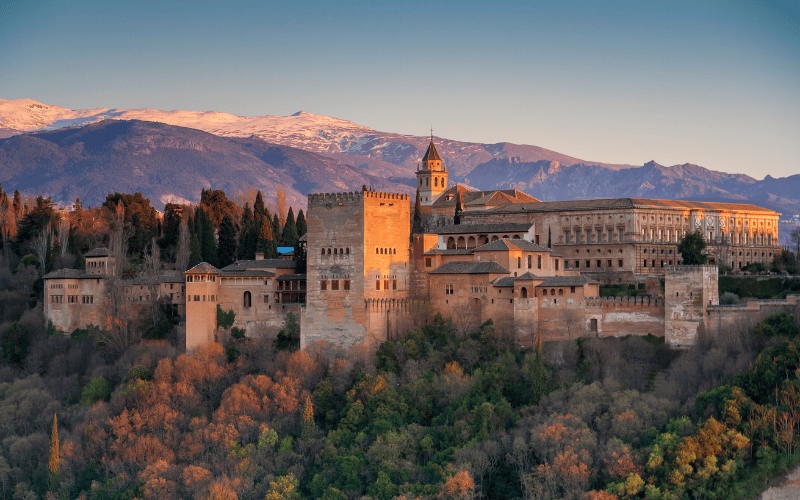
The must-see palace in Spain is, of course, the Alhambra (#16) in Granada, the center of Moorish Spain back in the day. I write about my suggestions for visiting Granada and touring the Alhambra in A Culture Steeped Itinerary to Tour Andalusia Comfortably in 10 Days.

Allocate at least two nights in Granada so that you can spend the entire day touring the Alhambra and the Nasrid Palace. The complex is massive and requires stamina to enjoy. Pace yourself and make sure you get reservations well in advance of your visit.

View of the Alhambra in Granada, Spain--a must-see for the artsy traveler
The fabled Alhambra in Granada

In Madrid, the Royal Palace is also definitely worth a visit.

Keep Exploring Spain with Artsy Traveler

One of the many things I love about traveling in Spain is the variety of interesting sights and regions. At least two weeks is needed to even scratch the surface of Spain. It’s a huge country!

Must-see regions are Catalonia to visit Barcelona, Andalusia to visit Seville, Cordoba, and Granada, Madrid and Toledo in the center, and northern Spain from Santiago de Compostela in the far northwest to Bilbao and Basque country and the Pyrenees in the far west.

Artsy travel experiences abound. Here are more posts to explore:

Carol Cram
About Carol Cram

Carol M. Cram is the author of five award-winning historical novels inspired by art and the women who shaped it, the creator of Artsy Traveler, an arts-focused travel blog, the founder of Art In Fiction, a curated database of 2,500+ novels inspired by the arts, and the host of The Art In Fiction Podcast. She also authored 60+ textbooks on computer applications and taught at Capilano University for over two decades. She lives with her husband, artist Gregg Simpson, on beautiful Bowen Island near Vancouver, BC.

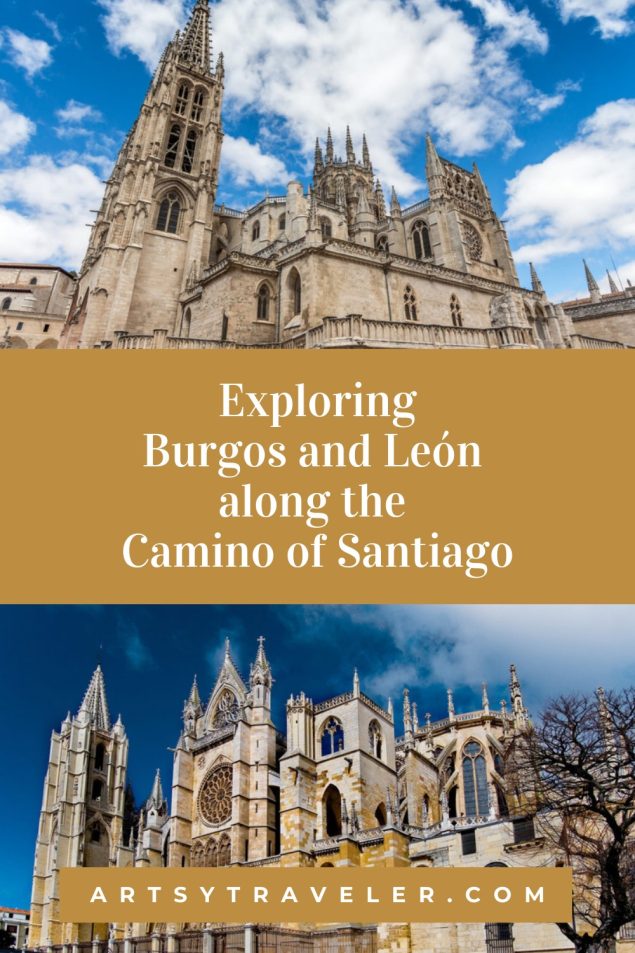
Exploring Burgos and León along the Camino of Santiago

Burgos and León are both fascinating cities located along the Camino of Santiago in northern Spain.

Guest poster Elizabeth Petrie spent time in Burgos and León during her journey along the Camino of Santiago.

In this post, Elizabeth shares what to see and do in two of Northern Spain’s most beautiful—and often undervisited—cities.

Guest poster Elizabeth Petrie on the Camino of Santiago


Orientation to Burgos & Leon

The map below includes the places mentioned in this post. Click a number to find out more information.


Exploring Burgos

Burgos is the provincial capital of Castilla y León in Northern Spain. Its location on the Camino de Santiago route makes it a natural stopping point for pilgrims traveling the Way. This gorgeous medieval city is well worth a day or two of any traveler’s time.

If you’re traveling in Northern Spain, put Burgos on your itinerary. Major sights include:

  • One of Spain’s most magnificent cathedrals
  • A castle
  • An atmospheric old city
  • Excellent museums, including the world-class Museo de Evolución Humana
  • The wonderfully photogenic Arco de Santa Maria
  • Wonderful food

Museo de Evolución Humana

The Museo de Evolución Humana (#1) (Museum of Human Evolution) is simply terrific and a highlight of our travels in Northern Spain. The modern glass construction with high open spaces houses three floors of authentic and reproduction artifacts, including bones, skulls, animal jaws, tools, and portable art.

Adults and kids alike enjoy the interactive displays and quizzes, the videoclips of recent discoveries, the various re-enactments and interpretations of early humans’ social behaviours, and marvellous representations of various members of Australopithecus and Homo.

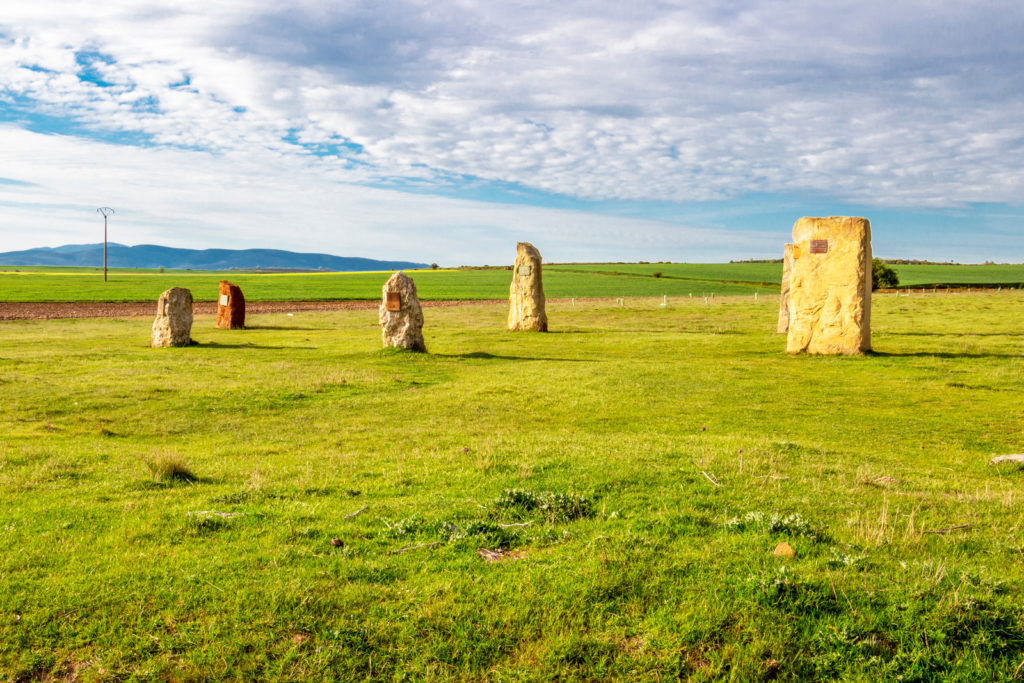
The museum also includes exhibits on Atapuerca, the archaeological site north of Burgos. Here, Europe’s oldest human fossil remains were discovered in 2007. We walked past Atapuerca on our way into Burgos.

Menhirs in a field near Atapeurca in northern Spain
Standing stones near Atapuerca in the Province of Burgos and near the Way

Lucky for us, the museum was almost empty. We were able to spend as much time as we liked in front of the various displays and interactive activities.

Statue of Rodrigo Díaz de Vivar

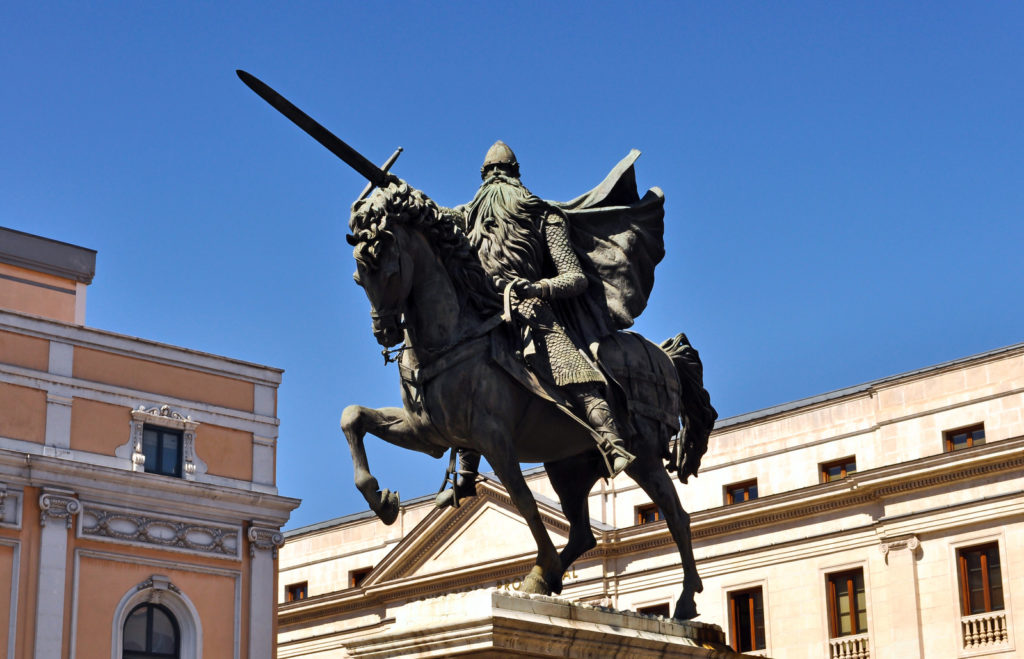
On your way from the museum back to the central plaza in Burgos, you pass a statue of hometown boy Rodrigo Díaz de Vivar, better known as El Cid, who was born in Burgos in 1043 and died in 1099.

Statue of El Cid mounted on horseback with sword in Burgos

El Cid was a Castilian knight and warlord who became a Spanish folk hero and national icon as a result of his service in the armies of both Christian and Muslim rulers, and his temporary conquest of Valencia. El Cid is the protagonist in the most significant medieval Spanish epic poem, El Cantar de Mio Cid.

The Cathedral of Burgos

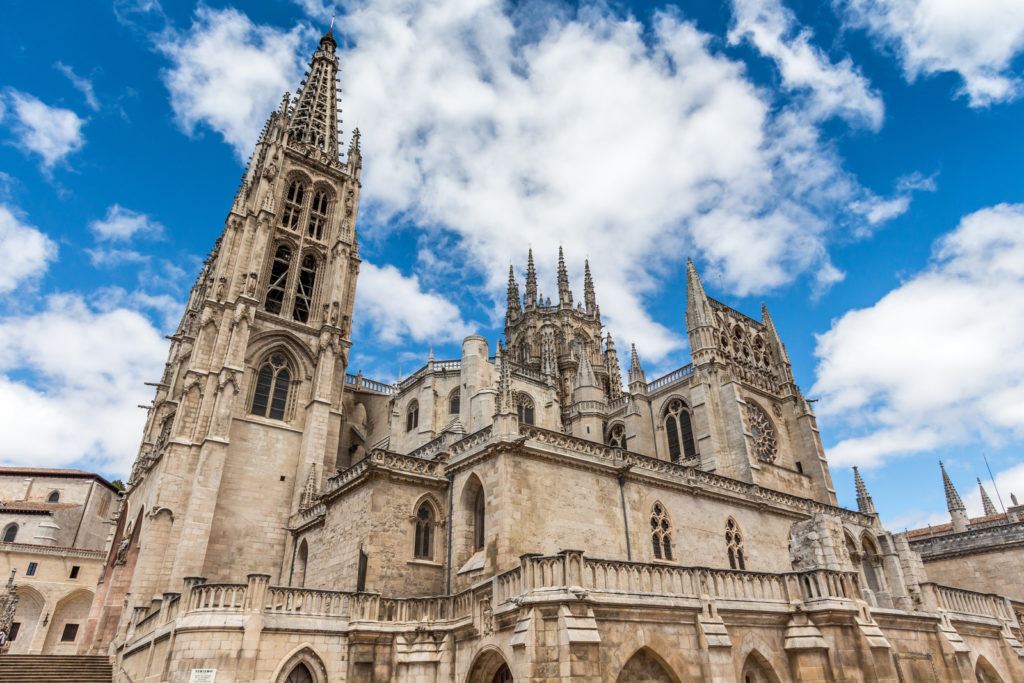
The 13th-century Cathedral of Burgos (#2), a UNESCO World Heritage Site, is massive, incorporating the church itself, the cloisters, the Bishop’s Palace, and part of the original city walls. The interior has three naves separated by rows of huge columns and flanked by fifteen side chapels containing altars, tombs, relics, and precious artifacts. 

View of Burgos Cathedral in Burgos, Spain
Burgos Cathedral is one of the most important cathedrals in Spain.

Everywhere you look, whether on the façades or inside the cathedral, you’ll see decoration or carving. The term “el horror del vacío” (“the horror of empty space”) was never so applicable as in the interior of Burgos Cathedral.

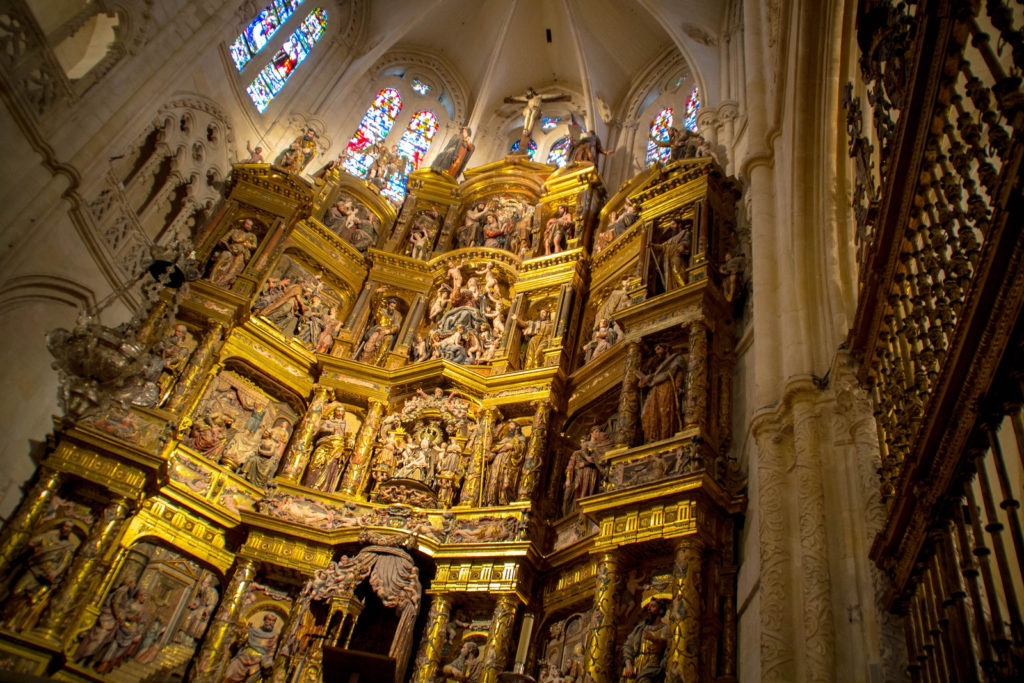
The magnificent star-vaulted dome and the spectacular rose windows are awe-inspiring. Also amazing are the gold plating and ornate carvings on the retablo of the high altar that depicts the life of the Virgin Mary.

Altar in the Cathedral of Burgos

Saints, angels, the nobility, important clergy, and the monarchs appear below the deities, a reminder of God’s absolute power.

One of the highlights in the cathedral is a portrait of Mary Magdalene by Leonardo da Vinci (~1515 ). We also saw one of El Cid’s trunks and a small wooden door with a carved face into whose mouth pilgrims inserted small coins.

If you go, rent the audioguide to learn about the art and architecture. The Cathedral of Burgos ranks alongside the likes of Westminster Abbey, Notre-Dame in Paris, and Milan Cathedral, but without the crowds.

Burgos Castle

Include a visit to Burgos Castle (#3), whose original structure and fortifications date to the 9th century. The small museum is interesting, but the real attraction is the spectacular view over the city of Burgos.

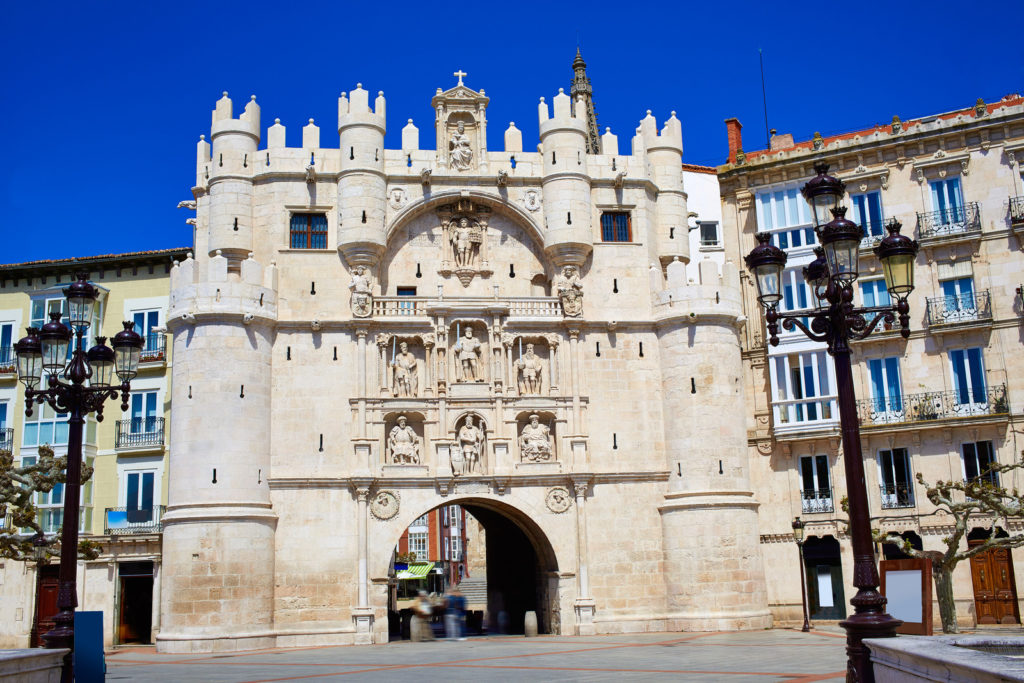
Arco de Santa Maria

The Arco de Santa Maria (#4) is one of the twelve medieval doors that led into the medieval city of Burgos. Rebuilt by Charles V in the 16th century, the structure is worth a stop to admire the carvings on the façade. You can go inside to view special exhibitions and a small museum. At night, the Arco de Santa Maria is beautifully illuminated.

View of the Arco de Santa Maria, an ornately carved wall in Burgos, Spain
Arco de Santa Maria in Burgos

Tours in Burgos

Here are some options for tours in Burgos through GetYourGuide:

Powered by GetYourGuide

León

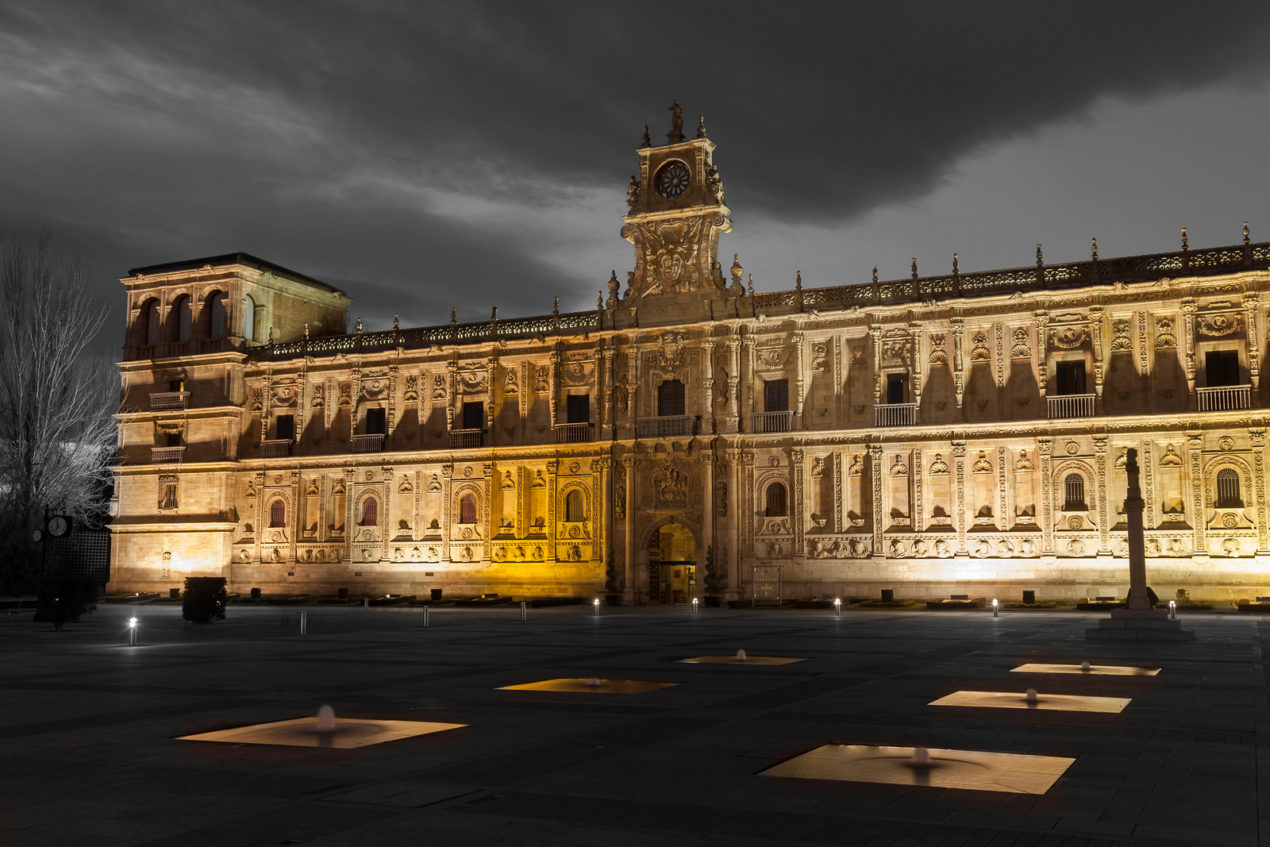
León is a delightful small city that is a bit off the beaten path but worth a visit for its magnificent cathedral, beautiful old town, and the chance to stay in Parador de León, Hostal de San Marcos, Spain’s top parador (see description below).

We stayed two nights in León which, like Burgos, is situated on the Camino. In fact, the Camino crosses the large plaza in front of the parador. The distinctive concha design symbolizing the Camino is everywhere in León, including on the façades of the buildings.

Historic Center of León

The historic centre of León is utterly charming, with narrow streets and very old and historic buildings. Some of the architecture incorporates the city walls of Roman times. You’ll find plenty of small and large plazas lined with outdoor cafés and interesting shops.

Take time to wander around the town, even occasionally getting lost while appreciating the beauty of this wonderfully walkable city.

León Cathedral

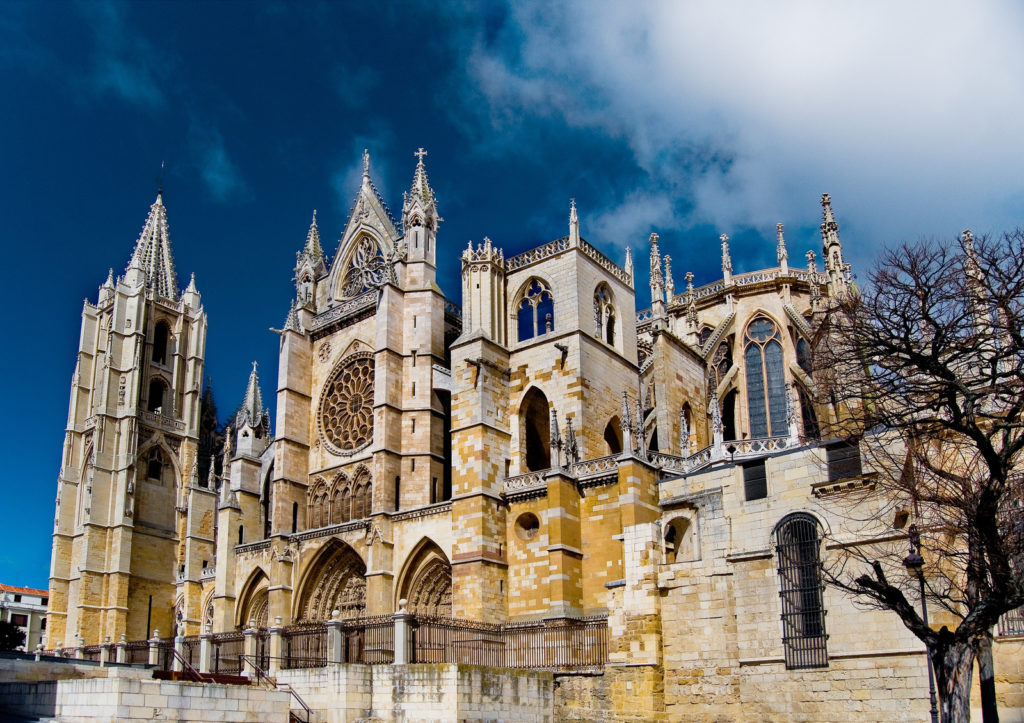
Often dubbed La Casa de la Luz (House of Light), the 13th-century Catedral Santa María de León (#5) is magnificent. Soaring sandstone towers glow in the evening light, and the interior is breathtaking, with three rose windows instead of the usual one.

View of the Cathedral of Leon in Spain
Cathedral of León in Spain

The cathedral was built on the site of the 2nd-century Roman baths, which were converted to a royal palace around the year 1000. A masterpiece of Gothic architecture, the cathedral consists of two towers with a large portal between them, and flying buttresses crusted with gargoyles on the exterior walls.

León is often referred to as the city of stained glass, and no wonder. Windows dating from the 13th to the 15th centuries contain over 1,800 square meters of stained glass. Also inside the cathedral are hundreds of pieces of sacred art, including examples from Romanesque to Neoclassical times.

León’s cathedral is one of the most important along the Way.

Basilica of San Isidro

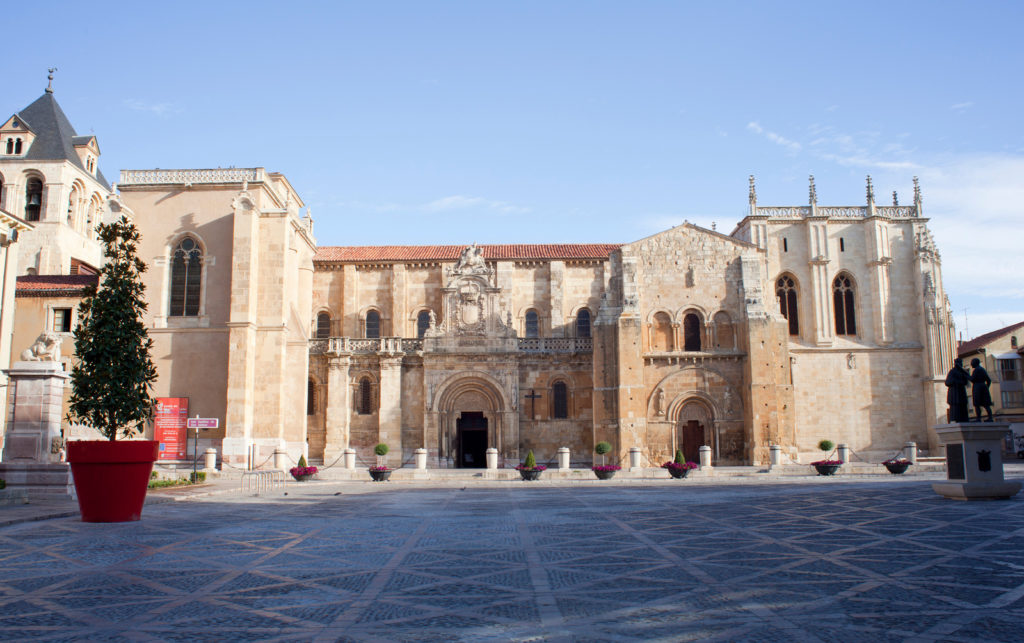
Don’t miss the smaller but equally enchanting Basilica of San Isidro (#6). Located on the site of an ancient Roman temple, the church’s Christian roots extend to the early 10th century when a monastery for Saint John the Baptist was erected on the grounds.

Basilica of San Isidro, León - Spain
Basilica of San Isidro, León – Spain

Built in the Romanesque style, the basilica also has elements of both Gothic and Islamic architecture. Check out the 12th-century painted murals in the funeral chapel of the kings of León. The exceptionally well-preserved murals present New Testament subjects as well as scenes of contemporary rural life.

Stay at the Parador de León

The Parador de León (#7) is one of the most luxurious places I’ve ever stayed at. Sponsored by the Spanish government, the parador system of lodgings includes refurbished historic buildings, such as castles, monasteries, and royal residences. The system also includes some purpose-built, modern hotels.

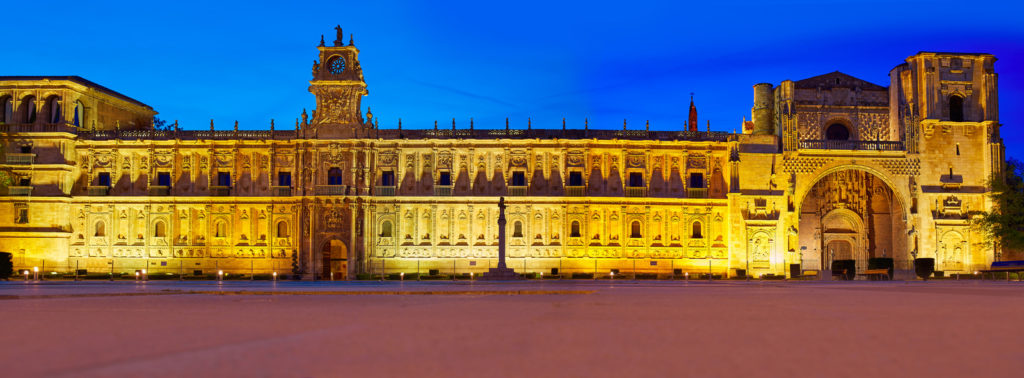
Parador San Marcos in  León
Parador San Marcos in León

For five-star luxury, we paid about €170 each for two nights, a serious bargain, considering the service and surroundings.

King Ferdinand founded the Parador de León, Hostal de San Marcos in the early 16th century as a church and hospital for knights of the Order of Saint James. Part of the original staircase has been preserved, as have the curved ceilings, chandeliers, and cloister windows. Fabulous portraits and Renaissance artifacts and armour adorn the lobby and corridors.

Our room, which we accessed with a large skeleton key, was located in one of the converted monks’ cells in the cloister. The room was beautifully appointed with 1000-count monogrammed sheets, slippers, and luxury toiletries.

Museum at the Parador

Visit the church and museum attached to the parador. The original buildings were erected on the remains of a Roman fortress, and the church dates from the mid-12th century. Many sarcophagi and Roman stelae from ancient times dot the lovely cloister gardens. Sadly, parts of the church grounds have a darker past when they served as a prison for suspected or accused fighters in the Spanish Civil War.  


Tours in León

Here are some options for tours in León through Tiqets.com:


Keep Exploring Northern Spain and the Camino on Artsy Traveler

Even if you’re not walking the Camino, put Burgos and León on your itinerary in Northern Spain. For more information about places to visit in Northern Spain, including both Santiago de Compostela and Bilbao, see Exploring Northern Spain and Basque Country.

For more about Elizabeth’s journey along the Camino read her Top Tips for Walking the Camino of Santiago and excerpts from her journal in A Camino Journal: Pamplona to Santiago de Compostela.

Carol Cram
About Carol Cram

Carol M. Cram is the author of five award-winning historical novels inspired by art and the women who shaped it, the creator of Artsy Traveler, an arts-focused travel blog, the founder of Art In Fiction, a curated database of 2,500+ novels inspired by the arts, and the host of The Art In Fiction Podcast. She also authored 60+ textbooks on computer applications and taught at Capilano University for over two decades. She lives with her husband, artist Gregg Simpson, on beautiful Bowen Island near Vancouver, BC.

Best Tips for Walking the Camino of Santiago

Everyone I know who has walked the Camino of Santiago (the Way) to Santiago de Compostela in northwest Spain raves about the experience.

My friend and guest poster Elizabeth Petrie is no exception. She and her friend Cheri walked the Camino from Pamplona to Burgos and from Sarria to Santiago, with train travel between Burgos, León, and Sarria.

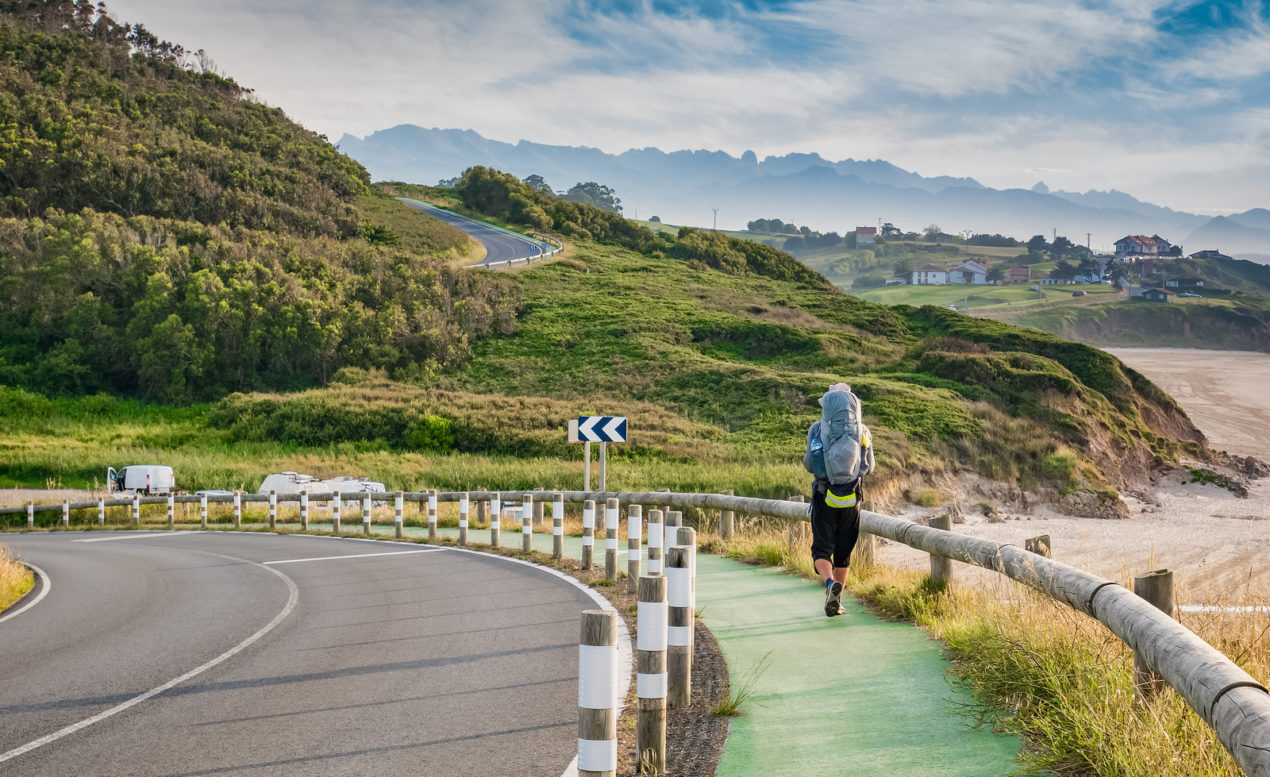
Pinterest graphic with the text Top tips for walking the camino of santiago over a picture of a person carrying a backpack and walking along a path on the camino of santiago

Elizabeth shares her experiences and recommendations in three posts on Artsy Traveler. In this post, learn her top tips for enjoying the Camino of Santiago. To find out how Elizabeth and Cheri organized their walk, read A Camino Journal: Pamplona to Santiago de Compostela. Elizabeth’s recommendations for Burgos and León are included in Exploring Burgos and León.


Guest Poster Elizabeth Petrie

Retirement brings new opportunities, and one of my most cherished is having the chance to travel. New places, unique experiences, wonderful memories—what could be more enticing? 

For a long time, walking across Northern Spain on the Camino has topped my “bucket list”. My friend Cheri shared the same interest, so we decided to make plans to walk the Camino together.

Guest poster Elizabeth Petrie on the Camino of Santiago

Here are tips for helping you plan an awesome experience on the Camino of Santiago.


Prepare for the Camino of Santiago

Distance walking was new to me, so I started training about a year before leaving for Spain. Cheri and I began with modest treks of six to eight kilometers twice a week and worked up to walks of ten to twelve kilometers. By the time we left for Spain, we could comfortably walk about fourteen kilometers with our backpacks partially full.

Plan Your Itinerary

The Camino of Santiago extends across several countries and hundreds of kilometers. Start in France on the Camino Francés or complete all or a portion of the Camino del Norte like we did.

We put together an itinerary that included stays in four-star hotels in the cities we’d pass through: Pamplona, Burgos, León, and our final destination, Santiago de Compostela. We knew we’d appreciate a bit of luxury after days of slogging along and nights spent in the dormitory-like albergues.

An albergue is a hostel that provides accommodation only for pilgrims walking the Camino of Santiago. To stay in an albergue, you need to have a Pilgrims Passport.

Obtain a Pilgrims Passport

The Pilgrims Passport contains spaces for the sellos (stamps) that prove you’ve walked that day and are entitled to stay in one of the state-run albergues.

If you start the Camino from St. Jean in France or from Pamplona, as we did, you need to get one stamp per day. If you walk only the last 100 kilometers from Sarria, you need to get two stamps each day.

So long as you have sufficient stamps and you state at the Pilgrims Office in Santiago de Compostela that you’ve completed the Camino for religious or spiritual reasons, you’ll receive the Compostela at the end of the journey in Santiago.

If you state other reasons for completing the Camino, you receive a different certificate to commemorate your journey.

You can also get a passport at some albergues and pilgrims’ offices along the Way.

However, to save time, I recommend you obtain your Pilgrims Passport before you leave. To do so, connect with the Pilgrims’ Association in your home country.

Camino Websites for the UK and the United States

For other organizations, search online for Pilgrims’ Association and the name of your country.

Choose When to Go

Consider walking the Camino in May or September. The weather from June to August is too hot, the hotel prices are higher, and the Way is much more crowded.

We found that May was perfect when it came to both the weather and the crowds (or lack of!). While you definitely won’t run into crowds in the winter months, be aware that many of the smaller albergues are closed from mid-October to mid-April.

Purchase a Guidebook

I recommend A Pilgrim’s Guide to the Camino de Santiago (Camino Francés): St. Jean – Roncesvalles – Santiago by John Brierley. The book includes all the information you’ll need: route and town maps, and the location of coffee shops, restaurants, and albergues. The book also lists telephone numbers of the albergues so that you can book ahead.

Plan Your Daily Walk Duration

Plan to walk no more than 15 to 18 kilometers in a day (about five hours), depending on the terrain.

This distance is long enough to give you a reasonable goal, time to stop for sightseeing and meals, and the best chance of finding accommodations. Also, we found that blisters started forming if we attempted to walk more than 22 kilometers in one day.

On most days, we left the albergue around 8 am and arrived at our next albergue in the mid-afternoon. The earlier you get to the albergue you plan to stay in, the better your chances of finding accommodations. Many albergues do not take reservations, although sometimes you can speak with the hospitalero and ask them to call ahead for you.

Book Accommodations for the Final 100 Kilometers

While you do not need to book accommodations along the early stretches of the Way (and often you cannot), you should book places to stay along the last 100 kilometers.

The Way becomes increasingly crowded the closer you get to Santiago. We used booking.com to book small hotels along the last stretch of the Way and were glad we did. Each place we booked was clean and conveniently located.


Walk the Camino of Santiago

Here are some tips for helping you enjoy your time on the Camino.

Use the Send-Ahead Pack Service

Send your main pack ahead and hike with just a day pack. The send-ahead service was well worth the few extra euros (usually €3 to €5 per pack). You can send your pack from any Camino albergue in the morning to the albergue at your next stopping point. Call ahead to make sure the albergue you plan on staying at has available beds and will be open when the van arrives with your pack.

Take a Day Pack

Pack the following items in your day pack:

  • A full first-aid pack, complete with Compeed* blister treatment, a needle and cotton thread, antibiotic ointment, Band-Aids, antiseptic spray, antihistamines, Afterbite, an elastic bandage, and sunscreen. You’ll find plenty of pharmacies along the Way in case you run out of anything.
  • A litre of water. If you sweat a lot, you will occasionally need to supplement your water with a local version of Gatorade.
  • A change of socks. Sweaty socks can bring on blisters. 
  • A change of shirt and rain gear if rain threatens.
  • Fresh or dried fruit, nuts, protein, etc. Depending on your route for the day, you’ll usually find small coffee bars and restaurants along the Way where you can purchase lunch.
  • Your passport, credit cards, and other essential documents. Also, carry a day’s worth of currency and never flash around large amounts of cash.

*Compeed is a miracle blister treatment available in Spanish farmacias.

I suggest stocking up on Compeed before you leave by buying it online. As soon as you feel a friction blister coming on, put the clear plastic Compeed over it and leave it on. You’ll never have another blister!

Limit Technology

On the Way, consider forgoing technology as much as possible. If you take a SmartPhone to check weather reports and make hotel bookings, particularly in the last 100 kilometers, purchase a cell phone package for Europe from your service provider or pick up a SIM card at a local provider such as Vodafone or Orange.

Use your phone to take pictures instead of carrying a heavy, expensive camera. Also, I suggest not wearing earbuds while you’re walking or you’ll miss the bird song and conversation.

One of my lasting memories on the Way is the sound of an amazing variety of bird songs.

Enjoy the Pilgrim’s Dinner

Have the pilgrim’s dinner when it’s offered at the albergues. You’ll get a cheap and tasty meal that includes soup or salad, a fish or pork entrée, dessert, and a glass of local wine. The local soups are delicious and filling.

Use Other Transportation as Needed

Consider occasionally taking a taxi or public transit when you get tired rather than risking injury. Walking the Camino in short stages will help conserve your energy.

Take Good Footwear

Wear hiking boots that are well broken in. Also, pack a pair of lighter shoes, such as Teva sandals, to occasionally give your feet a rest. Wear flip-flops in the shower and around the albergue at the end of the day.

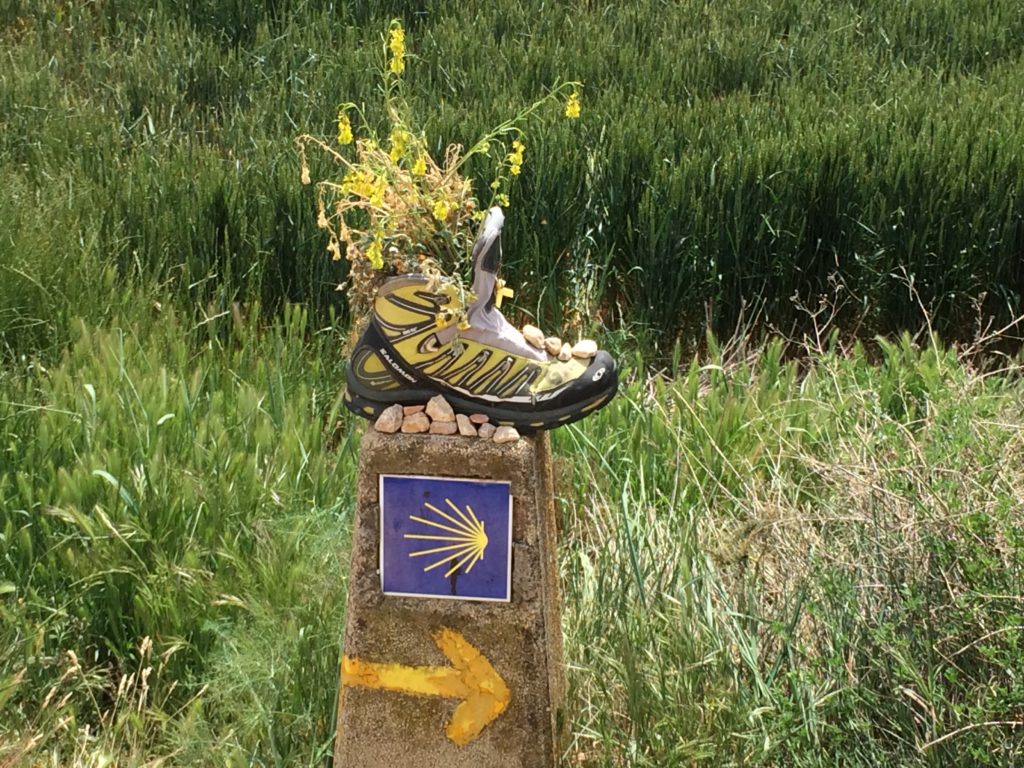
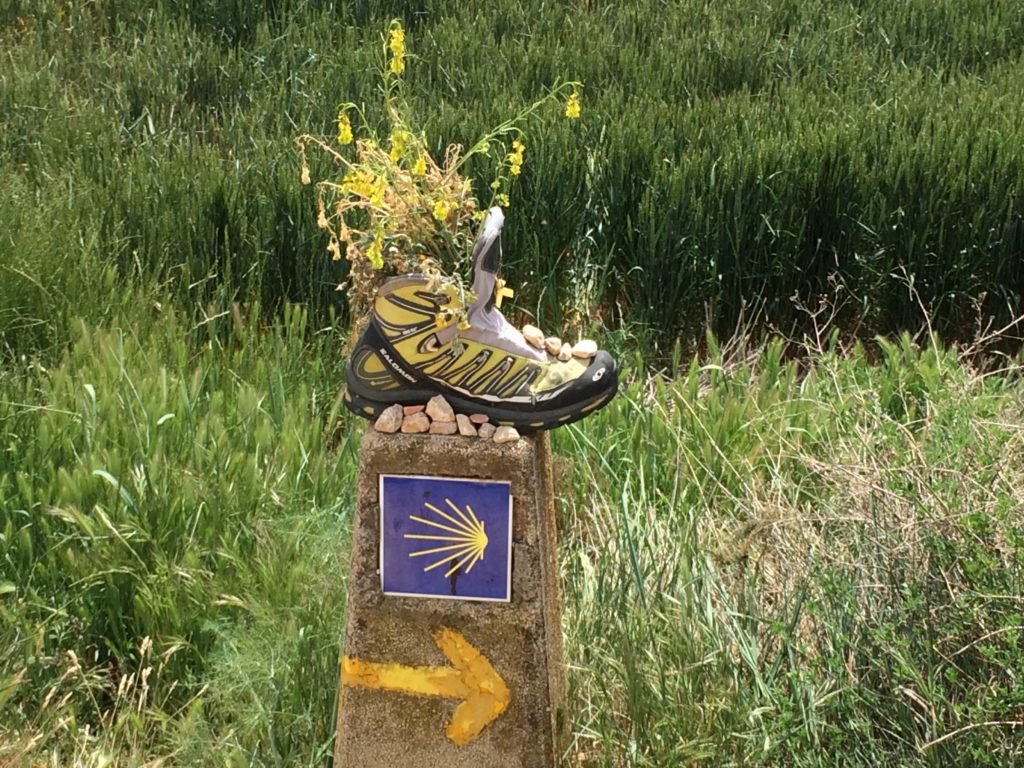
Marker along the Camino of Santiago with a running shoe
Some markers are decorated imaginatively.

Enjoy Meeting New People on the Camino

A highlight of walking the Way is meeting many wonderful and interesting people. People in the albergues and elsewhere along the Camino could not do enough for us. We always left our packs closed, and they were never disturbed, even when we left them in dormitories to go sightseeing. 


Slow Down

My best advice for walking the Camino is to slow down and savor the experience. In other words, stop and smell the roses!

Check out as many churches, shrines, historical sites, and civic plazas as you can. You’ll be amazed at the unexpected beauty and fascinating art and architecture.

Sign on the Santiago of Compostela
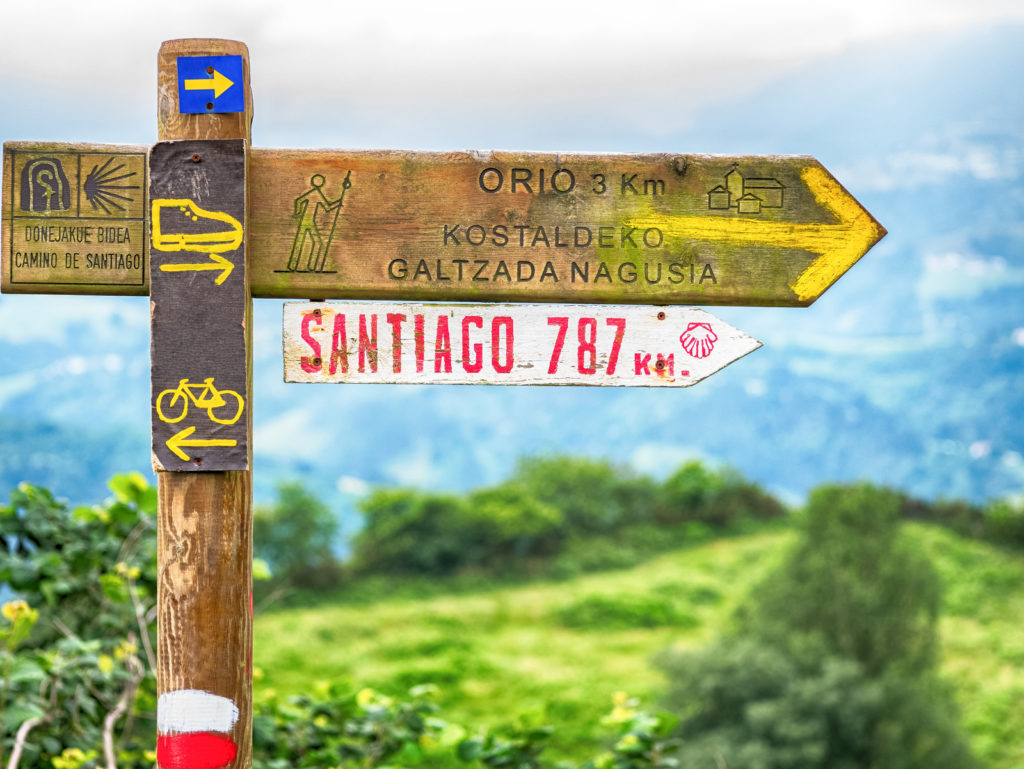
Sign on the Camino de Santiago

Northern Spain has been home to human beings for tens of thousands of years, from Neanderthal times to the present. You can hardly take a step without passing a fascinating site of historical significance.

For example, on some sections of the Way, you’ll be following, if not actually walking on, the original Roman roads. And in some of the smaller villages where the Spanish Civil War was fought in the 1930s, you’ll still see bullet holes in the walls of old barns and houses.

Suggested Itinerary

For a detailed breakdown of our itinerary that started in Pamplona, Spain and included stops in Burgos and León, along with a few train journeys, see the post A Camino Journey: Pamplona to Santiago de Compostela.

I can’t imagine how our trip could have been better. We enjoyed pretty much perfect weather, and we both kept well and healthy. In addition, we met interesting people, enjoyed delicious and reasonably priced meals, and soaked up some of the rich history and culture of Navarra, La Rioja, and Galicia.

We also appreciated the spiritual nature of our journey to Santiago, taking time every day to reflect with humble gratitude upon our many blessings. Our trip was a pilgrimage in many senses of the word.

Do I recommend walking the Camino? Absolutely!

¡Vaya con Dios!

Carol Cram
About Carol Cram

Carol M. Cram is the author of five award-winning historical novels inspired by art and the women who shaped it, the creator of Artsy Traveler, an arts-focused travel blog, the founder of Art In Fiction, a curated database of 2,500+ novels inspired by the arts, and the host of The Art In Fiction Podcast. She also authored 60+ textbooks on computer applications and taught at Capilano University for over two decades. She lives with her husband, artist Gregg Simpson, on beautiful Bowen Island near Vancouver, BC.

Walking the Camino from Pamplona to Santiago de Compostela: A Journal

Is walking the Camino (walking the way) across Northern Spain to Santiago de Compostela on your travel wish list?

Artsy Travelers who Walk the Way will view countless treasures, including the portrait of Mary Magdalene by Leonardo da Vinci in Burgos, tiny medieval churches steeped in history, and soaring architectural wonders, such as the cathedral at León.

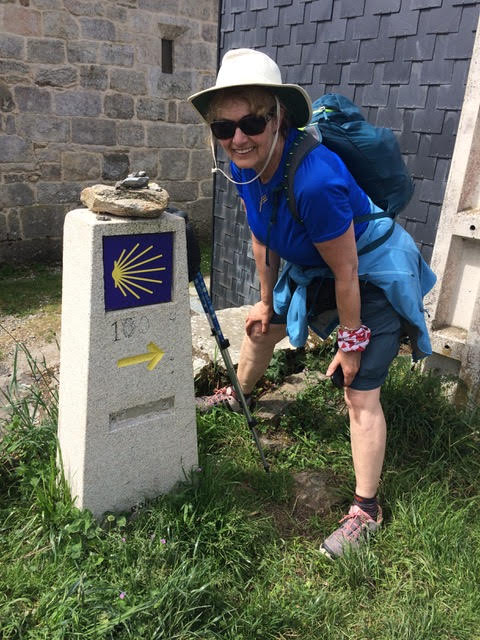
Elizabeth Petrie, my friend and an Artsy Traveler guest poster, walked the Camino with her friend Cheri, and shares her experiences and insights.

A promotional image for the Camino de Santiago journal, reading 'Walking the Way: Pamplona to Santiago de Compostela' overlaid on a path and stone marker with the scallop shell symbol.


Overview of Walking the Way from Pamplona to Santiago de Compostela Camino Route

Elizabeth and Cheri walked first from Pamplona to Burgos. After a few days sightseeing in Burgos, they took the train to León and then to Lugos.

From Lugos, they rejoined the Way at Sarria and walked the last 120 kilometers to Santiago de Compostela.

Elizabeth shares her experiences and recommendations in three posts on Artsy Traveler.

A smiling person standing next to a Camino de Santiago marker with a scallop shell symbol, wearing a blue hiking outfit and hat.
Guest poster Elizabeth Petrie on the Camino of Santiago

This post includes excerpts from the detailed journal that Elizabeth kept while walking the Way. If you’re interested in walking the Way yourself, read Elizabeth’s recommendations in Top Tips for Walking the Camino to Santiago de Compostela. And for suggestions about what to see and do in beautiful Burgos and León, read Exploring Burgos and León along the Camino of Santiago.

Elizabeth’s lively description of her journey is excerpted from the journal she kept while walking the Way between May 3 and June 1, 2017.


Part 1: Walking the Camino from Pamplona to Burgos

Welcome to Pamplona

The capital of Navarra, Pamplona charms us with its pretty streets, attractive green spaces, and many historical buildings. From our window at the NH Pamplona Hotel, we enjoy a southeast view of a nearby quarry that glows in the evening sun. 

A short stroll along the main boulevard brings us to La Cittadella, an old, star-shaped fortress with huge, thick walls. The fortress is situated in a large park through which the Camino passes.

On the day we start our Camino journey, we’ll only need to walk a short distance from our hotel to pick up the trail.

What to See in Pamplona

The central Plaza del Castillo is an attractive public square surrounded by beautiful old buildings. Pamplona is full of monuments, typical in a country with thousands of years of history. All the statues and monuments are well signed and beautifully maintained.

Especially interesting is the large bronze statue depicting the famous “running of the bulls” (el encierro de toros). The portrayal of some unfortunates being trampled or gored by the bulls looks very realistic.

There’s not enough money in the world to convince me to do it, which is just as well since women typically don’t participate.

Monument depicting the Running of the Bulls in Pamplona, Spain, featuring bronze sculptures of bulls and runners in a dramatic chase scene.
Running of the Bulls Monument in Pamplona, Spain

Walking Tour of Pamplona

Consider taking a free walking tour with Free Walking Tour Pamplona.  You’ll explore the old town and visit the Gothic Cathedral of Santa Maria, the Plaza del Castillo, and the impressive fortifications that once protected the city. There’s a lot to see in Pamplona!

We’re On Our Way!

At the pilgrims’ albergue in front of the Gothic cathedral, we get our first stamp (estampilla) in our pilgrims’ passports (pasaportes de peregrinos).

We have officially begun walking the way from Pamplona to Santiago de Compostela! 

Day 1: Walking the Way from Pamplona to Puente la Reina: 27 kilometers

After three nights in lovely Pamplona, we’re feeling well rested and ready to begin walking the Way on our first stretch of the Camino.

Starting Out

As the sun rises in a clear blue sky, we walk through the beautiful grounds of the Universidad de Navarra and out into lovely rolling countryside. Wild poppies are scattered among fields of newly planted crops. We hear birds singing in the fields and hedgerows.

Hikers hiking along a gravel path surrounded by green fields and trees near Pamplona, Spain, on the Camino de Santiago trail.
Setting off on the Way, west of Pamplona

We stop to get a stamp at a private albergue next to the 12th-century Iglesia de San Miguel. The fortified tower of the church was part of the Monasterio de los Hospitalarios de San Juan de Jerusalén.

The knights of the Hospitallers eventually became the Knights of St. John of Malta from which we get the St. John Ambulance service today. 

Our First Steep Section

The Alto del Perdón, the first steep section we encounter on the trail, is described in our guidebook as “not as difficult as you will have heard” and is estimated to take “only a half-hour”.

Wrong on both counts!

The trail climbs pretty much straight up, the hardest ascent along the whole Camino. Whenever we start feeling weary, we chant “Alto del Perdón, Alto del Perdón! Nothing is as hard as Alto del Perdón” in rhythm with our steps.

Eventually, we make it to the top where the views are spectacular. Both nearby and in the distance we see one of the many wind farms that take advantage of the strong breezes coming from the Atlantic Ocean and the Bay of Biscay.

Modern metal cut-outs describe the various methods that pilgrims used over the centuries to travel the Camino. One of the inscriptions reads, “”where the road of the winds crosses the road of the stars”.

Silhouette metal sculptures of pilgrims and animals on the summit of Alto del Perdón, Camino de Santiago, with a vast mountainous landscape in the background.
Cut-outs and view at the summit of the Alto del Perdón

Albergue de Santiago Apóstel in Puente la Reina

At our first albergue, we’re assigned two upper bunks (no ladders!) in a four-bunk room. After a hot shower, we enjoy a pilgrim’s dinner of salad, fish, water, and yogurt, all for just €20, including accommodation.

We’re gratified to have virtually no injuries or aches other than a couple of small blisters. I decide to alternate boots with shoes to avoid putting too much pressure on any one spot on my feet. 

The medieval Puente la Reina bridge in Navarre, Spain, reflecting perfectly on the calm waters of the river below.
Bridge leading into Puente la Reina

Day 2: Puente la Reina to Ayeguí: 20 kilometers

The next morning, the owner kindly calls ahead to book beds at the albergue in Ayeguí. He also confirms transportation of our packs for only €5 each. Normally, albergues do not take advance reservations. I wonder whether the fact that I speak Spanish helped?

The second day of walking the Way is much easier than the first, even with a few strenuous uphill stretches. (Altos del Perdón, Altos del Perdón…). The countryside continues to amaze us with its many crops, flowers, and birdsong. Small lizards sun themselves on the stone walls that mark the route.

Lorca

We stop for coffee in Lorca, a medieval hill town with a wonderful view of the surrounding valley. The route out of Lorca drops very steeply down what is little more than a slippery, rocky gully. After a few more hours of walking, I feel a blister starting on my heel. We decide to take a taxi the rest of the way to Ayeguí.

I recommend occasionally taking taxis and public transport to save your feet. A small blister can become a large one very quickly and make walking agony.

Day 3: Ayeguí to Torres del Río: 27 kilometers

Our third day walking the way is a long one! We take a break in Irache, where a fountain with a dual spigot offers both water and wine. We fill our water bottles from one and take a sip from the other.

The sign on the fountain reads “Pilgrim! If you wish to arrive in Santiago full of strength and vigour, just take a drop of this great wine and jump for joy.”. Another sign notes “We invite you to enjoy in moderation; if you wish to take some wine along, you will have to buy it!“.

The Camino winds past numerous churches and historical buildings, too many to count and, unfortunately, too many to visit. Many are Romanesque in style, reminding us again of the extent of the Roman Empire at its height. 

Sometimes, we walk at the side of the local highway and at other times on gravel paths dating from ancient times. The Way between Villamayor de Monjardín and Los Arcos typifies the Camino.

It’s a long, narrow road stretching into the distance between open fields, with very little shade and no place to fill our water bottles. 

Los Arcos

Arriving in Los Arcos is a relief for our feet and our thirsty throats. It’s a beautiful old town that has been inhabited since Roman times. The Iglesia de Santa María has a mixture of architectural styles (Romanesque, Gothic, and Baroque), and the series of arches along the walls of the original cloisters gives the town its name. 

Los Arcos is a popular stopping point, but we decide to continue another six kilometers to Torres del Río. Hmm…perhaps not the best idea, as it turns out! The weather has warmed considerably, and there’s not a breath of wind. We sing, make lists of places we’d like to go someday, and generally distract ourselves from the trudge. 

A Camino de Santiago marker featuring a yellow scallop shell and arrow, topped with a hiking shoe and wildflowers, set against a green field
Some of the markers along the Way have been decorated by passing pilgrims

Finally, we arrive at the delightful little town of Sansol and take a taxi to Albergue La Pata de Oca at Torres del Río. What a treat! The main building is hundreds of years old, with thick stone walls and solid beams in the ceilings, all covered with plaster.

Our private room is upstairs under the rafters. The ceiling slopes so much that we have to stoop to open the window. The patio is lovely, with lots of flower pots filled with bright red geraniums.

We enjoy a delicious dinner of bean and chorizo soup, chicken, flan, and wine. After a long, hot day, we collapse into bed about 9:15.

Day 4: Torres del Río to Ventosa: 4 kilometers

We decide to take it easy after yesterday’s long walk and opt for a later start and a shorter walk with a taxi ride in between.

While relaxing over breakfast on the terrace, we meet Ian from Ireland. He tells us that he’s a former addict who has been clean for 26 years and has adopted his nephews (one of whom is on the autism spectrum) after the death of their parents.

Encounters with people like Ian and others from all over the world and with a variety of backgrounds is one of the most enjoyable aspects of our journey.

Before starting our walk, we visit the Romanesque Church of the Holy Sepulchre across the street from the albergue. Dating from the 12th century, the small, octagon-shaped church was founded by the Knights Templar during the time of the Crusades.

The dome’s ribbing forms the outline of an eight-sided star, typical of Moorish Spain. The 13th-century crucifix depicts Christ’s feet separately rather than crossed one over the other as is typical.

Day 5: Logroño to Ventosa: 21 kilometers

We stop for lunch in Navarrete, an attractive hill town with narrow cobblestoned streets leading to the town plaza. A small church, La Iglesia de la Asunción, doesn’t look particularly special from the outside. We almost don’t go in. Luckily, we did and found one of the most amazing Baroque retablos (altarpieces) in all of Spain. 

Our albergue in the tiny village of Ventosa has a typical set-up, with ten bunks to the room, plenty of hot water and many modern conveniences. Again, our pilgrim’s meal is delicious and very reasonably priced. For €10, we dine on paella with chorizo along with salad and a beer.

Day 6: Ventosa to Nájera to Santo Domingo de la Calzada: 5 kilometers

Cheri’s blister and ankle are acting up, so we take a taxi and then a local bus to Santo Domingo where we stop for the night.

A rooster motif is everywhere in Santo Domingo, reflecting the legend of how a young man had been wrongly accused and executed for theft.

One version recounts that his parents had seen a vision of St. Dominic holding their son up alive. When they rushed to the magistrate to report this miracle, the judge laughed and said that the boy was as dead as the rooster and chicken on his plate. At that, the birds came alive and fluttered about the room, thereby “proving” that the young man was innocent.

To this day, a pen inside the cathedral holds a rooster and a hen (different ones every two weeks). It’s a sign of good luck if you hear the rooster crow.

Day 7: Santo Domingo de la Calzada to Belorado: 21 kilometers

On a day of mixed sun and cloud, we pass through the town of Viloria de Rioja, the birthplace of St. Dominic and from there into the province of Castilla y León. 

At the albergue in the evening, we enjoy our €10 pilgrim’s dinner of two courses and wine and chat with Marcelo from Argentina and David from San Sebastián. Our pleasant conversation covers everything from politics, to films, to the various people we’ve met on the Way, to our common love of travel and adventure.

Day 8: Belorado to Cardeñuelo Río Pico: 9 kilometers

We carry our big packs today and find that after more than a week of walking the Way on the Camino, we’re getting stronger.

The Albergue Santa Fe in Cardiñuela where we stop for the night has just one double room left, complete with a private bath, towels, soap and shower gel, and a television. With dinner included, the cost is about €55 each, another example of the excellent travel bargains to be found on the Camino.

Day 9: Cardeñuela Río Pico to Burgos: 17 kilometers

A strong, cool breeze in the morning makes for good walking weather. As we approach Burgos, we pass through several prosperous-looking neighbourhoods which likely are bedroom communities of the city itself. 

The Camino enters Burgos via a pretty walk along the river. When we finally reach the center of town, we take a taxi to the AC Hotel which is perfectly situated about two blocks from the central plaza and the cathedral.

We enjoy tapas at one of the outdoor cafés in the colonnaded central plaza.


Part 2: Walking the Way from Sarria to Santiago de Compostela

Days 10 to 14: For the next several days, Elizabeth and Cheri tour Burgos and then León. Read Elizabeth’s suggestions about what to see there in the post Exploring Burgos and León.

Day 15: Samos to Sarria: 21 kilometers

After several days exploring Burgos, León , and Lugos, we take the train to Sarria, drop off our packs at the albergue La Casona de Sarria and then take a taxi to Samos to explore the Benedictine Monastery.

Wow! The Benedictine monastery at Samos is stunning, with some sections dating back to the 6th century.

Currently, only eight monks and two novices are in residence, with some of the original monks’ cells now serving as simple accommodations for people participating in organized religious retreats.

Benedictine Monastery of San Julián de Samos in Galicia, Spain, surrounded by lush greenery and a reflective stream under a cloudy sky.
Benedictine monastery of San Julian de Samos located in Samos, Lugo, Galicia

The interior cloister at the monastery is the largest in Spain, and some of the walls display original frescoes.

Back on the Camino: Samos to Sarria

After a quick lunch, we resume walking after our days off for sightseeing in Burgos, León , and Lugo. We set off back to Sarria, a distance of about twelve kilometers and one of the most beautiful stages of our journey.

The route starts behind the monastery, winds past the kitchen gardens and along cool shaded paths alongside a small river, with some ascents and some descents but few signs of modern habitation. We pass a couple of 12th-century wayside chapels, small abandoned houses, wooden bridges, and old slate drystone walls.

You can almost imagine yourself a thousand miles from any center of population and thousands of years back in time.

One farmer is repairing his drystone slate wall and lets us fill our water bottles from his well. We stop a bit farther on for a cold drink in a typical taberna do Camino.

Day 16: Sarria to Portomarín: 24 kilometers

We start our day by crossing the old Roman bridge just down from the albergue. The stela marker informs us that we are 113 kilometers from Santiago.

At this point of our walk, we’re encountering many more people on the Camino, particularly Europeans taking a week to do the minimum journey (100 kilometers).

To receive the completion compostela in Santiago, pilgrims must present their passports bearing at least two stamps per day for the final 100 kilometers.

As we’ve come to expect, the countryside is absolutely beautiful, with rolling hills, manageable ascents, and plenty of lush vegetation providing shade in the increasingly hot weather.

This region is quite well watered by rain, and there are lots more dairy cattle and other livestock grazing in green pastures. 

Scenic view of the San Estevo water reservoir near Portomarín, Galicia, Spain, with a vibrant green valley, river, and rolling hills under a cloud-streaked sky.
Countryside along the Way in Galicia

At one short rest stop, we listen to a piper in Galician dress, a reminder of the strong Celtic influence in this part of Spain. Much of the day’s route follows the old Roman road, with some of the original Roman stone walls still marking out different pastures. 

A very old church marks the beginning of the final 100 kilometers to Santiago.  

Day 17: Portomarín to Palas de Rei: 26 kilometers

Today’s route includes ups and downs through rolling and beautiful countryside. We’re starting to become blasé about the medieval churches. Ho hum, 14th century.

We find a fair bit of traffic along the Camino and several small tour groups.

Part of the Camino passes through thick stands of eucalyptus trees, originally imported from Australia. The scent of the leaves that have fallen to the ground and crushed by passing feet is delightful. 

Day 18: Palas de Rei to Melide to Arzúa: 17 kilometers

Despite the heat, we enjoy a good night’s sleep followed by an excellent breakfast.

In a small chapel along the route, I’m fascinated by a poster of a stunning Madonna and Child (Mater Divinae Providentiae) painted by Scipione Pulzone da Gaeta in the mid-16th century.

I’ve never seen a Madonna which so tenderly expresses the love of mother for child. How different from the usual dreamy, remote images of Mary and the baby Jesus. This one is all about maternal love and one of the loveliest I’ve ever seen. I’ve never heard of this artist, and I plan to learn more about him.

The Camino from Melide to Arzúa is not a difficult stage, but it does have ascents and descents virtually the entire way. Fortunately, the many groves of fragrant conifers and eucalyptus trees along the path are very pleasant and make the steeper inclines much more manageable.

The official markers remind us that we’re getting closer to our final destination. 

Later this afternoon, I suffer the only mishap of the entire trip when I stumble into a patch of nettles. Ouch! But Cheri quickly pulls out the antihistamine tablets and After Bite lotion, and, almost immediately, the rash subsides and the itch disappears.

Day 19: Arzúa to Pedrouzo: 22 kilometers

Our water and energy drinks at the ready, we set off early before the heat sets in and make pretty good time, even on the up and down stretches. The crowds are certainly growing. 

At one stop, we purchase coffee, bananas, and small concha patches sold on the honor system/por donativo. Next to the building is a “wall of wisdom” (muro de la sabiduría) containing interesting quotes and reflections on travel.

I’m sure the quotes keep conversation going among the pilgrims as they near the end of a long journey. 

An interesting feature of the places we pass are the corn cribs, large covered storage areas on stilts. The walls are perforated to allow air circulation but not rodents, and their height prevents livestock from investigating too closely and knocking them over.

Day 20: Pedrouzo to Santiago de Compostela: 22 kilometers

Our last day of walking the Camino!

We’re up and away before sunrise on what promises to be another warm day. The crowds have become thick, and we sometimes have to jostle for room to manoeuvre around groups. 

Approaching Santiago de Compostela, the Camino skirts the northern end of the airport, which is clean and modern. We encounter a couple more steep spots, and then, suddenly, we’ve reached the official city limits of Santiago.

To enter the city proper, we cross a rickety plank footbridge into a semi-residential area and up into the original medieval town. We descend a flight of stairs, walk through a large portal set into very thick stone walls, and enter the central plaza of Santiago de Compostela.

The scaffold-covered cathedral looms into the rapidly clouding sky. We’ve made it!

We head to the new tourist center to get our official completion credential. There’s a long queue, and for a while we wait outside in the patio area.

Almost immediately after we enter the building, a big thunderstorm breaks, rain teeming down on the poor folks still out walking on the Camino or waiting outside to get their final stamp.


Arrival in Santiago de Compostela

We celebrate our achievement with an empanada and beer in the restaurant of the Santiago Parador, a former hospital founded by Ferdinand and Isabella in the 1490s.

We enjoy a deep, restful sleep, despite the thunderstorms. By mid-morning, the weather has cleared, and we return to the cathedral and tour the adjacent museum, timing it so that we can enter the cathedral itself from the cloister.

Visit to the Cathedral of Santiago

The entrance to the cathedral closes at 11:45 in preparation for the Pilgrims’ Mass, and by 11:15, it’s already filling up. We snag a spot on a small ledge at the base of one of the huge pillars near the back and have a reasonably good view. 

Facade of the Cathedral of Santiago de Compostela, Spain, showing intricate Baroque architecture and two towering spires against a deep blue sky
The Cathedral at Santiago de Compostela

The service starts, and the nun leading the chants and responses has the most glorious voice. We recognize many of the service prayers, even though they are in Spanish: the collect, the Lord’s Prayer, the reading from the Old and New Testaments (Corinthians and John), the general confession, and so on.  

The highlight of the service, and the reason that many people are there, is the swinging of the enormous censer across the transept.

At least five or six deacons or lay brothers manoeuvre it into place and set it swinging, and the sweep of its pendulum action gets higher and higher. Ropes and pulleys are affixed to the ceiling, and the angle of the swing is maybe 120° or more. 

After the service, people line up behind the main altar to hug a plaster statue of St. James. Meanwhile, there are practically no people lined up to descend to the crypt to see St. James’ ossuary, an amazing chest of embossed silver.

If the bones of the saint are really contained within, it’s interesting to think that here was someone who actually knew Christ. 

Back at the hotel after a bit of shopping, we calculate the distance we’ve walked. From our first day of walking to our final day in Santiago de Compostela, we logged 338 kilometers!


Continue Exploring the Camino on Artsy Traveler

Would I do the Camino again? Absolutely! Do I recommend it to anyone who is reasonably fit and looking for an adventure? Of course!

Something magical happens when you slow down to tread in the footsteps of the thousands of pilgrims who have walked the Way.

You hear birdsong, feel the sun warm your face, view stunning landscapes steeped in history, enjoy wonderful food, and meet people from all over the world.

The Camino beckoned and I’m very glad I followed.

For more on the Camino, read Elizabeth’s recommendations in Top Tips for Walking the Camino to Santiago de Compostela. And for suggestions about what to see and do in beautiful Burgos and León, read Exploring Burgos and León along the Camino of Santiago.

Carol Cram
About Carol Cram

Carol M. Cram is the author of five award-winning historical novels inspired by art and the women who shaped it, the creator of Artsy Traveler, an arts-focused travel blog, the founder of Art In Fiction, a curated database of 2,500+ novels inspired by the arts, and the host of The Art In Fiction Podcast. She also authored 60+ textbooks on computer applications and taught at Capilano University for over two decades. She lives with her husband, artist Gregg Simpson, on beautiful Bowen Island near Vancouver, BC.

Exploring Spectacular Northern Spain & Basque Country: My Best Bets

Northern Spain stretches from the Atlantic to the Pyrenees, a distance of almost 700 kilometers. This area of Spain boasts extraordinary scenery and something else you won’t see much of in the rest of Spain: rain.

Galicia in the northwest corner of Spain is green and gorgeous, with a culture that owes more to its Celtic neighbors in Brittany and Cornwall than to the rest of Iberia.

Pinterest graphic with the text northern spain and basque country over a picture of rock formations on the spanish coast.

You’ll find a lot to enjoy in northern Spain: historic Santiago de Compostela, the Picos de Europa mountains, pinchos (pintxos) in San Sebastian, and the Guggenheim Bilbao, one of Europe’s top modern- art museums.

This post is part of my guide to artsy & independent travel in Spain, where I share my best tips for exploring Spain’s creative cities, historic sites, and cultural experiences.


Devote at least a week to this area of Spain. To help you plan your tour of northern Spain, I’ve compiled a ten-day itinerary that starts in Santiago de Compostela and ends in San Sebastian.


Orientation to Northern Spain

The map below includes the places mentioned in this post. Click a number to find out more information.

This map was created with Wanderlog, an itinerary planner on iOS and Android

Getting Around Northern Spain

My itinerary presumes you’re driving. It’s possible to visit this area by train, but if you rent a car you can explore more of this fascinating and beautiful region, particularly the Picos de Europa.

A Single Stop for European Rail Travel

Consider flying to Santiago de Compostela and touring the city for a few days before picking up your car and heading east. Drop it off in Bilbao and take a train to San Sebastian, or drive all the way to France and drop the car off there. Bordeaux is a convenient choice.

I suggest spending two days and three nights in Santiago de Compostela, one night on the north coast, three nights in or near Llanes to explore the Picos de Europa, one night in Santillana del Mar, one night in Bilbao, and one night in San Sebastian.

That’s a lot of one-nighters, so if you prefer and have the time, add more two-night stays. There’s a great deal to see in northern Spain!


Days 1 to 3: Santiago de Compostela

We spent a week in Santiago de Compostela a few years ago when Gregg had a major exhibition at the Granell Museum. The city of 100,000 people is a compact and lovely place with wonderful restaurants and parks and an atmospheric old town.

One of my favorite things to do was hanging out in the Praza do Obradoiro in front of the cathedral to watch Camino pilgrims enter the plaza. Santiago de Compostela, while not the actual end of the Camino de Santiago, is commonly the place most pilgrims stop.

The Cathedral at Santiago as seen from the Praza do Obradoiro

It was moving to see the pilgrims enter the plaza. Some were limping after weeks on the road, and most carried their pilgrim’s staff topped with a distinctive scallop shell similar to the shells that mark the Camino route. I saw a lot of tears and hugs and selfies.

Catedral de Santiago de Compostela

Pilgrims crowd into the cathedral (#1) where the remains of Saint James are allegedly buried. The cathedral is a jumble of architectural styles: Romanesque, Gothic, and Baroque. A highlight inside the west entrance is the Pórtico de la Gloria, containing 200 Romanesque sculptures dating from the late 12th century.

Truth be told, I found the cathedral dark and overcrowded, but there’s no denying the atmosphere of piety, particularly from the pilgrims who walked the Camino for religious reasons.

The Old Town

Wander the granite streets of the old town of Santiago, enjoying the arches, squares, and monuments that contributed to the city’s designation as a UNESCO World Heritage Site in 1985. You’ll find plenty of good shopping, particularly for jewelry. The atmosphere is laid-back and friendly, with throngs of students, pilgrims, tourists, and locals.

A street in the Old Town in Santiago de Compostela

Parks and Museums

Alameda Park (#2) is a large green space, wonderful to chill out in away from the crowds in the Praza do Obradoiro. You also get a marvelous view of the cathedral from the park.

When Gregg was in Santiago on a solo trip, he came across a large group of people in traditional costumes playing instruments and dancing in San Domingos de Bonaval Park. Watch his video on YouTube. Notice how Celtic the music sounds with the drums and bagpipes, completely different from the flamenco rhythms in the south.

In Bonaval, you’ll also find the Galician Contemporary Art Centre and the Museum of the Galician People (Museo de Pobo Galego).

In Santiago de Compostela, you’ll notice that you’re in Galicia first, Spain second. Local people speak Galician and are proud of their heritage. You’ll be understood in Spanish, and likely in English, in restaurants and hotels.

On the Pazo de Bendaña, not far from the cathedral, is the Granell Museum, housed in a beautiful old Baroque building. If you’re a fan of Surrealism, check out this museum that includes an extensive collection of work by Eugenio Granell and other artists linked to Surrealism, including Marcel Duchamp, Max Ernst, Joan Miró, and Roberto Matta.

Dining in Santiago de Compostela

With so many students, tourists and pilgrims swelling its population every year, Santiago de Compostela has become known for its excellent restaurants. We enjoyed several memorable meals during our week-long visit. Check restaurant apps and reviews and make reservations.


Day 4: North Coast

Head north from Santiago de Compostela to the coast then meander eastwards into Asturias, stopping at one of the many beachside towns. Magnificent rock formations are a draw at Playa Las Catedrales (#3), located near Ribadeo on the north coast.

Playa Las Catedrales beach near Ribadeo, Galicia of Lugo, Spai

Slow down and get off the main roads. Oviedo, the capital of Asturias, is a possible stopping place for the night. The Fine Arts Museum of Asturias looks intriguing.


Days 4 to 5: Llanes and the Picos de Europa

You’ll encounter rugged mountain vistas as you continue east toward the Picos de Europa. The jagged peaks of Picos de Europa (#4) National Park, Spain’s first national park, are nicknamed “Spain’s Dolomites”.

The mountains straddle southeast Asturias, southwest Cantabria, and northern Castilla y León. If you’re a hiker, you’ll want to spend a few days here.

One option is to home-base in the charming coastal town of Llanes (pronounced YAH-ness).

We discovered Llanes (#5) by accident on our drive across northern Spain. For once, I hadn’t booked a hotel, deciding that we’d just stop driving when we got tired and hope for the best. I don’t recommend that approach, particularly in the busy summer months, but sometimes it’s fun to live dangerously!

I saw the sign for Llanes, figured it was as good a place as any, and directed Gregg to the old town.

What a fortuitous decision! The little seaside town of Llanes turned out to be delightful, with beautiful buildings covered in fine woodwork and small windows. An inland waterway lined on both sides with cafés runs through the town center. Pull up a chair in one of the cafés to enjoy some tapas and beer, and watch the boats go by.

Traditional houses in Llanes, Asturias, Spain.

Take a walk out to the breakwater. An artist has painted the huge concrete blocks that protect the town from high tides with all sorts of crazy patterns.

Painted cement blocks on the breakwater in Llanes, Spain
Painted cement blocks on a jetty in Llanes, Spain

Watch the sun set over the Atlantic and prepare to be enchanted.

Eat dinner at an outdoor café in the network of tiny lanes in the old town. Two three-course meals and several glasses of red wine cost us just €10. Now, that’s a bargain!

The waiter insisted on giving us several of his business cards so we could tell everyone we met about his restaurant. We wandered back through picturesque squares to our hotel, situated in a renovated convent.

In the middle of the night, I woke up, terrified that something—someone—was in the room. Perhaps a nun, long dead, was not happy to find me sleeping in a room that had once been her cell. I was so frightened that I had to wake up Gregg!

Is it likely that thousands of years of history, much of it violent, have produced their share of discontented ghosts?

Maybe.


Day 6: Santillana del Mar & Bilbao

The Caves of Altamira are located close to Santillana del Mar (#6). Seventeen caves are decorated with art of the Paleolithic age dating from 35,000 to 11,000 BC.

Because of their deep galleries, isolated from external climatic influences, these caves are particularly well preserved. You can visit the replica caves. Check out the official website.

Bilbao

The drive from Santillana del Mar along the coast to Bilbao (#7) is gorgeous. Get off the highway and explore some of the windswept, rock-choked coves. This part of northern Spain is spectacular.

Bilbao is a large port city with a tangle of highways leading to the Nervión River and the Guggenheim. Use your GPS to navigate into the city, and avoid hotels in the old town. We chose the Hotel Melià, a modern hotel on the river, which was easy to find and featured a large parking garage.

The street signs written in the Euskara language are daunting and largely unpronounceable, at least for foreign tourists like us! Many of the streets have names consisting of 20 letters, most of which are Xs and Zs. When you’re in Basque country, you may forget you’re still in Spain.

Fortunately, you’ll easily get by in Spanish and English.

The big attraction in Bilbao is the Guggenheim Museum (#8), one of the world’s top modern art museums. I love that the city of Bilbao decided to revitalize itself and attract tourist euros by building a world-class art museum. That choice showed vision along with a heartening belief in the importance of art and culture.

Exterior of Guggenheim museum in Bilbao, Basque, Spain

We chose one of the ultra-modern hotels in an ultra-modern area of Bilbao about a ten-minute stroll along the river from the Guggenheim. Read my suggestions for hotels in Bilbao in Where to Stay in Spain: My Best Picks.

Likely your first view of the Guggenheim will be of Puppy, the colossal topiary of a West Highland White Terrier that stands guard in front of the museum. With its variegated coat of flowers that changes with the season, Puppy is remarkably photogenic.

Puppy at night in front of the Guggenheim Bilbao

After you’ve slaked your thirst for Puppy pics, walk around the building to admire the silvery-gold slabs of hammered, stamped steel of architect Frank Gehry’s Guggenheim and to view more of the modern sculptures.

You’ll see Anish Kapoor’s astonishing sculpture of huge silver orbs stacked almost as high as the roof of the museum and facing the river. The piece is perfectly situated to catch the sun, turning the entire column of orbs into one pulsing, glistening beacon. Another marvelous sculpture is Maman by Louise Bourgeois, a massive spider not recommended for arachnophobes.

Once you’ve had your fill of the exterior, enter the Guggenheim and get your bearings. Find out what the special exhibition is, study the maps or download the app, and plan your route.

A highlight is the enormous sculpture by Richard Serra on the ground floor. The work consists of six steel slabs bent and curled in various ways that invite you into their depths to wander until you feel dizzy. We went into two of the sculptures, and that was enough! The effect is startling, and a little goes a long way.

When we visited, we saw a stylishly curated exhibition of new paintings and digital works by David Hockney.

Following your visit to the Guggenheim, stroll across the bridge to the old town to spend your evening enjoying tapas and drinks. On your way back, you’ll see the Guggenheim and Puppy evocatively floodlit.


Day 7: San Sebastian

If you’re driving to San Sebastian, called Donostia (#9) by the Basques, your first view may be nondescript suburbs miles away from the famous sweep of beach. Persevere until you reach the water and the old town.

Our hotel was situated at the top of Mount Urgull, one of two mountains that flank San Sebastian. Here’s the stunning view of San Sebastian from near our hotel.

View over San Sebastian, Spain
Overview of the Bay of San Sebastian, Spain

Traffic in San Sebastian was remarkably sedate when we were there. Head for one of the big parking lots in the commercial center and then explore San Sebastian on foot.

San Sebastian consists of three main areas: the long sweep of beach bristling with frolicking holiday-makers, the modern town built on an easy-to-navigate grid system, and the old town with its narrow streets and intriguing aromas.

Spend your evening in San Sebastian bar-hopping in the old town to sample as many pinchos (pintxos) as possible.

Squeeze into a bar (they’re all crowded!), grab a plate, select a few cold pinchos from the platters lined up on the bar (so many varieties to choose from!), grab a glass of local wine, eat standing up amid the crowds, then saunter off to another place.

Platters of pinchos on a bar in San Sebastian
Spanish tapas called pintxos of the Basque country served on a bar counter in a restaurant in San Sebastian, Spain

Each pincho is a mini work of art. If you don’t see something you like on the cold platters, order hot pinchos listed on chalkboards behind the bar.

The incredibly efficient servers keep track of what you’ve eaten by the number of toothpicks left on your plate. You also crumple up your used napkins and throw them on the floor, a practice that takes some getting used to!

Go from bar to bar sampling two or three pinchos at each, along with a glass of wine. Prices are amazingly reasonable. Our evening of pincho-eating and wine-guzzling cost just €30, including two gelatos.

Everyone seemed in great humor. Families with little kids filled the streets late into the evening. The San Sebastian people know how to live!


Where to Stay in Northern Spain

For accommodation suggestions in Santiago de Compostela, Llanes, San Sebastian, and Bilbao, see Where to Stay in Spain: My Best Picks.


Other Tour Options in Northern Spain

Here are more tour options in northern Spain offered through GetYourGuide:

Powered by GetYourGuide

Keep Exploring Spain with Artsy Traveler

Here are more posts about Spain on Artsy Traveler:


Carol Cram
About Carol Cram

Carol M. Cram is the author of five award-winning historical novels inspired by art and the women who shaped it, the creator of Artsy Traveler, an arts-focused travel blog, the founder of Art In Fiction, a curated database of 2,500+ novels inspired by the arts, and the host of The Art In Fiction Podcast. She also authored 60+ textbooks on computer applications and taught at Capilano University for over two decades. She lives with her husband, artist Gregg Simpson, on beautiful Bowen Island near Vancouver, BC.

Reflecting Pool in Alhambra Courtyard: Symmetrical courtyard with a reflecting pool in the Alhambra, Granada, showcasing the beauty of Moorish architecture, perfect for an Andalusia itinerary.

Best 10-Day Itinerary to Tour Andalusia in Southern Spain

Heading to Andalusia in southern Spain? You’re in for a treat!

I recommend allocating ten days to tour Andalusia by car. This amount of time allows you to comfortably sample this incredible region. 

My suggested itinerary in Andalusia starts in Cordoba and ends in Seville, and takes in Ronda, the White Towns, Cadiz, and Granada, along with lovely Cadiz facing the Atlantic Ocean.

Travel blog cover featuring the Cordoba Mosque-Cathedral and a flamenco dancer, with the title 'Visiting Andalusia: A 10-Day Itinerary' from ArtsyTraveler.com

As an artsy traveler, you’ll find more than enough cultural sites and experiences to delight you when touring Andalusia.

This post is part of my guide to artsy & independent travel in Spain, where I share my best tips for exploring Spain’s creative cities, historic sites, and cultural experiences.


Andalusia at a Glance


Why Tour Andalusia?

To me, Andalusia is Spain on steroids. It’s the Spain of my imagination with bone-white villages perched on rocky crags, the skull-pounding rhythms and olés of flamenco, and tranquil Moorish courtyards with fountains splashing.

I just have to say Andalusia and I feel romantic.

Carol Cram in Grazalema in Andalusia, a stop on a culture-stepped itinerary to tour Andalusia
Me on the road leading to Grazalema, one of the Pueblos Blancos (white towns) in Andalusia

To get you in the mood for touring Andalusia, listen to this clip from Concerto for Aranjuez by Joaquín Rodrigo.

If your heart swells and your palms get a bit sweaty from an excess of romantic swooning, then you’ll know that touring Andalusia is for you!


Getting Around Andalusia

As one of the largest regions in Spain, Andalusia stretches from the Portuguese border in the west, south to the Mediterranean and the resorts on the Costa del Sol, and east almost as far as Cartagena.

Here’s a map of the area:

Trip map courtesy of Wanderlog, a road trip planner on iOS and Android

One way to tour Andalusia is to connect the three principal cities—Cordoba (#1), Granada (#2), and Seville (#5)—by train. The distances are short, and train service is efficient and fast.

On my first trip to the area, I took trains and found the experience easy and relaxing.

If you’re keen on a road trip, add in Cadiz (#4), the White Towns (Pueblos Blancos), and Ronda (#3) (highly recommended).

One option is to take the high-speed train from Madrid to Cordoba, enjoy the city for one night, then rent a car at the airport in Madrid and drive east to Granada for two nights.

Then, circle around to the west to visit the White Towns, Ronda, and Cadiz by way of Arcos de la Frontera.

Drop off your rental car at the airport in Seville, grab a shuttle or a taxi to an apartment in the old town (where I don’t advise driving), and enjoy the final days of your trip in Andalusia.


Suggested Itinerary for Touring Andalusia

For a Southern Spain itinerary that combines driving and trains, I suggest:

  • One night in Cordoba
  • Two nights in Granada
  • Three nights in the countryside near Ronda to explore it and the White Towns
  • One night in Cadiz
  • Three nights in Seville

Highlights of your week include visits to the Alhambra in Granada and the Mosque-Cathedral in Cordoba, touring gorgeous Ronda and the White Towns, basking on the beach at Cadiz, and, of course, enjoying flamenco pretty much everywhere, but especially in Seville.


Best Time to Visit Andalusia

Summers are HOT in Southern Spain so you may want to plan your trip for April, May, September or October.

I’ve visited the area during those times and found the weather just about perfect. I also visited Seville in July and found it a bit stifling. If you travel during the summer, make sure you rent an air conditioned place, take the afternoons off for siesta, and do your touring in the mornings and evenings.


Train to the South from Madrid

If you’re starting in Madrid, you may want to take the train to the south and then rent a car.

On one trip to the area, I took an early morning train from Madrid to Cordoba, and was glad I was on the train and not driving. The distance is quite vast and the landscape stark and beautiful, but not particularly varied. You’ll pass a lot of olive trees.

On another trip to Spain, I drove from Toledo (just south of Madrid) to Ronda (not far from Cordoba). As I discovered when watching the landscape from the train on my first trip, the vast distance doesn’t improve when seen from a car.

However, driving in Spain is not difficult. The roads are good and the traffic is generally light. But like anywhere in Europe, you want to avoid driving into medieval towns and villages. Park on the outskirts and walk or take a taxi.


Day 1: Cordoba

We arrived in Cordoba and moments later were careening through the historic Jewish Quarter in the back seat of a taxi driven by a guy who didn’t know where he was going.

As we had all morning, my husband and I continued to congratulate ourselves for not driving.

The author with a glass of sherry in the courtyard of a hotel in Cordoba

Finally, the driver found the lovely little hotel on a small square in the maze of tiny streets. We entered a cool courtyard where a fountain tinkled and the friendly proprietor offered us a cold glass of wine. Heaven after a long day of traveling!

Balcón de Córdoba is a good place to stay in Cordoba, or pretty much anywhere deep in the Old Town.

Exploring Cordoba

Refreshed from our drink and a rest, we ventured out into this lovely old city. One can’t help but love Cordoba.

The old town is compact, with plenty of twisting medieval streets, and the Mosque-Cathedral and the Roman Bridge are world-class sites.

Touring the Mosque-Cathedral (Mezquita)

Visit the Mosque-Cathedral (a UNESCO World Heritage site) in the late afternoon or early morning. With any luck, the tour groups will have dissipated, leaving you to enjoy this incredible place in relative solitude.

Wander around to soak up the history and then, if you can, hover at the edges of a guided tour to pick up some information about the history and architecture.

Moorish architecture of the praying hall. The Mezquita is regarded as the most accomplished monument of the Umayyad Caliphate of Córdoba. After the Spanish Reconquista, it once again became a Roman Catholic church.
Moorish architecture of the praying hall in the Mosque-Cathedral

Around 900 AD, Cordoba under Moorish rule had 400,000 inhabitants and was one of the most sophisticated cities in Europe. In those days, the mosque was called the Mezquita and was a glorious forest of arches and columns.

In the 15th century, the King built a church in the center of the mosque—a terrible shame, from an architectural standpoint. However, be grateful that they didn’t pull down the mosque itself so we can still see what it looked like in its heyday. What’s left of the mosaics, and the lovely symmetry of the columns and arches, provides an interesting contrast to the overly ornate church bits. 

Enjoying Flamenco in Cordoba

In the evening, enjoy tapas in the historic quarter and then catch a flamenco performance at the Tablao El Cardenal. We were entranced for over two hours.

Two guitar players, two singers, and six dancers made up the company. Unbelievable!

The singers did things with their throats that I didn’t think humanly possible, and the flamenco guitarists were breathtaking. And then there were the dancers! Both soloists and ensembles performed what sometimes looked choreographed and at other times improvised, inspired by the singers and guitarists.

Strolling the Roman Bridge

After the show, wander out to view the Roman Bridge dating from the 1st century BC that spans the Guadalquivir River. Walk across and look back to see the floodlit Mosque-Cathedral.

Cordoba's Roman Bridge illuminated at night, leading to the iconic Mosque-Cathedral, a breathtaking stop on an Andalusia itinerary
Roman Bridge on Guadalquivir River and Mosque-Cathedral (La Mezquita) illuminated at dusk in the city of Cordoba, Andalusia, Spain.

Cordoba Tours

Here’s an option that includes the highlights of Cordoba:

Powered by GetYourGuide

Days 2 & 3: Granada

Drive about two hours or catch a train to Granada. If you’re driving, take a detour to the las Sierras Subbéticas National Park to enjoy amazing views.

Granada is a thriving town with more going for it than just the Alhambra. Spend your first afternoon and evening walking around the backstreets and barrios of this lovely city. Stop by one of the lively plazas for a drink and tapas and watch the world go by. You might hear a band playing in a nearby park.

Also, stroll up to Sacromonte, the atmospheric gypsy quarter. Peer into cave houses and later in the evening enjoy more flamenco.

Visiting the Alhambra

Buy your tickets for the Alhambra within three months of your visit to Granada. Your ticket is valid all day. However, you need a special time-slot admission ticket to visit the Nasrid Palaces (Palacios Nazaries) at the heart of the Alhambra. If possible, choose a time early in the day to have a fighting chance of beating the crowds.

Panoramic view of the Alhambra in Granada with the Sierra Nevada mountains in the background, a top destination on an Andalusia itinerary
A beautiful view of Alhambra, Granada, Andalusia, Spain

Take a taxi up to the Alhambra (taxis are not expensive).

The Alhambra complex is huge. You’ll walk a lot, but every few steps you’ll see another new and glorious vista or intriguing detail to admire.

One of the huge towers of the Alcazaba fortress inside the Alhambra, a place to see while visiting Andalusia
One of the huge towers of the Alcazaba fortress inside the Alhambra

Touring the Nasrid Palaces

About thirty minutes before the time noted on your ticket for the Nasrid Palaces (Palacios Nazaries), line up at the entrance. The signs and the line-up are hard to miss!

Even in the morning, the crowds will be large, making the visit through the rooms of the palace a claustrophobic squeeze. Check out the drippy stonework on the ceilings, the incredible tilework, and the serene courtyards.

Detailed Moorish arches and carvings inside the Alhambra in Granada, a highlight of an Andalusia itinerary filled with historical and cultural wonders.
Ornate stonework in the Nasrid Palace

After visiting the palace, wander over to the Generalife Gardens which are usually not so crowded as the Alhambra and contain many more fountains. Apparently, the fountains are a 19th-century addition, since the Moors preferred standing water to fountains.  

Water games and beautiful vegetation in the gardens of the Generalife on the hill of the Alhambra

Spend the rest of the day relaxing after the exertions of the Alhambra, do some shopping, eat more tapas, and chill. End the day with more flamenco!

Options for Touring the Alhambra

Here are some options for ways to tour the Alhambra:

In Granada, consider staying at the Suites Gran Via 44. You’re within walking distance of the old town and the rooms are large and comfortable and include a small kitchen.


Days 4 to 6: Ronda & the White Towns

Take your time enjoying this lovely and rugged region of Spain. The White Towns (Pueblos Blancos) get their name from the whitewashed walls of most of the houses. Set amidst rocky gorges and jagged cliffs, they gleam in the heat under harsh blue skies.

Many of the towns are located within the Sierra de Grazalema Natural Park.

I suggest home-basing at a rural property outside of Ronda. We stayed at the Hotel Cortijo Las Piletas, a wonderful family-run hotel about a twenty-minute drive from Ronda on the road leading to the Caves of Pileta. For more about the Caves, check out Prehistory Sites in Europe: 7 Spine-Tingling Ancient Places.

Relax during the heat of the day, and tour the towns in the early morning or late afternoon.

Ronda is worth a day of your time. The famous gorge is, well, gorgeous, particularly at sunset. We enjoyed a dinner overlooking the gorge and the bridge spanning it, and then stood at the edge of the bridge to watch the sun set over Andalusia.

Golden hour view of whitewashed houses perched on dramatic cliffs in Ronda, a picturesque stop on any Andalusia itinerary.
View over Ronda at sunset

Breathtaking! And so romantic!

Carol Cram on the bridge at Ronda, a highlight of touring Andalusia
Enjoying a sun-drenched view on the bridge at Ronda

Walk out onto the bridge and look down. It’s a long, long way down to the gorge.

View looking down from the bridge at Ronda.
Looking straight down from the bridge in Ronda

The tiny roads linking some of the White Towns, such as Zahara de la Sierra and Grazalema, are extremely twisty. Slow down and take your time navigating the hairpin turns while gasping at the spectacular vistas.

Here’s a tour that goes from Seville and visits Ronda and some of the White Towns of Andalusia:

Powered by GetYourGuide

Day 7: Cadiz

I craved a bit of beach time but wasn’t keen on making the scene in the coastal resorts of the Costa del Sol near Malaga.

So, we headed to Cadiz by way of Arcos de la Frontera, one of the larger but picturesque White Towns.

Instead of trying to navigate the narrow streets of old Cadiz, stay at a hotel along the main drag leading to the city and walk a block to the ocean. We stayed at the Hotel Monte Puertatierra.

The beach stretches for miles, and the swimming is fabulous. Just about everyone on the beach was a local. Cadiz isn’t on the tourist beat.

View of the beach at Cadiz, a great place to chill while touring Andalusia
Enjoy the beach at Cadiz

Again, slow down and enjoy. In the evening, find a place alongside the sea front for a leisurely dinner and watch the sun sink below the horizon.


Days 8 to 10: Seville

And finally, to Seville, the jewel of Andalusia (in my opinion!). I adore Seville and after two visits, I am nowhere near done with it.

Although a substantial city, the core of Seville is easily walkable and oh-so-picturesque. Yes, it can get crowded, particularly around the massive Seville Cathedral, but walk a few blocks and you’ll have the streets to yourself.

The two major attractions are the Seville Cathedral and the Real Alcázar (the Alcázar Palace).

Visiting Seville Cathedral

The cathedral is decorated with much of the gold brought back by the Conquistadors and, although beautiful, is a little over-the-top. But do pop in for a look. A guided tour is a good idea.

Illuminated Seville Cathedral and La Giralda tower at night, a must-see landmark on an Andalusia itinerary, showcasing stunning Gothic and Moorish architecture.
Seville Cathedral, Spain.

Touring Real Alcázar

A UNESCO World Heritage Site, the Real Alcázar is worth a visit. It’s a palace still in use by the royal family that was built by Christians on the site of a Moorish fortress. The Alcázar is considered a preeminent example of the Mudéjar style of architecture characterized by decorative motifs first developed by the Moors.

Line-ups are long, so make sure you get tickets in advance and wear good walking shoes. There’s a lot to see here!

Enjoying More Flamenco

Visit the Flamenco Museum and enjoy a show (or two) of flamenco in one of the many venues. We favor Los Gallos for its intimate setting. Get tickets in advance. Read Flamenco for my take on the flamenco experience in Seville.

Here’s an option for tickets through GetYourGuide:

Powered by GetYourGuide

Hanging Out in Seville

The real charm of Seville is the city itself: the outdoor cafés, the views along the riverside, the palm-studded parks, the tiny streets often shaded by canopies to keep out the sweltering heat.

Yes, Seville is hot. On a trip there in July, the thermometer grazed 41 degrees C (over 100 degrees F). Make sure you book an apartment or a hotel room with air conditioning; it’s worth any extra cost.  

Spend the mornings sightseeing, return to your cool apartment in the heat of the day for siesta (such a civilized custom!), then venture out around 7 to start your evening. In Seville, the action barely gets going until after 10 pm.

Options for Touring Seville


Exploring the Area

Here are some more GetYourGuide tours in Andalusia.

Powered by GetYourGuide

Keep Exploring Spain with Artsy Traveler

Here are more posts about Spain on Artsy Traveler:

Carol Cram
About Carol Cram

Carol M. Cram is the author of five award-winning historical novels inspired by art and the women who shaped it, the creator of Artsy Traveler, an arts-focused travel blog, the founder of Art In Fiction, a curated database of 2,500+ novels inspired by the arts, and the host of The Art In Fiction Podcast. She also authored 60+ textbooks on computer applications and taught at Capilano University for over two decades. She lives with her husband, artist Gregg Simpson, on beautiful Bowen Island near Vancouver, BC.

Traveling in Central Spain: Best Destinations for the Artsy Traveler

Traveling in central Spain is a commitment! Distances are vast and destinations spread out. You will drive and drive and drive, and not see a whole heck of a lot. The journey by car from Zaragoza in the east to Toledo just south of Madrid took us about six hours.

Fortunately, the long drives are rewarded with lots to see in the four cities described in this post: Madrid, Toledo, Zaragoza, and Salamanca.

This post is part of my guide to artsy & independent travel in Spain, where I share my best tips for exploring England’s creative cities, historic sites, literature, theater, and cultural experiences.


Map of Sparin

Here are the four places on a map.

Map created with Wanderlog, for making itineraries on iOS and Android

You’re most likely to visit Zaragoza and Salamanca if you’re driving into or out of Spain from France (Zaragoza) or Portugal (Salamanca).

The fastest way to reach Madrid is to either fly or to take a high-speed train from Barcelona. Once in Madrid, visit Toledo on a day trip with either a tour or on public transit, or stop in on your way south if you’re driving.

Auto Europe Car Rental

I suggest allocating at least three nights for Madrid and one night for each of the other three cities en route to other parts of Spain.


Madrid is the Heart

Madrid is monumental. Large avenues lined with massive buildings give the city a solid but not terribly intimate feel.

Panoramic aerial view over Madrid, Spain
Panoramic aerial view over Madrid, Spain.

On one trip we happened to visit on September 29, the national day of protest against proposed government cuts. Thousands of demonstrators in the central Puerta del Sol wore red and chanted “No!”.

We’d heard that the whole city was shut down, but, as tourists, we didn’t experience any inconvenience beyond the taxis taking longer routes to get to the museums and tacking on a €2 surcharge. Considering the fares were around €5, we weren’t bothered!

On another trip, we stayed for two weeks and loved having the time to thoroughly explore Madrid. Check out my post: Exploring Fascinating Madrid–Europe’s: Best-Kept Secret for the Artsy Traveler for more in depth information about exploring Madrid.


Map of Madrid

The map shows the location of the six major sites described in this post.

This map was created with Wanderlog, a trip planner on iOS and Android

Art Museums in Madrid

If you’re an art lover, you’re likely visiting Madrid to tour the Prado, the Reina Sofia, and the Thyssen-Bornemisza Museum of Art, all located in Madrid’s “Golden Triangle of Art”.

The Prado

The Prado is simply wonderful. With over 7,000 paintings in its collection and around 1,500 on display, your artsy heart will be beating wildly. My favorite piece in the Prado is The Garden of Earthly Delights by Hieronymus Bosch. It’s even more creepy and surreal in real life than in reproductions.

 The Garden of Earthly Delights in the Museo del Prado in Madrid,  by Hieronymus Bosch ,  c. 1495–1505.
The Garden of Earthly Delights in the Museo del Prado in Madrid,
by Hieronymus Bosch , c. 1495–1505.

Other notable works in the Prado include Velasquez’s Las Meninas and other fine works, particularly those of the Spanish royal family, and Goya’s 6th of May and Las pinturas negras (The Black Paintings). You’ll also find great works by El Greco, Rubens, Bruegel, Rembrandt, and van Dyck.

Spare some time for the art of Spanish masters, such as Bartolomé Esteban Murillo and José de Ribera, and the stark figures of Francisco de  Zurbarán. I’ve become partial to Zurbarán after seeing a major exhibition of his work in New York a few years ago. His figures are incredibly compelling.

Museo Thyssen-Bornemisza

Visit the Thyssen-Bornemisza to see a huge range of art styles and artists spanning the centuries from the Middle Ages to the moderns.

It’s a veritable “who’s who” of Western art. Start on the second floor (the top floor) and work your way through the 13th and 14th centuries (my faves), check out the Portrait of King Henry VIII by Holbein the Younger, then stroll past Tintorettos, Titians, Caravaggios, et al.

The Thyssen-Bornemisza also houses masterpieces by van Gogh, Monet, Renoir, Degas, Goya, Gainsborough, and Gauguin, to name a few. And then there are the moderns: Kandinsky, Picasso, Braque, Dali, and Madrid’s own Juan Gris.

Take your time and soak it all in!

Reina Sofia

You’ll probably want to spread your museum-going over two days. Seeing all three museums in the Golden Triangle in one day would be artsy suicide. Pace yourself!

Visit the Reina Sofia to view Picasso’s powerful Guernica, which he painted to protest the bombing of the Basque town of Guernica during the Spanish Civil War. The painting is displayed in a room of its own. Arrive early or late to view it without the crowds.

The rest of the museum houses an excellent collection of contemporary art, including works by Salvador Dalí and Joan Miró.

Botanical Gardens & Parque del Buen Retiro

I love European gardens, and these two parks adjacent to each other in Madrid are among the best. We spent a lot of time strolling through the botanical gardens to see a glorious display of dahlias (it was September) along with an outdoor exhibition of photographs documenting seminal moments in Spanish history from 1896 to the present.

Some of the shots were just amazing: dead bodies in the streets during the civil war, Franco riding in a car with Nixon, the Beatles wearing matador hats, and on and on—100 photographs. I wish I could have read the commentaries, but my Spanish is just about nil.

 The Beatles visit Madrid in Spain
The Beatles visit Madrid!

From the botanical gardens, wander into the main gardens where you’ll come across an artificial lake, exhibition spaces, and monuments, including one to the 191 victims of the 11 March 2004 train bombings in Madrid. You’ll also find lots of trees and shady pathways. The park is a treat!

Plaza Mayor

The grand central square of Madrid is an attractive open space that features imposing architecture and Madrid’s central tourist office. I liked all the archways.

Old Madrid after Dark

Madrid after dark is cooking and intense. Grab a drink and some tapas in an outdoor café and watch the world go by, then wander farther to find another place for dinner. Be careful not to overorder in Madrid! Portions are massive, and much of the food is fried and wrapped in ham. It’s tasty but more than a little on the stodgy side.

Madrid cuisine, appetizer - hearty food in Spain.
Madrid cuisine can be heavy.

Gregg and I often order one dish to share. The servers don’t mind.

Tour the Royal Palace (Palacio Real)

The Royal Palace in Madrid is the largest palace in Western Europe. With 2,800 rooms, it’s almost twice the size of Versailles.

You can tour the palace to view the only surviving example of a Stradivarius quartet, a portion of the permanent art collection, and the Royal Kitchens (only open to the public since 2017).


Don’t Miss Toledo

Take a day trip from Madrid to explore beautiful Toledo or drive there on your way south.

If you’re driving, head straight for the massive car park at the base of the city. You can’t miss it. Just be sure to note where you parked your car and where you exited. Take pictures of your stall, the floor number, and your exit.

We did not follow this advice and ended up walking miles out of our way late at night.

You can’t help but like Toledo. It’s charming with a capital C.

Toledo, the city on a hill, is a UNESCO World Heritage Site famous for its monuments, its awesome cathedral, and for being the “City of the Three Cultures”, thanks to the cultural influences of Christians, Muslims, and Jews. The city was also the capital of the Visigothic Kingdom from 542 to 725 CE, which is kind of cool.
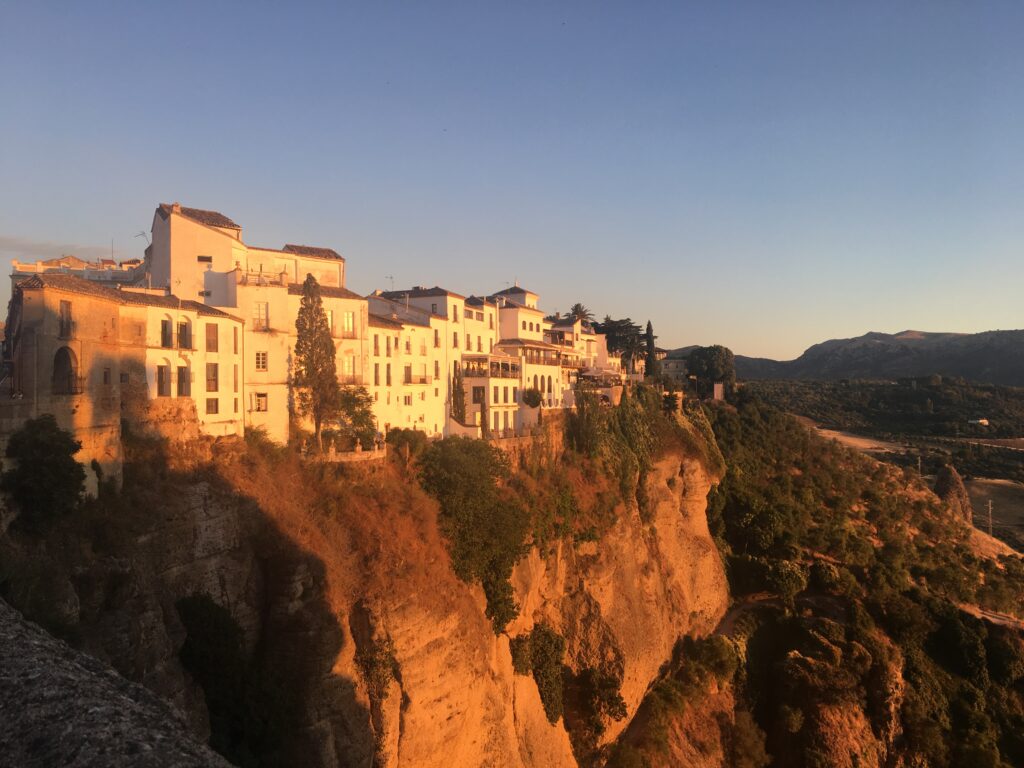
Here’s Gregg in front of the classic view of Toledo made famous in a painting by El Greco.

In front of the classic view of Toledo, Spain
Gregg Simpson in front of the classic view of Toledo, Spain

Toledo is a popular tour stop, so during the day, you’ll have to dodge busloads of tourists huffing and puffing through the narrow streets in the stifling heat. Scoot around them to get a look inside the stunning cathedral that lives up to the hype.

I was mesmerized by the choir stalls. The carving on each stall is different.

Toledo is the place to buy items made from the famous Toledo steel. Display windows bristle with swords and knives and other sharp things that would never make it through airport security in your carry-on bag. I bought several pairs of sewing scissors as gifts.

Store window display of swords in Toledo
Store window display in Toledo

In the evening, once the tour buses have left, the streets fill with locals. Weave through the streets of the old town in search of tapas and wine. You’ll find plenty!


Visit Off-the-Beaten-Track Zaragoza

You’ll likely visit Zaragoza en route to somewhere else. It makes a convenient stopping point for drivers coming from France through the Pyrenees. You can also break up the drive from Barcelona to Madrid in Zaragoza.

The city is the perfect one-night stop along a desolate stretch of a very large country. And you’ll have a chance to enjoy a virtually tourist-free Spanish city that has a great deal to offer the visitor.

Zaragoza Overview

As the capital of the province of Zaragoza and of the autonomous community of Aragon, Zaragoza is a good size, but the interesting part of the city is compact enough to stroll around with just one inexpensive taxi ride out to the Aljafería Palace.

Here’s a map of the city showing the sights mentioned in this post:

Places mapped by Wanderlog, a trip planner on iOS and Android

The streets and shops are prosperous-looking, clean, and thronged with locals. You’re unlikely to see many tourists, although you’ll find an air-conditioned and well-staffed tourist office on the main plaza, so clearly tourists do go there.

A friendly young man at the tourist office told us where to go for cut-price tapas that evening. Apparently, there’s a street where all the tapas joints charge just €2 for a tapa and a glass of vino. Count me in!

Basílica de Nuestra Señora del Pilar

Zaragoza borders the Ebro River which you’ll probably drive across on your way into town and see again when you visit Zaragoza’s main sight: the Basílica de Nuestra Señora del Pilar (#1 on the map).

Cathedral and Ebro River in Zaragoza. Aragon, Spain
Cathedral and Ebro river in Zaragoza, Aragon, Spain

Built between 1681 and 1872, this massive Baroque cathedral with its fabulously tile-topped cupolas and turrets is worth a look. Wander around the vast aisles and check out the highlight: a roomful of paintings by Goya.

Zaragoza is Goya’s hometown, so across from the cathedral is a museum (#2) dedicated to his work. We didn’t visit it on this trip, instead opting to grab a cab to the Aljafería Palace which reportedly dates from Moorish times.

Aljafería Palace

We were virtually alone as we ambled through the various rooms to admire interesting exhibits and take photos of the attractive—and empty—courtyard complete with reflecting pond, palm trees, and arches. The Aljafería Palace (#3) is no Alhambra, but it’s worth a quick look.

Aljafería Palace in Zaragoza, Spain
Palace built in Zaragoza in the 11th century.

In the evening, stroll through streets comfortably filled with locals to find tapas. We arrived at the place of the €2 tapas at 8 pm, only to find it and most others still closed. This is Spain, where things typically don’t get going until well past 9 or 10.

But persevere and you’ll find that even regular-priced tapas are not expensive. Zaragoza is a bargain for food and drink.

We stayed at the Hotel NH Collection Gran Hotel de Zaragoza (#4) which was comfortable albeit rather bland. But the location was good and we could walk everywhere.


Explore Lovely Salamanca

Visit Salamanca on your way to or from Portugal. If your accommodation budget extends to a splurge, book into the Parador de Salamanca, located about a fifteen-minute walk from the town.

Cathedral of Salamanca next to the river in Salamanca, Spain
Cathedral of Salamanca next to the river

Paradors in Spain are special hotels usually located in historic buildings such as convents and palaces. They have a certain level of luxury with prices to match, although bargains can be had. Check the booking sites!

The parador in Salamanca is one of the few modern paradors in Spain. Its main claim to fame is its location overlooking the skyline of old Salamanca.

Here’s the view from our room:

Parador of Salamanca

Salamanca is a great place to visit for its old town, fabulous central plaza, and Casa Lis, a marvelous art nouveau museum. Here’s a map of the highlights mentioned in this post.

Trip map created with Wanderlog, the best trip planner app on iOS and Android

Casa Lis Art Nouveau and Art Deco Museum

If you love art deco, you’ll adore this museum. La Casa Lis itself is an extraordinary building in the art nouveau style with plenty of stained glass. Exhibits of over 2,500 pieces of art deco and art nouveau objets d’art include porcelain figures, gold and ivory statues, enamels, bronze items, toys, and even Fabergé eggs.

Casa Lis Art Nouveau and Art Deco Museum, in Salamanca, Spain
Casa Lis Art Nouveau and Art Deco Museum, Salamanca, Spain

The display of Paris fashion dolls from the late 1800s was especially compelling. Spend a couple of hours strolling from room to room in the virtually empty museum.

Plaza Mayor

Wander uphill into Salamanca’s lovely old town. Very little car traffic is allowed, so the streets are clear and easy to walk in. As the sun begins to go down, people flood into the streets to enjoy the evening air.

We arrived in the Plaza Mayor to find it packed with thousands of people waving placards. Just as in Madrid, Spain’s austerity measures were not going over well with the citizens of Salamanca. However, the protest was one of the most good-humored I’ve seen. The crowd consisted mostly of families and middle-aged or older people smiling and laughing as they periodically brandished their signs. The gist of most signs was a large, red “NO”.

If you encounter a protest (unlikely!), wait until it moves off , then snag a table to gaze out over what must be one of the loveliest plazas in Spain.

Enjoying Plaza Mayor

The Plaza Mayor appears square, lined on all four sides by uniform façades that date from the 18th century. Bands of young men dressed in medieval garb played Mexican-sounding music. We wondered why the music sounded so Mexican and were told by our server that Salamanca has maintained ties with Mexico and Latin America. Apparently, many of the Spanish people who emigrated to Mexico came from Salamanca, and some of the wealthier ones have returned to make Salamanca so prosperous-looking. It’s a beautifully maintained city.

Around 10:30, when the light still hadn’t faded much (it was early July), the lights were turned on, and everyone in the square gasped, much to the amusement of our server who just rolled his eyes. I guess he sees it every night.

Plaza Mayor in Salamanca, Spain
Plaza Mayor in Salamanca, Spain at night.

Where to Stay in Central Spain

For accommodation suggestions in Madrid, Toledo, Zaragoza, and Salamanca, see Where to Stay in Spain: My Best Picks.


Keep Traveling in Spain with Artsy Traveler

Have you visited the cities described in this post? Leave your comments below. Here are more Artsy Traveler posts about Spain:

Carol Cram
About Carol Cram

Carol M. Cram is the author of five award-winning historical novels inspired by art and the women who shaped it, the creator of Artsy Traveler, an arts-focused travel blog, the founder of Art In Fiction, a curated database of 2,500+ novels inspired by the arts, and the host of The Art In Fiction Podcast. She also authored 60+ textbooks on computer applications and taught at Capilano University for over two decades. She lives with her husband, artist Gregg Simpson, on beautiful Bowen Island near Vancouver, BC.