

One Day in Manchester: Pre-Raphaelites, a Gothic Library, and a Dying Chopin
I'm Carol Cram, novelist and arts travel writer, and founder of Art In Fiction, a curated database of 2,700+ novels inspired by the arts. Artsy Traveler contains affiliate links for products and services I personally use and recommend. As an Amazon Associate, I earn from qualifying purchases. Please read the Disclosure for more information.
Manchester was never high on my list of cities to visit in the UK, which is a bit unfair of me. The city won’t win awards for beauty, but it does have quite a lot to offer the Artsy Traveler with a day to spare.
In addition, Manchester’s proximity to the Yorkshire Dales makes it a good place to pick up a day trip to Brontë country.
I spent a day in Manchester as part of my three-week trip to the UK and Ireland. Here’s how the day went, what I’d do again, and whether Manchester deserves more than a day of your time.
Table of contents
Where I Stayed: The Alan
The Alan is a boutique hotel in a converted industrial building. Although exposed pipes, brick, and big windows give it a warehouse feel, the room was comfortable and quiet. Best of all, the central location made it easy to walk everywhere I wanted to go.

Getting Around Manchester
The city centre is compact, and a good chunk of it is traffic-free, so it’s easy to explore on foot. Trams cover anything farther afield.
Walking is the best way to catch Manchester’s habit of tucking Victorian red brick between glass towers. This little church, St Mary’s on Mulberry Street, is known locally as the Hidden Gem. You turn a corner from the office blocks and there it is.

A few minutes away, the Town Hall’s Gothic clock tower dominates Albert Square. When I visited, scaffolding wrapped much of the Town Hall.
The Town Hall interested me in particular because it makes a cameo appearance in my novel The Choir. Back when the novel took place, the hall would have been black with soot. Clean-up efforts in recent years have revealed the hall in all its Victorian Gothic glory.

Manchester Art Gallery
I had one full day to spend in Manchester, so naturally my first stop was Manchester Art Gallery on Mosley Street.
The gallery is housed in a Greek Revival building designed by Charles Barry, the architect who later gave London the Houses of Parliament. The city took over the building and its collection in 1882, and the gallery has kept growing ever since.
Admission to the permanent collection is free. I love how so many major galleries are free in England!

Look up as you come in. Barry’s entrance hall is pure Greek Revival, with casts of the Parthenon frieze marching around the walls under a coffered ceiling.
Like Liverpool, Manchester got rich on cotton, and its merchants spent a good deal of that money on contemporary art, which, in the second half of the 19th century, meant the Pre-Raphaelites.
The result is one of the best Pre-Raphaelite collections in the country, hung on deep red walls that make the colours sing.
Here are a few of my favourites.
Astarte Syriaca by Dante Gabriel Rossetti (1877)

Described as an earlier and more menacing version of Venus, Astarte was an ancient Middle Eastern goddess of love. She shimmers in a clinging green gown, flanked by two torch-bearing attendants gazing up at her emblem, an eight-pointed star where the sun and moon meet. According to legend, her girdle made her irresistible.
Rossetti packed the picture space so tightly that Astarte looks ready to step out of the frame and confront you. As with most of Rossetti’s goddesses, the face is that of Jane Morris, the wife of his friend William Morris.
Sibylla Delphica by Edward Burne-Jones (about 1886)

Burne-Jones’s Sibyl of Delphi, priestess of one of the most important temples in ancient Greece, stands in coral drapery beside the sacred flame, holding the laurel leaves her famously puzzling prophecies were written on.
The painting began as a design for a church window, which explains the tall, narrow format. Sibyls were believed to have foretold the coming of Christ, and this one supposedly said “the Prophet born of the Virgin shall be crowned with thorns.”
Burne-Jones probably had Michelangelo’s sibyls on the Sistine ceiling in mind, which he’d seen in Rome.
Eve Tempted by John Spencer Stanhope (about 1877)

This painting is one of my favourite depictions of Eve. I can’t decide whether she looks pensive or sad, as if she knows what’s about to happen thanks to the weird-looking dude whispering in her ear. She almost seems to be resigned to a fate she doesn’t deserve.
The label calls her a femme fatale, but I don’t see it. She is more like Everywoman caught up in a fate she has no control over, and yet she is determined to survive.
A day later at the Walker Art Gallery in Liverpool, I found Stanhope’s Expulsion from Eden, with Adam and Eve being shown the door. So if you visit both cities, you get the before and after.
The Bower Meadow by Dante Gabriel Rossetti (1850 to 1872)
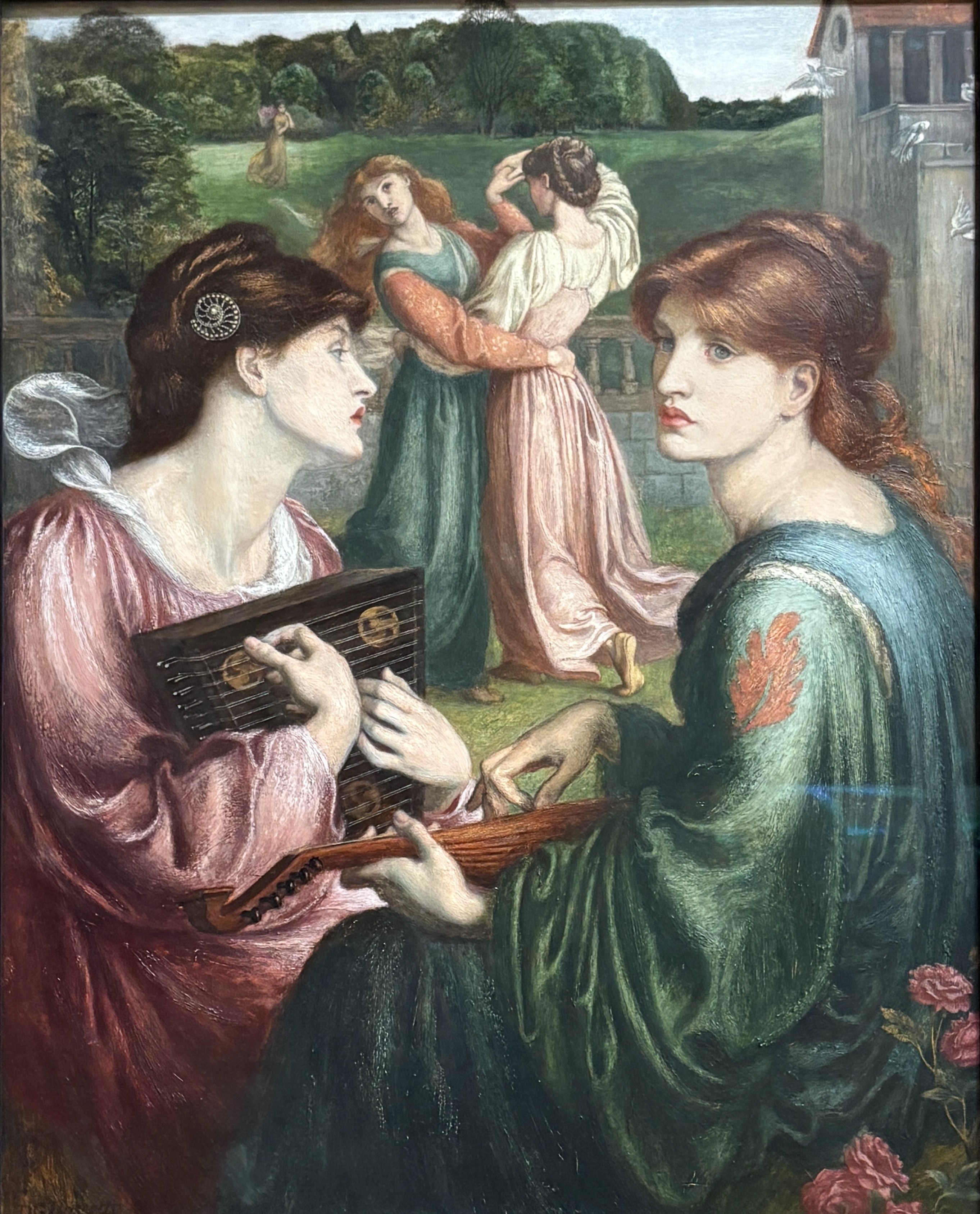
This painting took Rossetti 22 years to complete. He first painted the background outdoors at Sevenoaks in Kent in 1850, in the company of Holman Hunt, as part of a big picture of Dante meeting Beatrice in Paradise. Then he put the canvas away.
When he picked it up again twenty years later, his style had gone soft and lyrical, and so he filled the meadow with musicians and dancers. According to the label, he painted it after what he called his “time of love” with Jane Morris at Kelmscott Manor, which explains the mood. The label calls it “an undefined feeling of poetic melancholy.” The two women in front look like they’ve just been told something they’d rather not have heard.
Sappho by Auguste Charles Mengin (1877)

Not everything on the red walls is British. This French Salon painting shows the Greek poet Sappho on a cliff above the sea, lyre in hand, at the moment before she supposedly threw herself in over unrequited love for a young man. It’s one of several stories told about her, and Mengin picked the most dramatic.
What I appreciated was the label’s candour. It notes that the painting has “an intense sexual charge intended to appeal to male viewers” at the Paris Salon, with the fine brushwork and the classical reference there to make it respectable.
The Sirens and Ulysses by William Etty (1837)

And then there’s Etty, who makes Mengin look restrained. This enormous canvas shows Ulysses lashed to his mast and his men rowing hard, their ears stuffed with wax, past three Sirens singing on a beach littered with the bodies of sailors who didn’t have the wax.
According to the label, Etty modelled those dead bodies on real corpses he’d sketched in morgues. The critics, already sniffy about all the nudity in his work, were particularly appalled by nudity and death shown side by side. Etty considered it one of his most important works. A Mancunian cotton mill owner, Daniel Grant, bought it from him, and it came to the gallery from the Royal Manchester Institution in 1882. Apparently Manchester’s mill owners were made of sterner stuff than London’s critics.
Glen Birnam by Sir John Everett Millais (1891)
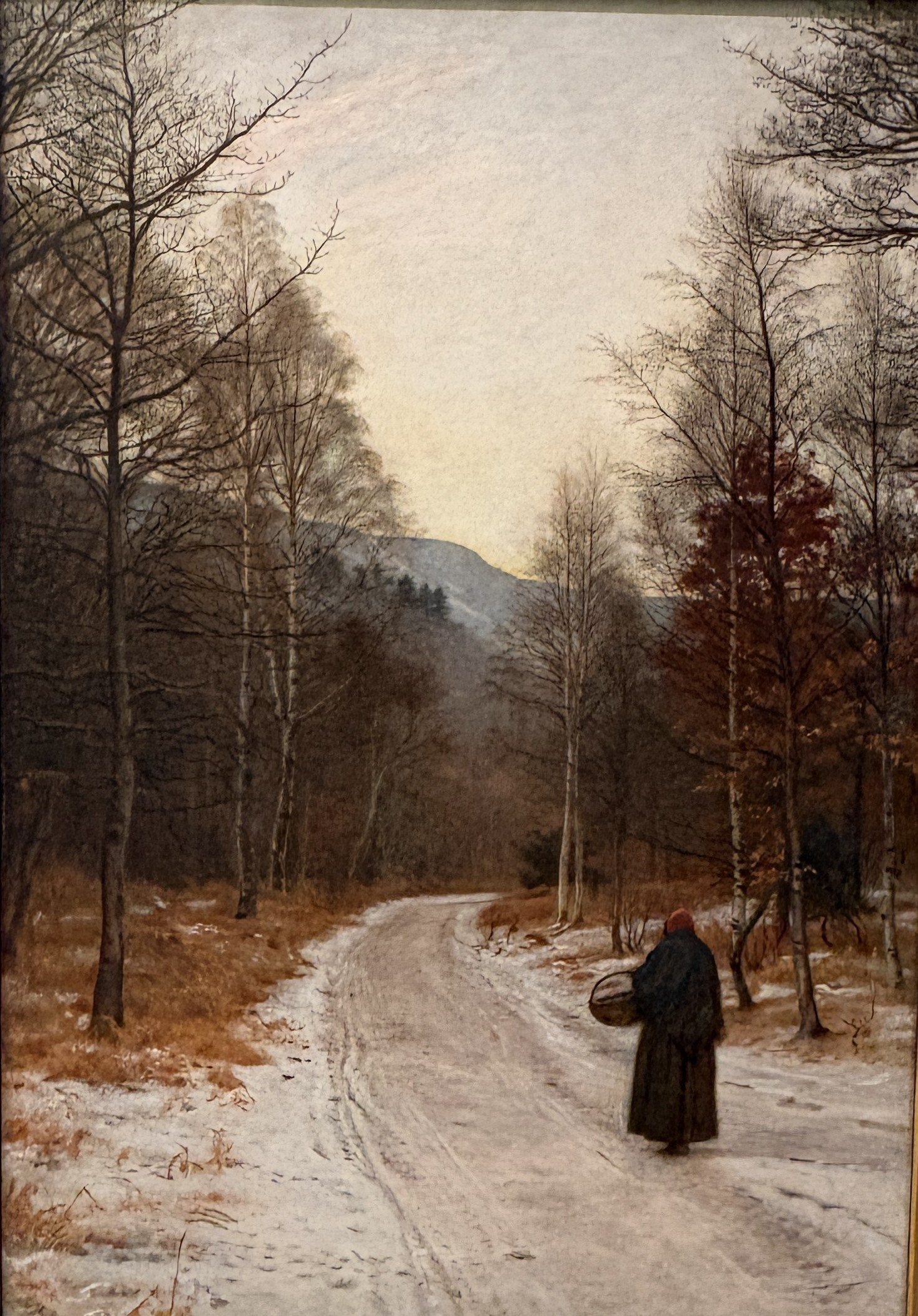
By 1891, Millais was one of the busiest and most popular painters in Britain, and the label notes, with some sympathy, that after months of trying to please the people whose portraits he was painting, it was good to escape to Perthshire and a landscape like this. A frosty road, bare birches, and a lone woman with a basket beautifully capture the bleak beauty of the region.
Duff by Ruth Murray (2018)
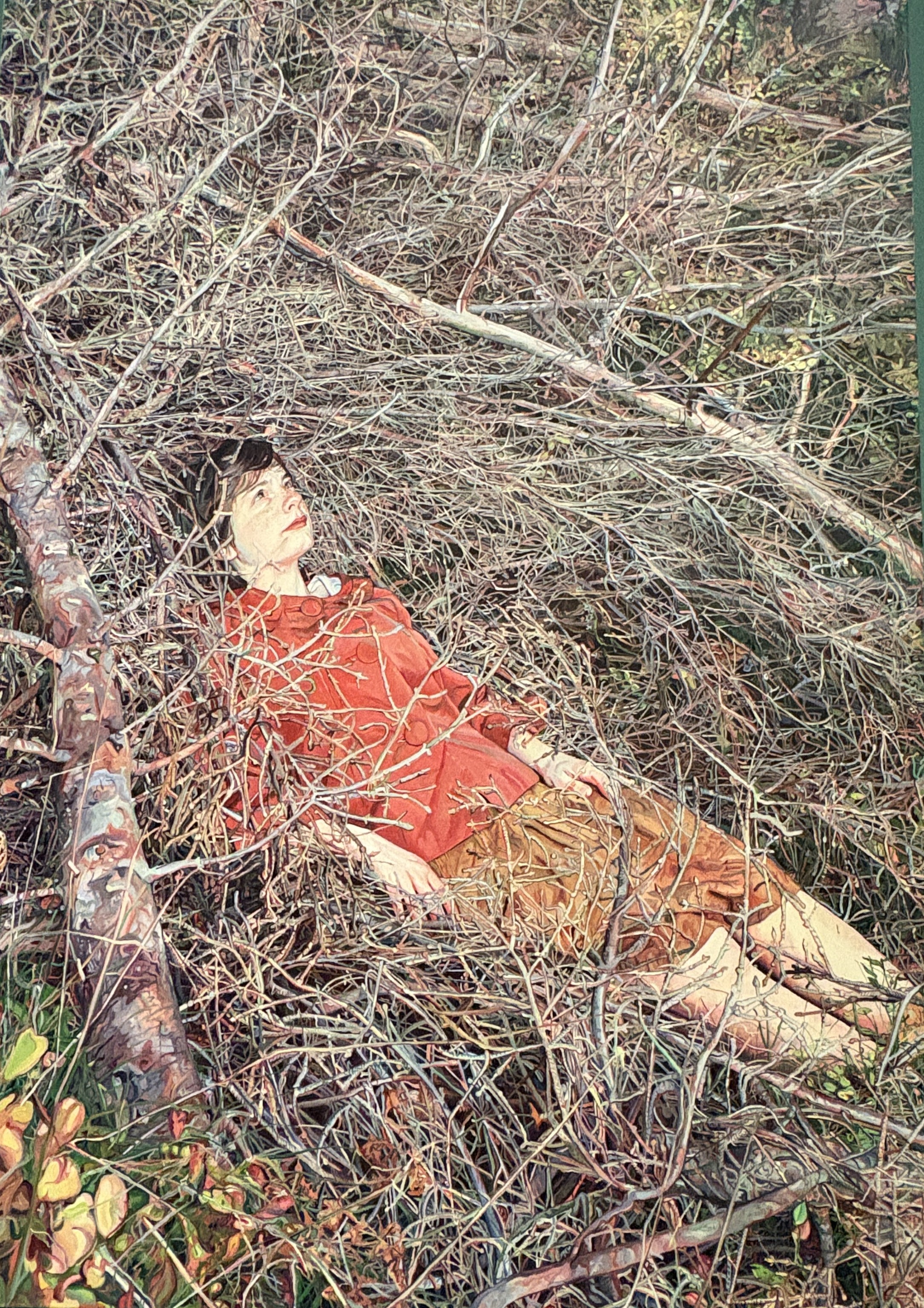
Not everything at Manchester Art Gallery is Victorian. Ruth Murray is a Manchester-based painter whose work always puts women and their experience at the centre, and she staged this one in Bergen, Norway. “Duff,” I learned from the label, is the decaying matter that covers the ground under trees.
A young woman in a red coat lies tangled in twigs and branches, looking at something outside the frame. The label asks whether she’s distant, bored, trapped, or lost, and refuses to say. I couldn’t decide either, which is presumably the point.
The John Rylands Library
If you only have time for one thing in Manchester, make it the John Rylands Library on Deansgate. From the outside it looks like a cathedral that wandered into the wrong neighbourhood, especially now that the glass boxes of Spinningfields have sprung up next door.
The library exists because of Enriqueta Rylands, the third wife of John Rylands, a textile magnate and Manchester’s first multimillionaire. When he died in 1888, Enriqueta spent a large part of her fortune building a library in his memory. She hired the architect Basil Champneys, took a close interest in every detail, and opened the doors to the public on January 1, 1900.

You approach the reading room up stairs and along vaulted corridors that feel designed to make you lower your voice before you get anywhere near a book.
The building is neo-Gothic from top to bottom: soaring vaults, carved stone, stained glass, and a long reading room. It was also remarkably modern for its day, with electric lighting from the start and an air filtration system to protect the books from Manchester’s notorious soot.

The Reading Room
The Historic Reading Room is the showstopper: a red carpet running down the centre like an aisle, octagonal oak tables, a great stained glass window at the far end, and a white marble statue of John Rylands where the altar would be. The reading alcoves along the sides are watched over by statues of the great and good of literature, theology, and science.
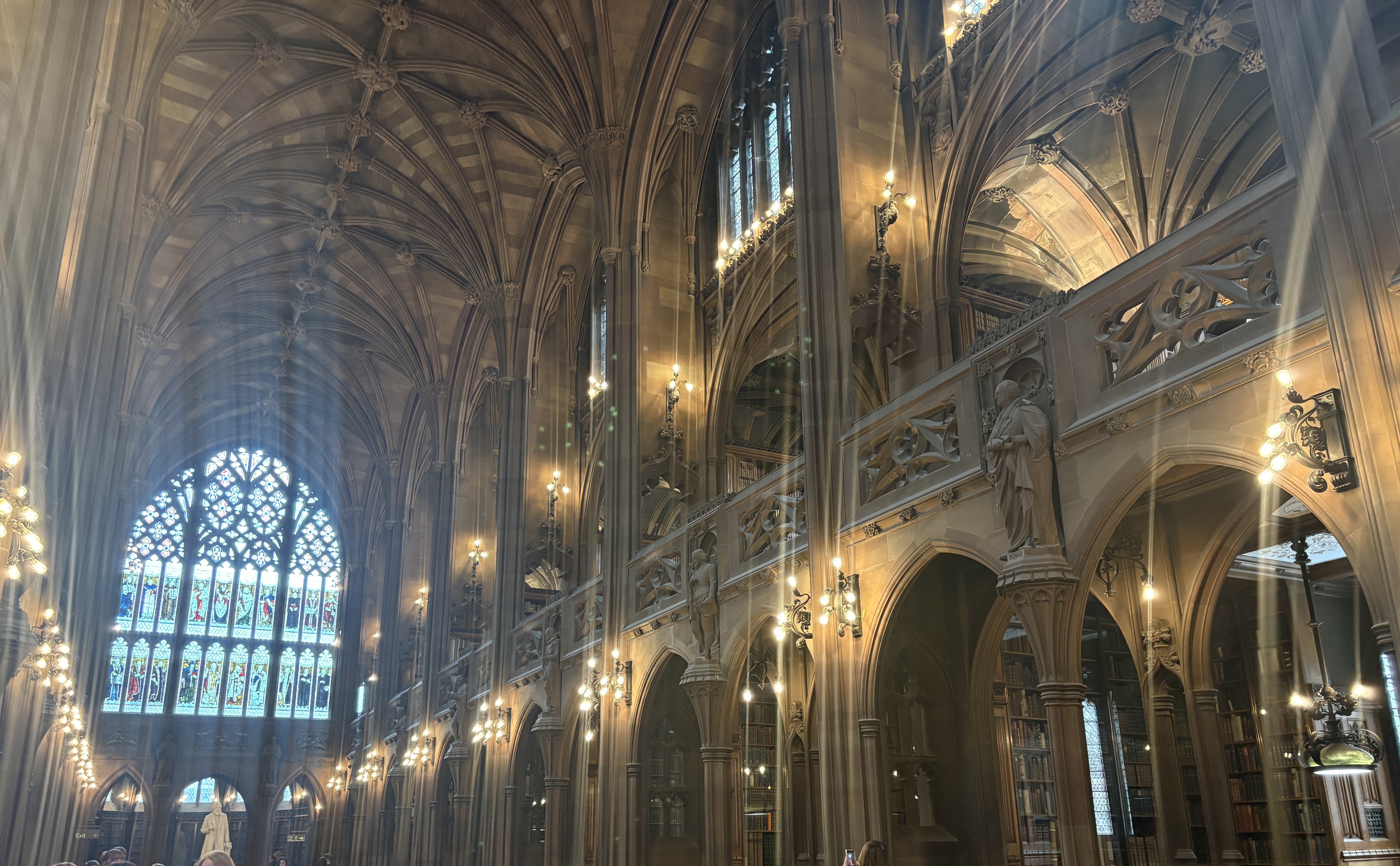
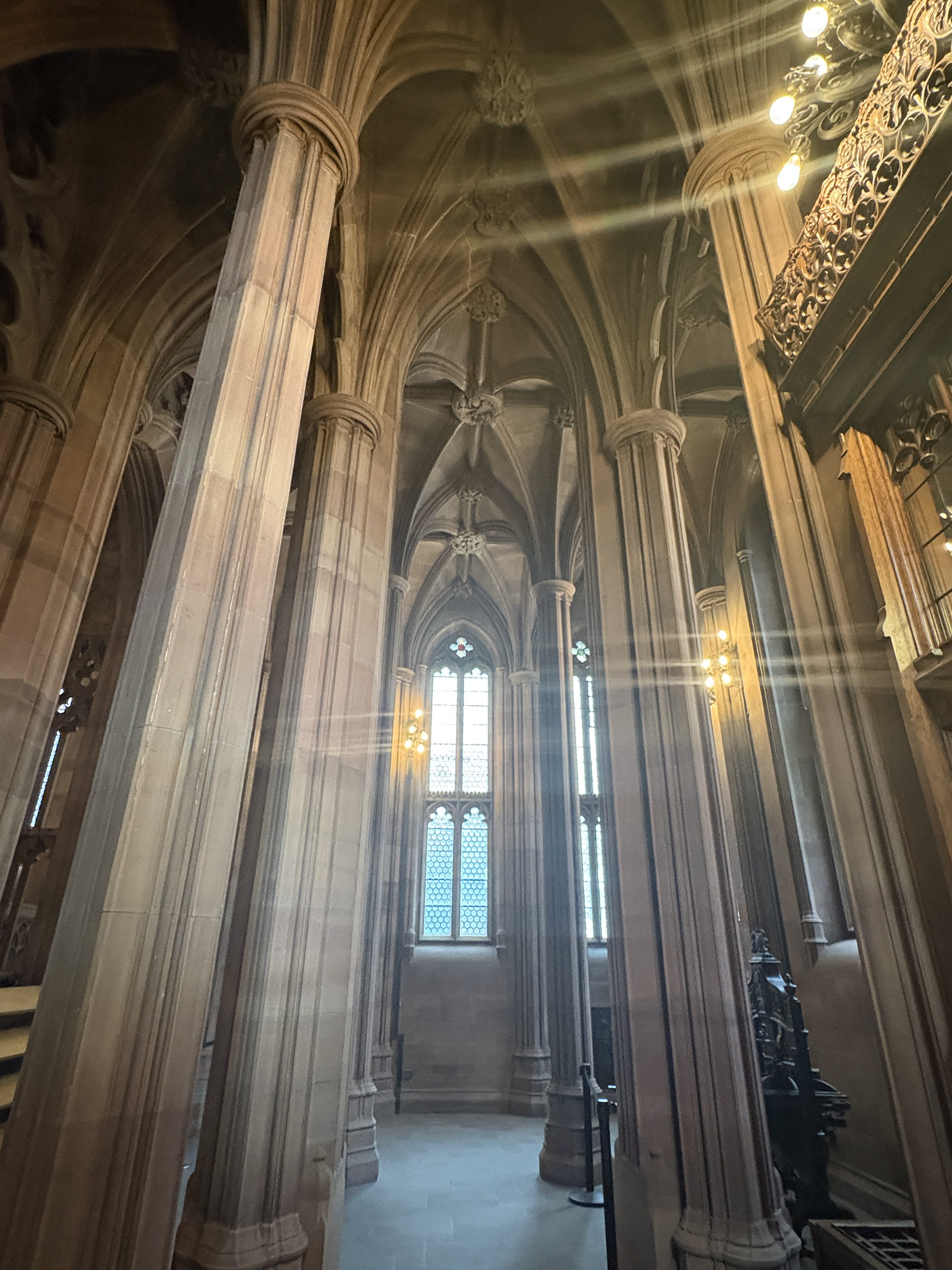


The staircases and landings are carved in red sandstone with a delightful plethora of tracery, foliage, and fan vaulting.
As for what’s on the shelves, Mrs. Rylands didn’t do things by halves. She bought the celebrated Spencer collection of early printed books from Althorp, which included a large number of books printed by William Caxton, and she followed it up with a major collection of manuscripts.
Among the library’s treasures is a scrap of papyrus with a few lines from the Gospel of John, thought to be one of the earliest surviving fragments of the New Testament. Today the library is part of the University of Manchester, and admission is free.
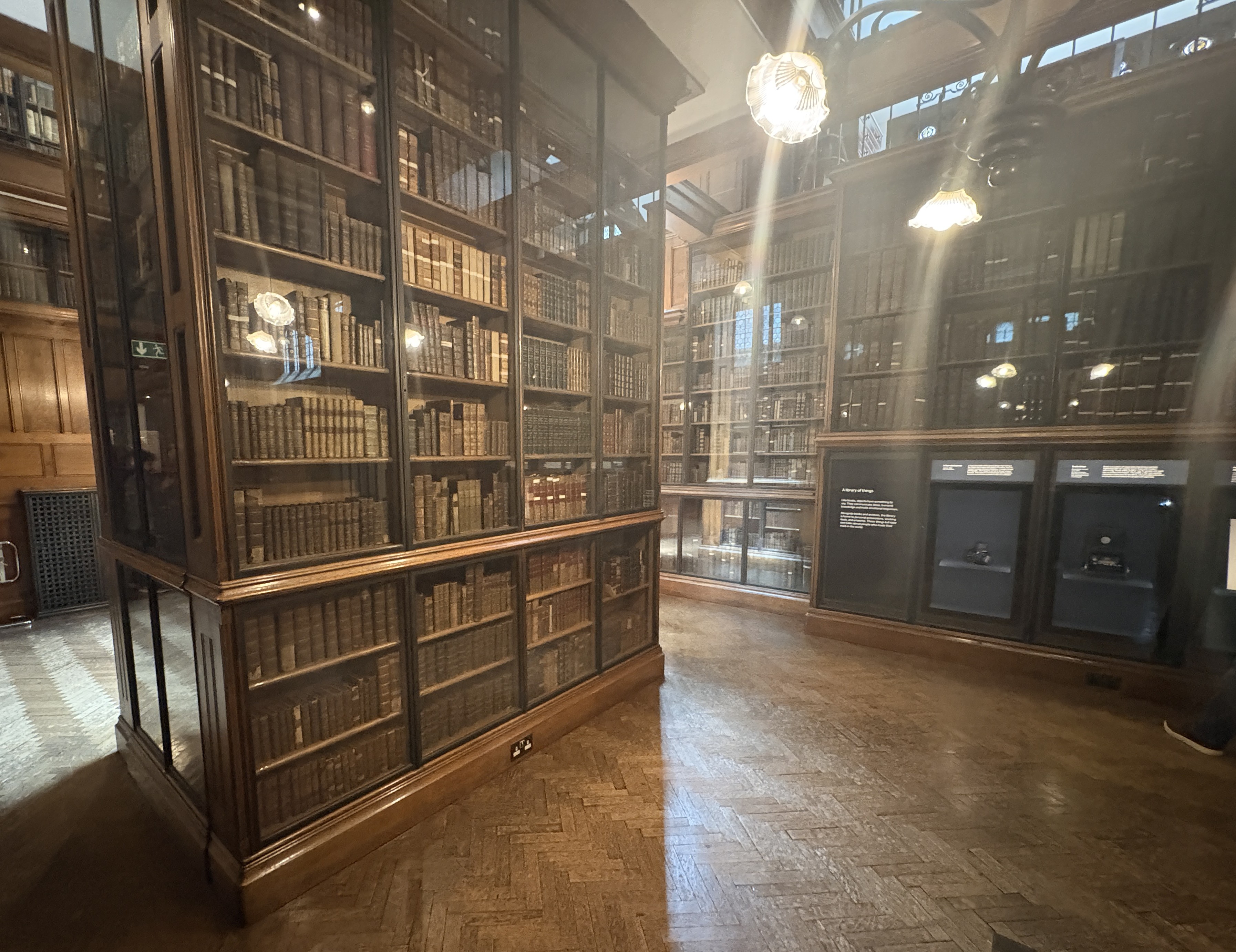
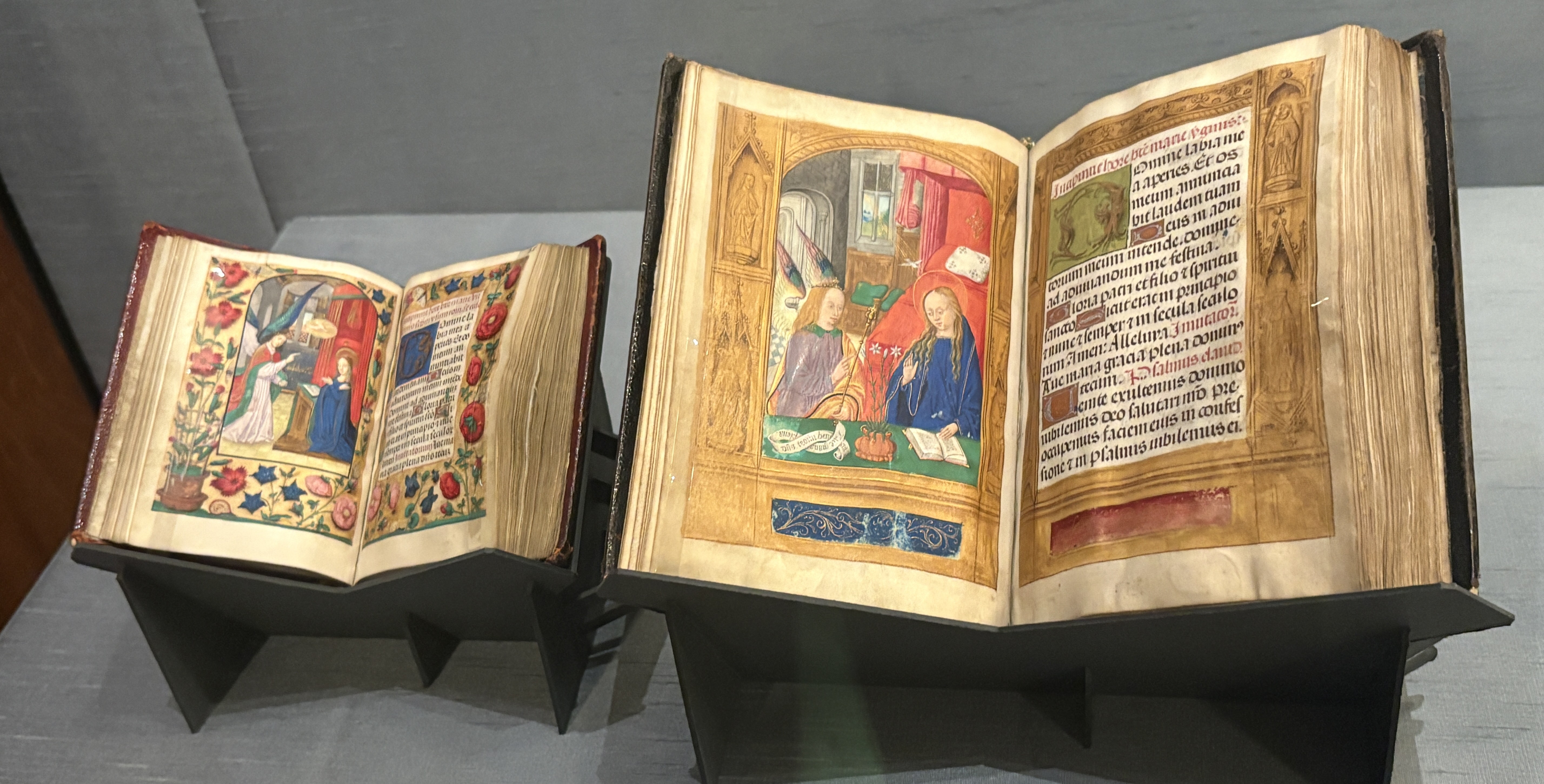
The display galleries, under more rib vaulting, are where you get up close to the collection. I lingered over a pair of illuminated books of hours, both open at the Annunciation: in one, the angel Gabriel arrives through a border of painted roses and carnations, and in the other, the Virgin sits reading at a green table with a pot of lilies, under a frame of gilded Gothic niches. Someone spent months on each page. Five hundred years later, the gold still catches the light.
Although admission is free, you may encounter a line-up to get in. I waited about twenty minutes.
Dinner with a Fellow History Lover
That evening I had dinner with a member of the Huddersfield Choral Society at a lovely Italian restaurant where the food was excellent and the conversation even better. We talked history for most of the evening, and it turns out she’s planning to write historical fiction herself.
Manchester’s Statues: Pankhurst, Lincoln, and Chopin
What I liked best about wandering the centre were the unexpected touches, particularly the statues.
Emmeline Pankhurst
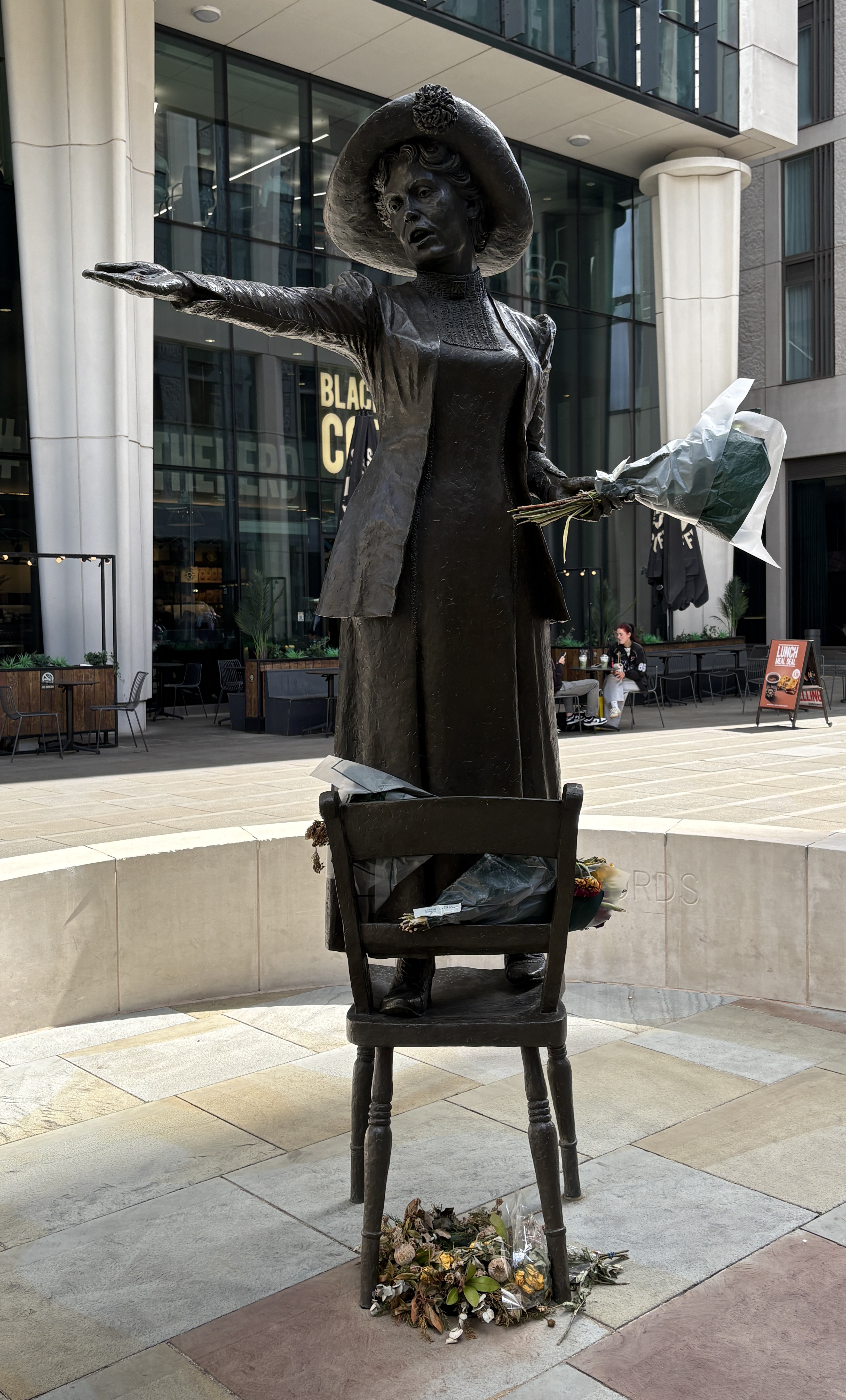
In St Peter’s Square, Emmeline Pankhurst stands on a chair, arm outstretched, mid-speech. The statue, by Hazel Reeves, went up in 2018, a hundred years after some British women first won the vote. Pankhurst was born in Manchester and founded the Women’s Social and Political Union here in 1903, so it seems only right that she has the floor.
When I visited, someone had tucked a bouquet into her hand and left more at her feet. A hundred-odd years on, people are still showing up for her.
Abraham Lincoln
Lincoln is here too, in Lincoln Square, which surprised me until I read why. During the American Civil War, Manchester’s cotton workers backed the Union blockade of Southern cotton, even though it put many of them out of work and into real hardship.
On January 19, 1863, Lincoln wrote to thank “the working people of Manchester.” His letter, reproduced on the plinth, calls their stand “an instance of sublime Christian heroism which has not been surpassed in any age or in any country.” Not many mill towns get a letter like that. Manchester put it on a statue.

Frederic Chopin
My favourite, though, was Chopin.
The bronze shows him at the piano while a woman rises out of a great swirl of sound, or possibly a cloak. Behind him, a figure brandishes a banner, a nod to his Polish patriotism.
The plaque tells the story. On August 28, 1848, a gravely ill Chopin gave a gala concert to an audience of 1,200 at the Gentlemen’s Concert Hall at the corner of Peter Street and Lower Mosley Street. He was dying of tuberculosis and yet insisted on performing, which, according to the plaque, has endeared him to Mancunians ever since. He died in Paris the following year, aged 39.
The British tour was exhausting, the weather was damp, and the trip pretty much finished him off.

He wasn’t the only one having a terrible 1848. About 40 miles away in Haworth, Branwell Brontë died that September and his sister Emily that December. I visited their home the next day, and you can read about it in A Day Trip to Haworth and the Yorkshire Dales from Manchester.
Is Manchester Worth a Visit?
Yes, for one busy day.
The centre is compact and easy to walk, the Rylands Library is magnificent, and the art gallery’s Pre-Raphaelites are worth the trip on their own. Add in Mrs. Pankhurst, Mr. Lincoln, and a dying Chopin, and you have a very pleasant day.
Manchester also makes an excellent base for exploring the region. It’s well connected by train and a short hop from the Dales, the Brontës, the Lake District, and Liverpool. I used it to launch a day trip to Haworth and the Yorkshire Dales, which was the highlight of my time in the north.
Use it as a launch pad, and give it a day of its own on the way through. Here are some tours of the region that go from Manchester:
What to Read Before You Go
The Education of Delhomme: Chopin, Sand, & La France by Nancy Burkhalter
Chopin’s final years, including the 1848 British tour that helped finish him off, seen through the eyes of his fictional piano tuner, who gets tangled up in a spy ring targeting George Sand during France’s revolutionary upheavals.
The Choir by Carol M. Cram
In the mill towns of 1890s Yorkshire, Eliza Kingwell forms a choir of spirited working women to win a singing competition and the prize money that could free her from a loveless marriage. The catch: her estranged friend Ruth Henton, a disgraced star of the London stage, is one of the judges. Manchester Town Hall makes a cameo.
Manchester FAQs
For the highlights, yes. One busy day covers Manchester Art Gallery, the John Rylands Library, and the statues of Pankhurst, Lincoln, and Chopin, all within walking distance of each other in the compact city centre.
Yes. Admission to the permanent collection is free, including one of the best Pre-Raphaelite collections in Britain, with works by Rossetti, Burne-Jones, and Millais.
No, admission is free. The library is on Deansgate and is part of the University of Manchester. Be prepared for a line-up to get in. I waited about twenty minutes.
During the American Civil War, Manchester’s cotton workers supported the Union blockade of Southern cotton even though it cost many of them their jobs. In 1863, Lincoln wrote to thank the working people of Manchester, and his letter is reproduced on the statue’s plinth in Lincoln Square.
Manchester is well connected by train and makes a good base for tours to Haworth and Brontë country, the Yorkshire Dales, the Lake District, and Liverpool. I took a day trip to Haworth and the Yorkshire Dales from Manchester, and it was the highlight of my time in the north.
I stayed at The Alan, a boutique hotel in a converted industrial building. The room was comfortable and quiet, and the central location made it easy to walk everywhere.
Keep Exploring England with Artsy Traveler
- One Day in Liverpool: What I Saw, What I Loved, and What I’d Skip
- Ten Lakes in a Day: A Mountain Goat Tour from Windermere
- A Day Trip to Haworth and the Yorkshire Dales from Manchester
- Day Tours from York: Whitby, the Moors, and the Dales
- Get The Best Out Of Southwest England On A Rabbie’s Small-Group Tour
- Hidden Gems of the Cotswolds: An Excellent Day Out with Go Cotswolds Tours
- Birmingham City Break: Why England’s Second City is a Pleasant Surprise
- Stratford-upon-Avon: A Love Affair for Shakespeare and Theater Fans

Carol M. Cram writes novels inspired by the arts; runs Artsy Traveler, an arts-focused travel blog, and Art In Fiction, a curated database of 2,700+ novels inspired by the arts; and hosts The Art In Fiction Podcast. She has also authored 60+ textbooks on computer applications and taught at Capilano University for over two decades. Carol lives with her husband, artist Gregg Simpson, on beautiful Bowen Island near Vancouver, BC.

 See all my novels