Behind the Red Door: A Private Tour of the Charles Dickens Museum
I'm Carol Cram, novelist and arts travel writer, and founder of Art In Fiction, a curated database of 2,700+ novels inspired by the arts. Artsy Traveler contains affiliate links for products and services I personally use and recommend. As an Amazon Associate, I earn from qualifying purchases. Please read the Disclosure for more information.
I vividly remember staring at a large stack of very thick books by Charles Dickens and wondering how I’d get through them all. I was a student at Reading University taking a course that required me to read everything Dickens wrote.
He wrote a lot.
To be honest, I never managed to read everything Dickens wrote, but I did get through most of his novels and so naturally, I wanted to visit the Charles Dickens Museum on a recent trip to London. I reached out to the museum to request a tour so that I could write about it for Artsy Traveler and discovered that my contact was also a Reading University alumnus.
I love synchronicity!
If you visit the museum, I recommend taking a guided tour. While you can wander through the house on your own, your visit will be richer with a tour. The staff enliven the experience with plenty of stories about Dickens, and you can ask questions.
Table of contents
Overview of The Charles Dickens Museum
The first thing I leaned was that Dickens lived in several homes in London during his lifetime, but only the one where he moved with his wife and young family at the beginning of his career has survived. The original house plus the house next door is now the Charles Dickens Museum.
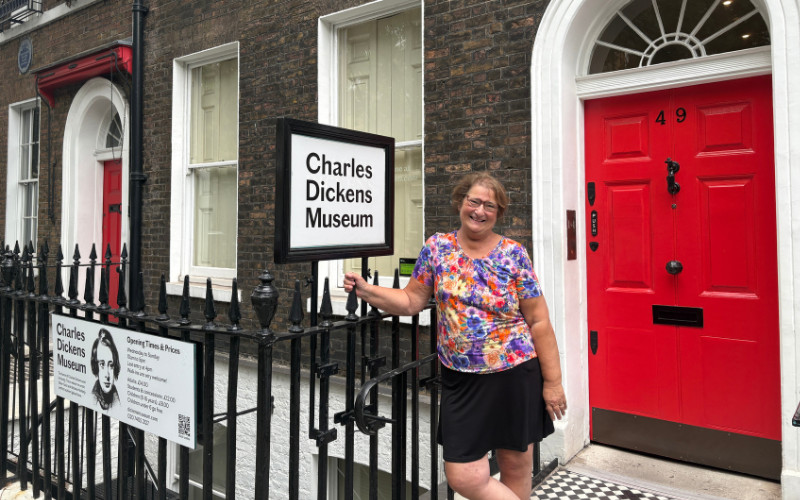
The Charles Dickens Museum is located at 48 Doughty Street in a quiet area of Bloomsbury lined with Victorian houses and a short walk from the British Museum.
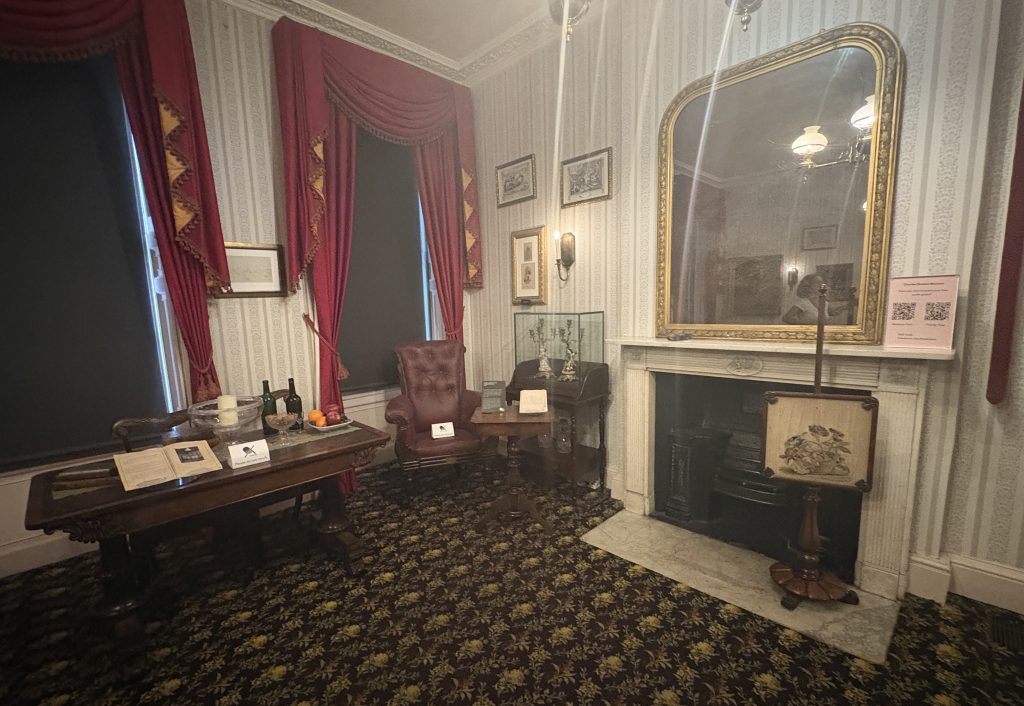
Dickens moved here at age twenty-five when he was just starting to become famous but was not yet rich. The modestly sized house is a good example of a middle class home from the period, complete with dining room, drawing room, a basement containing the kitchen, and bedrooms on the upper floors.
Even if you’re not a big Dickens fan, a visit to the Charles Dickens Museum is worthwhile to give you a feel for life in the early Victorian period.
The man who lived in this house wasn’t the whiskered elder most of us envision when we think of Charles Dickens. A portrait in the hall depicts him with long, wavy hair that makes him look like a romantic poet. He was quite the looker in his day.
The Private Tour
The Ground Floor


The Study
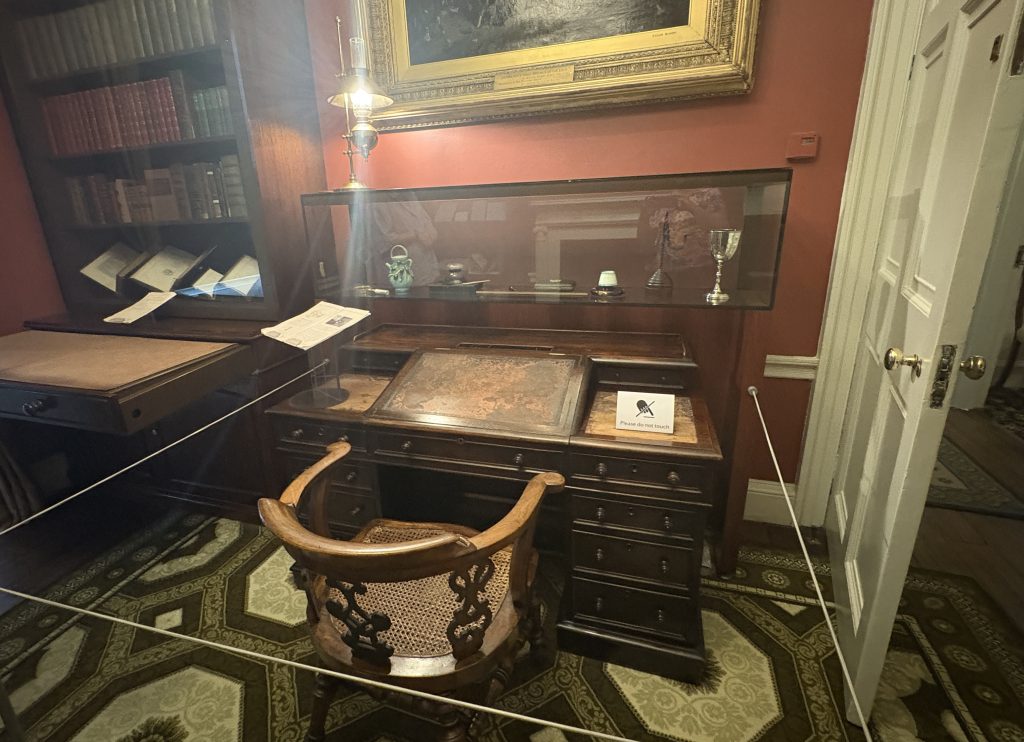
A highlight of the museum, and the room most people look forward to seeing, is the study. Here is where Dickens actually wrote. You can gaze upon his desk and the cane chair in which he sat.
Apparently, the cane bottom with its holes for ventilation was an important feature for Dickens, who suffered from a condition not to be mentioned in polite company.
The guides told a story about one of his daughters who wanted to watch him work. Within minutes of her entering the study, Dickens forgot she was in the room. He jumped up from his desk and started acting out his characters in front of the mirror, pulling faces and expressions before returning to his desk to write down what he saw.
No wonder Dickens’s characters were so vivid. I was reminded of one of my favorite passages from Dickens, his description of Ebenezer Scrooge from A Christmas Carol:
The cold within him froze his old features, nipped his pointed nose, shriveled his cheek, stiffened his gait; made his eyes red, his thin lips blue; and spoke out shrewdly in his grating voice.
Upstairs

The Garden, the Tea Shop, and a Fridge Magnet

Practical Visitor Information
Location of the Charles Dickens Museum
The Charles Dickens Museum is located at 48 Doughty Street in London. The closest London Underground station is Russell Square (Piccadilly line), about a 5-minute walk from the museum. Other nearby Tube options are Chancery Lane (Central line), Kings Cross/St Pancras Station (Victoria, Piccadilly, Hammersmith & City, Northern, and Metropolitan lines), and Paddington (Elizabeth line).
Hours & Tickets
The Charles Dickens Museum is open Wednesday to Sunday from 10am to 5pm, and is closed Mondays and Tuesdays. Tickets: Adult (17+) – £14.00; Child (6 – 16) – £8.00; Child (under 6) – Free; Concession (see the website for eligibility) – £12.00
Tours
Check the museum’s website for guided tour times before you go. Note that guided tours only operate outside of normal opening hours. Here are the tours currently offered:

Charles Dickens Museum FAQs
Adult tickets are £14, concessions £12, children 6 to 16 are £8, and children under 6 enter for free. Check the museum’s website for current concession eligibility.
The museum is open Wednesday to Sunday, 10am to 5pm, and closed Mondays and Tuesdays.
Yes, though guided tours run outside normal opening hours, so check the museum’s website for current tour times and book ahead.
The museum is located at 48 Doughty Street in Bloomsbury. The closest Tube stop is Russell Square on the Piccadilly line, about a 5-minute walk, with Kings Cross/St Pancras and Chancery Lane stations also nearby.
Yes. Even without deep Dickens knowledge, the house is a well preserved example of an early Victorian middle class home and gives real insight into daily life in that period.
Recommended Novels to Read Before You Go
Mr. Dickens and His Carol by Samantha Silva imagines Dickens in 1843, broke, blocked, and dreading Christmas, wandering London in search of the story that becomes A Christmas Carol. This novel is a fitting companion to the study where you can still see the desk and chair where he actually wrote it.
Mrs Dickens by Emily Howes retells the marriage from Catherine Dickens’s side, including the death of her younger sister Mary at seventeen, in the very house that’s now the museum. This novel is a sharper, sadder companion to the bedrooms upstairs.
Search more novels about Charles Dickens on Art In Fiction →
Where to Stay in London
When visiting London, I suggest staying in the West End where you’ll have easy access to the theaters and many of London’s most iconic sites.
On a recent trip to London, I stayed at the Radisson Blu London Leicester Square, which of all the places I’ve stayed in London is the most conveniently located. I was within five minutes of all three of the theatrical performances I attended, and around the corner from the National Gallery and Trafalgar Square. My room was quite spacious and well-appointed, the staff were very helpful, and the air conditioning on some unseasonably hot days in August was more than adequate.
Here are other excellent options at which I’ve stayed:
Park Plaza Victoria. Located right across the street from Victoria Station, this place is a remarkably good deal for a modern, four-star hotel in the heart of London. My room for two was spacious and even had a view over London.
The Wilde ApartHotel in central London is also a wonderful choice. I appreciated its central location within walking distance of Trafalgar Square and most of the West End theaters. Check out my post about the Wilde ApartHotel.
Continue Exploring London’s Museums & Galleries
London is full of intriguing museums and cultural experiences, including many that remain delightfully off the beaten path.
If you’re planning to explore more of London’s outstanding museums and galleries, here are guides to three of my favorites:
- Best of the Courtauld Gallery in London: A Treasure Trove for the Artsy Traveler
- How to Get the Most Out of Your Visit to the Victoria and Albert Museum in London
- London’s National Gallery: The Best of the Best
For more inspiration, see Visiting England, where you’ll find all of my England travel guides in one place.
For guided literary experiences in London, GetYourGuide has some options:
Would you like to save this post?

Carol M. Cram writes novels inspired by the arts; runs Artsy Traveler, an arts-focused travel blog, and Art In Fiction, a curated database of 2,700+ novels inspired by the arts; and hosts The Art In Fiction Podcast. She has also authored 60+ textbooks on computer applications and taught at Capilano University for over two decades. Carol lives with her husband, artist Gregg Simpson, on beautiful Bowen Island near Vancouver, BC.

 See all my novels