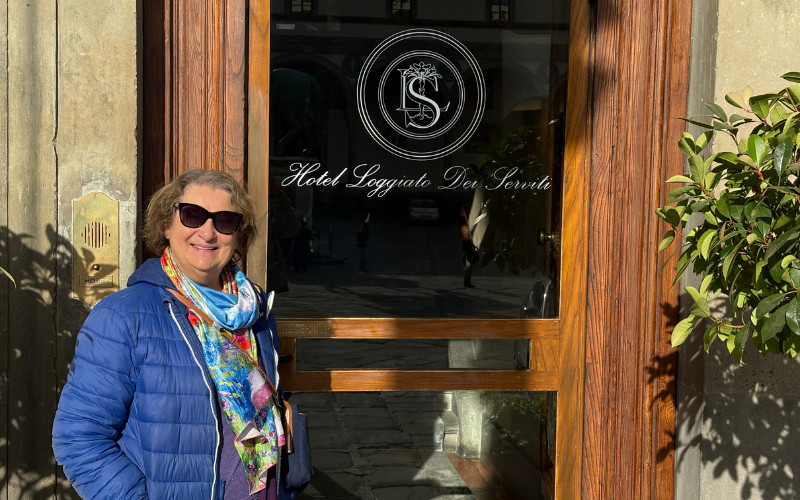
Hotel Loggiato dei Serviti, Florence: Sleeping Where the Pilgrims Slept
I'm Carol Cram, novelist and arts travel writer, and founder of Art In Fiction, a curated database of 2,700+ novels inspired by the arts. Artsy Traveler contains affiliate links for products and services I personally use and recommend. As an Amazon Associate, I earn from qualifying purchases. Please read the Disclosure for more information.
One of the many pleasures of visiting Florence is the chance to stay in a historic building. And by historic, I mean really historic, as in medieval or Renaissance (or even earlier).
I’ve stayed in a few of these hotels over the years, but my recent stay at the Hotel Loggiato dei Serviti was the most luxurious and the most interesting.
I stayed for three nights in November and was treated to a tour by Chiara Baruffa, the Operations Manager, who shared her extensive knowledge of the hotel’s history.
What follows is part hotel review and part history lesson, because at the Loggiato the two are hard to separate.
Short version: if you love art and history and want to sleep inside both, book this hotel.
The Loggiato is part of Dimore d’Epoca, a collection of historic residences across Italy where you’ll sleep inside the story rather than just next to it. I paid for my stay at Hotel Loggiato dei Serviti; the hotel kindly provided a small discount, a history tour and a welcome plate.
To view more hotels in the Dimore d’Epoca collection, check this page. You can select one of the hotels listed or search for a hotel in a location you are visiting. Artsy Traveler readers get 5% off the online rate at every property in the collection.
Table of contents
- Quick Pick: Hotel Loggiato dei Serviti
- From Country Chapel to Pilgrims’ Inn
- Guests You May Have Heard Of
- The Purest Renaissance Square in Florence
- From Convent to Hotel
- Our Room: Room 12
- Hotel Details
- Recommended Novels to Read Before You Go
- Hotel Loggiato dei Serviti FAQs
- Keep Exploring Florence and Tuscany with Artsy Traveler
Quick Pick: Hotel Loggiato dei Serviti
- Where: Piazza della Santissima Annunziata 3, a ten-minute walk from the Duomo
- Best for: art lovers, history buffs, and anyone who prefers antiques to prefab
- Room to request: Room 12 if you want space (and a Juliet moment), Room 28 if you want a story to take home
Ready to book? Book the Hotel Loggiato dei Serviti here
From Country Chapel to Pilgrims’ Inn
In 1087, the site of the hotel was open countryside outside the city walls, with a small chapel dedicated to San Sebastiano. It wasn’t until the last circle of walls went up from the 1280s to the 1330s that the area became part of Florence.
In 1233, seven Florentine noblemen received a call from the Virgin Mary to give up their wealth and dedicate their lives to her.
The seven men preached in the area for a while, then withdrew to a hermitage on Monte Senario in the hills north of the city. Years later they returned and founded the Servants of Mary, the Servites, which is where the hotel gets its name (Loggiato dei Serviti, literally the loggia of the Servites).
They laid the first stone of a larger church on March 25, 1250. Since that date was exactly nine months before Christmas, they dedicated it to the Annunciation.
In 1252, a friar named Fra Bartolomeo was painting an Annunciation for the church but couldn’t get the Madonna’s face right. He fell asleep in despair and awoke to find the angels had finished it for him. Word spread, and pilgrims poured in from the countryside and nearby cities to pray before the miracle-working image.
Since nobody could make the round trip in a day, the friars started building small lodgings for them. Over the next few centuries those lodgings grew into the building now housing the Loggiato dei Serviti. The finishing touch was the arcaded loggia, built between 1517 and 1523 by Antonio da Sangallo the Elder, that gives the hotel its name.

The building has been welcoming travelers for about 700 years. As Chiara pointed out, every guest at the hotel, me included, is a modern pilgrim.
Guests You May Have Heard Of
Florence’s northern gate, Porta San Gallo, stood just behind the church, so anyone arriving from the north came first to this square.
Leonardo da Vinci, having sold his Florence house, stayed with the friars on his trips back and forth between Florence and Milan before leaving for France for good. Martin Luther most probably stayed here too on his way to Rome in 1510.
The Purest Renaissance Square in Florence
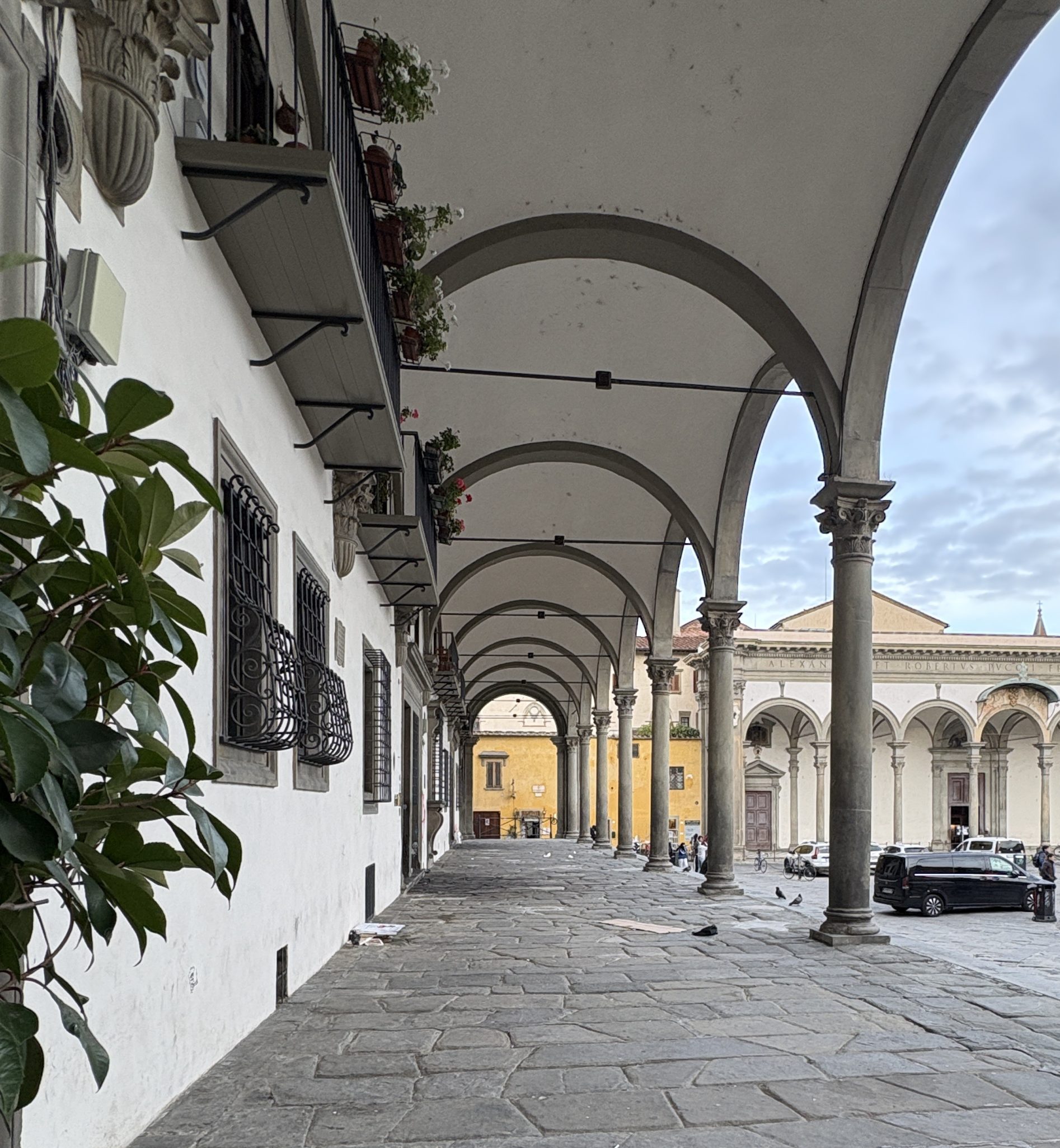
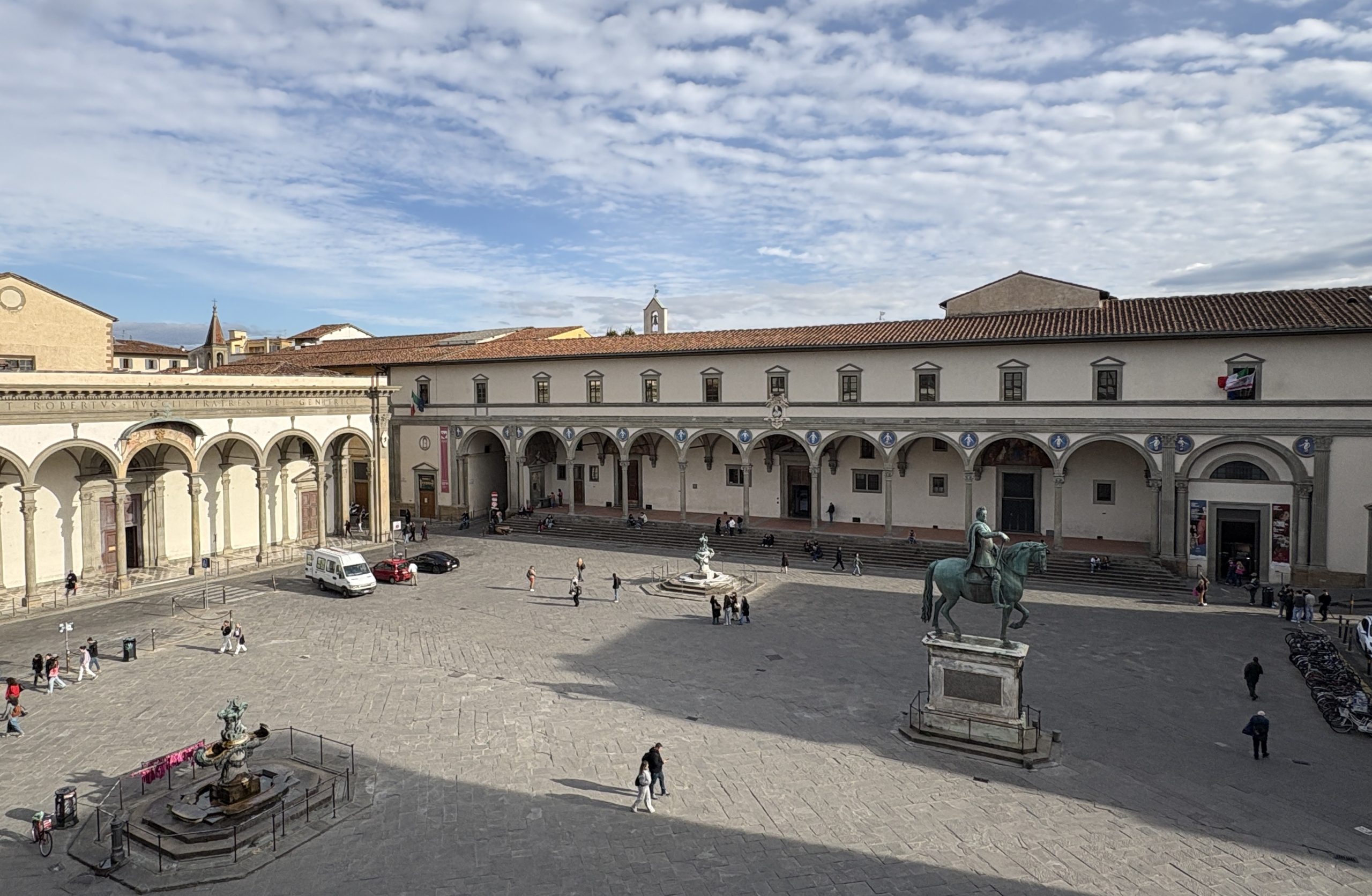
One of the many fascinating things about staying at the Loggiato dei Serviti is its location on what Florentines consider the purest Renaissance square in the city. Every building facing it has a story.
The Ospedale degli Innocenti
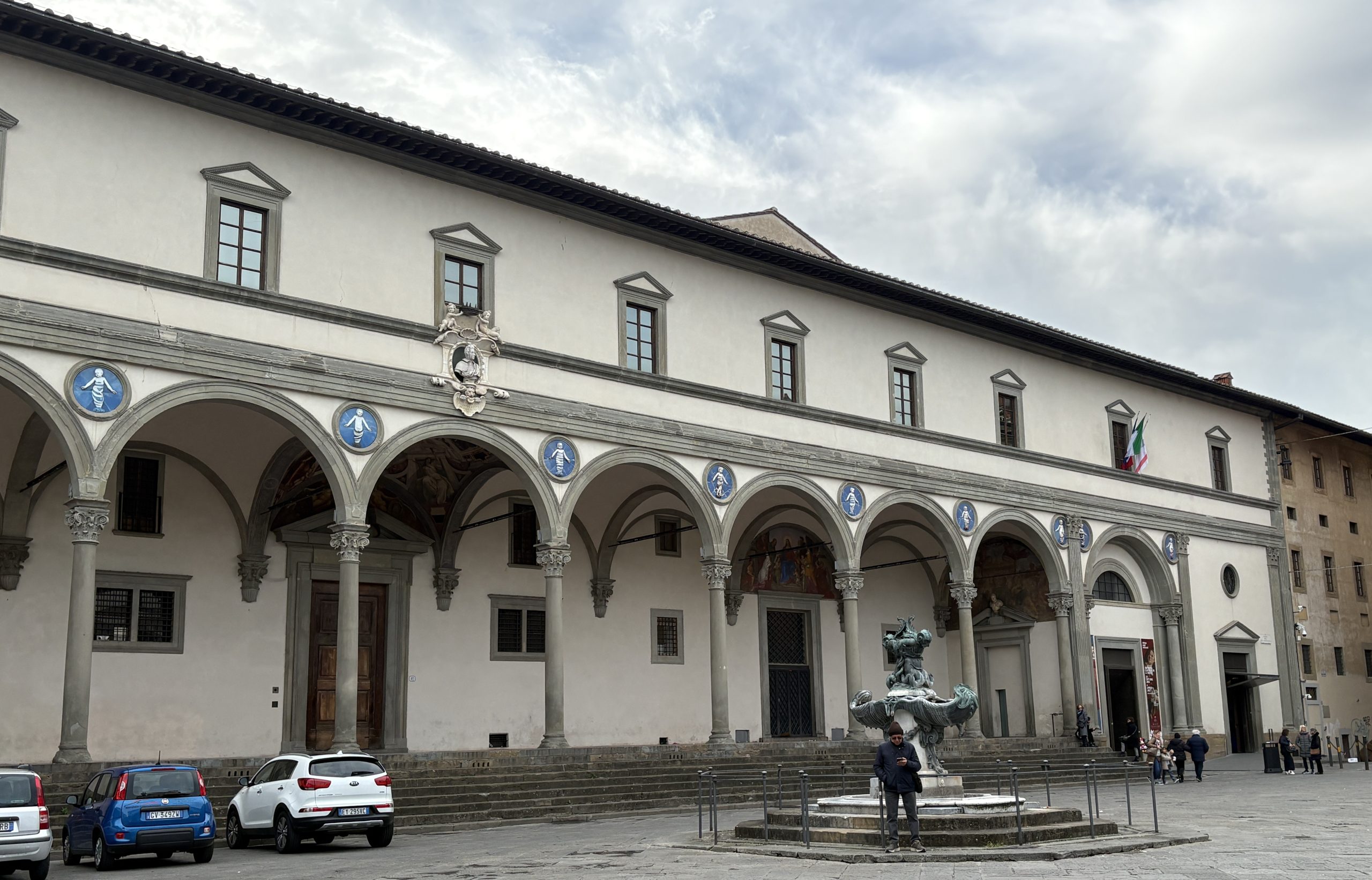
Directly across from the hotel is the Ospedale degli Innocenti, which was an orphanage rather than a hospital. Brunelleschi got the commission to build it in 1419, and then got the commission to build the dome on the Duomo in 1420.
As I gazed out my window on the second floor overlooking the square, I could imagine Brunelleschi striding between his two building sites.
Parents leaving a child at the door of the orphanage often left a token with the baby, such as a single earring or half a medallion, so they could reclaim the child if the family’s fortunes improved. All along the arcade are the blue and white Della Robbia roundels of swaddled babies, still the symbol of the institution.
The Basilica of Santissima Annunziata
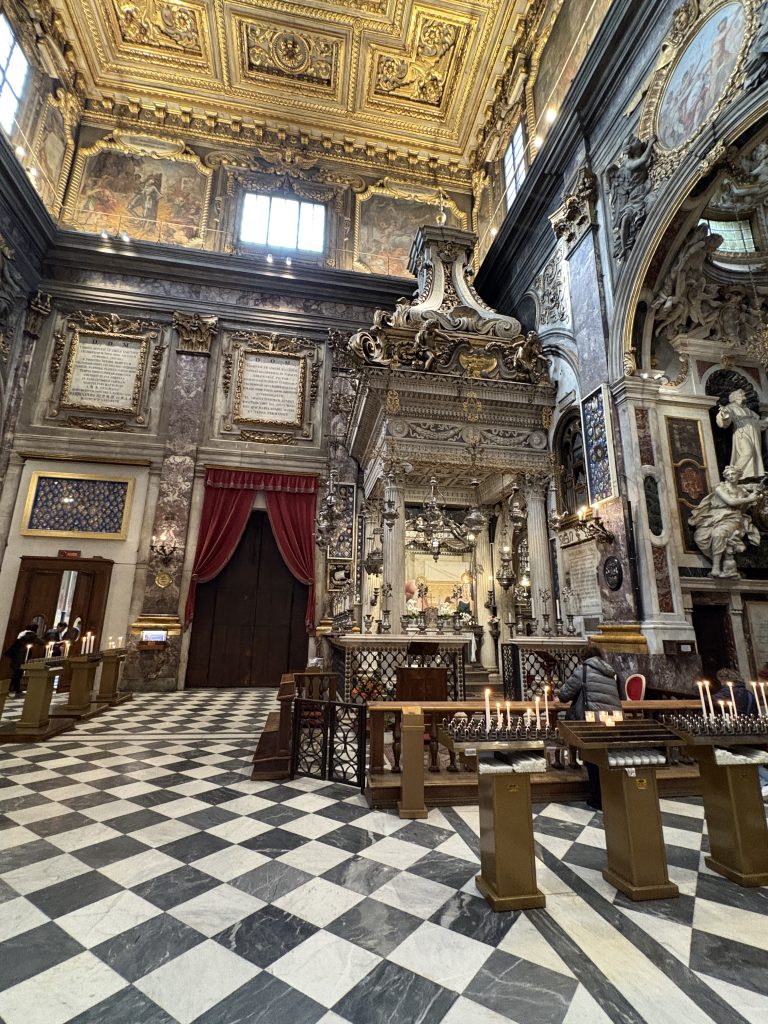
The miraculous Annunciation is still inside the church. Michelangelo supposedly said it really must have been painted by angels. It was the first to show Mary calm rather than startled, at the moment she says “Behold the handmaid of the Lord”, arms folded in her lap, ready. Many later Annunciations followed its lead.

When the church was enlarged, the friars tried to move the icon to the new main altar. Every morning they found it back in its original spot. They eventually gave up, which is why this is the only church with two main altars: one at the end of the nave and the original to the left as you enter.

Artists in the ’Hood
This area of Florence was home to many artists. Masaccio, who perfected perspective in painting, lived on Via dei Servi. Donatello, who brought the Renaissance to sculpture, had his workshop at the end of the street where the restaurant Le Botteghe di Donatello stands today.
A Medici Murder Mystery
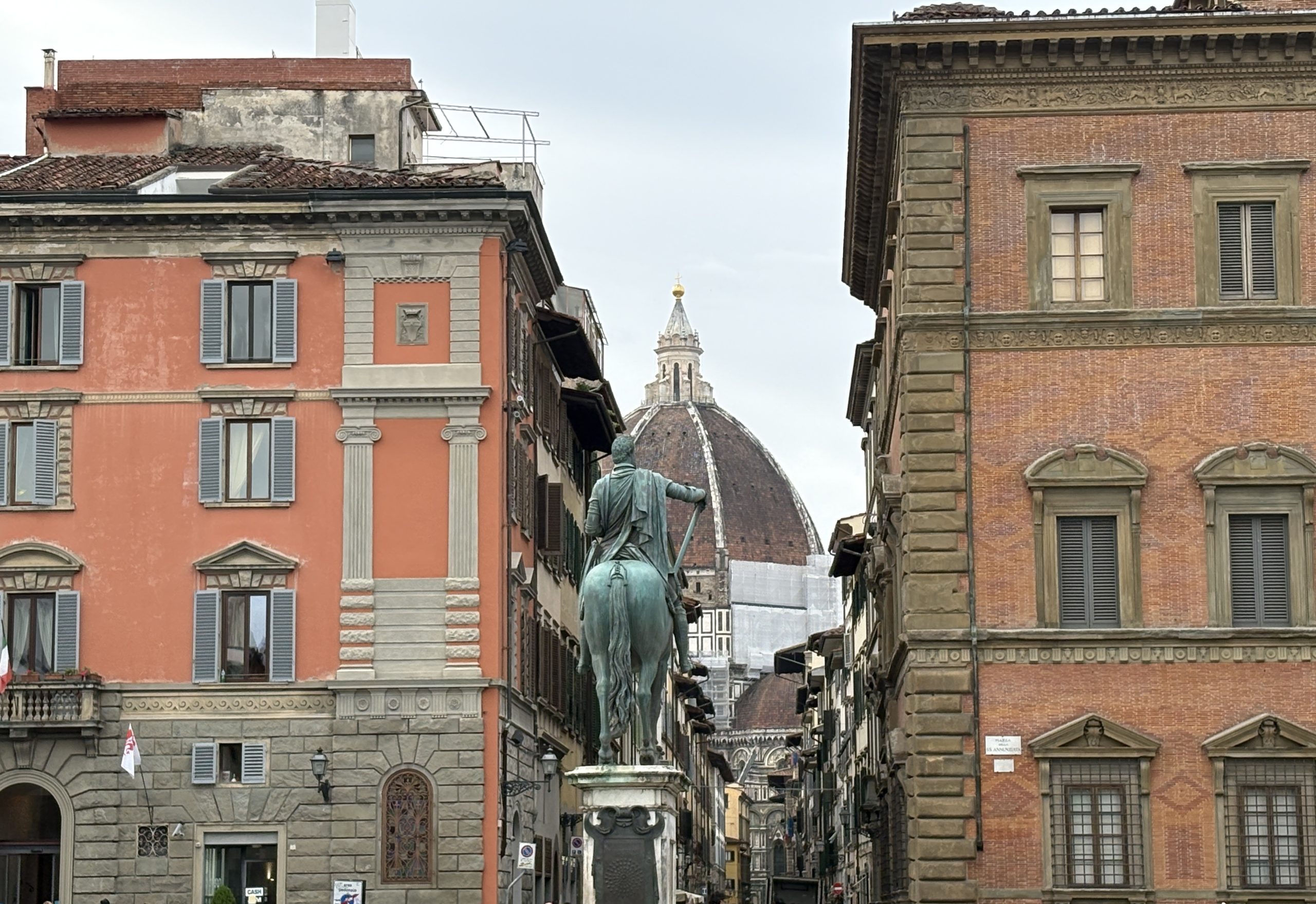
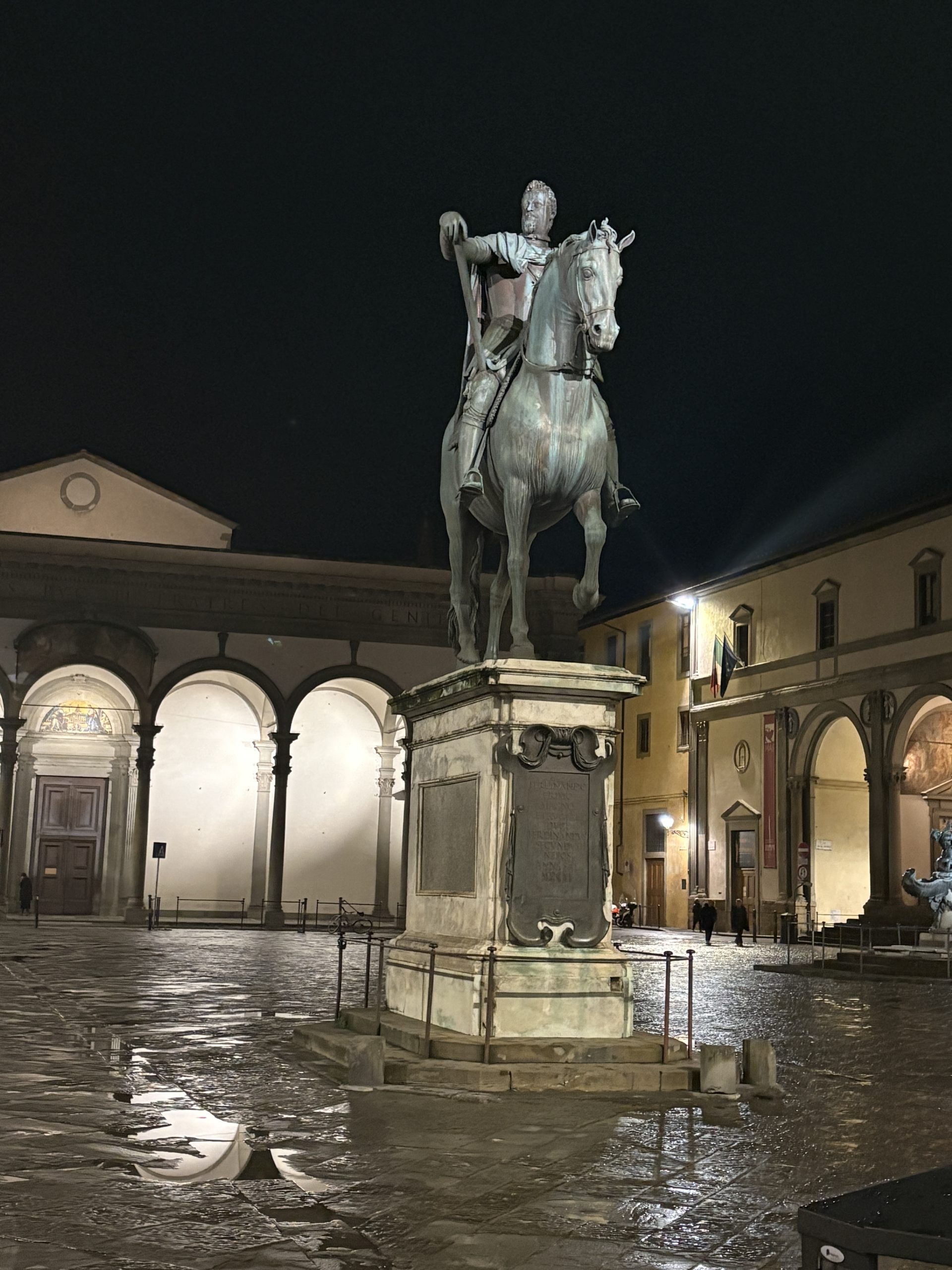
The bronze horseman in the middle of the square is Ferdinando I de’ Medici, second son of Cosimo I. As the spare rather than the heir, he was sent to Rome and made a cardinal. His older brother Francesco became Grand Duke but preferred chemistry and philosophy to politics, and Florence’s power brokers began whispering to Ferdinando that something had to be done.
It didn’t help that Francesco had married his mistress, Bianca Cappello, a Venetian the family considered far beneath them. In 1587 Ferdinando wrote to make peace and the three sat down together for a friendly dinner. Within days both Francesco and Bianca were dead and Ferdinando became Grand Duke.
The official cause of death was malaria, but was that true?
In 2006, researchers at the University of Florence analyzed Francesco’s beard hairs and organ remains found in terracotta jars in a church near the villa where the couple died, and reported lethal levels of arsenic. Other researchers found evidence of malaria in Francesco’s bones, so the debate continues.
The statue was Giambologna’s last work, finished by his pupil Pietro Tacca and unveiled in 1608. It was cast from bronze cannons taken from pirate ships during the Medici’s campaigns to keep the Mediterranean safe for trade.
Sea Monsters, Far from the Sea
The two fountains flanking the statue, by Pietro Tacca, feature sea monsters, an odd choice for a city nowhere near the ocean. They were meant for Livorno, the Medici port, but the Florentines liked them too much to let them go.
Livorno had trouble attracting residents because of malaria, so the Medici offered a fresh start to anyone willing to move there, from thieves to prostitutes. Jews, confined to the ghetto in Florence, could live freely in Livorno.

The Window That Never Closes
To the right of the entrance to the Loggiato dei Serviti is a red brick palazzo. Begun in the 1560s for Ugolino Grifoni, private secretary to Cosimo I, it was designed by Bartolomeo Ammannati and finished by Bernardo Buontalenti. Red brick is so rare among Florentine palazzi that it still stands out.
Look for the shutter that’s always open. Legend says a young Grifoni bride waved her husband off from that window and promised to watch for his return. He never came home, and she spent the rest of her life waiting. When she died, the family closed the shutter in mourning. Books flew off shelves and furniture crashed to the floor. They opened the shutter again, and it has stayed open ever since.
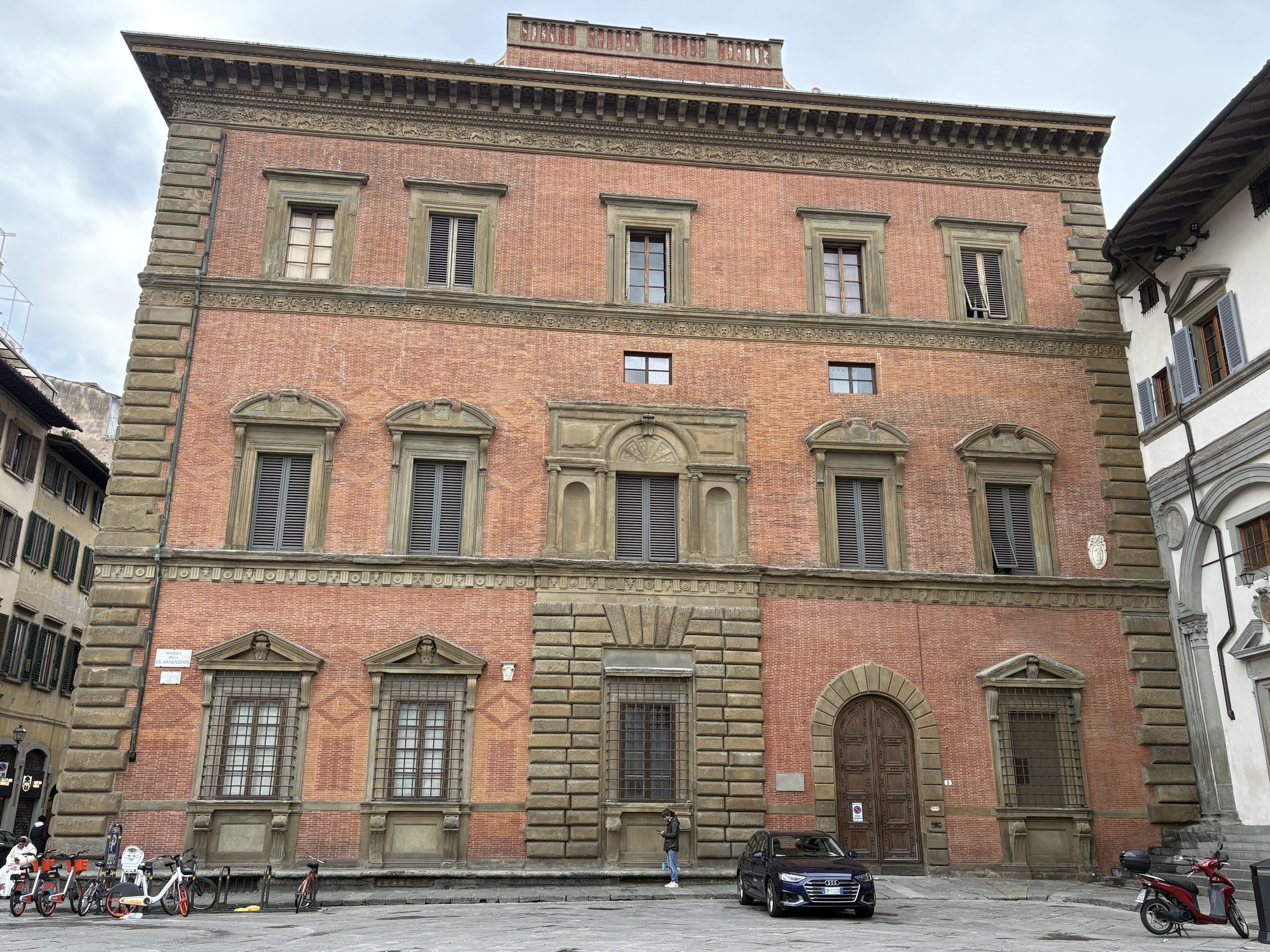
The palazzo still belongs to the Budini Gattai family, the same family who turned the Loggiato into a hotel.
From Convent to Hotel
The building left church hands in two stages: first under Napoleon, who had little use for religious orders, then after Italian unification in the 1860s. Before becoming a hotel, it was a pensione for students and Grand Tour travelers.
The Budini Gattai family officially opened the hotel in 1985 and furnished it with antiques from their own villas and houses. The result feels more like a noble palazzo than a hotel, with sitting areas and a library where you can wait for your room or linger before checkout.

There are 32 rooms in the main building and five more in an annex around the corner. The annex dates only from the 17th century, which makes it a teenager by local standards.
The hotel spreads across three buildings, numbers 3, 4 and 5 on the square. Walk the upper corridors and you’ll see blind doors, which look like doors but open onto solid walls. They mark the old connections through what was once a single building.
Some rooms come with their own stories:
- Room 25 is furnished with pieces that belonged to the Florentine mistress of Napoleon III.
- Room 28 has a four-poster bed that’s actually an upside-down Art Nouveau billiard table. When two young Australians asked Chiara whether the bed was so high because it once belonged to a nobleman, she told them they could go home and tell their friends they’d slept on a billiard table for three nights and they weren’t even drunk. The Art Nouveau lamp over the bar once lit that same table.
The staff deserve their own paragraph. From check-in to check-out, everyone at the front desk was friendly, professional and quick to help, whether we needed a restaurant booked, a taxi called or directions to the nearest pharmacy. Chiara’s tour set the tone, and the rest of the team lived up to it.
Our Room: Room 12
Room 12 was a revelation. Chiara later told me it’s the biggest room in the hotel. Spread over two floors, it’s more of an apartment, suitable for a family or two couples.
The first impression on walking in is understated 19th-century luxury. On the lower floor is the sitting area, a stylish room with heavy wooden furniture, a comfortable upholstered sofa, two easy chairs, and high coffered ceilings. To the left, a short hallway leads to the first of two bedrooms, an imposing twin with a canopy. I’ve never slept under a canopy!


The lower floor also has a small bathroom with a shower. After many weeks in Europe, this was the best shower we’d had. Despite the building’s venerable age, the water pressure is excellent.
Upstairs is my favourite part of the suite. A massive four-poster king bed takes pride of place, its elaborately decorated posts reminding me of the mooring poles in the canals of Venice. There’s also a larger bathroom with a tub (a bit too small for me to sit in comfortably).

Best of all is the large antique desk, where I set up my computer within about five minutes of arriving.
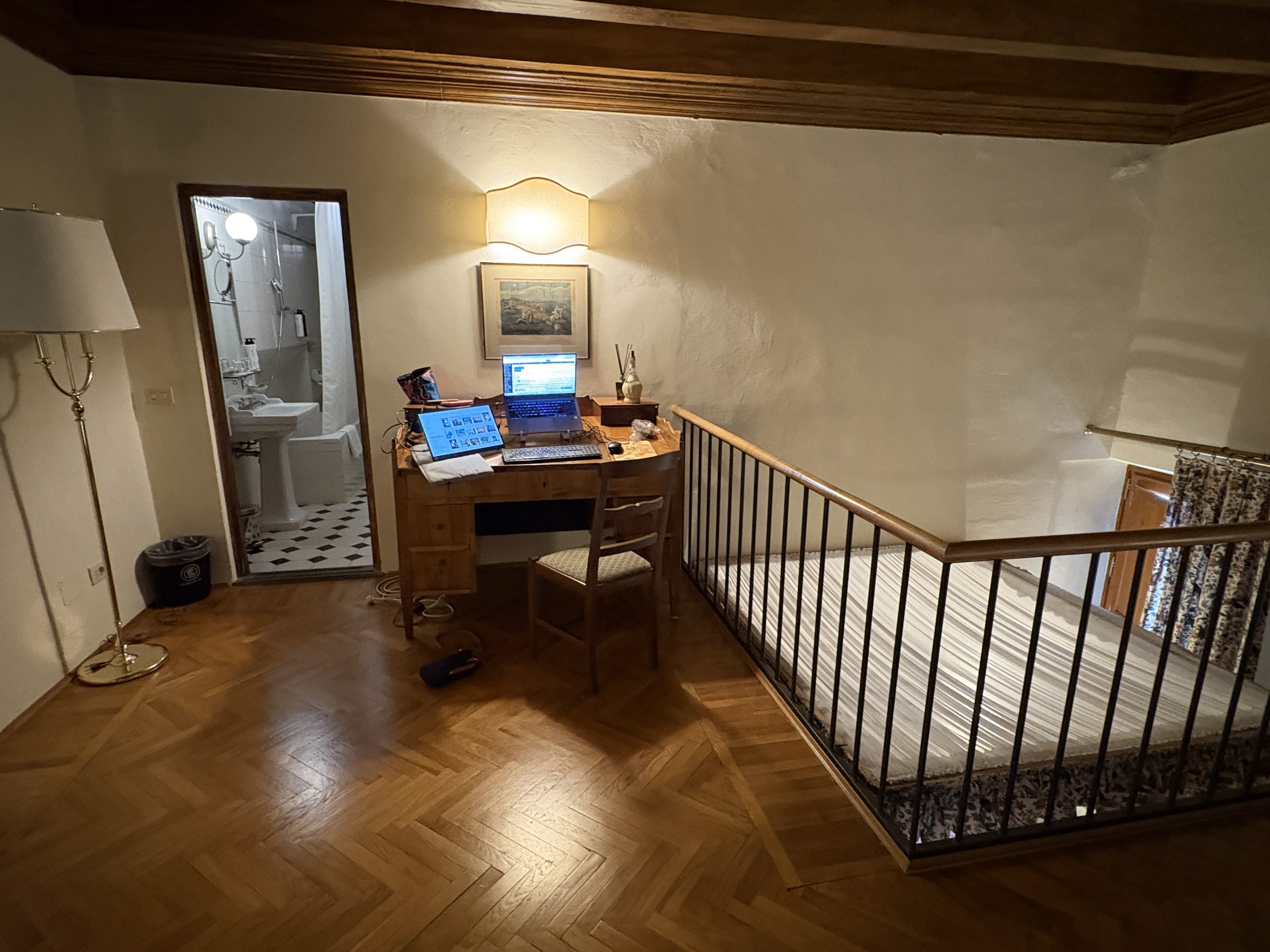
The top floor also has a little bridge that crosses open space to a window. I re-enacted the balcony scene from Romeo and Juliet, which I memorized at the age of thirteen. Sadly, Gregg didn’t know the words, so I had to play both parts.

The hotel thoughtfully provided a fruit plate and, even better, a bottle of Vin Santo with a bag of crunchy cantucci for dipping.
And as if the gorgeous room and thoughtful amenities weren’t enough, we had a panoramic view over the Piazza della Santissima Annunziata.
Breakfast
Breakfast is included and served in a high-ceilinged room on the ground floor. Along with the usual buffet items, there are some standouts, including turmeric bread, waffles, and honeycomb.
Hotel Details
- Address: Piazza della Santissima Annunziata 3, 50122 Florence
- Rooms: 32 in the main building plus five in the annex
- Elevator: Yes; Room 12 has an internal staircase
- Air conditioning: Yes
- Noise from the square: Minimal when the windows are closed
- Price range: From €143 per night; room 12 was about €280 per night
- Getting there: About ten minutes by taxi from Santa Maria Novella station
- Nearby: Ospedale degli Innocenti, the Archaeological Museum, and the Accademia (home of Michelangelo’s David)
Ready to book? Book the Hotel Loggiato dei Serviti here
Recommended Novels to Read Before You Go
Bianca’s Cure by Gigi Berardi
History remembers Bianca Cappello as the Medici mistress who may have died of arsenic. Gigi Berardi imagines her instead as a woman of science, chasing a cure for malaria in the Medici alchemy labs of 1560s Florence. More on Art In Fiction
The Medici Boy by John L’Heureux
Donatello’s workshop stood at the end of the street outside the hotel. John L’Heureux tells the story of his bronze David through the eyes of a former monk turned apprentice, with Cosimo de’ Medici never far away. More on Art In Fiction
Hotel Loggiato dei Serviti FAQs
If you love art and history, yes. You’ll sleep in a building that has welcomed travelers since the 13th century, on what Florentines call the purest Renaissance square in the city, surrounded by antiques.
Room 12 is the biggest in the hotel, a two-floor suite with a sitting room, two bedrooms and a view over the piazza, ideal for a family or two couples. For a story to take home, ask for Room 28, where the four-poster bed is an upside-down Art Nouveau billiard table.
At Piazza della Santissima Annunziata 3, about a ten-minute walk from the Duomo and roughly five minutes from the Accademia and Michelangelo’s David. The Ospedale degli Innocenti is directly across the square.
Rooms start from about €143 per night. Room 12, the two-floor suite, was about €280 per night during my November stay.
Yes. Breakfast is served in a high-ceilinged room on the ground floor. Along with the usual buffet, look for the turmeric bread, waffles and honeycomb.
Yes. Room 12 spreads over two floors and has an internal staircase.
Not really. The rooms have air conditioning, and noise from the square is minimal when the windows are closed.
The Servite friars began building lodgings for pilgrims here in the 13th century, after a miraculous Annunciation painting drew crowds to the church next door. The loggia that gives the hotel its name was built between 1517 and 1523 by Antonio da Sangallo the Elder, and the Budini Gattai family opened the hotel in 1985.
Keep Exploring Florence and Tuscany with Artsy Traveler
- How to Spend a Perfect Artsy Traveler Day in Florence
- Uffizi Gallery: Top 11 Masterpieces You Can’t Miss (And How to Visit)
- Sensational Siena: Best Things to Do, Top Sights and How to Visit
- San Gimignano: Top Things to See in Tuscany’s Tower Town
- Art Masterpieces in Tuscany You Won’t Want to Miss
- Tuscany & Umbria: The Ultimate Art Lover’s Itineraries
- Stay at Sant’Antonio Country Resort: A Tuscan Hidden Gem
- A Visit with Tuscan Artist Silvia Salvadori in Arezzo, Tuscany
- Get Inspired at a Writing and Art Retreat in Tuscany
- Where to Stay in Italy: My Best Picks
- The Best Novels Set in Italy for Arts-loving Travelers

Carol M. Cram writes novels inspired by the arts; runs Artsy Traveler, an arts-focused travel blog, and Art In Fiction, a curated database of 2,700+ novels inspired by the arts; and hosts The Art In Fiction Podcast. She has also authored 60+ textbooks on computer applications and taught at Capilano University for over two decades. Carol lives with her husband, artist Gregg Simpson, on beautiful Bowen Island near Vancouver, BC.

 See all my novels